Baseball

Art Howe

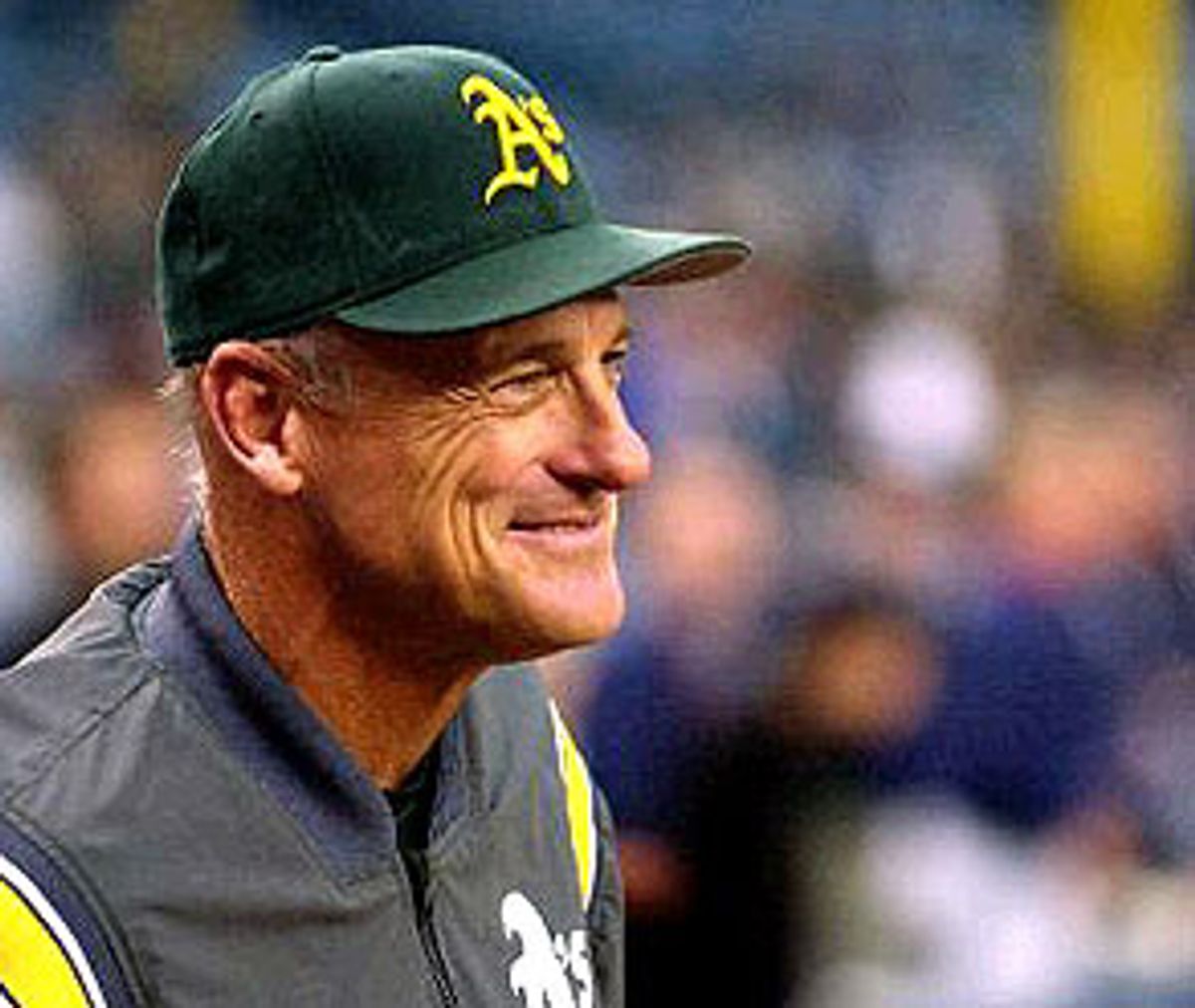
The laid-back manager of the hard-charging Oakland A's does it his way, laconically and happily. And that drives his critics crazy.

  • more
    • All Share Services

Topics:

Art Howe

Some labels are hard to shake. Get tagged as a self-promoter, or a horn dog, or a cheapskate, and that characterization is going to follow you around like a strip of toilet paper trailing from your heel. But none of those is half as tough to overcome as that most lethal of putdowns: being dismissed as a nice guy, mild but harmless. That was the situation Art Howe faced when he arrived in Oakland, Calif., late in 1995 to take over the job of A’s manager from Tony La Russa, an intense man who vibrated like a Chihuahua and often gave the impression he would bite your nose off if you did not show him sufficient respect.

How did Howe handle that? His first move was to do nothing, and I mean that literally. It was my job back then to cover the A’s for the San Francisco Chronicle, but I was gone in the off season, so the Chronicle’s slash-and-burn columnist Glenn Dickey was handed the task of writing up Howe’s arrival in town. Dickey had wrongly speculated in print earlier in the week that a likable bullshit artist named Jim Lefebvre, a former A’s hitting coach, was the leading candidate to replace La Russa. In his article announcing Howe’s hiring on the front page of the Chronicle sports section — the morning Howe arrived for his welcome press conference — Dickey went on at length about Lefebvre and made clear his low regard for Howe. He even ridiculed his hiring as “just another step toward anonymity for the A’s, once the most colorful team in baseball.”

At the end of the press conference when Dickey went up to shake Howe’s hand, Howe raised his hand to shake until he heard “Hi, I’m Glenn Dickey.” Then he dropped his hand. It was an unmistakable snub of the powerful, head-hunting columnist for all to see. In fact, four different people all told me about it later, saying “It was amazing!” or “I couldn’t believe it!”

It was a brazen, ballsy way to start his time in Oakland, and he paid for it, repeatedly. But that’s Howe. And that’s the key to his story: Howe knew just what he was risking in refusing to kiss anyone’s ass, and he would make the same decision again, even knowing the consequences, and again and again. He’s a calm nice guy on the outside, but get to know him and you find he’s tough in ways that are not at first obvious. That’s why his team made it to the playoffs, despite a wretched 8-18 start to this year’s season.

“Obviously his greatest coup is that when the team was down this year he didn’t panic, he stayed calm, and his players stood behind him,” Phil Garner, the Detroit Tigers manager, tells me in a phone interview. “He’s very solid and even-keeled. He doesn’t seem to get too high, and doesn’t seem to get too low. I don’t know if that’s the only way to be, but it’s one way. Dusty Baker gets high as a kite, and his players feed off that. Art was a good player, a sound player who did not make mistakes. That’s the way he manages, and that’s what he expects from his team. He wasn’t flashy, but he was a grinder, he did his routine every day. He had really terrific hands, very good defensively, and was very sturdy.”

Howe, 55, had a respectable career as a player, batting an unspectacular .260 over 11 major-league seasons, seven of those playing for the Houston Astros. But he was always the kind of guy you want on your side. His strength was defense, and though he’s known as a third baseman, he played only 400 of his 840 big-league games at third, and also 284 at second, 130 at first and 26 at shortstop. He was, in short, the kind of player always eager to do whatever it took to win — lying to a manager about whether he had played second base before, just to stay in the lineup, playing hurt, whatever.

Howe had some tough seasons with the A’s and his long-term job security has been in doubt as often as not. But the A’s 102-win regular season this year bumps Howe’s Oakland numbers up to a solid 497-474 mark, and he trails only La Russa (798-673) in wins for an Oakland A’s manager. (Howe was 392-418 in his five seasons managing the Astros.) Howe, in short, is right on the threshold of moving up a notch, from well-liked baseball man, widely admired but never more than that, to something else. It just might be that his managing style makes more sense now than ever, as even young players have big money at their disposal.

“One of the things that always bugged me was I would hear people say he’s such a nice guy, but he can’t be a good manager because he’s too soft,” says Howe’s wife, Betty. “They figured you needed to be more in-your-face, like a Tony La Russa.”

“Well, Art treats these guys as men. They are doing a man’s job. He corrects them, but his philosophy is not to get in their face. He calls them in the next day if he has a problem. He’s done that quite often, if he has to, and he’s gotten results. People don’t know about it. But he gets it done. I think they listen to him because they are treated with respect. It’s hard because even though you have young players, they might be making five times as much money as you are. So you’d better be able to relate to people if you’re going to last very long.”

The point is not to argue against the style of La Russa, for example. The St. Louis Cardinals manager goes to war out there, every day, and he surrounds himself with a collection of smart, colorful assistant coaches who make up a formidable brain trust. La Russa thinks everything out, and then thinks it out again a few more times. It’s probably safe to call him brilliant. But in his brilliance, La Russa may be too much for players. I remember the sad case of a player named Brent Gates, a young guy with a body like Gumby and a face that, well, you just have to describe as “elfin.” Actually, I did describe him as “elfin” one time in print, and Gates looked that word up in a dictionary, saw that it meant “fairy,” and thought I was calling him queer or something. He hated me forever after that. And yet, when La Russa decided to move Gates from second base to third, Gates actually got the word from yours truly. He looked like he was going to keel over on the spot. And though he hit .290 as a rookie, Gates is out of the game now. Many feel that La Russa was too tough on him.

That is one thing Howe has never been. The question is, can he be tough when he has to be? As his wife pointed out, his style has always been to call players in quietly, a day later, to discuss a sore subject without getting the media involved. Even so, if you are around Howe for even a few days, you know he’s a man who would prefer not to make waves. He’s having too good a time, just showing up for another day of baseball.

I covered Howe during seasons when he never really needed to be tough. But times are different. General manager Billy Beane has been easily the best executive in baseball the last two seasons, and has assembled a remarkable collection of talent. When I covered the A’s, they had a hard time finding a single ace pitcher to anchor their rotation. Now they have Mark Mulder, Tim Hudson and Barry Zito, a combined 56-25 this regular season and quite possibly the best collection of three starters in baseball right now, and they are all just starting out.

I think Howe probably was too nice at times, during the years I covered him, but it’s hard to say for sure. All I know is that this season, when Howe benched mercurial young shortstop Miguel Tejada for not hustling and running out a ground ball, it was a different Howe than the man I watched. Howe not only yanked Tejada right out of the game, he told reporters just what he had done and why. It was a calculated risk, and it paid off beautifully. Tejada apologized to his teammates and seemed to gain a new maturity and consistency heading into the playoffs. Anyone who knows Howe knew it was not easy for him to lean on Tejada like that. He did it because he had to.

“Believe me, it hurt him to do that,” Betty Howe tells me. “He came home and told me, ‘I hated to do that to Miguel. I had to send a message to the team.’ He was sending a message to everyone else, ‘Not on my team.’ It really hurt him. He likes Miguel, he loves Miguel, and he knows that on top of everything else, Miguel has the language barrier.”

“The Latin players have so much pride,” Betty Howe says. “Miguel’s problem is he just gets down on himself. He hit a little rut where he was getting lax. I think it was because he wasn’t hitting like he wanted to. The one game, he did not run all the way out to first base. The second basemen fell down, and got up and threw the ball and Miguel was out. It was at a crucial time when we still had to be winning ballgames. We knew if we weren’t winning by the All-Star Game, management would probably dismantle the team. Art pulled him. When the team went out to take their defensive positions, Miguel was not at shortstop.”

“Art did it for Miguel, and he did it for the team. He called Miguel in the next day and said, ‘Miguel, you’re a team leader, and you want to be a team leader. People look to you for an example.’ He didn’t rant and rave. But he did tell him he was disappointed. To me that’s kind of Art being a father, and Miguel being a son. That’s the way Art manages, kind of like a father with a son, giving that knowledge you have and passing it along. That’s how he was with our three kids, who are all grown now. Art didn’t really rant and rave. I did. I’m the ranter and raver. That’s not to say Art doesn’t have a temper. He does have. If you push him too far, you will be very surprised. He just controls it.”

Maybe it’s not a good idea to manage a ball club for a living when you’re as comfortable with yourself as Howe is. Dusty Baker, who I happen to believe is the coolest man alive and who I would hire in a nanosecond if I ever owned a baseball team, has an edgy energy about him. Not Howe. He always looks like a man who just sunk a long, long birdie putt, and will tell you about it if you’d like to hear. He does what he does, his own way, always laconically and happily, and that drives his critics crazy and warms other people to him.

Plenty of people will probably be pointing fingers after the A’s fell to the Yankees with an error-filled effort Monday night in the Bronx. The A’s became the first team ever to win the first two games of a playoff series on the road, then end up losing the series. Worse yet, Tejada made a costly mental mistake, failing to advance to third on a Jason Giambi single to right field, a lapse that ended up costing the A’s a run and earned Tejada a spirited chewing-out from Giambi, captured by Fox Sports.

It may well be true that a more in-your-face manager would have set a tone all season that made such lapses at such a critical time unthinkable. But an edgier approach might not have let young talent flourish the way Howe’s leadership did this season. Those are questions to be thrashed out over time, starting next spring when the A’s set about trying to polish what they have over a full season. What’s clear is that, whatever criticism he might or might not face after the A’s collapse, it’s unlikely to have much effect on the way Howe does what he does.

“Baseball managers generally fall into one of two categories,” New York Post columnist Tom Keegan tells me. “The majority base decisions on what they think will enable them to keep their jobs. They make moves they can defend to the media and to their bosses, their general managers. They never enjoy managing because they are consumed by paranoia. They forever smell the GM’s breath, always envision the next unflattering headline and hear the boos from the crowd, even in their sleep.”

“And then there is Art Howe,” Keegan continues. “He falls into the second group. Even if Howe had hair, he wouldn’t be losing it from constantly worrying about his job security. He’s good at his job, he knows it, and he’s not going to let anyone convince him otherwise, even his general manager. He cares more about doing what he considers the right thing than what anybody else thinks.”

Continue Reading Close

Guillen’s pro-Castro candor

The Miami Marlins' manager is lucky to get a suspension. Not so long ago, he might have received a car bomb.

  • more
    • All Share Services

Topics:

Guillen's pro-Castro candorA contrite Miami Marlins manager Ozzie Guillen gestures at a news conference on Tuesday. (Credit: AP/Lynne Sladky)

There’s not much reason to doubt that baseball manager Ozzie Guillen admires Fidel Castro. He said so five years ago in an interview with Men’s Journal. When asked to name the toughest man he knew, Guillen replied, “Fidel Castro. He’s a bull—- dictator and everybody’s against him, and he still survives, has power. Still has a country behind him. Everywhere he goes, they roll out the red carpet. I don’t admire his philosophy; I admire him.’’

No one cared about that macho thought because Guillen was skipper of the Chicago White Sox at the time. As the newly hired manager of the Miami Marlins, Guillen repeated the notion to Time last week–”I respect Fidel Castro,” he said. “You know why? A lot of people have wanted to kill Fidel Castro for the last 60 years, but that [expletive] is still there”–and he found himself on the brink of unemployment.

As Miami’s Cuban-American talk radio hosts whipped up a storm of protest, the Marlins denounced Guillen and suspended him for five games. On Tuesday the chastened manager repudiated his statements, said Castro was a bad man, and apologized “on my knees.” With Guillen’s job hanging in the balance, most sportswriters attributed the controversy to his big mouth: He is known for insulting gays and admitting he likes to get drunk often.

But Guillen’s real problem is Cuban Miami, where enforcing the anti-Castro party line is a more popular pastime than baseball, not the least because the Marlins owners arranged to stick the city’s taxpayers with the bill for their new $640 million ballpark in Little Havana while depriving local residents of legal parking spaces. The combination of Guillen’s candor, Miami politics, and the Marlins’ arrogance is what has brought the Cooperstown-bound skipper to the brink of being fired.

The city has never shown much tolerance for people who say nice things about Castro. In 2000, Jim Mullin, editor of the city’s alternative weekly New Times, compiled a chronology of violent intolerance that has few parallels in modern America. In 1975 a Cuban American man was murdered after advocating closer relations with Castro’s Cuba. In 1978, an anti-Castro talk radio host had his legs blown off by a car bomb because he dared criticize his fellow exiles for resorting to violence. In 1983, the Little Havana branch of a Miami bank was bombed because one of its executives had negotiated with the Castro government for the release of 3,600 political prisoners. In 1998, a bomb threat emptied a concert hall during a performance by Compay Segundo, a 91-year-old musician made famous by the movie “The Buena Vista Social Club.” All told, Mullin found more than 40 instances of bomb threats and explosions directed at people who had somehow offended the anti-Castro orthodoxy.

A 1994 Human Rights Watch report on the sorry state of free speech in Miami concluded,  the city is “dominated by fiercely anti-Communist forces who are strongly opposed to contrary viewpoints.” The HRW reports linked these forces to “acts of repression ranging from shunning to violence.” The reports found “significant responsibility” by the government at all levels, including “direct harassment by the government and government support of groups linked to anti-free speech behavior.”

That tradition continued this week when two local politicians injected themselves into the controversy by calling for Guillen’s firing. The call was echoed by a vigilante group known as Vigilia Mambisa, which describes itself as “a hard-line, right wing, Anti-Castro, Anti-Communist group of dedicated Cuban-American demonstrators … known for their rapid response to calls for protest aired on Miami Spanish-language stations.”  The group is calling for a boycott of the Marlins until Guillen is fired.

The problem is Miamians are already boycotting the Marlins. The team ranked 28th out of 30 major league teams in attendance last year. Dario Moreno, a professor of political science at Florida International University, said, “I don’t think this is a free speech issue. There’s a lot more tolerance than there was 30 years ago.” Moreno noted that south Florida’s three Cuban-American congressional representatives and the state’s Cuban-American senator have not called for Guillen to be fired.

“This has more to do with the Marlins and a community that invested large sums of money in their stadium over the objections of lots of people,” Moreno said. “The promise was that they would bring the community together and give us something to be proud of. It’s not working out very well.”

Moreno says he thinks Guillen may be able to keep his job if the Marlins muzzle Guillen (good luck with that) and reach out to the community. “The baseball fans are willing to let this one go by if he just promises to not talk politics,” Moreno said.

“As a Christian, I accept his apology,” said Alberto Muller, a former newspaper columnist who spent 15 years in a Cuban prison. “But in Miami, not everybody is a Christian.” Muller thinks Guillen will be fired.

A Miami Herald online reader survey found 57 percent of 2,500-plus respondents saying Guillen’s five-game suspension was sufficient punishment. If Guillen only loses his job for expressing admiration for Fidel’s toughness, it will be a sign of civic progress. Not long ago, he might have lost his legs or his life.

Continue Reading Close
Jefferson Morley

Jefferson Morley is a staff writer for Salon in Washington and author of the forthcoming book, Snow-Storm in August: Washington City, Francis Scott Key, and the Forgotten Race Riot of 1835 (Nan Talese/Doubleday).

The Marlins’ bizarre new look

The team's revamped logo involves a whimsical rainbow swoosh. The effect is anything but intimidating

  • more
    • All Share Services

Topics: , ,

The Marlins' bizarre new look

So far the biggest story to come out of baseball’s early off-season isn’t some splashy free agent signing or the abrupt retirement of St. Louis Cardinals manager Tony LaRussa, but that of the logo and uniform redesign of the Florida Marlins. The new look was officially announced on Friday, and if you haven’t seen them already, you might not believe your eyes. In fact, when some of the images of the new logo were leaked there was such shock and disbelief by the baseball world, most people assumed it was a farce, calling the look everything from “Hawaiian Shaved Ice” to “Push-up Pop” to “Rainbow Bright.”

Florida Marlins

The rebrand was planned as part of the team’s big move to their new stadium, New Marlins Ballpark (which also sports a logo with a rainbow motif), a baseball-only park with a retractable roof to keep the tropical rains away. With a name like New Marlins Ballpark, the powers-that-be decided the team needed a new identity as well. So not only are the uniform colors radically different, but the team will now be called the Miami Marlins.

Gone is the teal, silver and black color scheme the team has worn since its inception in 1993 (and in which it won two World Series), and in its place, as you can see, is a curious combination of oranges, yellows, blues and assorted other bright hues. Gone too is the detailed illustration of the eponymous fish, bursting around and through the logo with furious determination. Instead there is now a whimsical suggestion of a marlin swooshing from some unclear source out of the Aztec-influenced M letterform. Whatever its origin, one thing is sure: The overall effect is anything but intimidating.

In addition to the new logo and color scheme, new uniforms will also be revealed. Again, this look isn’t certain to be the one unveiled on Thursday (and in light of all the backlash, it’s entirely possible the Marlins’ design team has gone back to the drawing board) but this is what has been floating around the ether and seems to make sense based on the logo. White home jerseys with black caps. Away grays with a radically out of place blue cap (that strangely echo the original Tampa Bay Devil Rays uniforms). And some assortment of combinations for Fridays and other games.

Apparently the team’s (and stadium’s) colorful new look is meant to reflect the multicultural heritage of the many diverse ethnic groups living in the area. But you have to wonder if the Marlins’ head honchos learned nothing from the atrocious Houston Astros uniforms of the mid-1970s (known as the “rainbow era”) that made even Nolan Ryan and J.R. Richard, at left (two of the era’s most dominating pitchers), look a tad sheepish.

Not to say orange is a bad choice for a sports team (the Giants, Orioles and Tigers pull it off pretty well), but it does require some tasteful design skill and a healthy grasp of workable color palettes.

Perhaps it’s not the worst logo ever (for some ideas on that front click here); there are always the Chicago White Sox shorts and collared unis from the ’80s to claim that distinction. But if this is indeed the look of the new Miami Marlins, my guess is it won’t be around long.

Copyright F+W Media Inc. 2011.

Salon is proud to feature content from Imprint, the fastest-growing design community on the web. Brought to you by Print magazine, America’s oldest and most trusted design voice, Imprint features some of the biggest names in the industry covering visual culture from every angle. Imprint advances and expands the design conversation, providing fresh daily content to the community (and now to salon.com!), sparking conversation, competition, criticism, and passion among its members.

Continue Reading Close

Exonerating Bill Buckner

25 years after the Red Sox infielder's infamous World Series error, we look at what really happened that October

  • more
    • All Share Services

Topics: ,

Exonerating Bill Buckner (Credit: AP)

Bill Buckner’s error in the 1986 World Series – 25 years ago today, a day of infamy for Red Sox fans — is one of the two most famous plays in World Series history. (Willie Mays’ catch in the 1954 fall classic is the other.)

Like Mays’ over-the-shoulder catch, Buckner’s booboo is entrenched in American folklore. Jimmy Fallon’s Red Sox fanatic in “Fever Pitch,” distraught over breaking up with his girlfriend, watches Buckner’s play over and over on his VCR. During congressional hearings in 2008, U.S. Rep. John Yarmuth, D-Ky., called former Treasury Secretary John Snow, then-SEC chief Christopher Cox and former Federal Reserve Chairman Alan Greenspan “three Bill Buckners.” On “Curb Your Enthusiasm” this season, Larry David loses a softball game when a ball rolls between his legs; his coach screams, “You Buckner-ed me!”

Everyone knows that Buckner lost the 1986 World Series for the Red Sox. But what everyone knows is wrong.

At the time, the Red Sox were burdened with 68 years of frustration; their last championship was in 1918. Leading three games to two against the New York Mets, Boston was ahead by a score of 5-3 in the bottom of the 10th inning. Red Sox pitcher Calvin Schiraldi got two quick outs. In the Sox locker room the champagne was iced, and the scoreboard flashed “Congratulations Red Sox.”

Gary Carter, Kevin Mitchell and Ray Knight all singled, and the score was 5-4 with Mitchell on third. Reliever Bob Stanley came into the game to pitch to Mookie Wilson and threw a wild pitch that brought Mitchell home and tied the score. But it’s the next play that still has Red Sox fans screaming in the middle of the night.

Stanley threw a sinker-ball, designed to produce ground balls to infielders. What was supposed to happen did happen—Mookie Wilson tapped a slow grounder at Buckner at first base. But the ball rolled between Buckner’s legs, and the Mets won in the most incredible finish to a World Series game ever. (See it with commentary by the inimitable Vin Scully.)

Buckner’s career changed in an instant. Up to that moment, he was one of the game’s great unsung hitters. He’d batted better than .300 seven times in his career, winning the 1980 American League batting title. He led the league four times in assists. During that crucial September 1986 playoff run, he carried the team, hitting .340 with eight home runs. All that was soon to be forgotten.

The scholar Stephen Jay Gould (in Natural History magazine) called him “a gallant first baseman and a veteran with a long and distinguished career.”

“For weeks,” wrote Gould, “manager John McNamara had been benching Buckner for defensive purposes during the last few innings of games with substantial Red Sox leads, but after a long and hard season, Buckner’s legs were shot … he could hardly bend down.”

Plagued with chronic ankle soreness—he was the first player to wear high-top baseball cleats to ease the pain— Buckner had been relieved in three previous series games by Dave Stapleton. Why was he still playing when Wilson hit the ground ball? Because McNamara was sentimental; he wanted his regulars on the field when the Red Sox won the series.

But Buckner’s error did not lose the championship for the Red Sox; it didn’t even lose Game 6 for them — the Red Sox had already blown their two-run lead. Two nights later, with another chance at the ring, Boston lost 8-5.

(Buckner, incidentally, had two hits in four at-bats and scored a run in Game 7.)

Red Sox fans cried “Curse of the Bambino”—the punishment Boston supposedly merited for selling Babe Ruth to the Yankees in 1919—but the focus of the curse that season was Buckner. Yet Buckner did not put the tying runs on base. He didn’t throw the wild pitch that made it 5-5. He did not make the decision to keep his defensive replacement on the bench. Had he made the play, the Red Sox could have lost the game anyway.

When so many others contributed as much or more to the Red Sox defeat, why has history made Buckner the goat? Perhaps Gould said it best when he suggested that in the collective minds of Red Sox fans, “If Buckner fields the ball properly, the Sox win their first World Series since 1918 and eradicate the Curse of the Bambino. In this scenario, Buckner’s miscue marks the unkindest bounce of all, the most improbable trivial little error sustained by a good and admired man. What hath God wrought?”

What God wrought, perhaps, was a curse on both teams. The New York Mets have not won another World Series since; their greatest stars on that 1986 team —pitcher Dwight Gooden and slugging outfielder Darryl Strawberry—saw their careers cut short by drug abuse. In 2007 and 2008, the team crumbled down the stretch and missed the playoffs. And this year, the Red Sox, who seemingly broke the Curse by winning the World Series in 2004 and 2007, suffered the all-time worst collapse in baseball history, losing 20 of their last 27 games.

But that was kid’s play for what God had in mind for Donnie Moore. Red Sox fans were quick to forget that they never would have had a crack at their own little tragedy had it not been for Donnie Moore. Boston made it to the World Series by beating the then-Anaheim Angels in the American League Championship Series. After four games, they were in better shape against the Red Sox than the Red Sox ever were against the Mets.

On Oct. 12, 1986, playing in Anaheim, the Angels were up three games to one with a 5-2 lead going into the top of the ninth. Then, a real curse revealed itself. Don Baylor hit a two-run homer to make it 5-4. Moore had been a fine relief pitcher that season, tallying 21 saves. With two outs and the tying run at second, Moore got two strikes on Dave Henderson, then tried to slip a fastball by the Red Sox outfielder. The pitch changed his life. Henderson slammed it to deep left field for a two-run homer. On TV, Al Michaels screamed, “Unbelievable! Astonishing! With one strike away Anaheim Stadium was one strike away from turning into Fantasyland! You’re looking at one for the ages here!”

Like Buckner, Moore was damned for losing the big one. What was forgotten is that the Angels came back to tie it, and Moore, still in the game, induced Jim Rice to ground into a double play. But in the 11th, the Red Sox scored another run off Moore on a sac fly by – of course – Dave Henderson. The Angels lost 7-6.

But that still left them with two chances to win their first-ever pennant and trip to the World Series. The Sox blasted the Angels pitching for 19 runs over two games and went on to meet their destiny against the Mets, without the slightest thought that they owed a great big ugly debt to sheer luck – one that would soon be repaid with interest.

Still, to Angels fans, it had all come down to the pitch that Donnie Moore threw to Dave Henderson. All the subsequent chances that they lost were the evil spawn of that one pitch.

For the next two years, Moore couldn’t walk out on the field without being booed, crushed and heckled. When he left the ballpark, fans were lineup to scream insults, even when he won. Moore began to drink heavily and his talents eroded. On July 18, 1989, Moore got into a shouting fight with his wife at their home in Anaheim Hills. He went to his closet, got an automatic pistol and, in front of his children, shot his wife and one of his daughters. The daughter drove herself and her mother to the hospital; they survived. Moore did not. Back in the house, with his son pleading for him to drop the gun, Moore shot and killed himself.

Now that is tragedy. That puts Bill Buckner’s error in perspective. It’s only a game, unless you choose to regard it as something more.

Meanwhile, the infamous Buckner ball, once owned by Charlie Sheen, is up for auction on eBay, asking price $1 million. The bid will close at the exact minute of the 25th anniversary of the play.

Now a successful businessman, Buckner has lived down the error by turning the joke on himself. On “Curb Your Enthusiasm,” he won the cheers of a New York crowd by catching a baby dropped from a burning building.

In 2008, he threw out the first pitch of the Red Sox home opener and got a standing ovation from the sell-out crowd. Somewhere, one has to feel, the Bambino himself was applauding.

Continue Reading Close

Allen Barra's next book is "Mickey and Willie -- The Parallel Lives of Baseball's Golden Age," from Crown.

What baseball tells us about racism

Most home-plate umpires are white -- and they seem to be hurting the careers of minority pitchers

  • more
    • All Share Services

Topics: ,

What baseball tells us about racism

Despite recent odes to “post-racial” sensibilities, persistent racial wage and unemployment gaps show that prejudice is alive and well in America. Nonetheless, that truism is often angrily denied or willfully ignored in our society, in part, because prejudice is so much more difficult to recognize on a day-to-day basis. As opposed to the Jim Crow era of white hoods and lynch mobs, 21st century American bigotry is now more often an unseen crime of the subtle and the reflexive — and the crime scene tends to be the shadowy nuances of hiring decisions, performance evaluations and plausible deniability.

Thankfully, though, we now have baseball to help shine a light on the problem so that everyone can see it for what it really is.

Today, Major League Baseball games using QuesTec’s computerized pitch-monitoring system are the most statistically quantifiable workplaces in America. Match up QuesTec’s accumulated data with demographic information about who is pitching and who is calling balls and strikes, and you get the indisputable proof of how ethnicity does indeed play a part in discretionary decisions of those in power positions.

This is exactly what Southern Methodist University’s researchers did when they examined more than 3.5 million pitches from 2004 to 2008. Their findings say as much about the enduring relationship between sports and bigotry as they do about the synaptic nature of racism in all of American society.

First and foremost, SMU found that home-plate umpires call disproportionately more strikes for pitchers in their same ethnic group. Because most home-plate umpires are white, this has been a big form of racial privilege for white pitchers, who researchers show are, on average, getting disproportionately more of the benefit of the doubt on close calls.

Second, SMU researchers found that “minority pitchers reacted to umpire bias by playing it safe with the pitches they threw in a way that actually harmed their performance and statistics.” Basically, these hurlers adjusted to the white umpires’ artificially narrower strike zone by throwing pitches down the heart of the plate, where they were easier for batters to hit.

Finally, and perhaps most important, the data suggest that racial bias is probably operating at a subconscious level, where the umpire doesn’t even recognize it.

To document this, SMU compared the percentage of strikes called in QuesTec-equipped ballparks versus non-QuesTec parks. Researchers found that umpires’ racial biases diminished when they knew they were being monitored by the computer.

Same thing for high-profile moments. During those important points in games when umpires knew fans were more carefully watching the calls, the racial bias all but vanished. Likewise, the same-race preference was less pronounced at high-attendance games, where umps knew there would be more crowd scrutiny.

Though gleaned from baseball, these findings transcend athletics by providing a larger lesson about conditioned behavior in an institutionally racist society.

Whether the workplace is a baseball diamond, a factory floor or an office, when authority figures realize they are being scrutinized, they are more cognizant of their own biases — and more likely to try to stop them before they unduly influence their behavior. But in lower-profile interludes, when the workplace isn’t scrutinized and decisions are happening on psychological autopilot, pre-programmed biases can take over.

Thus, the inherent problem of today’s pervasive “post-racial” fallacy. By perpetuating the lie that racism doesn’t exist, pretending that bigotry is not a workplace problem anymore, and resisting governmental efforts to halt such prejudice, we create the environment for our ugly subconscious to rule. In doing so, we consequently reduce the potential for much-needed self-correction.

Continue Reading Close
David Sirota

David Sirota is a best-selling author of the new book "Back to Our Future: How the 1980s Explain the World We Live In Now." He hosts the morning show on AM760 in Colorado. E-mail him at ds@davidsirota.com, follow him on Twitter @davidsirota or visit his website at www.davidsirota.com.

What's the best baseball movie?

And why are great films about the national pastime so rare? As "Moneyball" hits theaters, baseball writers weigh in

  • more
    • All Share Services

Topics: ,

What's the best baseball movie?Tim Robbins and Kevin Costner in "Bull Durham."

If two of America’s biggest pastimes (and industries) are baseball and the movies, why are there so few truly great baseball films?

That’s the question we posed to several experts — novelists, sports journalists, even a former baseball commissioner — as  “Moneyball” hits theaters. We also asked each to name a favorite baseball movie (“Bull Durham” turns out to be, as one writer put it, “the gold standard”), and discuss whether baseball is better suited to prose — fiction or journalism — than it is to the big screen. Below are the responses we received.

John Thorn

[My favorite baseball movie is] “Bull Durham,” because it is gritty, real, and smart about the subculture that only baseball professionals know. Not to mention that it is funny, as is “Major League,” which stands up to repeated watching. Not funny but also with much to recommend them are “The Natural” (better than Malamud’s dreary novel) and “Field of Dreams,” a three-hankie weeperoo for guys.

Baseball movies are hard to get right, as are baseball novels, as are novels or films about the worlds of film or theater. The writer or filmmaker tackling baseball always starts off at one remove from reality, and is always playing catch-up. Baseball is not about baseball, at least not entirely, even if you’re playing it. It is about past glories, power transference, surrogated combat and unconscious contests of generation and gender. Some of this is acknowledged in “Bull Durham,” along with the humor and the realism, which makes it, for me, the gold standard.

John Thorn is the official historian for Major League Baseball. His most recent book is “Baseball in the Garden of Eden: The Secret History of the Early Game.”

Nicholas Dawidoff

The best baseball movie I have seen is “Bull Durham” — so funny! so sexy! — but my favorite is “Field of Dreams.” I know, I know! So uncool! But while it’s undeniably sentimental to the point of mawkishness, much of the joy of pretty good movies has to do with what the viewer brings to them. I grew up without a dad in the house and because that was just the way it was, this was also just something we didn’t talk about in our family. As a younger person I only thought about the situation obliquely, through mediums like movies and baseball players. I think the film gets exactly right that primary feeling of longing for an absent father, and the mysterious way baseball can express so much about how people romanticize the things they don’t have but very much want. I remember sitting in that dark theater in my very early 20s, getting choked up and trying to be stoic in public, when suddenly all around me I heard the sound of grown men weeping in the dark. That was a huge moment in my life — there were others! — and I haven’t since been able to separate the film and the moment. I also liked the cornfield and James Earl Jones.

One of the problems with baseball movies is that baseball itself is so exciting and so dramatic and also real. Most baseball films feature play that seems lame and contrived. That is also true, by the way, of baseball novels. They try to match the reality and can’t compete. One reason that Chad Harbach’s new novel, “The Art of Fielding,” is so successful is that it really understands the game. The book takes the time to address the nuances in persuasive and insightful ways that would be very challenging to express on film, and it uses baseball as a backdrop for big subjects like college life, coming of age, the search for beauty, etc. I think that the life in full of a small college baseball team might make an excellent film, especially if the baseball was kept to a minimum. Baseball films that are just about baseball don’t work. The reason the television program “Friday Night Lights” is the best fiction ever filmed about football is that there isn’t much football — it’s the story, among other things, of a distinctive community in small-town Texas and the most convincing marriage I’ve ever seen portrayed on-screen. “Field of Dreams” may be sentimental, but it’s also a very smart commentary on sentimentality. And by making no attempt at all to seem real, it feels real and true to something original and meaningful.

Nicholas Dawidoff’s books include “The Catcher Was a Spy: The Mysterious Life of Moe Berg” and “The Crowd Sounds Happy: A Story of Love, Madness, and Baseball.”

Jane Leavy

[My favorite baseball movie is] “Bull Durham” — because it gets the language of baseball right, the studied obfuscations and the native dugout patois. Because I want to be Susan Sarandon in a bathtub with Kevin Costner. Because Ron Shelton, the one-time minor leaguer turned filmmaker, allowed a woman to be the apostle of that old time baseball religion without getting all religious about it. Remember the gospel of Annie Savoy: “I believe in the Church of Baseball. I’ve tried all the major religions, and most of the minor ones. I’ve worshipped Buddha, Allah, Brahma, Vishnu, Siva, trees, mushrooms, and Isadora Duncan. I know things. For instance, there are 108 beads in a Catholic rosary and there are 108 stitches in a baseball. When I heard that, I gave Jesus a chance. But it just didn’t work out between us.”

I don’t know why there aren’t more baseball movies. My funny friend Norman Steinberg, who wrote “My Favorite Year” as well as the unproduced screenplay of my baseball novel, “Squeeze Play,” says: “There’s a common belief among studios and distributors that baseball movies don’t put asses in the seats the way Mickey Mantle did. Then, every once in a while, one comes along to explode the popular negative belief as ‘Bull Durham’ did and ‘Squeeze Play’ woulda’. Damn.”

Maybe it’s locker room verisimilitude they can’t handle. The studio exec who passed on our film told Norman, “Take the penis off the cake” — a marzipan likeness I had situated on a post-game buffet table. It was her only note.

I do think I know why baseball writes so well. The pace of the game, so infuriating to the gigabyte generation, is writerly. The pauses between innings and pitches, and all those goddamn pitching changes, allow for imagination and the play of words. In fact, writing is a whole lot like the rhythm of baseball: long periods of hair-pulling inaction waiting for the right word to explode into consciousness like a 95-mile-an-hour heater. And when it does, you feel, for just an instant, like the man on the mound with electrifying stuff.

Jane Leavy’s books include the bestseller “Sandy Koufax: A Lefty’s Legacy.” Her acclaimed biography of Mickey Mantle, “The Last Boy,” is out in paperback Oct. 4.

Roger Kahn

I’m not a critic, nor was I meant to be, but I do have favorites. From a non-critical perch my favorite baseball movie is “Bang the Drum Slowly,” based on Mark Harris’ moving novel. A double-edged success: the film is faithful to the book and the actors look as though they actually had played some ball. (In truth they had, under a coach the producer hired.)

Worst baseball movie? For reasons too numerous to list, a tie between “The Babe Ruth Story” and “Pride of the Yankees.”

More than five different producers have bought options to make a movie of my book, “The Boys of Summer.” None has succeeded, although we had scripts by such talented writers as Mark Harris and my late friend Ring Lardner Jr. Why not? Funding never materialized and if I understood that I would understand capitalism, which I don’t.

Roger Kahn’s many books include “The Boys of Summer,” which James Michener called “the finest American book on sports.”

Joe Posnanski

[Choosing a favorite baseball movie is tough] for me. I’d say it’s either “Bull Durham” or “The Natural,” depending on my mood at the moment. “Bull Durham” is the funniest baseball movie ever made, I think, and so I’d probably go with that one three out of four days.

I do think a baseball movie is hard to get right … but only in the same way that everything is hard to get right. I was just talking about this with a friend. I suspect lawyers would tell you that most law movies get it really wrong. I suspect doctors would tell you that most medical movies get it really wrong. And so on. I don’t think movies, in general, are meant to get it right … I have yet to see a movie that gets sportswriters right.

The trouble is that baseball — unlike the law, or medicine or sportswriting — is enjoyed by millions and millions of fans. And so getting it wrong in baseball can crush a movie. John Goodman is a very funny and likable actor, but there’s no way he could swing a bat like Babe Ruth. Ray Liotta is a wonderful actor, but most baseball fans know that Shoeless Joe Jackson swung left-handed and threw right-handed, not the other way around. It isn’t that movies get baseball wrong more than they get other things wrong … it is that it matters in baseball.

Joe Posnanski is a senior writer at Sports Illustrated, and was sports columnist at the Kansas City Star from 1996 to 2009. He blogs here.

Fay Vincent

It is difficult to make a good movie and it is difficult indeed to make a wonderful movie. No one should ever underestimate the challenges of filmmaking. For every memorable film there are dozens of failures. Indeed the definition of a “good film” is tricky. Is it a film that makes lots of money or a film that meets with great critical acclaim but only appeals to a thin slice of the general audience?

My favorite baseball films are “Bang the Drum Slowly” — also the choice of Bart Giamatti — and “Eight Men Out.” A close competitor is “Bull Durham.” These films were about basic human failures and issues but set in a baseball context. The drama and themes of these films are much broader than baseball. The effort to show the game as part of the film, as in “The Natural,” often defeats the film maker. Nothing is so false as fake baseball footage.

It is not that baseball defeats the filmmaker. Filmmaking is just a difficult art form in an even more difficult industry.The miracle is not that there are so few great baseball films. It is, rather, that there are so few great films on any topic. Or as someone once said, there are only four story lines in all of film making and every film is predicated on one of those stories. Baseball is the background. It can not overcome the realities of the business.

Fay Vincent was MLB Commissioner from 1989 to 1992. He was president and CEO of Columbia Pictures when TriStar made “The Natural.” His books include “The Last Commissioner: A Baseball Valentine.”

Allen Barra

There is no question that the greatest baseball movie ever is “Bull Durham.” It’s the best written. There are phrases in there that just went into the American lexicon. … [Director] Ron [Shelton] was a former minor league ball player and he knew all the stuff from the ground up.

[So] clearly, “Bull Durham” is the best. But the other night, there was a radio show and Bob Costas called in, and I was curious to see what Bob was going to say as to the second-best film. In the past, [when] we have talked about this, he’s either picked “The Natural,” which I loathe (it completely falsifies the end of Bernard Malamud’s novel), or “Field of Dreams,” which also sentimentalizes and falsifies the Kinsella novel, “Shoeless Joe,” that it was made from. [Costas] had the guts to say “Major League” — [a] much maligned [film] — which is terrific fun: it’s vulgar, it’s crass, and it’s very, very true in a lot of ways. … It’s got good baseball in it; Charlie Sheen has a terrific cut fastball. I mean, if he’d devoted himself to it from his college career, he could have been Mariano Rivera. He’s got a nice windup too. You see balls and strikes — in what other baseball movie do you see a guy picked off first base? When do they ever bother with that? Also, every other movie ends with a big home run; how do they end it with this? A bunt. I have to say, very seldom do you see a sports movie where you’re surprised at the end [as you are with "Major League"]. I’ll take “Major League” for my second best. …

[One] reason they don’t make more [baseball movies] is that there aren’t more natural ideas out there. Ron Shelton said to me once, “They always end these sports movies with a ‘big game.’” He said, “In real life, there is no big game. There’s always a game coming up after.” And that’s really the problem. I mean, he made one of the best baseball movies ever, and hardly anyone went to see it — “Cobb,” the biography of Ty Cobb — with Tommy Lee Jones, a fabulous performance. And it wasn’t a commercial success. It’s hard to find new variations upon an old theme.

George Plimpton once said, “The smaller the ball, the better the book” — which is why no one’s ever written a good book about beach ball. And I think baseball, if it’s done right, is a better cinematic subject than anything else. … Frankly, baseball doesn’t lend itself to television. Have you ever been to a game with somebody who’s there for the first time? “Oh my God, I didn’t realize the ball was hit so hard! Oh, it’s hit so fast!” The routine things in baseball are absolutely amazing. … If done right, [baseball] works better than anything else on the movie screen.

Salon contributor Allen Barra is author of “Yogi Berra: Eternal Yankee.” He writes about sports for The Wall Street Journal and other publications.

Joe Lemire

“Bull Durham” is my favorite baseball movie. It gives a taste of minor-league baseball life and a sampling of the eccentric characters that have always populated the game. Nuke LaLoosh is a classic archetype of the all-talent, no-brain ballplayer. So much of baseball — thanks to its long season and short bursts of action following periods of anticipation — is a mental game. And his conversations with the veteran Crash Davis (long on maturity, but with just enough talent to get by) are compelling.

I do think the baseball movie is hard to get right, though I think that’s true of all sports movies. Replicating sports action is difficult. And depending on what you’d call legendary, I think there have been several very good baseball films (all in their own way): “Bull Durham,” “The Natural,” “Field of Dreams” and “Major League,” most notably. At least in my opinion, it’s not like there’s a disproportionate number of great basketball or football or golf movies that have been made. I think all sports are hard to capture on the big screen.

Joe Lemire writes about baseball for Sports Illustrated.

Richard J. Tofel

I can’t say that I buy the premise of your question. Four of my favorite films are baseball movies — “A League of Their Own,” “Bull Durham,” “Field of Dreams” and my personal choice, “The Natural.”

What is noteworthy, and what perhaps your question is getting at, is this: Baseball is a subject serious writers love to take seriously, from George Will to Bart Giamatti, from David Halberstam to Michael Lewis, even from Jacques Barzun to John Updike. Yet, our more serious filmmakers have not been similarly moved by the game, and our best baseball films are not as serious — “Bang the Drum Slowly” aside — as our best baseball writing. Even wonderful baseball films such as “Field of Dreams” feel compelled to take the edge off the writing from which they emerge — in that case, W. P. Kinsella’s “Shoeless Joe.”

“The Natural” is perhaps the most extreme example of this phenomenon, transforming Bernard Malamud’s dark ending into a fantasy of exploding stadium lights. That may not be great literature, but it is the most fun I’ve ever had at the movies.

Richard Tofel is the author of “A Legend in the Making: The New York Yankees in 1939″ and four other books, none of them about baseball. He very favorably reviewed “Moneyball” for The Wall Street Journal when it was published in 2003. 

Continue Reading Close

Emma Mustich is a Salon contributor. Follow her on Twitter: @emustich.

Page 1 of 81 in Baseball