Books
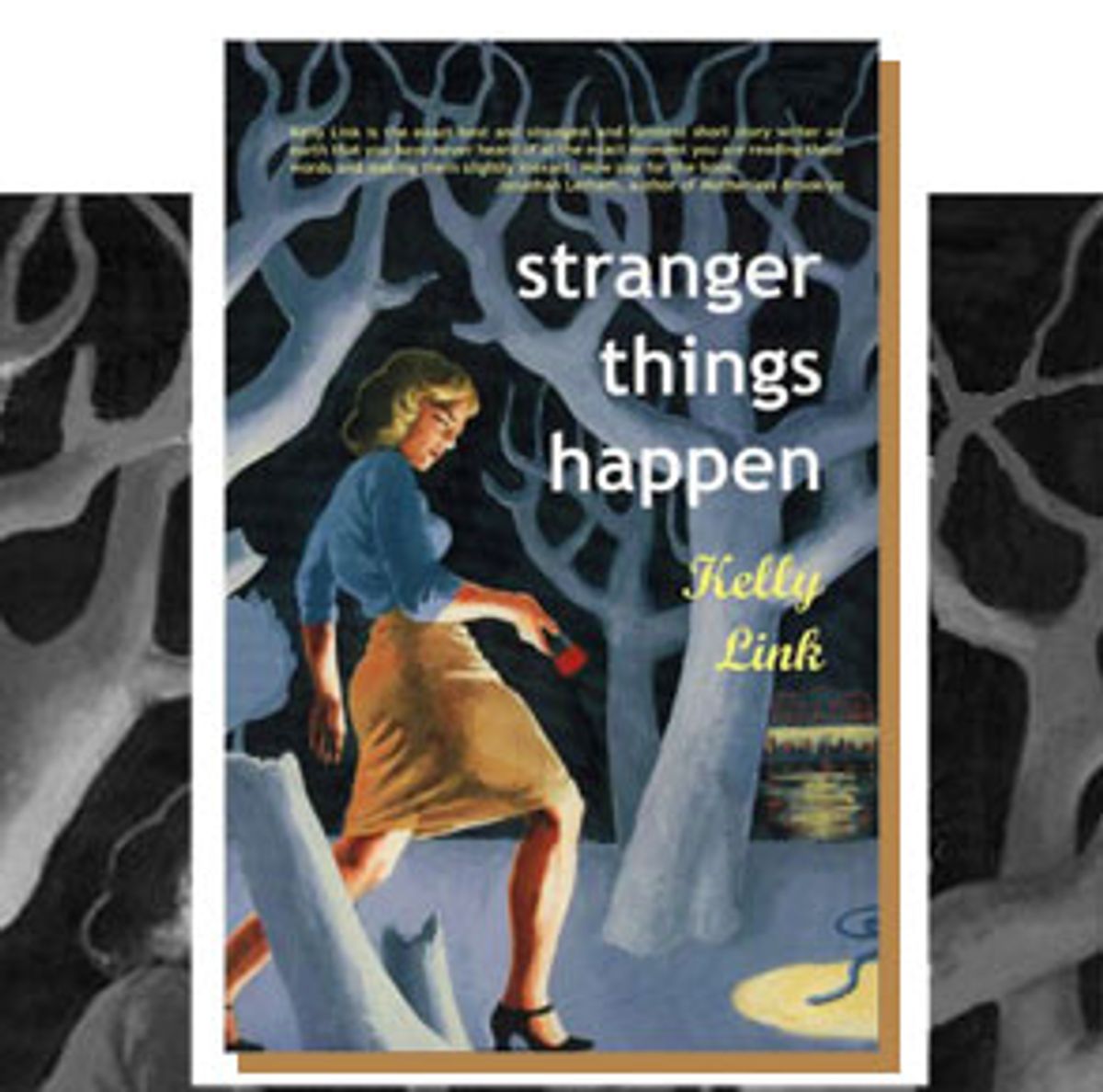
“Stranger Things Happen” by Kelly Link
In these dazzling, uncanny stories, myth becomes part of everyday life and Nancy Drew visits the underworld in search of her long-lost mother.
In Kelly Link’s pristine, dreamy stories, elemental forces move beneath the facade of ordinary life like the shadows of vast marine creatures below the surface of the sea. The things that happen in her fiction are strange indeed — a dead man posts letters to the wife whose name he can’t remember from a mailbox planted on the beach of a deserted resort; a woman invites a group of cellists to her apartment to play for the naked male ghost that’s been crawling across her floor at night — but they’re also intimately connected to the most universal and vexing of emotions: grief, regret, jealousy, restlessness, anger and, especially, sexual passion.
Human beings have used myths and fairy tales to wrestle with these feelings for much, much longer than they’ve used realist fiction, and in writing about the entanglements and betrayals of contemporary life, Link helps herself freely from those warehouses of stories. In “Travels With the Snow Queen,” a story told in the second person, a young woman’s unfaithful boyfriend goes out for a pack of cigarettes and never comes back: “The man at the corner store said that he saw your lover get into a long white sleigh. There was a beautiful woman in it, and it was pulled by thirty white geese. ‘Oh, her,’ you said, as if you weren’t surprised.” She sets off on an epic journey to find him, armed with a numbered list of things she wants to get off her chest, including “3. I never really liked your friends all that much.” Along the way she meets a princess with an admirable “dedication to the art and practice of sleep,” a robber girl who lends her a cute pair of shoes, a handsome guardsman and more talking animals than she would have preferred.
Other contemporary writers have borrowed from fairy tales, of course, most notably the late British author Angela Carter, clearly an influence on Link. But while Carter recast the old stories in ornate, voluptuous prose that reveled in their Freudian and Sadeian undertones, Link’s writing is cool, controlled and scrupulously spare. Carter would tweak the legends of, say, Bluebeard or Little Red Riding Hood to arrive at an exhilarating, if sometimes savage, feminist denouement. Most of the young women in Link’s stories, on the other hand, have the self-deprecating, wisecracking outlook of Melissa Bank and Lorrie Moore. Carter celebrated desire, while Link prefers to tally up its costs.
Link is also a master of the unsaid, which equips her wonderfully to write ghost stories. Many of the stories here use enigma to expertly conjure up an atmosphere of dread or menace in a way that’s reminiscent of David Lynch at his best. Perhaps the creepiest is “The Specialist’s Hat,” which concerns a pair of 10-year-old twin sisters who have moved into an old house with their father after their mother’s death. They debate the differences between being “dead” and being “Dead” with their baby sitter, a person who at first appeared to be a grown-up, “but now she hardly looks older than them. Samantha has forgotten the babysitter’s name”:
Claire’s face is stubborn. “When you’re Dead,” she says, “you stay up all night long.”“When you’re dead,” the babysitter snaps, “it’s always very cold and damp, and you have to be very, very quiet or else the Specialist will get you.”
“This house is haunted,” Claire says.
“I know it is,” the babysitter says. “I used to live here.”
Then there’s the young man in “Water off a Black Dog’s Back,” who has the misfortune to be in love with a girl whose mother has a wooden leg and keeps a barnful of sinister, inky Labradors.
But the tour de force in “Stranger Things Happen” is the last story, “The Girl Detective,” a kaleidoscopic saga that sends a modern pop culture heroine on one of the oldest quests in classical myth. “The girl detective’s mother has been missing a long time,” the story’s opening explains, a situation that will be instantly recognized by Nancy Drew fans. Link then goes on to suggest that readers “think of the underworld as the back of your closet, behind all those racks of clothes that you don’t wear anymore. Things are always getting pushed back there and forgotten about. The underworld is full of things that you’ve forgotten about.” While this story can’t be said to follow any conventional narrative path, it somehow all makes sense. And besides, it’s full of delectable morsels like this passage, under a heading that reads “There are three kinds of food”:
One is the food that your mother makes for you. One is the kind of food that you eat in restaurants. One is the kind of food that you eat in dreams. There’s one other kind of food, but you can only get that in the underworld, and it’s not really food. It’s more like dancing.
“The Girl Detective” is a story of longing and reunion, an alchemical mix of Borges, Raymond Chandler and “Buffy the Vampire Slayer.” Like the rest of the tales in “Stranger Things Happen,” it’s not the kind of story your mother told you. Instead, it’s the kind of story you usually get to read only in dreams.
Laura Miller is a senior writer for Salon. She is the author of "The Magician's Book: A Skeptic's Adventures in Narnia" and has a Web site, magiciansbook.com. More Laura Miller.
“People Who Eat Darkness”: The disappearing blonde
A true crime story set in Tokyo illuminates the complicated truths behind media cliches
Joji Obara and Lucie Blackman (Credit: Estate of Lucie Jane Blackman) Lucie Blackman, 21, went out for the afternoon in 2000, phoning her roommate and best friend Louise to arrange a meeting later that night. Lucie never showed up, and within a few days she’d become one of those vanished blondes whose fates fuel headlines and hours of speculative media coverage. She was British, a former flight attendant, and she and Louise were living in Tokyo. They were also bar hostesses, a profession with a very specific meaning in Japan, difficult to explain to foreigners and not entirely clear to the Japanese themselves. Lucie both did and didn’t match the classic Missing Blonde profile, and for a while the mystery of what happened to her threatened to lapse into permanent obscurity.
Continue Reading Close
Laura Miller is a senior writer for Salon. She is the author of "The Magician's Book: A Skeptic's Adventures in Narnia" and has a Web site, magiciansbook.com. More Laura Miller.
Corporate criminals gone wild
The maker of the documentary film "Inside Job" has a new book excoriating Wall Street -- and President Obama
A detail from the cover of "Predator Nation" “Inside Job,” Charles Ferguson’s Oscar-winning documentary film on how government, Wall Street and academia colluded to deliver us the worst financial crisis since the Great Depression, made a powerful case that something was very very rotten at the heart of the American political/economic nexus. His follow-up book, “Predator Nation: Corporate Criminals, Political Corruption, and the Hijacking of America,” can be considered the legal brief that dots every “i” and crosses every “t” in his argument. A tightly argued, profusely footnoted and deeply enraged castigation of everyone involved, “Predator Nation” isn’t just a factually unchallengeable account of how Wall Street blew up the global economy. It’s a denunciation, a call for justice and a warning: After getting away with the crime of the century, Wall Street still isn’t satisfied.
Continue Reading Close
Andrew Leonard is a staff writer at Salon. On Twitter, @koxinga21. More Andrew Leonard.
Can you identify?
Science shows that the only way around some readers' prejudices is to trick them
(Credit: Shutterstock/Salon) The news of recent research documenting how readers identify with the main characters in stories has mostly been taken as confirmation of the value of literary role models. Lisa Libby, an assistant professor at Ohio State University and co-author of a study published in the Journal of Personality and Social Psychology, explained that subjects who read a short story in which the protagonist overcomes obstacles in order to vote were more likely to vote themselves several days later.
The suggestibility of readers isn’t news. Johann Wolfgang von Goethe’s novel of a sensitive young man destroyed by unrequited love, “The Sorrows of Young Werther,” inspired a rash of suicides by would-be Werthers in the late 1700s. Jack Kerouac has launched a thousand road trips. Still, this is part of science’s job: Running empirical tests on common knowledge — if for no other reason than because common knowledge (and common sense) is often wrong.
Continue Reading Close
Laura Miller is a senior writer for Salon. She is the author of "The Magician's Book: A Skeptic's Adventures in Narnia" and has a Web site, magiciansbook.com. More Laura Miller.
“The Aleppo Codex”: The bizarre history of a precious book
A reporter traces the shadowy fate of the definitive version of the Hebrew Bible
Matti Friedman An ancient and priceless book, a murky history of evasions and coverups, an underground of sinister and possibly violent dealers, a former spy who drops tantalizing hints and a wily 84-year-old millionaire who says stuff like, “The problem with this story is that it could damage your health”: Are these the ingredients for a cheesy, improbable historical thriller? Yet “The Aleppo Codex,” Matti Friedman’s account of his attempts to learn the history of one of the world’s most precious books, sports all of these assets, and it’s nonfiction. If reporting this story damaged Friedman’s health, it probably happened when he realized what he’d stumbled into and his reporter’s heart started beating in doubletime.
Continue Reading Close
Laura Miller is a senior writer for Salon. She is the author of "The Magician's Book: A Skeptic's Adventures in Narnia" and has a Web site, magiciansbook.com. More Laura Miller.
Augusten Burroughs: Conquer trauma by letting it go
Salon exclusive: The best-selling memoirist says past horrors haunt us because we think about them too much. Stop
Augusten Burroughs Many people continue to feel influenced and even controlled by the things that happened to them a long time ago. Sometimes, people harbor dark, traumatic memories from childhood. Or fragments of memories — incomplete scenes, uncomfortable feelings, perhaps even a sense of certainty that something specific and terrible happened to them, but little more than this.
Others experienced something traumatic in adulthood that continues to affect them day to day many years later. Maybe an assault has left a person afraid to leave their home or enter a particular neighborhood.
Continue Reading CloseAugusten Burroughs' many books include "Runnning With Scissors," "Dry," "Sellevision," "Magical Thinking" and "Possible Side Effects." His latest book is "This Is How." More Augusten Burroughs.
Page 1 of 984 in Books