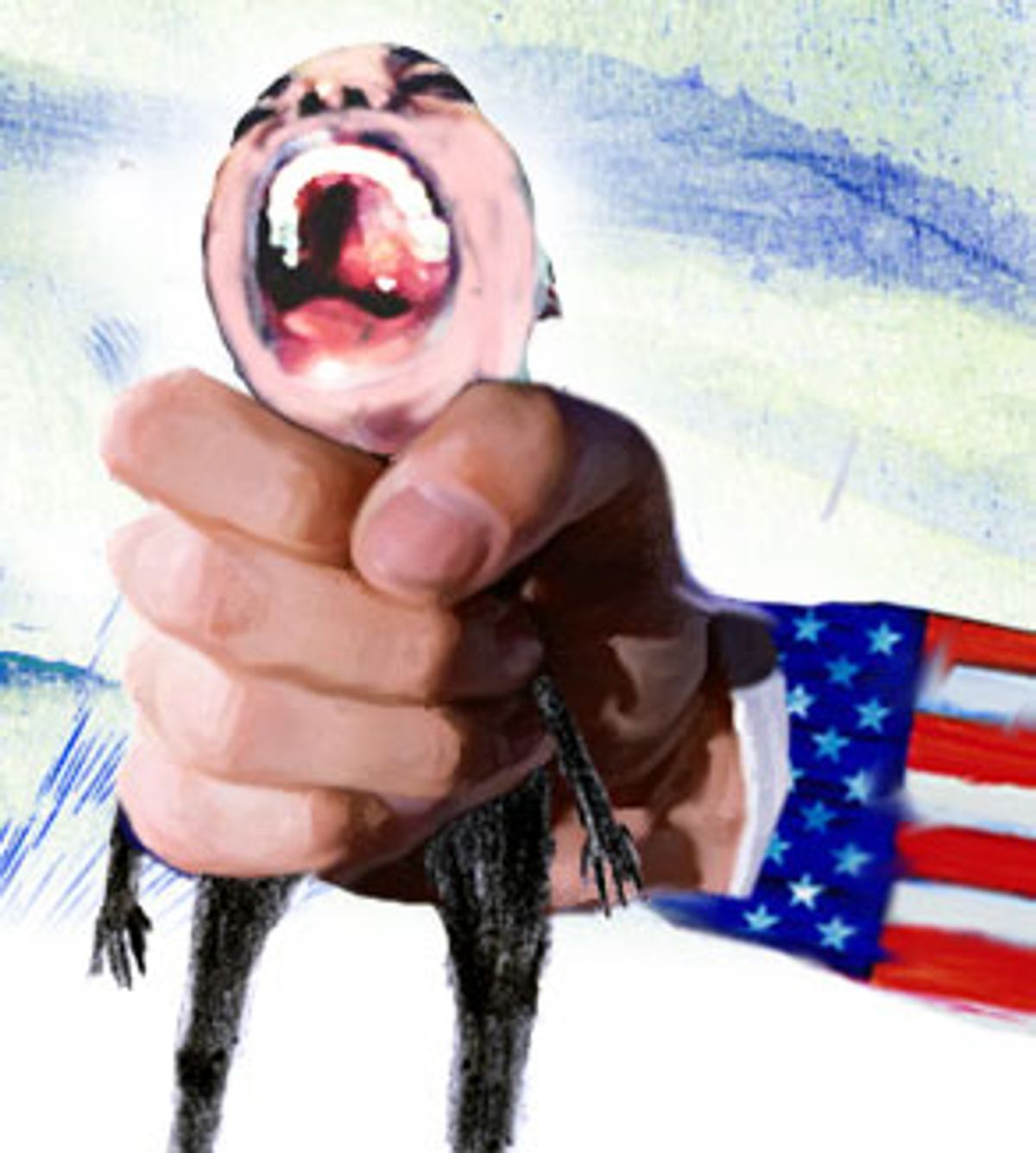
Torture

Time to torture?

Americans are debating whether torture should be used against terrorists. But the case of Israel shows that brutality in the name of morality doesn't pay.

  • more
    • All Share Services

Topics: ,

Time to torture?

It’s a classic moral dilemma: Imagine security services know a bomb is about to blow up in a crowded public space, killing and maiming possibly hundreds of people. But the plot can only be foiled if information is violently extracted from a tight-lipped terrorist suspect. What should you do?

As Americans grapple with the possibility of ticking time-bomb scenarios in the wake of Sept. 11, the once unthinkable is being openly talked about: torture. In a column titled “Time to Think About Torture,” liberal Newsweek columnist Jonathan Alter mused whether torture would “jump-start the stalled investigation into the greatest crime in American history.” Alan Dershowitz, normally known as a staunch civil libertarian, told Newsweek: “I’m not in favor of torture, but if you’re going to have it, it should damn well have court approval.”

On the unabashedly patriotic Fox News, where anchors sport American flag pins, anchor Shepard Smith introduced a segment by saying, “Should law enforcement be allowed to do anything, even terrible things, to make suspects spill the beans? Jon DuPre reports. You decide.” Academic Jay Winick, writing in the Wall Street Journal, described how Philippine authorities tortured terrorist Abdul Hakim Murad into revealing a plan to crash U.S. jetliners and rhetorically wondered what would have happened if Murad been questioned by U.S. authorities, not Filipino ones. And conservative pundit Tucker Carlson opined on CNN’s “Crossfire” that “Torture is bad. Keep in mind, some things are worse. And under certain circumstances, it may be the lesser of two evils. Because some evils are pretty evil.”

Amid these calls to begin debating a practice formerly condemned by all sides as barbaric — not to mention the Bush administration’s plan to try suspected terrorists in military courts, where they would have far fewer rights — it is worth examining Israel’s experience. The Jewish state has been using torture for decades against Palestinians. And its experience should serve as a powerful warning against the temptation to use brutal interrogation methods.

Officially there is no torture in the Holy Land. But on any given day, and on many more days now that the intifada has shattered Israelis’ sense of security, there may be a dozen people screaming in Israeli interrogation centers and in Palestinian jails, as Israelis hunt for Palestinian terrorists and Palestinians hunt for collaborators with Israel. “In Israel, torture is seen as regrettable but necessary, so the courts and the public close their eyes. In the Palestinian territories, there is a witch-hunt against collaborators so no one speaks up,” said Mireille Widmer, a Swiss human rights lawyer.

Until recently, torture was widespread, routine, legal and institutionalized in Israel. Although the state always denied that it resorted to torture, interrogation methods known as “moderate physical pressure” were deemed acceptable, legal and necessary in Israel’s fight against Palestinians it deemed security threats. These methods included violent head-shaking; relentless sleep deprivation; shackling of detainees to poles, desks and slanting kindergarten chairs in excruciating positions; beatings; exposure to extreme temperatures, incessant harsh light and blaring music; and threats to family members.

“Moderate physical pressure” was seen by politicians and terrorist experts as the perfect answer to a tough quandary: how to protect the lives of Israeli citizens while remaining true to the Jewish state’s self-image as the only Western-style democracy in the Middle East. According to Boaz Ganor, director of Israel’s Counter-Terrorism Institute, it successfully “breached the contradiction between effectiveness and the threat to liberty and democratic values.”

Human rights groups shattered that myth, contending that “moderate physical pressure” unequivocally met all definitions of torture under international law (including the Convention Against Torture which Israel ratified in 1991) and seriously undermined the moral foundations of Israeli democracy. They filed a petition against the abusive methods used by the Shin Bet, Israel’s domestic security force (also known as the General Security Services, or GSS) and partially won. In September 1999, a nine-judge panel of the Israeli Supreme Court unanimously outlawed torture (although the judges shied away from using the “T” word). The judges left the door open, however, for physical pressure in exceptional circumstances by giving interrogators the right to invoke the defense of necessity if criminal charges were brought against them.

Torture continued to be practiced even after the high court’s ruling, but its frequency diminished dramatically. Then came the al-Aqsa intifada of Sept. 28, 2000. A year after the High Court verdict, the second Palestinian uprising started, pitting Palestinian stone-throwers, gunmen and terrorists against Israeli soldiers, settlers and interrogators in a bloody cat-and-mouse game in which about 900 people have died so far, four-fifths of them Palestinian. In this context, it was predictable that torture would come back in vogue, along with shatter-proof windshields, armored buses and guns, as a way of coping with danger.

According to a study published recently by the Public Committee Against Torture in Israel (PCATI), one of the nongovernmental organizations that petitioned the High Court in 1999, the Shin Bet has reverted to many of its old habits. After reviewing affidavits from Palestinian detainees and other material collected by lawyers and human rights workers over the past year, the Public Committee concluded that although some of the torture methods outlawed by the court have almost entirely disappeared, “each month, dozens of Palestinians” interrogated by the Shin Bet are still “exposed, to one extent or another, to methods of torture and ill treatment.”

“After the High Court decision, there was a drop in the cases of torture. But affidavits have been pouring in since September 2000,” said Hannah Friedman, the executive director of PCATI. “Our conclusion is that there is real use of methods banned by the high court.”

Raanan Gissin, spokesman for Prime Minister Ariel Sharon, denied that torture is commonplace. “These so-called human rights organizations are laden with political motives and have their axes to grind,” he said in a phone interview. “As a veteran warrior, I’ve been hearing these accusations for over 20 years. It’s always the case that you hear about Israelis torturing the Palestinians, the poor guys, and nothing about the atrocities Palestinians commit against Israelis. We’re a free, open society, a democracy. We have nothing to hide.” Gissin contrasted that with the Palestinians, who he said used every means to further their cause and didn’t stop at “fabricating stories about torture.”

“When there are allegations of torture, we have investigative mechanisms to deal with them. The General Security Services are subjected to parameters and employ force only in the case of ticking bombs. There is an allowance for force but under the complete supervision of a board. And there’s always the press. I’m not saying that violations don’t occur. They do occur. But the numbers are small and we have mechanisms to deal with them.”

But Israeli human rights groups and other organizations charge that the practice of illegal torture is far more widespread than the Israeli government is willing to publicly acknowledge. For example, the Palestinian Human Rights Monitoring Group, a well-respected group that mostly documents abuses by the Palestinian Authority, has direct knowledge of a case of torture that occurred this spring when one of its field workers, Abed Rahman Al-Ahmar, was arrested and beaten by Israeli security forces and later interrogated by the Shin Bet. On June 10, according to the testimony he gave his attorney, Al-Ahmar was shackled in tight handcuffs to a slanting chair for a whole day — a method known as “shabeh” that was outlawed by the High Court in 1999. (The angle of the chair, often a kindergarten chair whose front legs have been sawed down, places enormous pressure on a detainee’s lower back and stomach.) “Abed, being a human rights activist, knew it was illegal and protested. The interrogators just laughed,” said Widmer, the human rights lawyer who works for the same organization as Al-Ahmar.

“There’s a feeling of complete impunity — especially now [with the Intifada],” said Widmer. When human rights groups petitioned the High Court in the name of Al-Ahmar, the court rejected the petition, saying there was no sign of torture “in spite of the fact Abed was obviously sick,” said Widmer. “His wrists were all red and puffy and he vomited in the court.”

The alleged torture of Al-Ahmar raises another troubling issue: the authorities’ tendency to use torture, once it is allowed, against individuals who appear to have nothing to do with terrorism. As far as his colleagues can tell, Al-Ahmar is being held for membership in an illegal organization (he was once a supporter of the PFLP, a radical Marxist PLO splinter group) — that is to say for political reasons, not for any operational terrorist-related reasons. (No charges have been brought against Al-Ahmar, still imprisoned today. He is in administrative detention, a measure that allows Israel to hold people without revealing evidence and without trial, under Emergency Laws that were originally adopted by the British in 1945 to fight the Jewish underground. Al-Ahmar has been adopted as a Prisoner of Conscience by Amnesty International.)

Although Al-Ahmar’s case and dozens of others documented by human rights groups show that physical force is still commonly used by the Shin Bet, the High Court ruling has brought some significant changes. “Since the ruling, the situation has totally changed,” said Yael Stein, a researcher for B’tselem, a prominent group that documents human rights abuse in the Israeli-occupied territories. “In the past, torture was routine. Everybody went through the same procedures. It was documented, approved by the high court, the Knesset, the government — it was rooted in the system. Today it is less routine. There is no more shaking [which produces severe dizziness, brain damage, and possibly death]. Sleep deprivation is not as severe as it was. And numbers have dropped. Of course it depends on your definition of torture. There is ill-treatment and humiliation, but holding someone incommunicado [forbidding contact with family and lawyers] is not torture.”

Ledgers from the era that preceded the High Court ruling make chilling reading: interrogators kept precise records of their actions, jotting down how many hours a person was forced to crouch, how long a person was tied to a small chair tilted forward with a filthy sack on his head, etc. They used standard equipment for torture and put detainees through well-defined stages of physical pain and mental anguish.

This bureaucratic self-assurance was the product of the Landau Commission, a 1987 governmental commission led by former Supreme Court justice Moshe Landau. The commission, which was created after several public scandals, clarified just what type of physical force authorities were allowed to use against Arabs. Before 1987, torture was widespread — the practice began in the ’70s — and there was no specific legislation that narrowed down the use of force in interrogation. (According to PCATI head Friedman, before 1977 it was mostly the police (not the Shin Bet) who tortured Arabs.) Although the exact interrogation torture guidelines — which the Israeli historian Benny Morris called “a document unique in the annals of modern Western judicial history” — set by the commission remain secret to this day, the idea was that force would be used only in the case of “ticking bombs” — i.e. when information about an imminent attack could save lives.

“The first obligation of the government is to guard the lives of others. There is no higher right than the right to live,” said Ganor, the counterterrorism expert. After 1987, “torture was not allowed,” he added. “What they did was moderate physical pressure. The Shin Bet was reluctant to use these abilities because interrogators were under judicial control. If the guidelines were breached, they could be brought to court. It was not a no-man’s land where anything could be done.”

In practice, however, the legal restrictions on the use of physical force by the Shin Bet did not hold. “Israel’s experience shows you can’t stop the slippery slope: They tortured almost all the Palestinians they could. It was in the system. The moment you start, you can’t stop,” said Stein, the B’tselem researcher. B’tselem estimates that before 1999, the security services used torture against 85 percent of the Palestinians they interrogated. The exceptional became routine. Some 23,000 Palestinians were interrogated between 1987 and 1994, the years of the first intifada. In 1995, the late Prime Minister Yitzhak Rabin admitted that violent shaking had been used against 8,000 detainees.

The “ticking bomb” scenario is the one most often invoked by Americans who argue that torture may be a valid weapon in the fight against terrorism. The problem, however, is that such a pure, morally unambiguous scenario rarely exists. “‘Ticking bombs’ are a very rare case,” said Stein. “The secret services also admit it’s very rare. It’s almost impossible to stay within the lines of this pure case. What is imminent? An hour? Tomorrow? In a week? What if a neighbor knows someone who knows someone who knows about a plot? You cannot restrict torture only to pure ‘ticking bombs.’” Palestinian detainees have often testified that interrogations stopped on Fridays and Saturdays, confirming the suspicion that torture had nothing to do with urgency.

The argument of necessity, which can still protect Israeli interrogators today if torture charges are brought against them, is technically flawed: Interrogators may not know if someone represents a ticking bomb and whether torture is justified (or defensible in court) unless they torture him into confessing first — a form of evidence-gathering that bears an uncomfortably close resemblance to the witch trials of the 17th century. It is also morally absurd. “If everything is justified in order to preserve life, why stop at ‘moderate physical pressure’? ” asks Stein. “Why not do worse? Pull nails, rape sisters and wives? Shin Bet interrogators could do worse things — but they don’t. It’s illogical.”

Israel’s attempt to limit torture to exceptional cases was further doomed by the failure of courts to uphold human rights and prosecute Shin Bet interrogators responsible for breaching the Landau Commission’s guidelines. PCATI notes that over a period of seven years “not a single interrogator has been tried in criminal court, not even when detainees left interrogation wings with permanent physical or mental disabilities,” nor when a Palestinian detainee, Abd Al-Samad Harizat, was tortured to death in 1995 (the guilty interrogator resumed interrogating after a short suspension).

According to PCATI, interrogators are still protected from external scrutiny and from the threat of criminal investigation today. (Complaints by detainees are collected by an agent who works for the Shin Bet, who naturally prefers the version of his colleagues. And, as Al-Ahmar’s case has shown, the courts also prefer to close their eyes.)

“There is no doubt torture degrades society at large,” says Stein. But he sees torture as only one element of the methods used by Israel to enforce the occupation of the West Bank and Gaza and protect itself from Palestinian ire. That list includes military sieges that punish entire communities, racial profiling and extra-judicial killings. All of these, he believes, have destructive effects not just on the Palestinians but on the Israelis who carry them out. “There are so many immoral things. Torture is just the more obvious and difficult to accept. When a man on reserve duty has to stand at a checkpoint for 30 days and enforce the closure on Palestinians, he also comes home brutalized by the experience. Occupation affects Israeli society in many ways.”

Indeed, Stein believes the High Court’s change of heart in 1999 came about in part because judges, who defended torture in petition after petition, “couldn’t stand it anymore.” Torture enlists the doctors who determine beforehand whether someone is fit for interrogation or needs to be treated with some restraint because of, for example, asthma, and violates their professional oath when they send patients back to the interrogation/torture room after perfunctory checkups.

The corrosion of values doesn’t stop at judges and doctors. Torture still seems indispensable to a wide majority of Israelis. “There was a public outcry after the High Court ruling — people were scared,” says Stein. Politicians of all stripes, including former Prime Minister Ehud Barak, have vowed to pass legislation that would make physical interrogation methods legal again. “In most countries people would be ashamed of using such methods. Here they are proud of it. There’s huge support for these methods,” said Yael Stein.

Although Israelis can easily imagine themselves victims of a terror attack — they seem to happen every week, everywhere, in restaurants, discos and train stations — torture is different. “Israelis don’t feel concerned by torture because it is something that will never apply to them but always to others, to Palestinians,” says Widmer. “It’s easier to torture people of a different race,” notes Friedman. The most recent PCATI report on torture is full of religious curses and religious slurs used by interrogators to dehumanize Palestinians.

For Palestinians, shackled to desks or shaken senseless during Israeli interrogations, the impact is obvious too. “You destroy a man’s soul and body for his whole life. He cannot work, marry, sleep at night. He has hallucinations. Torture is also a political way to destroy a people,” says Friedman. Not surprisingly, the interrogation methods used by Israel have found their ways into Palestinian jails. “Palestinian torturers were first in Israeli jails. They have work experience, so to speak. And now they use the same methods [against Palestinian collaborators],” says Friedman.

Finally, there is the question of torture’s effectiveness. Assessing this is difficult, if not impossible, for two obvious reasons: First, Israel still practices torture, despite officially outlawing it, and second, there is no way to know after the fact whether torturing a suspect would or would not have prevented a terrorist attack. But surely the burden of proof should be on the advocates of torture: If they cannot show that the practice’s results justify its use, it should be rejected.

It would be difficult for an advocate of torture to argue that the payoff is worth the cost. The routine torture sanctioned by the Landau Commission did not stop bombs from going off in the past. And today, when “moderate physical pressure” is in theory outlawed, the security services boast impressive successes. Although bombs have killed scores of Israelis since the beginning of the intifada, security forces have deactivated bombs in watermelons, bags and garages, intercepted terrorists strapped with explosives and foiled numerous plots by killing bomb-makers and terrorist leaders in targeted military operations.

Ganor is amazed by the success Israel’s security forces have had without being allowed recourse to force: “As a counterterrorism expert, I’m surprised to see that the Shin Bet manages even without moderate force. Detainees are very hard to interrogate,” he says. “They are trained not to give away secrets and to resist Israeli methods. When one is released, he goes back to his group and briefs others. Hamas and Islamic Jihad have put out books and leaflets teaching people how to withstand interrogation — even telling them which methods are allowed and not allowed so they can send their lawyers to court.”

Sharon spokesman Gissin admits there is pressure to revert to the good old days when the usage of physical force during interrogations was less restrained. “Of course some people would like to give the security services more of a free hand. But despite the limitations, there’s an impresssive rate of success so there’s no need to use torture as such and we don’t use torture as such.”

“In some cases, in a very tense situation like we have now with daily terror alerts, restrictions create problems and a certain burden on the security services,” said Gissin. “But despite that, within these limitations, the number of terror attacks foiled, stopped, scuttled, is far greater than the number of attacks that succeeded. I can’t tell you if a suicide bomber succeeded because not enough pressure was used during someone’s interrogation. But despite the guidelines, we have a very effective GSS and it’s doing a tremendous job in terms of locating terrorists and preventing attacks.”

Part of the reason for the agency’s success is that it can rely on an excellent network of collaborators to collect information — a luxury the United States may not have in its own war against terrorism. Israel, a much more powerful and wealthy country than its Palestinian opponents, has huge leverage to recruit collaborators by offering much-needed work permits, the right to be reunified with exiled family members, import licenses and money. (Collaborators tip off Israelis in their search for terrorists and help also to extract information inside jails by posing as friendly co-detainees.)

“A lot of experts feared that Israel’s intelligence ability would suffer if moderate force was not allowed,” says Ganor. “But at the end of the day, the Shin Bet manages to work without.”

There is one last point to be considered: For every actual terrorist who spills the beans because of torture, who knows how many non-terrorists are pushed into deadly fanaticism by the experience of being tortured?

One of the Palestinian teenagers who were tortured at the Gush Etzion police station last winter made headlines in the Israeli press when he said, several months after he was released, that he now wanted to become a suicide bomber. He was arrested for throwing stones at settlers’ cars, but he said the degradation and suffering caused by his interrogation made him consider terrorism.

Continue Reading Close

Flore de Preneuf is a Jerusalem writer and photographer.

Memorial for America’s conscience

On this holiday, Americans should confront a grim fact about our country: We are torturers

  • more
    • All Share Services

Topics: ,

Memorial for America's conscienceIn this Oct. 9, 2007 file photo US military personnel inspect each occupied cell on a two-minute cycle at Camp 5 maximum-security facility on Guantanamo Bay U.S. Naval Base in Cuba. (Credit: AP Photo/Brennan Linsley, file)

Facing the truth is hard to do, especially the truth about ourselves. So Americans have been sorely pressed to come to terms with the fact that after 9/11 our government began to torture people, and did so in defiance of domestic and international law. Most of us haven’t come to terms with what that meant, or means today, but we must reckon with torture, the torture done in our name, allegedly for our safety.

It’s no secret such cruelty occurred; it’s just the truth we’d rather not think about. But Memorial Day is a good time to make the effort. Because if we really want to honor the Americans in uniform who gave their lives fighting for their country, we’ll redouble our efforts to make sure we’re worthy of their sacrifice; we’ll renew our commitment to the rule of law, for the rule of law is essential to any civilization worth dying for.

After 9/11, our government turned to torture, seeking information about the terrorists who committed the atrocity and others who might follow after them. Senior officials ordered the torture of men at military bases and detention facilities in Afghanistan and Iraq, in secret CIA prisons set up across the globe, and in other countries – including Libya and Egypt — where abusive regimes were asked to do Washington’s dirty work.

The best known of all the prisons remains Guantanamo on the southeast coast of Cuba. For years, the United States naval base there seemed like an isolated vestige of the Cold War – defying the occasional threat from Fidel Castro to shut it down. But since 9/11, Guantanamo – Gitmo – has been a detention center, an extraterritorial island jail considered outside the jurisdiction of US civilian courts and rules of evidence. Like the notorious Room 101 of George Orwell’s “1984,” the chamber that contains the thing each victim fears the most to make them confess, Guantanamo’s name has become synonymous with torture. Nearly 800 people have been held there. George W. Bush eventually released 500 of them, sometimes after years of confinement and cruelty. Barack Obama has freed 67, but 169 remain, even though the president pledged to close the Guantanamo prison within a year of his inauguration. Now, forty-six are so dangerous, our government says, they will be held indefinitely, without trial.

We almost never see the detainees. Were it not for the work of human rights organizations and the forest of lawsuits that have arisen from our actions, the prisoners would be out of sight, out of mind. Five of the Guantanamo prisoners were recently arraigned before a military commission for their role in the attacks. One of them is Khalid Sheikh Mohammed, who says he was the mastermind behind 9/11. He was waterboarded by interrogators 183 times. Pentagon officials predict it will be at least another year before the five go on trial.

Earlier this month, lawyers for Mohammed al-Qahtani – the so-called “20th hijacker” who didn’t make it onto the planes — filed suit in New York federal court to make public what they described as “extremely disturbing” videotapes of his interrogations.  He was charged in 2008 with war crimes and murder but the charges were dropped after the former convening authority for the Guantanamo military commissions, Susan Crawford, told journalist Bob Woodward that al-Qahtani’s treatment “met the legal definition of torture.”

He remains in indefinite detention, as does Abu Zubaydah, a Saudi citizen alleged to have run terrorist training camps. He was waterboarded at least 83 times in a single month.  Just this week a federal appeals court refused to release information on the interrogation methods the CIA used on Abu Zubaydah and other terrorist suspects.

You may also have seen the flurry of action this month around a section of the new National Defense Authorization Act that allows the military to detain indefinitely not only members of al Qaeda, the Taliban and “associated forces” but anyone who has “substantially supported” them.  A federal court struck down that provision in response to journalists and advocates who believe it could be so broadly interpreted it would violate civil liberties.  Nonetheless, two days after the court’s decision, the House of Representatives reaffirmed the original provision.

The other day, eight members of the Bush Administration – including President Bush, Vice President Cheney, and Defense Secretary Rumsfeld – were found guilty of torture and other war crimes by an unofficial tribunal meeting in Malaysia.  The story was played widely in parts of the world press, with reports that the judgment could lead the way to proceedings before the International Criminal Court in The Hague. It received almost no mention here in the United States.

This summer, it’s believed that the United States Senate’s intelligence committee finally will release a report on “enhanced interrogation techniques,” that euphemistic phrase for what any reasonable person not employed by the government would call torture. The report has been three years in the making, with investigators examining millions of classified documents. The news service Reuters says the report will conclude that techniques such as waterboarding and sleep deprivation do not yield worthwhile intelligence information.

So here we are, into our eleventh year after 9/11, still at war in Afghanistan, still at war with terrorists, still at war with our collective conscience as we grapple with how to protect our country from attack without violating the basic values of civilization — the rule of law, striving to achieve our aims without corrupting them, and restraint in the use of power over others, especially when exercised in secret.

In future days and years, how will we come to cope with the reality of what we have done in the name of security? Many other societies do seem to try harder than we do to come to terms with horrendous behavior commissioned or condoned by a government. Beginning in 1996, in South Africa, the Truth and Reconciliation Commission held hearings at which whites and blacks struggled to confront the cruelty inflicted on human beings during apartheid.

And perhaps you caught something said the other day by the president of Brazil, Dilma Roussef.  During the early seventies she was held in prison and tortured repeatedly by the military dictators who ruled her country for nearly 25 years. The state of Rio de Janeiro has announced it will officially apologize to her. Earlier, when she swore in members of a commission investigating the dictatorship, President Roussef said: “We are not moved by revenge, hate or a desire to rewrite history. The need to know the full truth is what moves us.”

In other words, “You shall know the truth and the truth shall make you free.”

Continue Reading Close

Bill Moyers is managing editor of the new weekly public affairs program, "Moyers & Company," airing on public television. Check local airtimes or comment at www.BillMoyers.com.

Michael Winship is senior writing fellow at Demos and a senior writer of the new series, Moyers & Company, airing on public television.

Bush aide blasts torture

Philip Zelikow tried to warn Bush on interrogations. Now he's penned an authoritative article on how he was ignored

  • more
    • All Share Services

Topics: ,

Bush aide blasts torture (Credit: Reuters/Jim Young)

The Bush administration hasn’t heard the last from Philip Zelikow. After the rediscovery last week of his long lost 2006 anti-torture memo, Zelikow, a former State Department official, has written arguably the most damning article yet about U.S. government’s interrogation policies from 2001 to 2009. The article, called “Codes of Conduct for a Twilight War,” will be released in a forthcoming issue of the Houston Law Journal, and was obtained exclusively by Salon. Says Zelikow in an email: “I’m not aware of other accounts that combine historical, policy and legal approaches to” the subject of the Bush administration’s interrogation methods.

Based on published histories and his firsthand observations, and adapted from a lecture delivered in November, the article calls the administration’s rationale for its use of torture — which he nonetheless insists only on calling “extreme interrogation” and “coercive methods” — “radical,” “an amazing contention,” “untenable and extreme,” “unsustainable,” “an unprecedented program of coolly calculated dehumanizing abuse and physical torment,” and, finally, simply a “mistake.” He concludes: “This was a collective failure of American public leadership, in which a number of officials and members of Congress (and staffers) of both parties played a part, endorsing a CIA program of physical coercion without any precedent in U.S. history.”  In fact, “The only defense against criminal prosecution would be that officials acted in good faith reliance on the advice of their government lawyers.”

Part of what makes Zelikow’s analysis so damning and definitive is its judiciousness. The article is deeply empathetic of the uniquely fearful situation under which the Bush administration was initially operating. Zelikow calls the Sept. 11 attacks a “collective trauma” and a “shoc[k] to mass beliefs.” He notes that Bush and others spent time in burn units, morgues and with survivors of the attacks. One traumatic experienced often overlooked — overlooked because it appeared in Stephen Hayes’ stenographic biography of Dick Cheney — was that the vice-president’s daughter was (falsely, it turns out) told that her house with her children in it had tested positive for anthrax. Similarly, Cheney and National Security Advisor Condoleezza Rice were told that they and others had been exposed to an extremely lethal toxin in a particular area of the White House — and might soon die as a result. “The alarms did not stop and they too were not abstract … The pressure on Bush and his senior advisers was so direct because so much of the response had to be invented and improvised,” the article reads.

An additional factor in the power of the article is Zelikow’s credibility and history. Before entering government, he was a civil rights lawyer in Texas battling the Ku Klux Klan and then a highly esteemed Harvard historian specializing in U.S. foreign policy — he co-authored one book with Rice. He then served on the National Security Council under President George H.W. Bush and directed the 9/11 Commission before becoming counselor to Rice at the State Department from 2005 to 2007. He currently volunteers part-time on the President’s Intelligence Advisory Board under President Obama.

Such bipartisan, establishment credentials render the breakdown and conclusion of this article all the more damning. He believes that what should have been a political and moral question — should the United States torture captives? — became strictly a legal matter left up to government lawyers, few of whom had any experience with these issues, and who had to take the necessity of extreme measures as a given. “These lawyers then became secular priests, granting absolution to the supplicant policymakers,” Zelikow writes.

The problems began when the Office of the Vice President and the CIA took central roles in policymaking. Cheney felt himself above the rest of the National Security Council, bypassing Rice and other traditional channels of national security policymaking. Ad-hoc decision-making and improvisation became “a habit of thought,” which seemed initially to pay off in the security of the nation, as well as in Bush’s political standing and self-confidence.

With Cheney and CIA head George Tenet “the key entrepreneurs in setting codes of conduct for the War on Terror,” it was essentially left to their obsequious lawyers to decide, in secret, on the interrogation methods America should employ. Bush even told the Senate’s Intelligence Committee chairman that “the vice president should be your point of contact … [He] has the portfolio for intelligence activities.” Decisions were made to jettison international treaties. By December 2001, the CIA was already interested in reverse-engineering methods “heretofore used only to treat Americans to resist enemy torture.” When a senior al-Qaida member was captured in March 2002, the prototype for the administration’s torture policies was already developed. “So, for the first time in American history, leaders of the U.S. government carefully devised ways and means to torment enemy captives.”

Zelikow notes that “None of the policy or moral issues connected with these choices appear to have been analyzed in any noticeable way.” Perhaps worst of all, no serious consideration was given to weighing the costs of benefits of the torture program, with reference to relevant historical precedents and/or examinations of the respective French, British and Israeli experiences in dealing with captured terrorists. “Bush and Rice should have insisted on this,” Zelikow writes.

The 52-page article observes the successes of Obama’s counterterrorism policies after repudiating the use of torture. On the basis of the empirical evidence then, “[t]here is no evident correlations between intelligence success and the available of extreme interrogation methods,” no matter what Bush and Cheney claim. Finally, “The program’s costs — which include the high-level effort expended in order to establish, maintain, and defense the program — appear on the evidence so far to have well outweighed any unique value the program might have had as a method of counterterrorism intelligence collection.” This is apart from the damage to America’s international standing and corrosion of its traditional values.

Zelikow concludes his analysis by arguing that, although the Obama administration has the right to wage war and use extralegal methods to defeat al-Qaida, its claim of that authority to defeat “associated forces” is unwarranted. “The U.S. government should publish and explain any overarching policy and legal documents that guide and confine the conduct of deadly operation against its foreign enemies … the executive branch of the U.S. government has a duty to articulate the scope of its warfare to the Congress and the public.” The Bush administration’s unprecedented elevation of torture to national policy may be history, but the job to get U.S. foreign policy in line with its constitutional and moral obligations is far from over.

Continue Reading Close

Jordan Michael Smith writes about U.S. foreign policy for Salon. He has written for the New York Times, Boston Globe and Washington Post.

The memo Bush tried to destroy

A document advising the Bush administration against torture has resurfaced, despite his best efforts to hide it

  • more
    • All Share Services

Topics: ,

The memo Bush tried to destroyGeorge W. Bush in 2006 (Credit: AP/Ron Edmonds)

In February of 2006, Philip Zelikow, counselor to Secretary of State Condoleezza Rice, authored a memo opposing the Bush administration’s torture practices (though he employed the infamous obfuscation of “enhanced interrogation techniques”). The White House tried to collect and destroy all copies of the memo, but one survived in the State Department’s bowels and was declassified yesterday in response to a Freedom of Information Act request by the National Security Archive.

The memo argues that the Convention Against Torture, and the Constitution’s prohibitions against cruel and unusual punishment, do indeed apply to the CIA’s use of “waterboard[ing], walling, dousing, stress positions, and cramped confinement.” Zelikow further wrote in the memo that “we are unaware of any precedent in World War II, the Korean War, the Vietnam War, or any subsequent conflict for authorized, systematic interrogation practices similar to those in question here, even when the prisoners were presumed to be unlawful combatants.” According to the memo, the techniques are legally prohibited, even if there is a compelling state interest to justify them, since they should be considered cruel and unusual punishment and “shock the conscience.”

Chillingly, the memo notes that “corrective techniques, such as slaps,” may be legally sustained, as might be “[C]ontrol conditions, such as nudity, sleep deprivation, and liquid diets…depending on the circumstances and details of how these techniques are used.” However much distress Zelikow’s memo caused the White House, it was not an ACLU briefing paper.

“I’m pleased the memo is now part of the historical record and available for study,” Zelikow wrote Salon in an email. The White House had determined that the memo — which was not binding since Zelikow’s was a bureaucratic position without legal authority — was too dangerous to exist. “I later heard the memo was not considered appropriate for further discussion and that copies of my memo should be collected and destroyed,” he said in a May 2009 congressional hearing.

At that hearing, before the Senate Committee on the Judiciary, Subcommittee on Administrative Oversight and the Courts, Zelikow said he had “no view on whether former officials should be prosecuted,” a decision he thinks should be left to “institutions.” However, he did call for a thorough inquiry and a public report examining how the U.S. came to employ torture.

Of course, no such inquiry was ever launched. The Obama administration declined to revisit the U.S. employment of torture, with the president saying he didn’t want to “look back.” Zelikow believes this was a mistake. “I still believe an inquiry would be useful, though less so as time passes and more information becomes available, especially after the 9/11 trials conclude, hopefully this year,” he says in an email.

During his congressional testimony, Zelikow declined to say whether Department of Justice lawyers acted improperly or immorally, conceding only that their opinions were “unsound, even unreasonable.” But in a 2007 lecture in Houston, he had no problem saying “the cool, carefully considered, methodical, prolonged, and repeated subjection of captives to physical torment, and the accompanying psychological terror, is immoral.”

The importance of the memo lies in its revelation that there was real, serious debate inside the Bush administration about how to interrogate captured terrorist suspects. The members of the White House declined to enter that debate — indeed, they did their best to squash it. The destruction of Zelikow’s carefully reasoned memo suggests the White House did not want any record of alternative views even existing, lest they be considered reasonable or people get the idea that the torture policies were thought controversial even by members of the administration.

Continue Reading Close

Jordan Michael Smith writes about U.S. foreign policy for Salon. He has written for the New York Times, Boston Globe and Washington Post.

Extraordinary rendition lawsuit also window into low point for American experiment

A fight between subcontractors leads to the publication of details of the CIA's secret kidnapping program

  • more
    • All Share Services

Topics: , , , ,

Extraordinary rendition lawsuit also window into low point for American experimentThe lobby of the CIA Headquarters Building in McLean, Virginia, August 14, 2008. REUTERS/Larry Downing (UNITED STATES)(Credit: © Larry Downing / Reuters)

A lawsuit between two aviation companies concerning a couple hundred thousand dollars in unpaid expenses has inadvertently led to the publicizing of a great deal of information about the CIA’s extraordinary rendition program. (The program involved the illegal transport of thousands of terrorism suspects to secret CIA prisons in foreign nations and then to countries where suspects could be tortured. It is basically “kidnapping” followed by “torture” but the CIA did it so no one went to jail for it.)

The records from this lawsuit between two sub-contractors involved in the renditions will eventually be taught in an undergrad history course titled “America: Where It All Went Wrong.” Detainees were transported by the same companies that fly billionaires on private jets to their resort vacations. (The CIA doesn’t have an air force, so they relied on massive government contractor DynCorp, which… just rented some private planes.)

We learn that the CIA provided the flights with letters from a fictional State Department official (the State Department was almost certainly not involved in the rendition program) providing diplomatic cover.

We learn that one the planes used to transport a suspect (Abu Omar, captured in Italy and tortured in Egypt) was owned by the co-owner of the Boston Red Sox. The plane sported a Red Sox logo on the tail. I mean a Yankees plane might’ve been more poetically apt but either way it seems like such a pat symbol of America’s behavior in the wretched first decade of the 21st century that I’d roll my eyes at it if it turned up in a piece of fiction. An executive’s private plane, sporting the logo of a rich baseball team and carrying an Imam captured overseas by the CIA, touches down in Egypt, a nation led by an American-backed strongman, where the Imam is to be tortured. What preachy liberal hack dreamed up that one? (The executive also owns part of Liverpool FC, because we can’t forget Great Britain’s help in all this.)

Then the hedge funds took an interest in privatized torture:

DynCorp was purchased in 2003 by Computer Sciences Corp., another leading federal contractor, in a $940 million merger. Computer Sciences Corp. then took on a supervising role in the rendition flights through 2006, according to invoices and emails in the court files. CSC sold three DynCorp units in 2005 to Veritas Capital Fund, a private equity firm, for $850 million, but retained ownership of other parts of the old company. Veritas in turn sold the restructured DynCorp — now known as DynCorp International — for about $1 billion in 2010 to Cerebrus Capital Management, another private equity fund.

So at least a couple rich people got even richer off of our national shame. There’s an upside to everything.

Continue Reading Close
Alex Pareene

Alex Pareene writes about politics for Salon and is the author of "The Rude Guide to Mitt." Email him at apareene@salon.com and follow him on Twitter @pareene

New “sick details” emerge about water torture

On "Countdown," Jeremy Scahill discusses how the DOD hid behind waterboarding while using other water tortures

  • more
    • All Share Services

Topics: , , ,

New Jeremy Scahill on "Countdown"

The official government narrative, as defended by Donald Rumsfeld, is that no prisoners were waterboarded at Guantanamo Bay; the CIA did use waterboarding as an interrogation technique, but only at so-called “black sites”; and only three prisoners were subjected to this treatment.

However, new evidence is emerging to the contrary, largely in anecdotal form. As Truthout reported this week, a number of stories have come out about forced water choking and other uses of water for torture at sites including Gitmo.

Investigative reporter Jeremy Scahill discussed the issue with Keith Olbermann Thursday. He recalled an incident he had investigated (which would not be classified as waterboarding) of a former Guantanamo detainee having a high pressure water hose fixed up a nostril. Water would be forced up his head until suffocation.

Scahill noted President Obama’s “extremely poor record” at holding people accountable for torturous acts and expressed concern that little has changed at Guantanamo.

Rumsfeld currently faces a lawsuit over the alleged use of torture, bought by a former military translator held in Iraq for nine months, but Scahill emphasized that the U.S. administration always tends to get its people off the hook.

Watch the clip for “Countdown” below:


Continue Reading Close

Natasha Lennard covers the Occupy movement for Salon. A British-born, Brooklyn-based journalist, she has been covering Occupy Wall Street since before the first sleeping bag was unrolled in Zuccotti Park. One of the first journalists arrested at an Occupy action, she has managed to enrage Andrew Breitbart, Rush Limbaugh and Glenn Beck. You can follow her on Twitter (@natashalennard), and email her any Occupy updates/videos/ideas to natasha.lennard@gmail.com

Page 1 of 62 in Torture