Sean Elder

Appreciation: Ken Kesey

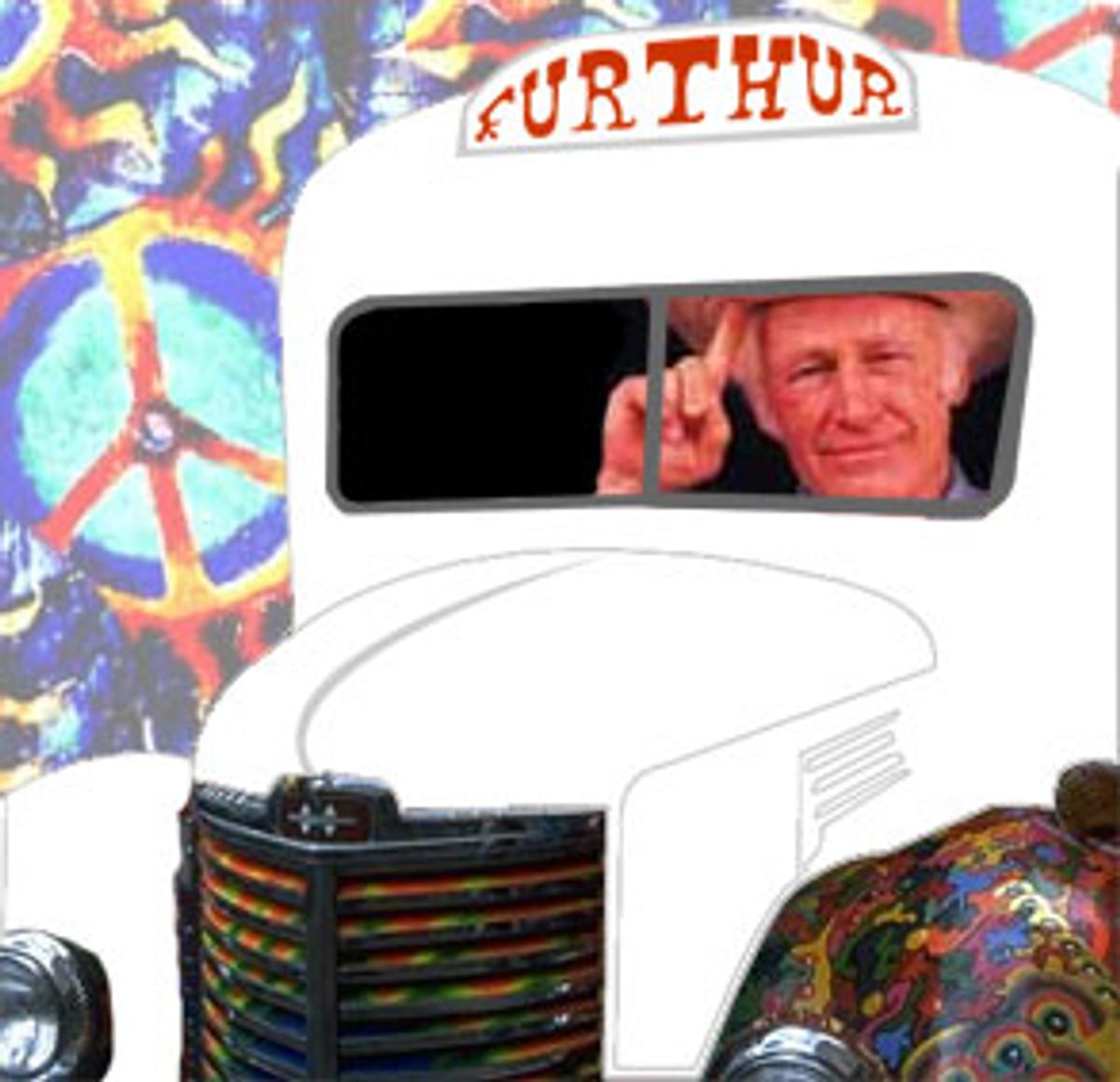
Captain Flag of the good ship Furthur didn't just create great literature, he was great literature -- and a quintessentially American character.

  • more
    • All Share Services

Appreciation: Ken Kesey

Word of Ken Kesey’s death came in under the radar last weekend, which is surprising considering the way the ebullient author rode into the American circus.

It’s easy to imagine him playing his own best-known character, Randall P. McMurphy, the bull-goose loony in “One Flew Over the Cuckoo’s Nest,” or see him as Hank Stamper in the 1971 film version of “Sometimes a Great Notion,” just by squinting a little at Paul Newman. But when I think of Kesey, I think of him on top of that bus, the same old International Harvester he left to the weeds outside his Oregon farm instead of the Smithsonian Institute.

Here’s one of the luminous snapshots captured in Tom Wolfe’s “Electric Kool-Aid Acid Test,” the book that chronicled the 1964 cross-country trek of Kesey and his Merry Pranksters with the same love and attention to detail Stephen Ambrose employed to limn the voyage, toward a different frontier, of Lewis and Clark.

“Going through the steams of southern Alabama in late June and Kesey rises up from out of the comic books and becomes Captain Flag. He puts on a pink kilt, like a miniskirt, and pink socks and patent leather shoes and pink sunglasses and wraps an American flag around his head like a big turban and holds it in place with an arrow through the back of it and gets up on top of the bus roaring through Alabama and starts playing the flute at people passing by …”

But Kesey wasn’t headed west. The Oregon-born farm boy turned hepcat author was headed in the opposite direction, toward New York and the old America that had no idea what to make of him and his bus’s stated destination: “Furthur.” While “Cuckoo’s Nest” had been published to mostly enthusiastic reviews just two years earlier, “Sometimes a Great Notion” met a much more mixed reception. It was too outsized and over-the-top, some critics complained, too lyrical and lusty — all together too western. Besides, declaring Kesey’s second book a failure meant that the East Coast Literary Establishment (as that posse was invariably referred to then) wouldn’t have to create a new category for the writer after all. He could go down in literary history dismissed as one of those branded with, and broken by, literary promise.

Pity. For it is that very East-West split that fuels “Notion.” The story centers on a rivalry between two half-brothers — one college-educated and sophisticated, the other defined by native wit and instinct — fighting over the same woman. As Kesey told an interviewer at the time, “The two Stamper brothers in the novel are each one of the ways I think I am.” And for all its iconic status, “Cuckoo’s Nest” looks a little stiff and one-dimensional these days: McMurphy’s martyrdom is too obvious and symbolic, as is Big Nurse’s smiling malice. “Notion,” for all its baggy patches and unfinished jazz riffs, has the feel of real life — the kind that sticks its thumb in your eye. In an age when organized labor was still largely revered in fiction, the Stamper family battled with the union; and just as tree-saving became a national passion, Kesey gave us loggers for heroes.

And pranksters. The Stampers are a family of jokers who salute the town they’re battling with by tying their father’s severed arm, middle finger erect, to the mast of a logging boat. McMurphy expressed much of his disrespect for authority in tricks and sight gags, like the World Series game the inmates “watch,” sans picture. The Merry Pranksters themselves aspired to be sort of holy fools, as fellow Prankster and lifelong friend Ken Babbs reminded the assembled at a funeral service for Kesey in Eugene on Wednesday. “It’s important to know what a prank is,” the eulogist said, standing before the author’s painted paisley coffin. “Kesey defined it as something that doesn’t hurt anyone. It has to be illuminating and it has to be funny.”

The book on Kesey has always been: link between the beats and the hippies. His peripatetic adventures, including exile in Mexico, echoed Kerouac’s (the two met, badly, on that very trip in ’64), and his bus driver was Neal Cassady, for crissakes, the very model of Kerouac’s great hero, Dean Moriarty, in “On the Road.” And everything Kesey and the Pranksters did was consciously imitated by countless longhairs in the years that followed, from the amount (if not the quality) of LSD consumed to the vagabond existence. (The Pranksters created the prototype for Deadheads before their Acid Test house band began calling itself the Grateful Dead.) But like most convenient summations, that thumbnail sketch of Kesey is too small for the big picture.

“On the Road” is one of those great wannabe books, in which the author identifies with the man of action who is the story’s true hero. Kesey dodged that tomahawk in a most unexpected way: He made himself the hero of his life. The best writing he did after the ’60s (“The Day After Superman Died” and “Now They Know How Many Holes It Takes to Fill the Albert Hall,” about the deaths of Cassady and John Lennon, which were included in Kesey’s 1986 book, “Demon Box”) blurred fact and fiction. The protagonist, if not named Kesey, was his spiritual twin, plunked down in similar circumstances. And though these infrequent pieces didn’t have Norman Mailer looking over his shoulder, they proved that the old boy still had it, and just chose to do something else with it. Some still contend that the critics’ failure to fully embrace “Notion” put the zap to Kesey’s head, and that his decision to quit writing then and live the life of a media outlaw was, in the words of fellow Stanford Writing Program grad Gordon Lish, “avoidance behavior.” His pursuit of celebrity, followed by celebrity’s dogged pursuit of him, cost him the time and space a writer needs to experiment, and to fail. (Kesey himself confessed that he at times felt haunted by his failure to write another book as good as the first two.)

But in his desire to be part of the show rather than the audience, Kesey heralded a change in behavior that busted the seams of the ’60s, a whole generation weaned on TV, only to discover that there was nothing good on. “I’d rather be a lightning rod than a seismograph,” the novelist told Wolfe in an attempt to explain his decision to quit writing. It’s a sort of Patrick Henry cry of the turned-on era: Give me electricity or give me death. (Is it any wonder that Dylan was the Pranksters’ default musical choice?) Before he arrived at Stanford, after his stint at the University of Oregon, Kesey tried his luck in Hollywood for a year, hoping to break into the movies. How apt that the Pranksters –armed with microphones, cameras and sound equipment — were ostensibly trying to make their own movie as they drove across the country, holding a mirror up to the startled passersby.

It was a stoned, ridiculous idea, of course. Like much of the ’60s. And the fact that nothing ever “came of it” — fellow Prankster and lifelong friend Ken Babbs is editing that footage to this day — the fact that there was no Hollywood blockbuster or ABC miniseries to show for it all when it was over, is all the more delicious. In his own way, Kesey understood that getting there was more than half the fun, it was the whole game.

That game included some timeless values — in an age when the family was challenged and nearly disintegrating, Kesey was always an ardent family man — and he knew he was as equipped to play it as anyone, and to lead by example. It’s a pity he didn’t write more, but what a joy that he gave others so much to write about. “The Electric Kool-Aid Acid Test” is still, to my thinking, Wolfe’s best book, an exploration of an inner moonscape and the astronauts who sought it that took the chief spaceman as seriously as you could take anyone wearing a pink kilt. After a frigid blast of ’50s cool, Kesey pointed toward something infinitely warmer, slightly dangerous. “Unless you get up near that very precipice where you’re likely to make a fool of yourself,” he said, “you’re not showing much of how you feel.”

Thanks for the show, Captain.

Tucker the Terrible vs. the Ragin’ Cajun

Making dueling-pundit shows more civil is a ticket to nowhere. What we need to see is Bob Novak in leopard-skin tights and a well-oiled Paul Begala.

  • more
    • All Share Services

In what was no doubt intended as a modest proposal, Los Angeles Times Op-Ed page editor Michael Kinsley last week suggested a bit of kinder, gentler political TV to salve the wounds of our fractious times. After tweaking Jon Stewart for taking himself too seriously when he appeared on CNN’s “Crossfire,” Kinsley, a former “Crossfire” commentator himself, made his pitch (one he claims that CNN and others have declined).

“The idea, in a word, ‘Cease-Fire,’” wrote Kinsley, who edited Slate and the New Republic before joining the Times. “You get your politicians or your experts or your interest-group representatives, and instead of poking them with a stick to widen their disagreement, you nudge and bully and cajole them toward some kind of common ground. It sounds goody-goody, I know, but the intention would be more Judge Judy than Bill Moyers.”

In television, alas, the road to ratings hell is paved with goody-goody intentions (imagine Judge Judy Woodruff). While Stewart was probably right when he said that the right-left, Jib-Jab formula of “Crossfire” was “hurting America,” he is probably mistaken if he thinks its viewers hunger for a more elevated level of discourse. While record numbers of viewers tuned into the generally substance-laden presidential debates, with the third one beating the baseball playoffs nationwide, fans of shows like “Crossfire” seem every bit as partisan as the show’s hosts. They’re guys (mostly) who find C-SPAN too wonky but Fox News too one-sided. They aren’t interested in elevating the level of discourse. On “Crossfire,” it’s all about the level of discord — and audiences want to turn it up to 11.

Let’s go to the tape for a show that aired Nov. 5.

Tucker Carlson: “Three days after the presidential election, it is clear that it was not the war on terror, but the issue of what we’re calling moral values that drove President Bush and other Republicans to victory this week. In the end, in other words, most Democrats just don’t want Barbra Streisand in charge of their lives. [Laughter] Democrats had no idea.”

Paul Begala: “Well, Democrats do need to do a better job of talking about their values. But shouldn’t Republicans do a better job of actually living by theirs?” [Cheering and applause] “If I hear one more, one more, sanctimonious Republican working on his third divorce lecture me about my values, I’m going to smack him.”

Yeah, baby! And that was from one of our guys. While “Crossfire” was mildly annoying back in Kinsley’s day (when he locked lances with such neocon Orcs as Morton Kondracke), it now resembles nothing more than World Wrestling Entertainment’s popular “Smackdown.” Heroes and villains are invoked by both sides to predictable audience reaction: Hillary gets hisses on the right, Ashcroft guarantees catcalls from the left (I doubt Alberto Gonzales will garner the same sort of reaction, but give him time). Bad guys and good guys alike commit blatant fouls — mentioning Viagra whenever Bob Dole comes up; reminding viewers why Bush had the Oval Office cleaned so thoroughly after Clinton. It’s all the equivalent of hitting your opponent with a metal folding chair, and the audience loves it.

The guys on the right even have their own costumes: Robert Novak has been sporting that black suit and grisly demeanor for so long his nickname should be The Undertaker. (If only the name weren’t already taken by a longtime wrestling villain, “the innovator of Inferno Matches, Casket Matches, and, of course, the famed Hell in the Cell,” according to the WWE site.) Kid Carlson, with his bowtie and mop-top, plays youthful ward to Novak’s dark prince, trying hard to do the unflappable thing that Silent Bob learned from Darth Vader, though The Kid too often seems to get his suspenders in a bunch.

As pure theater, the Democratic side doesn’t fare as well. Sure, James Carville has an irascible persona familiar to voters and viewers alike (dyslexic, dyspeptic and sometimes quite funny) and he even comes with a handle, The Ragin’ Cajun, which CNN employed in a lame attempt to hype the show in the manner of a boxing card this summer. But he doesn’t have an outfit. And he’s married to a Republican, a high priestess in the church of Cheney at that, which to me would be like learning that Eliot Ness played cards with Frank Nitti. And poor Paul Begala doesn’t seem to have anything going for him. He looks exactly like what he is, a Democratic apparatchik (both he and Carville worked for Clinton and later advised the Kerry campaign — and look where that got the senator), and has no nickname that I know of. Plus he lets Tucker get under his skin, acting more peevish than his old boss on the South Beach diet.

But if “Crossfire” and its ilk are becoming more like professional wrestling in terms of temperament if not entertainment value, they offer no threat in the audience department. “Smackdown” and its sibling, “Raw,” regularly draw 4 to 5 million cable viewers, while Jon Stewart’s visit to “Crossfire” garnered 867,000 viewers — the biggest episode of the show’s season. (Web downloads of video of the “Daily Show” host’s 2-on-1 with Carlson and Begala were close to a million.) Of course, it doesn’t help that “Crossfire” is aired at 4:30 p.m. EST, guaranteeing an audience of the marginally employed. In order to ratchet up the excitement, the show is now taped before a live audience at George Washington University — though a glimpse of the audience reveals a lot of them to be a little old for school. And they’re certainly not learning anything.

Aficionados of political theater may be tempted to look to William F. Buckley Jr.’s weekly political program, “Firing Line” (1966-2000), in which the archconservative parried with a host of largely left-wing guests, for an antecedent. But Buckley, who played John the Baptist to Reagan and much of the neocon movement, had a certain oily charm. A Psychology Today poll taken in the early ’70s found a huge sampling of women had fantasies about Buckley while having sex with their husbands (I think it was his tongue).

But the God-man of Yale generally engaged in something we would recognize as debate. He would ask his guests questions about their positions and usually had the decency of letting them answer. He seldom lost it with his guests (Gore Vidal being the most famous exception) and one could come away from the program feeling they had heard an issue argued from at least two sides.

In sheer bellicosity, “Crossfire” now owes more to the long-running syndicated gab fest “The McLaughlin Group,” which many still associate with the “Saturday Night Live” parody in which Dana Carvey, as host John McLaughlin, would ask guests questions like “What did I have for breakfast?” only to shout over their reply: “Wrong!” But compared to “Crossfire,” the real “McLaughlin Group” seems positively genteel as regular panelists such as the Democratic Lawrence O’Donnell and the Republican Tony Blankley politely wait for each other to finish before disagreeing.

The trend to turn up the decibels is an obvious nod to the ratings success of Fox shouter (and after-hours phone monologist) Bill O’Reilly. On “Crossfire,” hosts and guests alike are forced to smile while calling each other naove Pollyannas and fascist bootjacks. They step on each other’s lines and shake their heads at their opponent’s inability to grasp even simple facts. For all the ways it resembles pro wrestling, though, “Crossfire” is still no “Smackdown.”

Fans of “Smackdown” know that each character has a back story, a mentor, a finishing move. Most intriguingly, they can cross over to the other side at will. Take “Raw” superstar Triple H (Hunter Hearst Helmsley) aka The Game aka the Cerebral Assassin. After a brief period in which he fought on the side of niceness, “The Game’s true colors came shining through and he has once again found himself listening to the fans’ jeers,” according to his WWE bio. “To further solidify the fact that he doesn’t care about the fans, Triple H aligned himself with ‘the dirtiest player in the game,’ Ric Flair, Randy Orton and Batista. Together, they called themselves Evolution.”

Are you listening, Begala? You know how those red-state hicks feel about evolution; I think you could steal this one wholesale and no one would be the wiser. Imagine Tucker’s mashed-in face when you deliver a pump-handle slam on his supine person. Of course his bow tie could start spinning in a defensive maneuver, blowing pixie dust into your eyes while the Undertaker sneaks up behind you and throws you into a coffin, cackling, “How do you feel about the right to die now?” That’s when a trap door could open and the Ragin’ Cajun could appear to the strains of “Gris-Gris Gumbo Ya-Ya,” carrying a flaming skull.

Alas, “Crossfire” will never be so entertaining. But that’s not because its audience wouldn’t get it or the network wouldn’t allow it. With those kinds of numbers (the show averages a little over 600,000 viewers without Stewart) they could afford to play with the format. Holding down that spot between “Inside Politics” and “Wolf Blitzer” doesn’t exactly make them the linchpin in CNN’s afternoon schedule. So why not go all the way? Don the tights and jump into the ring.

Folks in Georgia (CNN’s ancestral home) understand the message behind the admonishment “eat a peach,” even if they are referring to the Allman Brothers. Get messy and chomp on the pit. Audiences of “Crossfire” and its ilk don’t want reason. They want to whoop and holler at the red-meat lines, like the yahoos who threw rotten vegetables at the figure of Abraham Lincoln that appeared in the stage version of “Uncle Tom’s Cabin” in “The Gangs of New York.” They don’t want tuna with good taste. They want the taste of blood when “Crossfire” offers cherry soda. The show may be hurting America, but trust me, Jon, America wants the hurt.

Continue Reading Close

Oops, they went goth!

My daughter and her friends are suddenly wearing plaid miniskirts and carting around Living Dead Dolls. What do black lipstick and snap-on dog collars mean to a 10-year-old?

  • more
    • All Share Services

It all began when my daughter’s friend Catherine moved to the Midwest. Catherine and Franny, my 10-year-old, had been friends since they were babies, and the decision of Catherine’s parents to leave New York — brought about in part by Sept. 11 — was traumatic for both girls. Besides, Catherine was a New York kid. What would they make of her in Minnesota?

Catherine had her own answer to that. When she came to visit us a few months into the school year, her look had completely changed. Gone was the generic Gap and Old Navy garb of before. Though only 11, she was now wearing a plaid miniskirt, striped stockings and a little black shirt adorned with a tragic looking kewpie doll — imagine a bobble-head with a Laura Petrie do — called Oopsy Daisy and the message “Oops, I Went Goth!”

Musically, goth has always been sort of like punk’s sick little sister. While punk snuck out at night and smashed your parents’ car, goth was at home setting things on fire. Punk liked speed; goth preferred absinthe. But both were joined by a certain cynicism and disdain for what our president might call “traditional values” — and certainly good grooming. While punk has splintered into myriad musical shards — from the pop punks who groove to radio-friendly bands like Good Charlotte and A Simple Plan to spiritual punks who listen to straight edge groups — goth is still best represented by bands like Bauhaus and the Cure.

But the goth (and, to a lesser extent, punk) fashions favored by kids today don’t necessarily have anything to do with the music (just as goth-looking bands like the Grammy-winning Evanescence don’t have much to do with goth). It’s a look — deathly pallor, black everything — that can be traced back to Wednesday Addams and Winona Ryder’s character in “Beetlejuice.” It’s a look that put the fun back in funereal, and after making the rounds on high school campuses for decades, it’s filtered down to the preteen set. Aggressively antisocial and unhealthy looking, goth provides a uniform for those determined not to blend in. And the gloomy outlook it evokes (“My whole life is a dark room!” complains Winona’s character in “Beetlejuice”) speaks to the black moods of puberty.

Catherine’s mother, Betsy, says her daughter’s look was a way of defining herself in this new environment. “At the end of the day,” says Betsy, “all the kids come off the bus in their shades of pastel and there’s the kid in black.” While she has not inspired others to follow her through the gates of hell, neither has Catherine’s look alienated her from her peers or her family. After six months in the fifth grade she was given something called the Friendship Award (it is Minnesota), and Mom and Dad, while prohibiting anything too extreme, are supportive of her new style. “I’m proud of her for being willing to live out loud,” says Betsy, and, like any good parent, she’s more concerned with how her daughter behaves than how she looks. Still, she adds, there are limits: “No belly shirts, no bras showing, no fishnets and, except for lip gloss, no makeup.”

Catherine’s example made an impression on my daughter, and within a few weeks of her friend’s visit Franny was clamoring for clothes featuring Emily the Strange and timorously trying on snap-on studs and dog collars. When did all this merchandising of goth and punk paraphernalia start targeting little girls? I wasn’t haunted by the specter of Marilyn Manson and the Columbine kids, Middle America’s nightmare of the ’90s: I knew too many authentically nice kids who looked like Hellboy. And I wasn’t worried about the look sticking, either; in middle school in the ’60s, I had gone for Carnaby Street gear only to switch to work shirts and jeans in high school. It’s the sense of disconnection I feel seeing my little girl trying on an older look and attitude. Franny still inhabits a world where her pets are more important than petting, and I can’t escape the style’s echoes of sex and death.

Not that I have anything against sex and death. (They are, in fact, two of my principal preoccupations.) I just don’t like to think about them in the context of my daughter. Especially when she’s 10 years old.

If youth cries for anything, it is the authentic. From Young Werther to Holden Caulfield, from “Rebel Without a Cause” to “The Gilmore Girls,” adolescents throughout history have disdained the phony and clamored for the true.

Punk was supposed to be true — the no-bullshit alternative to bloated prog rock and self-satisfied consumerism. (That punk became commercialized itself was prophesied in Joe Strummer’s dictum: “He who fucks nuns will later join the church.”) To a young punk in the late ’70s, there was no graver insult than the ubiquitous “Poser!” And posers were everywhere, from musicians who introduced jazz chords to their songs, to the yuppies who wore skinny ties and danced to the Knack.

I was not exactly hardcore myself. Living in San Francisco then, single and reasonably unfettered, I found the punk scene to be the most fun thing going, and spent evenings at such local haunts as the Mabuhay Gardens and the Deaf Club, listening to S.F.’s (mostly lame) local bands while awaiting the return of such heroes as the Clash and the Ramones. Punk elevated both cynicism and passion, and I remember pursuing a lot of pleasures for no reason but kicks — authentic kicks, of course. For all that, punk remains the classic soundtrack of youth.

But not 10-year-old youth! Forget about the sex and drugs, if you can. Punk embraced contempt and affected a world-weariness that I think are well and proper when in your 20s, maybe even in your teens. I feel like an old scold saying, “My daughter’s too young to be that cynical!” and I realize I’m experiencing the feelings of denial common to all parents who watch in alarm as their children grow, with the added protectiveness a father feels for his girl. But I also feel like she’s trying on a costume (she toyed with the idea of going trick-or-treating as a punk last Halloween but went as a goth vampire instead), which, like all costumes, can be discarded. The battle against cynicism will be a lifelong one, I think, and is not limited to those who dress only in black.

While committing some then-punk sins in my youth (I still had a job, I still smoked pot, I still washed my hair), I managed to avoid the poser tag by getting most of my gear — Army jackets, bowling shirts, spaz sunglasses — from the Salvation Army. The punk stores that existed were mostly cheap and located on off streets in the Mission District. Only a poser would buy a motorcycle jacket from a boutique.

The little punks and goths of today don’t have to go skulking around back alleys to get their garb. Now, kids can get their goth on at any of Hot Topic’s over 500 stores, conveniently located in local shopping malls. Goth has gone mainstream or mainstream enough to be considered just another fashion choice for the young miss or mister. The equally ubiquitous Claire’s Accessories, where good girls once went to get just their ears pierced, now sells silver cross leatherette cuffs right beside the butterfly glitter charms. Even Disneyland features fashions inspired by Tim Burton’s “Nightmare Before Christmas.”

While Emily the Strange — a dark-banged night crawler with four cats for friends — can be found in America’s better shopping malls, she was born in West Oakland’s Dogtown, a neighborhood with real street cred. Emily creators Matt Reed and Rob Reger (whose company, Cosmic Debris, also brought us such Hello-Kitty-in-hell characters as Oopsy Daisy — she of the “Oops!” shirts — and Yum Pop) had the brilliant idea of making street wear for girls and adding the goth touch. “When we first started we didn’t really have an age in mind,” says Cosmic Debris’ Brian Brooks of Emily’s early days. “It was just whoever would buy it.” Brooks worked on Emily for years before coming up with Oopsy Daisy (whose audience he defines as “anybody who likes things a little bit messed up”). Though Emily now has her imitators, he thinks her appeal is her singularity.

“Emily is the original one who forged into this darker land,” says Brooks. “Everything geared toward kids is sickly sweet and colorful.”

If Cosmic Debris gave the little goth girls something to wear, the makers of Living Dead Dolls gave them something to play with. Living Dead Dolls are just that; each comes in its own coffin, with its own death certificate. Some are missing eyeballs, in a look that owes nothing to Little Orphan Annie. In fact, the general expression is one of menace, closer to “The Twilight Zone’s” Talking Tina than to Chatty Cathy. Like Emily, the dolls went from cult status (co-creators Ed Long and Damien Glonek originally made them by hand and sold them at horror conventions like Chiller Theatre) to the mainstream. (The dolls are now made in China and sold in Tower Records and Hot Topic.) And there’s ancillary merchandise as well: T-shirts (“We’ve Passed Away, Now It’s Time to Play”), stationery and a dead-doll’s-head pencil sharpener (stick a pencil in its eye and the shavings come out its mouth).

“There’s really not one set or group that is buying our dolls,” says Glonek. “We do a lot of conventions and signings and we see a certain core of our audience. They range from little kids to older women and men in their 50s and 60s. And they’re from all walks of life, from goths to punks to normal housewives.” The creators of both Emily and the Living Dead Dolls seem somewhat clueless when it comes to their merchandise’s appeal to the younger set, or maybe they’re just too busy to consider the implications of marketing morbidity to little girls.

Older fans may appreciate the echoes of Charles Addams and Edward Gorey found here (“Shy little Hush and her pet rat Shriek/ Dwelling in the sewer, these two are bound to reek”) while kids hear something else. (The packages are labeled: “For Spooky Kids Age 15 and Up.”) “I think some of the darker humor aspect goes over their heads,” Glonek says of the preteen girls clutching tiny coffins in their hands. “They just see the cute little creepy dolls, which is the essence of the product to begin with. They’re too young for the humor. They grasp onto the innocence of it.”

And grasping at innocence is what we’re talking about here. Not the girls: Some are too innocent to know what the loss of innocence means, while others are itching for the chance to throw theirs away, as soon as they can figure out how. No, the people grasping at innocence here are fools like me: the parents.

————

When Franny’s friend Catherine came to visit, my wife took the girls ice skating. While Catherine hugged the rails, knock-kneed in her safety-pinned skirt, a grown man circled about and stopped to compliment her on her look. “Do you know that goth shop over on 10th Avenue?” he asked her before my wife shooed him away. He was, in the local argot, a creep.

In the aftermath of this encounter, both Franny and Catherine had a chance to consider the downside of the goth look. “She and her girlfriends think sex stuff is gross,” Catherine’s mother tells me, and the very mention of sex is enough to give Franny the giggles. But the creep at the ice rink is not alone in his fixation. Just Googling “goth girls,” I got a couple of provocative hits: popular indie porn site Suicide Girls, with plenty of soft-porn pictures, and Barely Evil, “Gothic erotica, punk porn and bad girl models.” It seems sex and death preoccupy some others as well, and some of them do more than simply surf the Web.

But at this age, girls just want to have fun. It’s the parents who bring their anxieties to the table, sometimes accompanied by misgivings about their own adolescent behavior. “Parents experience an enormous sense of loss when their girls enter this new land,” Mary Pipher wrote in her seminal work “Reviving Ophelia,” a book that posited the idea that the best aspects of pre-adolescent girls — their independence, their confidence, their courage — were lost in the “Bermuda Triangle” of teendom. Pressured to become “feminine” and define themselves in relation to men, girls lost their identities and punished themselves through conformity, anorexia and self-destructive behavior.

But as a parent who stands on the other side of that gulf, I feel like I’m peering into the murk. I don’t want to make too much of my daughter’s fashion choices; she is in the midst of defining her own style, she tells me, and is quick to take offense. Franny is also of the age where she trusts the adult world to look after her. When Janet Jackson exposed her breast at the Super Bowl halftime show, Franny refused to believe that “they” would allow such a thing to happen. “Can they show that on TV?” she asked, stung more by Justin Timberlake’s staged humiliation of the singer than the sight of Jackson’s bejeweled nipple.

Right now her interest in the macabre is as childish as our love of “Casper the Friendly Ghost” was when we were kids. Last night she put her Living Dead Dolls to bed side by side, their little coffins touching, as if to protect them. She has a host of pets — a dog, a cat, a turtle and a fish — that she blesses each night, too, in a sort of rude 10-year-old way. Pipher believes that preadolescent girls identify with animals so strongly because they empathize with their lack of speech, their powerlessness. Could they empathize with ghosts for the same reason? Or is it a sign that they’re too big to be scared? Living Dead Dolls, for instance, offer both a through-line to childhood (remember when we played with dolls?) and a send-up of that innocence (remember when we chopped their heads off?).

Pulling her dark hair over her eyes, Franny can do a spot-on impression of the little dead girl in “The Ring.” “Everyone will suffer!” she hisses. The Buddhist in me figures she’s right about that. But I would like to delay some of her suffering just a little while longer. There will be time enough for death wishes and revenge fantasies, not to mention the real heartache and horrors of adolescence. Maybe adopting the goth look, however timorously, will be Franny’s way of outfoxing the femininity trap. (Black lipstick certainly says, “I’m nobody’s damn doll!”) How can I tell? The codes have changed since I was young. Watching her from the shore as she sets off on her journey I can only hope I’ll be able to tell if she is drowning or just waving. Providing she looks back at all.

Continue Reading Close

From street thug to dharma punk

Noah Levine rejected the spiritual path of his father, Stephen, and then, many tattoos later, joined him.

  • more
    • All Share Services

It’s Friday night in San Francisco and a crowd has gathered at the Justice League, a cavern on a dirty stretch of Divisadero Street, for an evening of punk rock, old (Slaughter and the Dogs) and new (the Belltones). The local scene, always less violent than L.A.’s and less arty than New York’s, wins points for endurance. Looking out over the river of mohawks, porkpies and D.A.s, you could swear it was 1977.

Among the faithful tonight are the Dharma Punx, a loose affiliation of friends who share a love of punk rock and a penchant for spiritual practice. In S.F., home to gay conservatives and pacifist policemen, spiritual punks hardly raise a pierced eyebrow. The Justice League doorman waves them in like the regulars they are. There’s Mike Haber, who was the leader of a rockabilly motorcycle gang in Santa Cruz, Calif., before sobering up and discovering meditation; and Lars Frederiksen, the clean-and-sober member of the stalwart S.F. punk band Rancid, as well as a new group called the Bastards; and Lars’ roommate, Noah Levine, a former drunk, drug addict and jailbird who now brings Buddhist teaching into jails and juvenile halls, when he’s not out seeing shows.

Levine is the glue that holds the crew together. With his shaved head, gold teeth and neck-to-navel tattoos he could be standard issue street punk — until you notice that among the images adorning his arms are those of Buddha and Krishna, and instead of “hate” and “love” tattooed across the knuckles of his hands, he’s got “wisdom” and “compassion.” (“Same thing,” he shrugs when I ask him about it later.) And despite his gentle manner, his drug-and-alcohol-free status, the locals don’t treat him like a wimp.

“Some of the people in the Dharma Punx are some of the oldest punks in the scene,” he tells me outside the club. “At 31, I’ve been coming to punk shows for 18 years. It’s not like some Buddhist guy coming in and trying to infiltrate a scene. This has been my scene my whole life.”

- – - – - – - – - – - -

Levine’s “whole life” did not promise to be a long-running show at first. Despite a privileged middle-class upbringing and a famous spiritual teacher (Stephen Levine) for a father, he seemed ready for an early grave in his teen years, or at best a life behind bars. “I had friends who had done time there,” he says of San Quentin, “so the first time I walked out in the yard there were all these kinds of images: This is what my brothers, my friends had to deal with.

“But I also felt like, this is my population, these are my peers. But for this interesting turn of fate — but for the grace of the universe, for lack of a better word — I ended up getting out of this. But I was headed on a nonstop train to prison for several years.”

Levine doesn’t spend all his time at punk clubs and prisons. Sometimes he can be found at spiritual retreats such as Marin County’s center for Buddhist study, Spirit Rock (where he has led teen and family meditation groups) or New York’s Omega Institute. These are familiar scenes for Levine, despite his brush with prison. His father is a star in these circles. His books on death and grieving (“Who Dies?” and “A Gradual Awakening”), often written in collaboration with his wife (and Noah’s stepmother), Ondrea, have sold over a million copies.

But like any good adolescent, Noah did not have time for his father or his “practice” when he was growing up. “As our youngest child, Noah, dutifully rebelled, he rejected ‘meditation and the lot,’” Stephen Levine wrote in a personal memoir, “Embracing the Beloved.” “Having mutinied with considerable energy and originality in our youth, we could not imagine how he might ‘get to us’ as we had ‘gotten’ our parents … Until the afternoon he came home from school with a tattoo and nailed me.”

Says Noah, “As soon as I heard punk rock, when I was 11 years old, I knew that I had found my tribe.” Bouncing around between his father’s home in a remote part of New Mexico and his mother’s place in Santa Cruz, Noah began to alienate himself to the tune of the Dead Kennedys and Black Flag. With his parents’ blessing, he declared himself “emancipated” at age 16, “with the intention to be on my own,” he recalls. “But I couldn’t get my shit together so I was still on my mom’s couch.”

He dropped out of high school and hit the streets of Santa Cruz to live the life of a full-time skate punk. He was arrested for numerous infractions — drugs, alcohol, hitting someone over the head with his skateboard — until the local authorities locked him up for serious time when he was 17. His folks had tried to warn him about the choices he was making, “But when I try to remember what they were saying, I have this impression of the adults in ‘Peanuts’: ‘Wah, wah, wah.’ Even though I probably knew they were telling the truth, I didn’t believe ‘em.”

Noah spent his last year as a teenager locked down. “They said, ‘You get arrested too much, we’re taking you off the streets.’” And while any parent would freak to see their kid behind bars, the experience had a particular resonance for Stephen Levine. “It must have been very difficult for him but interesting,” says Noah, “because he had also been in prison. He did time for pot in the ’60s on Rikers Island.” As Noah began a three-month stretch at Santa Cruz County Juvenile Hall (he served another three months in a halfway house), his father began to call him with personalized instructions.

“My father said, ‘Meditation is the only thing that ever worked for me.’ And that’s when I started practicing. The relationship was such that when I was vulnerable and in enough pain and ready to change and take responsibility, I was able to hear it from him.” Noah also was ready to deal with the addictions he had picked up over the years.

“Pretty much everything” is how Levine defines his drug consumption then. “My drug of choice, what really brought me to the bottom, was my addiction to crack cocaine. But I was using heroin and PCP and any kind of pills and booze I could get my hands on.” He began a 12-step recovery program, brought to him and the other juvies by young punks who worked with teen addicts. “They weren’t just adult wino recovering folks,” he says. In fact there was the whole clean-and-sober punk movement called Straight Edge brewing at the time, and Levine took to it like a convert, drawing X’s (the sign of Straight Edge) on his hands. “That was my real refuge,” he says. “Once I got sober, that was all I had — the punk scene.”

It was not enough. Though he attended college (studying psychology and, later, emergency medical technician training) and had a few jobs, he found new ways of misbehaving. At age 19 he was arrested in Santa Cruz for vandalizing property with graffiti. Mike Haber, leader of the United Rockers, a biker gang that favored British Triumphs and Nortons, recalls seeing graffiti all over Santa Cruz that Levine had left: “Noah Core,” “Just Say Noah.”

“A lot of his friends, the punks and the skins, just wanted to kick his butt about that,” says Haber. “They just wanted to give him the beat down.”

The “Noah Core” tags led to his arrest, not surprisingly. Though he avoided jail time, Levine could not avoid a spiritual lesson: “What I was looking for was not really going to be found in anything outside of myself; it was an inside job, or at least a spiritual job.

“I had been using meditation in those first couple of years the way people often use prayer,” he says: “‘Oh God, get me out of this one and I’ll never do it again!’” Combining more extended periods of reflection with a greater dedication to 12-step principles he found himself face to face with one of those ugly facts familiar to recovering alcoholics and drug addicts.

“I began to see that all of my actions are very selfish, very self-centered,” he recalls. “I was still causing a lot of pain to myself and other people. As I began to see that in my meditation practice and my recovery practice, I began to start changing.” He was working then, making fairly good money at a hospital in Santa Cruz, and he put his salary to a new use.

“I started taking responsibility for all of my past actions and making amends, repaying tens of thousands of dollars, not only for the graffiti stuff but all the people I had stolen from, and really actively started seeking forgiveness.”

Levine was still a biker wannabe then and though Haber and the United Rockers tolerated him, they wouldn’t give him a patch because he wouldn’t drink with them. He talked to them about meditation then, but “everyone thought he was crazy,” says Haber.

Ten years later, when Levine “had traded in my motorcycle for a meditation cushion,” he ran into Haber in San Francisco. The ex-United Rockers leader had just quit drinking and was experiencing the roller-coaster effects of new sobriety. “He helped me with my 12-step work,” says Haber, “and I asked him, ‘What’s this other stuff you’re doing?’”

“He was a natural Dharma Punk,” says Levine, using the handle he coined — with a nod to Kerouac’s book “Dharma Bums” — to describe his fellow “spiritual revolutionaries.” “And for me it was such a wonderful full circle: to be able to offer something back to someone who I had looked up to in the past.”

The two remain close today and Haber’s spiritual practice is stronger than ever. He volunteers at San Francisco’s Zen Hospice Project, providing care and comfort to AIDS patients, many of whom are indigent. Like Levine, he was given the fisheye by some of the project’s other volunteers when he arrived — a reaction he could understand. “I used to hate hippies,” he says, “and I thought meditation was just for hippies. It’s all part of breaking down the walls.” Are there others following the Dharma Punx example? “More than I ever dreamed of,” says Haber. “The kids now are more interested in learning about spiritual practice than we ever were.”

In the 10 years since his second arrest, hundreds of young people have been turning out to hear Noah Levine’s story. After studying with renowned Buddhist teachers Jack Kornfield and Mary Orr, Noah began conducting classes himself, starting at Spirit Rock. He’s aware that his family connection has a lot to do with the attention he’s received. “I think if some other fully tattooed hooligan showed up and said, ‘I’m teaching meditation,’ he might not be as well received,” he says with a laugh. “But also my father has reminded me, ‘Your name, your lineage will open doors for you, it will get you invited in for tea. But if you don’t have anything interesting to say, if you’re not a good teacher, you won’t be invited back.’”

Though the young people at Spirit Rock and Omega are less desperate than the captive crowds he addresses in jail, Levine still feels a connection to them. He has billed his classes as “Buddhism for the Next Generation,” noting that for the most part Buddhist practice has been embraced in this country by boomers — ex-beats and hippies. He’s trying to connect with people in their 20s and 30s, even teenagers, though the song remains the same.

“I don’t think the dharma is any different,” he says. “The dharma — the teaching of the Buddha, the spiritual truths — is ageless. It’s survived now for 2,500 years and each generation maybe teaches it in a different way, but it’s a pretty set, simple tradition.” And Buddhism and its core concepts — that attachment causes suffering, and an end to attachment will end suffering — is something he’s happy to promote however he can.

What is the meaning of “Dharma Punx,” the slogan he has tattooed on his hands and the title of his forthcoming autobiography? “It’s taking that rebellion off the streets, and turning it into our own hearts and minds.”

- – - – - – - – - – - -

A fight breaks out in the Justice League after the Belltones’ set. Noah and I are in a doorway outside by then, catching up as kids come by to pay their respects and ask him what’s happening. “I hear you’ve taken up smoking,” a punkette says to him accusingly. “Yeah,” he admits. “I started smoking when I started writing. The whole Jack Kerouac thing.”

Right now, getting schmoozed by kids on the street, Noah Levine seems like some S.F. update of the teen preacher in the 1970 Christian flick “The Cross and the Switchblade.” Call it “The Mandala and the Skateboard.” With the trappings of materialism (he drives a ’64 Impala Super Sport, maroon with tan interior these days — “my dream car”) and adoration, does he worry about his ego getting in the way of his message? “The trick is not taking it personally. It’s not Noah inspiring people; it’s the dharma inspiring people,” he says.

Besides, adds Levine, “Whether I was doing Buddhist meditation teaching or I was doing nothing, I would still be saying hello to all those people.”

Continue Reading Close

The shadow president

People say I look like you know who. Why me, lord?

  • more
    • All Share Services

The shadow president

The first time it happened I didn’t pay it any mind. I was having lunch with a couple of young women in Manhattan about a year and a half ago; one was an editor at a magazine I was doing some work for, the other was a writer who had just done a nice story for us. The writer had already made some waves with a novel of the I-was-a-teenage-nymphomaniac sort so popular a few years back. For a middle-aged man such as myself, lunches don’t get much more promising.

We were just past the introductions, opening the menus and ordering drinks, when the young nympho fixed me with a frank gaze.

“Did anyone ever tell you,” she said, smiling coquettishly, “that you look just like George Bush?” I must have shot water out of my nose because she hastened to add, “I find him very attractive!”

“You know, you do kind of,” the editor said. The rest of the lunch passed in a blur as I tried to study my reflection in the silverware. At least she didn’t mean George Sr.

The next time it happened I was at another lunch. The editor of a men’s magazine was interested in hiring me to write for them on a regular basis. We were in one of these clubby old steak houses where you can imagine them killing the steers in the back room, but I was not wearing a suit, nor was my jacket adorned with an American flag stick pin. I was in the middle of making some droll observation when he leaned forward and squinted a bit.

“It’s weird,” he said, “but you look just like the president. Has anyone ever told you that?”

Once, I admitted, but the woman who said it was so crazy that she thought the president was hot. Maybe, I suggested, people just have Bush on the brain.

“No,” he said with determination. “There’s definitely a resemblance.” Reminding myself how much I wanted the job I grimaced and agreed. For all I knew this guy was part of W’s inner circle. For all I knew he thought George was hot.

It would be facetious of me to say that I have nothing against our president. Like half the country, I was appalled when he was elected and prayed for an uneventful four years. And like 95 percent of the country, I prayed even harder when things got eventful last year that he had the character to get us through this crisis. My feelings about his intelligence or qualifications are balanced by a sense of hopeful fear, or fearful hope. As LBJ told the American people, “I’m the only president you’ve got.”

But as my feelings about George W. Bush vacillated I never once thought: Damn! I wish I looked like that. Too beady-eyed, I thought. Too jug-eared. Too weak-chinned. Too … rich.

I decided that in my media engorged city I was just hanging out with too many people who watched too much TV. Out in the heartland no one would mistake me for the president, or his doppelgänger. I happened to be on assignment in the heartland last October, doing a story in Hibbing, Minn., when I heard those fateful words. I was sitting in a restaurant called Zimmy’s — a sort of shrine to Bob Dylan, Hibbing’s most famous son — interviewing a couple of locals. We’d had a nice talk and I was paying the bill when one of them said to me, sotto voce, “You probably hear this all the time.”

Uh-oh. “What?” I said, smiling hopefully.

“You and W?” He made a sort of ambiguous gesture with his hand — more than amigos? Less than hermanos? I grimaced in reply.

“I’ve heard it,” I said through gritted teeth and resolved to do something about it. Studying my reflection in the bathroom mirror that night I recalled the other people I had been compared to during my life. Kris Kristofferson, when we were both young and before he had the beard. Jim Morrison, when we were both alive and before he had the belly. Patrick Swayze, when we were both single and before he mistook the freeway for a runway.

What did these men have in common with the president and me, aside from a pronounced history of substance abuse? Small eyes (though I wouldn’t call them beady), a high forehead, a certain fullness of face. I considered growing a beard but my daughter said I would look like an old man while my wife said people would think I was having a midlife crisis. Right. Her hair color changes more than Tom Ridge’s daily danger index but it’s the price of being a magazine pro. I stop shaving for two days and I’m having a midlife crisis …

It was the hair, I decided. Like W, I still have most of mine. And again, como mi hermano, I’ve been wearing it pretty short now for a while. I had long hair in the late ’60s and duck tails and who knows what else in the ’70s and ’80s, but for the last six years I’ve been getting the same cut every six weeks. Call it The Clooney: the short Caesar cut, inspired by the former “ER” actor, so popular with graying gents a few years ago. Clooney has moved on, sartorially speaking, but for a number of men of a certain age, his old cut remains a no-brainer. You don’t have to think about it, let alone do anything to it, yet style-wise you are still several rungs above the full Cromwell.

The problem with my Clooney is that when it grew a little, at about Week 4, it revealed a hairline uncannily like our president’s. Change the hair and change the man, I figured, and I returned to New York filled with determination. I let my hair grow longer than it had been in years and started to slick it back; the effect generally owed more to Joe Strummer than Pat Riley but no one was playing “Hail to the Chief” when I entered the room.

I told Alberto, the barber who has been giving me The Clooney for the last six years, that I wanted to go longer. People had been telling me I looked like the president, I explained. He frowned and in his Chico Marx accent said, “That’s-a no good.” He worked with me, trimming the sides, evening out the top, while I began to fuss with my hair à la John Travolta in “Saturday Night Fever.” In a quest to avoid looking like our leader I was becoming high-maintenance.

Things fell apart during the World Cup. When I went to see Alberto, Italy had yet to be eliminated. He was wearing his Del Piero jersey and pacing around his barber chair like a cheetah. He swore he’d been sleeping but he didn’t seem to be paying attention as he cut my hair. After he applied some gel I looked like Gumby. I was in danger of morphing from George W. into Ronald Reagan.

The kicker came at a Barnes & Noble store in Brooklyn. I was checking out when the clerk behind the counter did an exaggerated double take. “Damn!” he said, shaking his head and blinking his eyes like Chris Rock. “Mr. President! I was looking for the Secret Service!”

I wanted to point out that my hair was nothing at all like the president’s but decided to give it up. For an instant I thought maybe I could do something with this perceived similarity. In the movie “Dave,” Kevin Kline looks so much like the POTUS that he runs the country for a few days, à la “The Prince and the Pauper.” He even balances the budget in the bargain.

But the chances of me being invited to the White House are about those of seeing George W. on the Brooklyn Bridge. If nothing else, I decided I would take back my hair. I returned to Alberto (long after they’d stopped partying in Brazil) and demanded The Clooney. He seemed pleased with my return to form. The Romans, after all, invented the Caesar cut.

It’s been almost a week since then and no one has yet asked me about that Harken stock or mentioned the name Osama. I figure it’s all projection anyway. When Clinton was first elected, a homeless man on the subway told me I was a dead ringer for Bill.

Maybe people just recognize presidential material when they see it.

Continue Reading Close

The death of Rolling Stone

The magazine that invented rock journalism lost its reason to exist years ago. Now, with a British lad-mag editor taking the helm, it's time to pull the plug.

  • more
    • All Share Services

When Jann Wenner finally announced a few weeks ago that he had hired the British editor of a laddie mag to be the new managing editor of Rolling Stone, media critics heralded it as a sea change in American publishing. “The U.S. music industry bible is about to be re-written,” brayed the Guardian, a left-leaning British daily, “and its purist followers already sense the whiff of betrayal.”

The Moonie-owned Washington Times, ever ready to re-fight the culture wars of the ’60s, painted the hiring of FHM editor Ed Needham as a potentially good thing, one that might sound a death knell to the writings of Hunter S. Thompson and his imitators: “It’s probably too much to expect a change in the sort of drug-boosterism that inspires pot-friendly travel tips, non-judgmental post-mortems on overdosed rockers, and hysterical posturings against the drug wars.” The Los Angeles Times was downright nasty. “Shove over, you middle-aged boys, with your Bics burning at Bruce Springsteen concerts, your thinning hair, your love of 6,000-word dispatches from Tom Wolfe and other gonzo authors,” read the lead. “It’s not about you anymore.”

But for all the Chicken Little clucking (caused in part by Needham’s own remarks of the who-has-time-to-read variety), there is no immediate evidence that the old guard is up in arms. As with the tennis-playing mimes at the end of Antonioni’s “Blow Up” — to really date myself — there is no ball in the air. That movie is best remembered by rock cognoscenti for the nightclub scene: The Yardbirds are on stage performing “Train Kept A-Rolling” when Jeff Beck’s guitar starts to distort. He smashes the neck into an amplifier, breaks it off and tosses it into the crowd, at which point a scrum breaks out. The hero (played by David Hemmings) fights for the guitar neck and, having secured the prize, walks outside and tosses it in the trash.

Which may be how those boomers mocked by media mavens feel about the magazine. It has been a shadow of its former self for so long that most of us have forgotten what its former self looked like. While most of the press reaction to Wenner’s choice of editor — which came after months of speculation and supposed soul-searching on his part — referred to “long investigative” pieces, not many were mentioned by name. (T.D. Allman’s long dispatch from Colombia, the second half of which appears in the July 4 issue, represents the last vestiges of that tradition.)

The sui generis writings of Thompson and P.J. O’Rourke are seldom seen in the magazine’s pages now, and even those seem like pale imitations of the original. The truth is that Rolling Stone has been such an undistinguished hybrid — part ’70s-style journalism (investigative reporting, distinct voices and rambling interviews), and part any other entertainment magazine you can name — for so long that most of its subscribers are probably unaware that they still get it. Why upset them by sending some tricked-up men’s mag with the classic Rolling Stone logo emblazoned on the top?

It’s demographically impossible to please both 49-year-old rock fans and the walking boners who buy FHM (or more to the point, Blender, the Maxim-derived music mag that got Wenner trembling in the first place), so why try? Rather than reintroduce the magazine with a new facelift, guaranteed to be as warmly received as Greta Van Susteren’s, why not do something altogether more radical? Why not shut the mother down?

It may seem like an insane idea on the face of it. Any magazine with a million-plus circulation (compared to Spin’s 525,000 and Blender’s 350,000-and-growing) is sitting pretty in today’s down market. It was Rolling Stone’s declining newsstand sales that moved Wenner to fire managing editor Robert Love, a 20-year veteran of the magazine (Wenner lists himself as publisher and editor, while the managing editor actually puts out the magazine), and it is newsstand savvy that British editors are believed to possess. (New M.E. Needham has actually been in the U.S. three years now, and his FHM is as Americanized as an afternoon of MTV and about as thought-provoking.)

Indeed, it was the whirring caused by Blender’s newsstand sales that put Wenner in motion in the first place. With only seven issues under its belt, Dennis Publications’ foray into the rock biz — which bills itself “The Ultimate Music Magazine” — is leaping off the shelves. Its magic-bean numbers are reminiscent of the advent of its cousin Maxim (whose seeming overnight success turned nearly every men’s magazine in the country into a frat party a few years ago) and the effect on the competition has been just as pronounced.

Even before Wenner made his move, Spin editor Alan Light took a stroll, ostensibly to start his own magazine, though his replacement, Sia Michel, has said she will make some changes that could make the magazine more Blender-like. And in announcing Love’s imminent departure, Wenner also pledged to put his journal on a shorter lead time while speeding up the production cycle in the interest of breaking news sooner.

But in his publicized search for an M.E. — all the more notable given the number of editors out of work in New York — Wenner seemed to indicate that he was not willing to sell out completely. After a meeting with former Maxim editor Mark Golin (now an AOL vice president and creative director) the two deemed the union a nonstarter. Golin, who briefly brought his short-and-snappy style to Condé Nast’s Details in 1999 before getting the heave, was more interested in rebuilding Rolling Stone from the ground up than Wenner was. For all his tough talk, it seemed Wenner was unwilling to throw the baby out with the bong water.

In the 37-year-old Needham (who some have suggested was his first choice all along), Wenner seems to have found an editor willing to try it both ways. After some early remarks disparaging Rolling Stone’s perpetual “wall of copy,” Needham went on the offensive, qualifying his remarks to anyone who called. “One of the things that has made Rolling Stone the magazine that it is, is its great journalistic pedigree,” he told the Guardian, “and I certainly intend to preserve and maintain that.” To the San Francisco Chronicle’s Dan Fost he was even more blunt: “It’s certainly not the end of Rolling Stone as you know it,” he insisted.

Right. That happened some time ago. Since the first issues of Rolling Stone rolled off the printers at San Francisco’s Garrett Press (publishers of the Hillsdale Merchandiser and the Irish Herald) in 1967, Wenner has tweaked the magazine several times. In the late ’70s he dragged the publication from the West Coast to New York, launching a few new titles (Us, Men’s Journal) along the way. As music mutated (disco, punk, rap, grunge) Rolling Stone struggled to keep up while covering politics, movies, even the odd crime story. But by trying to reach a younger audience even as it holds onto the old with the other hand, Rolling Stone is starting to look contorted, like some aging hipster playing Twister until his back gives out.

It’s a scary time in the magazine business. The ad market is flat (though some publications saw a bump in May), tobacco companies are pulling out of publications aimed at minors and many ad buyers perceive Rolling Stone in particular as catering to an aging demographic. While Wenner likes to point out that the average age of its readers is 27, the twin blades of Perception and Reality — the key words behind a famous Rolling Stone 1985 ad campaign — cut both ways.

So why not start over? Go after the kids you crave with whatever it is you think kids want while letting the august title of Rolling Stone go out with some dignity. Old wheezers like me (who saw the Faces when they were still Small) can comfort themselves with what they remember of the magazine in its glory days while the belly-button set can enjoy yet another outlet for nearly-naked Natalie Portman pictures. The fix that Needham promises — “busier design, a lot of entry points on every page” — will certainly remind us of Blender, but the mix will no doubt be familiar to any reader of general-interest magazines. Wherein lies the problem.

As Wenner himself has noted, a lot of titles are feeding off the menu he helped invent. Entertainment Weekly has launched a regular music supplement; Vanity Fair socks its readers with a fall music issue the size of the Manhattan phone book; magazines and newspapers alike pursue celebrities with the same slavish devotion. But none of them pretends to be the country’s preeminent rock publication. Though putting Portman on the cover certainly appeals to some younger readers, it’s got nothing to do with music. The same issue (June 28) featured a paltry 16 CD reviews (as opposed to the 195 in the June/July Blender, a number touted on its cover) and, aside from a short profile of Weezer’s Rivers Cuomo, no real rock ‘n’ roll features.

As Rolling Stone has slowly morphed into a magazine just like dozens of others, it has lost its reason for being. It was never meant to be the ultimate magazine of the music business (Billboard still does that just fine, thanks); if anything it was meant to give the finger to that business, as well as magazine publishing in general, television, Madison Avenue, the Pentagon, etc. Without that contrary attitude — or any attitude at all, for the most part — Rolling Stone seems like an anachronism, the Ladies’ Home Journal of rock journalism.

Is it possible for a rock magazine to age with dignity? Overlooked in all the talk about newsstand sales is the growing popularity of some other British imports, Mojo and Uncut. While Mojo in particular is maligned as a retread publication for those who never tire of reading one more explication of Elvis Presley’s truck-driving days or the origins of the Buzzcocks, it is not nearly as time-warped as that. By establishing their credentials as lovers of rock in all its forms, the editors of Mojo can back up their current recommendations. When they told me to drop everything and go hear the White Stripes, I did.

Uncut takes the formula a step further, including free CDs with each issue that feature a sampler of bands reviewed in its pages, old and new. The current issue, featuring a CD of various artists covering Bob Dylan songs, is sold out at the newsstands in New York — at $9 a pop. My point being: I’m willing to spend money on the newsstand, but not on a magazine that puts Natalie Portman (or Kirsten Dunst or any other beautiful young actress) on the cover.

Celebrity covers, and celebrity coverage in general, is considered a necessary evil by magazine editors everywhere (and anyone who has dealt with these celebrities’ publicists knows that “evil” is used here in a strictly descriptive sense). The guiding philosophy is to get the suckers in the tent, which is fine if you then give them some bread along with the circus. Any magazine with a starlet on the cover has to then pass the airplane test: It must give me enough to read to get me through the average unpleasant airplane flight. Rolling Stone doesn’t even get me through the gate and onto the jetway. And that’s in its current incarnation, buttressed by what Needham calls “the wall of copy.” At a time when it’s not insulting to call a magazine a “flip book” or a “must-skim,” don’t expect more of the new Rolling Stone.

Not that Needham will find himself unfettered. Rolling Stone has always been Wenner’s magazine and he has done a great job over the years, giving free voice to writers as diverse as Lester Bangs and Tom Wolfe. He made stars of Hunter Thompson and Annie Leibovitz and his fingerprints can be found all over journalism. Though his attempts to turn Wenner Media into an empire have certainly distracted him, he has an undisputed eye for talent and a seeming appetite for adventure. And while famously thin-skinned and imperious — he hates to be addressed by the help but is reportedly stung when he goes unrecognized by the press — there is no law that says publishing geniuses need to be likable. Which might explain why none of them are.

No, “[His] sin is [his] lifelessness,” as Bob Dylan sang in “Desolation Row” and Greil Marcus later wrote (in the pages of Rolling Stone) of Elvis in Vegas. No one who was witness to the creation of the magazine mistook Wenner for a hippie; he always wanted success and, like rock promoter Bill Graham, was often condemned for just that. But with that drive he combined principles. His inaugural editor’s note makes Charles Foster Kane’s manifesto sound practically jaded.

“We have begun a new publication reflecting what we see are the changes in rock and roll and the changes related to rock and roll,” Wenner wrote in the fall of 1967. “Because the trade papers have become so inaccurate and irrelevant, and because the fan magazines are an anachronism, fashioned in the mold of myth and nonsense, we hope we have something here for the artists and the industry, and every person who ‘believes in the magic that can set you free.’”

That last line is from the Lovin’ Spoonful song that John Sebastian long ago licensed to McDonald’s. The world has changed immeasurably since Wenner wrote that note and he would doubtless blush to read those words today. He never wanted to be portrayed as some progenitor of ’60s counterculture, even as he dreamt up the promotional idea of sending out roach clips with each subscription. He just knew which way the smoke was blowing — even when he pointed out (as in the Perception/Reality ad campaign) that his readers drove BMWs instead of Volkswagen vans and drank vintage California wine instead of Ripple. But the magazine’s name (and its very typeface) still has a resonance with readers like me, while I’m sure the young readers Wenner wants would draw a complete blank if pressed on its etymology.

The community that once existed for Rolling Stone has splintered, like pop music itself, into a thousand shards, and there are plenty of publications covering those fractions (not forgetting Vibe — which actually sells far more copies than Spin or Blender — along with the Source, Fader, Q and so on). A magazine built on the notion of Us vs. Them is no longer relevant; there is no Us.

Unless you mean the magazine. That publication was launched with no principles whatsoever and no mission beyond competing with People. Having found, in Bonnie Fuller, an editor willing to suck what little brains there ever were out of Us Weekly, Wenner finally has the editors at People alarmed as newsstand sales of Us are climbing. All he had to do was tout some celebrity diet secrets and rip the façade off Jennifer Lopez’s marriage to get there. Yes, Us is doing fine without a thought in its head. Let’s hope that if Rolling Stone gets the same lobotomy, Wenner will have the decency to smother it with a pillow.

Continue Reading Close

Page 1 of 18 in Sean Elder