J.R.R. Tolkien

“The Lord of the Rings: The Fellowship of the Ring”

The heroic and epic film version of "The Lord of the Rings" brings beauty, awe and excitement back to the big screen.

  • more
    • All Share Services

The most heartbreaking thing about faithful moviegoing is that awe, beauty and excitement, three of the things we go to the movies for, are the very things we’re cheated of the most. The great wonder of “The Lord of the Rings: The Fellowship of the Ring” is that it bathes us in all three, to the point where we remember — in a vague, pleasurably hallucinatory sensation from another lifetime — why we go to the movies in the first place. It would be an insult to say the picture merely lives up to its hype; it crashes the meaning of hype, exposing it as the graven image it is. Advertising is dead: Long live moviemaking.

The first 10 minutes of “The Fellowship of the Ring” renders all hype — whether it’s the kind that’s bought and paid for or the kind generated by eager fans — inconsequential. In adapting the story of hobbit Frodo Baggins and his mission to guard and ultimately destroy a ring that has the power to bring cursed evil upon the world, director Peter Jackson has given us an epic in the true sense, with none of the pretentious fakery that the word “epic” has come to imply.

Jackson’s approach is refreshingly egalitarian: I had feared that “The Fellowship of the Rings” would be a ferociously clubby movie, one that would, with a snobbish sniff, shut out people unfamiliar with Tolkien’s books.

My guess, though, is that most fans of the books will warm to Jackson’s version (even if the story has been streamlined a bit, with some characters’ roles enhanced and other figures sliced out altogether). And as for everyone else, Jackson makes all the right moves in reaching out to them.

He explains the essential back story in a fleet, graceful expository passage at the beginning: In ancient times, in an undefined place, a set of powerful golden rings were forged and dispersed to various kingdoms across the land. The dark lord Sauron himself made the One Ring, the ring that would complete and intensify the power of all the others. But the ring was taken from him, and ages later, it accidentally found its way into the hands of a humble Hobbit by the name of Bilbo Baggins (here played by Ian Holm). Sauron will stop at nothing to get the ring back, but he needs to find it first. That’s the tale told in “The Hobbit,” the prequel to Tolkien’s trilogy.

As the movie opens, the aged Bilbo has decided to bequeath the ring to his favorite cousin, Frodo (Elijah Wood), who is unaware of its significance. A great wizard, Gandalf the Grey (Ian McKellen), clues Frodo in to its dangerous powers, and urges him to transport the ring to the one place where it can be destroyed forever. Frodo sets out, along the way assembling a ragtag crew of colleagues. Some of them, like Frodo’s faithful friend Sam (Sean Astin), come from the hobbits’ home, the grassy, idyllic Shire. Gimli (John Rhys-Davis) is a gruff, rough dwarf. Strider (Viggo Mortensen) is a mysterious human who understands how crucial it is to keep the ring out of Sauron’s hands. And Legolas (Orlando Bloom) is a golden-handsome Elf warrior.

Jackson captures the spirit and flavor of Tolkien’s storytelling in the way he lays the group’s adventures before us. Early on we’re introduced to the Black Riders, a nightmare-haunting group of faceless horsemen who have been sent by Sauron to find and capture the ring. They’re the movie’s earliest clue that “The Fellowship of the Ring” isn’t going to be a sprightly, cheerful jaunt: At moments, in fact, it’s terrifying.

“The Fellowship of the Ring” is soaked around the edges with a melancholy darkness, which is part of what gives it such resonance and depth. (At this point I need to make a special plea to all those cranky souls who have no patience for ren-faire and sword-and-sorcery bullcrap: My brothers and sisters, I feel your pain, but “The Fellowship of the Ring” is too big and too masterly to be scrunched into those puny categories.)

Jackson unfurls the action so that it drifts into graceful peaks and valleys; the picture is a marvel of pacing, built on the premise that the proper flow of tension and suspense is the most powerful special effect of all, not to mention the cheapest. “The Fellowship of the Ring” looks lavish but never wasteful, miraculous given the way everything in Hollywood these days costs big money, and yet nothing looks like it. (Compared with “Fellowship,” the gaudy and lifeless “Harry Potter and the Sorceror’s Stone” looks like a play mounted at a school for rich kids, where no expense was spared in the attempt to cover up clumsy amateurishness.)

Jackson doesn’t scrimp on staging, and the images and scenery have a grand, burnished richness. His battle sequences are magnificently plotted, and shot so that every angle of the action is clear. (They’re thrilling, but they also invoke the peril of warfare. There’s always the sense that people — in other words, characters you’ve come to care about — could die.)

He shows us immense landscapes of snow or forest or rolling greenery that make us feel incredibly small and inescapably human. And his special effects are so seamless, so organic to the scenes in which they appear, that you often spot them, dreamlike, first out of the corner of your eye. (I gasped in disbelief as I watched a tidal wave, conjured by an Elf princess, swiftly but subtly transform into a herd of galloping horses, their heads and manes defined by dancing crystals of water.)

This is moviemaking on a grand scale, which is not to say that it’s merely a big, impressive movie. (Any old goat can make one of those.) The crucial distinction is that Jackson’s sense of scale is impeccable. The vistas are huge and wondrous, the special effects sparkling: But Jackson also trains the eye on details that, more than anything else, define the movie’s rich, dreamy look.

The cloaks worn by Frodo and his gang are clasped with delicate green enamel pins in the shape of an art nouveau leaf. As readers of the Tolkien books know, the clasps will ultimately have a special role. Even so, considering that most of us understand the visual shorthand of movie props and costumes, there’s no reason they’d have to be so exquisitely made. As it is, with their tendrils and fragile veins, they look like family heirlooms, and they’re valuable grace notes to the look of the movie. Unlike the painstakingly re-created carpets and china patterns of James Cameron’s “Titanic,” obsessive details that just get swallowed up in the blur of the movie’s hubris anyway, these cloak pins are a bit of visual music to go along with the story.

They also help establish its gorgeous pre-Raphaelite look. Rivendell is filled with architectural details (trellises, gazebos) that echo the graceful swoops and swirls of nature — if Alphonse Mucha were a production designer, he’d be proud to put his name on it. (As it is, production designer Grant Major is the one who deserves the credit.) Cate Blanchett plays Galadriel, a bewitching but foreboding Elf queen, and the movie makes perfect use of the actress’s floating carriage and luminescent porcelain skin: Her Galadriel is an enchantress who’s floated out of an Edward Burne-Jones painting.

Visual cues like that one give “The Fellowship of the Ring” a glow that’s both ancient and redolent of the turn of the last century. They also establish it as a love letter of sorts to England, specifically to the beauty of the English countryside, which Tolkien so loved. Cinematographer Andrew Lesnie (“Babe,” “Babe: Pig in the City”) shoots the billowing, grassy hills so that they sing out with love for that countryside — no matter that it wasn’t filmed there: Through Lesnie’s lens New Zealand is its spiritual twin.

And yet the secret to the great wonder of “The Fellowship of the Ring” lies not just in Jackson’s ability to marshal detail and action and panorama to do his bidding. It’s in the way he opens his camera to the faces of his performers. Most “big” movies make a human sacrifice of their actors; that’s become so common it’s almost an accepted practice. (You had to paw through the rubble of “The Phantom Menace” to get any sense of its star, Ewan McGregor.)

“The Fellowship of the Ring” is a big movie in its scope and vision. But Jackson makes it work on a much more intimate level as well, by allowing the faces of the characters to tell the story in its most emotional terms. The great Christopher Lee appears as the once good, now malevolent wizard Saruman, and, with his robes and long white hair, he looks like an evil Jesus. Jackson shoots Lee’s face, with its noble, hooked contours, as if it were one of the world’s great landscapes. Ian McKellen’s Gandalf has a silvery nobility that’s never overplayed — he’s a wizard who clearly understands that the glimmering undercurrents of magic are just as powerful as its giant signs and explosions.

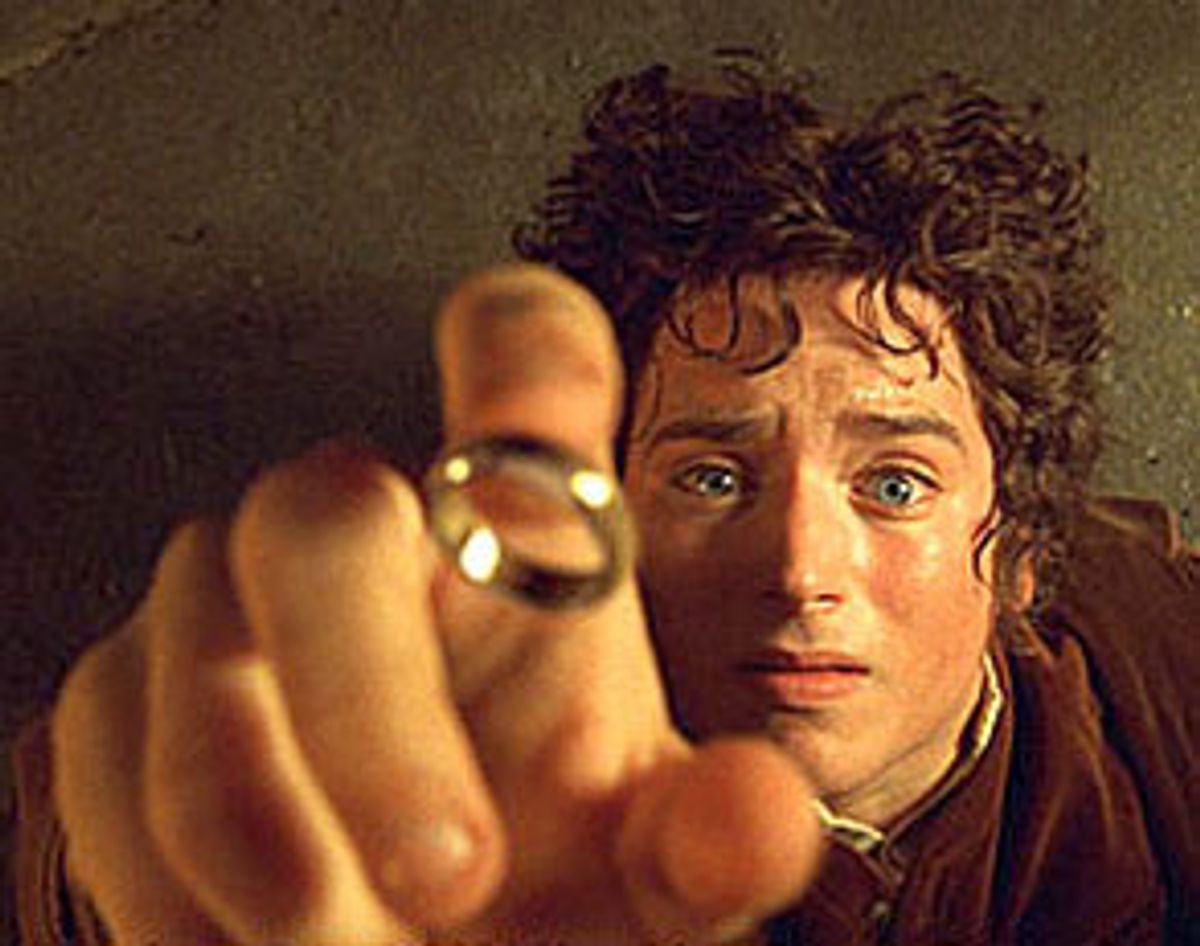
Sean Astin’s Sam, Frodo’s cheerful and devoted companion, has a face that’s almost heartbreakingly open. And Elijah Wood’s Frodo holds the camera captivated in just about every one of his scenes. He shows equal parts boyishness and gravity. His face, all immense eyes, still glows with youthful innocence, but there’s also something fearfully mature about it: If you’ve read the books, you’ll see how that look points the way to the darker, more devastating turns this story will take from here. (The two sequels, “The Two Towers” and “The Return of the King,” have already been shot and are scheduled to be released at Christmastime in 2002 and 2003, respectively.)

“The Fellowship of the Ring” could have gone wrong in so many ways. As it is, though, I see it as nearly perfect: It’s one of the best fantasy pictures ever made. And it’s a lovely example of how, with care and thought and not all that much money (Jackson will have made all three “Rings” movies for less than $300 million), a director can successfully capture the mood and feel of a book on the big screen. (I read and enjoyed the books more than 25 years ago, but the details of them had gone hazy. Jackson brought them back more vividly than I could have hoped.)

Most of us are happy enough these days to go to the movies and not get screwed, so rarely does a movie even keep its promises, much less surpass them. That’s why “The Fellowship of the Ring” is something of a miracle. It makes the great potentialities of movies seem realistic and achievable. Inventive, magical and relatively inexpensive, it proves that throwing money at a movie doesn’t necessarily make it good — an idea that should be much easier for Hollywood to grasp than it actually is.

Writing about Bernardo Bertolucci’s “1900,” Pauline Kael identified the distinction between studio-driven big-budget pictures and those that are powered by the skill and vision of a filmmaker. “The artist-initiated epic is an obsessive testing of possibilities, and often it comes out of an overwhelming desire to express what the artist thinks are the unconscious needs of the public. It comes, too, from a conviction, or a hope, that if you give popular audiences the greatest you have in you they will respond.”

“The Fellowship of the Ring” throws down a daunting challenge to filmmakers everywhere, and even more so to the studios that back them. Audiences deserve the greatest you have in you. If you’ve made money off giving them anything less, it was just dumb luck. From now on, they’ll know they have a right to magic.

Stephanie Zacharek is a senior writer for Salon Arts & Entertainment.

Is “Game of Thrones” too white?

Fantasy fiction might have racial problems, but they're just a reflection of America's broader battles

  • more
    • All Share Services

Is Nonso Anozie, Lena Headey and Jason Momoa in "Game of Thrones"

Ser Jorah’s face grew thoughtful as their horses trod together down the godsway. “When I first went into exile, I looked at the Dothraki and saw half-naked barbarians, as wild as their horses. If you had asked me then, Princess, I should have told you that a thousand good knights would have no trouble putting to flight a hundred times as many Dothraki.”

“But if I asked you now?”

“Now,” the knight said, “I am less certain.”

– George R.R. Martin, “A Game of Thrones”

Epic fantasy — sprawling stories full of swords, castles, magic, kings and lots and lots of white people – is slowly finding its way into America’s cultural mainstream. In the age of the anemic box office, Peter Jackson’s films of J.R.R. Tolkien’s Lord of the Rings trilogy remain a gold standard of blockbusterdom – and his forthcoming version of “The Hobbit” will almost certainly follow suit. Newer writers like Brandon Sanderson and Patrick Rothfuss have sold hundreds of thousands of their “door-stopper” tomes of wizardry and courtly intrigue. And tonight, countless viewers will be glued to their sets for the return of what is arguably the hottest show on television, “Game of Thrones,” HBO’s adaptation of George R.R. Martin’s A Song of Ice and Fire fantasy novels.

This is all a bit odd for those of us who grew up with – maybe even got beaten up for – an obsession with these sorts of books. Accustomed to being mocked for our profoundly uncool fixations, many fantasy nerds, myself among them, have an almost nurtured notion that our love of the fantastic and the pseudo-medieval is something that the rest of the world Just. Doesn’t. Get.

But now, as our beloved genre finds its way into “normal” people’s hearts and minds, fantasy fans are increasingly confronted with an inversion of this notion – a question that I, as an Arab-American fantasy fanatic, have been wrangling with for years: If the mainstream doesn’t get fantasy, just how well does epic fantasy, with its lily-white heroes, get the multicultural real world of 21st-century America? As some of the most popular works in the genre’s history – works that shed any pretension of being children’s fare – A Song of Ice and Fire and its wonderful TV spawn are particularly useful springboards for this question.

When it comes to inherited conventions regarding race in epic fantasy, “Game of Thrones” is, in a sense, standing on the shoulders of dwarfs. The Lord of the Rings is the most obvious predecessor to Martin’s work, and it’s not hard to find subtle rhetorical responses to Tolkien in his books. When Time magazine dubbed Martin “the American Tolkien,” it highlighted not only Martin’s rather astonishing genius in world-building and narrative scope, but also the ideological baggage that all of us writing in the genre have inherited from our shared progenitor.

And it’s heavy baggage indeed, however much we love Tolkien’s creation. His half-sublimated wranglings with race are more complex and fraught than either his shrillest detractors or his most fawning defenders would have us believe. But there is some irreducible ugliness in his masterpiece that really can’t be convincingly redeemed. The men of the global East and global South (“black men like half-trolls with white eyes and red tongues”) are monstrous and evil, naturally and culturally inclined to bow to Sauron, and to make war on the good men of the North and West. The bestial visages of orcs bear a striking resemblance to racist caricatures of African and Asian facial features. Above all, to be dark-skinned in Middle Earth is to be part of a savage horde – whether orcish or human – rather than to be a true individual.

The savage hordes described by Tolkien have been imported by his dozens of imitators over the years, becoming a mainstay of fantasy in books, movies and video games. It’s a convention that Martin both takes up and departs from in depicting the Mongol-inspired Dothraki. As a people en masse, the Dothraki value only their horses, treating life cheaply, and reveling in violence:

Across the road, a girl no older than Dany was sobbing in a high thin voice as a rider shoved her over a pile of corpses, facedown, and thrust himself inside her. Other riders dismounted to take their turns. That was the sort of deliverance the Dothraki brought the Lamb Men.

The HBO production – which has been so remarkable on so many fronts — has exacerbated this hard-R-rated cartoonishness, bringing out some of the novel’s more unfortunate tendencies. The show’s depiction of the Dothraki has been positively cringe-inducing. In the novels, Martin’s quasi-Mongol warrior culture is depicted in a problematically essentialist, but still complex fashion. But HBO has nudged Martin’s creation fully into racial caricature by casting a seemingly random variety of colored people, and apparently raiding productions of both “Hair” and “Braveheart” to clothe them.

Even so, by skillfully replicating the juxtapositions posed by Martin’s back-and-forth POV, the show has managed also to replicate his ultimate, rather un-Tolkienish subtext: There is nothing unique about the savage horde’s savagery. If Dothraki society is depicted as violently perverse, so is Westerosi (i.e., quasi-European) society, which bows to the whims of the Aryan-featured boy-monster King Joffrey, and which has knighted mass murderers and rapists like Ser Gregor Clegane, one of the most horrifying minor characters in all of fantasy. Every culture is savage in “Game of Thrones,” and that’s a very different view of the world than what Tolkien gave us.

- – - – - – - – - – - – -

Sunday’s Season 2 premiere begins HBO’s adaptation of “A Clash of Kings,” the second book of A Song of Ice and Fire. Book II is even more wide-ranging in terms of setting and scope than Book I was, so viewers can expect brief glimpses of characters from other parts of the world, including the Summer Isles, Martin’s analogue for Africa.

Unfortunately, some of these depictions partake in some pretty familiar stereotypes about African sexuality. It will be interesting, for example, to see what the show does with Chataya, an associate of Tyrion’s from the Summer Isles, and an upscale brothel madam. Chataya blithely sends her own 16-year-old daughter into prostitution at her “pillow house.”

Chataya continued, “My people hold that there is no shame to be found in the pillow house. In the Summer Isles, those who are skilled at giving pleasure are greatly esteemed. Many highborn youths and maidens serve for a few years after their flowerings, to honor the gods.”

“What do the gods have to do with it?”

“The gods made our bodies as well as our souls, is it not so? They give us voices, so we might worship them with song. They give us hands, so we might build them temples. And they give us desire, so we might mate and worship them in that way.”

“Remind me to tell the High Septon,” said Tyrion. “If I could pray with my cock, I’d be much more religious.”

Again, an entire nonwhite culture is presented as holding skewed values. But this wince-inducing depiction is tempered by some interesting implied questions about sex and commerce and spirituality and culture and power. Here’s hoping there’s a hint of this in the show’s version of things as well.

Part of the challenge of adapting Martin’s novels for television has to do with honoring his skill in constructing jaw-droppingly epic sweeps of plot and setting from beautifully rendered small details. If there’s a saving grace for the racial imagery in A Song of Ice and Fire, it’s in some of these little glimpses and hints that appear throughout – skillful deployment of which on”Game of Thrones” could help make an already good show great.

As an example, the only black character in the first novel is the barely mentioned, but deeply intriguing Jalabhar Xho, “an exile prince from the Summer Isles who wore a cape of green and scarlet feathers over skin as dark as night.” In the first novel, Xho’s most notable act is to frighten one of Sansa Stark’s fellow court ladies with his exotic appearance. So the first black guy to show up in A Song of Ice and Fire basically scares a white girl and then disappears. (He also ties for second place in an archery competition.) Not exactly marquee stuff, but – if online reader reactions are any measure – tantalizing. Yet the character didn’t appear at all in Season 1 of “Game of Thrones” – an understandable enough choice, given that Xho is essentially court furniture, but still a disappointing one for those of us who notice such things.

Another minor character who might have been used a bit more effectively to add a smidge of color to the screen in Season 1 is Syrio Forel, Arya Stark’s vaguely Mediterranean “dancing master” (a gender-acceptable euphemism for “sword-fighting teacher”). Forel is a fan favorite among readers, much more than one might guess from his brief appearances. The show could certainly have added a scene or two more of the wonderful actor Miltos Yeromelou, giving us just a bit more of his character training Arya in the deft swordsmanship of the East. All the more so because Arya’s POV on the show has thus far felt a bit diminished from the books. One supposes training flashbacks are always possible …

Of necessity, turning 1,000 pages of prose into a relatively few hours of screen time involves dropping, combining and retooling elements of a novel. “Game of Thrones” has already taken a few liberties with Martin’s books – cutting minor scenes, combining some characters and eliminating others, and (most notoriously) signposting plot points and character motivations through clumsy new “sexposition” scenes. It would be nice if, moving forward, the writers and producers chose as well to keep an eye on these sorts of promising moments of cultural variety and — dare I say it? — color in Westeros. But, given the contempt our culture currently holds for anything smacking of the much maligned (if chimerical) “political correctness,” I’m not holding my breath.

- – - – - – - – - – - – - -

As an Arab-American writing fantasy fiction, I’ve been asked more than once whether fantasy’s race problem is in a better place now in the Age of Martin than it was in the Age of Tolkien. My short answer is yes, but honestly, I think such questions are almost beside the point.

Ultimately, A Song of Ice and Fire, like the Lord of the Rings, is the work of a brilliant and conscientious writer who is nonetheless writing in his own time and place. The United States in 2012 is, far too often, and even with a black president, still a culture rich in racist stereotypes and xenophobic fear-mongering. Expecting a writer to remain entirely unstained by this is expecting a person to live underwater without getting wet. If we still find troubling racial assumptions and caricatures in fantasy – whether on the page, or on the big or small screen — this probably tells us more about our culture-wide problems than it does about a single writer’s, or a single show’s issues. A Song of Ice and Fire is indeed our American Lord of the Rings, and if Westeros has its race problems, they are simply a powerful reflection of America’s.

Continue Reading Close

Saladin Ahmed has been a finalist for the Nebula Award for Best Short Story and the Campbell Award for Best New Science Fiction or Fantasy Writer. His fantasy novel "Throne of the Crescent Moon" was recently published to wide acclaim.

If Tolkien were black

African-American writers are taking on a literary genre dominated by nostalgia for Medieval England

  • more
    • All Share Services

If Tolkien were blackN.K. Jemisin (left) and David Anthony Durham

Looking at the most visible exemplars of epic fantasy — from J.R.R. Tolkien to such bestselling authors as George R.R. Martin and Robert Jordan — a casual observer might assume that big, continent-spanning sagas with magic in them are always set in some imaginary variation on Medieval Britain. There may be swords and talismans of power and wizards and the occasional dragon, but there often aren’t any black- or brown-skinned people, and those who do appear are decidedly peripheral; in “The Lord of the Rings,” they all seem to work for the bad guys.

Our hypothetical casual observer might therefore also conclude that epic fantasy — one of today’s most popular genres — would hold little interest for African-American readers and even less for African-American writers. But that observer would be dead wrong. One of the most celebrated new voices in epic fantasy is N.K. Jemisin, whose debut novel, “The Hundred Thousand Kingdoms,” won the Locus Award for best first novel and nominations for seemingly every other speculative fiction prize under the sun. Another is David Anthony Durham, whose Acacia Trilogy has landed on countless best-of lists. Both authors recently published the concluding books in their trilogies.

Although they came to the genre from different paths, both Jemisin and Durham have used it to wrench historical and cultural themes out of their familiar settings and hold them up in a different light. “I never felt that fantasy needed to be an escape from reality,” Durham told me. “I wanted it to be a different sort of engagement with reality, and one that benefits from having magic and mayhem in it as well.”

In Durham’s trilogy, four royal siblings are deposed and then fight their way back to the throne in an empire presided over by the island city of Acacia. Their dynasty’s power resides in a Faustian bargain made with a league of maritime merchants: the League supplies a rabble-soothing drug in exchange for a quota of the empire’s children, who are sent off across the sea to meet an unknown fate. As promised, “Acacia” is a sweeping yarn filled with adventure, intrigue, sorcery and battles.

“There’s a little bit of the Atlantic slave trade in there, and there’s a bit of the Opium Wars and quite a bit of Halliburton,” Durham said. When set in the real world, such topics come “weighted with particular agendas and political orientations.” Readers often approach them with established opinions — or are so convinced they already know what the author is going to say that they never bother to approach them at all. When similar themes arise in an imaginary world, said Durham, “I have some readers who are quite liberal and some that are more conservative than I am, but they still engage with the book that I wrote, with all the components that are at play in it, in a way that I think they wouldn’t if they perceived me to have a political agenda right from the start.”

While Durham came to writing epic fantasy after publishing two literary novels (he has an MFA from the University of Maryland) and a historical novel about Hannibal’s march on ancient Rome, Jemisin has been a self-identified “black geek” since childhood. She started out reading science fiction, deeming fantasy to be insufficiently “real,” a notion she now considers “bizarre.” Furthermore, “I was reading almost exclusively male writers.” Her youthful attempts at writing her own stories hit a snag when her father prompted her to create a black female character, and she found she couldn’t do it. “I really didn’t know how to write from the female perspective, even though I was female.” An active search for more innovative science fiction led her to the work of Octavia Butler, “and my consciousness was utterly changed.”

Perhaps because the notion of envisioning a different future is baked into the form, science fiction is known for fostering such groundbreaking black authors as Butler and Samuel Delany. (Although, Jemisin pointed out, the first book she read by Butler featured no author photo and a cover illustration of white women, a practice known as “whitewashing.”) Much of epic fantasy — usually set in a preindustrial world — is more conservative. For example, the genre’s founding author, Tolkien, expressed a keen nostalgia for Anglo-Saxon rural life in the feudal past.

Still, some authors have tried to expand the genre’s borders. Both Jemisin and Durham cite Ursula K. Le Guin’s Earthsea books as an important influence. Le Guin, the daughter of a pioneering anthropologist, set her young-adult series in an archipelago of islands, and based its culture and religion on Asian and Native American models. Her primary characters in those novels were people of color.

Nevertheless, when Jemisin decided to write her own epic fantasy in grad school, she found herself abiding by some of the genre’s most shopworn conventions. Her main character was a man. “I was thinking it had to have a quest in it, with a MacGuffin of Power being brought to a Place of Significance,” she said. The book didn’t quite work, so she set it aside, and when she returned to it a few years later, she decided to start over. She made the main character a woman and, in an even more marked departure from the norm, she decided to have that character narrate the book in the first person. “I knew that what I was writing was inherently defiant of the tropes of epic fantasy,” Jemisin said, “and I wasn’t sure it would be accepted.”

Jemisin’s series, too, is set in the capital of an empire that has been run by an aristocratic clan for generations. The power of the Arameri family, however, resides in the gods — specifically a pantheon of deities whom they have imprisoned and enslaved. The narrator of “The Hundred Thousand Kingdoms” is the daughter of a renegade member of the clan who ran off with a foreigner. Raised in a remote kingdom with its own fiercely independent customs, she returns to the capital seeking information about her mother and, once there, becomes embroiled in vicious palace intrigues.

When Durham decided to write an epic fantasy, he set out to recapture the enchantment he felt as a 12-year-old, discovering Tolkien at his father’s house in Trinidad, while “brushfires and buzzards” ranged over the neighboring hills. Jemisin, on the other hand, based her trilogy on “the old-school epics: not Tolkien, but Gilgamesh.” The gods in her imaginary world evoke the squabbling divine families of the world’s great myths: “The ancient tales of mortals putting up with gods and trying to outsmart gods, of trickster gods outsmarting other gods: That’s the basis of my work.”

Despite such differences, what’s most striking about the fictional worlds Durham and Jemisin have created is how cosmopolitan they are. Their cities are populated by people of different races and religions, mixing together and comparing their respective values. They bridle at the limitations of class. Economics drive many of their actions, and the conflicts that inevitably arise can’t be easily parsed. “The strange thing about some of [the most popular epic] fantasy worlds,” Durham said, “is that it does seem that the entire world is northern Europe. That’s all there is. It’s always easy for me to engage with that, but then a part of my mind is also wondering, ‘What happened if you spin the globe?’ What are the people doing there? How is their history been shaped by the magic of that world? There’s something exciting about acknowledging that everybody is not the same and that affects their struggles.”

Jemisin finds deeper problems in “certain expectations of the genre that are rooted in Western cultural assumptions that are not necessarily true. For example: the whole good-versus-evil focus, the binary. You see that in so much of epic fantasy. The Dark Lord is really bad, we know this. Because he’s dark. Well, did you do something to him? Doesn’t matter, he’s dark. That’s why he’s bad and that’s why you’ve got to go kill him. That kind of thinking I inherently do not trust.”

If these writers can bring fresh perspectives to the genre, the genre reciprocates by bringing them new and more varied readers. Durham’s second book, a literary novel titled “Walk Through Darkness,” about an escaped slave and the man tracking him, “never made it to the front of the store, really, because it was immediately shelved as an ‘African-American novel.’” Now, “my stuff is being read by more and a wider range of people than it was in the early days.”

Jemisin has been annoyed to learn that her first novel sometimes gets shelved in the same section, which means that readers searching the science fiction and fantasy area can’t find it. “The inherent danger of that section,” she said, “are the ideas that, a) only African-Americans would be interested in it, and b) African-Americans are interested solely because there is something African-American associated with it — usually the writer. I don’t see the novels of white authors who write black characters getting shoved into that section.” This is all the more irksome when, as was the case with her first novel, people assume her narrator is black; Jemisin envisioned the character and her people as similar to the Incas. “Just because I am black,” she said, “does not mean I am always going to write about black characters.”

In fact, the epic fantasy genre makes an imaginative departure from the contemporary (or historical) African-American experience feel less politically charged. Although one of Durham’s royal siblings comes of age amid a dark-skinned people living on a savannah, the siblings themselves are brown with straight black hair. (He describes them as “sort of Mediterranean.”) Because slavery in Acacia isn’t tied to race, he can explore its consequences, as well as the effects of colonialism, apart from the issue of skin color.

“The genre can go many, many more places than it has gone,” said Jemisin. “Fantasy’s job is kind of to look back, just as science fiction’s job is to look forward. But fantasy doesn’t always just have to look back to one spot, or to one time. There’s so much rich, fascinating, interesting, really cool history that we haven’t touched in the genre: countries whose mythology is elaborate and fascinating, cultures whose stories we just haven’t even tried to retell.”

Continue Reading Close
Laura Miller

Laura Miller is a senior writer for Salon. She is the author of "The Magician's Book: A Skeptic's Adventures in Narnia" and has a Web site, magiciansbook.com.

Even more evidence “Candy Land” movie will be like “LOTR”

Film's writer confirms previous comments; admits to loving challenges, J.R.R. Tolkien, candy

  • more
    • All Share Services

Even more evidence "Here the gumdrop hammer-stroke will fall hardest."

Last week, the sweet world of nostalgic board games got a little bit more bloody. Glenn Berger, one of the writers for the upcoming “Candy Land”  film, told Entertainment Weekly to “envision it as Lord of the Rings, but set in a world of candy.”

While my first reaction was to send that idea to Yikers Island for a life sentence, Berger’s bold vision grew on me. Think of how many jokes there are to be made here! Lord Licorice bellowing from the Cupcake Commons, “NONE SHALL PASS … UNTIL THEY PICK A PURPLE CARD FROM THE TOP OF THE PILE!” And that’s just from the top of my head! I could think of so many more jokes by the time the film actually came out.

So anyone who thought Berger was going to try to backpedal from that grandiose claim was badly mistaken. If anything, the writer wants audiences to know how committed he is to doing a J.R.R. Tolkien thing for the Hasbro game. Also, how committed he is to candy:

That’s precisely, I think, why we got the job on CANDY LAND. But that’s also why we were excited about getting the job on CANDY LAND. It’s something that, on the face of it, seems like a huge challenge: it’s a board game for kids, and there’s no strategy involved. But what it does have is the opportunity to set an action movie in a world made of candy. So when we meet with the director, Kevin Lima, and he says, “I want this to be LORD OF THE RINGS but with candy,” you could either laugh at that, or say, “If you could pull that off, that would be really cool. We’d love to be a part of that because we love LORD OF THE RINGS and we love candy.”

That should just be the film’s tag line: “Love ‘Lord of the Rings’? Love candy? You’ll love this movie!”

Hey, if you can think of a better tag line … or even a better “‘Candy Land’ meets ‘Lord of the Rings’” joke, let me hear them in the comments.

Continue Reading Close

Drew Grant is a staff writer for Salon. Follow her on Twitter at @videodrew.

Middle-earth according to Mordor

A newly translated Russian novel retells Tolkien's "The Lord of the Rings" from the perspective of the bad guys

  • more
    • All Share Services

Middle-earth according to Mordor

As bad lots go, you can’t get much worse than the hordes of Mordor from J.R.R. Tolkien’s “The Lord of the Rings.” Led by an utterly evil disembodied entity who manifests himself as a gigantic, flaming, pitiless eye, and composed of loathsome orcs (or goblins), trolls and foreigners, Mordor’s armies are ultimately defeated and wiped out by the virtuous and noble elves, dwarfs, ents and human beings — aka the “free peoples” — of Middle-earth. No one sheds a tear over Mordor’s downfall, although the hobbit Sam Gamgee does spare a moment to wonder if a dead enemy soldier is truly evil or has simply been misguided or coerced into serving the dark lord Sauron.

Well, there’s two sides to every story, or to quote a less banal maxim, history is written by the winners. That’s the philosophy behind “The Last Ringbearer,” a novel set during and after the end of the War of the Ring (the climactic battle at the end of “The Lord of the Rings”) and told from the point of view of the losers. The novel was written by Kirill Yeskov, a Russian paleontologist, and published to acclaim in his homeland in 1999. Translations of the book have also appeared in other European nations, but fear of the vigilant and litigious Tolkien estate has heretofore prevented its publication in English.

That changed late last year when one Yisroel Markov posted his English translation of “The Last Ringbearer” as a free download. Less polished translations of brief passages from the book had been posted earlier on other sites, but Markov’s is the “official” version, produced with the cooperation and approval of Yeskov himself. Although the new translation’s status as a potential infringement of the Tolkien copyright remains ambiguous, it may be less vulnerable to legal action since no one is seeking to profit from it.

The novel still has some rough edges — most notably, a confused switching back and forth between past and present tense in the early chapters — and some readers may be put off by Yeskov’s (classically Russian) habit of dropping info-dumps of military and political history into the narrative here and there. For the most part, though, “The Last Ringbearer” is a well-written, energetic adventure yarn that offers an intriguing gloss on what some critics have described as the overly simplistic morality of Tolkien’s masterpiece.

In Yeskov’s retelling, the wizard Gandalf is a war-monger intent on crushing the scientific and technological initiative of Mordor and its southern allies because science “destroys the harmony of the world and dries up the souls of men!” He’s in cahoots with the elves, who aim to become “masters of the world,” and turn Middle-earth into a “bad copy” of their magical homeland across the sea. Barad-dur, also known as the Dark Tower and Sauron’s citadel, is, by contrast, described as “that amazing city of alchemists and poets, mechanics and astronomers, philosophers and physicians, the heart of the only civilization in Middle-earth to bet on rational knowledge and bravely pitch its barely adolescent technology against ancient magic.”

Because Gandalf refers to Mordor as the “Evil Empire” and is accused of crafting a “Final Solution to the Mordorian problem” by rival wizard Saruman, he obviously serves as an avatar for Russia’s 20th-century foes. But the juxtaposition of the willfully feudal and backward “West,” happy with “picking lice in its log ‘castles’” while Mordor cultivates learning and embraces change, also recalls the clash between Europe in the early Middle Ages and the more sophisticated and learned Muslim empires to the east and south. Sauron passes a “universal literacy law,” while the shield maiden Eowyn has been raised illiterate, “like most of Rohan’s elite” — good guys Tolkien based on his beloved Anglo-Saxons.

The protagonist of “The Last Ringbearer” is a field medic from Umbar (a southern land), who is ably assisted by an Orocuen — that is, orc — scout, who is not a demonic creature like the orcs in “The Lord of the Rings,” but an ordinary man. They’re given the task of destroying a mirror in the elf stronghold of Lorien before the elves can further use it to infect Middle-earth with their alien magic. Meanwhile, the remnants of Mordor’s civilization fight a rear-guard guerrilla campaign to sustain the “green shoots of reason and progress,” in opposition to the “static” and “tidy” pseudo-paradise of Middle-earth under the elven regime.

Some of the supporting characters from “The Lord of the Rings” — such as Faramir and Eowyn — get more attention and and even a bit more respect in “The Last Ringbearer.” Others, like Aragorn — depicted by Yeskov as a ruthless Machiavellian schemer who is ultimately the puppet of his wife, the elf Arwen — have been completely transformed. (Still others, like the hobbits, don’t even exist.) Nevertheless, the primary characters are entirely Yeskov’s inventions, presented in a radically rethought version of Tolkien’s world. The novel is clearly dependent on Tolkien’s creation, but it’s also original and ingenious.

Some Tolkien fans have dismissed “The Last Ringbearer” as nothing more than fan fiction, although it certainly doesn’t conform to the stereotype of fan fiction as fantasies of unlikely romantic pairings among “canonical” characters as imagined by teenage girls. What the novel most closely resembles is “Wind Done Gone” by Alice Randall, a retelling of Margaret Mitchell’s “Gone With the Wind” from the perspective of a slave born on Scarlett O’Hara’s plantation. “Wind Done Gone” was published in 2001, prompting a copyright infringement suit from Mitchell’s estate. Randall, who is African-American, and her publisher mounted a defense resting in part on the argument that “Wind Done Gone” is a “parody,” intended to highlight the retrograde racial attitudes and historical distortions in Mitchell’s misty-eyed depiction of the Old South.

It should be said on behalf of “The Last Ringbearer” that it is superior to “Wind Done Gone” as both literature and entertainment. The two books do, however, have similar agendas. In Yeskov’s scenario, “The Lord of the Rings” is a highly romanticized and mythologized version of the fall of Mordor, perhaps even outright propaganda; “The Last Ringbearer” is supposed to be the more complicated and less sentimental true story.

The inhuman nature of the orcs and Tolkien’s depiction of Mordor’s human allies as swarthy-skinned outsiders has prompted complaints that his book obscures the moral conundrums of warfare and dabbles in racial demonization. The American critic Edmund Wilson described “The Lord of the Rings” as a children’s book that had “somehow got out of hand” and “juvenile trash,” in large part for such reasons. Others, like the novelist Michael Moorcock, have attacked Middle-earth as a childishly rose-tinted vision of the Merrie Olde England that never was, as well as willfully blind to the hardships and injustice of preindustrial and feudal societies.

“The Lord of the Rings” wouldn’t be as popular as it is if the pastoral idyll of the Shire and the sureties of a virtuous, mystically ordained monarchy as embodied in Aragorn didn’t speak to widespread longing for a simpler way of life. There’s nothing wrong with enjoying such narratives — we’d be obliged to jettison the entire Arthurian mythos and huge chunks of American popular culture if there were — but it never hurts to remind ourselves that it’s not just their magical motifs that makes them fantasies.

Yeskov’s “parody” — for “The Last Ringbearer,” with its often sardonic twists on familiar Tolkien characters and events, comes a lot closer to being a parody than “Wind Done Gone” ever did — is just such a reminder. If it is fan fiction (and I’m not sure I’m in a position to pronounce on that), then it may be the most persuasive example yet of the artistic potential of the form.

Continue Reading Close
Laura Miller

Laura Miller is a senior writer for Salon. She is the author of "The Magician's Book: A Skeptic's Adventures in Narnia" and has a Web site, magiciansbook.com.

Martin Freeman cast as Bilbo Baggins in “The Hobbit”

Director Peter Jackson says the star of Britain's "The Office" was born to play the role. Is he just blowing smoke?

  • more
    • All Share Services

Martin Freeman cast as Bilbo Baggins in LONDON - OCTOBER 17: (UK TABLOID NEWSPAPERS OUT) Actor Martin Freeman attends The Times BFI 51st London Film Festival opening night gala screening of "Eastern Promises" at Odeon Leicester Square on October 17, 2007 in London, England. (Photo by Dave Hogan/Getty Images)(Credit: Getty Images)

The much maligned “Lord of the Rings” prequel just got a little … funnier?

Director Peter Jackson announced yesterday that British actor Martin Freeman will play the lead role of Bilbo Baggins. Freeman is best known to Americans for playing Tim Canterbury in the British version of “The Office.” The character Tim, a mild-mannered salesman who is drolly aware of his job’s pointlessness, is the U.K. version of Jim Halpert.

Freeman, at the very least, looks the part of Bilbo: boyish, unassuming, short with a decidedly British expression. “Hobbit” fans, however, wonder if Freeman can carry a dramatic movie. He was at ease starring in the underrated “The Hitchhiker’s Guide to the Galaxy” and he proved more than capable with short cameos in “Shaun of the Dead,” “Hot Fuzz” and “Love Actually.” But those, like “The Office,” are comedies. Falling in love with the receptionist is one thing; fighting off trolls, goblins and giant spiders is another.

Jackson, the project’s mastermind, isn’t worried. “There are a few times in your career when you come across an actor who you know was born to play a role, but that was the case as soon as I met Martin,” the director said in a statement. The CS Monitor thinks Freeman is “the perfect Bilbo Baggins.” The Washington Post says he’ll be fine.

Let’s hope.

“The Hobbit” is scheduled to begin production in February 2011.

Here’s a scene from the second season finale of “The Office.”  It’s dramatic, sad and funny all at once.  Maybe Freeman is the right choice.

Continue Reading Close

Page 1 of 8 in J.R.R. Tolkien