Movies

Fog of war

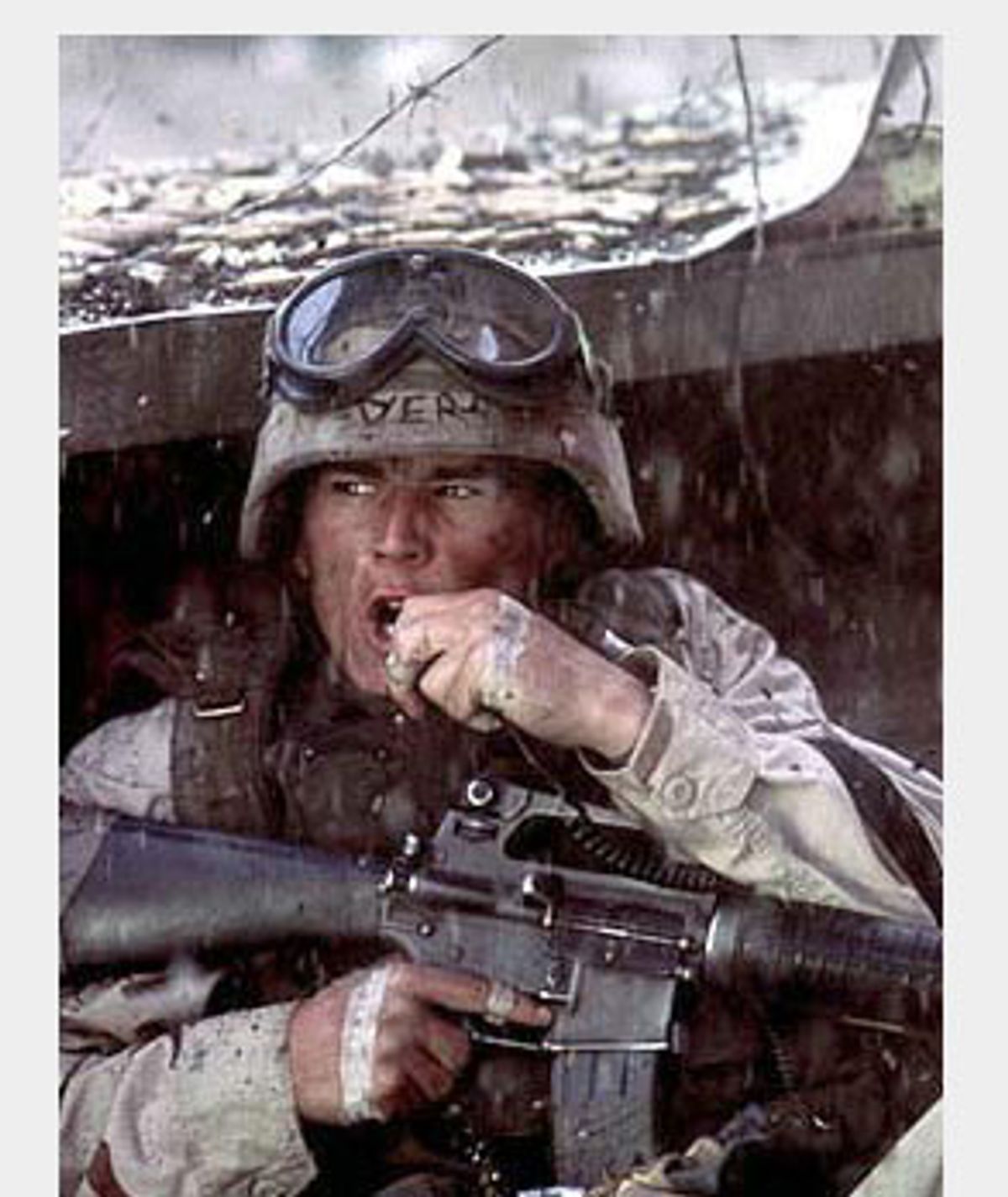
"Black Hawk Down's" gripping images of the U.S. military's missteps in Somalia grope about in a context-free void.

  • more
    • All Share Services

Fog of war

Here’s a news flash: War is hell. All right, it helps if we don’t forget that, especially at this time of pseudo-war, when the distant, ambiguous conflicts playing out in Whateveristan or Televisionistan seem more like video games, or breathless “reality” specials hosted by Ashleigh Banfield, than the real thing.

In “Black Hawk Down,” adapted from the nonfiction best-seller by journalist Mark Bowden, Ridley Scott is after the real thing: a grueling, relentless, moment-by-moment account of the 1993 battle in which two U.S. Army helicopters were downed and nearly 100 Special Forces troops were trapped overnight in a hostile section of Mogadishu, Somalia. But Scott is primarily — some would say solely — a creator of memorable images rather than a storyteller. He isn’t capable of the poetry or philosophy or political context that might lend meaning to what went wrong in Mogadishu. So “Black Hawk Down,” with its cliché-riddled script by Ken Nolan (apparently assembled from loose fragments of other war films), becomes an endless battle scene in search of a movie. It’s every bit as harrowing — and also every bit as pointless and misguided — as the botched military mission it depicts.

Even in Scott’s least successful films (consider also “G.I. Jane” or “Black Rain” or “Someone to Watch Over Me”), his eye for imagery never fails him completely, and there are at least a moment or two of expressive power that defy language and reason. Strictly in a compositional sense, “Black Hawk Down” — shot by Slawomir Idziak, once Krzysztof Kieslowski’s cinematographer — is often brilliant, from its careening aerial sequences over Mogadishu (the dilapidated ex-colonial architecture is actually that of Rabat, Morocco) to the unrelenting nightmare of the street battle between U.S. forces and the militias of warlord Muhammad Farah Aidid. When two American soldiers, lost and perhaps forgotten by their comrades, tiptoe through an empty intersection, they meet a solitary donkey pulling a gaily decorated cart. Deep in the night, when the trapped Americans are beginning to wonder how much worse it can get, we watch one soldier dying of his wounds, as he holds a friend’s hand and tries to say something. All he can get out is: “There’s nothing. There’s nothing.”

Even today, the Oct. 3, 1993 firefight in Mogadishu remains the U.S. Army’s most bitter engagement since Vietnam; 18 Americans died, along with uncounted hundreds of Somalis. (Osama bin Laden, although not mentioned in either the film or the book, was reportedly fomenting anti-Americanism in Somalia at the time.) While the episode seems ripe with both dramatic potential and contemporary relevance, Scott can’t decide whether to make the film a propaganda shoot-’em-up or a moral docudrama, and it ends up as a half-assed neither-nor. If it’s possible to describe a movie as simultaneously gripping and dull, this is that movie. For all its pulse-pounding death and terror, all its blood and screaming, all its slo-mo animation of rocket-propelled grenades in flight, “Black Hawk Down” never gives you the sense that it has an idea in its head or a clear destination.

I can understand why Scott avoided the most mythic and primal image from the Mogadishu battle: the half-naked corpse of Master Sgt. Gary Gordon being dragged through the streets to be kicked and spat on by the very people he was theoretically there to help. All the same, there’s something dishonest about leaving it out. As unpleasant as it might be for Americans to see that image again, it contains a kind of truth that is both literal and symbolic. Like pictures of Ground Zero in New York, it reminds us of things we’d rather not be reminded of, but that we can’t always avoid. It’s not clear — at least, not to me — that we are honoring the memories of Gordon and his comrades, or of the thousands in the World Trade Center, by sanitizing our memories and sugaring our emotions, by thinking only the thoughts about our country that we wish were true.

Trapped between the desire to create a patriotic spectacle and the demands of Bowden’s rigorously researched narrative, Scott and Nolan haven’t served either purpose especially well. On one hand, the film version of “Black Hawk Down,” unlike the book, provides virtually no context for the famine and civil war in Somalia, and presents the citizens of Mogadishu as a teeming, vicious horde, an angry black tide that engulfs the lonely emissaries of civilization. On the other hand, none of the movie’s American characters (some of whom are composites, while others bear the name of real soldiers) amounts to much more than a wisecrack, a typical gesture or an attitude.

There’s the eccentric coffee aficionado (Ewan McGregor), the big, laconic colonel (Tom Sizemore), the legendary shitkicker (Eric Bana), the old pro (William Fichtner), the hard-ass captain (Jason Isaacs), the jovial pilot everybody calls Elvis (Jeremy Piven) and the eager kid on his first mission (Orlando Bloom). I know these characters’ names only because I have the press kit. They’re archetypes — and witless ones at that — rather than people, and the only challenge they establish for the viewer is trying to guess which of them will come home in pine boxes. One of Bowden’s great accomplishments was his portrait of the hidden world of Special Forces, with its culture clash between the straitlaced Rangers and the good-time cowboys of Delta Force, which almost totally disappears in Nolan’s screenplay.

Inevitably, Scott and the producers have attempted to recast “Black Hawk Down” as a story of American military heroism, rather than a grim fable of a Murphy’s-law mission doomed by arrogance, incompetence and sheer bad luck. (I don’t know whether the film was recut after Sept. 11, but I wouldn’t be surprised.) There’s no denying that the men who fought and died for their country that day in Mogadishu were brave: As shown in the film’s most agonizing scene, two Delta Force commandos volunteered to air-drop into one crash site and defend the injured chopper pilot from an armed Somali mob without knowing when, or if, they might get help. (If you’re expecting a thrilling last-second rescue involving Russell Crowe or Keanu Reeves, you’ve picked the wrong movie.) But what were they doing in Somalia in the first place? Why did an entire city seem to rise up in hatred against them? What purpose did their bravery serve?

“Black Hawk Down” never answers these questions, or even quite asks them. There’s an awkward bit of exposition early in the film, when a group of young Army Rangers is hanging around their barracks waiting for the fun to start. They begin teasing Staff Sgt. Matt Eversmann (Josh Hartnett) — the closest thing to a main character this overcrowded yet anonymous movie can offer — about his supposed affection for the “skinnies,” as the starving Somalis are known in dark-humor Army-speak. “Look, there are two things we can do,” responds the earnest sarge. “We can help these people or we can watch them die on CNN.” There was a third option, as it turned out: Armed with good intentions and expensive weaponry, we could blunder into a situation we only partly understood, causing a lot of death and destruction and making a bad situation even worse.

“Snow White and the Huntsman”: A would-be fantasy classic

Charlize Theron blows Kristen Stewart off the screen in "Snow White and the Huntsman," an unexpected summer delight

  • more
    • All Share Services

Charlize Theron in "Snow White and the Huntsman"

There’s plenty of ambition and imagination on display from the first seconds of “Snow White and the Huntsman,” along with an enthusiasm for the material that can’t be faked and which makes up for at least some of the film’s missteps. I resisted this derivative mishmash of classic fairytale and modern epic fantasy for as long as I could, but ultimately it swept me up into its geeky but manly embrace and carried me away on a white charger. English commercial director Rupert Sanders makes his feature debut with a splash, launching a fantasy-adventure franchise that probably isn’t as good as any of the things it references — the classic Walt Disney film, of course, but also “The Lord of the Rings,” the Narnia series, “Game of Thrones,” “Star Wars,” Shakespeare and countless other works besides — but comes close enough, I’d guess, to carve out its own niche and create its own fan base.

Mind you, a lot of things go wrong in “Snow White and the Huntsman,” so many that it’s surprising the film feels as exhilarating and entertaining as it finally does. The problems start with the central premise and the leading actress, but there are also the wobbly CGI effects, uncertain character arcs and unresolved subplots, not to mention the regional British Isles accents, which may be tough for American viewers to follow. (This is essentially a British film, although partly fueled with dollars from Universal Pictures.) Let’s accentuate the positive, though, by beginning with the stunning and sinister Charlize Theron, who plays the usurper Queen Ravenna (aka Snow White’s evil stepmother) as a proto-feminist vengeance seeker clad in a succession of delirious, lapidary outfits out of Jean Paul Gaultier’s nightmares. (The costume designer is the estimable Colleen Atwood.)

An embittered beauty determined to resist the aging process — she has moved on from Botox and plastic surgery to physically sucking the life force out of virgins and flowers, it seems — Ravenna is such a complicated and intriguing character that Sanders and his team of writers run themselves into a version of the infamous “Satan problem” from Milton’s “Paradise Lost.” In that epic poem, the fallen angel Lucifer, who devotes all his energies to perverting and destroying mankind, is a much more interesting, and indeed appealing, character than God, a figure singularly lacking in dramatic possibility. It doesn’t help that Theron’s icy but tormented queen completely blows Kristen Stewart’s anodyne and somewhat androgynous Snow White off the screen, leaving us feeling that the overdetermined pagan-Christian parable at the heart of this story — the tomboy princess is The One to whom ancient forest beasts bow down, The One who will make the land bloom again — is both unfair and rather dull.

I’m a fan of Stewart’s, generally speaking, and will irritatingly add that I always think of her, first and foremost, as “that girl from ‘Adventureland.’” She badly needs to get out of the business of playing storybook virginal princess types, however, and I hope she and the people around her have enough sense not to let Bella define the rest of her career. (I haven’t seen “On the Road” yet; maybe that will help.) She cuts a fetching line in both gowns and suits of armor, but this Snow White — who is sometimes Bilbo Baggins (and sometimes his Ring), sometimes Luke Skywalker, sometimes Joan of Arc and sometimes Henry V — calls for both broad hambone instincts and a natural aristocratic bearing. Stewart possesses neither, looking and acting rather too much like a standoffish American girl faking a posh accent.

In fairness, I have no idea whom else I’d have cast or how well she’d have done. Sanders and his writers — the story is by Evan Daugherty, who co-wrote the screenplay with John Lee Hancock and Hossein Amini — never quite decide whether they’re doing a sardonic, young-adult update of the 1937 Disney classic or cutting themselves free from that material and going back to its roots in European folklore. Mostly, in fact, it’s the former: If the scene where Snow White gets lost in the forest scared you when you were 5, they seem to say, wait till you see the super-scary haunted forest we’ve got for you now! Cute bunnies? We’re doubling down on the cuteness! Seven dwarves, you say? Well, OK then — but let’s make them debauched, violent, pseudo-Celtic little bastards! (The gang of dwarves includes Ian McShane, Bob Hoskins, Ray Winstone and Toby Jones, who are rendered small through both newfangled and old-fashioned trickery and are highly enjoyable, overall.)

Sanders mounts an impressive faux-medieval spectacle in the first third of the film, although he has little gift for action, and therefore the battle scenes are uniformly disappointing. We see how Ravenna seduces and destroys Snow White’s father, locking the child princess in the tower and seizing the crown for herself. The resemblance to HBO’s “Game of Thrones” (and the George R.R. Martin books behind it) may be coincidental, but it is nonetheless strong, and the intrigue even includes a semi-incestuous relationship between Ravenna and her perverted brother Finn (Sam Spruell), whose lecherous advances upon Snow White give her an opportunity to escape. Not daring to pursue the girl into the Dark Forest, Finn hires a drunken, widowed huntsman with no known name (Chris Hemsworth of “Thor” and “The Avengers”) to fetch her back so his enraged sister can tear Snow White’s heart from her breast and thereby live forever.

There’s no denying that taking the repentant huntsman, a brief and buffoonish cameo role in “Snow White and the Seven Dwarfs,” and making him the ennobled working-class hero of the whole story is an ingenious twist. Whether it pays off, I’m not sure. Hemsworth is an agreeable action hero with tremendous charisma, and the long midsection of this movie, as Snow White and the huntsman go on a Tolkienian voyage of adventure and discovery, is both enjoyable and predictable. Stewart’s best and most delicate acting, in fact, comes as Snow White begins to wrestle with the unexpected possibility that this uncouth muscleman — and not the effete, aristocratic William (Sam Claflin) who has loved her since childhood — may be her real Prince Charming.

I don’t think I can be accused of issuing spoilers when it comes to a fairytale, but let’s leave a faint shroud of mystery over precisely how this triangle is resolved, or not resolved. Ravenna’s delivery of the poisoned apple to Snow White is brilliantly done, perhaps the movie’s best revisionist moment, but after that the momentum declines sharply. Snow White “dies” and is revived — more mysteriously, and with less emotional impact, than in the Disney film — and then she must lead her rebel troops into battle, delivering a knockoff version of the St. Crispin’s Day inspirational speech from “Henry V” (which Stewart, frankly, can’t pull off at all). This is a big, crude, cynical and impressive movie that will leave almost any viewer with mixed feelings, partly because it kills off its best character in what seems like an irrevocable fashion. It ends by virtually begging us to call for a sequel, stopping just short of an on-screen ellipsis and question mark. I’m inclined to conclude that “Snow White and the Huntsman” is a vigorous simulacrum of classic fantasy, rather than the real thing. But keep your expectations reasonable, and that’s enough to make it one of the summer’s unexpected delights.

Continue Reading Close

Blockbuster fatigue? A summer alt-movie guide

Summer movies beyond Batman, from male strippers to a Depression neo-noir to Matthew McConaughey's big comeback

  • more
    • All Share Services

Blockbuster fatigue? A summer alt-movie guideFrom top: stills from "Beasts of the Southern Wild," "Take This Waltz" and "Lawless"

It may feel to you as if the summer moviegoing season has only just begun and many months of popcorn-munching delight lie ahead. That’s both true and not true. There’s a degree of pseudo-Calvinist predestination about the whole thing this year that’s unusual even by the standards of Hollywood, where conventional wisdom and guesswork-in-advance count for actual knowledge.

I mean, nobody knows for sure how much money the 1980s big-hair musical “Rock of Ages” will gross or whether “The Dark Knight Rises” will beat out “The Avengers” as the top box-office hit of the year. (My answers: Not enough to be a huge hit, and no.) But pretty much any idiot with a computer — me, for instance — can look at the calendar and figure out what the biggest hits of the summer will be. As I just mentioned, the summer’s No. 1 movie, in all probability, has already been released. (I’ll save the trollery about how it wasn’t really all that great for some other time.) After we get through “Prometheus” and “Abraham Lincoln: Vampire Hunter” in June, followed by “The Amazing Spider-Man” and “The Dark Knight Rises” in July, well, that’s pretty much it. I exaggerate, but only a little — these days, blockbuster season commences in early May and is over by the end of July, with August reserved as usual for offbeat genre movies, the fourth chapters of trilogies, and the continuing careers of Sylvester Stallone and Jackie Chan. (In other words, the good stuff.)

Now, I’m not copping some elitist attitude — or at least not the one you’re thinking. I’m plenty excited to see Ridley Scott’s “Alien” prequel “Prometheus” later this week, believe me. And I have a funny feeling about Chris Nolan’s last “Dark Knight” chapter, which might wind up being a lot better, and tougher, than skeptics like me are inclined to expect. But there is a lot of smaller-scale summer movie goodness to look forward to, and arthouse-type specialty distributors have learned that packing the season with alternative fare aimed at grownups can definitely pay off. Please note that I do mean “summer movies,” that is, those possessing high entertainment value and ample sensual rewards. Of course I still love three-hour fillums from Turkey about the meaninglessness of existence (like that one some of you will never forgive me for), but I also agree they don’t go all that well with flip-flops, the smell of spray-on sunscreen, and those mind-altering cola-slush concoctions.

So here are 10 terrific blockbuster alternatives for the summer of 2012, ranging from some mildly offbeat studio fare to low-budget indies that will spread slowly and gradually across the country. (Several will also be available on-demand, and I’ve tried to note that.) I should mention that three excellent such options have already opened in major cities and should reach you soon if they haven’t already: Wes Anderson’s blissful, tragicomic mid-1960s fantasy “Moonrise Kingdom”; Norwegian director Joachim Trier’s heartbreaking one-man, one-day character study “Oslo, August 31st”; and Nadine Labaki’s “Where Do We Go Now?” a sweet-natured, mildly experimental retake on “Lysistrata” set in a Lebanese village.

Extraterrestrial A guy wakes up next to a hot chick after an apparent one-night stand — but why can’t he remember anything about it? And why is there a flying saucer hovering over their now-abandoned city? From Spanish director Nacho Vigalondo, who made the deceptively silly and thoroughly enjoyable time-travel heist movie “Timecrimes,” comes this appealing hybrid of indie relationship comedy and alien-invasion flick. (Opens June 15 in Brooklyn, N.Y.; Seattle; Austin, Texas; and on VOD. Other cities will follow.)

Your Sister’s Sister This irresistible indie rom-com from Seattle-based filmmaker Lynn Shelton may be less distinctive than her provocative bromance “Humpday,” but Shelton has stepped up her game, movie-star-wise, while retaining her sharp-edged dialogue and real-life characterizations. Mark Duplass plays a grieving loser who has a fun, drunken one-nighter with a lesbian friend (Rosemarie DeWitt) — but it’s her sister (Emily Blunt), the ex of his late brother, for whom he’s kept a torch burning. (Opens June 15 in Chicago, Los Angeles, New York, San Francisco, Seattle and Washington, D.C., with a wider release to follow.)

Beasts of the Southern Wild First-time director Benh Zeitlin’s magic-realist fable is already the year’s most acclaimed debut. Set in an isolated corner of Louisiana’s bayou country, where a six-year-old girl lives in a fantastical harmony with nature — at least until the big storm hits — “Beasts” has won both the Sundance Grand Jury Prize and the Caméra d’Or at Cannes, for best first film in any section of the festival. This is a genuinely visionary work, albeit one that will strike some viewers as a mite too precious. I simply can’t tell whether it’s a breakout hit waiting to happen or this year’s version of “Uncle Boonmee” — a film loved by a handful of cinephile insiders but ignored by most. (Opens June 27 in major markets, with wider release to follow.)

Magic Mike Yeah, picking this one is probably cheating. It’s a studio film (at least at the point of release) that stars Channing Tatum, Alex Pettyfer and Matthew McConaughey as male strippers. In other words, it’s got obvious audience appeal and will probably be a hit, at least at some level — but it’s also a Steven Soderbergh film, meaning it was shot fast and cheap and close to the ground. (Soderbergh shot and edited the whole damn thing himself, as usual.) That also means it’s got at least a bit of clinical, borderline-misanthropic edge to go along with the ample humor and even ampler servings of beefcake. Honestly, what’s not to love? (Opens June 29.)

Take This Waltz Actress-turned-director Sarah Polley’s second film (the first was the wonderful “Away From Her”) is an almost ruthless examination of one woman’s journey out of an apparently happy marriage into a stormy new relationship, featuring 2011 Oscar nominee Michelle Williams in what I think is her best role to date. (And Seth Rogen is so terrific as her jilted husband that I hereby forgive him his willfully dumb comedy roles.) By turns erotic, comic, tragic and even experimental, “Take This Waltz” has divided critics and audiences at festivals so far. I think it’s one of the year’s best movies, and it announces Polley’s arrival in the front rank of North American filmmakers. What will you think? (Now available on VOD; opens June 29 in theaters.)

Ballplayer: Pelotero Summer simply isn’t summer without an unconventional take on the baseball movie. In this acclaimed documentary, already a hit at numerous festivals, directors Ross Finkel, Trevor Martin and Jonathan Paley take us inside the rarely seen world of Major League Baseball’s training camps in the Dominican Republic, where teenagers from the poor island nation are bred to become future diamond superstars (or, more likely, to wash out somewhere along the way). The filmmakers follow two highly ranked prospects as they approach their 16th birthday — the moment they can sign professional contracts. (Opens July 13 in New York, with other cities and home video release to follow.)

The Queen of Versailles A Florida real-estate tycoon and his appealing, immensely flawed wife try to build the country’s biggest McMansion in photographer-turned-filmmaker Lauren Greenfield’s documentary, which is stranger than any work of fiction. Surrounded by controversy since well before its Sundance premiere (when subject David Siegel tried to sue the festival), “Queen of Versailles” veers from profound human compassion to domestic horror as Siegel’s wife Jackie wanders through her enormous but trashed home scraping dog crap off the carpets. It’s like a Theodore Dreiser novel for our time, infused with the vivid, vulgar spirit of reality TV. (Opens in theaters July 20; VOD release is likely but has not been announced.)

Killer Joe A mean-spirited plot about a guy who takes out a hit on his own mother, a delightful-sounding cast headed by the resurgent Matthew McConaughey (what a big year for him!), and an NC-17 rating. Add that all up, and this Coens-flavored tale of backwater deviance, written by playwright Tracy Letts, could finally be the comeback film that onetime Oscar-winner William Friedkin (“The Exorcist,” “The French Connection”) has been pointing toward for decades. Mind you, like all of Friedkin’s recent movies, “Killer Joe” was made on the cheap, far away from Hollywood and its piles of money. That only makes me want to see it more, especially with Emile Hirsch, Juno Temple, Thomas Haden Church and Gina Gershon all along for the ride. (Scheduled to open July 27 in limited release.)

Premium Rush This one’s another studio movie, technically speaking — but everything about this Manhattan chase thriller screams irresistible August sleeper, from its indie-rific star (Joseph Gordon-Levitt, still a niche-oriented leading man) to its director (A-list screenwriter David Koepp, who’s made several other films, none of them hits). Gordon-Levitt plays a bike messenger who picks up a mysterious envelope that lures a dubious cop (the inimitable Michael Shannon) into an extended street pursuit, complete with BMX-style bike acrobatics and action-movie clichés galore. (Scheduled to open Aug. 24 in wide release.)

Lawless This bootlegging saga set in Depression-era Virginia, from the Aussie duo of director John Hillcoat and screenwriter Nick Cave (yes, the post-punk music legend, who also wrote Hillcoat’s “The Proposition”), has run through three titles during its brief existence, which often signals a troubled production. (It was previously “The Wettest County in the World” and then just “The Wettest County” — and the filmmakers only switched to “Lawless” after Terrence Malick agreed to give it up.) Reviews and reactions at the Cannes premiere ran the gamut from raves to outrage, but with an ensemble that includes Tom Hardy, Gary Oldman, Jessica Chastain, Guy Pearce and Mia Wasikowska (along with the much-mocked Shia LaBeouf), I can’t believe it won’t be fascinating. (Scheduled to open Aug. 29.)

Continue Reading Close

The kids are all wrong

Nightmare children populate the dark, dreary and near-perfect "The Bad Seed" and "We Need to Talk About Kevin"

  • more
    • All Share Services

The best movies act as a kind of amber, trapping the life of their times. Sometimes, you get jewels, other times you get, well, amber.

It was hard to read anything about “We Need to Talk About Kevin” without some reference to its distinguished antecedents in the “there’s something about that boy, June” school of demon child cinema. “The Omen,” “Rosemary’s Baby” and “Problem Child” all got their time on deck, but one film in particular gets mentioned, for it invented this entire genre. And that film is Mervyn LeRoy’s 1956 epic “The Bad Seed.” This is one of those movies embedded in our consciousness that perhaps should stay embedded and not actually be pried loose.

Which brings us to this week’s double bill. “We Need to Talk About Kevin,” just out today, is an unrelentingly grim, absolutely depressing, difficult-to-recommend-to-anyone work of sublime, essential filmmaking. Say again? OK. In the words of Preston Sturges, there is “nothing like a deep-dish movie to drive you out into the open.” “We Need to Talk About Kevin” is that kind of movie, an absolutely brilliant work of narrative and deliberately elliptical narrative storytelling. It takes this trope of the bad seed and plants it so it grows into some kind of hallucinatory kudzu. It cannot be easily eradicated once it is experienced first-hand. Not since Billy Mumy wished those pesky adults into the cornfield in one of the all-time creepiest works of TV Noir has a demon child been depicted as being quite so, well, “hellish.”

Based on the 2004 novel by Lionel Shriver, “We Need to Talk About Kevin” is told from the point of view of worldly travel writer Eva Khatchadourian. Besides having to cope with a difficult-to-spell last name, Eva has to endure a nightmarish life as the mother of perhaps the worst child in cinema history. This slow-motion torture of Eva is capped with a Columbine-style school massacre that tears this movie’s heart wide open. No surprise there, but the brilliance of the film is the way the chronology of catastrophe coils around itself, yet propels relentlessly forward. I must mention here that the editing of the film is wonderful. I also must mention that the editor of this film is my friend and colleague Joe Bini, but I’m not just saying this to butter Joe up so he takes my notes seriously next time. If anything, the editing in this film makes me nervous to ever suggest anything to Joe ever again — it is that good. But there is enough praise to go around. The film’s director, Lynn Ramsey, has a command of film vocabulary that keeps it from becoming the Art House “Omen” it so easily might have been. Yes, there are many scenes of mannered excess, but what manners, what excess!

Now, no film about a Bad Seed can succeed with a bad child actor – and “We Need to Talk About Kevin” has two extraordinary seeds. Ezra Miller plays the teenage Archer from Hell, and Jasper Newell is simply terrifying as a Satan in Snuggies. Both not only look alike and talk alike, at times they even glare alike. You can lose your mind, as Tilda Swinton does, thoroughly, across two excruciating hours. Any parent who read the recent New York Times Magazine article on 9-year-old newly diagnosed psychopaths cannot help but empathize with Swinton’s Eva. Those same parents also should not — repeat not — watch this movie. Cherish your pet hamster and let this one go. Trust me on this.

This brings us to the only real problem with “We Need to Talk About Kevin” — the reason for its existence. One wonders just why this story demanded to be told and why so many consummate craftsmen felt compelled to tell a story of such absolute darkness and despair. It reminds me of another work of scary excellence that was pretty much a career black-hole for all connected with it, Bob Fosse’s “Star 80.” Perhaps the worst first-date movie of all time, “Star 80” worked brilliantly on just about every level, except for the basic story it told, which had even Fosse disciples screaming for the exits and pretty much torpedoed the career of Julia Roberts’s far more talented brother.

Both “Star 80″ and “We Need to Talk About Kevin” get the “Michael Powell Peeping Tom” award for Excellence In Service of Repulsion, and both are great films. I really just wonder what the filmmakers thought they were doing, what audiences they thought they were going to reach, and why they wanted to reach them in the first place. I’m not going to ask my friend Joe, but, God bless Lynn Ramsey and her creative team, and Bob Fosse and Michael Powell, for going for it – whatever they thought “it” might be.

“The Bad Seed,” on the other hand, did nothing to derail the career of its director, Mervyn LeRoy. Perhaps it should have. A too-faithful translation of the 1954 hit Broadway play, it’s a film best consigned to legend and not actually watched, unless, of course, as the first part of this double bill with “We Need to Talk About Kevin.” LeRoy was the ’50s king of Broadway adaptations, with “The Bad Seed” following “Mister Roberts” and leading into his translation of “No Time for Sergeants.” His best work helming Warner Brother’s Pre-Code quickies was 25 years behind him, not to mention a guest shot at the “Wizard of Oz.” LeRoy brought very little to the “The Bad Seed.” Most of the cast of the play were imported to LeRoy’s set, and most were still delivering their lines to the far balcony. LeRoy’s camera just got in the way.

And what lines they delivered! “The Bad Seed” is one long pulled punch.

Remember the ending of “Psycho” where all of the delicious crimes are explained away in a long exposition scene? This film is stuffed with what Orson Welles called “dollar-book Freud,” apparently necessary for 1950s audiences who could not – or would not – imagine a child who actually did enjoy pulling the wings off flies. Even Bosley Crowther, the arteriosclerotic film critic for the New York Times, called the movie out on its staginess and over-the-top acting — and this was in 1956. Sadly, the film isn’t really bad enough to be really good. With the exception of Patty McCormack’s trailblazing performance as Rhoda Tasker, the titular Bad Seed in question, all the other performances are mannered beyond belief. Henry Jones, in particular, must be signaled out for essaying the role of Leroy, the dimwitted proto-pervert maintenance man. Leroy has Rhoda’s number early on, but keeps forgetting to add it up correctly, until Rhoda demonstrates convincingly why children should not play with matches.

But, rejoice, fans of Hollywood tacked-on Hays Code endings. You will absolutely love the very end of this film, where the cast takes an actual curtain call (!) and demon Rhoda gets an actual spanking (!!) from a smiling mom. And all this after God smites Evil in just about that amount of time. Astonishing now, and I have to believe astonishing then. This is as complete an act of dramatic self-negation as ever appended to a Hollywood movie. When TCM junkies pine for the days of classic old Hollywood, movies like “The Bad Seed” do not help them make their case. “We Need to Talk About Kevin,” on the other hand, is a fully realized work of committed cinematic virtuosity, in the service of a story that many simply do not want to hear. It has the courage of its convictions, and in this era of focus-group-driven filmmaking, courage is more than enough.

Watching this double bill shows just how far we have come – on a journey we may not want to make.

Worst first-date movie of all time? I suggested “Star 80,” but perhaps you, dear readers, can help with other titles, and, perhaps, the saga of other disastrous movie dates. See you in the comments section!!

Continue Reading Close

Pick of the week: Haunting, gorgeous “Oslo, August 31st”

Pick of the week: "Oslo, August 31st" is a wrenching voyage of discovery in Norway's suddenly trendy capital

  • more
    • All Share Services

Pick of the week: Haunting, gorgeous

“Oslo, August 31st” is, as the title suggests, an evocation of one day in the Norwegian capital, as experienced by a troubled young man who’s facing the end of summer and the end of his youth. It’s a marvelously constructed personal journey, both wrenching and bittersweet, whose emotional ripple effects stay with you for days and weeks afterward. While much of international art cinema can seem overly talky or conceptually alien to American viewers, this second feature film from Norwegian director Joachim Trier is a dynamic, even breathtaking visual experience without much dialogue or any philosophical heavy lifting, following the bony, handsome, exceedingly vulnerable Anders (Anders Danielsen Lie) through coffee shops, nightclubs and bodies of water, en route to an ambiguous final destination.

I saw “Oslo, August 31st” last year at Cannes and found it powerfully affecting, but I never would have guessed that this small movie from a small country would have touched an international nerve the way it apparently has. In the wake of a breathless profile of doctor-turned-actor Lie and his supermodel wife, Iselin Steiro, in the New York Times’ style magazine — which made the film sound rather like a fashion accessory, or a handbook to Oslo architecture — I almost feel the need to dial back expectations a little. Yes, there are drugs and dance clubs and traveling shots but, honest to Pete, we’re not talking stylish, scenic, lovable hipster romp here, people. While “Oslo, August 31st” definitely has the dynamism and street-level energy of, say, an early Godard picture, and may indeed leave you eager to visit Norway, it’s first and foremost an intimate tragedy about a likable young man who has wandered off the path of life into some very dark woods, and isn’t necessarily finding his way back.

As in Trier’s equally wonderful first film, the 2006 “Reprise” — I’m pretty much the president of the cult on that one — the director is interested in exploring the existential dark side of Scandinavian social democracy, with its largely homogeneous character and devotion to equal opportunity. When I talked to Trier about that film, which featured Lie and Espen Klouman-Hoiner as a pair of arrogant, doomed aspiring novelists, he observed that in Norway “there are a lot of people with a lot of choices. It sounds wonderful but there’s a darker side to that. Lots of people are not dealing with those choices very well.” Anders in “Oslo, August 31st” is something like the worst-case outcome for Lie’s character in “Reprise”; he’s a guy from a loving, middle-class family who’s got looks, health, intelligence and education, but for unknowable reasons finds himself on the edge of middle age as a penniless, unemployable, supposedly recovering junkie.

Trier and co-writer Eskil Vogt adapted their central premise from “Le Feu Follet,” a 1930s novella about alcoholism by Pierre Drieu La Rochelle, but “Oslo, August 31st” could really be set anywhere at any time. It’s about the painful necessity of adapting to change, every single day that we’re alive, and if we identify with Anders even as we rage against his despair, it’s because every living human has at some point considered the possibility that it’s just too much and the struggle isn’t worth it. Anders is doing well in drug rehab, and has cautiously been granted a one-day leave to visit Oslo friends and apply for a job. But we can tell from the first moments of the film that his agenda is more complicated than that; Anders is in the position of a certain Danish prince, evaluating the reasons for being against the reasons for ceasing to be. (Trier, by the way, is cousin to another famous Dane, “Melancholia” director Lars von Trier, and one could argue their visions of the world are related as well.)

“Oslo, August 31st” runs a lean, mean 95 minutes, and not one second seems unimportant. Anders moves through the streets of Oslo looking for reasons to live and reasons to die, and even though we don’t know those streets as he does, we can tell that they’re haunted with memories and private agonies. The city is dotted with construction cranes and demolition sites, remorselessly regenerating itself while he appears to stand still. Indeed, Anders’ family home will soon be sold, and one of his personal missions is to pay a final visit. (The fluid, poetic cinematography is by Jakob Ihre.) He insults a prospective employer, refuses to make peace with his alienated sister, falls off the wagon — at first tentatively, and then enthusiastically — and leaves increasingly pathetic messages for his lost love, a woman who’s now in New York. (It’s the voice of Steiro, Lie’s real-life spouse.) On the other hand, he flirts with a younger girl who seems affectionate and charming, and who seems to open for him the promise of a new beginning. Their scene together at an Oslo swimming pool that has just closed for the season, so suggestive of both death and rebirth (and, literally, of baptism) is so gorgeous I wanted to cry. OK, I did cry, and that wasn’t the only time.

But none of that, not even the scenes where we feel that Anders is in imminent danger of taking his own life, are quite as painful as his visit with Thomas (Hans Olav Brenner), an old friend and veteran of long literary discussions and booze-and-drug sessions. Thomas has a wife and a kid now, and his vices involve an occasional bottle of beer. In the manner of one-time bohemians who’ve more or less grown up, he’s kind of an ostentatious jerk about it — but then admits to Anders, when they’re alone, that he’s desperately unhappy. Perhaps that’s the “ordinary unhappiness” Freud wrote about, the unhappiness we all have to accept to get from the last day of August into the first day of September, in Oslo or anywhere else. But is that enough? Is that ever enough, for anybody? And can we forgive those who decide that it isn’t?

“Oslo, August 31st” opens this week at the IFC Center in New York, and June 1 at Laemmle’s Playhouse 7 and Laemmle’s NoHo 7 in Los Angeles, with more cities and DVD release to follow.

Continue Reading Close

“Moonrise Kingdom”: Wes Anderson’s mid-’60s love story

Bruce Willis and Ed Norton are at their best in the rapturous summer fantasy "Moonrise Kingdom"

  • more
    • All Share Services

Tilda Swinton, Bruce Willis and Edward Norton in "Moonrise Kingdom"

All the details of Wes Anderson’s rapturous and hilarious mid-1960s New England summer romance “Moonrise Kingdom,” taken one at a time, are plausible. Indeed they are more than plausible; they’re perfect, from the fitted uniforms and yellow canvas tents of the troop of “Khaki Scouts” headed by cigarette-smoking Edward Norton to the achingly picturesque island home where the brood of children belonging to Bill Murray and Frances McDormand sit around listening to the Leonard Bernstein recording of “A Young Person’s Guide to the Orchestra.” (I’m not going to bother questioning whether that record existed in 1965; some production intern probably spent half a day tracking down its history.)

Yet, as usual with an Anderson movie, this meticulous and convincing detail does not add up to realism but — depending on your perspective — to something either much less or much more than that. Something that could be described, and has been, in all kinds of ways: As fantasy or fairytale; as a whimsical miniature under glass; as a diorama created by a brilliant, obsessive-compulsive child. All reasonable descriptions, at least up to a point — and I’m on board for all of it. I’ve pretty much been on Anderson’s wavelength from Day One — or at least from “Rushmore,” which isn’t quite Day One. That’s not the same thing as saying that I think all his movies work equally well, or that he doesn’t occasionally lapse into laziness or self-indulgence. (I’ll have to give “The Life Aquatic with Steve Zissou” another chance one of these days, but I feel pretty confident that was a misstep.)

I understand why Anderson’s films drive some viewers nuts, in fact, and I would simply respond that it should be clear by now that his vision of cinema and the world is idiosyncratic and not to everyone’s taste and that there’s no point sitting around hoping he’ll become more normal. But here’s what I reject completely: The idea that the artificiality or hyperrealism (a better word, I think) of Anderson’s worlds — which is admittedly cranked up pretty high here — is fundamentally pretentious and insincere, or that it reflects some kind of “kidult” refusal of grown-up emotion. Yes, Anderson’s principal subject, and arguably his only subject, is the collision between the emotional lives of adults and children and the paradoxical tragicomedy it can so often produce. But if Anderson’s adults yearn for the comparative simplicity of childhood while his children long for the big, important feelings they believe (wrongly) go with growing up, that in itself is a distinctly adult perspective.

“Moonrise Kingdom” takes place at the tail-end of summer — that season which is more charged with a rueful sense of passage than any other. Its preteen lovers, Sam and Suzy (played by newcomers Jared Gilman and Kara Hayward, respectively), most certainly aspire to the grand passions of Tristan and Isolde or Abelard and Heloise, and it’s entirely possible they’ve heard of them. They first met backstage during a performance of Britten’s “Noye’s Fludde” at the island of New Penzance’s only church, when Sam was in his Khaki Scout uniform and coonskin cap, and Suzy was wearing a bird costume. (The use of Britten, of all possible composers, as this film’s musical muse is wonderfully unlikely, and totally Andersonian.) After a hot and heavy epistolary romance, they conspire to run away together — as it happens (so we are told by on-screen narrator Bob Balaban), just three days before a major hurricane will hit New Penzance.

As irresistible as our young lovers are — Sam with his corncob pipe and camp-tested scouting skills, Suzy in her saddle shoes and with her dangerous pre-Lolita sexuality — this isn’t a movie about kids, and they are Potemkin protagonists. Against the certainty and clarity of the childhood world, we see the real heroes of New Penzance: Norton’s upright Scout Master Ward, who confesses his secret fears to a reel-to-reel tape recorder in the depths of the night; Bruce Willis’s Captain Sharp, the island’s only cop, who’s in love with Kara’s artsy, bespectacled mother, Laura (McDormand); Murray as the gentle, lawyerly Walt (Laura’s husband and Kara’s dad), who knows he is being cuckolded but can’t quite bring himself to do anything about it. All these lonely people are portrayed with wonderful delicacy and sensitivity, right in the middle of an artificial construction that contains plenty of shtick. I honestly don’t think I’ve ever seen Norton and Willis, in particular, be better than they are here.

Sam and Suzy’s tempestuous love affair, along with that looming act of God that’s boiling up out there in the Atlantic, will not merely bring all these people together but will give them an excuse to escape their everyday routine and their ingrained fears. In that sense, and in others too, “Moonrise Kingdom” is a deeply romantic film, perhaps the sweetest and most compassionate Anderson has ever made. What has evidently confused some viewers is the fact that it’s also an obsessively curated re-creation of an era that never quite existed, a meticulous storybook version of 1965 that’s more perfect than the original. In real life, Boy Scout tents of that era were made of canvas but were never yellow, and government social workers never wore Salvation Army-style uniforms, as Tilda Swinton’s officious character (whose only name appears to be “Social Services”) does here. And so on.

I suspect that people conflate the artificiality of Anderson’s movies with inauthenticity or insincerity (different things, to be sure) because his artificiality is obvious and worn on the surface, whereas the highly mannered films of, say, Martin Scorsese masquerade as realism. I’m not picking that example at random, by the way; Scorsese has identified Anderson as his favorite among younger American directors, I suspect because he sees a kindred spirit. The two men have very different aesthetics, but both are visionaries who see the world through a personal lens, and both are technical virtuosi concerned with managing every detail of their created universes. You’re free to prefer one director’s work to the other’s, of course, but “Raging Bull” and “Goodfellas” are every bit as obsessed with style and production design as any Anderson film. (The cinematography in “Moonrise Kingdom” is by Robert D. Yeoman, who has shot all of Anderson’s live-action films. The production designer is Adam Stockhausen, the art director is Gerald Sullivan and the spectacular costumes are by Kasia Walicka-Maimone.)

To the extent that “Moonrise Kingdom” can be described as nostalgia, it isn’t personal nostalgia, since Anderson himself was not born until 1969. Very likely it’s an attempt to create a fantasy version of the lost world of his own parents. I wonder whether Scout Master Ward, when the magical summer of ’65 fades into memory, will get married, move to Texas and have a son. The island cabin of Walt and Laura feels like a creation out of a classic children’s novel, but it is imbued with the sadness of a failing adult marriage. In the third act, it feels like Anderson and co-writer Roman Coppola get a little lost in plot shenanigans, and they introduce several extra characters (Jason Schwartzman, Harvey Keitel and Swinton all show up in small roles) to little effect. But all of “Moonrise Kingdom” — from Sam’s miniature stolen canoe to the Benjamin Britten excerpts to Captain Sharp’s heartbreaking bachelor trailer home — is a labor of love, as pure and sweet as the lovelorn letters of its young runaways. Wes Anderson can fool some people, maybe, but he’s not fooling me.

“Moonrise Kingdom” opens this week in New York and Los Angeles, with wider release to follow.

Continue Reading Close

Page 1 of 708 in Movies