Fox News

Florida witch hunt

When a tenured professor loses his job for vocally backing the Palestinian cause, Jeb Bush applauds, Bill O'Reilly boos and academics say it's the worst threat to free speech since Sept. 11.

  • more
    • All Share Services

Topics: , ,

Florida witch hunt

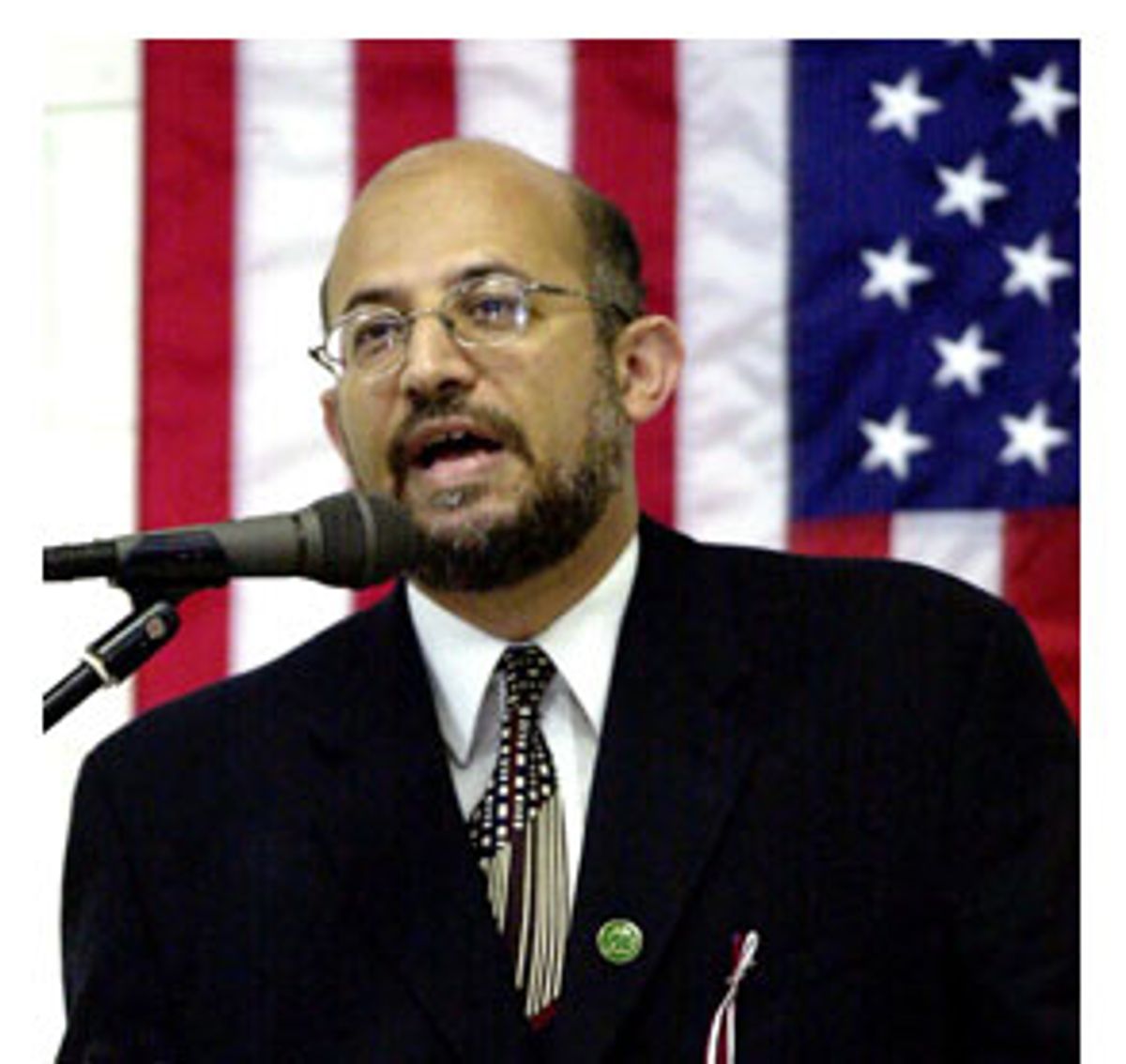
When Sami Al-Arian, a computer science professor at the University of South Florida and a Muslim community leader in this Tampa suburb, agreed to go on Fox News’ popular “O’Reilly Factor” Sept. 28, he thought he’d be discussing American Muslims’ reaction to Sept. 11. Instead he found himself denounced by host Bill O’Reilly as a patron of terrorists for his work on behalf of Palestinian statehood, with O’Reilly demanding an explanation for incendiary anti-Israel remarks Al-Arian made 15 years ago.

And that was only the beginning of what has become the most intense debate anywhere in the nation about academic freedom in the wake of Sept. 11. Al-Arian’s “O’Reilly” appearance triggered hundreds of phone calls and e-mails (as well as death threats) from critics outraged that USF would employ the supposed “terrorist.” Three days after his Fox appearance, university president Judy Genshaft suspended the Palestinian-born Al-Arian with pay, ostensibly for his safety and that of the university community; just before Christmas, she fired him.

Genshaft made no pretext that Al-Arian’s academic performance was at issue; he is both tenured and popular with his students. Al-Arian was terminated, she said, for failing to make clear he was speaking for himself and not the university when he appeared on Fox, thus making USF the vortex of right-wing fury about his views. “We are experiencing a level of disruption that no university anywhere is set up to deal with on an ongoing basis.”

The question raised by Al-Arian’s firing — Can a university punish controversial speech by one of its professors? — is not only polarizing Tampa Bay, it is sounding alarm bells throughout academe; and the story of how this local spat caught fire like autumn leaves suggests how fragile the national psyche remains four months after the World Trade Center and Pentagon attacks. The firestorm has pulled in Florida Gov. Jeb Bush, who personally appoints USF’s trustees and has praised Genshaft’s move, and Fox attack-dog Bill O’Reilly himself, who has defended the Palestinian academic’s right to his views and denounced the university president for firing him.

The firing has been criticized by the American Association of University Professors and the Foundation for Individual Rights in Education. On Thursday, Al-Arian will get a chance to defend himself to the university’s administration in an appeal required under his union contract.

The Al-Arian story, like so much about Sept. 11, did not begin with the hijacking of those four airplanes. Instead, it goes back nearly a decade. In the early 1990s, Al-Arian, along with other Palestinian exiles in the Tampa area, founded an Islamic studies center at USF, inviting speakers ranging from mainstream to radical. “What we were trying to do,” Al-Arian recalls, “was foster dialogue” across the broad range of Islamic political opinion. Al-Arian himself — who taught in the university’s engineering school since 1986, and also serves as the imam of the Islamic Community of Tampa, where he founded a well-regarded parochial school attended by over 200 children — emerged as a passionate defender of the Palestinian intifada, occasionally given to the kind of hotheaded rhetoric familiar from liberation movements the world over. And he helped establish a charity to raise money for the families of Palestinians killed in the uprising.

USF first caught heat for its professor’s political commitments in 1994. That year, terrorism maven Steve Emerson produced a controversial PBS documentary called “Jihad in America.” It interspersed video footage of one of Al-Arian’s anti-Israel speeches with images of Sheik Abdul Rahman, the blind cleric convicted in the first World Trade Center bombing, who had once appeared at one of the USF center’s conferences. Emerson, citing anonymous sources, labeled Al-Arian’s center “the primary support group in the United States” for Palestinian Islamic Jihad.

Emerson, it should be noted, is no neutral observer of the Islamic scene; a New York Times review of his 1991 book “Terrorist” found it “marred by factual errors and by a pervasive anti-Arab and anti-Palestinian bias.” He lost much of his credibility as a journalist when he rushed to proclaim Timothy McVeigh’s Oklahoma City bombing the work of Muslim terrorists, but his stock recently rose again thanks to the insatiable hunger for “terrorism experts” post-Sept. 11, and he regularly appears on cable news shows. Al-Arian considers his 1994 documentary “a classic example of guilt by association,” and traces his present plight to Emerson’s never-proven allegations.

Controversy returned a year later when the former co-editor of the USF center’s journal, who had disappeared after just six months’ work, turned up in Syria as general secretary of Palestinian Islamic Jihad. The FBI, apparently convinced the center was a front for terrorism, seized its computers, videotapes and files and froze its accounts; USF, painted by the media as “Jihad U,” suspended Al-Arian with pay and hired a prominent Tampa lawyer to conduct its own independent investigation. After 15 months the FBI and the university both cleared the center of any connection to terrorism or Palestinian Islamic Jihad. A federal judge later affirmed their findings, calling Al-Arian’s enterprise — which by then had folded its tent — “a reputable and scholarly research center.”

But that wasn’t the end of the saga. Apparently still hoping for pay dirt, Tampa FBI officials decided to arrest Sami Al-Arian’s brother-in-law, a soft-spoken scholar named Mazen Al-Najjar, for unspecified terrorist associations. Al-Najjar — the brother of Al-Arian’s wife, Nahla — had arrived at Tampa in 1981 and earned a doctorate at USF. Al-Najjar was arrested under then new antiterrorism laws allowing suspects to be held on the basis of secret evidence, without the precise charge being revealed in court. For the next three and a half years, Al-Najjar would remain in Bradenton prison without anyone — not his lawyers, not even the judge — ever seeing the purported evidence against him.

The secret-evidence arrest of his brother-in-law galvanized Al-Arian and his family. While continuing to teach at USF, Al-Arian threw himself into building a national effort to challenge such cases. “The whole idea of secret evidence,” he recalls, “was so repugnant, such a repudiation of everything we thought the American system stood for.” The radical campus speaker evolved into a canny coalition-builder, winning friends in Congress ranging from the liberal David Bonior to conservatives like Henry Hyde and Bob Barr and rallying Tampa religious leaders to the case. Indeed, prior to September 11 Congress was close to passing a bill sharply restricting secret-evidence trials.

In May of 2000, a no-nonsense federal judge declared Al-Arian’s brother-in-law’s detention unconstitutional, an immigration judge declared the terrorism charge unfounded and a year ago December Mazen Al-Najjar at last went home to spend Ramadan with his family.

Then came Sept. 11, 2001. The terror attacks on New York and Washington left Al-Arian and his family both sickened and fearful. “This is un-Islamic by every definition, to have innocent people being killed. I don’t see anyone who can claim religion here. This is an evil act,” he told local papers. Members of the mosque donated blood, and Al-Arian helped organize an interfaith service. Muslim schools in the area immediately received threatening calls. “This is worse than any nightmare could be,” brother-in-law Mazen Al-Najjar told a reporter. “I am sad for every reason, for what happened to the victims, for what happened to the world.”

It was, Al-Arian thought, to talk about the Islamic community’s response to the attacks that he agreed on Sept. 28 to appear on “The O’Reilly Factor,” a show he had never seen. Instead, host Bill O’Reilly peppered him with the very charges from 1996 that had long ago been discarded by the FBI and discredited by a federal judge. The transcript is almost comic in its crude tabloid-like melodrama: USF “may be a hotbed for Islamic militants,” O’Reilly warned his audience. He quoted a speech Al-Arian gave 15 years ago: “You did a little speaking engagement in Cleveland, and you were quoted as saying Jihad is our path. Victory to Islam. Death to Israel. Did you say that?” Al-Arian tried gamely to defend himself, saying that “death to Israel” meant “death to occupation, death to apartheid.” He also tried to point out how similarly incendiary President Bush’s talk of a “crusade” seemed to much of the Muslim world.

O’Reilly wasn’t having any of it. “I appreciate your coming on the program, but if I was the CIA I’d follow you wherever you went. I’m saying I’d be your shadow, doctor.”

In a sense, that was exactly what happened. O’Reilly’s interview, and several Fox rebroadcasts, inspired hundreds of e-mails and calls to USF, and numerous death threats. That barrage of mail landed on the desk of USF’s president, Judy Genshaft, who had taken the job just 18 months earlier. And Genshaft was faced with a dilemma: How to balance those threats with the tradition of academic freedom?

Genshaft’s initial response, three days after the O’Reilly show, was to suspend Al-Arian with pay. It was, she declared, a step designed to protect both professor and campus. “I will protect this university as a safe and secure learning environment,” she said, and pointing out that Al-Arian was not under any investigation by the FBI or police.

In retrospect, it seemed a move designed to buy time. And it didn’t work. After O’Reilly, the Tampa Tribune — the more tabloid of the area’s two major newspapers — decided to make a crusade of its own, ressurecting the years-old charges in its editorial pages and news columns, branding Al-Arian a “hate-monger” in its headlines. (By contrast, the more sedate St. Petersburg Times, while criticizing his old speeches, declared that Genshaft’s “first responsibility” was to protect an academic’s right to speak.) Soon the university changed its tune from protecting Al-Arian and the campus to protecting the campus from Al-Arian, warning him in an October letter that he risked disciplinary action should he even set foot on campus after hours.

Still, controversy did not abate: “The death threats are not subsiding,” Genshaft sighed in early October. And as the controversy rose, so did the political stakes: Genshaft’s boss, after all, is Gov. Jeb Bush, the president’s brother. Over the summer, Bush had stopped by the USF campus and delivered a speech on academic freedom, but that was then and this was now.

Finally, on Dec. 19, the school let drop the other shoe: Al-Arian was fired, effective immediately. The professor, Genshaft said, had not made it clear on Fox that he was speaking for himself and not the university.

It was a peculiar accusation: Professors who appear on TV programs are hardly expected to issue such boilerplate disavowals. But Genshaft won immediate support from her boss. “Professors have the right to say things that are unpopular,” Bush said. “But they do not have the right to disrupt the life of a university.” Al-Arian, he declared, “continues to make very provocative statements” — as if provocative statements are grounds for firing a scholar. None of the Florida press corps, apparently, thought to point out that it was threatening callers, not Al-Arian, who were doing the disrupting — or that Al-Arian’s offending rhetoric had been uttered when today’s USF students were still in elementary school.

While Genshaft may have pleased Bush, her decision to fire Al-Arian elevated the case into a high-profile academic freedom controversy. And in a bizarre irony, one of the first to leap to the professor’s defense was … Bill O’Reilly. “You don’t sack a tenured professor for saying stuff you don’t like,” he growled on his program. “This president of the University of South Florida should resign. She’s a coward.”

For Al-Arian’s family, the firing comes at a particularly painful time. In late November the INS rearrested his brother-in-law Mazen Al-Najjar. No secret charges of terrorism this time: Instead, the INS is moving to deport him for overstaying a long-expired student visa. But as a stateless Palestinian he has nowhere to go, and supporters say the Justice Department is using his case to create a precedent for unlimited detention of Palestinian deportees.

In some ways, as a civil liberties issue, Al-Arian’s firing pales beside his brother-in-law’s second detention. After his earlier three-and-a-half-year stint in prison, with secret charges against him, again Al-Najjar is accused of no crime. But he is now being held in solitary confinement, in a maximum-security federal prison, strip-searched twice daily and forbidden contact visits with his family.

Yet the firing of a university professor for his views, past or present, has its own profound and disturbing echoes of witch hunts past. The plight of the Al-Arian family — one member jailed awaiting deportation, the other fired from his teaching post — recalls the precise conditions that inspired the creation of the American Civil Liberties Union during World War I: on the one hand, roundups of immigrant radicals, and on the other hand, the firing of antiwar academics like James McKeen Cattell, the founder of Columbia’s psychology department, and political scientist Scott Nearing, who after being fired from the Wharton School of Business, achieved cult status for books on “Living the Good Life” in rural Vermont and Maine.

The very institution of academic tenure was created to ensure that scholars feel free to speak out on public controversies, whether in or outside their official academic portfolio. What’s more, in a world haunted by terrorism, the stakes in the Sami Al-Arian case go beyond civil libertarian abstraction. If anything helps fuel terrorism, it is a sense that politics cannot work. Sami Al-Arian may be a militant Palestinian nationalist — but he is a militant who proved to himself, and to his communities both in the US and abroad, that politics and democratic institutions like courts can work, by clearing his name and freeing his brother-in-law. Firing Al-Arian because of public hysteria over spurious charges turns the hiring and firing at USF over to a gang of hecklers and telephone thugs. And like the rearrest of his brother-in-law, it sends a disquieting worldwide message that democracy will betray those most clamoring for it.

Continue Reading Close

Bruce Shapiro is national correspondent for Salon News.

Fox ad’s phony footage

Updated: Images from the controversial video suggesting 2008 were actually filmed just a few weeks ago

  • more
    • All Share Services

Topics:

Fox ad's phony footage

[UPDATED BELOW]

Fox News’ new four-minute attack ad against President Obama aims to contrast the excitement candidate Obama sparked in this country four years ago with the misery of higher gas prices and unemployment President Obama has supposedly wrought on the nation today.

The ad — which the network seems to have a love/hate relationship with, as it’s been removed and replaced from its website at various points today — starts with footage meant to represent the former Obama with his message of hope and change back in 2008 and then moves into the darker times of today.

But there’s just one problem: The montage of the cheering fans from yesterday seems to include footage from just a few weeks ago. About 35 seconds into the ad, the camera follows Obama walking into a packed arena, and one woman can be seen holding a campaign sign that reads “Forward” — a slogan the campaign adopted less than a month ago.

The clip shows the inside of a stadium that highly resembles the Schottenstein Center at Ohio State, where Obama officially kicked off his general election bid on May 5. The crowd was given “Forward” signs there. Above Obama’s head in the Fox clip, scarlet banners can be seen — much like the ones that can be seen behind the crowd in photos from the May rally (scarlet is one of the school’s colors). Obama is also wearing a light blue shirt in the Fox ad that appears similar to the one he wore at the rally. Meanwhile, the arena is adorned with the wrong color for 2008: Light blue. That color was adopted by the campaign this year, while the other “hope and change” clips from the ad show the familiar navy blue signage of four years ago.

Now, Fox doesn’t claim that all the footage from the front of its ad is from 2008. But the fact that screaming Obama fans today can be passed off as screaming Obama fans from four years ago does seem to undercut the narrative that Obama’s star has fallen.

Update: Fox News’ Executive Vice President of Programming, Bill Shine, tells Yahoo News, “The package that aired on ‘Fox & Friends’ was created by an associate producer and was not authorized at the senior executive level of the network.”

Continue Reading Close

Alex Seitz-Wald is Salon's political reporter. Email him at aseitz-wald@salon.com, and follow him on Twitter @aseitzwald.

Fox News cuts Obama attack ad

Updated: The four-minute video aired on Fox and Friends before the network pulled it from its website

  • more
    • All Share Services

Topics:

Fox News cuts Obama attack ad

[UPDATED BELOW]

Perhaps frustrated after years of pretending to be a “fair and balanced” news organization, Fox News threw out its usual playbook of merely skirting the line of journalistic ethics today and went all-in with a four-minute video that can only be described as a political attack ad.

The slickly-produced video, which Fox & Friends co-host Steve Doocy said had been “weeks” in the making, aired on the morning news show today after a brief introduction from the Fox crew. “Let’s talk a little bit about what the campaign slogan used to be for President Obama when he was a candidate. Remember it was ‘hope and change,’” co-host Gretchen Carlson said, “so we decided to take a look back at the president’s first term to see if it lived up to ‘hope and change.’”

What follows has all the trappings of a classic negative campaign ad: Dark and ominous orchestral music, news anchors intoning about various troubles facing the American middle class, quick cuts to stock footage of foreclosure signs, and graphics comparing gas prices and food stamp usage before and after Obama’s term. If one removed Carlson’s introduction and the Fox ticker at the bottom, even the most informed political observer would think it was produced by a Karl Rove attack group or a Mitt Romney super PAC — not a “news” organization.

Of course, Fox has long been a sort of hybrid between a real news organization and a GOP messaging shop, but the attack ad is a new level of brazenness for an already brazen outfit.

It may, in fact, even be too much for Fox executives, as the video appears to have been removed from the network’s website. It could also potentially violate parent company News Corp’s ethics standards, which prohibit the use of company resources to aid political candidates. “Always keep in mind that ‘contribution’ is defined broadly,” the ethics guide warns. It seems highly unlikely, though, that the company would worry about this, as much of what Fox has done could be considered aiding a various candidate in some sense.

A Fox spokesperson did not immediately respond to a request for comment.

Some conservatives are also concerned. “Should a news organization produce and publish attack ads like this?” Hot Air’s Ed Morrissey wondered. “We usually criticize that kind of behavior with other news organizations … That shouldn’t be the job of news-reporting organizations, even when we like the message.”

The ad comes just six months after Fox News chief Roger Ailes declared the network was undergoing a “course correction” to get away from the rank partisanship it had come to be known for. The network tried to “distanc[e] itself from the tea party cheerleading that characterized the first two years of President Barack Obama’s presidency” and “ increasingly promoted its straight-news talent,” Politico reported in February. So much for that.

Update: After displaying an error message for several hours today, suggesting it had been removed, Fox’s video of the ad is now working properly. The network may have decided to own the controversial spot, as Fox Nation, the rabidly right-wing aggregation arm of the news channel has now posted and tweeted the video, declaring it a: “MUST-SEE VIDEO.”

Update 2: The Fox Nation post has been taken down.

Update 3: Fox News’ Executive Vice President of Programming, Bill Shine, tells Yahoo News, “The package that aired on ‘Fox & Friends’ was created by an associate producer and was not authorized at the senior executive level of the network.”

Continue Reading Close

Alex Seitz-Wald is Salon's political reporter. Email him at aseitz-wald@salon.com, and follow him on Twitter @aseitzwald.

Communist accusations matter

O'Reilly says I secretly adore Karl Marx -- and provides another example of how Fox ruins the national dialogue

  • more
    • All Share Services

Topics: ,

Communist accusations matter Bill O'Reilly (Credit: Wikipedia)
This originally appeared on Robert Reich's blog.

Bill O’Reilly, the tumescent personality of Fox News, said on his Friday show “Robert Reich is a communist who secretly adores Karl Marx.”

It’s an odd charge. If we were living in the 1950s, amid Senator Joe McCarthy’s communist witch-hunts, O’Reilly’s accusation might have some bite and cause me real injury. But these days it’s hard to find a full-throated communist anywhere in the world.

O’Reilly’s accusation isn’t even logical. How can he know if I secretly adore Karl Marx, if it’s a secret?

For the record, I’m not a communist and I don’t secretly adore Karl Marx.

Ordinarily I don’t bother repeating anything Bill O’Reilly says. But this particular whopper is significant because it represents what O’Reilly and Fox News, among others, are doing to the national dialogue.

They’re burying it in doo-doo.

O’Reilly based his claim on an interview I did last week with Jon Stewart on the Daily Show, in which I argued that because America’s big corporations were now global we could no longer rely on them to make necessary investments in human capital or to lobby for public investments in education, infrastructure, and basic R&D. So, logically, government has to step in.

Since when does an argument for public investment in education, infrastructure, and basic R&D make someone a communist or a secret adorer of Karl Marx?

But obviously, O’Reilly has no interest in arguing anything. Ad hominem attacks are always the last refuges of intellectual boors lacking any logic or argument.

This is what’s happening to all debate all over America: It’s disappearing. All we’re left with is a nasty residue.

In Washington, Democrats and Republicans no longer even talk. They just vent charges and counter-charges.

The 2012 election doesn’t seem likely to clarify any issue. At this moment the candidates and their surrogates are debating the treatment of dogs.

Across the nation, conservatives right-wingers and liberal or progressive lefties have stopped debating their respective views, or even listening to anyone they disagree with. They just find broadcasters and bloggers who confirm their views.

We’re even sorting by belief according to where we live. Today your neighbors are more likely to agree with your politics than disagree. We’ve settled into like-minded enclaves where we don’t need to think because everyone we meet confirms what we assume we already know.

It’s not that the nation is more polarized than it’s been in the past. America has been through searing conflicts, some within the living memories of most of us. The communist witch-hunts of the 1950s were followed by the civil rights movement, the Vietnam War, battles over womens’ reproductive rights and gay marriage.

What makes our current conflicts remarkable isn’t their severity but our utter lack of engagement debating them.

So many Americans are so angry and frustrated these days – vulnerable to loss of job and healthcare and home, without a shred of economic security – they’re easy prey for demagogues offering simple answers and ready scapegoats. Take, for example, Bill O’Reilly and his colleagues on Fox.

But people can only learn from others who disagree with them — or at least from witnessing debates between people who respectfully and civilly disagree. Without respect and civility, it’s not a debate – it’s just back to name-calling.

A democracy depends on public deliberation and debate. Without it, the members of a society have no means of understanding what they believe or why. The Lincoln-Douglas debates were notable not because they solved anything but because they helped Americans clarify where they agreed and disagreed on the wrenching issue of slavery.

Hence the danger today – when deliberation has stopped.

This morning I left a message on Bill O’Reilly’s office phone asking him to invite me onto his show to debate whether public investments in education and infrastructure are needed.

What are the odds he’ll invite me on?

Continue Reading Close

Robert Reich, one of the nation’s leading experts on work and the economy, is Chancellor’s Professor of Public Policy at the Goldman School of Public Policy at the University of California at Berkeley. He has served in three national administrations, most recently as secretary of labor under President Bill Clinton. Time Magazine has named him one of the ten most effective cabinet secretaries of the last century. He has written 13 books, including his latest best-seller, “Aftershock: The Next Economy and America’s Future;” “The Work of Nations,” which has been translated into 22 languages; and his newest, an e-book, “Beyond Outrage.” His syndicated columns, television appearances, and public radio commentaries reach millions of people each week. He is also a founding editor of the American Prospect magazine, and Chairman of the citizen’s group Common Cause. His widely-read blog can be found at www.robertreich.org.

Fox: “Glee” makes you trans

Bill O'Reilly thinks the show is coming for your children -- and once again misunderstands inequality VIDEO

  • more
    • All Share Services

Topics: , , ,

Fox: (Credit: Wikipedia)

“Here we go again,” says the blond lady from Fox. Gretchen Carlson, I assure you I feel exactly the same way.

On Thursday’s “O’Reilly Factor,” Bill O’Reilly grappled with the terrible, terrible paradox that while “Glee” may have some merits, it also sends the message “that alternative lifestyles for children may be positive.” And then, oh no, he showed a clip of the character Unique performing a KC and the Sunshine Band song in a dress and heels. O’Reilly, who is terribly concerned that America’s youth “might go out and experiment with this stuff,” next welcomed Carlson, along with Judge Jeanine Pirro, for an old-fashioned round of pearl-clutching. “Here we go again,” said Carlson, “pandering to .3 percent of the American population that consider themselves transgender. Now I get to explain this to my 8-year-old, if I just wanted to watch a nice family show with some nice music?”

Sound familiar? Wasn’t it this time last year that a Fox affiliate was stressing out that “Glee” might turn our children gay? Wasn’t it just this week that Tennessee moved to eradicate any mention of homosexuality from the elementary school curriculum because, as Rep. Joey Hensley put it, “I have two children — in the third and fourth grade — and don’t want them to be exposed to things I don’t agree with.” It’s the old LA LA LA I DON’T WANT TO SEE YOU ploy, one that assumes whatever “these dopey kids” know about, they will “experiment” with. It’s the same kind of faulty logic that insists that abstinence-only programs will keep kids from having sex. (Spoiler: They will not.)

It’s fortunate that Pirro was on hand to gape, “Do you really think that this is the kind of thing that’s contagious?” and explain that “We all parent our kids but you can’t parent their sexuality.” Sadly, it didn’t seem to penetrate O’Reilly’s or Carlson’s brain. That “.3 percent” that Carlson so sneeringly refers to takes an overwhelmingly disproportionate amount of abuse and harassment. That’s why it’s awesome when they can see positive images of themselves on television. And as one of the teens in a powerful new clip from Illinois Safe Schools explains, “Just because you’re gay doesn’t mean you want to go sleep with every guy or turn all straight people gay.” It’s about being visible; it’s about moving from the darkness of ignorance to basic respect.

Frankly, I don’t let my own 8-year-old watch “Glee” because I think it’s too racy for her – and I question any high and mighty moralizer who thinks it’s just “a nice family show with some nice music.” But my daughter knows that there are gay and lesbian and transgender people in the world – she even knows gay and lesbian and transgender people! And yes, sometimes it’s confusing for kids to get their heads around identity and sexual orientation. But I’m here to tell Gretchen Carlson it’s a lot easier teaching a child that some boys feel they were meant to be girls than it is answering their questions about gravity or the nature of time or how big God is. To paraphrase Louis CK on the hand-wringing over what to tell The Children, it’s your kid, you figure it out.

Like Carlson, I care about what my kids watch. I don’t want my children exposed to images or ideas that would influence them to be mean or cold or desensitized to violence and its consequences. I likewise don’t want my daughters to pick up any notions from the media that they have to be skinny or sexy or downplay their intelligence to be liked.

But I don’t believe for a second that gay and trans kids are trying to ruin anybody’s Tuesday evening musical entertainment with an agenda of indoctrination. They’re not trying to entice America’s little boys to put on dresses. Good entertainment is just about understanding the human condition, about empathy for characters whose lives and experiences may be just like ours, or completely different from them. I’m about as non African-American transgender male teenager as it gets, and I can honestly say that having one on television poses exactly zero threat to my family or the identity of any member within it. “Glee’s” Unique isn’t out to change your kids or mine. Unique is just a fellow human being, with dreams and disappointments and dignity, whose boogie shoes just happen to be silver, and very, very high.

Continue Reading Close
Mary Elizabeth Williams

Mary Elizabeth Williams is a staff writer for Salon and the author of "Gimme Shelter: My Three Years Searching for the American Dream." Follow her on Twitter: @embeedub.

Fox’s misinformation effect

It's not just the programming. Conservatives are more likely to seek out outlets that affirm their views

  • more
    • All Share Services

Topics: , ,

Fox's misinformation effect Bill O'Reilly (Credit: AP/Charles Sykes)
This article originally appeared on AlterNet. It is an excerpt from Chris Mooney’s new book "The Republican Brain: The Science of Why They Deny Science and Reality."

In June of last year, Jon Stewart went on air with Fox News’ Chris Wallace and started a major media controversy over the channel’s misinforming of its viewers. “Who are the most consistently misinformed media viewers?” Stewart asked Wallace. “The most consistently misinformed? Fox, Fox viewers, consistently, every poll.”

AlterNetStewart’s statement was factually accurate, as we’ll see. The next day, however, the fact-checking site PolitiFact weighed in and rated it “false.”In claiming to check Stewart’s “facts,” PolitiFact ironically committed a serious error—and later, doubly ironically, failed to correct it. How’s that for the power of fact checking?

There probably is a small group of media consumers out there somewhere in the world who are more misinformed, overall, than Fox News viewers. But if you only consider mainstream U.S. television news outlets with major audiences (e.g., numbering in the millions), it really is true that Fox viewers are the most misled based on all the available evidence—especially in areas of political controversy. This will come as little surprise to liberals, perhaps, but the evidence for it—evidence in Stewart’s favor—is pretty overwhelming.

My goal here is to explore the underlying causes for this “Fox News effect”—explaining how this station has brought about a hurricane-like intensification of factual error, misinformation and unsupportable but ideologically charged beliefs on the conservative side of the aisle. First, though, let’s begin by surveying the evidence about how misinformed Fox viewers actually are.

Based upon my research, I have located seven separate studies that support Stewart’s claim about Fox, and none that undermine it. Six of these studies were available at the time that PolitFact took on Stewart; one of them is newer.

The studies all take a similar form: These are public opinion surveys that ask citizens about their beliefs on factual but contested issues, and also about their media habits. Inevitably, some significant percentage of citizens are found to be misinformed about the facts, and in a politicized way—but not only that. The surveys also find that those who watch Fox are more likely to be misinformed, their views of reality skewed in a right-wing direction. In some cases, the studies even show that watching more Fox makes the misinformation problem worse.

So with that, here are the studies.

Iraq War

In 2003, a survey by the Program on International Policy Attitudes (PIPA) at the University of Maryland found widespread public misperceptions about the Iraq war. For instance, many Americans believed the U.S. had evidence that Saddam Hussein’s Iraq had been collaborating in some way with al-Qaida, or was involved in the 9-11 attacks; many also believed that the much touted “weapons of mass destruction” had been found in the country after the U.S. invasion, when they hadn’t. But not everyone was equally misinformed: “The extent of Americans’ misperceptions vary significantly depending on their source of news,” PIPA reported. “Those who receive most of their news from Fox News are more likely than average to have misperceptions.” For instance, 80 percent of Fox viewers held at least one of three Iraq-related misperceptions, more than a variety of other types of news consumers, and especially NPR and PBS users. Most strikingly, Fox watchers who paid more attention to the channel were more likely to be misled.

Global Warming

At least two studies have documented that Fox News viewers are more misinformed about this subject.

In a late 2010 survey, Stanford University political scientist Jon Krosnick and visiting scholar Bo MacInnis found that “more exposure to Fox News was associated with more rejection of many mainstream scientists’ claims about global warming, with less trust in scientists, and with more belief that ameliorating global warming would hurt the U.S. economy.” Frequent Fox viewers were less likely to say the Earth’s temperature has been rising and less likely to attribute this temperature increase to human activities. In fact, there was a 25 percentage point gap between the most frequent Fox News watchers (60 percent) and those who watch no Fox News (85 percent) in whether they think global warming is “caused mostly by things people do or about equally by things people do and natural causes.”

In a much more comprehensive study released in late 2011 (too late for Stewart or for PolitiFact), American University communications scholar Lauren Feldman and her colleagues reported on their analysis of a 2008 national survey, which found that “Fox News viewing manifests a significant, negative association with global warming acceptance.” Viewers of the station were less likely to agree that “most scientists think global warming is happening” and less likely to think global warming is mostly caused by human activities, among other measures.

Health Care

In 2009, an NBC survey found “rampant misinformation” about the healthcare reform bill before Congress — derided on the right as “Obamacare.” It also found that Fox News viewers were much more likely to believe this misinformation than average members of the general public. “72 percent of self-identified Fox News viewers believe the healthcare plan will give coverage to illegal immigrants, 79 percent of them say it will lead to a government takeover, 69 percent think that it will use taxpayer dollars to pay for abortions, and 75 percent believe that it will allow the government to make decisions about when to stop providing care for the elderly,” the survey found.

By contrast, among CNN and MSNBC viewers, only 41 percent believed the illegal immigrant falsehood, 39 percent believed in the threat of a “government takeover” of healthcare (40 percentage points less), 40 percent believed the falsehood about abortion, and 30 percent believed the falsehood about “death panels” (a 45 percent difference!).

In early 2011, the Kaiser Family Foundation released another survey on public misperceptions about healthcare reform. The poll asked 10 questions about the newly passed healthcare law and compared the “high scorers”—those that answered 7 or more correct—based on their media habits. The result was that “higher shares of those who report CNN (35 percent) or MSNBC (39 percent) as their primary news source [got] 7 or more right, compared to those that report mainly watching Fox News (25 percent).”

“Ground Zero Mosque” 

In late 2010, two scholars at the Ohio State University studied public misperceptions about the so-called “Ground Zero Mosque”—and in particular, the prevalence of a series of rumors depicting those seeking to build this Islamic community center and mosque as terrorist sympathizers, anti-American, and so on. All of these rumors had, of course, been dutifully debunked by fact-checking organizations. The result? “People who use Fox News believe more of the rumors we asked about and they believe them more strongly than those who do not.”

The 2010 Election

In late 2010, the Program on International Policy Attitudes (PIPA) once again singled out Fox in a survey about misinformation during the 2010 election. Out of 11 false claims studied in the survey, PIPA found that “almost daily” Fox News viewers were “significantly more likely than those who never watched it” to believe of them, including the misperceptions that “most scientists do not agree that climate change is occurring” (they do), that “it is not clear that President Obama was born in the United States” (he was), that “most economists estimate the stimulus caused job losses” (it either saved or created several million), that “most economists have estimated the healthcare law will worsen the deficit” (they have not), and so on.

It is important to note that in this study—by far the most critiqued of the bunch—the examples of misinformation studied were all closely related to prominent issues in the 2010 midterm election, and indeed, were selected precisely because they involved issues that voters said were of greatest importance to them, like healthcare and the economy. That was the main criterion for inclusion, explains PIPA senior research scholar Clay Ramsay. “People said, here’s how I would rank that as an influence on my vote,” says Ramsay, “so everything tested is at least a 5 on a zero-to-10 scale.”

Politifact Swings and Misses

In attempting to fact-check Jon Stewart on the subject of Fox News and misinformation, PolitiFact simply appeared out of its depth. The author of the article in question, Louis Jacobson, only cited two of the studies above–“Iraq War” and “2010 Election”—though six out of seven were available at the time he was writing. And then he suggested that the “2010 Election” study should “carry less weight” due to various methodological objections.

Meanwhile, Jacobson dug up three separate studies that we can dismiss as irrelevant. That’s because these studies did not concern misinformation, but rather, how informed news viewers are about basic political facts like the following: “who the vice president is, who the president of Russia is, whether the Chief Justice is conservative, which party controls the U.S. House of Representatives and whether the U.S. has a trade deficit.”

A long list of public opinion studies have shown that too few Americans know the answers to such basic questions. That’s lamentable, but also off point at the moment. These are not politically contested issues, nor are they skewed by an active misinformation campaign. As a result, on such issues many Americans may be ill-informed but liberals and conservatives are nevertheless able to agree.

Jon Stewart was clearly talking about political misinformation. He used the word “misinformed.” And for good reason: Misinformation is by far the bigger torpedo to our national conversation, and to any hope of a functional politics. “It’s one thing to be not informed,” explains David Barker, a political scientist at the University of Pittsburgh who has studied conservative talk-radio listeners and Fox viewers. “It’s another thing to be misinformed, where you’re confident in your incorrectness. That’s the thing that’s really more problematic, democratically speaking—because if you’re confidently wrong, you’re influencing people.”

Thus PolitiFact’s approach was itself deeply uninformed, and underscores just how poorly our mainstream political discourse deals with the problem of systematic right wing misinformation.

Fox and the Republican Brain

The evidence is clear, then—the Politifact-Stewart flap notwithstanding, Fox viewers are the most misinformed. But then comes the truly interesting and important question: Why is that the case?

To answer it, we’ll first need to travel back to the 1950s, and the pioneering work of the Stanford psychologist and cult infiltrator, Leon Festinger.

In his 1957 book “A Theory of Cognitive Dissonance,” Festinger built on his famous study of a doomsday cult called the Seekers, and other research, to lay out many ramifications of his core idea about why human beings contort the evidence to fit their beliefs, rather than conforming those beliefs to the evidence. That included a prediction about how those who are highly committed to a belief or view should go about seeking information that touches on that powerful conviction.

Festinger suggested that once we’ve settled on a core belief, this ought to shape how we gather information. More specifically, we are likely to try to avoid encountering claims and information that challenge that belief, because these will create cognitive dissonance. Instead, we should go looking for information that affirms the belief. The technical (and less than ideal) term for this phenomenon is “selective exposure”: what it means is that we selectively choose to be exposed to information that is congenial to our beliefs, and to avoid “inconvenient truths” that are uncongenial to them.

If Festinger’s ideas about “selective exposure” are correct, then the problem with Fox News may not solely be that it is actively causing its viewers to be misinformed. It’s very possible that Fox could be imparting misinformation even as politically conservative viewers are also seeking the station out—highly open to it and already convinced about many falsehoods that dovetail with their beliefs. Thus, they would come into the encounter with Fox not only misinformed and predisposed to become more so, but inclined to be very confident about their incorrect beliefs and to impart them to others. In this account, political misinformation on the right would be driven by a kind of feedback loop, with both Fox and its viewers making the problem worse.

Psychologists and political scientists have extensively studied selective exposure, and within the research literature, the findings are often described as mixed. But that’s not quite right. In truth, some early studies seeking to confirm Festinger’s speculation had problems with their designs and often failed—and as a result, explains University of Alabama psychologist William Hart, the field of selective exposure research “stagnated” for several decades. But it has since undergone a dramatic revival—driven, not surprisingly, by the modern explosion of media choices and growing political polarization in the U.S. And thanks to a new wave of better-designed and more rigorous studies, the concept has become well established.

“Selective exposure is the clearest way to look at how people create their own realities, based upon their views of the world,” says Hart. “Everybody knows this happens.”

Indeed, by 2009, Hart and a team of researchers were able to perform a meta-analysis—a statistically rigorous overview of published studies on selective exposure—that pooled together 67 relevant studies, encompassing almost 8,000 individuals. As a result, he found that people overall were nearly twice as likely to consume ideologically congenial information as to consume ideologically inconvenient information—and in certain circumstances, they were even more likely than that.

When are people most likely to seek out self-affirming information? Hart found that they’re most vulnerable to selective exposure if they have defensive goals—for instance, being highly committed to a preexisting view, and especially a view that is tied to a person’s core values. Another defensive motivation identified in Hart’s study was closed-mindedness, which makes a great deal of sense. It is probably part of the definition of being closed-minded, or dogmatic, that you prefer to consume information that agrees with what you already believe.

So who’s closed-minded? Multiple studies have shown that political conservatives—e.g., Fox viewers–tend to have a higher need for closure. Indeed, this includes a group called right-wing authoritarians, who are increasingly prevalent in the Republican Party. This suggests they should also be more likely to select themselves into belief-affirming information streams, like Fox News or right-wing talk radio or the Drudge Report. Indeed, a number of research results support this idea.

In a study of selective exposure during the 2000 election, for instance, Stanford University’s Shanto Iyengar and his colleagues mailed a multimedia informational CD about the two candidates—Bush and Gore—to 600 registered voters and then tracked its use by a sample of 220 of them. As a result, they found that Bush partisans chose to consume more information about Bush than about Gore—but Democrats and liberals didn’t show the same bias toward their own candidate.

Selective exposure has also been directly tested several times in authoritarians. In one case, researchers at Stony Brook University primed more and less authoritarian subjects with thoughts of their own mortality. Afterwards, the authoritarians showed a much stronger preference than non-authoritarians for reading an article that supported their existing view on the death penalty, rather than an article presenting the opposing view or a “balanced” take on the issue. As the authors concluded: “highly authoritarian individuals, when threatened, attempt to reduce anxiety by selectively exposing themselves to attitude-validating information, which leads to ‘stronger’ opinions that are more resistant to attitude change.”

The psychologist Robert Altemeyer of the University of Manitoba has also documented an above average amount of selective exposure in right wing authoritarians. In one case, he gave students a fake self-esteem test, in which they randomly received either above average or below average scores. Then, everyone—the receivers of both low and high scores—was given the opportunity to say whether he or she would like to read a summary of why the test was valid. The result was striking: Students who scored low on authoritarianism wanted to learn about the validity of the test regardless of how they did on it. There was virtually no difference between high and low scorers. But among the authoritarian students, there was a big gap: 73 percent of those who got high self-esteem scores wanted to read about the test’s validity, while only 47 percent of those who got low self-esteem scores did.

Authoritarians, Altemeyer concludes, “maintain their beliefs against challenges by limiting their experiences, and surrounding themselves with sources of information that will tell them they are right.”

The evidence on selective exposure, as well as the clear links between closed-mindedness and authoritarianism, gives good grounds for believing that this phenomenon should be more common and more powerful on the political right. Lest we leap to the conclusion that Fox News is actively misinforming its viewers most of the time—rather than enabling them through its very existence—that’s something to bear in mind.

Disinformation Passing as “News”

None of which is to suggest that Fox isn’t also guilty of actively misinforming viewers. It certainly is.

The litany of misleading Fox segments and snippets is quite extensive—especially on global warming, where it seems that every winter snowstorm is an excuse for more doubt-mongering. No less than Fox’s Washington managing editor Bill Sammon was found to have written, in a 2009 internal staff email exposed by MediaMatters, that the network’s journalists should:

. . . refrain from asserting that the planet has warmed (or cooled) in any given period without IMMEDIATELY pointing out that such theories are based upon data that critics have called into question. It is not our place as journalists to assert such notions as facts, especially as this debate intensifies.

And global warming is hardly the only issue where Fox actively misinforms its viewers. The polling data here, from the Project on International Policy Attitudes (PIPA) are very telling.

PIPA’s study of misinformation in the 2010 election didn’t just show that Fox News viewers were more misinformed than viewers of other channels. It also showed that watching more Fox made believing in nine separate political misperceptions more likely. And that was a unique effect, unlike any observed with the other news channels that were studied. “With all of the other media outlets, the more exposed you were, the less likely you were to have misinformation,” explains PIPA’s director, political psychologist Steven Kull. “While with Fox, the more exposure you had, in most cases, the more misinformation you had. And that is really, in a way, the most powerful factor, because it strongly suggests they were actually getting the information from Fox.”

Indeed, this effect was even present in non-Republicans–another indicator that Fox is probably its cause. As Kull explains, “even if you’re a liberal Democrat, you are affected by the station.” If you watched Fox, you were more likely to believe the nine falsehoods, regardless of your political party affiliation.

In summary, then, the “science” of Fox News clearly shows that its viewers are more misinformed than the viewers of other stations, and are indeed this way for ideological reasons. But these are not necessarily the reasons that liberals may assume. Instead, the Fox “effect” probably occurs both because the station churns out falsehoods that conservatives readily accept—falsehoods that may even seem convincing to some liberals on occasion—but also because conservatives are overwhelmingly inclined to choose to watch Fox to begin with.

At the same time, it’s important to note that they’re also disinclined to watch anything else. Fox keeps constantly in their minds the idea that the rest of the media are “biased” against them, and conservatives duly respond by saying other media aren’t worth watching—it’s just a pack of lies. According to Public Policy Polling’s annual TV News Trust Poll (the 2011 run), 72 percent of conservatives say they trust Fox News, but they also say they strongly distrust NBC, ABC, CBS and CNN. Liberals and moderates, in contrast, trust all of these outlets more than they distrust them (though they distrust Fox). This, too, suggests conservative selective exposure.

And there is an even more telling study of “Fox-only” behavior among conservatives, from Stanford’s Shanto Iyengar and Kyu Hahn of Yonsei University, in Seoul, South Korea. They conducted a classic left-right selective exposure study, giving members of different ideological groups the chance to choose stories from a news stream that provided them with a headline and a news source logo—Fox, CNN, NPR, and the BBC—but nothing else. The experiment was manipulated so that the same headline and story was randomly attributed to different news sources. The result was that Democrats and liberals were definitely less inclined to choose Fox than other sources, but spread their interest across the other outlets when it came to news. But Republicans and conservatives overwhelmingly chose Fox for hard news and even for soft news, and ignored other sources. “The probability that a Republican would select a CNN or NPR report was around 10%,” wrote the authors.

In other words Fox News is both deceiver and enabler simultaneously. First, its existence creates the opportunity for conservatives to exercise their biases, by selecting into the Fox information stream, and also by imbibing Fox-style arguments and claims that can then fuel biased reasoning about politics, science, and whatever else comes up.

But at the same time, it’s also likely that conservatives, tending to be more closed-minded and more authoritarian, have a stronger emotional need for an outlet like Fox, where they can find affirmation and escape from the belief challenges constantly presented by the “liberal media.” Their psychological need for something affirmative is probably stronger than what’s encountered on the opposite side of the aisle—as is their revulsion towards allegedly liberal (but really centrist) media outlets.

And thus we find, at the root of our political dysfunction, a classic nurture-nature mélange. The penchant for selective exposure is rooted in our psychology and our brains. Closed-mindedness and authoritarianism—running stronger in some of us than in others—likely are as well.

But nevertheless, it took the emergence of a station like Fox News before these tendencies could be fully activated—polarizing America not only over politics, but over reality itself.

Continue Reading Close

Chris Mooney is the author of four books, including "The Republican War on Science" (2005). His next book, "The Republican Brain: The Science of Why They Deny Science—and Reality," is due out in April.

Page 1 of 81 in Fox News