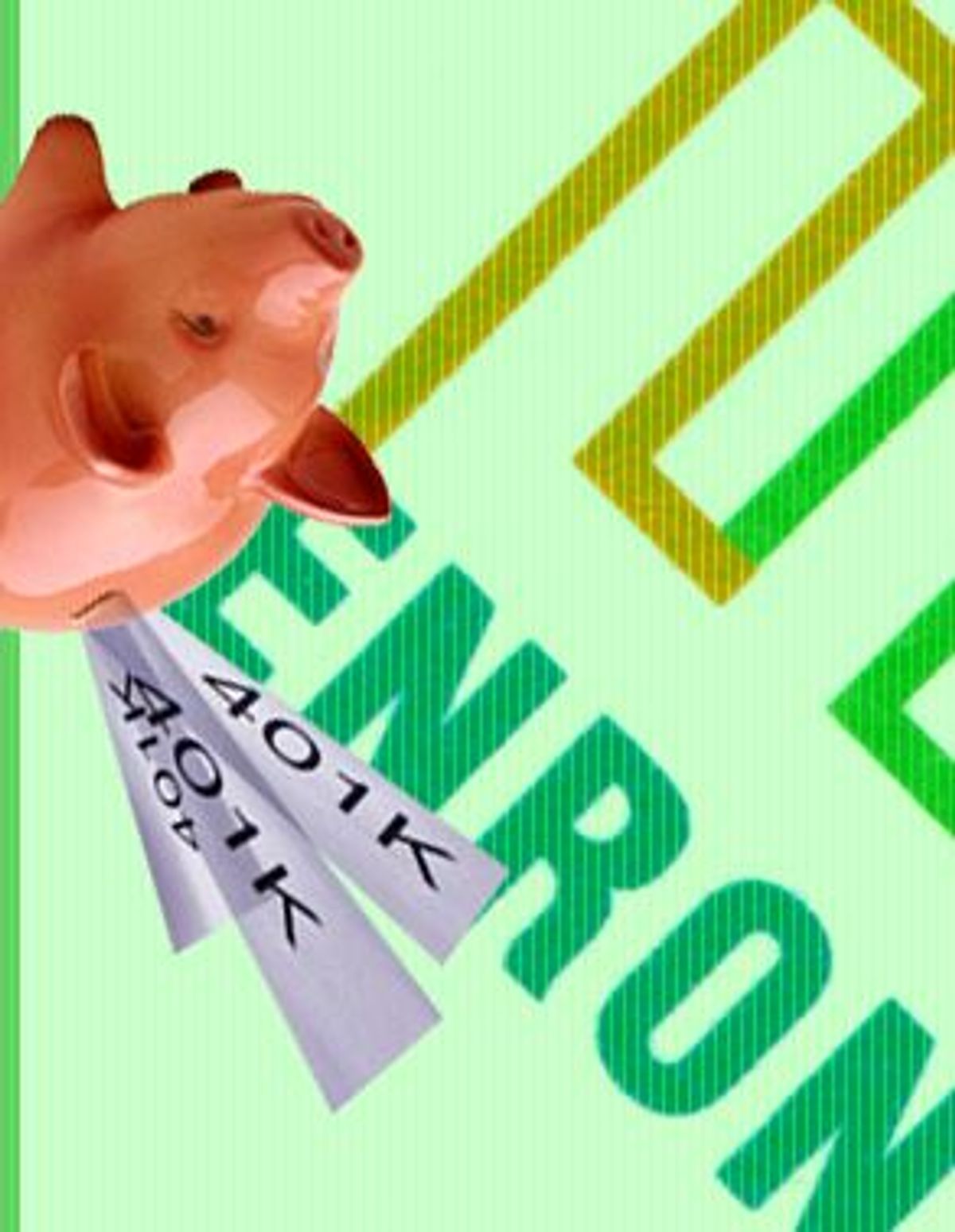
When Enron filed for bankruptcy in December, thousands of employees lost not just their jobs but also the money set aside for their retirement. Utility workers, midlevel managers and others who invested in Enron stock via the energy trader's 401K savings plan lost an estimated $1.3 billion.
In all, "about 18,000 to 20,000 employees lost money because their retirement accounts were invested in Enron stock," says Karl Barth, an attorney for Hagens and Berman, a Seattle law firm that's suing the energy trader on behalf of the employees. Chances for quick recovery appear nonexistent; the lawsuits won't be completed for years, corporate bankruptcy filings typically send shareholders to the back of the creditors line and, on Jan. 15, the New York Stock Exchange delisted Enron's stock.
The plight of Enron's employees, in contrast to widely reported stories of top Enron executives cashing out for millions of dollars over the past few years, has made Enron's 401K plan a hot political topic. President Bush, Treasury Secretary Paul O'Neill and several members of Congress have called in recent weeks for an investigation -- "to make sure that people are not exposed to losing their life savings as a result of a bankruptcy," as Bush put it.
Barth aims to hold Enron accountable. The design of Enron's 401K savings plan, he says, contributed substantially to employee losses. Enron limited employees' investment freedom from the start by matching their contributions only with company stock and by preventing employees from selling that stock until age 50.
And just as Enron's problems began to escalate into public view, Enron chose to change administrators of its 401K plan. During the period in which information about the plan's accounts was being transferred from one administrator to another, employees were locked into the 401K decisions that they had already made.
The timing could not have been worse. The decision to change administrators came just before Enron released information about its business that was bound to depress its stock price further.
There's some dispute about the length of the lockdown -- Enron says it lasted from Oct. 29 to Nov. 13; employees claim they couldn't make changes between Oct. 17 and Nov. 19 -- but what's clear is that employees were unable to shift their investments away from Enron stock as its price tumbled ever lower. Specifically, on Nov. 8, when the company restated its earnings from 1997 to 2001, employees who had Enron stock in their retirement accounts could not sell. They had to hold the stock, which was then falling below $9 per share (from a high of $90 in September 2000), until at least Nov. 12, according to Enron, and Nov. 19, according to Hagens and Berman's complaint.
The employees most at risk were those who had expressed the most faith in Enron by putting their own contributions into Enron stock. Meanwhile, says Barth, some Enron executives reportedly were enrolled in a different retirement plan that did let them dump their shares. Executive-selling disclosures for October and November have not yet been released. So it is impossible to know how many executives took advantage of their opportunity. But the mere existence of the loophole has employees crying foul.
While Enron certainly lived at the cutting edge in many of its financial operations, the way its 401K plan was structured was not exceptional -- on the contrary, it was typical. If there's any silver lining to the Enron mess, it may be that the high profile of Enron's implosion may finally focus long overdue scrutiny on how contemporary pension plans and retirement funds work.
The timing of Enron's 401K lockdown raises a host of questions about Enron's intentions, but the larger story of how the company's 401K plan was set up is far from unique. The days of guaranteed, or "defined" benefits -- you get out what you pay in -- were over long before Enron collapsed. Today, so-called defined-contribution plans, in which the payoff depends on how your investments play out, can be found at nearly every sizable company.
In large public companies, it's also common for employees to have the vast majority of their money tied up in their employer's stock. Enron's employees had about 60 percent of their assets in Enron stock, but that's far from the extreme. Procter & Gamble's workers keep about 94 percent of their 401K money in P&G stock, according to a recent survey. Employees of the Sherwin-Williams paint company keep 90 percent of their plan's assets in company stock; at Coca-Cola, more than 81 percent of 401K assets sit in the soft-drink company's paper.
As any financial planner will tell you, undiversified investment is risky, but for many Enron employees -- like the workers at Lucent, Ikon Office Solutions and other companies that are being sued by their 401K holders -- the danger wasn't recognized until it was too late.
"There's a tremendous amount of inertia with 401Ks," says Brigette Madrian, a professor at the University of Chicago business school. "By the time the lockdown started, Enron's stock had fallen by a lot, at least two-thirds, so you'd think that people would have gotten out, but they didn't. They still had 60 percent of their assets in company stock."
Which raises the question: Do 401K investors need to be protected from themselves more than their companies?
The question never even occurred to Ted Benna, who first came up with the design of today's 401K about 20 years ago. He figured that creating a framework of pre-tax contributions, matched by employers, would encourage people to save for the future. In 1981, the IRS approved Benna's plan. But the veteran financial planner never expected 401Ks to take off, nor did he imagine that people would tie up most of their savings in a single company's stock.
"The problems of today weren't an issue 20 years ago because investing wasn't that big a deal," he says.
Defined benefit programs had dominated the retirement field for decades. In combination with regulations that precluded employers from investing more than 10 percent of the assets in any one entity, they were safe, predictable savings tools.
"In the old days, you knew what you were going to earn at the end of your life," says Ernest Englander, professor of business and public policy at George Washington University. "But in the '80s and '90s, we moved to defined contributions, not benefits."
Along the way, companies started exerting more influence over the retirement investments. Specifically, "Many companies set up rules so you had to put the money into your own company," Englander says. CEOs wanted people to feel like they had a stake in the company, but risks came with connection.
They also had another, less honorable motivation. Making contributions in stock avoided expensive cash payments that could detract from the company's bottom line.
"Not only were you not diversified, but there were also restrictions on when you could take that money out," Englander says. "It made you be fully invested in your own company: Not only is your income based on the company, but so too is your retirement."
Few employees noticed or cared during the '90s, when the stock market surged ever upward. As newly minted dot-com millionaires made headlines, companies in every sector of the economy started distributing stock, sometimes in lieu of salary. Many employees welcomed the change. The "I don't want to miss out on a good thing" mentality ruled, Benna says. It was everywhere. He even remembers listening to the administrator of General Electric's 401K plan, who repeatedly told people at conferences, says Benna, "that he was penalized by following his own advice and that of pros by diversifying rather than investing his whole account in GE stock like some other employees did."
When the stock bubble burst in April 2000, the love affair with stock largely ended. But the idea of 401K reform remained in the background. California's Democratic Sen. Barbara Boxer had proposed legislation to enforce diversification in 1997 but the idea never went anywhere. Now, after the downturn, experts stressed the dangers of overinvestment in one stock and tried to draw attention to previous collapses, such as Carter Hawley Hale's and Color Tile's. (Both companies' employees had more than 90 percent of their 401K investments in company stock, so when they went bankrupt -- Carter Hawley Hale in 1991; Color Tile in 1997 -- they lost nearly everything.)
But not even a lawsuit filed last summer against Lucent attracted calls for reform. Even though the company's 401K holders claimed that Lucent violated its fiduciary duty by placing stock in 401K accounts -- as the stock dropped from a high of almost $80 in 1999 to under $7 -- there was little effect on the overall 401K market. Only 7 percent of 401K plans have limits on how much can be invested in one stock, according to a Fidelity Investments study, and as of July 31, nearly one-third of 401K assets were invested in company stock, according to the Hewitt 401K index, based on data from 1.5 million plan participants.
The Enron debacle threatens to end 401K complacency. On Jan. 10, Sens. John Corzine, D-N.J., and Boxer introduced a bill that would limit 401K plan investments in a single company's stock to 20 percent of the entire fund. President Bush has also called for an analysis of the nation's retirement and pension system, and Treasury Secretary Paul O'Neill noted on Tuesday that contributions to 401K plans "belong to the individual workers and no one should take control away from the individuals who own those nest eggs."
"Enron is the bellwether for reforming the 401K system," says Madrian. "A number of economists and practitioners are of the opinion that 401K plans are an inappropriate place to invest stock, that it's too risky. This case has gotten a lot of publicity; it could be enough to bring about change."
But shouldn't investors bear some of the responsibility for their own actions? Wouldn't limits on the amount of stock employees could own in their own company restrict their ability to have complete control of their investments?
Roger Porter, professor of business and government at Harvard, is skeptical of "this awkward situation where we're trying to protect people from themselves." Even Benna, who favors a law limiting investment in a single company's stock, concedes that "some of the blame rests with employees who decided to put their own money into Enron stock."
But those who are calling for reform argue that the 401K system favors executives at the workers' expense.
"The retirement rules are written in such a way that the workers move to the head of the losers list, and shareholders come right after that," says Englander. "The Enron collapse raises important questions about what it is we want our capitalism to look like. Should we have protections for workers? For shareholders? For holders of pensions? These are the questions that will now arise."
Employees shouldn't be locked into buying company stock, says David Sandretti, spokesman for Boxer. "Employees don't have a choice a lot of the time," he says.
"There's a lot of pressure from employers to invest in their company," adds Sandretti. "Employees end up wanting to show loyalty to their employer and end up frequently encouraged to make these investments. And in Enron's case you had officials of the company sell employees a bill of goods because at the same time they were selling stock they were encouraging employees to continue investing in Enron."
The main risk of new legislation seems to be that companies, if barred from contributing their own stock, would stop matching employee savings. But Madrian says there is no evidence to prove that would happen. In any case, she notes, protections are long overdue. Traditional pension plans limit investment in a single stock to 10 percent; 401Ks should have limits too, she argues.
Benna compares the situation to seatbelt laws and helmet laws "that have been passed to protect people who won't use these safety devices on their own." The unfortunate financial truth is that, yes, people "need to be protected from themselves." But he adds, they also need protection "from management who pushes them to buy company stock."
Shares