Books

The (non-)confessions of St. Ralph

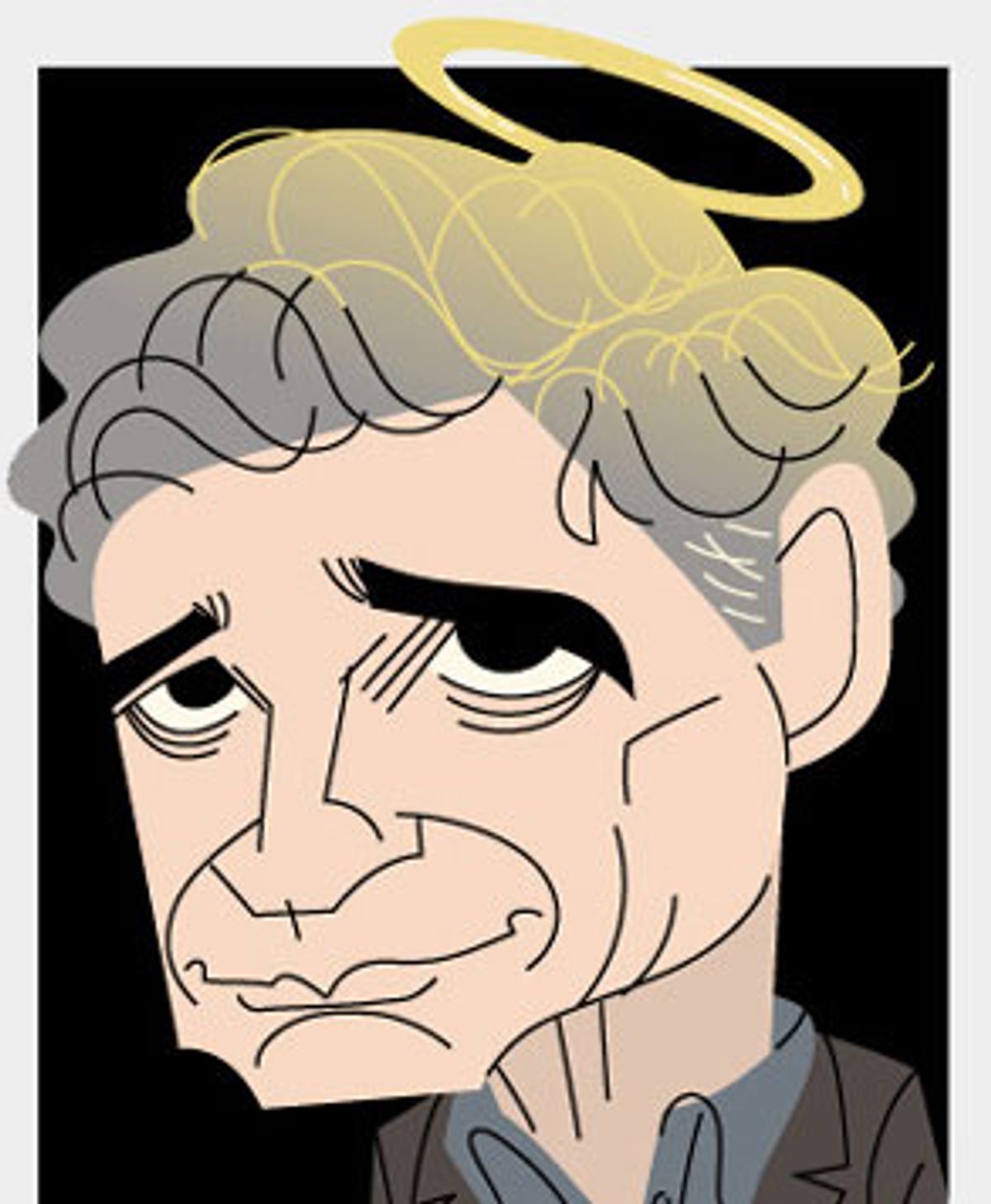
Ralph Nader's new book makes it painfully clear that he has no idea how to build a left-wing alternative to the Democrats. But when you're pure of heart and unsullied by politics, who cares?

It’s official: Green Party spoiler Ralph Nader gave the presidency to George W. Bush in 2000 by stealing votes from Al Gore. “The Simpsons” tells us so: The Jan. 6 episode featured Homer’s boss Mr. Burns at a meeting of Springfield Republicans, asking what new “unspeakable evil” the party can come up with. One rumpled fellow is waving his hand, ooh-ooh-oohing for attention like a schoolboy, but Burns dismisses him: “You’ve already done enough, Nader.”

Ouch! Sucks to be Nader! The nation’s foremost anti-corporate crusader lampooned by its foremost anti-corporate sitcom? It isn’t fair. But the notion that Nader is to blame for Bush’s presidency had hardened into fact for bitter Democrats even before Simpsons creator Matt Groening made it funny. In his new book, “Crashing the Party: How to Tell the Truth and Still Run for President,” Nader carps about it nonstop; an appendix features the full text of a self-righteous Nation essay by lefty actor, Nader backer (and husband of Susan Sarandon) Tim Robbins, who complains about being attacked at parties by Gore voters who snarl at him: “We hope you’re happy now!” — meaning now that he helped elect (is that the right word?) President Bush. They even harass his and Susan’s children!

Now let’s get this straight, Gore voters: Nobody should be attacking Tim Robbins’ and Susan Sarandon’s kids for their parents’ support of Ralph Nader. At this point, let’s be nice to them at parties, too, OK? I’m not being entirely facetious: Reading the Robbins piece made me cringe a little, because I’ve needled friends who voted for Nader in much the same way. In the days before and after the November 2000 election — especially after the Florida deadlock made it clear that had just half of Nader’s 96,000 Florida votes gone to Gore, the Democrat would have won the state, and the presidency — there were lefties lining up to kick Nader in the pages of Salon: Todd Gitlin (twice), Joe Conason (also twice) and Charles Taylor; I myself couldn’t resist a cheap shot at Nader and the “poor dumb Greens” in a less than stirring endorsement of Gore Nov. 6. It could have been a new Internet business model: Instead of paying them, we could have let writers pay us for the satisfaction of denouncing Nader’s evil appeal.

Two things made me crazy about Nader and his Green Party groupies. First and foremost was their sanctimony. But a close second was the way the Green campaign represented the depressing fatal tendency of the American left to divide and conquer — itself. Nader and his friends were nastier about Al Gore and Bill Clinton than even Bush was, and to me that reflected the circular firing squad mentality that’s kept the left a comparatively marginal force throughout most of American history.

But even during that soothing frenzy of Nader-bashing during the otherwise unbearable Florida debacle, it occasionally occurred to me that my own ire, and that of my allies, could be an example of the exact same tendency. Why be such a Nader-hater? Some liberals seemed more outraged at Nader than, say, Supreme Court Justice Antonin Scalia, whose shocking halt to the Florida recount, we now know, did more to hand Bush the presidency (if you believe, as Newsweek and the Orlando Sentinel reported, that Florida Judge Terry Lewis was prepared to order the counting of overvotes, which favored Gore) than Nader’s quixotic candidacy.

A year after the shouting, I had to at least consider the possibility that Nader-hating was my version of the way the powerless (and that certainly includes the American left) typically respond to their plight: by lashing out at something small they have some control over — Nader and the Greens’ appeal — in order to forget the bigger things that they can’t change — the way Bush won the White House, the way Gore lost it. Certainly Nader wasn’t all wrong in his critique of the Democrats: Their failure in the past year to block Bush’s agenda, especially his budget-busting tax cut, seemed to prove his point about their wimpiness, though Senate Majority Leader Tom Daschle may have gotten a spine for Christmas.

And clearly the metastasizing Enron scandal proves Nader right about the corrosive effects of corporate control on both parties. Sure, the Bush administration seems like a wholly owned subsidiary of Enron: The company’s lavish financial patronage helped the up-from-failure president’s son launch a political career at 48 and become president six years later, and its ties to the Bush Cabinet rival those between al-Qaida and the Taliban. But generous Enron donations to Democrats are blunting the scandal’s partisan edge. CEO Ken Lay played golf with President Clinton and advised Al Gore on energy deregulation. The corporation gave Democrats $532,000 in “soft money” during the 2000 election, Republicans $623,000. Perhaps the most powerful advocate of an Enron bailout — something no Bush administration figure publicly backed — was a Democrat, former Clinton Treasury Secretary Robert Rubin, who unsuccessfully lobbied his old department, as chairman of Citigroup, to intervene with bond-rating agencies to stop the downgrading of Enron’s status (and massive losses for Citigroup) last November.

So I resolved to read Nader’s new book, and revisit his 2000 campaign, with an uncharacteristically open mind. What was he trying to say last year, while I kept my fingers in my ears and chanted “Spoiler!” so I wouldn’t have to hear him? I never even considered voting for Nader. Could his book convince me that I was … wrong?

Parts of “Crashing the Party” remind you of what’s best about Nader: the reach of his intellect and activism over the last 40 years, from auto safety to bank redlining in the inner city to pay equity for women. Even the most vicious attacks on Nader in 2000 had to begin by acknowledging the legislation he’s inspired, the groups — Public Citizen, the Public Interest Research Groups, Multinational Resource Center, Consumer Project on Technology — he’s helped found.

And for political junkies, the book is sometimes a surprisingly fun read, despite Nader’s preternatural lack of playfulness. There’s a hilarious section on the strange role of Warren Beatty, who flirted with a presidential run himself, then flirted with backing Nader, and then disappeared, but not before giving Nader some cash, some political advice and some cosmetic tips. He told the gaunt activist to insist on direct lighting for TV appearances, since lighting from above or below tended to make the lean, mean Green look like a character in a horror movie. Thanks, Warren.

He also revisits his crusade to get the corrupt Commission on Presidential Debates to give him a podium. Nader’s level of outrage is in this case appropriate to the topic at hand: the way the two parties wrested control over the debates from the League of Women Voters, and subsequently rigged the rules to protect their lackluster candidates from serious questions and third-party challengers. The worst abuse was Nader’s being denied entrance to the debates even as an audience member, even when he produced a ticket. It won the Green Party candidate some of the most sympathetic and high-profile media coverage of his campaign, although there’s been no serious subsequent challenge by the media to the CPD’s disgraceful reign over the debates, which will likely continue in 2004.

Complaints about the media dominate “Crashing the Party,” and some are on target. The New York Times ran several vituperative lead editorials attacking Nader for his presidential bid, and they embarrassed the paper, making it seem at once like a house organ of the Democratic Party and profoundly anti-democratic. At the time even Nader-haters found the editorials remarkable and offensive, and Nader is on the money when he blasts the Times for its crude arrogance (it was the crudeness that was remarkable; the Times’ arrogance is usually expressed much more subtly and seductively).

But much of his grousing about the media is unfair. He grows tiresome as he recites supposedly major events and pronunciamentos the Times and the Washington Post failed to cover. The fact is, with a few exceptions — his campaign to join the debates; media wizard Bill Hillsman’s great spoof of MasterCard’s “Priceless” ads; the sold-out, inspiring Madison Square Garden rally in October 2000 — Nader ran a lackluster campaign. And who’d have thunk it? Globalization was finally on the map as a political issue that year, there was a consumer product safety scandal in the news thanks to the Ford/Firestone tire tragedy — an auto-safety scandal, for God’s sake, tailor-made for the author of “Unsafe at Any Speed” — plus a looming energy crisis. Meanwhile, Bush and Gore were more tweedledum and tweedledee than any pair to run for president in American history. Nader should have thrived, but his campaign never caught fire, and blaming the media misses the point.

In fact, I’d argue that Nader got more coverage than he deserved, given the Green Party’s lack of national stature, his single-digit poll numbers throughout 2000 and his own lack of elective experience. A Lexis-Nexis search of “Ralph Nader” and “Green Party” for Jan. 1, 2000, through Election Day turns up almost 8,000 news and magazine stories; the supposedly neglectful New York Times alone ran 250 articles that at least mentioned Nader and his Green candidacy, as opposed to only 33 about Pat Buchanan’s Reform Party bid. That’s despite the fact that Buchanan made two earlier runs for the Republican presidential nomination, and his Reform Party predecessor, Ross Perot, had in 1996 drawn 8 percent of the vote plus federal matching funds, compared with Nader and the Greens’ less than 1 percent that same year.

Though it would chagrin Nader to admit it, there’s no doubt his celebrity, not his compelling political agenda, won him much of the national media attention he got — that, plus the fact that as the race tightened closer to Election Day, the Gore campaign took off the gloves with a drive to convince lefties that a vote for Nader was a vote for Bush. Political reporters everywhere were suddenly trailing the possible spoiler, but he couldn’t turn the new attention into votes. His poll standing started to fall and in the end, he won a disappointing 2.6 percent — enough to tilt the election to Bush, but far less than his goal. Nader’s failures in 2000 — to run a compelling campaign, and to achieve what many said was his real aim, the 5 percent of the vote that would get the Greens matching funds from the Federal Election Commission — has a lot to say about the sorry state of the left. But it says even more about Nader’s own shortcomings as the limping left’s would-be leader.

For 30 years the American left has mostly been a freak show of clashing grievances in search of a persuasive agenda and a dynamic leader, and inevitably finding neither. In some ways, of course, activist left-liberalism was a victim of its own success: Advocates for labor, consumers, minorities and the poor helped end child labor, win the eight-hour day, achieve voting rights, abolish legal segregation, extend new health and welfare programs to the needy, pass groundbreaking clean air and water legislation, mandate seat belts, airbags and highway mileage standards — the list could go on and on. All those reforms took the edge off the misery of the poor, blunted capitalism’s worst abuses, robbed muckrakers of vast acres of muck and made the nation safe for complacency.

But the left colluded in its own defeat and ongoing irrelevance. In one telling passage, Nader notes that the last president to back a progressive social policy agenda was none other than that great lefty, Richard Nixon, who proposed a host of reform legislation including a national minimum income plan as an alternative to welfare and a comprehensive health insurance proposal. Nader fails to mention that the left helped defeat both, believing it could win more for the poor by holding out. Instead it won a backlash against the poor and against the ineffectual Democratic Party by working-class Democrats, which led to the election of Ronald Reagan.

Nader correctly charts the way business began to fight back in the early 1970s, against laws (signed by Nixon) establishing the Occupational Health and Safety Agency, the Environmental Protection Agency and the Consumer Product Safety Commission. This no doubt made a difference: Jimmy Carter’s 1976 post-Watergate victory represented the last gasp of New Deal/Great Society liberalism. But while aggressive political counterpunching by big business helped, so did the Democrats’ — and the Democratic left’s — incompetence. By the end of the 1970s, the energy crisis, runaway inflation, rising welfare rates, crumbling schools and inner cities and the failure of foreign policy that led to the Iran hostage crisis convinced Americans that Democrats and so-called big government couldn’t manage a changing world. That ushered in the Reagan-Bush era, which may ultimately turn out to be the Nixon-Reagan-Bush-Bush-probably not poor Dick Cheney era, with the Carter and Clinton years turning out to be mutant flashes in an otherwise solid two generations of Republican dominance. Time will tell.

What’s already clear is that Nader has no clue about how to challenge Republican dominance in any lasting way. He has some decent instincts about what’s wrong with the left: He hates identity politics, for instance. That’s partly because he’s more partial to a class analysis of American inequality, but especially because in the last election, identity politics rose up and bit him in the ass, when women, gay and minority Democratic leaders pretty shamefully distorted his record to say he wasn’t good on their issues, in order to help Al Gore.

But if they were wrong when it came to the letter of Nader’s career and his record, they were on to something when it came to the spirit. Nader’s rejection of the crass appeals of victimology by various Democratic constituencies reflected both his integrity and his arrogance. How dare Democratic Party feminists deny his strong record on women’s rights, he says in “Crashing the Party.” Why, “in the early 60s,” he writes, “I started collecting material for a book on discrimination against women in the United States only to open the newspaper to discover Betty Friedan’s ‘The Feminine Mystique’ did it better than I ever could. All this was years before Gloria came upon her life’s mission.” What a sensitive New Age guy, you first think, but it doesn’t quite sit well: Is he staking a claim to being one of feminism’s founding fathers? Needling Steinem for being late to her own party? There’s something off about the preachy tone.

Likewise, he’s somewhat sympathetic when he describes his anguish at the fact that black Democrats and their allies tried to impugn his civil rights record to promote Gore. He lays out his work on racial issues, from efforts to improve banks’ lending practices in poor, minority neighborhoods, to clean up toxic brownfields in those same areas, even to make landlords eliminate lead paint (which still poisons too many low-income black children) from slum buildings. But then he kvetches, ungracefully, about how blacks don’t care enough about the issues he deems important, harping instead on such things as police brutality and racial profiling.

His work to eliminate environmental racism, he writes, should have won him more black support: “The discrimination inherent in ‘breathing while black’ deserves at least equal attention to ‘driving while black.’” Says who? I’m sure Nader has no idea how arrogant that sounds. He just doesn’t get it: He can’t pick the black community’s issues, or anybody’s issues; a successful political leader has to start from where people are, and try to reach them there.

But I can forgive Nader his confusion about how to handle the left’s fractious interest groups and their shortsighted leaders, to whom almost no liberal (except maybe Oakland Mayor Jerry Brown) has stood up when running for office, and lived to tell about it. What I ultimately can’t forgive is the sanctimony that makes Nader, and his prominent followers, the antithesis of what’s needed to galvanize a cross-class, cross-race, broad-based American left.

Nader’s supporters are worse than he is, but in the book he seems blind to their insufferable self-righteousness. He affectionately quotes his buddy Michael Moore haranguing college students, warning that if they vote for Gore as the lesser of two evils “you’re going to have a miserable life!” We see Susan Sarandon express sadness, not anger, when her friend Gloria Steinem attacks Nader; with probably unconscious condescension she suggests the feisty feminist is scared to buck the Democrats: “I would ask Gloria … to stop being so frightened,” she says. The enlightened Tim Robbins also sees fear paralyzing Gore voters. “It’s a frightening threshold to cross,” he says of his decision to join the Greens, “but an essential one.” The book helped me formulate exactly what I can’t stand about so many Nader backers: They exude an inner certainty that deep down they’re better people than the rest of us — braver, happier, smarter, more full of integrity, probably better friends, better parents, better lovers. Maybe Robbins is right: They frighten me.

Nader himself is more admirable, but there’s still something off in the way he tried to make himself over as a political leader. He seems to be doing a rather stiff impression of a politician, rather than actually being one. (Gore wasn’t much better.) Early on in “Crashing the Party,” there’s a perhaps unintentionally revealing chapter in which Nader describes his father driving him around their Connecticut town, showing him the community institutions — libraries, schools, public buildings — built by the wealthy. He was raised to make that kind of individual contribution, he tells us, rather than to be a politician. There’s a term for that kind of civic leadership, of course, and it’s noblesse oblige, though Nader never uses the words. Noblesse oblige wasn’t all bad; it was certainly better than the ethic of selfishness and entitlement embraced by so many of the wealthy today. But it’s the kiss of death for a politician. Nader can’t help the way his innate elitism shows through. I know he’s of Lebanese ancestry, but he often seems like a Yankee WASP (and he doesn’t add to his populist street cred by referring regularly in the book to old friends and supporters from his Princeton and Yale days).

Just as damningly, Nader’s discomfort with the personal touch that leadership requires fairly jumps off the page. He himself stiffly puts it this way: “Running for president requires a level and intensity of political ego that I do not find congenial.” It’s not exactly ego he lacks — the book confirms that much of Nader’s pique at Clinton and Gore arose from their failure to meet with him as requested; he perceives Gore’s offer to talk by phone as an insult. He’s got plenty of ego, and is entitled to it; what Nader really dislikes is the sweaty, messy, hands-on business of politics — and he confesses as much.

Before his big Madison Square Garden super-rally, he admits: “I have a visceral aversion to addressing very large audiences as if they were a crowd. In college, I read books on crowd psychology, how speakers mesmerize masses with tested propaganda cant, verbal incitations, and the more silent language of gestures and voice modulations. I dislike these methods.” He approvingly quotes Noam Chomsky, who wouldn’t go on television to debate the Vietnam War because its sound-bite format favored the right, letting it win the debate with formulations like “Peace through strength.” So he doesn’t like speeches to big crowds, and he doesn’t like TV sound bites. What does he like? He says he liked the fact that raising money as the Green Party candidate for president, “nobody I called wanted anything in return, which frequently would have been the case were I running as a Democrat.” Of course, that would have been the case if Nader had any prayer of political success, in any party — that’s what politics is about. People want something, and they turn to politics, and politicians, in order to get it. But our hero seems to prefer political failure — it keeps his hands clean, and it’s better for his soul.

In the end, though, the book’s most shattering revelation is that Nader and the Green Party have absolutely no idea how to build a left-wing alternative to the Democrats, and no feel for the issues that would move them toward majority. Toward the conclusion of “Crashing the Party,” as he surveys the political landscape for hopeful signs, he tells us that youth will be the vanguard of any new movement, and notes that America was founded by comparative youngsters: Thomas Jefferson was 32 in 1776, he points out, James Madison 35, and George Washington “was only 44.” Of course, they were actually geezers, since life expectancy in 1776 was only 35. It’s a small point, but it’s typical of the way Nader lacks a convincing analysis of what’s necessary for leftward political change.

A more damning omission in the book — and one that should disqualify Nader from running for president again — is its complete neglect of foreign policy. There’s exactly one citation under “foreign policy” in the index, and that points to a section in which he urges the Defense Department to take the lead in infectious disease eradication. I’m not kidding. There are no entries under “terrorism,” “Israel,” “Iran” or “Iraq,” though his indexers missed a reference I found to “cruel” U.S. sanctions against Saddam Hussein’s nation. To be fair to Nader, foreign policy got relatively scant attention by Bush and Gore during the 2000 campaign, a stunning omission, in hindsight, thanks to the wisdom bestowed on all of us, left right and center, by Sept. 11. But he hasn’t used the last four months to formulate a platform either. Asked by Fox’s Bill O’Reilly how he’d respond to the terror that killed 3,000 Americans, he spent most of his time fulminating against “autocratic ideologues” and “corporate greed mongers” in the U.S. who he thinks have taken advantage of the threat to restrict our liberties and profiteer.

Finally, “Crashing the Party” never takes on what I believe is the most damning argument against his cause: That in a non-parliamentary, winner-take-all system, there’s nothing a third party can do but play spoiler to the mainstream party that’s closest to it ideologically. Again and again, he quotes left-wing Democrats who admire his history of activism begging him to run in the Democratic Party, and he rejects their advice with little respect or reflection — he’s so convinced of the rightness of his cause. He doesn’t even consider the fact that a strong showing in the primaries might have forced a chastened Al Gore to bargain with Nader and support some of his causes.

In that scenario, however, Nader would have had two obvious problems. The first is the fact that his campaign failed to identify one or two crucial issues worth compromising to achieve. The campaign amounted to a tedious assortment of grievances and complaints, with some good ideas and some nutty ones side by side. To be fair, the Greens are great on campaign finance reform and reducing obstacles to voter participation — but on those issues, Gore at least said the right things, and the most serious obstacle has been the GOP. Nader’s book only underscores the party’s failure to develop coherent, persuasive programs and policies. It features three pages on legalizing the hemp industry, for instance, but nothing substantive about how to reform the welfare system; it’s got lots of references to opposing educational testing and developing a democracy curriculum for the public schools, and nothing about teacher shortages, crumbling school buildings and unconscionably high dropout rates. And the Greens don’t have a platform they could have bargained with Gore about: Befitting their holier-than-thou approach to politics, they offer voters a list of 10 “key values” rather than a series of planks and positions, including “ecological wisdom,” “feminism,” “nonviolence,” and, um, “future focus and sustainability.”

The second problem with a scenario in which Nader ran as a Democrat and tried to bargain with party leaders is that he would have had to leave the safety of his clean Green sanctuary, in which “nobody I called wanted anything in return.” He’d have had to haggle and compromise, maybe even get his hands dirty; noblesse oblige won’t take you far in Democratic primaries. Maybe most important, he’d no longer be the revered party leader who always has the last word; he’d be just another Democrat with a sharp mind, a way with words and his own brand of charisma, who’d have to convince others he was right in order to get his way. Until Nader decides he’d rather be effective than pure, he won’t amount to anything more than a bumper sticker specially designed for the holier-than-thou.

Joan Walsh

Joan Walsh is Salon's editor at large.

“The Aleppo Codex”: The bizarre history of a precious book

A reporter traces the shadowy fate of the definitive version of the Hebrew Bible

Matti Friedman

An ancient and priceless book, a murky history of evasions and coverups, an underground of sinister and possibly violent dealers, a former spy who drops tantalizing hints and a wily 84-year-old millionaire who says stuff like, “The problem with this story is that it could damage your health”: Are these the ingredients for a cheesy, improbable historical thriller? Yet “The Aleppo Codex,” Matti Friedman’s account of his attempts to learn the history of one of the world’s most precious books, sports all of these assets, and it’s nonfiction. If reporting this story damaged Friedman’s health, it probably happened when he realized what he’d stumbled into and his reporter’s heart started beating in doubletime.

The Aleppo Codex is the most authoritative version of the Hebrew Bible, produced in the 10th century by the great rabbi Aaron Ben-Asher and the scribe Shlomo ben Buya. Friedman, who lives in Israel and has covered the Mideast and the Caucasus for the Associated Press and other publications, explains that the codex’s significance to Jewish faith and identity is more than symbolic. As a people scattered across the globe, “instead of being bound by a king, a temple, or geography, [Jews] needed to be bound by something else, something portable. What emerged was the idea that a people could be held together by words.” Yet in the centuries before printing, when words were transmitted orally and by copyists, it was all too easy for mistakes and variations to creep in, and “Jews could not be held together by a book if they were not reading precisely the same one.”

The codex was the perfect version of the Bible, a sort of atomic clock of Judaism, and intended to be the model for all subsequent copies. Its early history was fraught: captured by Crusaders in the fall of Jerusalem, ransomed by the Jewish community in Cairo and consulted by the fabled sage Maimonides, it was eventually taken to the Syrian city of Aleppo. There, it resided for half a century. Although it was well-cared-for by Aleppo’s Jewish community, it had come to be revered as a relic or treasure; few were allowed to see it and no one was allowed to copy it.

All that changed in 1947, when the establishment of the state of Israel by a United Nations resolution led to unrest in the Arab world and the harassment and persecution of Jewish communities in Muslim nations. In Aleppo, this took the form of riots and the sacking of the synagogue. The codex — commonly referred to as the Crown — was supposed to have been consumed in a fire set by the mob.

It was not, and in 1958, the Crown was smuggled into Jerusalem by a cheese merchant who was one of the few Syrian Jews to receive official permission to emigrate to Israel. Friedman became interested in this “lonely treasure and millennium-old traveler” in 2008, when he decided to write an article about it. He imagined the piece would be “an uplifting and uncomplicated account of the rescue of a cultural artifact,” but what he discovered instead was a thicket of conflicting reports, missing records, puzzling omissions, stonewalling officials and obsessed amateur sleuths.

The mysteries surround not the ancient history of the book, but what happened to it between 1947 and the mid-1970s, although even establishing where things got dodgy proved to be a challenge. Friedman relates each piece of the story as he untangled it himself, and part of the pleasure of “The Aleppo Codex” is getting to tag along on the heels of a real-life investigative journalist as he does his detective work. Those years spent writing wire copy have not eroded the author’s eloquence, either, as the book’s headier touches attest: “Down in those streets, the stores now shuttered, the women of the manzul were receiving clients, and the men were submerged in cafe smoke like deep-sea divers, tubes between their lips, inhaling the rose-scented oxygen of water pipes.”

While the official story simply states that the Crown was presented to the president of Israel, Itzhak Ben-Zvi, upon its arrival in Jerusalem in 1958, Friedman unearthed evidence that this was no simple handoff. Most of the Jewish community of Aleppo had immigrated to Israel, and their rabbis insisted that the Crown was supposed to have been delivered to them. The cheese merchant maintained that the rabbis still living in Aleppo, the ones who had passed him the book, told him no more than to give it to “a religious man.” (The Syrian government prevented communication with the Jews in Aleppo, so his story could not be confirmed or disproved.) The Aleppo rabbis decided to take their complaint to court.

This dispute embodied major tensions within the newly formed state. The Aleppo rabbis had presided over what was, as Friedman writes, “an old community by the time Roman legions destroyed the Jewish temple in Jerusalem in AD 70.” The Israeli leadership, “largely secular European socialists,” did not strike the Aleppo Jews as “representing the entire Jewish people.” Why should these interlopers be allowed to appropriate a book that had been the focal point of Aleppo’s venerable Jewish community for half a millennium?

The codex lawsuit was also a dramatic example of what Friedman describes as a “largely untold story” concerning the migration of the Jewish Diaspora to Israel after the formation of the state. Along with the movement of people, there was also a “great migration of books.” Jews from all over the Muslim world were forced to leave neighborhoods their families had inhabited for centuries. Not only did distinctive local cultures vanish overnight, but so did many of their treasured texts, left at docks and airstrips with the promise that they would be forwarded on to their owners in Israel, and then never seen again. Well, not exactly never: Some of these books and scrolls turned up later in state archives and even in booksellers’ shops.

If that were all there was to the story of the Aleppo Codex, it would be fascinating (and dismaying) enough, but after wrestling with the shadowy story of how the Crown got to Jerusalem, Friedman turns to a second and even more disturbing question: Where is the rest of it? About 200 pages, some 40 percent of the Crown, are missing. These are the most important parts of all: the first five books of the Bible, also known as the Pentateuch and the Torah. Again, the official story holds that portions of the Crown were burned in the 1947 fire, but this has since been disproved. A couple of single pages have been found in places as far-flung as Brooklyn, N.Y., where they were carried around by Aleppo old-timers as good-luck charms. The bulk of the Torah, however, remains MIA.

This is where Friedman’s investigation gets especially lively, as he consults with a former Mossad case officer and secretly records an impromptu interview with one of the dozen or so men rich enough to have bought the missing pages. Supposedly, this collector and his daughter were approached by two dealers with a briefcase at a Jerusalem book fair in the 1980s. They were shown an old codex identified as part of the Crown, but the collector says he refused to buy it because the price was too high. One of the dealers later turned up dead in a Tel Aviv hotel room registered to a man who didn’t exist.

Friedman has his suspicions about the collector’s story: Would this man really consider $1 million too much to pay for a supposedly priceless text? He devotes most of his energy, however, to getting to the bottom of who is responsible for ripping out the heart of the Crown and selling it on the black market. As he settles on three likely culprits, “The Aleppo Codex” builds to a moral crescendo more impressive than the climactic fight scene in any thriller. “A volume that survived one thousand years of turbulent history was betrayed in our times by the people charged with guarding it,” Friedman writes. “We might file this tale between Cain and Abel and the golden calf, parables about the many ways we fail.”

Continue Reading Close
Laura Miller

Laura Miller is a senior writer for Salon. She is the author of "The Magician's Book: A Skeptic's Adventures in Narnia" and has a Web site, magiciansbook.com.

Augusten Burroughs: Conquer trauma by letting it go

Salon exclusive: The best-selling memoirist says past horrors haunt us because we think about them too much. Stop

Augusten Burroughs
Excerpted from "This Is How" by Augusten Burroughs. Copyright © 2012 by the author and reprinted by permission of St. Martin’s Press, LLC.

Many people continue to feel influenced and even controlled by the things that happened to them a long time ago. Sometimes, people harbor dark, traumatic memories from childhood. Or fragments of memories — incomplete scenes, uncomfortable feelings, perhaps even a sense of certainty that something specific and terrible happened to them, but little more than this.

Others experienced something traumatic in adulthood that continues to affect them day to day many years later. Maybe an assault has left a person afraid to leave their home or enter a particular neighborhood.

For a certain kind of person this will be the end of the story. What ever experience they endured essentially continues to this day, ever present in the background, shaping the choices made on a daily basis, affecting the quality and range of their life. This kind of person might be angry all the time or feel guilty or afraid. They just accept these states as a part of themselves.

Then there are people who are keenly aware of their experiences, who are psychologically ambitious; they wish to “get over” these historical traumas and might see a therapist to help them.

The therapeutic process takes time, commitment, and funding. Then, insight leads to understanding, which leads to choice. At last, they are free to move on.

It’s such a clean, well-defined structure for the process of healing. Almost like a paint-by-numbers portrait where all those black outlines are confusing at first, but in time, as you apply the correct colors in the right areas, the tangle of lines resolves into a perfectly clear image.

Unfortunately, our brains tend to color outside the line. First, there is the matter of understanding our past and the events that transpired.

Understanding what happened in the past is rarely truly possible. Because true understanding must incorporate context. Not merely what we experienced, but why. And the why requires knowing the motivations of the other people involved. Without the perspective of this context, our understanding will always be biased; it will be from a single perspective: Ours. And therefore, not necessarily accurate or true.

If you are on a highway and you drive past a car accident so severe that the hood of the car has been crushed up against the windshield, you may very well assume the occupants are dead. And perhaps this will haunt you because as you passed by the car, you glimpsed a little girl’s doll on the shelf behind the backseat. One look at that accident was all anybody would need to know what “unsurvivable” looked like. And you have never been able to forget that doll or the little girl who must have loved it and who died in such a terrible crumple of steel and glass. Let’s imagine that you are haunted by dreams where you come upon the accident and you see the doll and you do nothing.

Let’s say that what was unknown to you was that the car was a high-end Mercedes that featured crumple zones designed to absorb the impact of a crash while protecting the occupants within a safety cage. And let’s say that the two occupants inside the car were sitting there as you drove by and the man in the driver’s seat was on his cell phone.

“No, I mean totally like, trashed, totaled. We’re waiting; they’re supposed to send a tow truck. She’s good except she has to pee so she’s—”

“Oh my God, did you just tell Jason that I have to pee? Now he’s going to imagine me peeing. Don’t forget to tell him we found the doll at a tag sale but we need to buy wrapping paper. At least we think it’s the doll.”

“You hear that? Yeah, don’t think about her peeing. And we’re pretty sure it’s the right doll; we had to spend like three hours on Craigslist to find one.”

Imagine that after the tow truck arrives and our couple has been safely installed into a rental vehicle, they don’t really ever think about that crash again except both are pleased with the new car’s color. Neither liked the wrecked Mercedes’ particular shade of red.

In this example, you can see how your entire perception of what happened — and you were a witness — is completely distorted by your point of view.

So, if you were to enter therapy over being disturbed by this wreck, you could spend years discussing why the sight of the doll was so upsetting, and how impotent you felt being unable to stop and help but even if you could stop, what could you have done?

Possibly, the therapist would have you write letters to the dead little girl.

What this really accomplishes is the creation of a sort of personal myth. A series of well-remembered events with finely honed details. As accurate as they may be, they are accurate from only one perspective.

For many years, I believed that one’s past had to be fully understood in order to move through and beyond it. I see now that I was wrong about this. I know now that scrutinizing one’s past and trying to gain understanding and “make peace” with it is a kind of addiction that keeps one focused on the past and not on the present.

As with any addiction, the first step to overcoming it is to see it.

And once you see it, you have to stop it.

- – - – - – - – - – - – - -

Once the current moment moves into the past, it is entirely gone. It ceases to exist except in documents, photographs, and an impression left in a sofa cushion. The past — and all the moments it contained — are no longer sharing this world with us.

They are no more real than Cinderella.

To spend time — year after year — in therapy or on your own thinking about your past and forming conclusions and stitching the elements into a narrative that you can name, “the truth,” in order to be “free” of it, is not how you become free from your past.

The past does not need to be reconsidered in the present and given a structure. The events of the past cannot be understood when you are the only element of the past actively engaged in reliving it.

When somebody says, “Therapy has been really helpful to me in terms of resolving some of my issues from the past,” what does this actually, in practical terms, mean?

Or somebody is “haunted” or controlled by their past. How is this possible?

When I first moved to New York, I became friends with a guy who seemed to be exactly the guy I wanted to be. He was very outgoing and had lots of friends and they probably all felt as I did: Like his best and closest friend.

After we’d been friends for almost a year, one night we were out drinking and he told me he had a confession to make, something he wanted me to know about himself.

I nodded and tried to look very sincere and open, while inside my mind it was the Kentucky Derby, with most of the money being placed on female-to-male transsexual. That wasn’t it.

He proceeded to tell me in great detail about the utterly atrocious physical abuse he’d experienced at the hands of his father and mother during his childhood. It was well beyond anything I myself had ever come close to experiencing.

After this evening, my friend spoke of his past abuse frequently. And I realized that all the time we’d been friends, all those moments prior to his revelation had probably been, in his mind, moments leading up to The Telling.

Only after The Telling could he be fully himself with me. His story of his past abuse was a large part of his identity. It was a protected secret that was kept out of view for acquaintances and coworkers. Only after a measure of trust and intimacy had been formed would there be almost a ceremony in which he detailed his abuse. Rather like unwrapping, slowly, an extravagant gift one knows is going to blow the mind of the recipient.

When we first became friends it had amazed me that he was single. I now understood that he was single because of
how guys reacted when my friend finally revealed his history. It was like encountering a new person. And my friend’s abuse was now like a third person with us wherever we went.

Who could blame him? It was a wonder he was still alive.

Today, I see it differently.

My friend is a dramatic example of somebody who is haunted by their past. But because the past is gone, how does it haunt? Of course, it does not. The past does not haunt us. We haunt the past. We allow our minds to focus in that direction. We open memories and examine them. We re-experience emotions we felt during the painful events we experienced because we are recalling them in as much detail as we can.

We enter therapy and discuss our past. We formulate opinions about what happened. We create a rich, detailed world. In therapy or on our own, we focus our attention on something that no longer exists in order to understand or have perspective or acknowledge or own what has happened. And only after we decide this understanding or recognition has taken place do we stop worrying that particular tooth with our tongue.

For years, I believed this was how to live.

I was wrong. It’s how to stagnate.

I know now how to get over the past. It has worked for me in a deeper, more enduring way than any therapy I have ever had.

Writing six autobiographical books is what freed me from my past.

If the books had been cookbooks I expect I would feel just exactly as free. That I wrote six books about my past is the red herring; nothing I have written has in any way altered the past or healed me clean, so no scar remains.

Perhaps the process of writing — being fully in the moment, while I write letter by letter — has soothed me because it’s kept me busy. When you’re busy, you lack the time to fondle your emotional baggage. And if that sounds too reductive, remember we crawled from the swamp. Simple isn’t such a terrible thing to be in this respect.

For the same reason, being out of a job and just hanging around is depressing in a thousand different ways. All you have is time. Sooner or later, you end up wandering around bad neighborhoods inside your head. Neighborhoods like, “They never should have fired me, those assholes.” Which may be true or it may be untrue but it’s irrelevant to everything. It is through work that challenged me and required continuous freshness that I began to occupy not the past but this, right now. My advertising career had not been challenging. Being busy is not the same as being focused. Being focused means being here.

And this, here, this line, that comma.

That’s what freed me from the past. The present kidnapped me. I climbed into its car when it held up its hand and showed me the candy. I hopped right in.

When something from my past upsets me here in my present, it’s because I let my mind think back to the past and grab hold of something.

This is how the past haunts us. We think about it.

Therapy could be of tremendous benefit to “getting over” one’s past if the therapy is focused on specific ways to stop submitting to the temptation to obsess.

Many people with difficult histories carry these histories with them, burnishing the past with each retelling. Sometimes, a particular trauma may be the largest thing we have ever experienced. So we kind of move into it, make it our home. Because there’s nothing in our lives on the scale of that loss or that trauma.

So, you need a larger life. Something that can successfully compete with your past.

To live with your mind in the past — in the name of healing or understanding or overcoming — is to live in a fantasy world where nothing new or original is created. To “understand” one’s past is to handle clay that no longer exists and shape it into a bowl nobody can ever see or touch.

Denial of the painful events in one’s past is the same as obsessing over one’s past. To actively refuse to discuss or think about, if need be, what happened is to imbue it with power. Recycling the past into a new business, a not-for-profit to help others, a workshop, a painting, a book, a song — these are ways to explore the past in the context of the present. These are things people who are actively alive do.

You must never allow something that happened to you to become a morbidly treasured heirloom that you carry around, show people occasionally, put back in its black velvet pouch, and then tuck back into your jacket where you can keep it close to your heart.

Then, when asked to join the pole vaulting club, pull the coach aside and whisper, “I can’t. See” — and remove your gem from your pocket — “this is my terrible thing and as I expected, showing it to you has taken your breath away and made you sympathetic. So I will be excused, I assume?”

Other people will allow you — they will never blame you or challenge you — to use your past as an excuse to not face the normal fears everybody has when facing their future. Even if you were brutally physically assaulted, you must not withdraw because you are afraid it will happen again. This is not a valid exit.

Your fears that it might happen again are perfectly reasonable and justified: It might happen again.

Many people believe that if something really bad happens to them, they have paid their dues and nothing else really bad can happen again. But on the day you attend your mother’s funeral or declare personal bankruptcy, there is no law in the universe that prevents you from also getting a speeding ticket and your first grey hair.

When multiple bad things happen, it can feel like “life is out to get you.” It’s not. And it’s not a sign, either. What you do is, you keep going. You stop waiting for fairness.

- – - – - – - – - – - – -

You do not need to work through your past so you can heal. You need to move forward and then you’re as healed as you’re likely to be.

Unless.

Unless you experienced something so unspeakably terrible, something so out of scale in magnitude that it simply doesn’t fit into the past. It is too large to be contained by time or space. And if this is you, the thing you can do for the duration of your existence is to tell your story over and over. So that other people can hear you tell it and they can be moved, changed by it. This can help others.

Which is the single comfort for people who will always remain locked in their history, inside something that is really a different species of awful.

I met somebody whose grandfather had survived the death camps in Germany.

He told me that his grandfather was a very quiet, broken man. He rarely spoke and when he did, he told the same stories about how he survived.

I told him, “Do you listen, every time he tells you?”

He said, “No, I just kind of let him talk and do my thing; I’ve heard it all a thousand times.”

I wondered if he had ever truly heard it once. I suggested he listen, hang on every word and try to see visuals in his mind of the story his grandfather was telling him.

Some stories must be carved into the present and the future by telling and telling again and then again until the story is part of us.

From “This Is How” by Augusten Burroughs. Copyright © 2012 by the author and reprinted by permission of St. Martin’s Press, LLC.

Continue Reading Close

Augusten Burroughs' many books include "Runnning With Scissors," "Dry," "Sellevision," "Magical Thinking" and "Possible Side Effects." His latest book is "This Is How."

Why did we move to Paris?

Leaving New York seemed ideal. Until the crazy landlord, topless exams, the French flu, the lack of credit cards...

Rosecrans Baldwin
Excerpted from "Paris, I Love You but You're Bringing Me Down," by Rosecrans Baldwin, published in May 2012 by Farrar, Straus and Giroux. Copyright © 2012 by Rosecrans Baldwin. All rights reserved.

Paris’s neighborhoods, the arrondissements, are organized like a twist. They spiral from the river like toilet water flushing in reverse and erupting out of the bowl — a corkscrew or what have you, a flattened pig’s tail, a whorling braid notched one to 20. But if you walk from one neighborhood to the next, there is little to suggest the numbers changing. So it was confusing. Anyway, if you began in the middle of the Seine and snaked around, we lived on the Right Bank in the top of the third arrondissement, called the haut Marais, the upper Marais, on Rue Béranger, a quiet little street curling down from Place de la République.

We’d chosen the apartment so we could be within walking distance of nearly everything. I’d overlooked its darkness and short ceilings for location’s sake: 15 minutes to Notre Dame; 25 to the Louvre.

Earlier generations of Americans wanted to live on the other side of the Seine, in the Latin Quarter, where artists and students rambled, but the Left Bank had long ago priced out the artists and students. Now it was home to the rich of Paris, the wealthy of the retired-expat class, and Russian moguls, while the youthful and creative tended to live on the Right Bank, especially in the higher, cheaper numbers, the 19th or the 20th — if not the Right Bank of Berlin, or Toronto.

But we were very happy about our neighborhood, if not our quarters. Our apartment, located above a costume jewelry shop, was dismal and dark. The apartment above us was being renovated — I hadn’t heard the noises during my initial visit. So during our first days — we had a solid week before I was required at work — we tried to get out as much as possible.

Behind our street was a village of elbow streets, sunny walls and filthy corners, and many tucked-away shops. A ten-minute walk south was the proper Marais, the former Jewish quarter that had become a trendy shopping zone, but our northern district was still untrafficked. There were tailors and art galleries. Cafés and butchers. A store that sold athletic trophies and one that sold model trains. A blood-samples lab, a computer-repair agency, a video rental. On a leafy corner was a brightly lit lingerie-and-sex-toy boutique.

And where roads didn’t cross was an old covered market, the Marché du Temple, blue with a dirty glass roof. Some weekends, men trucked in what appeared to be stolen leather goods, but otherwise the market stood empty — Thursdays, maybe it was Tuesdays, a tennis league strung up nets inside — and the surrounding quadrant would be filled with people dawdling over café tables that they’d occupy for hours, chatting with friends. Then behind the market was Rue Bretagne, a picturesque street that wasn’t trendy yet. It would be soon, but not yet. Rue Bretagne had a park with a playground, two bookstores, a boutique that sold vintage radios, a booth that sold found photographs—it was the Left Bank I’d seen in picture books, preserved in time. At the center stood the oldest Paris farmer’s market still operating, Le Marché des Enfants Rouges, built in the 1600s, now ringed by food stalls that sold Moroccan tagines, huge piles of Turkish desserts, West African stews, even sushi.

It was fantastic.

Rachel and I tramped from dawn to late at night, and collapsed each evening. We also spent a lot of time having our pictures taken. Every service we signed up for in Paris — cell phones, Internet, electricity — required passport photos, with strict rules about their composure. On two separate occasions, we were asked to resubmit our photos; too much smiling. No visible happiness was allowed in official pictures — pas de sourire, visage dégagé.

To become Parisian was business très serieux.

Anyway, we set up home: Bought dishes, stocked the larder, purchased a mop and broom. We ate cheaply so we could afford a few good meals, including an expensive lunch one day inside the Musée d’Orsay, under rows of dazzling chandeliers, where we drank too much wine. Later we got caught in a rainstorm, running for shelter alongside the Seine. That week we must have seen … we saw a lot. But there were also errands to do.

For example, we visited a bank to open a checking account and apply for a credit card. Well, France didn’t have credit cards. Perhaps didn’t grasp them, conceptually — it wasn’t clear. The bank representative, who did not speak English, said I shouldn’t be bothered, that yes, our accounts included debit cards.

“No,” I said in French, “I apply for a card of credit.”

“This is what you have, a debit card,” she said.

“No. The debit card, it takes money, when I have money,” I said, going slowly to find the words. “I want a card that does not have a need for money.”

The banker rumbled it for a second. “Well,” she said, “we have an option where the card does not remove the money until the end of the month. Is that what you want?”

“No,” I said. “Something different.” I smiled cheerfully and tried again. “I want the card when I do not have money.”

“Maybe I do not understand,” she said. “What type of bank has cards like these?”

“American banks,” I said. “For example, if I want a computer for 2,000 euros, but I do not have 2,000 euros? I have a card. The card buys the computer. I give money to the card. Each month, a little money. Then: 2,000 euros.”

“Ah,” the banker said, pleased now, “you would like to arrange a loan!”

“Yes, but no,” I said. “I want a card. A card that gives a loan.”

“I’m sorry, I don’t understand, what kind of card again?” the clerk said.

“Its name is ‘credit card,’ ” I said.

The clerk looked at me closely to make sure this wasn’t all one big joke.

“I’m sorry,” she said, “I do not think we have this in France.”

- – - – - – - – - – - – -

Toward the end of our first week, Rachel and I were sneezing, dizzy, exhausted, light-headed, almost fainting, lacking jet fuel, and coughing up sea-green mucus.

“The Paris Flu,” expats said. A persistent chest cold caused by French germs. “Everyone gets it,” I was told over a drink in Beaubourg, by an editor at the Herald Tribune, a friend of a friend. “Trick is,” he said, “you gotta eat the local honey. Go to that farmer’s market near you, Enfants Rouges. Introduce antibodies to your system from the Paris bees. Make sure you look for the sticker that says the bees are from Paris, that’s important.”

The next day, after a morning rain, there was a huff of good weather, and Rachel and I went out and purchased the honey of local bees. Then our stove broke. I was eating honey off a Kit Kat when the repairman rang the buzzer.

The repairman looked at our stove and drew squiggles on a ticket. He made to leave, so I handed the ticket back to him and attempted to explain that I couldn’t read his handwriting.

He wrote in block letters, CRÈME POUR LA PLAQUE.

So for lack of a creamy topping . . .

“The stove has plaque?” Rachel said from the doorway. She sniffled and went back into our living room, a cavern with dark beams.

I said quietly to the repairman, “Where do I find the cream for the plaque?”

But he’d already walked out. He was kind of a bastard.

In the hallway, he stopped in front of our neighbor’s door. There were buzz-saw sounds, and sawdust pouring in through an open window from the apartment upstairs. The repairman snatched the paper back from me and scrawled in carpenter pencil, “BHV,” then stomped downstairs, just avoiding a pregnant girl and her boyfriend.

“BHV,” I announced, closing the door. “What’s that?”

“Oh, the hardware store,” Rachel said, “near Hôtel de Ville. Bay-ash-vay. It’s the one with the lingerie section. I heard about it, I’ll take you later.”

- – - – - – - – - – -

Several letters arrived that week from the government. One said Rachel and I needed to be weighed, measured, and scanned for tuberculosis, immediately. Also, I’d be asked to pass a language test, since I’d be the one taking a job that could have gone to a French person.

Our appointment was the same day as the repairman’s visit. The health clinic was located near Place de la Bastille, not far away. We were in that paunch of Paris summer when the heat ballooned at one p.m., and the weather was lovely in a vehement way, glares everywhere.

At the clinic, Rachel and I were assigned to different waiting areas. After X-rays and measurements, I was directed to a language examiner’s office, for my French quiz.

“What do you do for a living?”

“I work in advertising.”

“What do you do in advertising?”

“I write.”

“What do you write?”

“I write for babies. Milk for babies.”

“Where are you from?”

“New York City.”

The examiner sat forward and said in English, “Wow, you are?” For five minutes she described to me how she was planning to visit Manhattan soon, it was a long-standing dream. “But isn’t it very dangerous?” she asked in English, her consonants sharp as thorns. “Do blacks and whites really get along?”

We stopped for a bite to eat on the way home, in a café on the Boulevard Richard-Lenoir. We ordered some white wine and frites, which came served with awful ketchup — and here I’d thought Heinz was universal.

“So,” Rachel said, “a lot of scientists have now seen me topless.”

“Oh, I know the feeling,” I said. I was holding my tuberculosis X-ray up to the window.

“Trust me, no, you don’t,” Rachel said.

She cinched her jacket, a green coat she’d bought especially for our move to France, and explained that things for women in Paris were quite different. “So the doctor is asking me questions. I have no idea what she’s saying. I think she tells me to remove my top. I’m pointing — This, my bra, she wants off? Yes, she wants off. Then I’m instructed to leave. Now that you’re topless, please go out that door. Only it’s a door for a closet with a yellow bulb inside, and at the other end there’s another door. I’m to go into the closet and wait for the other door to open.”

Rachel drank some wine. “So I’m asking myself, do I cover up, or go out full-frontal? Because I want to do it right. Do it the French way. What would Chloe do? I figured, probably a Frenchwoman would just walk out, you know, breasts on parade.”

“And?” I said.

“I went out French. The door opened, I checked my posture. It’s a big room, like an operating theater, with three male technicians. But they barely notice me. I’m like, You’re not even going to look? What does that say? Then I’m instructed to smoosh my chest against an upright X-ray machine, which was freezing, and they’re saying, Do it again, it’s not quite right. I mean, they’re wearing lab coats, but they’re also wearing jeans. How was I to know it wasn’t some crazy French reality TV show?”

- – - – - – - – - – - – - -

Friday evening of the weekend before my first day at work, Pierre and Chloe invited us over for dinner. In the same room where I’d slept during my interview weekend, we drank tequila and listened to Charles Trenet and Wu-Tang Clan until about three a.m., when Pierre and Chloe’s downstairs neighbor complained about the noise.

Outside, the black sky combined Paris, summer, and the oncoming morning. Noises floated over our heads, but on Pierre and Chloe’s street it was quiet enough to hear the traffic signals buzzing. To get home, we rented Vélibs. These were the new bicycles that Paris had installed in a bikes-for-rent program. They’d become the latest badge of chic. Misty mornings, columns of riders pedaled beside the river, and pictures were everywhere of bare-legged women cycling around town in Chanel. Columnists filed reports on Vélib trends, Vélib crime especially — how the city’s bright young things rode Vélibs home after partying and crashed them into the Seine.

On the map, one street, the Boulevard de Magenta, appeared to run straight to our apartment. We looked down the hill, and there it was: four empty lanes plunging into blackness, flanked by gracefully decaying Haussmann slabs brambly with iron balconies. Rachel went first, her dress flapping in the wind. There was neon in her hair, then she was eaten up by the dark. I took off after her, 20 feet behind. Fifty feet behind. Soon she was gone. The boulevard flattened out, but for all my pedaling I was slowing down.

Rachel reappeared and found me gliding, kicking with my toes. The chain had come off my bicycle and was grinding on the road. There was no one around.

“We shouldn’t have had the tequila,” Rachel said, pedaling a circle around me.

“No, no,” I said, stopping, “not the tequila.”

We stood next to a bus stop and stared around. A Vélib stand was nearby. We parked the bikes and walked home. It was one of those moments when nothing could go wrong.

- – - – - – - – - – - – - -

The next morning I tried to take out the garbage, but the shed door wouldn’t budge. I yanked it, banged on it, was about to quit when Asif, the gardien, our building manager, whose rooms abutted the shed, rattled his shutters and yelled at me to shut up.

Asif came out, smoking. He wore an unbuttoned paisley shirt and blue jeans with embroidery on the seat. Asif appraised me and said something in French. I didn’t understand and attempted a retreat. That just pissed him off more. He whipped back his hair and snatched my trash, unlocked the shed, and tossed the bag inside.

His hair had the slow-motion buoyancy of a mermaid’s.

“I’m sorry,” I said. “But I do not have a key.”

“Give me your keys,” Asif snapped in French, with a destabilizing Pakistani accent. I could barely understand him. He was tall and lank, posing like a model. He pinched the neck of a four-inch key on my key ring and handed it back to me with two fingers, like a silver snake.

“You’re American?”

“From New York,” I said. “My wife,” I said, pointing at our bedroom window, just above his head.

“I love New York,” Asif said. “I’m going soon. You’ll tell me where your family lives?”

He pulled me inside his rooms. They smelled of sex. A cute brunette in a bathrobe was sautéeing peppers and chicken. She smiled at me. Asif downed some whiskey from a glass on top of a trash can, and poured us shots. We did a toast to New York City. He gripped my arms, beaming. When I explained I needed to go run errands (faire les courses), Asif went slack. “Fine, then leave!” he shouted, frowning, and disappeared into the bedroom.

Over time, I’d learn that Asif gained and lost euphoria faster than anyone I’d ever met.

That same morning, Rachel and I walked down to BHV, the home-and-hardware store with a lingerie section — it also had a jewelry section, and cabinets of designer handbags, and a lumberyard in the basement, and a kitchen-items section with space for cooking classes — where we bought cream for our stove. Turns out the cream worked. Our coils didn’t conduct electricity when they lacked moisturizer; apparently they’d gone dairy-free too long. And the same day, just when we couldn’t face one more spoonful of honey, our flu vanished.

We lived in Paris, Paris being not only the city of milk and honey, but also the city where milk and honey were solutions.

No one wonders, because who needs to ask?

That afternoon, we walked halfway across the city and rode a bus home, and collapsed in bed. Lying there on top of the comforter, staring at the dark beams crossing the white plaster ceiling, suddenly I was anxious and out of breath, overpowered by homesickness.

I wanted out of that apartment, out of Paris, as fast as possible.

Rachel said something into her pillow about being hungry. Ice cream, I said, I’ll go get ice cream.

I don’t even like ice cream that much.

I ran outside, le monde à mes pieds, to Place de la République, the large traffic circle behind our apartment. République was a racetrack with four lanes of vehicles whipping around two parks. No square in America looked so majestic, yet in Paris République was considered a retail zone — hardly special except for being where protesters gathered whenever the government threatened to raise the retirement age. In the center was a statue of a robed woman. She was Marianne, symbol of the French Republic, proud and tall, perhaps unaware that her robe was slipping. In several ways, she reminded me of Mireille. I stood on an island in the middle of the Boulevard Saint-Martin, which flowed into République, and waited through several traffic lights, just watching. New, new, new, I was thinking. Our previous life would be reversed within 24 hours: Me working in an office, in a language I barely spoke, and Rachel at home writing when she wasn’t attending French lessons. Was this a good idea? Was it the right thing to do?

It seemed like a colossal mistake.

But would I really prefer to be anywhere else? Hadn’t Rachel’s breasts passed inspection by Parisian experts? As long as no one talked to me about topics other than New York, wouldn’t I be fine?

I was scared. Well, so what?

I got the ice cream. We ate it in bed. Through the windows came fragrances from the trees outside and Asif ’s vegetable garden. We heard only birdsong. I remembered a letter Edith Wharton wrote about Paris in 1907 that I’d seen excerpted in a magazine back in the States: “The tranquil majesty of the architectural lines, the wonderful blurred winter lights, the long lines of lamps garlanding the avenues & the quays — je l’ai dans mon sang!” (“I have it in my blood!”)

At the time, I’d thought I knew what she meant. But now I knew.

Excerpted from “Paris, I Love You but You’re Bringing Me Down,” by Rosecrans Baldwin, published in May 2012 by Farrar, Straus and Giroux. Copyright © 2012 by Rosecrans Baldwin. All rights reserved.

Continue Reading Close

Rosecrans Baldwin is a founding editor of The Morning News. His first novel, "You Lost Me There," was named one of NPR's Best Books of 2010. His latest book is "Paris I Love You, But You're Bringing Me Down."

Robert Caro’s bloated LBJ biography

Robert Caro's latest LBJ tome has everyone -- even Bill Clinton! -- hyping it. They've been had

“Even the President of the United States sometimes must have to stand naked.” When Bob Dylan wrote that line in 1964, the naked emperor was Lyndon Johnson, which makes that image perhaps the most disturbing in all of Dylan’s apocalyptic work.

By stripping down Lyndon Baines Johnson to his essence, Robert Caro has himself become an American legend. Since the publication of “The Path to Power” in 1982, Caro has transformed LBJ’s life into a cautionary tale of Shakespearean dimensions. In some wonky circles, the release of a new volume is heralded like the Summer of Love release of “Sgt. Pepper’s.” Can Caro possibly top his “Revolver”?”

I am proud to be one of those wonks.  Anticipating the release of “The Passage of Power,” I went full-metal LBJ, and reread every word of the previous 1,040 page “prequel” – “Master of the Senate.” Much like catching up on the last season of “Mad Men” before the new one begins, I time-traveled like the hero from the new Stephen King JFK-themed novel back to 1958, as the Master Senator (and Master Biographer) prepared for their rendezvous with world history.

The release of this new book has seen Robert Caro morph from legend to Literary Saint, a transformation aided and abetted by the Northern Liberal Media that Johnson so ridiculed. Charles McGrath of the New York Times recently wrote a piece  where Caro’s monastic work habits, nurturing relationship with his longtime editor and publisher, and total immersion into the life of his subject is detailed in every, and I mean every, detail.

And after this lengthy profile and slide show, the Times then unleashed crack literary critic Bill Clinton for a hagiographic “review” – which, no surprise, revealed more about Clinton than Caro or, yes, LBJ. The final premiere event was the by now traditional preview of coming attractions in the New Yorker. This time, the sneak peek  excerpt was Caro and historical writing at its very best. Things you thought you knew, things you think you have seen, are transformed. The background of the iconic photograph of Johnson being sworn in as president next to a bloodstained and haunted Jackie Kennedy on Air Force One take on entirely new meaning through Caro’s literary filter. Here are the last words of the article. “The oath was over. His hand came down. ‘Now let’s get airborne,’ Lyndon Johnson said.”

Few works of fiction, let alone history, are written that vividly, and after reading those words and that article, well, that’s when I decided to go back into the 1950s Senate and the wonderful world of cloture, cloakrooms and clout. A symbolic 1,776 pages later – 1,040 of “Master of the Senate” and 736 pages of “The Passage to Power,” here I now sit.

Remember that naked Emperor I mentioned earlier? I feel I’ve just read the same book twice. “The Passage to Power” breaks down to four books, one worth reading. Twenty-five percent is fresh, brilliant reporting (that New Yorker extract is by far the best part). Twenty-five percent is explicit and oft-cited retellings of stories from the previous three books. Twenty-five percent is editorial observations about LBJ repurposed from those previous three books. And 25 percent reads like a book proposal for what (hopefully) is to come in the next book.

Sadly, this is no “Sgt. Pepper’s.” It’s a greatest hits collection. Lyndon Johnson contained multitudes? Check. Adoptive father of civil rights movement? Check. Power that does not corrupt, but reveals? Check.

Caro also wanders off on tangents. These are not the fascinating tributaries of the history of the Senate that illuminated “Master of the Senate” or the luminous description of the Texas hill country in “The Path to Power.” Here there are chapters, long chapters, devoted to John Kennedy’s biography, even down to yet another recounting of the PT 109 saga. The chapter called “The Drums” seems entirely researched from watching readily available footage of the Kennedy funeral, with Caro’s insights on those days and that footage more appropriate for a DVD’s director’s commentary.

There are, of course, priceless nuggets of research gold scattered in this meandering stream. In the second to last chapter (and first part of the tease to the next book), Caro recounts LBJ’s eager questioning of an aide when he hears Robert Kennedy had been shot. “Is he dead? Is he dead yet?” This wishful thinking even shocked Johnson’s staff, and by 1968, they were not easily shocked. And then, there were the odds. According to Caro, before accepting the purgatory of the vice presidency, Johnson had his staff look up the odds for a president dying in office. Those odds worked out to a little less than 1-in-4 for a modern president. And as Johnson said to Clare Booth Luce on the night of Kennedy’s inauguration, “I’m a gambling man, darlin’, and this is the only chance I got.” And we wonder why he gets cast as the fall guy in many episodes of “Conspiracy Theatre“? But apparently, Caro doesn’t want to go there — any possible Johnson role gets dismissed in about a page.

My disappointment, as LBJ would say, comes “with a heavy heart.” The first book in the Caro series, “The Path to Power” and the third, “Master of the Senate,” are masterworks, deserving of any praise, hagiographic or otherwise. But the second, “Means of Ascent,” seemed a padded-out novella – it could have been edited down to a single, long New Yorker piece. Same thing here. These 736 pages could have been culled to 250 and still hit their target very hard.

Caro assumes the reader has not read any of the others in the series, so endlessly recounts what he wrote in them. At the same time, he wants to make sure that the reader is panting for the next installment to arrive, hence a lengthy tease to the next work-in-long-progress. It’s as if the 76-year-old author has made a deal for immortality, as long as he can just tease the reader into waiting another 10 years for him to get on with it.

Of course, each book should be able to stand by itself, and not require an act of devoted rereading before picking up the new one. Yes, but these books are also being written and produced as a definitive series, one long book now broken into five. They should stand with the big boys: Edward Gibbon‘s “Decline and Fall of the Roman Empire,” Carl Sandburg’s life of Lincoln, and Shelby Foote’s three-volume narrative of the Civil War.

In Caro’s defense, although he treads water in “The Passage of Power,” what water. His incisive look at the fear and loathing Johnson had for Robert Kennedy (and vice versa) is a highlight. There are flashes of descriptive writing that achieve a kind of Stephen King-esque kind of time travel. In the case of his account of the food at a Texas state dinner for German Chancellor Erhard, Caro’s literary powers summon a longing for a bib, a handiwipe and some of that thar barbecue. But these passages are few and far between, surrounded by lengthy flashbacks to previous books, long quotes taken from those same books, and even, quotes recycled yet again from the book you are still holding in your hand. The book cries out for the Ghost of William Shawn and a red pencil. How can a book take 10 years of obsessive work and still seem sloppy? It is no service to either Caro or history that he has achieved what every great writer thinks he wants, but should not necessarily have: an editor with Stockholm syndrome.

There is another non-editor-related problem that haunts this book. An omission that will definitely haunt the new work in progress no matter how exhaustively teased: the absence of the erudite voice of Bill Moyers.

Moyers was Johnson’s press secretary when the Credibility Gap was being invented and perfected. But he still has not spoken in any insightful detail of those days, to anyone. Thanks to the New Yorker excerpt, I did learn that Moyers was standing in the back of the crowd during that traumatic swearing in on Air Force One. He’s the guy with glasses, standing upper right. But although a recent profile mentions that Moyers shares an office building with Caro, he remains AWOL in “The Passage to Power.”  Moyers has stated he is writing a book about Johnson where he will grapple with their shared past. But will he? One wonders if the long arm of LBJ will throttle him into silence. For a man of Moyers’ eloquence and moral insight to remain silent, when even Robert McNamara finally and very publicly grappled with his demons, is a loss to Caro’s lifework, to history, and worse, to the America that Moyers has served so well.

McGrath and Clinton’s full admiration for Caro — and their grudging respect for LBJ — does make one wish that Caro had learned just a few things from The Master. Perhaps, in an upcoming elevator ride as he and Moyers head to their respective offices, Caro might grab Moyers by the lapel, pull him close, and give him a bit of persuadin’ to attend a Texas-style chinwag. Hope so. Time is not on either man’s side.

If the 10-year gap between Caro’s book and the 45-year gap since Moyers resigned during the “Sgt. Pepper” summer is any indication, time is not on our side, either.

Continue Reading Close

“Bring Up the Bodies”: Hilary Mantel’s power play

The sequel to her Booker-winning "Wolf Hall" is a thrilling exploration of what it took to run Tudor England

“Bring Up the Bodies,” Hilary Mantel’s follow-up to her Man Booker Prize-winning 2009 novel, “Wolf Hall,” is a high-wire act, a feat of novelistic derring-do. Mantel makes bold not with form — by now meaningful experimentation in that area seems exhausted — but with the very material that brings most readers to novels in the first place: our imaginative identification with fictional characters and the experiences we feel we’re sharing with them.

As with “Wolf Hall,” the central character in “Bring Up the Bodies” is Thomas Cromwell, master secretary to King Henry VIII of England. The son of a drunken, abusive blacksmith, Cromwell has risen about as high as any commoner could hope to, entirely on the strength of his acumen, industry, cunning and resilience. As an often-quoted passage from “Wolf Hall” declares, “He is at home in courtroom and waterfront, bishop’s palace or inn yard. He can draft a contract, train a falcon, draw a map, stop a street fight, furnish a house and fix a jury.”

This is, incidentally, Cromwell’s own assessment, but he’s saved from vanity by the fact that his confidence is not just well-placed but precisely placed; he is the ultimate realist, and he possesses that most potent of assets, an excellent knowledge of himself. In the thousands of fictional retellings of Henry’s reign — most of them focused on his ambitious second wife, Anne Boleyn — Cromwell is typically depicted as a ruthless schemer. He got rid of Henry’s first wife, Catherine of Aragon, when Henry wanted Anne, and he got rid of Anne, too, when the time came. The first ejection led to the foundation of the Church of England and the second to the execution of six people.

As Mantel tells it — she describes the novel as “a proposal, an offer,” rather than an assertion of historical truth — Cromwell represents the vanguard of a new era, one in which ability trumps noble birth. He can countenance any number of insults from the arrogant aristocrats he works with because he knows that “chivalry’s day is over. One day soon moss will grow in the tilt yard. The days of the money lender have arrived, and the days of the swaggering privateer; banker sits down with banker, and the kings are their waiting boys.”

He would never dream of voicing such thoughts, of course, and part of the marvel of Cromwell the character is his self-control. “I never forget myself,” he tells the ambassador from the Holy Roman Empire at a moment when his temper has been sorely provoked. “What I do, I mean to do.” The style Mantel employs to write about this exemplar of the will is declarative to the point of bullishness; her voice is his. The character’s allure lies in his energy and his resilience, and it’s thrilling to hitch your readerly perspective to a man who can seemingly do anything and furthermore has the nerve to try.

But if Cromwell is a man of action, he’s also, at age 50, prone to reflection and haunted by the dead. “Bring Up the Bodies” opens with falconry in the picture-book English countryside during the king’s summer “progress” (a sort of nationwide tour) of 1535. Cromwell’s falcons are named after his two daughters, who, with his beloved wife, died in London’s intermittent epidemics. He hasn’t forgotten them, but it’s significant that he’s memorialized them as birds of prey. Above all, Cromwell nurses a grudge against all who participated in the downfall of his mentor, Cardinal Thomas Wolsey. Yet, he is not without warmth. A conscientious and covertly tender householder, he presides over the lives of assorted dependents from various social classes. His carefully concealed soft spot for distressed gentlewomen and exiled court figures like Catherine and her daughter, Mary Tudor, leads him to make small but largely unappreciated efforts on their behalf.

We are shown that Cromwell is ruthless — there’s passing mention of hangings in Ireland, among other things — but we also know that he is loyal. This is his saving virtue. His allegiance is to England and to Henry, who, like the late Cardinal, has recognized his worth and raised him up. Some of the more notorious highlights of Cromwell’s career — the dissolution and sacking of monasteries and other Church property and the execution of Thomas More, depicted in “Wolf Hall” — are cast in this light: England’s riches should belong to the state, not to Rome, and be utilized for the benefit of her king and people. Like a modern Labor Party politician, Cromwell tries to pass poor laws and work programs in the face of mighty resistance from Parliament and the aristocracy.

Throughout the first two parts of “Bring Up the Bodies,” this is the Cromwell we accompany. He is the king’s most valued councilor and is effectively running the country. His enemies are preening, scornful and often foolish noblemen, out to promote clannish interests or reconciliation with Rome. Anne Boleyn, his former ally, has turned on him, and turned off the king. “He has always rated Anne highly as a strategist,” Cromwell thinks. “He has never believed in her as a passionate, spontaneous woman. Everything she does is calculated, like everything he does,” yet she has overestimated her own security. They are two of a kind, perhaps, but unlike him, she has let her success go to her head and will, in consequence, lose both.

Discouraged by Anne’s inability to give him a son and harried by the vixenish ways that once enthralled him, Henry falls for Jane Seymour, “a plain young woman with a silvery pallor, a habit of silence and a trick of looking at men as if they represent an unpleasant surprise.” It becomes Cromwell’s job not only to clear the way for Jane to become Henry’s third wife, but to make the king feel that he is justified in discarding a second spouse. Cromwell pursues this goal in the conviction that sooner or later Anne would have come after him and his friends.

That’s the setup, but as the interrogation and trials of Anne and her alleged lovers commence, Mantel carries the reader into harrowing territory. Cromwell tricks a foppishly romantic musician into boasting of having slept with the queen (Mantel does not endorse the view that the man was tortured into this admission) and conducts a series of interviews with the four doomed noblemen accused of being her lovers and of plotting against the king. The four also happen to be Cromwell’s political enemies and, furthermore, key participants in a satirical court entertainment that depicted Cardinal Wolsey being dragged to hell by devils. “He needs guilty men,” Cromwell tells himself. “So he has found men who are guilty. Though perhaps not guilty as charged.”

Political horror is not a new literary mode — you can find it in the New Testament as well as in such 20th-century works as George Orwell’s “1984.” However, the protagonist in those stories is invariably the victim. “Bring Up the Bodies” devotes 270 pages to developing its hero, investing the reader in the superiority of his personality and cause, and then ushers him into the interrogator’s chair. Cromwell is contriving to send these people to the scaffold for crimes they quite possibly did not commit, however “guilty” they may be of others. Because he is our man ever bit as much as he is Henry’s man, we are, in some obscure way native to the laws of fiction, implicated. These are not easy chapters to read, although they are magnificently realized.

As assured as her implacable protagonist, Mantel walks the edge of a very sharp knife in the last part of “Bring Up the Bodies.” I don’t believe she cuts her feet on it, but sometimes it felt as if she were cutting mine. It’s impossible to repudiate Cromwell, but embracing him has become infinitely complicated. Of all the many fictional depictions of the moral quandaries involved in the exercise of great power, this may be one of the most disturbing. It comes much closer than any I’ve ever encountered to letting you know how it must feel to manage the fate of a nation: how intoxicating and how very, very perilous.

Continue Reading Close
Laura Miller

Laura Miller is a senior writer for Salon. She is the author of "The Magician's Book: A Skeptic's Adventures in Narnia" and has a Web site, magiciansbook.com.

Page 1 of 984 in Books

www.salon.com/topic/books/