Enron

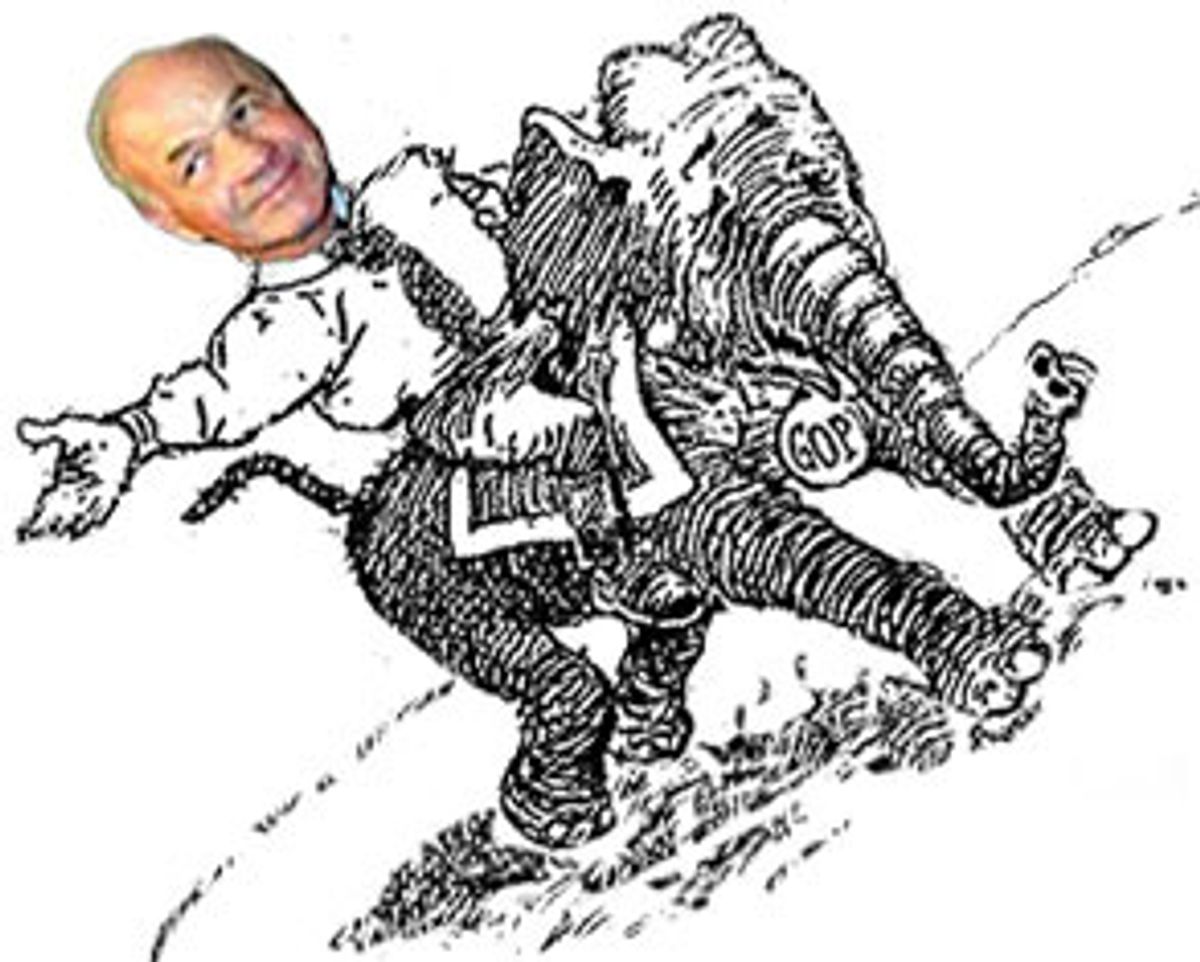
If Enron isn’t a political scandal, nothing is

So what if Bush and company didn't bail out Enron? The outrage lies in what politicians did for the company on its way up, not the way down.

  • more
    • All Share Services

Topics: ,

If Enron isn't a political scandal, nothing is

The collapse of Enron, we now hear, is not a “political scandal” — it’s a business story. A fine distinction! So far, no one possesses evidence that government officials lied, goofed around with interns, ran guns from the White House basement, burglarized opponents’ campaign offices or accepted bags of unmarked bills. And so a growing chorus in the media now chants that the Enron affair should not be considered in the same class as Whitewater, Watergate, Iran/Contra or any of the other previous brouhahas that have consumed Washington and brought presidencies to their knees.

“I don’t think it’s a political [scandal] story yet. I think it’s a business scandal” — that’s how the National Journal’s Charlie Cook put it during a journalism panel covered in the Hotline. “Reporters try to put everything into a Whitewater/Watergate prism.”

This tells us that the scandal yardstick our political and media culture currently uses is bent like a pretzel. You say your president may have finagled a real estate deal many years ago? Time to name a special prosecutor! He lied about his sex life? Draw up the articles of impeachment! But tell us that a high-profile corporation donated millions of dollars to legions of politicians, including the president; bent the government to its will; lined the pockets of its executives while dodging all taxes; then went bankrupt, vaporizing thousands of employees’ retirement accounts? Nah, that’s no “political scandal.” Come on — where’re the bimbos?

Enron’s dismal story simply doesn’t meet the high bar of triviality the press today demands. The sums of money involved are too great; the flaws in our political system that it exposes are too vast. It’s just too real to qualify.

The Enron affair seems to have earned its “get out of jail free” card from the pundits because, so far, it seems that no one in the Bush administration was stupid enough to try to help the corporation last autumn as its fortunes circled the drain. And since Enron’s campaign-donation tentacles and friends-in-high-places influence appears to have extended to both parties — lopsided a good ways toward the Republicans but also boasting some serious Democratic names (including former Treasury Secretary Robert Rubin and New York Sen. Charles Schumer) — the Enron saga does not perfectly fit the capital’s partisan templates.

To which the conscientious citizen should respond, so what? If Enron isn’t a political scandal then we might as well retire the phrase from our vocabularies. Of course no one in the Bush administration lifted a finger to help Enron while it was on the way down; they all understood that the spotlight on them was too glaring. It was while Enron was on its merry way up the stock price charts, conjuring markets out of thin air and billions in revenue through accounting tricks, that the company cashed in its chits with our politicians. Enron’s campaign contributions may not have purchased it a reprieve from bankruptcy, but its gifts had already been paid back with interest by both the legislative and the executive branches of our government.

What did Enron get for its money? We’re only beginning to unravel the full list, but from what’s already known, the answer is: plenty. Enron’s political contributions weren’t made out of charity or friendship; they were quid pro quos. The “quids” are on public record because campaign finance laws require their disclosure. Here are some of the “quos.”

We know that Enron essentially shaped the Bush administration’s energy policy, with its pro-drilling slant, bias against conservation and reluctance to intervene in California’s electricity crisis. Enron officials met six times with vice president Dick Cheney’s energy policy task force last year — and Cheney is still stonewalling the release of records of those meetings from congressional inquiry.

We know that Enron essentially engineered the removal of a chairman of the Federal Energy Regulatory Commission whose policies it disliked and had him replaced with a long-time Texas ally who could be expected to be more friendly to its interests.

We know that Enron would have benefited profusely from the corporate alternative minimum tax repeal that President Bush and his party have pushed so avidly. Not paying any income tax (through “the creation of 881 subsidiaries abroad, including 692 in the Cayman Islands, 119 in the Turks and Caicos, 43 in Mauritius and eight in Bermuda”!) wasn’t enough for Enron; it wanted — and would have won, if this provision became law — a gigantic tax rebate from the public trough.

We know, thanks to the Wall Street Journal, that Enron used its political clout to ward off government oversight of its trading in derivatives. Many financial experts and public officials foresaw trouble in Enron’s growing role as both “market maker” for the trading in these complex financial instruments and a participant in the same markets it oversaw. Enron turned to recipients of its largesse like Texas Sen. Phil Gramm to keep the government’s fingers out of its hair. (Gramm’s wife, Wendy, led a deregulatory push as head of the Commodity Futures Trading Commission in the early ’90s — then resigned to become a member of Enron’s board.) Even after the 1998 collapse of the Long Term Capital Management hedge fund spurred new congressional calls for reform, Enron pulled strings to make sure that it could do as it pleased in these markets, unrestrained by the kind of fair-rules enforcement provided in more traditional commodities and securities markets.

We know that Lawrence Lindsey, Bush’s chief economic advisor, was put in charge of monitoring Enron’s collapse, even though he was a paid advisor for Enron as recently as the year 2000.

That’s just at the federal level. In Texas we know that Enron’s contributions to then-Gov. George W. Bush won it a variety of perks and favors, including a Bush effort to lobby his friend Pennsylvania Gov. Tom Ridge on behalf of Enron. And in California, Enron was a key architect from the beginning of California’s disastrously half-baked energy deregulation plan, which last year drove the cost of energy in the nation’s most populous state through the roof and cost the state treasury a fortune.

No doubt there’s more. Plainly, Enron got its money’s worth. As we learn more about Enron’s business from the growing stink of the Arthur Andersen coverup, it’s increasingly clear why Enron needed to buy so many political favors: It was the most efficient means of providing cover for the company’s smoke-and-mirrors financial strategy.

Enron pumped up its stock price by jaw-droppingly “aggressive” accounting practices, like fobbing off its debt onto hidden partnerships, claiming hundreds of millions in revenue from phantom projects (like the broadband video pilot project the Wall Street Journal reports on today, where 1,000 test customers for a movie-on-demand service somehow generated $110 million in profits — that’s $110,000 per couch potato!) and counting as revenue the entire cost of energy trades it brokered, rather than simply the commissions it earned — a practice known, aptly, as “gross accounting.”

If Enron had fairly and accurately reported its numbers in terms laymen could understand from the beginning, it would never have earned its stock-market darling status. And, once its stock price had been jimmied through the roof, if it suddenly switched to telling the truth, its house of cards would collapse — that is the stark message of the anonymous whistle-blowing letter Enron official Sherron Watkins sent to chairman Kenneth Lay last August.

Enron positioned itself as a “new economy” company as it divested itself of physical assets and proudly forged businesses built on the trading of intangible financial instruments. What we can now see is that the Enron collapse, too, is a true information-age scandal. If good information had been available to the government and the public from the start, Enron could never have climbed to the heights from which it fell.

Enron was the proud standard-bearer of the deregulation movement. But its executives and supporters conveniently conflated two different kinds of regulation as it boldly fought for freedom from government control. The public understands “deregulation” to mean an end to government-mandated pricing of goods like airline seats and electricity. And common sense supports the notion that markets set such prices better than government bureaucrats can.

But there’s another kind of regulation that’s absolutely essential for those markets to work properly. It’s the kind of regulation that publicly certified accountants and the SEC provide for the stock market — regulations that require companies to disclose information that partners, competitors and the public need to make rational business choices. Enron’s success at remaining “deregulated” in this second meaning of the word paved its way toward its collapse.

It doesn’t take a doctorate in economics to see the fixes our political and economic system require in the wake of Enron. We need more effective oversight of new buccaneer markets, not to “regulate” the life out of them but to ensure that they operate fairly and don’t get manipulated by Enron-style hucksters and shysters. And we need tough campaign finance reform — stronger than the relatively mild constraints that the Republican House, led by friend-of-Enron Tom Delay, has so far successfully blocked — to make sure that participants in those markets don’t buy exemption from such oversight.

It may be that Enron and its officers did nothing in technical violation of the law. If so, the scandal lies precisely there: that what they did was legal when it plainly should have been outlawed; that they managed to buy the laws they needed to build the financial house of cards that earned them millions before crashing down on stockholders’ heads.

The Bush administration is deep in denial mode because so much of what was wrong in the Enron story is simply business as usual for its cadre of former oil executives and commuters through the revolving door between industry and government. Clearly, we need some new, better laws. Either Congress will pass some, or we will see just how thoroughly Enron managed to corrupt our system. And wouldn’t that be a scandal.

Continue Reading Close

Salon co-founder Scott Rosenberg is director of MediaBugs.org. He is the author of "Say Everything" and Dreaming in Code and blogs at Wordyard.com.

The Wall Street Journal’s Freudian tweet

The newspaper declares Enron-inspired Sarbanes-Oxley law struck down by Supreme Court. Er, not so fast

  • more
    • All Share Services

Topics: , , , ,

The Wall Street Journal's Freudian tweet

The Wall Street Journal has never made any attempt to hide its antipathy for Sarbanes-Oxley, the Enron/Worldcom-inspired law that attempted to increase oversight on public company accounting. The Journal’s position is that the law imposed costs on businesses that hurt the overall economy. Since this is the Journal’s editorial position on any legislation that tries to rein in the business world, no one was ever required to take their rantings too seriously (even though, it is true, Sarbanes-Oxley has resulted in compliance costs that can be challenging for smaller public firms).

So perhaps that explains why the Wall Street Journal’s flagship Twitter feed (as pointed out by Felix Salmon) jumped the gun this morning, reporting via a tweet practically dripping with glee that Sarbanes-Oxley had finally been vanquished!

BREAKING: Supreme Court strikes down Sarbanes-Oxley, the landmark anti-fraud law. Much more to come at http://wsj.com

Except, as the Journal and other publications soon reported, the court did no such thing. The court struck down a part of Sarbanes-Oxley that had to with the president’s power to fire members of the Public Company Oversight Accounting Board, the regulatory body set up by Sarbanes-Oxley to watch over the accounting firms that audit public companies.

Currently, members of the PCOAB can only be fired “for cause.” The court ruled that this violated the Constitution’s “separation of powers” principles. Now the president will be able to fire the overseers “at will.”

Critics of Sarbanes-Oxley had hoped that the court would use this flaw to throw out the entire law. But that’s not happening. The law stands. The proper tweet should have been “Supreme Court strikes down minor part of Sarbanes-Oxley; law remains in effect.”

Maybe it was an honest error — albeit retweeted around the world at near the speed of light. Or maybe it was an unintentional revelation of the deepest hopes and desires of the Wall Street Journal’s shell-shocked editorial core — the subconscious revealed in 140 characters or less. With just days to go before a new avalanche of financial sector regulation becomes law, the Journal saw one bright spot in the advancing gloom — Sarbanes-Oxley would be no more! And the paper (or a Twitter-feed monitoring intern) got a little excited. Hey, no worries, it’s happened to the best of us.

But the least the paper could do would be a follow-up, one-word tweet: Ooops! Any self-respecting blogger would have felt that much responsibility. But the Journal blithely tweeted forward, gradually approaching the truth, with nary a look back. Tut tut.

UPDATE: The man behind the mistaken tweet, Zach Seward, comes admirably clean in Felix Salmon’s comments.

Continue Reading Close
Andrew Leonard

Andrew Leonard is a staff writer at Salon. On Twitter, @koxinga21.

Jack Abramoff, Eliot Spitzer: A tale of two swindlers

What connects the disgraced N.Y. governor and the jailed D.C. lobbyist? Oscar-winner Alex Gibney explains

  • more
    • All Share Services

Topics: , , , , , , ,

Jack Abramoff, Eliot Spitzer: A tale of two swindlersFormer New York governor Eliot Spitzer speaks at the Reuters Global Financial Regulation Summit 2010 in New York April 28, 2010. REUTERS/Brendan McDermid (UNITED STATES - Tags: BUSINESS HEADSHOT)(Credit: © Brendan Mcdermid / Reuters)

What do the following have in common: Imprisoned Washington lobbyist Jack Abramoff, disgraced ex-New York Gov. Eliot Spitzer, the collapse of Enron, the Bush administration’s torture policies, the late gonzo journalist Hunter S. Thompson? Before we go chasing some thread of thematic continuity — and we could definitely do that — let’s observe the emotional connection. All of those people and things provoke or embody big, visceral reactions: shock, outrage, disgust, amazement.

The other thing they have in common, of course, is Alex Gibney, who has made movies about all those subjects, including the Oscar-winner “Taxi to the Dark Side,” the box-office breakthrough “Enron: The Smartest Guys in the Room” and “Gonzo: The Life and Work of Dr. Hunter S. Thompson,” which wasn’t a big hit but strikes me as a key work in understanding what Gibney is up to. He thrives on those oversize emotions mentioned above, channeling them into intentionally ambiguous pop documentaries that inhabit a nuanced middle ground between journalism and entertainment.

As he would be the first to admit, Gibney’s films depend on the work of old-school investigative journalists, those lumbering sauropods who take months or years to reach their destinations. His particular genius lies in taking their facts and figures, their reams of insider testimony, and spinning them into compelling on-screen yarns, loaded with archival news footage, goofy animations and special effects, dramatic re-creations and comic-relief moments. Yet if Gibney’s films are a long way from the purist cinema-vérité documentary tradition, they’re closer in spirit to old-fashioned muckraking than to the clown-prince pranksterism of Michael Moore. (Gibney’s voice can be heard in his films, both literally and figuratively, but he never appears as a character.)

Even by Gibney’s prolific standards, 2010 is shaping up as a bonanza, or perhaps an unmanageable pileup. When I met him recently at the New York offices of Magnolia Pictures, we were officially talking about his explosive, hilarious and eye-opening Abramoff film, “Casino Jack and the United States of Money,” which Magnolia releases in theaters this week. But Gibney also had — count ‘em — three other new movies premiering in the Tribeca Film Festival, at least if you count his section of the anthology documentary “Freakonomics,” adapted from Stephen Dubner and Steven Levitt’s bestselling books. (Other co-directors of that film are Seth Gordon, Eugene Jarecki, Morgan Spurlock and the “Jesus Camp” duo, Heidi Ewing and Rachel Grady.)

Gibney also unveiled a sneak preview of his as-yet-untitled Eliot Spitzer documentary at Tribeca, along with “My Trip to Al-Qaeda,” a film based on journalist and author Lawrence Wright’s solo theater piece about his quest to find the roots of Islamic terrorism. (That film will play on HBO, and perhaps also receive limited theatrical release. The commercial fate of the Spitzer film remains undecided.)

“Casino Jack” veritably revels in the rollicking, stranger-than-fiction details of the Abramoff scandal, in which a brilliant and charismatic lobbyist pimped out much of the United States Congress to big-money corporate clients, along the way defrauding Indian tribes, the territorial government of the Mariana Islands and other easy marks. Beyond that, though, Gibney is fascinated by the scandal’s larger implications — and it’s there that we begin to see the conceptual thread that ties his films together. Abramoff was no rogue out to enrich himself (although he did that too) but a committed right-wing ideologue who permanently changed the rules of the game in Washington. He embraced and embodied that old gag about the Golden Rule: Those who have the gold make the rules.

As always, Gibney was a cheerful, upbeat conversationalist in person. He’s a film buff who stays busy at festivals catching other people’s work, and in an interview context he delivers concise, on-message sound bites, not dark, philosophical jeremiads. Still, as I told him, I sense a pattern here, whether or not it’s entirely conscious: Gibney is documenting the not-so-slow and not-so-gradual demolition of the American dream, the interlinked vision of freedom, democracy and capitalism that has been so influential in the recent history of the world, and now seems to be in potentially terminal decay.

So, Alex, we’re here to talk about “Casino Jack and the United States of Money,” but you’ve got two other films that are either complete or almost complete. And then there’s “Freakonomics,” which you directed part of. I think you should write some kind of self-help book on how to get stuff done. Are you one of those people who’s incredibly organized?

Man, that would make everybody who knows me howl with laughter. I may be the world’s most disorganized person. But I do put in the hours. I should probably join Filmmakers Anonymous. Stop me before I say yes again!

You know, you could look at your films and describe them as miscellaneous. Generally you’re taking the work of journalists and adapting it for the screen. But when I look at them, I see a congressional corruption scandal, a major corporate scandal, a disgraced politician and a dead journalist who spent his life excoriating the stupidity and corruption he saw around him. Is there a pattern?

Maybe if you see it, you’ll let me know. [Laughter.] There are clearly certain things that interest me, and I seem to go there. But a pattern? I don’t know.

Well, if I were a graduate student trying to write a thesis about you, I might suggest that these are all aspects of the decline of America since 1980 — the legacy of the Reagan revolution and the triumph of conservatism in American politics.

Well, there’s a theme in that. I think that’s the big story. Now we’re seeing that the net result of the Reagan revolution was the Wall Street meltdown. Take away all the rules and regulations, and what do you get? Meltdown. So I think that’s a theme.

But the other thing that’s increasingly interesting for me is human behavior. What makes people do the strange things they do? How do good people go bad? How do people abuse power? Those are big things for me.

You’re showing your movie about Eliot Spitzer at Tribeca, but it has no title yet and we’ve all been asked not to write about it. So I take it you don’t think it’s ready to roll?

I’m taking my cue on the Spitzer film from what happened with “Casino Jack” at Sundance. We thought it was finished. But seeing it with an audience, who weren’t my friends or anything, you learn things about how it plays. So we made it a lot shorter, we took at some narration, we just shifted stuff around. I would say the Spitzer film is largely finished, and now we’ll see how people respond. We may make a few adjustments.

Your other new film is “My Trip to Al-Qaeda,” which — well, how would you describe it? Is it an adaptation of Lawrence Wright’s performance piece?

Yeah, in some ways it is. He did a one-man play called “My Trip to Al-Qaeda,” which is like “my summer vacation,” except in the Middle East. What intrigued me was that it was an everyman’s look at al-Qaida — why they attacked us, and why they came to be what they were. In making the film, we filmed the play, but then we enhanced it. The set of the play was Larry’s study, but it also included a TV screen. We made that TV screen significantly bigger on our set, and used it as a magic portal.

There’s a kind of time and space travel in the film, where we go to Cairo, to London. We also travel through space and time to the caves in Afghanistan, to Saudi Arabia, so that you can see and feel these places in addition to traveling on Larry’s personal journey, which is his play.

Getting back to “Casino Jack,” which is a movie about a scandal that was widely covered in the media when the story broke, five or six years ago. It seems as if you’re arguing that people may know Abramoff’s name, and maybe the general outlines of the story, but may not understand its importance.

In some ways, he assembled the tool kit that lobbyists are still using. Now, people will object to that: “Absolutely not! Jack Abramoff was one of a kind! He was completely outrageous.” Well, yes. He was outrageous, and he was way out of control. But he used the same tool kit everybody uses today: the rapacious use of not-for-profits to hide trips, to hide agendas, to hide money flows. The revolving door, where you get staffers from senators’ or congressmen’s offices and put them into your lobbying shops so you can influence votes, influence legislation. The use of entertainment and skyboxes — there are different rules now, but there are also ways to get around them. Biggest of all is the way you manage money to influence legislation, in a way that skirts the prohibitions on quid pro quo. It’s about going inside the kitchen in the world’s biggest restaurant and seeing how the sausage is made. Jack Abramoff was the master chef in the world’s biggest restaurant.

We wonder why Congress is dysfunctional, why they’re not doing the people’s bidding, why everyone seems to hate them. The reason is, the system is broken, because it’s all based on money. By looking at Jack’s story, you can see how that happened.

And Jack’s story — first of all, it’s hilarious and spectacular. It’s globe-girdling, there’s a murder in it, there are sweatshops in Saipan, dirty deals in Russia, arms whistling to the West Bank. But at its heart is the very stuff that is breaking our system of democracy.

This was the biggest congressional corruption scandal ever, at least at the time. But did the level of corruption that Abramoff represented become the new normal, in a sense? Because in the film you suggest that even more dramatic stuff has happened since his downfall.

The dispiriting thing is that Jack Abramoff, in the wake of the financial lobbying of the last few years, looks like a piker. I mean, he’s Podunk! The financial lobbyists, and the medical and pharmaceutical lobbyists, have taken what Abramoff did to a new level.

You mentioned the fact that the Abramoff story is highly entertaining, which it certainly is. And while it’s unlikely that your viewers will find him likable or sympathetic, let’s just say this: He makes one hell of a lead character.

There is another film, which is still called “Casino Jack.” I think they’re going to change the title. It’s a fictional version of this story, in which Kevin Spacey plays Jack Abramoff. I’ve seen the film, and Kevin Spacey is very good in it. But he’s no Jack Abramoff. [Laughter.]

Jack Abramoff is one of a kind. As Neal Volz, a former staffer for congressman Bob Ney who later worked for Jack, says, “Jack could talk a dog off a meat truck.” He was that persuasive. He was the ultimate salesman, but he was also a man of great imagination. He was a film buff, who saw his own life as an action film or a spy thriller. As a result, he imagined himself into situations that, you know, make for pretty good moviegoing.

Suddenly, we’re in Angola, in Africa, where Jack is holding a sort of right-wing Woodstock [in June 1985], shooting machine guns with a bloodthirsty character named Jonas Savimbi and a guy named Adolfo Calero, who used to run the Contras in Nicaragua. And they’re all holding hands after a lot of machine-gun shooting and singing a version of “Kumbaya” with this guy Lew Lehrman, who later ran for governor in New York state, and who gave George Washington’s bowl to Jonas Savimbi, this bloodthirsty dictator. You can’t make this stuff up!

Yeah, I literally couldn’t believe that entire sequence. It’s so amazing. It seems impossible, totally fictional. Was it difficult to find documentation of that event?

It sure was. We got lucky or we were good, one of the two. We tracked down a cameraman who had been there, and he still had 10 hours of footage. We also got Jack’s film, which was amazing. Jack was a film producer. He produced “Red Scorpion,” with Dolph Lundgren [released in 1989], and “Red Scorpion 2.” I think the Angola affair — it taught Jack that it wasn’t a big enough deal. That was his documentary version, and he was always going to make an action film. So he reinvents Savimbi into Red Scorpion, and has Dolph Lundgren as the action hero, shooting up everybody and performing weightlifting tricks. And that’s what Jack was as a young man, a weightlifter. So Dolph Lundgren is standing in for Jack.

I have a fun thing at the beginning of the film. There’s this thing that Jack said to somebody, which we transposed into an e-mail: “Documentary? You don’t want to make a documentary. Nobody watches documentaries. You want to make an action film.”

So to some extent, this film is an action film. That’s what I told Jack: “It’s an action film, man. People are going to be entertained.” I think it’s also a comedy, at least in parts. But unfortunately it’s a comedy in which the joke’s on us.

So you’ve had contact with Abramoff. What was that like?

Very interesting. I visited him in prison, and found him to be a very engaging character, very funny, good storyteller. He loves to quote movies.

Did he know who you were?

He did. I think — no, I know — that there was great reluctance to meeting with me. It wasn’t like I had a big record as a movement conservative, which was something we joked about. We agreed on one thing: I didn’t see him as a bad apple. I saw him as spectacular evidence of a rotten barrel.

He was at the center of things, not on the periphery. Everybody else was trying to make him the scapegoat: “Oh, we got rid of Jack Abramoff. Everything’s fine!” I told him, and I firmly believe, that he was at the center. He was doing stuff to the extreme, yes, over the top. But he was doing the same stuff everybody else was doing.

Well, you make a pretty strong case that Abramoff wasn’t in it for the money, or not entirely. He had an ideological motivation. He actually believed he was doing the right thing.

Right. I think he was a zealot. Unlike his partner, Mike Scanlon, who was in it for the money, Jack Abramoff was a zealot. He believed in the principles of the Reagan revolution. He was very anti-Soviet, but he also wanted to do what Grover Norquist has suggested: make government so small you can drown it in the bathtub. Denude it of its resources. Destroy the government, in effect.

Do you see any parallels between Abramoff and Eliot Spitzer? Here are these two brilliant, headstrong guys from opposite sides of the political spectrum, who appeared to be very idealistic, driven by ideology, but who allowed themselves to become corrupted.

I don’t know that Eliot was corrupted by his ideology, but I think he’s a character who did something that was wildly unexpected. If there is a parallel, it’s hubris. I think Jack became so entranced with his outsize reputation that he began to believe his own press releases. And I think Eliot Spitzer — he started seeing prostitutes at the moment of his greatest political influence. He was on his way to being governor, overwhelmingly popular among both Republicans and Democrats. And at that very moment, at the top of his game, he began to see prostitutes. Dudley Do-Right did wrong.

Of the two of them, maybe Spitzer was the real hypocrite. You can call Abramoff a lot of things, but not that.

I don’t think you could really accuse Jack of being a hypocrite. Jack was corrupt, and I don’t think you can say that Eliot Spitzer was corrupt. But he was hypocritical, there’s no doubt about that. Look, he had increased penalties for johns in New York, and he had prosecuted escort services. Now, I have rather politically incorrect liberal views about whether prostitution should be legal. [Laughter.] But the fact was that it was illegal, and he was the governor of New York, who had convinced people to elect him because he was Mr. Clean. So, yes, he was a hypocrite. And Jack wasn’t.

“Casino Jack and the United States of Money” opens May 7 in New York, Los Angeles and Washington; May 14 in Chicago, Phoenix, San Diego, San Francisco, San Jose, Calif., Santa Cruz, Calif., and Seattle; May 21 in Atlanta, Boston, Monterey, Calif., Nashville, Palm Springs, Calif., Philadelphia, Sacramento, Tucson, Ariz., and Austin, Texas; May 28 in Charlotte, N.C., Cleveland, Dallas, Kansas City, Miami, Minneapolis, Portland, Ore., Salt Lake City, San Antonio and Santa Fe, N.M.; and June 4 in Houston and Waterville, Maine, with more cities to follow.

Continue Reading Close

Exclusive Alex Gibney clip: Jack Abramoff and healthcare

See a deleted scene from Oscar-winner Alex Gibney's new movie about the guy who dosed Congress with dirty money

  • more
    • All Share Services

Topics: , , , , , , , ,

In an exclusive premiere for Film Salon readers, here’s a deleted scene from Oscar-winning director Alex Gibney’s upcoming documentary “Casino Jack and the United States of Money.” The film recounts the horrifying, mesmerizing saga of über-lobbyist Jack Abramoff and the congressional corruption scandal of the late ’90s and early 2000s that dramatically changed the landscape of Washington (and definitely not for the better).

In this Webisode, Gibney explores the elaborate money shuffle through which Abramoff channeled money from supposedly legitimate lobbying clients (like Indian tribes) through Republican PACs and Big Pharma front groups, who in turn wrote industry-friendly legislation that was passed intact by the GOP-led Congress. I’ll have an interview with Gibney and more coverage of the film next week. “Casino Jack and the United States of Money” opens May 7 in major cities, but you’ll only find this clip here (at least until the DVD comes out).

Continue Reading Close

It’s time for Wall Street to pay

We need accountability -- as in, jail time where warranted -- for those who created the financial disaster

  • more
    • All Share Services

Topics: , , , , ,

It's time for Wall Street to payJames Cayne of Bear Stearns, John Thain of Merrill Lynch, and Lloyd Blankfein of Goldman Sachs

Almost everybody’s got their noses out of joint these days — and no wonder. If there’s a significant American institution that hasn’t failed in its fundamental public responsibility over the past decade, it’d be hard to identify.

Writing in Time, Christopher Hayes puts it succinctly: “Nearly every pillar institution in American society — whether it’s General Motors, Congress, Wall Street, Major League Baseball, the Catholic Church or the mainstream media — has revealed itself to be corrupt, incompetent or both. And at the root of these failures are the people who run these institutions, the bright and industrious minds who occupy the commanding heights of our meritocratic order.”

Me, I blame the combination of runaway baseball salaries, the “talented and gifted” movement in schools, and the tyranny of SAT scores. I’m only half-joking. Once free agency drove even an average third baseman’s pay into the seven-figure range formerly reserved for tycoons who owned major industries or medium-size Midwestern states, practically everybody with SAT scores over 1,400 figured they deserved to earn as much as Aramis Ramirez.

The differences being that quality third basemen are a lot rarer than Ivy League MBAs, and are publicly and relentlessly evaluated. Steroids or no steroids, one bad season and they’re replaced by a 22-year-old from the Dominican Republic. That’s one of the things keeping us fans hanging on.

Not so in the corporate world. As recently as 2008, the geniuses running Wall Street investment banks bankrupted their companies and came perilously close to collapsing the world financial system. And what happened? A few CEOs departed via “golden parachute,” but most executives stayed shamelessly in place, profited from multibillion-dollar TARP bailouts and then began awarding each other obscene bonuses almost before the smoke cleared.

Meanwhile, a substantial part of a generation’s retirement savings vanished into thin air. Had the Bush administration succeeded in “privatizing” Social Security back in 2005, the damage could not have been worse.

Over time, American institutions appear to be growing steadily less accountable. Hayes cites the Catholic Church’s sex abuse scandal, which strikes me as a red herring. Yes, the bishops averted their eyes, placing the putative well-being of the church above children. Yes, ecclesiastical lectures on sexual sin are a bit harder to take. But the church has been hierarchical, secretive and self-protective since forever. Moreover, as recent developments in Ireland and Germany show, the problem is international.

More to the point, “look at CEO pay,” Hayes urges. “In 1978, according to the Economic Policy Institute, the ratio of average CEO pay to average wage was about 35 to 1. By 2007 it was 275 to 1.” In comparison, the ratio remains approximately 20 to 1 in most European countries; roughly 11 to 1 in Japan. Yet people complain about labor unions.

Hayes cites Nell Minow, an expert in corporate governance nicknamed “The CEO Killer” by Fortune magazine, to the effect that all many executives know how to do is “manipulate the levers of governance and devise ingenious methods of guaranteeing themselves windfalls regardless of their company’s performance.” The unvarying defense of the latest Wall Street bonuses, of course, is that the talented and gifted recipients might otherwise change teams. Why, perish the thought.

Only recently, reporters have begun catching up with the bankruptcy examiner’s report on the failure of Lehman Brothers investment bank, the precipitating event in the 2008 financial crisis. According to law professor and former white-collar prosecutor Peter J. Henning, writing in the New York Times’ DealBook blog, the 2,000-page document “discusses some accounting gimmicks that are eerily reminiscent of how Enron tried to prop up its balance sheet back in 2001 before it collapsed.”

And for which, it will be recalled, a number of Enron executives went to prison. The details can be dauntingly complex. But what they amounted to were a series of short-term accounting tricks designed to make the bank’s financial health appear robust as it “teetered on the brink of ruin.”

The examiner’s report calls CEO Richard Fuld “grossly negligent” at minimum, and reserves even harsher terms for Lehman’s accounting firm, Ernst & Young. Remember when accounting was a respectable profession? No more. They’re buccaneers today.

The basic gimmick was called a “Repo 105,” moving bad real estate-based assets off the books by using them as collateral for short-term loans just long enough to file quarterly reports, then unwinding the deals as quickly as overnight.

It’s as if your brother-in-law assumed your debts and deeded you his assets overnight so you could qualify for a bank loan, then took them back. Except Lehman was doing it to the tune of $50 billion a pop. You and your brother-in-law would go to prison for that, and so should somebody at Lehman Brothers. Hopefully, somebody with a brilliant academic record and impeccable social credentials, so the rest of them start paying attention.

© 2010, Gene Lyons. Distributed by United Feature Syndicate, Inc.


Continue Reading Close

Arkansas Times columnist Gene Lyons is a National Magazine Award winner and co-author of "The Hunting of the President" (St. Martin's Press, 2000). You can e-mail Lyons at eugenelyons2@yahoo.com.

Sundance: Searing portrait of a top lobbyist

Oscar-winner Alex Gibney talks about his new Jack Abramoff expos

  • more
    • All Share Services

Topics: , , , , ,

Sundance: Searing portrait of a top lobbyist18 Aug 2005, MIAMI, FL, USA --- Washington lobbyist Jack Abramoff leaves the courthouse in Miami August 18, 2005. Abramoff, a central figure in investigations involving House Majority Leader Tom Delay, plans to fight charges he defrauded two lenders of $60 million to buy a casino cruise line, his lawyer said on Thursday. Abramoff, a well-connected Republican lobbyist, and Adam Kidan, his partner in the $147.5 millions buyout of SunCruz Casino five years ago, were indicted by a federal grand jury in Fort Lauderdale, Florida, on August 11. --- Image by © CARLOS BARRIA/Reuters/Corbis(Credit: © Carlos Barria/reuters/corbis)

PARK CITY, Utah — Alex Gibney’s new documentary, “Casino Jack and the United States of Money,” which premiered at Sundance this week, is much more than a shocking and highly entertaining movie about Jack Abramoff, the über-lobbyist at the center of the biggest corruption scandal in congressional history. It’s a portrait of a political system that has been poisoned down to the root by the pernicious influence of big money, by the buying and selling of connections and influence, and by a radical free-market ideology that has been systematically employed to undermine the principles of representative democracy.

As the Oscar-winning director of “Taxi to the Dark Side” and “Enron: The Smartest Guys in the Room” told me in our conversation in a Park City restaurant, the Abramoff case was not an isolated instance of criminality, but a symptom of a much larger disease. As in his earlier films, Gibney dramatizes the work of America’s best investigative journalists, and directly attacks the “bad apple” hypothesis that’s repeatedly employed to explain away disturbing tales of corruption and malfeasance, from Enron to Abu Ghraib to Abramoff.

Magnolia Pictures will release “Casino Jack” in theaters this spring. For now, here’s Alex Gibney on the outlandish Abramoff tale and its rogue’s gallery of supporting players — from Tom DeLay to Grover Norquist to George W. Bush — why it definitely still resonates in the Obama era, and what it means for our imperiled republic. 

Continue Reading Close

Page 1 of 21 in Enron