Fashion

The lady’s Yves

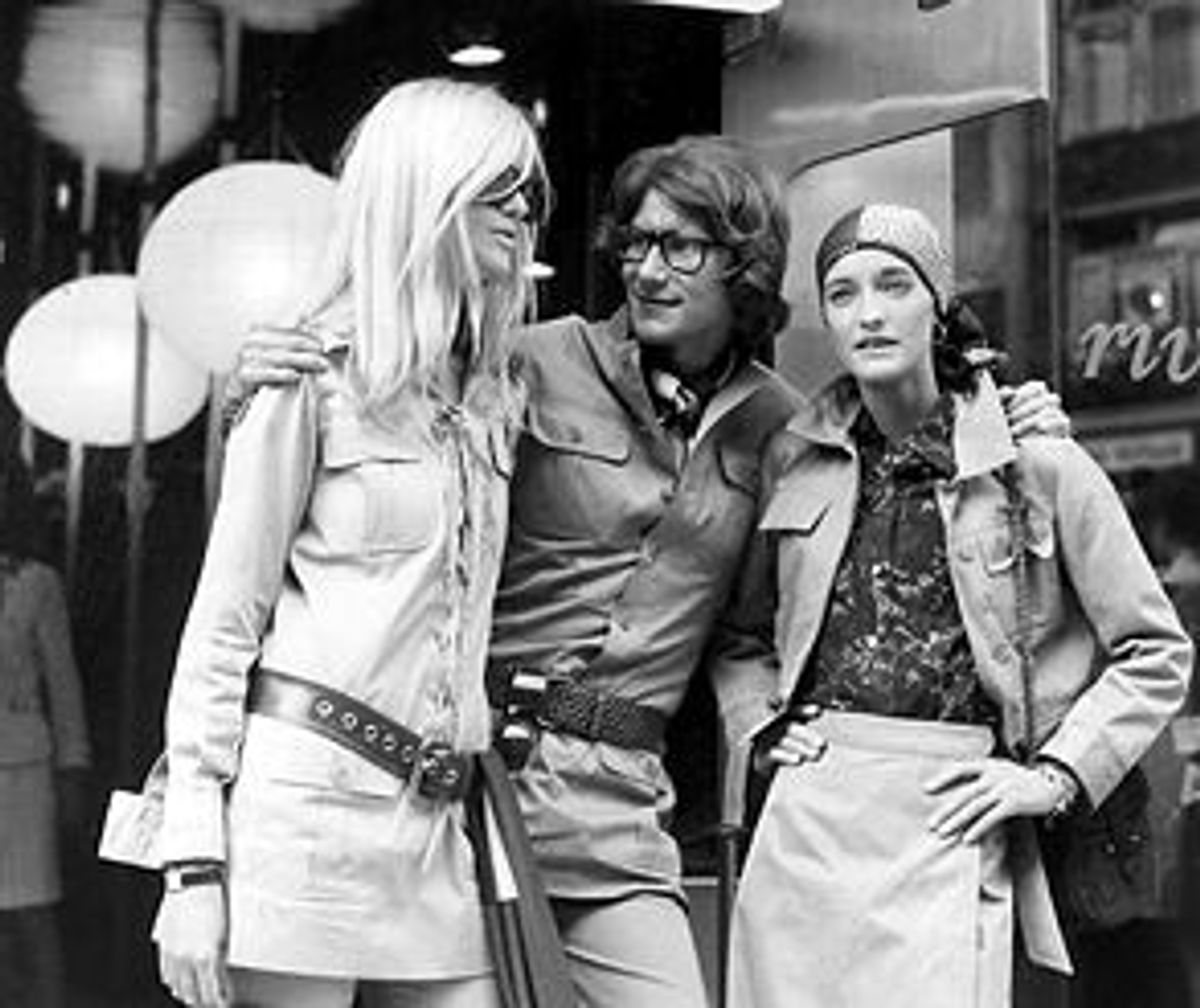
Yves Saint Laurent's love for women was never so loudly professed as in the lines of his garments.

  • more
    • All Share Services

Topics:

The lady's Yves

Looking back at the clothes Yves Saint Laurent has presented us in the past 10 years or so — largely retreads of his greatest hits, including lots of strong-shouldered jackets and trimly tailored trousers and trenches — it seems that, yes, it probably is time for one of the greatest designers of the 20th century to hang up his shears. But flipping through photographs of the clothes he’s given us in a career that spans more than 40 years, I can’t help feeling that somehow his time has come too soon.

It’s not that he hasn’t already given us enough. It’s just that there’s no one in the current landscape of fashion — not Alexander McQueen with his outlandish horned frocks, nor John Galliano with his magnificent mastery of bias, nor Hussein Chalayan with his wooden table dresses — who has proved able to jolt the world awake, as Saint Laurent did in the early ’60s, with clothes that were also perfectly cut and beautifully wearable.

The reason for that is simple, and it isn’t the fault of any of the contemporary designers mentioned or their colleagues: It’s just that in 2002, we’re fairly unjoltable when it comes to fashion. Part of what makes Saint Laurent’s retirement so hard to bear is that we can’t turn back time to an era when fashion could still shock us out of our armchairs. There is no present-day equivalent to Saint Laurent, although the last comforting fact is that there doesn’t need to be: He was the right designer at the right time, doing his best work from the early ’60s to the late ’70s, when the world seemed to be changing at its very fastest. The body of work he leaves is a challenge to everyone who follows, not just for its innovation and its craftsmanship but for its inherent passion. It’s fine to make a skirt out of wood, but the next frontier may lie in rediscovering the knowledge of just where a dart should fall. Saint Laurent was there first.

- – - – - – - – - – - -

What must Saint Laurent’s “Robin Hood” collection have looked like in 1962? In a photograph from the collection, a model wears a futuristic-beatnik leather balaclava and A-line jacket with crocodile-print boots that stretch from her toes clear up to the place where most decent ladies were still wearing garter belts. Later, Saint Laurent would be accused of stealing street fashion and making it acceptable for proper, moneyed ladies (and for what it’s worth, unlike street fashion, his clothes were so expertly crafted they were almost works of art in themselves). “Everyone knows Saint Laurent has been ripping off the kids’ street gear for years and even those knock-off waves of his roll in about six months to a year too late,” Village Voice fashion columnist Blair Sobol wrote in 1970. It’s not that she was exactly wrong: It’s just that — well, what does it matter? The ’60s belonged to young people, and they knew it. But by the end of the decade, many of them had forgotten that Saint Laurent was one of the people who’d handed it to them.

The Algerian-born Saint Laurent began his career in the late ’50s at the venerable house of Christian Dior, taking it over in 1958, at the age of 21, after Monsieur Dior’s death. His fifth collection at Dior, in 1960, was inspired by the Beats of the Left Bank (it featured turtlenecks and a mink-lined alligator jacket), and it caused an uproar among Dior’s regular clients and the press. Dior was a couture house, and Saint Laurent was a couturier: That meant the clothes were meticulously handmade for individual clients, who expected a certain gravity and dignity in the product. Those clients also tended to be a bit older than the youngsters from whom Saint Laurent drew his inspiration. Neither Saint Laurent’s employer nor the house’s clients nor the French press were amused; the collection gave the house of Dior an excuse to dismiss its young star.

In 1962 Saint Laurent and his business partner (to this day), Pierre Bergé, founded the house of Yves Saint Laurent. (Bergé and Saint Laurent were also a couple until the early ’80s.) Their relationship is often depicted as volatile — there’s a bit of lore about Saint Laurent’s inducing Bergé to chase him with a knife down a flight of stairs — but it’s also far too complicated for any outsider to fathom. It was Bergé who broke the news to Saint Laurent that he’d been dismissed by the house of Dior, as the young designer lay in a hospital bed after suffering a nervous breakdown: Saint Laurent, always a fragile man, had been drafted into the French army to fight against his homeland, Algeria, and apparently the emotional strain was too much to bear. The two decided that day to go into business together.

Saint Laurent became a success partly because he was able to translate the youthful excitement of street fashion into luxe, gorgeous garments for his couture clients. He has sometimes been criticized for trying to make his garments “relevant” to their time; but his earliest clothes look so fresh and so free — and so devoid of the stodginess that had come to define the world of couture — that it’s just as easy to believe that he loved street fashion for its energy alone. In 1966 he opened his ready-to-wear boutique, Saint Laurent Rive Gauche. He may have started out (as well as ended up) devoted to the couture, but he wanted his clothes to be worn and enjoyed by the masses, and not just by a relatively small handful of rich clients.

Saint Laurent has often professed his love for women, but never so loudly as in the lines of his garments. Season after season, for many years, they were romantic, wearable and deeply thrilling. His 1965 “Mondrian” dress, a simple shift divided into strong color blocks, at first glance seems to work at odds with the roundness of a woman’s body. Look at it some more, and you realize that the heavy black lines that divide the dress into chunks of color, like pop-art stained glass, are so carefully placed that they sketch out and hint at, rather than obliterate, the curves beneath them. It’s a trick dress: Its very “hardness” is the thing that allows it to be so aggressively feminine — it’s like a game to see how many right angles the feminine form can bear (and the woman wins).

Saint Laurent’s idea of femininity embraced innocence only some of the time, occasionally taking the form of a big sugar-pink bow or a touch of lace. But he was far more interested in implied femininity, in feeling out the thrumming subterranean pulse that made women feel sexy, playful and unconstrained.

He loved putting trousers on women — not the sporty flannel Katharine Hepburn kind, and not even the winkingly masculine Marlene Dietrich kind, but softly tailored ones that were generally worn with heels. It wasn’t that women’s trousers had never been seen before: It was simply that Saint Laurent made them suitable for all occasions. These were intended not as sportswear and not as costume but as clothing to be worn in the workplace and for evenings out.

In 1966 he revealed le smoking, which is easiest to explain as a softened version of a tuxedo, although that doesn’t come near to describing its supple elegance. The most famous story about Saint Laurent’s trousers and the stir they caused is the one about the evening sometime in the late ’60s when socialite Nan Kempner (who has been a vocally enthusiastic Saint Laurent client for nearly all the 40 years of his career) stepped into a tony Manhattan restaurant wearing one of Saint Laurent’s remarkable trouser suits, only to be told that women in trousers (I’ll bet anything the hostess actually used the word “slacks”) were not allowed. Kempner stepped out of the pants and strode into the restaurant wearing only the jacket. Many years later, giving a lecture on couture at New York University, Kempner wanted to make sure people understood the degree of workmanship that went into a completely handmade couture garment (which can take hundreds of hours to make, and tens of thousands of dollars to buy): She slipped out of her Saint Laurent skirt and jacket and passed them around the room. (Her Saint Laurent blouse stayed on.)

As his former employer Dior had done with his New Look, and as his spiritual predecessors Coco Chanel and Paul Poiret had done even earlier, Saint Laurent unveiled certain collections that not only changed the silhouettes of fashion, but changed people’s thinking about fashion overall. His 1976 “Ballets Russes” collection — an assortment of flowing skirts shown with slouchy boots, belted Cossack shirts and luxurious fur hats — put the women of the world into longer, fuller skirts.

But even then, the romance inherent in Saint Laurent’s different looks always counted more than the individual pieces. In 1971, a collection inspired by French wartime fashion started an uproar: Who wanted to look back 30 years? And wasn’t it just resurrecting and tarting up tired old ideas? But Saint Laurent made those clothes seem fresh again, allowing later designers the freedom of mining the past with impunity. (Miuccia Prada, a longtime Saint Laurent fan herself — she proudly proclaims that she wore his clothes even as a student radical handing out pamphlets in the late ’60s — is just one designer who benefited from Saint Laurent’s backward-looking foresight. Her highly successful collections of the past few years have mined everything from flirty ’40s dresses to ’50s bowling bags to ’60s Biba wear.)

In some cases, Saint Laurent’s clothes have become inseparable from the iconic women who wore them. His outfits for Catherine Deneuve (also a longtime client) in Luis Buñel’s 1967 “Belle de Jour” suited both the actress and her character’s understated elegance. Among the most famous images associated with Saint Laurent is a 1968 Franco Rubartelli photograph of the luscious Veruschka laced (but just barely) into a canvas safari jacket. The picture captures the essence of how easily Saint Laurent could slip into a woman’s world and share her sexiest, most secretive jokes, and also proves that he wasn’t afraid to allow the idea of sex to seem at least a little dangerous: This is an outfit just made for big game hunting. Saint Laurent, outfitting a woman for every occasion, could be counted on as a staunch ally.

The Saint Laurent name didn’t shine so brightly through the ’90s, although he always had loyal clients for his well-cut basics. His health, which had never been particularly robust, became even more fragile. In the ’70s, he was known to be a fabulous playboy and carouser. (“I’ve had an extraordinary sex life,” he brashly told New York Times fashion critic Cathy Horyn in 2000.) But he was also troubled by overuse of drink and drugs, as he himself freely admitted in the retirement speech he gave just a few weeks ago, and he fought depression constantly throughout his career.

In recent years he has been shy with the press and reclusive in general. One of his closest companions is a French bulldog named Moujik. It hasn’t always been the same dog, but it has always had the same name. As his partner explained habits like these in the New York Times: “‘It doesn’t matter at all what is real or not,’ Bergé says, laughing a little. ‘Everything must be the same, and that may be because Yves is frightened everything will be replaced.’”

But then, if you’d built a world out of the most beautiful clothes imaginable, wouldn’t you want to stave the real one off, too? Bergé’s statement is that much more mournful considering that Saint Laurent was replaced in a sense, when Gucci bought the Rive Gauche line in 1999 and later installed Tom Ford as its designer.

Saint Laurent continued to design his couture line, which was where his heart had come to lie. Over the years he’d become disenchanted with the ready-to-wear movement he’d championed earlier, claiming that it was dispiriting to work with factories instead of an atelier (the latter being a designer’s workroom, supported by an intimate team of seamstresses and assistants). Saint Laurent has said nothing publicly about Ford; Bergé has said that for Saint Laurent, Ford does not “exist.”

But Ford does exist, and his fall 2001 collection for Rive Gauche showed that he acknowledges the existence of Saint Laurent as well. The line included silk peasant tops and a rustling, tiered skirt that paid homage to some earlier designs of Saint Laurent’s without being carbon copies. It was as wearable and beautiful a collection as any designer could hope for.

But even though the clothes carry the name of Saint Laurent, they’re nothing more than a gorgeous shell — a shell plenty of us would gladly settle for, but a shell nonetheless. Saint Laurent’s friends and longtime clients don’t seem particularly sad (at least publicly) about his retirement. It’s simply time. Kempner told the Times, “I think he’ll have the happiest life. … Yves is someone who takes the beauty right out of the air.”

That’s a generous statement, but not an effusive one, if you look at the thousands of pictures of Yves Saint Laurent designs available in books and magazines everywhere. There’s beauty in all of them, even if it’s simply in the shape of a shoulder or the curve of a hem.

All women, even those who genuinely don’t care about fashion (all 39 of them), have been touched by Saint Laurent. Even if a Rive Gauche blouse — forget a couture one — has never skimmed your shoulders, he has played a significant role in the way you dress today. He put humor and sex into good taste, but never the other way around: It wasn’t his aim to make the great pleasures of life boring or dried out, but to bring them to the arena he loved best. Yves Saint Laurent saw what made women tick, and then thought up ways to help us dress for it. He’s one man worth dropping your pants for.

Continue Reading Close

Stephanie Zacharek is a senior writer for Salon Arts & Entertainment.

Kenneth Cole gets schooled

Updated: The fashion mogul has backed off his assault on schoolteachers after a public outcry

  • more
    • All Share Services

Topics: ,

Kenneth Cole gets schooled

[UPDATE BELOW]

It was always bound to go there, but few likely expected it would be so blatant. I’m talking about the ongoing campaign against organized labor; for decades deeply rooted in American political culture, the crusade has been periodically amplified in popular culture as well, from 1954′s “On the Waterfront” all the way to the Sopranos’ depiction of mob-controlled unions (and sometimes pop culture and political culture have even fused). So it was only a matter of time before vilifying rank-and-file union members would be commodified into a consumer brand by a company looking for an edge in the high-end retail market.

That’s where Kenneth Cole now comes in. The clothing designer has just launched a new crusade to tie his expensive clothing and shoes line to the elite’s movement du jour: the fight to demonize public schoolteachers and their unions. In a billboard and Web-based campaign, Cole’s foundation portrays the national debate over education as one that supposedly pits “Teachers’ Rights vs. Students’ Rights.”

“Should underperforming teachers be protected?” asks the foundation’s website.

When asked about the campaign, one of Cole’s spokeswomen insisted the company isn’t trying to insult teachers or unions, saying, “It’s something in the news and being debated, and we wanted to provide a forum where people could discuss it as well.” But with the company using the same loaded language as the conservative political activists trying to undermine public education and teachers’ unions, the corporate P.R.-speak is, to say the least, unconvincing.

No, Cole’s campaign is thinly veiled ideological propaganda, and it comes with myriad problems, not the least of which is the simple fact that almost nobody believes “underperforming teachers” should be protected. That includes the nation’s biggest teachers’ unions, which have been outspoken in backing “accountability” reforms for teacher tenure. So right off the bat, Cole is constructing a straw man, one that has served over the years to pretend that public employee unions in general and teachers’ unions specifically are about nothing more than making sure bad employees get to keep their jobs.

Of course, there is a legitimate debate among state lawmakers and school boards about how to determine what an “underperforming teacher” is. Should a teacher be considered subpar if her students perform poorly on standardized tests? Should any teacher-to-teacher peer review be included in performance evaluations? And should any factors other than tests and grades — say, student poverty levels — be considered when using student achievement to judge a particular teacher?

As evidenced by the language of his new campaign, Cole, like the anti-union activists in the larger corporate-sponsored education “reform” movement, doesn’t want those questions asked, much less answered, for pondering them raises the very queries about power and wealth that Cole’s fellow 1 percenters don’t want to discuss.

For instance, actually taking an honest look at America’s education system brings up queries about why other less economically stratified nations have unionized teachers and far better academic results than here in America. It also forces us to ask why it just so happens that wealthy unionized districts in America do so well — but poorer districts have such problems. All of that consequently compels us to consider issues like poverty and funding disparities between rich and poor districts — issues that inherently threaten the status quo, and thus the interests of the super-wealthy. And so under the veneer of the term “reform” and with the backing of seemingly altruistic philanthropy via foundations like Cole’s, the super-wealthy work to avoid substance and instead define the education policy discourse on reductionist slogans like “underperforming teachers.”

Perhaps the biggest problem with Cole’s campaign, though, is how it forwards the “us-versus-them” notion that teachers’ rights to due process in the workplace are automatically at odds with their students’ interests. This so fundamentally misunderstands how education works that it perfectly underscores why a clothing corporation doesn’t have much credibility on education issues.

Think about it: We need our best teachers to work in the public schools that educate the most at-risk populations. Why? Because with decades of social science research proving that achievement is driven mostly by out-of-classroom factors (poverty, family dysfunction, etc.), those are the schools that need the most skilled pedagogues to overcome comparatively difficult odds for success. But why would a good teacher opt to work in such a school without basic protections — protections designed to make sure the at-risk population’s achievement-suppressing disadvantages aren’t used as a rationale to fire her? She probably wouldn’t.

In this way, “Teachers’ Rights vs. Students’ Rights” is the mirror opposite of how things actually work. Without extending teachers’ rights to, say, be evaluated fairly or to challenge a termination, it would be difficult — if not impossible — for public schools to recruit the best teachers to the specific at-risk schools that need them the most.

Most likely, these inconvenient truths are of little concern to someone like Kenneth Cole. According to Gotham Schools, he sends his kids to private school, making him part of the larger trend of elites who are trying to foist radical policies onto public schools, knowing their own kin won’t be hurt by those policies.

But, you ask, wouldn’t a clothing mogul with no kids in public school be averse to a divisive crusade against teachers, if only to circumvent a controversy? Even if he is a political activist, wouldn’t he refrain from such a campaign for fear of losing customers?

These are fair questions, and they highlight how Cole’s campaign may say something hugely important — and troubling — about the long-term future of education politics in America.

Recall that Cole is in a zeitgeist industry that is all about lashing branded chic to the popular fad of the moment. That means his move probably reflects what he believes to be an ascendant cause célèbre — one that he thinks he isn’t joining in spite of his company, but in support of its profit-making objectives. Put another way, he probably believes he will gain customers if he ties his company to anti-teacher, anti-union themes.

Sure, that gamble could be wrong — and I hope it is. I hope America sees just how wrongheaded and ideologically extreme the crusade against public schools, teachers and unions is.

But as a successful mogul, Cole’s clearly got skill as a cultural seer; and if someone like him sees mass profit potential in not-so-subtly bashing teachers and unions, it’s a scary sign that such unhinged anti-teacher sentiment could be going more mainstream than ever.

Update: After a mass outcry from teachers, Kenneth Cole announced on Twitter Monday that it is removing the billboard. In its statement, the company said “We misrepresented the issue – one too complex for a billboard – and are taking it down.” It has also taken down the campaign on the accompanying website.

Continue Reading Close
David Sirota

David Sirota is a best-selling author of the new book "Back to Our Future: How the 1980s Explain the World We Live In Now." He hosts the morning show on AM760 in Colorado. E-mail him at ds@davidsirota.com, follow him on Twitter @davidsirota or visit his website at www.davidsirota.com.

The true meaning of prep

Whit Stillman's "Damsels in Distress" celebrates preppy life. Too bad it leaves out its complex cultural baggage

  • more
    • All Share Services

Topics: ,

The true meaning of prepGreta Gerwig and Adam Brody in "Damsels in Distress"

You may have heard that the director Whit Stillman, whose fourth movie, “Damsels in Distress,” opens Friday, is a chronicler of preppy culture. It’s not true. Stillman makes delightful movies, featuring light, witty scripts spoken by perfectly cast actors. But to consider Stillman an ethnographer of prep is to misunderstand both prep and Stillman movies.

It’s true that Stillman’s characters often wear stereotypically preppy clothing. They can be found in madras plaids, blue blazers, Lacoste shirts and other clothes historically associated with our country’s most selective colleges and the private schools that prepare — hence “prep” — students for them. They mention Brooks Brothers and Sag Harbor in casual conversation. But prepdom, as I understand it, and as I learned it in my own prep school and college, is only partly about clothing. It is more properly understood as an orientation toward power.

Preppies are most basically those people who don’t mind being associated with elite schools and the professions those schools feed into: banking, teaching, government (and one might add sailing instruction and magazine fact-checking). By virtue of the clothes they wear, they express their comfort being associated with a certain kind of cultural prerogative — one that is particularly suspect right now, in the era of foreclosures and Occupy Wall Street.

Stillman’s movies, from “Metropolitan” to “Damsels,” illustrate bigger ideas about the way preppiness is understood and misunderstood by Americans.

Like members of other subcultures, including Deadheads or Goths or English soccer hooligans, real preppies are at least willing to proclaim allegiances. Some of those allegiances are parochial, and might be represented by, say, a college scarf, while others are broader. But Stillman’s characters exist out of time and out of context. They may talk about politics (a bit), and may worry about how the lower classes perceive them, but they ultimately have almost nothing to say about, or even to do with, the institutions that form preppies: the universities, the banks, the government, even the yachting club. They’re all dressed up with no place to go.

Of course, thinking of Stillman as a preppy filmmaker is an understandable mistake. He is heavily responsible for his own inclusion in the pantheon of prep chroniclers, from J.D. Salinger to Louis Auchincloss, and Lisa Birnbach. His 1990 debut, “Metropolitan,” was the first movie to treat prep culture with a discerning eye after a decade that, despite the rise of Polo and other preppy brands, saw movie preps only as douffi (the plural of “doofus,” according to “Damsels in Distress”). I am thinking here of the Robert Prescott characters in “Real Genius” and “Bachelor Party,” or the golf-club villains in “Caddyshack.”

But “Metropolitan” was a shrewd movie about New York City private-school alumni on winter break from preppy colleges. It’s a movie whose plot hinges on a character’s decision to purchase at A.T. Harris the tuxedo he had been renting — after admitting to himself that if he’s to attend more debutante balls, he realizes he needs better threads — but that same character can have a thoughtful, if pretentious, discussion about Fourier. And Stillman, like F. Scott Fitzgerald, has the wit to give his characters names just a rep stripe away from caricature: “Tom Townsend,” “Serena Slocum,” “Rick von Sloneker.”

As if to further identify himself with prepdom, Stillman has always carried himself as a possible model for his characters. To this day, he meets reporters at the Harvard Club, and even when he is some miles away he still looks “like a wayward preppy trying to get into the Harvard Club” — a look, the New York Times Magazine recently noted, that involves “khakis, a white shirt and a blue blazer.” Stillman did, in fact, attend Harvard, which means that he could get into the Harvard Club, and if he had not attended Harvard he ought to have, being named John Whitney Stillman and all.

That willingness to dress a certain way — even when it might get you attacked by punks, as in “Last Days of Disco,” or called a fascist, as in 1994’s “Barcelona” — is a meaningful tenet of prepdom. But the clothes are not just an aesthetic choice. After all, it’s the rare preppy who does not know that she is wearing a uniform that, if not actually identical with an elite — anyone with a little money can buy the clothes — signals an aspiration toward elite society. To wear clothes made popular by the Ivy League is to announce an affirming attitude toward the Ivy League. That may not be a popular stance to take right now. For good reason, our country’s financial elite is under attack, and the schools that breed that elite deserve some of the opprobrium.

But preppy clothes have been the uniform of other products of the university, too, not just the bankers. Who loves a tweed jacket more than a humanities professor? And who loved a sack suit more than the elegant political radicals of the early 1960s? Take Malcolm X: For him, conservative attire was not ironic but proprietary. His clothes announced that he, and the Negro more generally, was entitled to the uniform and the prerogatives of power. Preppiness, in other words, is not inherently reactionary, and it is not inherently exclusionary; indeed, in a sense it is very democratic, precisely because one only needs the clothes, not a family crest. But it is not demotic; it is elitist. It is concerned with access to hierarchies, not the abolition of them. There have been left-wing preppies, but there have rarely been populist preppies.

In Stillman’s movies, however, preppiness almost never carries this complicated, interesting philosophical baggage. There are movies far less accomplished that nevertheless have more to say about the contradictions of prepdom. “School Ties” examines the anti-Semitism that used to pervade prep schools; “Igby Goes Down,” the nihilism and dysfunction of Manhattan private-school culture; “Dead Poets Society,” intellectual conformity; “Love Story,” the class chasm on Ivy League campuses. “The Rector of Justin,” the 1964 book by the dean of preppy novelists, Louis Auchincloss, depicts a rotten ethical core at the heart of a Groton-like boarding school. These works vary in quality, but they at least treat prepdom as the site of interesting, and often timely, dilemmas. They feature preppy clothes aplenty, for authenticity and because the clothes are beautiful to look at. But the clothes are just the superficial signifier of preppiness; the movies are about much more.

Stillman uses preppy clothes for an entirely different purpose.The clothes round out his characters, give the audience shorthand for what kind of families the characters come from, but above all take them out of time. For Stillman, preppy clothing is not a way to evoke, say, a Kennedy-era boarding school, but rather a way to defeat dating altogether. In short, if you wanted to make a fantasy movie set in some unidentifiable period of postwar America, you could use certain articles from Brooks Brothers and J. Press. And, indeed, that is what Stillman, who is not a realist or ethnographer but a fairy-tale fantasist, has done.

Consider “Metropolitan.” A screen card at the beginning says that it is set “not so long ago.” The characters seem to have late-20th-century diction — they don’t have the quasi-Brahmin speech patterns that persisted in the Ivy League into the 1960s (see the young John Kerry here) — but the yellow cabs are of an earlier vintage. The lapels on the men’s jackets are neither early-1960s narrow nor late-1970s wide. But the cut and the shoulders are not from the 1980s. Like the women’s gowns, the men’s dinner jackets are, in fact, designed to straddle all eras while beholden to none. It turns out that there are few styles harder to date accurately than the clothing appropriate for a debutante ball, or the preppy casual clothes one relaxes in afterward. The mystification of time continues in “The Last Days of Disco,” which according to the screen in the beginning occurs “in the very early 1980s,” but shows footage of the Disco Demolition Night held at Comiskey Park in July 1979.

In all Stillman’s movies, there is no racial or religious tension, no class envy, no religious bigotry. Stillman’s world even lacks many of the interlopers who have kept prep schools and elite colleges vital and meritocratic (and fashion-conscious): There are no obviously Jewish characters in Stillman’s movies, no Asian Americans, only one black character who so much as gets a name, and no gay men or lesbians.

There is nothing wrong with Stillman’s World, this alternate reality in which conversation is snappy, the young men and women are all attractive, and their clothes are tailored awfully well. There are times when I would not mind living there. But that’s because it’s a Utopia, literally a nowhere — it does not exist, it cannot exist. That the resident characters wear certain clothes we associate with certain schools, certain professions, certain vacation spots and certain stores does not mean that these characters are like the real-world people found in those schools, work professions, vacation spots or stores. Whit Stillman characters are not preppies; they just dress like them.

But more than ever, what is true of Stillman’s characters may be true of anyone wearing preppy clothing in America today: He is not exactly a preppy. It’s not that he lacks money or schooling — after all, the majority of preppies were always aspirational, rather than bred. It’s that the statement he is making has nothing to do with elite institutions or power. In fact, preppiness today is a way to avoid those conversations.

To wear such timeless clothing in 2012 is a bit like wearing very preppy clothing in 1970, when Whit Stillman was in college. Outside the haberdasher’s doors, there is warfare, recession and class anger; but on one’s back there are the clothes of another era, indeed clothes that transcend all eras. In a time of tumult, preppy clothing is escapist. It does not imply that its wearer is a conservative or a 1-percenter or opposes birth control for women. But it does suggest that, at least for the moment, he would rather talk about something else — as if it were a few years ago, or a few years from now. As if talking about something else were ever really possible.

Continue Reading Close

Mark Oppenheimer writes the Beliefs column for The New York Times. He can be followed on Twitter @markopp1. His website is www.MarkOppenheimer.com

Before Trayvon Martin’s hoodie: A history of controversial fashion

Don't tell Geraldo, but hooded sweatshirts are just the latest in a long line of ridiculously "suspicious" clothes SLIDE SHOW

  • more
    • All Share Services

Topics: , ,

Before Trayvon Martin's hoodie: A history of controversial fashion

View the slide show

Thanks to an acidic mix of harebrained punditry, blame-the-victim ethos and our national talent for self-distraction, America has been suckered into a debate about hooded sweatshirts in the wake of the Trayvon Martin tragedy.

Why the hoodie and why now? Do some clothes really suggest stronger criminal tendencies than others? The hoodie allows its wearer to hide under a little mobile shadow and enjoy a measure of anonymity. But if Martin had been shot in a pea coat with the collar popped, we wouldn’t be debating the sinister implications of wide lapels.

The hoodie is not the most vilified garment in American history — that can be gauged by the fact that no member of Congress has shown up to work in a burqa, along the lines of U.S. Rep. Bobby Rush’s hoodie stunt last Wednesday. In the past century, the lineup of suspicious clothing has included trench coats, jeans and stiletto heels. And they are all presumed innocent until proven guilty.

View the slide show

Continue Reading Close

Andrew Marcus is a journalist and playwright living in Los Angeles.

The prettiest boy in the world

A Bosnian male model is now appearing in bra ads -- and challenging how we think about beauty

  • more
    • All Share Services

Topics: , ,

The prettiest boy in the world
This article originally appeared on Imprint.

ImprintRecently in Holland there appeared a series of ads designed by Doom&Dickson for a HEMA’s push-up bra, using this tag line:

A push-up bra that gives you 2 cup sizes extra. Modeled by Andrej Pejic. A man. So imagine what it can do for a woman.

Andrej Pejic, a male model from Bosnia, is from my neck of the woods and is also known as “the prettiest boy in the world.” In the fashion industry, where a small percentage of female models succeed, Andrej is widely accepted as one of the top supermodels by fashion and mainstream media (See covers below).

When you find out he is a man, does he become less beautiful? If so, does that challenge your thinking about beauty?

Copyright F+W Media Inc. 2012.

Salon is proud to feature content from Imprint, the fastest-growing design community on the web. Brought to you by Print magazine, America’s oldest and most trusted design voice, Imprint features some of the biggest names in the industry covering visual culture from every angle. Imprint advances and expands the design conversation, providing fresh daily content to the community (and now to salon.com!), sparking conversation, competition, criticism, and passion among its members.

Continue Reading Close

How the vultures took Jason Wu for Target

Target's new line by the beloved designer brought out bloody instincts in consumers. And I was there to witness it

  • more
    • All Share Services

Topics: , ,

How the vultures took Jason Wu for Target

If you thought the End of Days was going to resemble a Chevy ad, you must not have been near a Target on Sunday. September’s Missonigeddon might have been intense, but it turned out to be small taters compared to the Jason Wupocalypse. This is how civilization ends. Not with a nuclear missile strike but with a run on kitty cat-festooned tote bags.

Jason Wu is the young, impeccably elegant designer whose career went into the stratosphere when high-profile Michelle Obama chose his dreamy, one-shouldered creation for her husband’s inaugural ball in 2009. His preppy-with-an-edge ready-to-wear designs retail at high-end stores like Neiman Marcus and Nordstrom for upward of a thousand bucks a pop. So from the moment Target – which has in the past done wildly successful collaborations with the likes of Alexander McQueen, Jean Paul Gaultier and Rodarte — announced that it was teaming up with Wu for a February launch, the slavering began. And when Target released a preview teaser of zippy little navy and cream ensembles, we all pretty much knew: There would be blood.

Sure enough, there was. Across the land, you could hear the cries of disappointment as the entire collection was snapped up before most of America had brewed its Sunday morning coffee. In some quarters, it got downright ugly. In Miami, a couple cleaned out the entire line “in two minutes.” Store security was called to intervene, the mob turned angry, and one of the Wu vultures allegedly taunted the other shoppers by saying they could “buy it off him outside.”

I’m a fan of Wu’s cool, ladylike and eminently wearable designs, and, as it happens, live near a Target. And because I usually swing by the superstore after my Sunday morning run anyway, I figured this weekend would afford an opportunity to at least check out the Wu wares. I assumed it wouldn’t be crazy there, because believe me when I say that the Bronx Target, conveniently located near the Applebee’s and that guy selling incense on a card table, is not exactly the fashionista Mecca of Miami.

It was not yet 10 in the morning on the line’s launch day when I entered the store. What I found was a scene of devastation unlike anything I’d since, oh, Filene’s Going Out of Business sale in December. The entire accessory line of cute purses and scarves was nowhere to be found. And the handful of racks that had held the promise of cap-sleeved blouses and pleated skirts was picked as clean as a cow carcass in piranha-infested waters. The real pros had likely cleared off moments after the store opened at 8. But around the racks, there still hovered a group of what appeared to be three teams of shoppers, who, by the random assortment of wares in their carts, were not there to beef up their own wardrobes. What was left? One XL trench coat. One XL gold peplum top. One L short-sleeved tee. Over in the children’s department, I noticed that someone had squirreled away a cream-colored shirt in a medium. I felt a momentary impulse to snatch it up like a gold nugget in a stream before remembering that it wasn’t really my style.

It was a scene being replayed in Targets all over the country, where the line swiftly disappeared — only to reappear soon after on eBay. There are currently well over 11,000 Jason Wu for Target items up for auction – most promising “NWT” (new with tags) — and selling at considerable markup. A $39 poplin dress is going for $180. A purse that was $49 is selling for $280. Free enterprise in action.

Designer collaborations with low-priced chain stores – and the frenzies that accompany them — are nothing new, as those of us who still wake up screaming from the flashbacks of the Lagerfeld for H&M stampede back in 2004 will attest. And they will no doubt continue — though Target imposed limits on how many items customers could order online, it set no such restrictions on what went down in the stores. Company spokesman Joshua Thomas told the Wall Street Journal this week “the company was ‘disappointed’ there was so much hoarding.” EBay put it in more calculating terms, noting that “this week the marketplace … reflected the public’s enthusiasm.

It may be “disappointing” that a handful of eBay-savvy pros can change how an entire line of clothing is distributed to the masses. But just because a designer goes down-market at the same place you buy your economy-size bags of cat litter, it doesn’t make the world of fashion any more inherently fair or democratic. If it were, designers wouldn’t be creating clothes with size 0 teenagers in mind. It’s just how it is. And so I left Target Sunday morning with dishwashing liquid but no new dresses. I didn’t mind. I’ve got my sights on spring’s new Marni for H&M line anyway.

Continue Reading Close
Mary Elizabeth Williams

Mary Elizabeth Williams is a staff writer for Salon and the author of "Gimme Shelter: My Three Years Searching for the American Dream." Follow her on Twitter: @embeedub.

Page 1 of 33 in Fashion