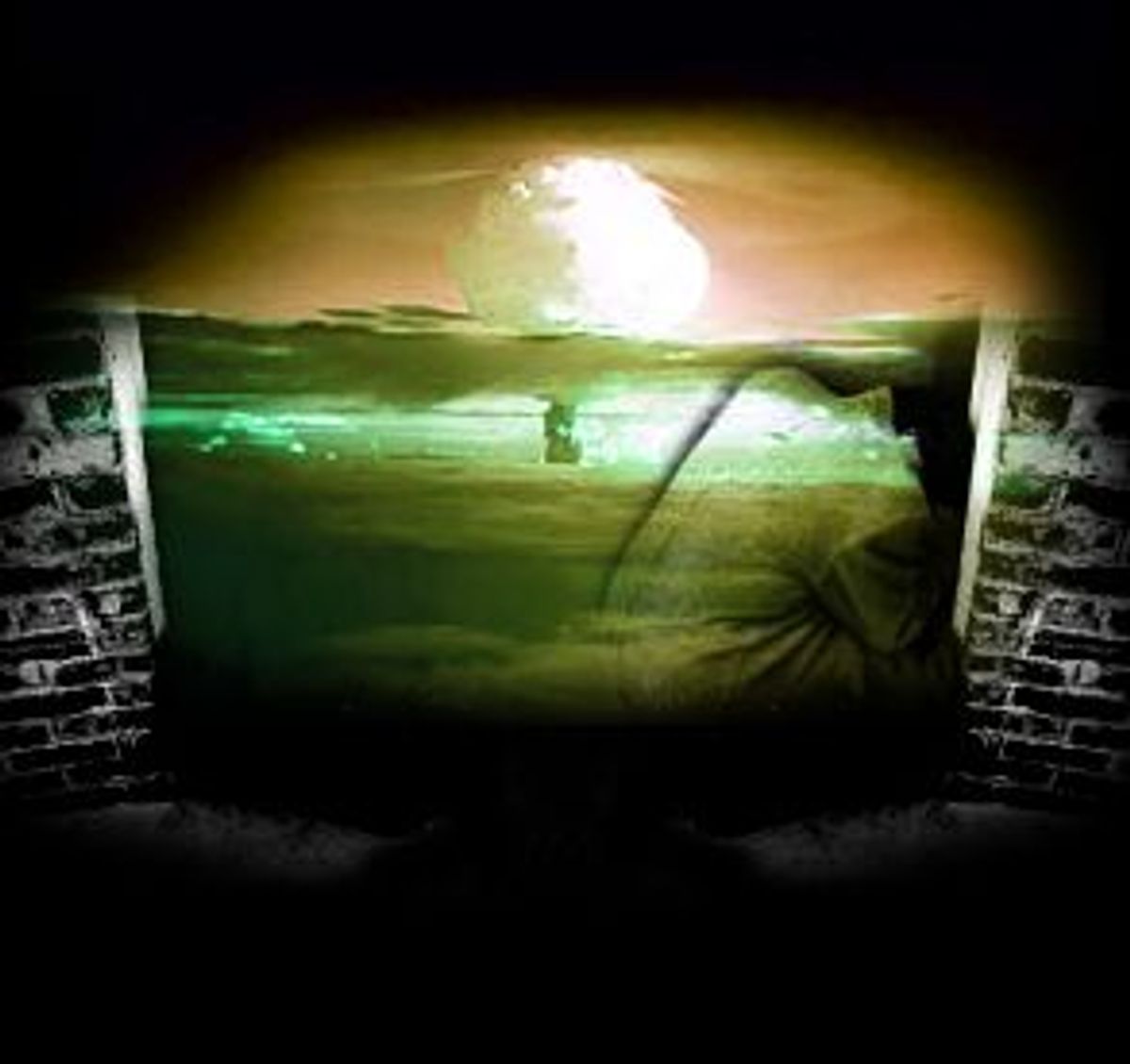
Should you happen to find yourself running a country under nuclear assault, you simply have to expect your national economy to suffer. Your wounded will demand intensive care regardless of their insurance plan, your labor force will be far too busy burying the dead to return to farm and factory, and mass destruction in major cities may hold up postal deliveries for months, even assuming you unearth enough change-of-address slips to go around. But fear not. If the forecasting skills of the United States military are to be trusted, only half of Americans will survive -- a decrease in population almost certainly sufficient to offset losses in goods and services.
This isn't fiction. On the contrary, it's the story the military told itself back in 1958. For decades after that, journalists heard rumors of an official government "doomsday scenario," yet it wasn't until 1998 that the document was briefly, inadvertently, declassified. Innocuously titled "The Emergency Plans Book," the elusive memorandum was turned over to the National Archives -- together with scores of other previously secret files released by the office of the Secretary of the Air Force in a routine housecleaning -- where military historian L. Douglas Keeney discovered it and had it xeroxed for future reference. When he returned to the archives a year later, he saw that the original was gone; a colonel had ordered it reclassified, and thereafter it was available only to those with top-secret clearance. Keeney found himself with the only copy in civilian hands. Naturally, he decided to publish it.
This month, Motor Books International -- specialty house to the hotrod and pickup crowd -- will release "The Emergency Plans Book," complete with Keeney's explanatory commentary and archival photographs of nuclear tests in the Nevada desert. Taking "The Doomsday Scenario" as its title, Keeney's book will for the first time expose the public to how the government has for decades pictured America the day after, and how it has schemed to contain the damage by keeping the president in office, the dollar stable and the telephones functional.
Keeney believes that "The Emergency Plans Book" is still in use, at least in part, judging from the government's response to the crisis on Sept. 11. He cites, for example, the flight of George W. Bush to Offutt Air Force Base -- where a Cold War-era shelter remains operational -- shortly after the terrorist strikes. And had the attack been nuclear, perhaps far more of the scenario would have been implemented: For example, to save the maximum number of lives, conserving the necessary supplies to do so most effectively, doctors might have had to let so-called hopeless cases die without even the ease of anesthesia. Fortunately, we may never know.
So such speculation is beside the point. What makes "The Emergency Plans Book" so interesting is that it offers such extraordinary insight into the military mindset. The fact that the scenario comes to a happy ending, relatively speaking, even in the wake of a nuclear holocaust, helps to explain the aggressive behavior of those who ought to know better than anybody the horrors of war. Generals may look grim and admirals may effect admirable calm in adversity, but the truth is that, far from heartless, military men are hopeless optimists, as blithesome as a Broadway musical.
Which isn't to say that "The Emergency Plans Book" is written at the chipper clip of an Andrew Lloyd Webber extravaganza. It seems instead dead serious, if only because the writing is so stiff. Its language wears the uniform of respectability, so rigid that even were the content doggerel, it would still sound like an official pronouncement. "The USSR has made attacks with large numbers of atomic weapons on the United States and on some of its territories, bases overseas, and its Allies," the book begins. "The domestic air defense warning yellow for the first attack was disseminated two hours before USSR aircraft appeared over U.S. frontiers."
This description is all business, nothing like "Failsafe," say, or "On the Beach" or any of the myriad other novelistic accounts of nuclear attack from about the same period. It's every bit as fictional, yet reads as stark fact. This apparent immediacy -- the urgency that makes someone say exactly what he means -- is what gives "The Emergency Plans Book" its surface legitimacy. The book is believable because it seems so artless: There's no expression of emotion by which we'd expect to be deceived.
So we're marched step by step through attack and aftermath. At first things admittedly look pretty lousy:
"Air Defense operations in North America and overseas have destroyed a substantial portion of the attacking aircraft, but half of those destroyed had reached the bomb release lines and had released their weapons ... Severe fire storms have occurred in heavily built-up cities and many rural fires were started involving growing crops and forests ... The general level of casualties throughout the United States is extremely serious ... The attack has caused an almost complete paralysis in the functioning of the economic system in all of its aspects ... Governmental control is seriously jeopardized and central federal direction is virtually non-existent ... Health resources, including physicians, nurses, and other manpower, hospitals and other medical care facilities, and health supplies and equipment, are in a critical state ... There are some reports of outbreaks of yellow fever and other tropical diseases in the South and of the plague, cholera, and typhus in coastal cities ... Bartering, unorganized confiscation, and looting are in evidence and threaten further the restoration of any orderly degree of economic activity ... Severe disruption of transportation service exists in all attacked and contaminated areas."
But, with a single, almost parenthetical, assumption that the surviving population "can be adequately motivated," all the above becomes but an unfortunate nuisance:
"In spite of the magnitude of the catastrophe that has struck the nation and the possibility of additional, but lighter attacks, more than 100 million people and tremendous material resources remain ... Salvable food stocks in the contaminated areas will particularly meet immediate needs since requirements have been reduced by heavy loss of life ... The non-military requirements for fuel in the post-attack period will be much smaller than pre-attack requirements, since millions of fuel-consuming units -- particularly residences, commercial buildings, electric power and generating plants, and factories -- have disappeared in the bombing ... The utilized labor force is engaged in large numbers in disposing the dead, taking care of surviving injured, decontaminating and cleaning up bombed areas, returning public works and utilities to operation, and other activities related to the direct and immediate effects of the attacks ... After the more pressing of the survival needs of the damaged economy have been met, the reconstruction period will start ... [T]he gradual return of workers to their places of employment sets in motion a slow recovery cycle, manifesting itself first in scattered, undamaged, nonfallout areas ... It will take months to determine the bottlenecks and dislocations, and many more months to overcome shortages and imbalances."
A bit of drudgery, undoubtedly, but hardly the twilight of the gods.
What we have to ask, then, is whether we should believe this story, and whether even its authors did. There appears in "The Doomsday Scenario" to be a domino effect beginning with the initial Soviet strike and continuing through to partial recovery of the economy six months later, a natural progression of offense and defense, war and peace, destruction and reconstruction. Is this any way to make a prediction? To build a military strategy?
At its most useful, the book is statistical, a best guess based on hard analysis of enemy capabilities in terms of available science:
"In addition to 25,000,000 dead or dying, there are 25,000,000 surviving casualties who require emergency medical care. Of this number, one-half (12,500,000) are suffering from blast and thermal injuries and have an immediate and evident need for treatment. Of the 25,000,000 radiation casualties, 12,500,000 have received lethal dosages and have died or will die regardless of treatment. Of the 12,500,000 remaining one-half will require hospitalization at some time during the period from D-2 weeks to D-12 weeks, with the peak, 5,000,000, being reached between D-5 weeks and D-7 weeks."
There is obvious value to this, as it may help guide emergency preparedness. Even in peacetime, resources are limited, and the above may aid the government in making difficult decisions about building medical facilities, especially in light of the following observation: "Some of this requirement for hospitalization can be met by facilities becoming available which were earlier unusable due to contamination and shortages of transportation and other services." Given the degree of initial carnage and the fact that contamination levels will decrease as demand for facilities increases, the government may be able to safely make do with fewer hospitals than at first seemed essential. The chilling truth is that some of the money might be better spent on weaponry.
Alas, the vast majority of "The Doomsday Scenario" has no such predictive worth. There's the supposition, early on, that the president survives the attack, which Keeney rightly notes is "hubris. Luck would be the most important factor." What he doesn't mention is that the same can be said for almost everything else in the book.
Each step of the suggested recovery doesn't necessarily follow from the one previous. There isn't a natural progression, but rather a chain of enormous suppositions. As slim as may be the probability of each supposition in its own right, the chance that several together may fall as predicted rests on an ever slimmer margin. Even the assumption that the "population can be adequately motivated" rests on the even greater supposition that anybody at all survives.
And if either of those premises, or any of dozens of others just like them enumerated in "The Emergency Plans Book," turn out not to be the case, then it will hardly matter that, say, "enough skilled manpower has survived to operate generating plants." Broken at any link, the chain falls apart. Considering its length, and the likelihood that between any two explicitly stated links lie a nearly infinite number of unmentioned ones, the scenario hardly seems sturdy enough to hold our credulity, let alone direct governmental policy.
That's just the nature of storytelling. It's a poor vehicle for prediction, an excellent one for persuasion. The great power of a doomsday scenario lies in its believability. So how are we to understand the 1958 memorandum? What purpose could it serve? Presumably that purpose at which it succeeds: as propaganda.
In a sense, "The Emergency Plans Book" is a lot like the original doomsday scenario, The Book of Revelation. While not exactly optimistic in its own right, Revelation is propaganda at a fever pitch: "And I stood upon the sand of the sea, and saw a beast rise up out of the sea, having seven heads and ten horns, and upon his horns ten crowns, and upon his heads the name of blasphemy."
Pretty far-fetched as prediction -- hardly good grounds for fortifying the Navy -- but it does make the point that bad behavior will not go unpunished in the end. The symbolism is deep, heads and horns marking particular characteristics of the sinful world. While such subtleties may be missed by your average layman without risk of confusing the central point, the genius of Revelation is that it serves as propaganda -- an admonition against holy excess -- within the clergy as well. Saint John the Divine seeks to preach even to the converted.
The same can be said of "The Emergency Plans Book" in the Cold War context. Top secret, it was never meant to be read by the American public, but it would have been a good way to keep its intended recipients, powerful policy-makers of mixed political persuasions, all on the same page, able to act confidently against any Soviet threat. In that respect, it fits into a much broader body of oddly upbeat Cold War ephemera, such as the civil defense brochures that reassured citizens they could survive a Soviet attack in "an underground shelter with 3 feet of dirt above it." The military may have made that one up, but, for purposes of preventing general panic, it seems to have worked well enough. The truth is that, even internally, the government seems to have been less worried about Cold War resolve than about Cold War fear. It needed a dose of its own propaganda to face a new day.
Of course, were the world to end, that would render "The Emergency Plans Book" obsolete. It's only useful, even hypothetically, to the extent that it charts a way out of catastrophe. And, like religion, optimism is a delusion that can have a strength of its own. Who would ever have guessed that, with all the worry over weaponry and strategy, the Cold War was won on the power of positive thinking?
Shares