Figure skating

Make Olympic skating judges accountable

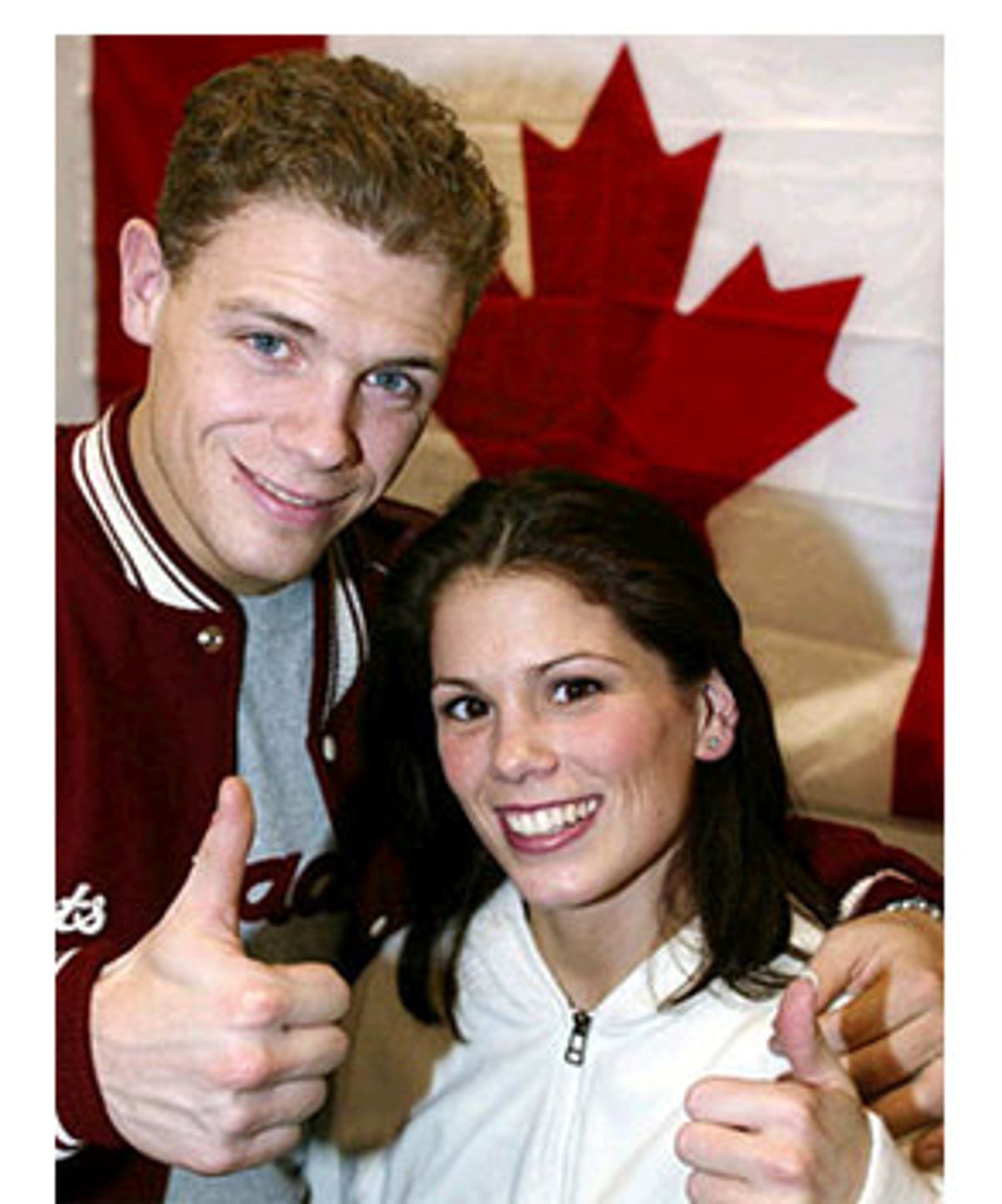
Awarding the Canadians the gold was a half-measure, but as long as figure skating is controlled by a bitchy sewing circle it won't be a real sport.

  • more
    • All Share Services

Topics: ,

Make Olympic skating judges accountable

Yelena Berezhnaya and Anton Sikharulidze, the Russian spoilers who initially won the gold medal in the Olympic pairs figure skating competition over Canadians Jamie Sale and David Pelletier, made a charmingly brief, deer-caught-in-headlights appearance Thursday on “Larry King Live.” In their extremely fractured English, they seemed a little punch-drunk by all the attention, and more than a little hurt that some people didn’t think they deserved to win.

You couldn’t help but feel for them, especially Berezhnaya, with her big Keane eyes and very own made-for-TV story line (like, alarmingly, many Russian figure skaters). Her first pairs partner, who was rumored to have been somewhat abusive to the quiet Berezhnaya, skated too closely to her during side-by-side spins, and the blade of his skate sliced into her skull. She required brain surgery, which left her unable to speak or walk, much less skate.

Enter the equally reticent, but resolute Sikharulidze. He hurried to her hospital bedside and after she recovered, they quickly became figure skating partners, romantic partners and then world champions. Could anyone be more deserving of an Olympic gold medal?

Well, actually, yes — the Canadians, who performed much more skillfully. The problem is, skill is not the only standard by which skaters are judged, as Sikharulidze pointed out, after King asked him to defend their victory despite their noticeable errors, like his wobbly landing on a double axel. “The [score for] Jamie and David was bigger than ours for technical merit,” Sikharulidze said. “But we have two marks, technical merit and artistic impression. And we had bigger marks for artistic impression. That’s why I don’t even understand what’s going on, why it’s such a big scandal from nothing.”

But that’s exactly why it became such a big scandal, and why it’s always been so easy to dismiss figure skating as the quintessential sissy sport. It’s not because men twirl through the air in sequins (frequently to show tunes). It’s because there’s too much emphasis on ill-defined “artistic” merit instead of measurable criteria for success.

Despite cries from Moscow that this scandal is some dark North American conspiracy (because, after all, we know what demanding hotheads those Canadians are), the public responded sympathetically to Sale and Pelletier not because they were Canadian, but because they seemed to skate better, and still didn’t win. It seemed to violate the rule of fair play. And the excuses, leaning on ineffable descriptions of the Russians superior “artistry” and “elegance,” do not sound like serious answers at all.

That’s why Friday’s decision by the International Olympic Committee to deliver a gold medal to Sale and Pelletier was the right one. After the IOC bullied the International Skating Union to investigate a complaint lodged by the referee, an American, in the pairs event, union officials uncovered some evidence that the French judge, Marie-Reine Le Gougne, a wispy looking woman who favors fur stoles and candy-apple hair dye, somehow behaved badly. “We have declared misconduct,” declared Ottavio Cinquanta, head of the International Skating Union, which then promptly voided her vote for the Russians. Subtracting Le Gougne’s vote left the Russians and Canadians tied 4-4, and voilà, we had two pairs of gold-medal winners!

The conspiracy theories will only persist: What was Le Gougne up to? Was it part of a pact that would deliver a gold to Russia in pairs in exchange for a gold to the French dance team?

Bizarrely, in this sport, that’s entirely possible. At the 1998 Olympics in Nagano, Japan, a Canadian judge accused a judge from the Ukraine, Yuri Balkov, of trying to collude on the voting in the ice dancing event. In 1999, at the world championships in Helsinki, a cameraman caught judges from Russia and the Ukraine exchanging what appeared to be foot signals during the pairs final. Remarkably, Balkov is expected to be judging the ice dancing event again in Salt Lake City — and all eyes should be rightfully focused on those sealskin clogs of his.

Furthermore, the constant talk of artistry and “presentation” in figure skating seems like nothing more than glittery trash talk. Fans of the Russian team have taken swipes at Sale and Pelletier’s saccharine music selection (the score to that masterpiece of movie schmaltz “Love Story”), while Canadian fans take pride in their pair’s modest costumes and roll their eyes at the Russian’s typical Siegfried and Roy-inspired attire and pretentiously serious choice of Massenet’s “Meditation From Thais” for their musical accompaniment.

Sale and Pelletier’s populist defenders have a point. Surely every time a figure skating fan demands that this sport be considered a serious art form, George Balanchine pirouettes wildly in his grave.

But artistry, of course, is always in the eye of the beholder, and Sale and Pelletier’s “Love Story” was certainly enough to reduce NBC analysts Scott Hamilton and Sandra Bezic — not to mention an entire stadium — to dewy-eyed teenagers. And it could be persuasively argued that — given the overt theatricality of figure skating (jump, spin and cry on cue) — a treacly, emotion-drenched movie theme might actually play better to an audience than a turgid sonata.

Those who claim that figure skating is a subjective art are actually making a compelling argument for throwing the sport out of the Olympics. Even newer, judged entries in the Olympics, like snowboarding, have clear criteria that competitors are judged on, such as amplitude of their jumps, and the number of rotations in their spins. In the next most high-profile Olympic sport where subjectivity plays a role, ski-jumping, style points are factored in, but how far a ski-jumper actually flies almost always determines the winner.

Figure skating seems to be the only Olympic sport in which passion outranks objective criteria. Rather than basing scores on loosely defined “technical merit” and “presentation” (i.e., the “artistic” performance), perhaps skating officials need to break down the criteria further, so that specific aspects of the skating (spins, jumps, form and the difficulty in choreography) can be separately judged, and the judges held more clearly accountable for their final scores.

If figure skating is to remain a valued part of the Olympics, and to continue being treated as a real sport, it must be forced to conform to understandable measures of accomplishment, instead of relying on the whims and connivings of what often appears to be an extremely bitchy sewing circle. If skating officials refuse to clean up their act, then they should be booted from the games — and then, considering how lucrative the sport has become — we might see some real tears on the ice.

Continue Reading Close
Kerry Lauerman

Kerry Lauerman is Salon's Editor in Chief. Follow him on Twitter: @kerrylauerman.

Young US women see figure skating medal streak end

For only the second time since 1952, no Olympic medals for US women's figure skating

  • more
    • All Share Services

Topics: ,

Mirai Nagasu’s face lit up when she saw her ranking after the women’s free skate.

Fourth place. No medal. Usually a catalyst for tears at the Olympics. But to the 16-year-old American, it might be the foundation for some better finishes in the future.

The U.S. women failed to win a medal for just the second time since 1952 at Thursday night’s competition. U.S. champion Rachael Flatt finished seventh.

“I’m just happy I was able to be right behind those top competitors because it’s my first really big international competition,” Nagasu said.

“Most 16-year-olds medal at their first Olympics,” she joked. “I’m sorry that I wasn’t able to keep up that U.S. trend. But, hopefully, I’ll be able to make up for it when I get to come back I hope for the next Olympics.”

Flatt was fifth and Nagasu was sixth coming into the finale. The top three skaters needed to make major mistakes for either one to make off with a medal. Nagasu finished more than 12 points out of a bronze.

The 17-year-old Flatt lost points on both her triple flips when she didn’t complete the rotation. She said “they felt just fine to me” and acknowledged she was a bit surprised by her score.

Asked if that made her Olympic experience somewhat less fun, Flatt said, “A little bit.”

“I wish that I could’ve gotten a better score, but you make do and just continue to improve,” she said, then added with a laugh, “Got to make sure I fix those flips.”

Any benefits from competing in Vancouver might be seen as early as next month, when the world championships are held in Turin, Italy. No U.S. woman has been on the world championship podium since 2006. American women have won seven Olympic gold medals overall, including three of the last five coming into Vancouver. The only other time since 1952 that they didn’t medal was 1964, which was three years after the entire U.S. team was killed in a plane crash.

Nagasu noted that this year’s gold and silver medalists are both 19 — only a bit younger than she will be at the 2014 Sochi Games. Kim Yu-na and Mao Asada each came into the Olympics with significant international seasoning.

“At 16 you don’t have the experience and the maturity that they skate with,” Nagasu said. “Hopefully, by that time I’ll be able to get that.”

Continue Reading Close

“Queen” Yu-Na takes the gold

Weepy announcers, flawless routines mark a dramatic Olympic women's free skate, while Speedy nails the Hurricane

  • more
    • All Share Services

Topics: , ,

South Korea's Kim Yu-Na reacts after performing her free program during the women's figure skating competition at the Vancouver 2010 Olympics in Vancouver, British Columbia, Thursday, Feb. 25, 2010. (AP Photo/David J. Phillip)(Credit: AP)

Are skin-colored skates tacky? Is the double hang-dog reversal an aerial freestyle move, or a maneuver performed by a chastened downhill skier regretting her somewhat envious remarks? Would South Korea’s figure skating favorite Kim Yu-Na take home the gold, or would an entire nation turn its back on her forever?

These are the questions looming on Thursday as the women’s giant slalom begins: The big unknown here is whether or not Mancuso can partially make up for her 18th place finish on Wednesday after being forced to repeat her first run due to a fall by Lindsey Vonn.

Of course, Mancuso has been drawing criticism thanks to her comments over the weekend about the “popularity contest” between Vonn and other skiers. She seemed to lament, in an interview for Sports Illustrated, that Lindsey Vonn had a big influence over the team. “People are having a hard time reaching their potential because it’s such a struggle for attention. You come to meetings after races, and it’s like it’s a bad day if Lindsey didn’t do well.”

Suddenly it’s crystal clear why Mancuso might be losing that popularity contest. Right before Mancuso’s second run, the NBC announcer says of Mancuso and Vonn: “These are two characters with polar opposite personalities. They approach their personal lives and their ski careers differently, they’ve got different goals, and you know what? That’s just the realities of life on the national team.” Everyone has said this so many times, and yet: What are the differences, exactly? This is just like those vague allusions to the “personal struggles” of Speedy Peterson. Does Mancuso drink and Vonn crochets? Mancuso sluts around in her rhinestone tiaras and Vonn is married? Give us something concrete, here!

Unfortunately, in the actual ski contest, Mancuso can’t make up for her bad finish the day before, and she finishes 8th after her second run. Germany’s Viktoria Rebensberg takes the gold, Slovenia’s Tina Maze takes silver, and Austria’s Elisabeth Goergl gets the bronze.

At the bottom of the hill, NBC’s announcer asks Mancuso about her comments. “I really think it’s been taken a little out of proportion,” Mancuso said (or, you know, taken out of context and then blown out of proportion). “Of course she deserves the attention, she really is the greatest American female skier we’ve had.” Nice double-remorse full reversal, Julia. Is that an event you’ve trained for, or are you just improvising?

At any rate, Mancuso has two silvers and Vonn has a gold and a bronze, so neither can be that unhappy.

Time for freestyle skiing, men’s aerials, see also, crazy twisty flipping by insane people. As you’ll recall from Monday night’s coverage, the big story here in terms of Americans is Jeret “Speedy” Peterson. Everyone is hoping he’ll do his huge Hurricane jump, as promised, a jump that he hasn’t landed in competition since 2007.

In fact, Peterson was in bronze medal position in Torino in 2006 and he decided to go for the Hurricane. He didn’t stick the landing and he lost his medal. This time he needs a really big jump to get a medal. He goes for the Hurricane … and nails it! He takes the lead! “He absolutely tagged it, one of the best ones I’ve ever seen him do!” says Johnny Moseley. The crowd goes wild!

Then Belarus’ Aleksei Grishin does a full-full-double-full, let’s call it the Mangler. He nails the landing and takes first! The final competitor is Canadian Kyle Nissin. He pulls his knees in and the landing isn’t totally controlled. He gets a very low score.

That means Speedy gets the silver! Hurray for Speedy!

 Next is the men’s nordic combined. The large hill jump already took place, now the competitors take part in a 10k cross-country race. Austrian Bernhard Gruber starts 34 seconds ahead, but Americans Bill Demong and Johnny Spillane catch up with him and leave the pack behind. It’s a nail-biter of a three-way race until the very end, when Demong pulls ahead, Spillane takes a close second, and Gruber struggles and falls behind. Gold and silver for the Americans! Right after crossing the finish line, Demong shrugs and jokes, “That was pretty good.” Undercutting your gold, for a quick laugh! A nation of undercutters heartily approves.

Finally it’s time for the women’s figure skating. Everyone’s talking about South Korean Kim Yu-Na after her fine performance in Tuesday night’s short program. But before we can see her shine, it’s time for American Rachel Flatt to take to the ice.

Flatt’s mother is a molecular biologist and her dad’s a geochemical engineer, and Flatt just got accepted to Stanford. Unfortunately, her skating kind of reminds me of Evgeni Plushenko’s: solid jumps, with no flair or grace, and her spins are downright ungainly. She does the job, but she doesn’t make it look very fun. Nonetheless, Scott Hamilton declares this “her best performance of the year.”

Before we go any further, a word about skin-colored skates: Blech. Yes, maybe they make your legs look longer, but they’re ugly, made uglier by those suntan-colored nude hose that run straight into them. They make skaters’ legs and feet look like two orange, misshapen fingers.

Japan’s Miki Ando comes out in a Cleopatra outfit skating to what sounds like the theme song to HBO’s  “Rome.” She nails all her jumps but her program isn’t all that moving, somehow. There’s no emotional center to it. “It just felt really conservative to me, but … without a lot of impact,” says Hamilton.

Speaking of conservative, tonight’s women’s figure skating outfits are pretty unremarkable. In fact, the whole night is just a little bit tame after the disco-barkers and enraged circus performers and Liberace-jumpsuit-wearing aliens we’ve seen at these games so far. In fact, the women’s free skate seems to feature lots of nice, conservative skating outfits, nice, conservative routines, and nice, conservative music. Give me something to work with, people!

Just as we’re starting to feel extra sleepy, here comes the night’s favorite, Kim Yu-Na. She is “the most popular celebrity in South Korea,” according to Tom Hammond, but he says that she wrote a book of short essays about the pressure she carries. In one essay, she wrote, “If my performance falters, not only people around me, but the whole nation might turn their back on me.” At least you don’t have to struggle for that attention, Yu-Na! You don’t know how hard it is to sport a little rhinestone tiara everywhere you go.

 Actually Yu-Na looks extremely relaxed for someone whose nation might ditch her at any second. She skates very fast and her jumps are higher than anyone else’s. She also has more musicality and grace than anyone else. By the end of her performance, I’m sniffling. “This is one of the greatest Olympic performances I’ve ever seen!” gushes Sandra Bezic.

“The coronation is complete, long live the queen!” says Hammond. Yu-Na gets a record-high score of 228.56, which destroys the old record, 210, also set by her.

“And the only woman who has a chance — had a chance — is on the ice now,” says Hamilton.

You really do have to feel for Japan’s Mao Asada, being forced to step out onto the ice while the crowd roars over Yu-Na. Mao is sporting a red and black outfit and she soon becomes the first woman in skating history to do three triple axels in a competition. But she also makes a few mistakes and her performance doesn’t come close to Yu-Na’s.

In truth, the night just isn’t very suspenseful, compared to the way women’s figure skating shook down at the last few Olympics.

But then, suspense is replaced by overwhelming emotion when Canada’s Joannie Rochette appears. She skated the short program two days after her mother’s unexpected death of a heart attack. She stumbles a little on a jump, but she’s a beautiful skater. After her program ends, she’s teary and none of the announcers can speak. Hamilton is very quiet, then his voice breaks, and it’s pretty clear that he’s weeping openly. I’m crying along with him, surrounded by tissues. Please let this poor girl take home a medal!

Finally we have American Mirai Nagasu, looking very young and very nervous. She nails every single jump, and her skating is pretty lovely. “She is a delight, and she just made herself her own Olympic moment,” says Bezic.

Nagasu’s scores lift her to fourth. That means Yu-Na wins the gold, Asada gets silver, and Rochette wins bronze! After seeing American women medal here so many times, it’s almost strange not to have an American on the podium. But these are the rightful winners tonight, and now we can sleep easy knowing that a whole nation will celebrate their queen instead of rejecting her forever!

Continue Reading Close

Heather Havrilesky is Salon's TV critic and author of the rabbit blog. Her memoir, "Disaster Preparedness," published in 2010.

Broadcasters under fire for comments about Weir

Skater should take a gender test, snarked one

  • more
    • All Share Services

Topics: , ,

Two broadcasters are facing criticism for derogatory comments made about American figure skater Johnny Weir.

The Quebec Gay and Lesbian Council has demanded a public apology from French-language broadcaster RDS after one commentator said Weir hurts figure skating’s image and another said Weir should be made to take a gender test. The remarks were “outrageous” and “homophobic,” CQGL said in a statement on its Web site.

Weir has repeatedly avoided questions about his sexual orientation in the past, saying it’s no one’s business and it has no bearing on what he does as an athlete. He is aware of the comments, agent Tara Modlin said Monday.

“The comment is so inappropriate that we will not even justify it with a response,” U.S. Olympic Committee CEO Scott Blackmun said.

Australia’s Channel Nine has reportedly gotten complaints from viewers after two of its hosts joked about the masculinity of Weir and other male skaters.

Skinny boys go up, big men go down

Siblings dance a romantic tango; ski jumping and downhill racing contrast; Bode Miller makes amends

  • more
    • All Share Services

Topics: ,

Skinny boys go up, big men go downSwitzerland's Simon Ammann makes his qualification jump during the Men's large hill ski jumping qualification round at the Vancouver 2010 Olympics in Whistler, British Columbia, Canada, Friday, Feb. 19, 2010. (AP Photo/Dmitry Lovetsky)(Credit: AP)

Deeper truths come fast and furious when you’re watching a pair of sequined siblings floating on the blades of desire to an elevator soundtrack stuck on Tango. It’s weird to see and triggers soul-searching. Watching Friday’s Olympic line-up, a cataract of Ski Jumping, Men’s Alpine Skiing, Couple’s Figure Skating and Women’s Skeleton, itself could have qualified as an Olympic sport. It was exhilarating, difficult and revelatory. Nattering Bob Costas led us not only down large snow-covered hills to weave between flags or to launch into the air. He led us to triple lutz into ourselves, to take a mythic Tango Romantica with our own souls. He’s the Virgil of Vancouver 2010. And so halfway through the journey of the Olympic Games, we found ourselves on a snowy hill.

Winter Olympic sports can be divided into three categories: those that go down, those that go up and those that are level. Last night’s spread included all three. While Alpine Skiing and Skeleton fall into the first category, Ski Jumping falls into the second and Figure Skating into the third.

Ski Jumping, a sport in which young boys in shiny green foam outfits slide down a large snow-covered ramp to launch themselves into the air, has been an Olympic sport since the first Winter Games in Chamonix-Mont Blanc in 1924. Ski jumpers are the gelflings of winter athletes, slight wispy doe-eyed boys (and for now, only boys) who, as has been much noted, starve themselves to fly higher. But it’s easy to understand why Ski Jumping hasn’t attracted much of an audience stateside. It’s straightforward to the point of dull and minimal to the point of static. [Poles, on the other hand, are reportedly mad for it.] There are basically only three positions — crouching, flying and landing and this series is repeated by every competitor with little variation. From the angle of NBC’s camera, the skier himself, as he floats through the air like an aerodynamic Canadian Goose, might as well be back at 30 Rock, wearing a silly suit and standing in front of a green screen in some Gumby-inspired SNL send up. But to focus one’s gaze on the barely moving part is to miss the point. There’s some sort of zen haiku calm to the sport that’s bores the mind but awakens the soul.

Once airborne, the skiers lean acutely into the wind beyond, like matadors of the air. They hold steady and still, the white ground reflected orangely in their ski goggles whirrs below them. For those of who appreciate the simple things in life–warm chocolate cookies, tax refunds, Fred Sandback’s string sculptures–the pure geometric simplicity of the sport is refreshing: two parallel planes, separated by a parabola, like a high school physics diagram made real. For those more metaphorically inclined, the striving ascension is a reminder of man’s hankering for transcendence of this realm of shadows and gravity. It’s Icarus on Ice.

But of course tonight’s event was just a qualifying round. The athletes weren’t competing to win but simply to move on to the next level. Accordingly, my eye was keyed toward failure, hoping secretly for a Vinko Bogatag Agony of Defeat moment. Sadly/happily it never came. Instead these boys glided down the ramp gracefully, floated between 119 and 142 meters, and landed as lightly as a dandelion seed.

If Ski Jumping embodies man’s transcendence, Alpine Skiing glorifies his descent. Here burly big-chinned men built like Clydesdales carom wildly down a mountain. The Super G is 2,076 meters of barely controlled chaos punctuated by great moments of difficulty. It, along with the luge, is the most unforgiving sport, one in which one error compounds into the next, where one miscalculation scotches the entire balance sheet. Anything that’s goes fast, has curves and loves going down is dangerous. [You can't see me, of course, but I'm winking really hard at the screen.] Compared to the quietude of the ski jump, it’s great fun to watch. Among the most spectacular on the slopes were of course Bode Miller who hewed closely to the flags, so closely in fact he wore arm pads. But Miller faced overwhelming competition both in terms of his ski time and redemption narrative from the Norwegian Aksel Lund Svindal who skied the course in 1:30:34 to win gold. Both are, to some extent, comeback kids. But whereas Bode Miller’s 2006 fall from grace was self-inflicted, involving an endless series of Italian nightclubs and subpar runs in the Torino games, Aksel’s fall was much more literal. In 2007, the highly rated Norwegian crashed hard in Beaver Creek, soaring unhappily through the air and breaking his face and groin upon landing. But, as we were told last night through a touching NBC montage, Aksel managed to come back to score a win at the very same course that nearly destroyed him less than a year later.

Does it perhaps say something about the indomitable American spirit that we prefer our heroes’ falls self-inflicted? Indeed, “Where were you when you learned Tiger Woods was a sex fiend?” is this generation’s version of “Where were you when JFK died?” We prefer our heroes on the way down than on the way up and besides, peripeteia is just so fun to watch on TMZ. This leads us somewhat unexpectedly to Figure Skating.

NBC might be losing $12 million on the Olympics but they aren’t going down without a fight. Throughout the games, Bob Costas, with his puppy dog eyes glinting mischievously, has tried to stir the pure Olympic cauldron, hoping some of the lesser qualities of mankind might rise to the top. He probably has a Post-It next to his mirror in his dressing room reading, “Double, double toil and trouble; Fire burn, and caldron bubble.” Last night Costas’ hankering for dirt was most evident in his stoking the flames between Evan Lysacek, the American cyborg who won Men’s Figure Skating Gold, and the Russian Evgeni Plushenko, who didn’t. Fireside, Costas endlessly needled Lysacek about the Russian’s mildly disparaging comments but Lysacek, though sleep deprived, remained gracious and even keeled. Costas O; Decency 1. But it was really in the Compulsory Ice Dance section of the night that NBC let its muckracking Automatic Grammatizator get going.

The Compulsory Ice Dance sounds like some sort of medieval torture and that’s not so far from the truth. If the Ski Jump is the haiku of the games, the compulsory ice dance is a villanelle, a sport corseted so tightly with rules and regulations that the gasps of creativity are remanded to grow through the cracks. Last night couples had to dance to something called the Tango Romantica, executing precise steps on certain beats in predetermined locations while describing proscribed patters on the ice. That does sound romantic! To comprehend the complexity take a look at this scoring sheet.

Bob Dylan might have said it best when, in his 1965 ballad of Figure Skating, he described the experience thus, “Old lady judges watch people in pair/ Limited in sex, they dare/ To push fake morals, insult and stare/ While money doesn’t talk, it swears/Obscenity, who really cares/Propaganda, all is phony.” Essentially inscrutable to the civilian, Ice Dancing seems like a bunch of men dressed as waiters dancing with women dressed as estate brooches to the same song. Compared to this my W9 forms seem compelling.

Enter Costas and Co. who spend an inordinate amount of time focusing on the drama between the two teams of Americans: Meryl Davis and Charlie White, and Tanith Belbin and Benjamin Agosto. In NBC’s hands, the rivalry–if there was one to begin with–escalates into an epic cold war. The younger Davis and White come to embody all that is light and white and right with the world. They’re young and dewy eyed. Charlie likes Jack Johnson and Kanye; Meryl’s favorite colors are blue and pink. They’ve been skating together since they were ten. Tanith and Benjamin are the Odile to Davis and White’s Odette. The duo are darker, more mysterious, dramatic, older and a little condescending. After minutes of off-screen NBC waterboarding, Agosto manages to say something a wee bit not very nice about Davis and White, something like, “We have more experience.” Davis and White manage to pooh pooh the rivalry itself which sounds suspiciously like they pooh pooh Belbin and Agosto. It’s not much but it’ll have to do and so the ice, once horizontal, starts to tilt and we merrily slide down it, picking up speed as we go.

Continue Reading Close

Men on ice

Pictures from a memorable men's skating competition

  • more
    • All Share Services

Topics: , ,

Men on ice

Dazzled by the bedazzled outfits from last night’s men’s figure skating competition — and inspired by Heather Havrilesky’s General Zod reference today — we thought we’d offer up a gallery of our favorite pictures.

View the slide show

Page 1 of 4 in Figure skating