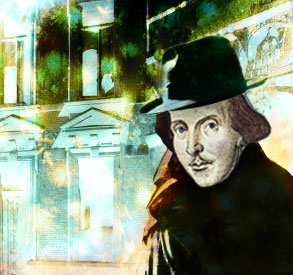

Shakespeare

Mystery man

A new documentary revives an old controversy: Was actor and landowner William Shakespeare merely a front man for Christopher Marlowe, the flamboyant gay genius and shadowy Elizabethan spy?

If you look hard enough, it’s possible to find a group of ardent souls, somewhere, who still believe almost any weird idea that might ever have held currency. The Flat Earth Society, for instance, is still very much in business, with headquarters both in America and what they’d hesitate to call the Southern Hemisphere, in Australia. There are groups of people, after all this time, who still think Japanese anime is edgy and avant-garde, and others still devoted to proving that Shakespeare didn’t write Shakespeare. Perhaps you know some of these people, or are one of them. For my part, I believe the Shakespeare-authorship thing. I think Christopher Marlowe might’ve written all the Bard’s works instead, and it was Michael Rubbo’s new video documentary, “Much Ado About Something,” which just completed a two-week run at Film Forum in New York and should appear somewhere near you soon, that smashed my paradigm.

The film is about the so-called Marlovians, the folks who say that Marlowe was the guy, as opposed to Francis Bacon or Edward de Vere, et al. Or, for that matter, the rustic actor named William Shakespeare who commonly holds the laurels. Rubbo is an Australian filmmaker best known for the 1974 Castro documentary “Waiting for Fidel.” He started out wanting to document the Marlovian apostasy because of all the interesting characters involved (they might as well have been flat-earthers instead). He entered intrigued, but as a skeptic — and was swayed.

Indeed, something odd seems to be ado, Shakespeare-wise: Mark Rylance, the somewhat dashing, hat-affecting artistic director of the Globe Theatre, speaks lavishly on-camera on how he thinks it was really Marlowe. Jonathan Bate, probably Britain’s leading orthodox Shakespeare scholar, appears all postmodern-unflappable in the film but helped award it a major prize and blurbs it in the press.

But back to my paradigm. Pre-Rubbo, I used to think the same as most semi-educated people about the Shakespeare-authorship controversy: that everyone knows the guy wrote his own stuff and we can totally prove it and it isn’t really a controversy at all but part of a common urge to find conspiracies all over the place. There are lots of people out there, for instance, who believe in a secret government conspiracy to create hypnotically programmed killers, like in “The Manchurian Candidate.” Of course, that actually happened — it was called MK Ultra and was, fortunately, unsuccessful, otherwise there might’ve been a rash of assassinations by lone, deranged gunmen beginning in the early ’60s — and there’s the rub: “Conspiracy theory” is a scare term, but real conspiracies happen all the time, especially wherever you find spies and government dirty-tricks bureaus. If they’re doing their jobs right, it’s sometimes very hard to tell where facts leave off and the conspiracy-nut surmise begins.

Rubbo’s film shows that Her Majesty’s Secret Service (the original, Elizabeth I version) might have been involved in the Shakespeare thing up to their Elizabethan ruffs. While “Much Ado About Something” begins by showing the Marlovians as harmless eccentrics, mostly of the English Miss Marple and Colonel Mustard variety, it also shows them as holding that rarest of patents in the conspiracy-buff field — an idea that keeps looking more compelling the further you get into it.

So, Marlowe. The film shows us a man who was the most eminent playwright and the finest writer in English of his day. A young guy, handsome; we have his portrait. He’s the guy, as even the orthodox scholars say, who would have been Shakespeare, if not for having been killed, in May 1593, at age 29, in a sudden brawl at a rooming house. Marlowe was an authentic genius, a polymath, and it turns out, an apostate freethinker with a warrant on his head from the church, and an upcoming date with the torture chamber. And according to the evidence the film shows, he was a highly ranked secret agent for the queen, sent on missions overseas to stir up trouble and dig up information.

His patron, Francis Walsingham, was certainly one of Elizabeth’s spooks, and Cambridge, Marlowe’s university, was a recruiting ground for young agents. A letter to the regents at his college shows that the queen had taken a keen interest in keeping Marlowe out of trouble. The college thought he’d gone to France to cavort with Catholics, a bad thing indeed in those days. The palace demurred on France, but vouched for Marlowe’s valuable service there to the crown.

But trouble struck. Church authorities got a line on Marlowe through an informer, and accused him of atheism, homosexuality and a number of other problematic things (mostly true, it seems). Marlowe scholar Charles Nicholl tells the camera that he believes the brawl, which happened a week after the warrant was served, was actually an assassination meant to keep Marlowe from spilling crown secrets. He was in the rooming house for eight hours, alone with three other men. One was a spy for the queen en route to deliver a diplomatic packet to London; another, Ingram Frizer, was employed by Marlowe’s own patron, Walsingham; and the third was a sort of Elizabethan Ratso Rizzo type. The official story, reenacted in the film, is that they argued about the “ley” (the bill for the food and booze), whereupon Marlowe grabbed Frizer’s dagger and struck him on the head with it from behind. Frizer turned, disarmed Marlowe and backhanded him with the same dagger, whose blade caught him in the right eye. And exeunt. But more on that anon.

Shakespeare has been a problem for centuries. The film begins at Poet’s Corner, at Westminster Abbey, scanning the memorial stones and reciting misgivings that the interred poets expressed about whether the man from Stratford really wrote all those works. “It is a great comfort,” Charles Dickens said, “that so little is known concerning the poet. The life of William Shakespeare is a fine mystery and I tremble every day lest something should turn up.” Thomas Hardy, also buried there, was similarly nonplussed. Coleridge wasn’t too bullish on it all either.

Nor for that matter were Mark Twain, Henry James, Ralph Waldo Emerson, Sigmund Freud and a host of other prominent doubters. Much of this was due to the Bacon-wrote-Shakespeare vogue that began as early as 1785, but something seems to have been ado even during Shakespeare’s lifetime. “There is an upstart Crow, beautified with our feathers,” the poet Robert Greene wrote in a broadside published in 1592, “That with his Tygers hart wrapt in a Players hyde [a steal from two plays, one by Marlowe, and one later published as Shakespeare's], supposes he is as well able to bombast out a blanke verse as the best of you: and beeing an absolute Johannes fac totum [read: errand boy, Stepin Fetchit], is in his owne conceit the onely Shake-scene in a countrey.” Hmm.

“Much Ado About Something” covers the obvious holes in the pro-Shakespeare thesis: We have no paper trail of Shakespeare as a playwright or poet, no correspondence, manuscripts, personal library or ephemera. We have numerous notices of him as an actor and as a bourgeois landowner, but only a few mentions in lists of contemporary poets (Greene’s is by far the most lavish). Most except Greene’s are merely title-page evidence, where it’s mentioned that such-and-such a play was published under such a name.

There are six extant Shakespeare signatures from banal documents, all crabbed and variant, as though he had difficulty writing his name. There’s no record of his having attended the village school, or of his having donated a penny to it in his wealthy middle age, although, as the film shows, he lived literally across the street. His daughters were, it seems, illiterate, in sharp contrast to the practice among educated Elizabethans (and in the ethics on display in the Shakespearean plays). We do know that William Shakespeare composed the oft-quoted inscription on his tombstone:

Good friend for Jesus sake forbeare,
To digg the dust encloased heare:
Blese be ye man yt spares thes stones,
And curst be he yt moves my bones.

It really kind of stinks.

Of course there’s more: Many of the plots of the dramas were borrowed from sources in French or Italian, where there was no English translation and William S. couldn’t read the original. Q: Why do so many of the plays display knowledge of locations in Marlowe’s home district of Kent, and never of Warwickshire, where Stratford is (Marlowe’s sister’s tavern even turns up in “Henry IV”)? Why are many set in Italy, and why do so many feature exiles as characters? Where are all the early works? Why do the sonnets refer to disgrace and a stain on one’s name, when William S. was apparently jollying it up in Stratford and, later, London the whole time?

The Marlovians believe the fatal brawl was a setup, all right, but in a different way. They believe that Marlowe was not really killed. Research has shown that the fateful rooming house was a kind of safe house, owned by a woman with connections to the queen’s personal escort. It was also right next to the river — the contemporary equivalent of having a meeting at the airport. After the incident, the case was taken over by the crown, whereupon the queen rapidly pardoned everyone involved and directed that all further inquiries be set under her own jurisdiction.

The avowed killer, Frizer, who was employed by Marlowe’s own spymaster and patron, kept his job. Another man in that same circle of Royal Secret Service men who was stationed at Dover, on the south coast of England, transported a group of agents to France the next day. He subsequently returned to London via Cambridge, Marlowe’s hometown. To the Marlovians, all this suggests that their man was sent off in exile, first to France, then to Spain and finally to Italy, where he lived out the bulk of his years before (possibly) returning home. They think Marlowe used the actor Shakespeare as a front man, so he could keep publishing in England. They believe this was more or less an open secret at the time.

It might seem too Elvis-lives to be true. But an epic poem in the Marlovian style, first registered to “anonymous” in the Stationer’s Register, was re-registered 13 days after this hypothetical flight would have taken place, in the name of William Shakespeare — the first time that name had ever appeared there. The title page carried a two-line quotation from Ovid, whom Marlowe himself had translated into English. The verse in question concludes:

The living, not the dead can envy bite,
For after death all men receive their right.
Then though death rakes my bones in funeral fire,
I’ll live, and as he pulls me down mount higher.

Hmm.

Many readers and scholars have wondered how Shakespeare got an inside view of court intrigues in Scotland (“Hamlet” and “Macbeth” are based on actual people and events there, including the court of James VI). And how he knew about life and politics in Italy (consider those Italian plays: “Romeo and Juliet,” “Two Gentlemen of Verona,” “The Merchant of Venice,” etc.). There’s also a longstanding problem with Miguel de Cervantes’ “Don Quixote,” and how it was translated into its masterful English edition. The Marlovians see a single hand behind these apparently unrelated literary conundrums, and further suggest that Marlowe was among the 47 translators who rendered the King James Bible into such remarkable English.

Maybe that seems to wrap everything up far too neatly. But hold on: Diplomatic records place a man named Marlowe in Scotland several years before the fatal brawl, engaged as a tutor (and double agent, in the queen’s service) in the court of James VI. And what’s this? Christopher Marlowe actually reappears in the diplomatic records, postmortem. He was in Valladolid, Spain, in 1599 — at the same time Cervantes was, and just a few years before the initial publication of “Don Quixote.”

The “Quixote” translation — which, in fairness, did not appear until 1612 — was long attributed to a Thomas Shelton, brother-in-law of the spymaster Walsingham (hmm). Except there was no such person as Thomas Shelton; it was a nom-de-plume. In 1602, a communiqué from Valladolid says that Christopher Marlowe is planning to return to England the following year, a full decade after the supposed death of the famous writer by the same name. And there we pick him up again, in prison records, with his bills charged to Robert Cecil, another member of that same Cambridge spy ring. That same year, James VI of Scotland becomes James I of England — and Marlowe’s not in jail anymore. Somehow the King James Bible appears, translated by the 47 mystery men. And that’s about where the research tapers off.

Well, except for the papers of Washington Irving, he of “The Legend of Sleepy Hollow,” who once served as an American diplomatic attaché to Italy, and who alludes in his papers to a 17th century document about an English poet named Marlowe, exiled and under the patronage of the Gonzaga family. The Marlovians say that there are still unresearched archives in Italy that might hold crucial evidence. In his film, Rubbo interviews the most likely such Italian librarian, who says that in all the decades she’s been there, nobody has yet come around asking to look at the Gonzaga family papers.

The weirdest bit, however, is something that the film mentions but doesn’t explore fully. Peter Farey, a British Marlovian with a sort of hobbyish civil-servant aspect, gets lots of screen time in the film. Among other things, Farey says he has decoded the famously obtuse inscription on the Shakespeare plaque in the Stratford chapel, placed there to commemorate the First Folio, which was published after Shakepeare’s death. It reads:

Stay Passenger, why goest thov by so fast,
read if thov canst whom enviovs Death hath plast
with in this monvment Shakspeare: with whome
qvick natvre dide: whose name, doth deck ys Tombe,
Far more, then cost: Sieh all, yt He hath writt
Leaves living art, bvt page, to serve his witt

Farey’s interpretation is more literal than many. Allowing for the peculiarities of Elizabethan punctuation and diction, he interprets it thus: “Read if you can whom envious death has placed within this monument to Shakespeare: with whom his [the real poet's] quick [living] nature died.”

That part seems pretty straightforward. When Shakespeare died, so died the living envoy of the real poet; so died his front man. But why would anyone, or anything, be placed there? It’s just a plaque.

“Whose name doth deck this tomb, far more, then cost?”

As for the second part, the only name on Shakespeare’s tomb (which is outside, in the yard) is that of Jesus Christ. Christ, far more, then cost — cost, such as the aforementioned “ley” presented by the innkeeper on that fateful night. Christ-far more-ley. Which is creepily close to the way Christopher Marlowe signed his name Christofer Morley) “Sieh all” is, Farey says, a common Elizabethan cipher: Nobody spelled “seeth” like that, especially on a plaque for a poet. Any literate Elizabethan, Farey claims, could have interpreted this as “he is,” in reverse, or, in the parlance of the time, returned. He is, returned, with the word, “all”: “He is returned with all that he hath writ.”

As for the last line, we scarcely need to ask who Farey thinks is the “page,” now gone, who served forth Marlowe’s wit. That would be the rustic actor Shakespeare, a mere “Johannes fac totum.” There is a bust of Shakespeare above the plaque (famously derided by Mark Twain as looking like a bladder). It shows the man with a quill and a piece of paper, writing on a pillow. It was renovated in the 18th century; early engravings show that the Bard of Avon was once effigied holding a sack of grain, like many another wealthy provincial landowner. Both the bust and the man, Farey would say, are but a figurehead. And what’s this about someone, presumably Marlowe, having “returned with all he hath writ”? What might be “placed” in the floor beneath the plaque? Nobody has ever thought to look. Hmm.

There’s more to the case as well: Funny references in the plays, Marlowe’s own motto woven into texts, a rustic boob named “Falstaff” (as in, Shake-spear) — stuff like that. But the question remains: Does it matter who wrote Shakespeare? As the scholar Touchstone (get it? It’s another, ruder pun) says to a rustic boob in “As You Like It,” “When a man’s verses cannot be understood, nor a man’s good wit seconded with the forward child Understanding, it strikes a man more dead than a great reckoning in a little room.”

A little room, perhaps, by the riverside on May 30, 1593. If you don’t “tremble,” as Dickens did, at the prospect of finding out some uncomfortable things about the Western canon, you can’t help wondering what would happen if scholars ignored the injunction on Shakespeare’s gravestone and started digging that dust and moving those bones.

Gavin McNett is a frequent contributor to Salon.

How Shakespeare got me through unemployment

I was depressed and broke, but I found inspiration in an unlikely way -- reading all of the bard's plays out loud

(Credit: Salon)

Three years ago, at one of the lowest moments of my life, I started doing something I never thought I’d do.  I’m reading every single play William Shakespeare ever wrote.  And I’m reading most of them aloud. From the three dour Henry VIs, through all of your Macbeths and Romeos and Hamlets, all the way to nutty Cymbeline and beyond.

I’m not a Shakespeare scholar. Or an actor. I read them as part of a Nashville Shakespeare Festival program called “Shakespeare Allowed!” which invites a group of strangers to gather at a giant square table in the downtown library and read one speech or line at a time, round-robin-style, regardless of gender or acting ability. (Others silently read along in the periphery, except during crowd scenes, when everyone homina homina hominas.) Over the years, people have tried to read lady parts in high voices (embarrassing) or French parts in French voices (disastrous) or ghost parts in, I don’t know, ghosty voices, but it never pans out. Eventually people settle down into their normal reading voices, because it’s really about the text and the simple act of reading in front of other people. It sounds as tedious as a toothache — but it’s been thrilling.

It began when I was in the midst of a particularly gruesome period of under-employment and depression, having decided to go out on my own as a freelance designer at the exact moment that the economy collapsed. It was positively, well, Shakespearean. Finding free entertainment was quite a challenge, and so one day, while flipping through an actual newspaper, I noticed an article about the Shakespeare Allowed! project and decided to go see what it was all about. I showed up at the library the first Saturday of the month and was amazed to see 40 eager people jammed into a tiny conference room, books in hand, ready to read “The Comedy of Errors.” I knew within 10 minutes that I’d be busy the first Saturday of every month.

As far back as high school, Shakespeare seemed like something I could admire but never truly love or understand. Like everyone ever born, I had to memorize and recite (disastrously, in the end) Mark Antony’s “Friends, Romans, countrymen” speech in English class, but that was about the extent of my Shakesperience. But here I was, in a roomful of everyday people, reading in their everyday voices, and as the lines flew by and the pages turned, I saw — or, rather, heard — a whole world opening up to me. Shakespeare no longer seemed impenetrable. And I had a sneaky feeling there was nothing going on in my life that he didn’t have an angle on. If I showed up every month, I’d discover them all.

The first few times I hid in the corner and read along silently. It took a few months before a freakishly low turnout forced me to sit at the grown-up table and read aloud from “The Merry Wives of Windsor.” At first, it wasn’t exactly a natural feeling, and no matter how many times I peeked ahead to see which line I’d get, the words never quite tripped off my tongue. I mangled a lot of lines. But there was no denying the thrill I felt when I managed to get to the end of a longish speech and realized there was a grin a mile wide on my face. Suddenly I wanted all the long speeches, all the big moments. From that moment on, the library would have to be on fire for me to give up my reading chair.

My unemployment dragged on for a year, half bad economy, half lack of ambition. Twelve Shakespeare plays. The very idea of having another play to read kept me going from month to month. Sure, I might not have been able to pay my mortgage or eat anything other than spaghetti for weeks on end, but once a month I could lament the loss of my Juliet and then drink a vial of poison. Or, as Henry V, I could return to England, where ne’er from France arrived more happy men. In comparison to Romeo and Prince Hal, I didn’t really have that many problems. My depression began to lift, and I started sitting at my desk more often, calling and emailing people, looking for work. Miraculously, after a few tiny freelance jobs, a client offered me a job, the one I still have today.

But still I kept going to read Shakespeare aloud. And it became clear to me that there was a debt to pay. To the Shakespeare Festival, to the library, to Shakespeare himself, for getting me through an extremely dark time. I started telling everyone within earshot about the program so that more people would come. The first year, I volunteered to work at Shakespeare in the Park over a dozen steaming Tennessee August nights (I now know “Love’s Labours Lost” by heart) and worked the crowd with my donation bucket, talking my head off about reading Shakespeare aloud. People donated money and scurried away, pointing at the grinning crazy person. The second year, finally employed, I donated more money than I’ve ever donated to any organization in my life as thanks for providing me with so much pleasure. It was the most fun I’d ever had writing a check. I didn’t even try to write it off.

The project also made me a better reader. In the beginning, I’d read and read and have no clue what I was saying; we were three-fourths of the way through “The Merchant of Venice” before I realized Shylock wasn’t the Merchant of the title.  But as we worked through the canon, I found myself discovering that the whole point of the project — to simply read the plays aloud — got me halfway to understanding the text. It was amazing how that text seeped into me without my even knowing it. While reading “King Lear,” Lear’s final death speech (“Why should a dog, a horse, a rat, have life, And thou no breath at all? Thou’lt come no more, Never, never, never, never, never!”) fell to me, and I had no idea I was even understanding it until I got to those five “nevers. ” Shakespeare didn’t give me just one to say, he gave me five. Five. Five grieving nevers, spoken by a heartbroken, dying king. To my surprise, I was in such a state of tears I almost had to pass the rest of the speech to the person next to me. After that, I was known as “the guy who cried.” When, almost inevitably, Mark Antony’s ”Friends, Romans, countrymen …” speech came my way, I repeated half of it from memory, having kept it stored somewhere after my fumbled high school recitation. I had no idea I still remembered it, but there I was, riding the unforgettable bicycle of Shakespeare.

We read the last play — “The Two Noble Kinsmen” — last month. This weekend, we’ll meet at the library for catered hors d’oeuvres and we’ll talk about the plays that pleased and surprised us (“Merchant” and “Pericles,” which would get staged more often if people knew it was full of pirates and zombie princesses) and the ones we were puzzled by (“Timon of Athens,” “All’s Well That Ends Well”). We’ll probably be a little sad and a lot smug. Then we’ll all separate and go home and flip the calendar to January, and mark the first Saturday of the month, when Shakespeare Allowed! begins all over again with “Henry VI, Part 1.” Three more years of mistaken identities, jealous rages and brooding Danes. I’ll be there reading the plays again, with a funny little group of misfit toys who’ve all managed to find this one thing we all adore, for all different reasons. I love having a job now, but I’ll never take a job that keeps me from my perpetual Saturday noon dates. Shakespeare saved my life, and I owe him that much.

Continue Reading Close

Joss Whedon takes on Shakespeare

The "Buffy" genius announces a modern "Much Ado About Nothing" -- and fans go nuts

(Credit: muchadothemovie.com)

Maybe it’s atonement for “The Avengers.” On Sunday night, actors Nathan Fillion and Sean Maher, along with costume designer Shawna Trpcic, cryptically tweeted a link to a Web page featuring a photo of Fillion toting a martini glass, somewhere in the middle of a lake. The image announced the completion of a new movie from Joss Whedon, the genius whose “Buffy the Vampire Slayer,” “Angel,” “Dr. Horrible’s Sing-Along Blog,” “Firefly” and, to a lesser extent, “Dollhouse” are the very definition of awesome to nerds everywhere. According to the clues, the film stars a veritable who’s who of Whedon alums. And it’s “based on a play.” A Shakespeare play. Oh God. Ohmigod. Then on Monday, Bellwether Pictures officially announced Whedon’s “Much Ado About Nothing.” That thud you heard was everybody in America with a liberal arts degree fainting dead in excitement.

It seemed so perfect, so beyond the dreams of every vampire-loving, space-cowboy wannabe and iambic-pentameter aficionado (and we are legion, people), that the whole thing struck many as an elaborate prank. Nathan Fillion as Dogberry? Really? It’s not even our birthday! But after much checking of calendars to make sure this is not the first day of April, fans are slowly switching from guarded skepticism to slavering anticipation. It’s real, all right. The filmmakers promise that the movie, a modern take on the original opposites attract rom-com, “should be completed by early spring and headed for the festival circuit” — because “it is fancy.”

The film is the first production from Bellwether, a “micro-studio” created by Whedon and Kai Cole for “small, independent narratives for all media.” Whedon told Entertainment Weekly Monday that after wrapping up the A-list, Marvel blockbuster-to-be “The Avengers,” he and his wife had planned a nice long vacation. “And she said, ‘Let’s not take the vacation. Make a movie instead.” For the guy who whipped up the Emmy-winning “Dr. Horrible” as a distraction during the writer’s strike, sure, why not?

Shot in just 12 days, “Much Ado” appears to be the greatest Whedon cast reunion ever. Amy Acker is the tart-tongued Beatrice, while Alexis Denisof plays her so-wrong-he’s-right sparring partner Benedick. It’s the Fred and Wesley payoff “Angel” fans have been waiting years for. “Dollhouse” vets Fran Kranz and Reed Diamond are the easily duped Claudio and the wise Don Pedro. “Firefly’s” Sean Maher is the scheming Don John, and even Tom Lenk (“Buffy’s” sweetest bad guy ever) is on board. Newcomer Jillian Morgese plays the beautiful, besmirched Hero.

The idea of Whedon — a guy very comfortable in the milieu of superheroes and butt-kicking — taking on the Bard might initially seem a little … unexpected. But Whedon has brilliantly articulated his regard for “strong women” throughout his career. And they don’t come much stronger than Beatrice, a woman who, unlike Shakespeare’s famous shrew Kate, never gets emotionally abused into submission. The big themes of Shakespeare – family, sex, betrayal, violence and clever wordplay – they are all over Whedon’s body of work. As he told the Hollywood Reporter, “The text is to me a deconstruction of the idea of love, which is ironic, since the entire production is a love letter — to the text, to the cast, even to the house it’s shot in.” Whedon filmed the entire production on his own grounds.

The glory of Shakespeare – and the glory of Whedon – is the depth of passion so beautifully evident in their work, a devotion that’s both touching and deeply inspiring. Whedon, surely the hardest working God among the Comic-Con crowd, told EW that “You make the time and you make it work if you really, really want it.” Desire. Perseverance. Ultimate triumph. Who doesn’t love a story with a happy ending?

Continue Reading Close
Mary Elizabeth Williams

Mary Elizabeth Williams is a staff writer for Salon and the author of "Gimme Shelter: My Three Years Searching for the American Dream." Follow her on Twitter: @embeedub.

“The Tragedy of Arthur”: Shakespeare or not?

An ingenious new novel -- presenting itself as a long-lost work of the bard -- comes with a whopping disclaimer

Arthur Phillips

Arthur Phillips may or may not resent Shakespeare; it’s hard to say for sure. But “Arthur Phillips” certainly does bear a grudge against the bard. Phillips is the author of four novels, including the sparkling debut, “Prague,” and Arthur is a character in the most recent of them, “The Tragedy of Arthur.” Arthur shares much of his creator’s history: He’s also the author of a novel titled “Prague” and has the same editor, agent and publicist as the real-life Phillips. But presumably the real Phillips is not the son of a small-time con man and the reluctant editor of a play experts have anointed as a long-lost work by Shakespeare.

As a rule, I’m leery of novels in which one of the characters has the same name as the author. Once upon a time, this seemed a clever gambit, calling attention to (among other things) the too-common tendency for readers to confuse novelists with their creations. By now, however, it’s gotten a bit stale, and provokes many readers into rolling their eyes and muttering darkly about “postmodern tricks.”

Nevertheless, “The Tragedy of Arthur” earns an exemption from such skepticism. This is a novel about authorship — real, false and contested — yet it’s far from the sort of arch and arid exercise in formalist tail-swallowing that most people think of when they refer to “postmodern tricks.” The novel is, indeed, a tragedy of authorship, but it is also the story of a man whose self-inflicted, tragicomic woes are as affecting and wincingly believable as those endured by the hero of any conventional fiction. That Arthur’s spectacular crash-and-burn comes nestled in a web of ingenious and very funny literary allusions only makes it that much more of a treat.

Here’s the premise: Arthur’s narration is the introduction to the play, which makes up the final third of the novel (and is a fine Shakespearean pastiche). Although he once (briefly) believed it to be genuine, he’s now convinced it was forged by his father (also named Arthur Phillips) — no matter what forensic and literary scholars say to the contrary. Trapped in an elaborate legal snare that makes it impossible for him to withdraw the thing from publication, Arthur has, however, retained the right to force his disillusioned introduction into the book and to bicker in the footnotes with the scholarly editor retained by his publisher.

Fuming, Arthur explains how he found himself in this excruciating situation. He describes an early childhood of idyllic companionship with his twin sister, Dana, and his charming father, who beguiles him with a telescope that shows people on Saturn looking back at the boy with their own telescopes. Later, he enlists both children in creating bogus crop circles in a farmer’s field. The father portrays his deceits as a campaign to replenish “the world’s vanishing faith in wonder,” but since he also applies his forgery skills to making a living, he ends up doing several stints in jail, breaking his daughter’s heart, ruining his marriage and enraging his son.

“I loved him without reservations until reservations were required,” Arthur explains, but the truth is a bit more complicated. Even before the first arrest, he was jealous of the bond between his father and his sister, cemented by their shared adoration of Shakespeare, a writer who leaves Arthur cold. Every so often, the disgruntled son takes a break from his narrative to rant about bardolatry, which he derides as “a trick of perspective, a rolling boulder of PR, a general cowardliness in us, a desire for heroes and easy answers,” and it must be said that some of his jibes deliver palpable hits. Does Shakespeare epitomize what we find great in literature, Arthur asks, or have we cut our conception of greatness to fit his form because we want so badly to believe that “one guy had it all”?

And now a word about the extracurricular attractions of “The Tragedy of Arthur.” Surely the modern world’s most extravagant bardolater is Yale professor Harold Bloom, who, as Arthur puts it, “traveled all the way to the maximalist and insane thesis that Shakespeare invented how people now live, communicate and think.” What Arthur doesn’t explain is that Bloom is perhaps most famous for “The Anxiety of Influence,” a book that advanced the theory that every great writer is locked in an oedipal struggle with the great writers of the previous generation and that these competitive feelings fuel artistic inspiration. Arthur is no exception. “You’re the first person ever to suffer from a double oedipal complex,” is how Dana puts it. “And one of your dads is four hundred years old.”

But if the fictional Arthur fantasizes about surpassing Shakespeare, the real-life Phillips has a different artistic daddy in mind, a writer whose name is never mentioned in “The Tragedy of Arthur,” although he is referred to once, obliquely. Phillips’ novel is, of course, a tribute to Vladimir Nabokov’s “Pale Fire,” which takes the form of an annotated long poem that is eventually submerged in the ravings of its demented and homicidal editor. Phillips’ Nabokovian flourishes are on ample display in “The Tragedy of Arthur,” as when he compares a snail to an “ornate, restless 2″ or worries that his father’s forgery will find favor with an academic champion, “some tenure-famished conniver ready to authenticate to make a name.”

But I’ll stop there, for fear that this will come to resemble Mary McCarthy’s famous review of “Pale Fire,” a piece titled “A Bolt From the Blue,” that is — in my opinion — over-celebrated. The review consists almost entirely of a listing of Nabokov’s literary references, and amounts to little more than McCarthy showing off her parochial-school erudition. (Literary critics, too — even the female ones! — have their oedipal grudges.)

Besides, you don’t need to know all this for “The Tragedy of Arthur” to work as a novel about a man whose refusal to believe that he is sufficiently loved causes him to alienate the people who really do love him. Like a lot of us, Arthur half-recognizes what he’s doing, but just can’t stop himself. “I refused to resemble my father in any way,” is how he describes his attitude at one crucial juncture, and of course that’s exactly whom he ends up resembling. There’s irony in that, but not the facile, sterile irony that many people think of when they talk about postmodern tricks. Instead, this is the hard-earned irony of lived experience, and if it sometimes laughs, that doesn’t mean it hasn’t known its share of tears.

Continue Reading Close
Laura Miller

Laura Miller is a senior writer for Salon. She is the author of "The Magician's Book: A Skeptic's Adventures in Narnia" and has a Web site, magiciansbook.com.

The Shakespeare film canon

Slide show: In the wake of "The Tempest," we look at the must-see movie adaptations of the Bard's best-known plays

View the slide show

“The girls today in society Go for classical poetry, So to win their hearts one must quote with ease Aeschylus and Euripides. But the poet of them all Who will start ‘em simply ravin’ Is the poet people call The bard of Stratford-on-Avon.” – “Brush Up on Your Shakespeare,” from “Kiss Me, Kate.”

In honor of the release of what must be the 265 millionth adaptation of a Shakespeare play, Julie Taymor’s version of “The Tempest,” we’ve put together a list of memorable Shakespeare adaptations for film and television. Because the playwright is infinitely adaptable, we’ve divided each slide into two categories: “Traditional” and “Wild Card.” The former refers to an adaptation that sticks somewhat close to the original story, characterizations and language (although the setting might have been changed or “updated”). “Wild Card” refers to an adaptation that takes a particular Shakespeare play as a jumping-off point, then does its own thing.

If we’ve omitted any obvious candidates — or neglected major Shakespeare plays that you believe have been filmed in enough varied ways to have merited their own slide — tell us in the comments. And rest assured that the author will cop to any grievous error of judgment or fact. “Oftentimes excusing of a fault doth make the fault the worse by the excuse.”  — William Shakespeare, “King John.”

View the slide show

“The Tempest”: Helen Mirren’s sadly elegant mom-magician

Director Julie Taymor makes Prospero female -- but fails to shed new light on Shakespeare's much-dissected play

Ben Whishaw and Helen Mirren in "The Tempest"

It’s difficult, but not impossible, to wreck a Shakespeare play completely, and if there’s a reason to be grateful for Julie Taymor’s muddled, middling production of “The Tempest,” it lies in the fact that she doesn’t do that. A wizard of the Broadway stage who created the long-running “Lion King” musical (and the now-previewing Spider-Man musical), Taymor has what you might call a mixed record as a film director: I mean, everything she makes is a mixed bag. (Her last two movies were the Beatles musical “Across the Universe” in 2007, and the biopic “Frida” five years earlier. Make sense of that, if you can.) This is her second big-screen attack on the Bard, and it’s a whole lot friendlier than her gory, deranged “Titus” from a decade ago.

Which is not to say it’s, like, amazing or anything. Taymor approaches Shakespeare’s last play (unless it isn’t; that issue, like everything else about the greatest dramatist of the English tradition, is disputed) with great respect, staying largely true to its impressive text and general narrative outline. Her interpretations and interpolations range from brilliant to indifferent to extremely silly; as Taymor surely knows, there’s nothing especially revolutionary in asking Helen Mirren to play the central role of Prospera (i.e., Prospero), the deposed duke/duchess of Milan turned white-magic practitioner. (Vanessa Redgrave played a gender-neutral Prospero on the London stage 10 years ago.) What it does get you is, well, Helen Mirren performing one of Shakespeare’s most complicated characters, which can make up for a lot of other problems.

The thing about “The Tempest” is that there’s almost no way to bring something new to this tremendously allegorical and ambiguous play, which is highly self-conscious and very much unlike anything else Shakespeare wrote — is it a comedy? a romance? a “masque”? — and may be the most reinterpreted, overanalyzed and deconstructed literary work in the Western tradition. Since the play was first performed in the 17th century, viewers have seen Prospero’s final decision to abjure his “rough magic” and break his staff as a metaphor for Shakespeare’s own decision to end his playwriting career. More recently, Prospero’s relationship with Ariel, his “airy spirit” servant, and Caliban, his deformed, island-born slave, have been understood in terms of colonial and/or psychoanalytic theory: love/hate, black/white, North/South, ego/Id.

I suppose in offering a traditional rendering, or nearly so — it’s set on an island, with characters more or less in Elizabethan dress, Ariel (Ben Whishaw) as a naked holographic sprite and Caliban (Djimon Hounsou) as a near-naked, mud-encrusted African — Taymor is allowing us to pick up the story and run in whichever direction we choose. But I can’t help wishing this “Tempest” had more of a distinctive personality. Instead, it waxes and wanes with its cast, some of whom are fully up to the task posed by Shakespearean dialogue and some of whom just aren’t.

Hounsou gives a powerful physical performance, but simply can’t be understood speaking Caliban’s difficult blank verse about half the time. It’s no good being a proto-Frantz Fanon colonial rebel if we can’t make out what you’re trying to say. (He’s better when quieter, as when reassuring newcomers: “Be not afraid, the isle is full of noises/ Sounds, and sweet airs, that give delight and hurt not.”) Felicity Jones and Reeve Carney, as the young lovers Miranda and Ferdinand, are merely dull. Some of the best scenes in the movie involve stage veterans like David Strathairn, Chris Cooper and Alan Cumming, playing the nefarious if subsidiary trio of King Alonso of Naples, Prospera’s brother Antonio and the Iago-lite Sebastian.

If you’ve seen the trailers, you’ll know that English comedian and not-quite movie star Russell Brand shows up as the buffoonish Trinculo, playing him as yet another of Brand’s Cockney rock-star caricatures. Thing is, that fits pretty well with the dimwit character, who briefly becomes — along with his drunken buddy Stephano (Alfred Molina) — an instrument in Caliban’s planned insurrection against Prospera’s rule. Those enjoyments aside, this “Tempest” is all about Mirren, who plays the aging female mage with a mixture of conqueror’s arrogance and motherly sadness, lending her final words about the rebellious Caliban — “this thing of darkness I acknowledge mine” — a tragic ambivalence. (She does not call him a “demi-devil” and “bastard” in the same breath, as Prospero does in the play.)

Lovely as it is to hear Mirren read some of the most challenging lines ever written in our language, Prospero does not look, to our eyes, like an entirely sympathetic figure (not that he necessarily did 400 years ago either), and making him female does not relieve him of the white man’s burden. Ultimately Taymor’s reading of “The Tempest” is more dutiful than exciting, and it’s strangely bereft of the visual imagination and diabolical machinery for which her theatrical productions are known. Perhaps more than any other Shakespeare play, this one has evaded successful translation from stage to screen. Derek Jarman’s homoerotic reimagining from 1980 and Paul Mazursky’s lightweight modern-language version made two years later are all but forgotten. I admire Peter Greenaway’s “Prospero’s Books” for what it is, which is a self-referential digital art project using Shakespeare’s text as one of its elements (along with lots of naked flesh). But none of those films really comes close to capturing the dense and nettlesome mysteries of “The Tempest,” and this earnest effort doesn’t either. Is “Forbidden Planet,” the 1950s sci-fi reworking, with Robbie the Robot as Ariel and an invisible, perhaps imaginary Caliban, still the best movie version?

Continue Reading Close

Page 1 of 8 in Shakespeare