Satire

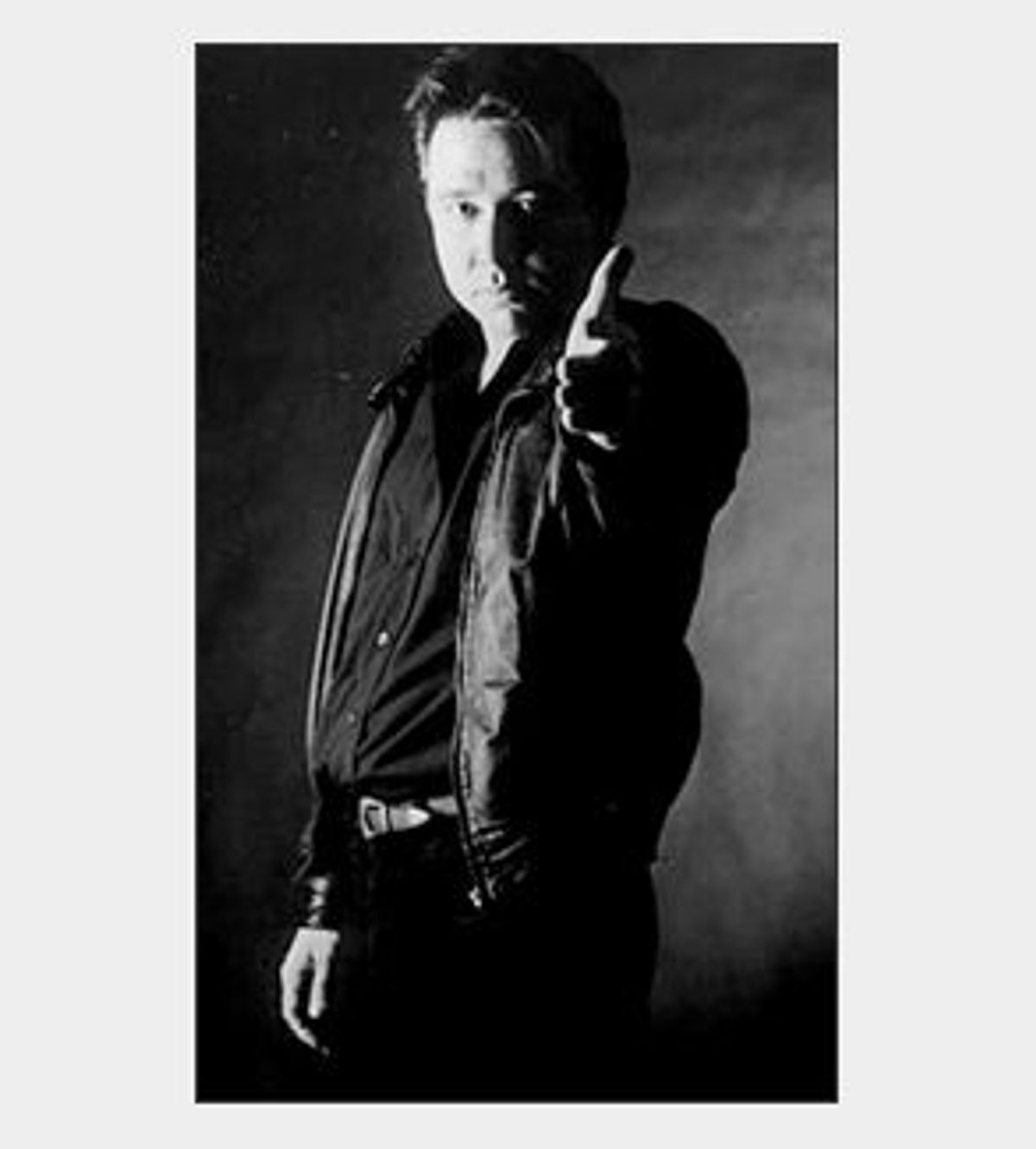
Bill Hicks, the black-humored articulator of doubt

One of America's best and darkest comedians is eight years gone, but with a new biography and a new CD, his career shows no signs of stopping.

  • more
    • All Share Services

Bill Hicks, the black-humored articulator of doubt

It’s October 1991, inside the brass-and-ferns Punch Line comedy club in San Francisco. The sound system is blasting Stevie Ray Vaughan at top volume. I’m here because a friend has pestered me for weeks about a comedian named Bill Hicks, whom I’ve never heard of. He’s performed in the city several previous nights, and I’ve finally made it down to see a show. I’m busy editing a satirical magazine called the Nose, and writing a similar column for SF Weekly. There’s funny all around me. I have plenty of friends who are cartoonists, writers, comedians. And the country is already full to bursting with comedy clubs and lame comics. So who the hell is Hicks?

He walks onstage wearing all black, thanks the crowd, and says it’s really great to be here, wherever he is. Pulling out a cigarette, he asks a guy in the front row how much he smokes. A pack and a half a day, the man answers. Hicks snorts. “You little puss — I go through two lighters a day.” He lights his cigarette, the flame adjusted to a ridiculous height, flaring like a blowtorch, and delivers a message for all the uptight, whining, prissy little nonsmokers: “Nonsmokers die … every day.” He pauses and exhales up to the ceiling. “Sleep tight.”

Bill Hicks died of cancer in 1994. But here in 2002, his career is doing quite well. A greatest hits CD, “Philosophy.” A brand-new Harper Collins biography, “American Scream.” Bill Hicks tributes at comedy festivals in Aspen and Montreal, another tribute in London, Hollywood screenplays in the works, all of it eight years after his death. The timing is weird, but not surprising. The specter of Andy Kaufman waited 15 years for his film treatment, and 17 years for the biographies. America often overlooks its own best resources, especially in the marginalized subculture of stand-up comedy.

Back at that club in 1991, as I watched the show, I had no idea that my life was going to become intertwined with Bill Hicks, however briefly, until his death. I was preoccupied with listening to the guy, because he was astonishing — polished, uncompromising comic sermons about hot-button subjects like Christians, JFK conspiracies, drugs, abortion. I’d never seen a comic so committed to communicating with an audience, and yet he could really care less if the crowd liked him. One bit about overpopulation ended with him squatting down to stare at the front row, and miming the act of a trailer-trash mother squeezing out unnecessary babies: “There’s Trucker, Junior. There’s your brother, Pizza Delivery Boy, Junior. There’s your other brother, Will Work For Food, Junior,” each birth punctuated with a loud “thunk.” This was rude humor taken to a new level. The antithesis of TV-friendly material. No wonder I’d never heard of him.

He was an acquired taste, and the San Francisco audience got it immediately. The city has always been a town hip to comedy, from Tom Lehrer to Lenny Bruce and Robin Williams. When tourists did walk out, he’d wave goodbye and thank them for coming.

This wasn’t standup comedy. It was something else: a tent revival meeting for a congregation of paranoid chain smokers? The word scalding came to mind. You felt it in your chest. I kept hearing an image, the sound of bacon frying, and thought, I need to know this guy. I introduced myself to him after the show, and he gave me his number.

I returned to the magazine offices and described to the staff what I’d seen. A black-humored, satanic Texan, holding forth on the world, articulating the doubts of every American who was paying attention. I’m pretty sure it was the first time any of us had heard Dick Clark referred to as “the anti-Christ.” In some ways Hicks was expressing in a live context what we were attempting to do in the world of magazines. Except, of course, he was actually making money.

In that pre-Internet time, the Lollapalooza generation developed a perverse fascination with the dark side, from autopsy photos to vintage porn, medical oddities, tattoos, piercings and government conspiracies. America’s pop culture was swirling with hellish apocalyptic information. Our magazine eagerly squeezed humor from this new shock chic. We didn’t really pay attention to comedy. To us, the world was already funny and disturbing enough. But Hicks seemed to fit into this groove. We had to interview him.

I contacted his management, and starting reading his press kit: suburbs of Houston, doing comedy since age 14, part of the hard-partying Texas Outlaw comedy collective along with Sam Kinison and Ron Shock. He’d recently gotten sober, had headlined six shows at the Just for Laughs comedy festival in Montreal. He’d done Letterman, released a CD, “Dangerous,” and was about to put out another. It seemed like he’d had at least two careers already, and he wasn’t yet 30.

What impressed me most was that he was an autodidact redneck with a high school education, who turned around and used his background to his advantage. (In one of his bits a dimwitted waffle house waitress came up to his table, saw him reading a book, and asked, “What are you reading for?” Not “what are you reading?” as Hicks put it, but “what are you reading for?” His reply was brutally funny: “Well, I read for a lot of reasons, but one of them is so I don’t end up a fucking waffle waitress.”)

A few weeks later Hicks, who’d agreed to an interview, called my apartment from a hotel in Houston. As we talked about comedy and sacred cows, he tossed in things he’d read by Ray Bradbury and Kurt Vonnegut. I asked him if he ever saw himself on a network television show. He paused, and then brought up a quote from Paul Westerberg of the Replacements. The idea was essentially if you hate elevator music, by all means write elevator music.

“Like, go in there and change it,” he said. “I thought that was very interesting. But I think there’s so many people that hate elevator music, they’re not all gonna be able to fit on the elevator. I don’t know. It depends on the show. I’m totally confused about what I’m going to do with my life. That’s why I’m going to an astrologer later today.” He laughed.

When asked for a favorite review, he dug up a letter to a club owner from an irate woman who had attended a recent show, hoping to see some “real and refreshing humor,” like Milton Berle or Sid Caesar. Instead, she listened to Hicks do bits about serial killer Henry Lee Lucas. He read the entire letter to me over the phone, shrieking with laughter at the woman’s anger — he had a great evil cackle — and how she thought his act had no scruples or dignity. He loved such feedback; it didn’t seem to bother him at all.

“You know, I don’t think mass murder is funny at all,” he said. “Probably the opposite. But I just have this weird theory. The best kind of comedy to me is when you make people laugh at things they’ve never laughed at, and also take a light into the darkened corners of people’s minds, exposing them to the light. I thought the whole point of it was to make you feel un-alone. Many thoughts I do have are not my own thoughts. You know what I mean? They’re not secret thoughts.”

Another of his bits, he told me, was about the movie “Silence of the Lambs.” The previous night, he had asked the audience if they found the film funny, a man cutting up women and wearing their skin as coats. Because he happened to think it was hysterical. The crowd oohed. Hicks described the movie’s advertising, which boasted that the film was so scary, viewers will hold their seats until their knuckles are white.

“That’s the way I feel after I see Chevy Chase movies,” said Hicks. “I pace the floor, I can’t sleep, I’m frightened. Are they makin’ another ‘Fletch’? How does this guy do it — is it a pact with the devil? Every one of his movies sucks. And then I go, ‘Maybe they should, you know, skin Chevy Chase and put his skin on a funny person.’”

We published the interview in early 1992, and ran cover type which announced: “Bill Hicks: Texas Outlaw Comic Says ‘Skin Chevy Chase!’” Hicks returned to San Francisco, and after the show I handed him the issue, pointed to the cover type, and he busted up laughing.

Many comics will put together a solid set of jokes, and then trot out the same bits over and over again, changing words here and there. But Hicks constantly wrote more material. The quality progressed as well. No more images of kiddie-pop stars Tiffany and Debbie Gibson spanking each other’s bottoms (“Now there’s a video I’ll watch”). His attention was shifting to the rest of the world — the Rodney King beating, President Bush and the Gulf War, America’s bully foreign policy and insights gleaned from his tours of Australia and the U.K. He asked for everyone in the audience who worked in marketing or advertising to kill themselves: “Suck a tailpipe. Hang yourself. Borrow a pistol from an NRA buddy. Rid the world of your evil fucking presence. OK, back to the show. You know what bugs me though, is that everyone here who’s in marketing is thinking the same thing, ‘Oh cool, Bill’s going for that anti-marketing dollar. That’s a huge market.’”

After the shows we’d chat a bit, but each visit he was attracting more and more people, crowding around him, that unmistakable momentum of someone on the rise. I called up my friend John Magnuson.

Magnuson was in his 60s, a film and advertising producer, and had worked with Lenny Bruce. Their 1965 collaboration, “The Lenny Bruce Performance Film,” was shot in one take in a San Francisco nightclub, an unedited record of Bruce’s act made expressly as a document, to be submitted as evidence in Bruce’s ongoing obscenity trials. Magnuson had told me stories about the two of them planning the project, walking the North Beach streets until the sun rose, talking like maniacs. The final film ended up a legendary piece of history, serving as a record of Bruce’s last-ever club gig and playing a pivotal role in clearing his name after his death.

Magnuson was always interested in the current state of comedy and satire. Hicks sounded right up his alley. If anyone could appreciate a scathing comedian who challenged the status quo, it had to be Magnuson. I suggested he check out a Hicks show, but he was skeptical. I guess I wasn’t the first to recommend a new comedian to him over the years.

In the summer of 1993, Magnuson caught Hicks’ show at Cobb’s Comedy Club in San Francisco, and had a peculiar feeling. Afterwards he walked up and introduced himself, as he had done with Lenny Bruce 30 years earlier. Magnuson told him he’d never seen anybody that had reminded him so much of Bruce. Hicks was surprised, and very flattered. The two met up the next day, and drove around the city, shooting scenes for a ninja film spoof that Hicks had been working on.

Later that week, Cobb’s was packed. After Austin and Chicago, San Francisco was Hicks’ biggest market. Local radio appearances, and a positive review from the Chronicle newspaper were drawing in the curious. But there was something else in the room, a conscious efficiency, as if there wasn’t time to waste. Microphones had been mounted in the ceiling of the club, recording the shows as audio sketches for a new album, “Rant in E Minor” (the final taping was eventually done in Austin).

The “Rant” album opens up with Hicks saying hello to the crowd, and immediately going off on the stunted intellectual behavior of Americans, about how the nation operates on an eighth grade mentality. A woman in the crowd shook her head no, and Hicks took the opportunity:

“Please don’t debate me, it’s my one true talent. I have 23 hours to develop this web of conspiracy theory, so please, just relax and enjoy your hair … Your little cracker spawn are back at the hotel choking down the mini bar contents, probably fucking each other and producing more little crackers to come fuck with my life, you inbred redneck hillbilly fucking tourist, you. Good evening, how are you tonight? Welcome, welcome to ‘No Sympathy Night.’ Welcome to ‘You’re Wrong Night.’”

This new material was his darkest yet. He was furious over how the government handled the David Koresh/Branch Davidian episode, and kept repeating that Janet Reno and Bill Clinton were liars and murderers. “I fucking hate patriotism,” he spat. “It’s a round world last time I checked.”

Hypocritical right-wing Christians were always prominent targets, but now the tone was even more poetically cruel. He envisioned the day when Sen. Jesse Helms finally snapped and committed suicide. Afterwards, authorities would find the skins of young children hanging in his attic, and we’d see his wife on CNN, saying, “I always wondered about Jesse’s collection of little shoes.”

This phase was some of his best writing, crafted for the hair-raising joy of live performance. His impersonation of a sell-out Jay Leno was devastating. But it bugged me that he kept insulting the audience. If we didn’t react properly to something he said, he’d call us a bunch of sleepy cows, following each other blindly, and do a quick impression of a lazy cow chewing its cud. I remember sitting in the audience and thinking, Who are you calling a cow? I came here to see you because I’m not a cow.

When the show ended, I asked the manager if I could speak to Bill. He burst out of the backstage room and came over to where I was sitting, very focused, intense but friendly. We talked about his change in management, and his newest album-in-progress, “Arizona Bay.” He thanked me for introducing him to Magnuson, and said he was looking forward to working with him. Over his shoulder I spied the tape recorder.

Hicks had always been obsessed with recording his work. Leaving a legacy was very important to him. But there was another reason for taping all the shows. A month earlier, doctors had diagnosed him with pancreatic cancer. It had already spread to his liver. In most cases, it was quick and fatal. At this point he hadn’t told even close friends. That was the last time I saw him.

In the coming weeks, Magnuson talked to Hicks frequently, and kept me updated. Publishers offered book deals. The Nation invited him to contribute. He envisioned a live performance film of his “Rant in E Minor” material, shot in San Francisco, filmed in black and white. Hicks called Magnuson and asked him to do the film. Magnuson was amazed. First he got to work with Lenny Bruce, and now Hicks. As the two discussed the project, Hicks didn’t seem at all to Magnuson like the kind of guy who had been told he was going to die.

In October, Hicks was scheduled to be a guest on Letterman, his 12th appearance. I was feeling out of the loop, juggling a magazine and a column, and made it a point to stay home to watch. This was Letterman’s new CBS persona, tassle-loafered and double-breasted, no more sweaters and Adidas sneakers. He introduced Hicks at the top of the show, guests came on, I saw another comedian I’d never heard of, and then the program ended. I thought, was I drunk? What happened? Hicks’ entire segment had been cut at the last minute.

The censorship made national news, and ended up the centerpiece of a New Yorker profile by John Lahr. In the article, Lahr referred to a letter Hicks had written to him, a 40-page explanation of the Letterman circumstances and a script of the jokes in question. Hicks also sent a copy to Magnuson, who passed a version to me. It’s an impressive and heartfelt document, a first draft written longhand. The Letterman staff, especially producer Robert Morton, come off as complete hypocrites, first approving Hicks’ material, then deciding at the last minute to scrap the entire segment, and blaming it on the network. Hicks admitted to Lahr that because of the Letterman incident, his awareness of the industry had changed: “I began working quite young, writing, growing, maturing, always striving to top myself — to make people laugh hard at things they know and believe deep in their hearts to be true,” he wrote. “It has been a long road, let me tell you, but after sixteen years of constant performing up until this little incident on October 1, 1993, the cold realization finally struck me. A sobering answer to the wish of that young boy I once was back in Houston, Texas, all excited with the idea that ‘if they like these guys, then they’re going to love me.’ The realization was — they don’t want me, nor my kind. Just look at 90 percent of television programming. Banal, puerile, trite scat. And this is what they want, for they hold the masses — the herd — in such contempt.”

With the ensuing media coverage, people were finally talking about Hicks. Because I’d written about him, I answered my share of “so what’s he like?” questions. One day Magnuson invited me over to his apartment, and we watched the “Revelations” TV special Hicks had shot in London the year before, taped at the 2,000-seat Dominion Theatre. Hicks was introduced with loud Jimi Hendrix music, and walked onstage through a circle of flames, wearing a black, floor-length duster coat and cowboy hat. I thought the opening was cheesy, the cliché Wild West theme, with coyotes howling in the background, but Hicks immediately took off the hat and coat, and did his material. The Brits ate it up, the naughty American making jokes about the “United States of Advertising.” Bits that had gotten a cool reception in a U.S. comedy club were understood in the nation that invented wit. Maybe this was Hicks’ destiny, the direction he was heading — a rock and roll theater act, with a smart audience instead of drunk tourists at a club.

Toward the end of the year, Hicks’ management sent me another package of materials. A press release described projects in the works. Besides the book and magazine offers, he was nominated for an American Comedy Award. HBO was planning to air the “Revelations” show. Channel 4 in the U.K. had signed him to do a new program. The package also included a home videotape of Hicks performing at Igby’s, a Los Angeles club, in November 1993.

This would be one of his last-ever performances, and it was a memorable one — onstage for over an hour, a cavalcade of what he called the “comedy of hate.” The audience was with him all the way, cheering even through a perverse scenario of Rush Limbaugh lying in a bathtub, with Reagan and Bush peeing on him, and Barbara Bush defecating into his mouth. At the end of the show, Hicks played Rage Against the Machine, singing along with the chorus, “Fuck you, I won’t do what you tell me!”

I’ve screened this video to friends over the years, and the reaction is chilling. Comedians in particular stare at the screen like they’ve seen a ghost. It isn’t the Bill Hicks they remembered, performed with, opened up for, introduced to the stage. No trademark black shirt and jeans. He was frighteningly skinny, wore a patchy beard, tweed sport coat and saggy khakis. Three months away from dying, and he was going for it, still in the saddle, riding the horse all the way down. The performance was sharp as a tack.

Magnuson and Hicks had agreed to shoot their film Jan. 23 during a performance at San Francisco’s Punch Line. The date crept closer. Magnuson still hadn’t heard from Hicks. The upcoming week of shows was suddenly canceled due to Hicks’ stomach flu. Hicks called up Magnuson and told him they’d have to wait. I was faxed a press release alerting everyone that Hicks was “seriously ill.”

January morphed into February. Hicks put all commitments on hold and moved back home to stay with his parents in Little Rock, Ark. Magnuson befriended Hicks’ parents, and passed me their address. In a daze, I wrote Hick a final letter while sitting on a train, one of those dopey letters you write to someone who has inspired you. I thanked him for furthering the cause of enlightened rednecks everywhere, and slipped a photo of JFK’s head autopsy into the envelope. He died a few days later, on Feb. 26. His manager Colleen McGarr and I ended up on the phone, and she started sobbing. A great one was taken from us much too early. A memorial service in Little Rock attracted comedians from around the country.

Bill Hicks passed away with a TV deal in the works, a finished film script and two albums waiting to be released. It would take his estate another three years to put out the material that was already recorded and compiled. Magnuson told me he made Mary Hicks, Bill’s mother, promise not to edit any of the original recordings. And so in 1997, when Ryko released its 4-CD set, “Dangerous, Relentless, Arizona Bay, and Rant in E Minor,” he noted that Mrs. Hicks had kept her word.

Joining these original CDs as part of the Hicks legacy is a greatest-hits compilation, “Philosophy,” released late last year, and the new biography, “American Scream,” by Cynthia True. For someone who never saw or met Hicks, True has done a thorough job of examining his life and career. She wisely stays out of the way, and lets the chronology unfold through quotes and dates, without analysis. Hicks fans will appreciate the attention to personal details, and since another biography doesn’t seem imminent, this book is, for the moment, the sole full-length version.

What strikes me about her book is the differences in how it was marketed to the U.S. and the U.K. Hicks was perceived quite differently by the two nations — in the U.K. he was stopped on the streets for his autograph, and yet in his home country he was censored off television. The American cover is a photo of Hicks sitting in a chair, in front of an American flag. On the U.K. cover, Hicks is lighting his cigarette from a burning American flag. The U.S. back cover runs a quote from Dennis Miller. The U.K. back cover prints an excerpt of the pro-life/Christians routine that was cut from Letterman’s show. The U.S. version features a forward by Janeane Garofalo, a recognized Hollywood name, but it doesn’t really introduce readers to the text. The U.K. edition carries a forward by Irish comedian/writer Sean Hughes, who describes the first time he saw Hicks take the stage at an Australian comedy festival. Hicks himself would have pointed out the differences, that the U.K. readers understand the wit and irony, and good old literal America, his home and birthplace, still needs to have everything explained very simply. And safely.

The United States thrives on “protecting” its citizens, and despite the Land of the Free hokum, if you dare to speak your mind and have more than 10 people ever hear it, you’ll encounter offers of compromise. You’ll hear unqualified taste-makers in every industry say the same things: Where can we fit you into what we’re doing? No, no, no, we don’t care what you think or how you feel. Can you do what this other guy did, only slightly different? How about a combination of x and y? Can you tone this down, beef this up? Can you be edgy? (A magazine editor once told me to make an article sound “undergroundy.”)

And if we pretend to embrace our job so we’ll always have a job, it’s fairly easy to pretend to embrace the rest of the nation, right? Even if it’s ironic. Once you place yourself in that proper frame of mind, it’s a snap to live in America and get excited, even if it’s cheap irony, over the daily distractions of unnecessary celebrities, unnecessary TV shows, unnecessary “news you can use,” unnecessary electronic gizmos, unnecessarily large vehicles and the rest of the shit culture we gleefully produce, consume and export around the world. You tell me where Hicks would fit into this picture. I’d like to go there. I’d like to live there.

Among Hicks’ favorite targets was the empty-headed celebrity, whether it was George Michael, Debbie Gibson, Michael Bolton or country singer Billy Ray Cyrus. One of the bits censored by Letterman was a new television show Hicks would host, called “Let’s Hunt and Kill Billy Ray Cyrus”:

“I think it’s fairly self-explanatory,” Hicks said. “Each week we let the Hounds of Hell loose and chase that jarhead, no-talent, cracker idiot all over the globe ’till I finally catch that fruity little ponytail of his, pull him to his Chippendale’s knees, put a shotgun in his mouth — POW!”

To help them run the estate, Bill Hicks’ mother and father have hired an attorney from Nashville, who counts among his clients … Billy Ray Cyrus.

Jack Boulware is a writer in San Francisco and author of "San Francisco Bizarro" and "Sex American Style."

What’s the matter with Nebraska?

Forget Article IV of the Constitution! Isn't it about time we stop pretending that all states are created equal?

  • more
    • All Share Services

What's the matter with Nebraska?Kevin Bleyer
Excerpted from the book "ME THE PEOPLE" by Kevin Bleyer. Copyright © 2012 by Kevin Bleyer. Reprinted by arrangement with Random House, an imprint of The Random House Publishing Group, a division of Random House, Inc. All rights reserved.

I once drove through Nebraska, via I-80, days after my girlfriend broke up with me, on a self-imposed road trip from Los Angeles to Cedar Rapids to find my brother’s shoulder and cry on it. It is a long, straight, hypnotically boring drive that not only gave me ample time to think about the loss, but also put my recent heartbreak in much-needed perspective.

It could be worse, I realized. I could live here.

Cold comfort, perhaps, but comfort nonetheless. And so, for providing the enforced monotony that only a dull road trip can provide, and the bleak void to which to compare my own relatively full life, I am grateful to the state of Nebraska. Nebraska has a special place in my heart.

It has no place, however, on a map of the United States.

Let me explain: California is a state. New York is a state. Texas, for the time being at least, is a state. And they deserve to be. They’re big, they’re boisterous — but most crucially, they’re populated. Thirty-seven million people live in California, four million in Los Angeles alone. New York is home to almost 20 million people. If California were a country, it would have the eighth largest economy in the world. If New York City were its own state, it would be the 12th largest — and in my humble New Yorker opinion, the best.

Whereas Nebraska?

There are more Americans in prison than in Nebraska. And not for nothing, but as I drove past endless rows of cornstalks, I couldn’t help but think: What’s the difference? Nebraska, whose official state motto is “Equality Before the Law,” nonetheless feels like a punishment for a crime. And like a criminal, I whiled away the hours (or was it days?) thinking up mottoes that better apply: “Nebraska — a great place to serve some time.” “Nebraska — if you lived here, you’d be bored by now.” “Nebraska — Canada’s Mexico!”

Sure, the argument could be made that Nebraska is in fact an idyllic land full of picturesque cities with enviable small towns steeped in small-town values personified by some of the loveliest Americans to grace the planet — and, I confess, in my wildest dreams I often fantasize about living among them in such a glorious place — but let’s be honest: It’s also a lifeblood-sucking leech on our body politic. Yes, my fellow citizens, despite what the original Constitution of the United States says about the qualifications for statehood and the guarantee of representation in Congress, by every measure that truly matters in America (bigness, crowdedness, awesomeness, Texasness), Nebraska doesn’t deserve its star on the American flag.

Which is to say nothing about Montana (4th largest, 44th most populous).

Or Wyoming (10th largest, 50th most populous).

Or the largest but 47th most populous state we call Alaska.

Add it up, and more than half of all Americans live in eight states. The big ones. The important ones. How many live in the eight least populated states? Less than 3 percent. Three percent — also known as the margin of error. (Which raises a terrifying scenario: It’s possible these states are completely empty.)

Yet what concerned me during my soul-deadening voyage toward Omaha was not whether these states deserve their claim on so much territory (they don’t), or whether, as guaranteed by Article I, they should be represented by two senators as powerful as the senators in states where people actually live (they shouldn’t). Rather, as my car sped past miles and miles of unharvested high-fructose corn syrup, my muscles atrophying and my eyes fluttering in and out of semi-consciousness, my mind was focused on Article IV. Because it is Article IV, the first in the Constitution to turn its full attention to the states rather than the branches of national government, that wants me to believe that Nebraska, this expanse of emptiness which so begs for my disdain, actually deserves my respect.

It reads, in part:

Section 1: Full Faith and Credit shall be given in each State to the public Acts, Records, and Judicial Proceedings of every other State.

Section 2: The Citizens of each State shall be entitled to all Privileges and Immunities of Citizens in the several States.*

Put plainly, Article IV makes a revolutionary claim: All states are created equal. Laws made in Alaska, which is known for its lawlessness, are as valid as laws made in Pennsylvania, which invented laws. Article IV insists that, as a nation, we should care as much about the Carolinas as we do about California. Montana  matters as much as Massachusetts. And New York is no better than any of its 49 neighbors — not even Nebraska. Which is, put even more plainly, ridiculous.

I should know. I’ve driven through Nebraska. I live in New York.

- – - – - – - – - – - – -

Was I thinking about the merits of giving “Full Faith and Credit” to each state as I drove through Nebraska? Not at all. At the time, I was merely thinking: I am soooooooo not a Nebraskan.

I was, at the time, a Californian. I had lived in the Golden State for four years, and as such, all of the rights and benefits of California residency were mine, all mine! I could serve on California juries, vote in California state elections, and draw California unemployment checks. Had I a major case of glaucoma or a minor case of cancer, in a few years I would even be eligible for my very own California-state-sanctioned, medically warranted marijuana — if I were, you know, into that type of thing. Citizenship has its privileges.

And Article IV is cool with that. It is designed to help me be a Californian even outside California. As written, it would guarantee that if I am granted certain “Privileges and Immunities” in my home state, all other states must also grant me those rights. I can thank Article IV for the fact that when I crossed the border from Colorado into Nebraska, I wasn’t immediately pulled over for not having a valid driver’s license. It is why when I stopped in North Platte to fill up my gas tank, the attendant couldn’t legally charge me $10 a gallon just because I wasn’t “from ’round these parts.” Although the Supreme Court has occasionally retreated to a more “limited interpretation” of Article IV — merely that states may not discriminate against citizens of other states in favor of its own citizens — it has always returned to the basic theme of Article IV: States must play nice with others, and do unto residents from other states as they would do unto their own.

Oklahoma must say to Oregon: Legal physician-assisted suicide? Not the way I would have done it, but I respect your choice. It looks good on you.

Oregonians must say to South Dakotans: Seriously? You’ll only provide abortions to a woman who has been raped if her life is at stake? Seems a bit heartless, but I guess that’s just another reason why we don’t live there.

This makes sense — I, for one, enjoy those regional quirks, and wouldn’t want to live in a country where I couldn’t tell Montana from Maine.

Yet Article IV isn’t all-powerful. As a referee between the states, it has its limits. The most famous check on Article IV, in fact, involved the states of New Jersey and Delaware, a boatload of purloined oysters, and George Washington’s nephew Bushrod. In 1832, Bushrod, then  a federal circuit court judge, ruled on a landmark case, Corfield v. Coryell. The question at hand was whether the state of New Jersey should be allowed to prohibit the plaintiff, Mr. Corfield (and all other non-Jerseyans), from gathering oysters found in the pristine waters off New Jersey (keep in mind, this was back in 1832, when New Jersey waters stood the chance of being pristine) only to return back to their home states to sell them for profit. Bushrod ruled that although the “Privileges and Immunities” protected by Article IV do include “the right of a citizen of one state to pass through any other state … for the purposes of professional pursuits,” stealing oysters isn’t one of them. “We cannot accede to the proposition,” he wrote, “that the citizens of several States are permitted to participate in all the rights which belong exclusively to the citizens of any particular State, merely upon the ground that they are enjoyed by those citizens.”

In other words, go ahead and cruise down our New Jersey turnpike and breathe our fresh New Jersey air, but if you’re not from New Jersey, hands off our New Jersey shellfish.

Article IV doesn’t merely snub oystermen from Delaware. It fails to protect Mormons who might want to marry a dozen sister-wives in Utah and expect Vermont to approve of their polygamous bliss, or gun-toting Kentuckians who want to bring their semiautomatics to church while visiting gun-skittish Maryland. These, too, go too far.

But what if I’m not a Delaware oysterman or a Utahan missionary or an armed Kentuckian? What if I am, say, a gay Iowan? And instead of illegally gathering winkles in Weehawken or wives in Salt Lake City, I have gotten legally married in Iowa — which sanctioned gay marriage way back in 2009. And what if I wanted to celebrate the nuptials with a road trip through Nebraska? (I’m not sure why I’d do that, but just roll with me.) Would Article IV compel Nebraskans to recognize my marriage?

Congress has tried to say no. In 1996, it passed the Defense of Marriage Act, citing the broad power Article IV gives Congress — brace yourself for some gobbledygook — to “prescribe the Manner in which such Acts … shall be proved, and the Effect thereof.” Which, if you ask me, makes about as much sense as in which such Sentences … shall be understood, and the Nonsense thereabouts.

Now, such gibberish would baffle a normal human; to Congress, however, it made perfect sense. It determined, conveniently, that if could limit “the Effect” that gay marriage would have as it traveled the nation, it could also prescribe that it must have no effect at all — which is to say, it could give states the power to ignore gay marriages entirely. The Harvard constitutional scholar Laurence Tribe has called this linguistic tap dance “a play on words, not a legal argument,” which forms in us the bad habit of creating “categorical exceptions” to Article IV, when Congress has no such power.

Neither side is happy with the arrangement. Gay couples, skeptical that the  federal government will ever give them that wedding day owed to them, want to see more states legalize gay marriage; opponents of gay marriage, fearful that gays might spontaneously band together and attack their northern border brandishing Le Creuset spatulas and Rufus Wainwright CDs, want to see nothing less than a constitutional amendment defining marriage as between a man and a woman. It’s all very confusing. What’s a gay couple to do — other than plan their honeymoon in San Francisco?

It is this competition, between what one state might want for its citizens and what another state might demand for its own, that Article IV is supposed to referee. Yet it hasn’t. It doesn’t. And what’s more — with all due respect to our nation’s homosexual polygamist mollusk aficionados — its failure to do so has meant repercussions far greater than a marriage license, or a second wife, or cheap, tasty New Jersey seafood: Namely, Article IV, with its schoolyard devotion to fair play and radical equality, has done something far more treacherous.

It started the Civil War.

From the book “Me the People,” by Kevin Bleyer. Copyright © 2012 by Kevin Bleyer. Reprinted by arrangement with Random House, an imprint of The Random House Publishing Group, a division of Random House Inc. All rights reserved.

Continue Reading Close

Mockery: Women’s new weapon

From a sex strike to satirical anti-Viagra bills, the war on reproductive rights has some responding with laughs

  • more
    • All Share Services

Mockery: Women's new weapon

From a proposed sex strike to mock legislation restricting access to Viagra, women are coming up with increasingly creative ways to respond to attacks on reproductive rights. Many of them are relying on something ladies are often said to be without: a sense of humor.

In case you didn’t catch on, the sex strike is tongue-in-cheek. Annette Maxberry-Carrara, founder of Liberal Ladies Who Lunch — the group that proposed the “Access Denied” protest — tells me with a laugh, “We’re not looking at it as a literal strike.” But they are making a serious political statement. The event’s tagline reads, “If our reproductive choices are denied, so are yours.”

You would have to be profoundly tone deaf to not recognize the satire in recent bills proposed by female lawmakers that proclaim “every sperm is sacred” and restrict access to the blue pill. Last month, Oklahoma state Sen. Constance Johnson offered a bill in response to Senate Bill 1433 — which seriously and nonsatirically holds that a fetus at “every stage of development” has “all the rights, privileges and immunities available to other persons, citizens and residents of this state.” Her proposal states, “[A]ny action in which a man ejaculates or otherwise deposits semen anywhere but in a woman’s vagina shall be interpreted and construed as an action against an unborn child.”

A handful of similar bills call for men to jump through hoops to obtain Viagra — a mandated cardiac stress test, a rectal exam, even being forced to watch a “horrific” video on the drug’s side effects. Some have managed to make a big statement without a bill: During a protest of Oklahoma’s Personhood measure, state Sen. Judy Eason McIntyre stood in front of the state Capitol with a grin on her face and holding a sign reading, “If I wanted the government in my womb I’d fuck a senator.”

It isn’t just these daring female lawmakers who are turning to humor to combat the anti-choice onslaught. Consider the scores of everyday women who have hijacked the Facebook page of Virginia state Sen. Ryan McDougle — a supporter of the state’s transvaginal ultra-sound mandate — with exquisitely detailed descriptions of their vaginas. For example: “Hey senator! just a quick hello to let you know that I’m currently ovulating! my vaginal discharge is thick and sticky and smells acidic (probably all the garlic i’ve been eating!).” In February, my Facebook news feed was filled up with repostings of a screenshot from “Morning Joe” showing an all-male panel criticizing an all-male Congressional panel on birth control. (The show certainly didn’t intend it as satire, but it read like a piece from the Onion, and women circulated it as such.) That’s not to mention recent biting commentary on the topic from comedians like Amy Poehler.

This isn’t entirely new, of course. Women have long used satire to make political points. Just look at suffragette Alice Duer Miller’s bulletpoint list of reasons why men should not be given the right to vote (a highlight: “Because men are too emotional to vote. Their conduct at baseball games and political conventions shows this, while their innate tendency to appeal to force renders them unfit for government”).

“There were a lot of women humorists in the 19th century who were going at the political system in a very similar way, and it had a very big effect on women getting the vote and being able to be admitted to colleges,” says humorist and feminist theory professor Gina Barreca. “Every generation of women sadly thinks they’re the first ones ever to do this because the tradition isn’t usually encoded.”

That said, it’s reached a fever pitch as of late. The recent comedy-infused pushback against the assault on reproductive rights builds on what Amber Day, author of “Satire and Dissent: Interventions in Contemporary Political Debate,” calls a “satirical renaissance” of the last decade. It’s a result, in part of the fact that “political debate has become so heavily stage managed that there is rarely any discussion of substance happening,” she says, and talking points are “repeated ad infinitum on the debate programs, with scarcely anyone bothering to fact check or to push through to the real substance of the matter.” Contemporary satire — from “The Daily Show” to “Saturday Night Live’s” Weekend Update — offer “us a way to satisfyingly break through the existing script.”

Women are turning to satire now “for many of the same reasons others have in the past,” Day says — it’s just that the current war on reproductive rights is more motivating for vagina-havers. “What much of the recent satire has demonstrated is that there is still a lot of sanctimonious language that gets used in discussions of women’s health and sexuality,” she says. “That language is revealed as ridiculous when applied to men’s sexuality.”

That was the aim of Missouri state Rep. Stacey Newman, a Democrat, who proposed a measure earlier this month that read in part, “A vasectomy shall only be performed to avert the death of the man or avert serious risk of substantial and irreversible physical impairment of a major bodily function of the man.” She tells me that attempts to restrict women’s reproductive rights are constant. “We deal with this all the time,” she says. “You feel like all you can do is sit there and bury your head and go, ‘Is anybody paying attention?’”

Maxberry-Carrara, of the faux sex strikers, was similarly aiming to get people’s attention, and her tongue-in-cheek protest did the trick — and the strike hasn’t even officially started yet. “What we wanted was to bring attention to the assault on women’s rights,” she says. Her hope is that by poking fun at these legislators, “the less seriously we can take them as candidates.”

Barreca, author of “It’s Not That I’m Bitter … : Or How I Learned to Stop Worrying About Visible Panty Lines and Conquered the World,” says women are turning to humor right now “because it’s so much more effective than weeping or banging your shoe on that table!” She says, “The point of satire is not only to illustrate the absurdity of things but to show what the world looks like when it’s turned upside down.”

Amanda Marcotte, a feminist commentator and author, says, “Things have just gotten to the point of absurdity that you can’t react without being absurd yourself.” Thanks to recent attacks on even contraception, “ordinary women who often don’t pay attention to politics are finally beginning to pay attention,” she says. “And I think that means more opportunities to communicate through humor instead of the typical outrage thing. Humor can be very clarifying.”

Meg Wolitzer, author of “The Uncoupling,” a fictionalized account of a sex strike, points out, there’s a long tradition, “starting with Aristophanes and continuing up through a strange episode of “Gilligan’s Island” that I remember from my childhood,” of sex strikes being used for comedy. “Desperate times do call for creative and vigorous responses, and the assault on reproductive rights today certainly qualifies as desperate times. I think women need to find lots of ways to speak out and act, and this is just one,” she says.

You might ask how effective it is in bringing about actual change. Day says, “Historically, satire has often been dismissed as never actually accomplishing anything, because it is extremely rare to be able to draw a straight line from a piece of satire to a substantive political response, like a bill being passed.” (Although she gives the example of Jon Stewart and the Zadroga Act; Stewart helped shame Republicans who filibustered against extending benefits to Sept. 11 responders who died of cancer or respiratory diseases.) But this is “an overly narrow way to think about political efficacy,” she says. “When satire is successful, it functions to shift the terms of the wider public discussion. And that, in itself, is a big deal.”

Continue Reading Close
Tracy Clark-Flory

Tracy Clark-Flory is a staff writer at Salon. Follow @tracyclarkflory on Twitter.

Welcome to the first annual celebrity religion swap

Leaders of the world's most powerful faiths convene to trade their famous converts -- and improve their image

  • more
    • All Share Services

Welcome to the first annual celebrity religion swap (Credit: AP/Salon)

Muslims worldwide groaned upon hearing the news that Oliver Stone’s son, Sean, converted to Islam while filming a documentary in Iran.

Although we — the collective 1.5 billion Muslims worldwide — assume Sean Stone is a fine, upstanding man and sincerely wish him spiritual contentment, we earnestly ask Allah why Islam only attracts controversial celebs (in this case, the son of a controversial celeb) who further tarnish our already toxic brand name?

We plead to the heavens for an answer as to why he converted in Iran, of all places, which is currently the most feared and loathed country in America and about as popular as herpes.

We have patiently endured, oh, Allah.

We miraculously survived Mike Tyson, who converted to Islam while incarcerated, and then angrily threatened Lennox Lewis in an infamous interview: “I want your heart. I will eat his children. Praise be to Allah.”

Awesome.

Islam has the lowest favorability rating of any religion in America. If Islam were a world economy, it would be Greece. If it were a professional athlete, it would be San Francisco 49ers punt returner Kyle Williams, who muffed two critical punts, which helped the New York Giants reach the Super Bowl. If Islam went to the prom, it would be the ugly girl with freckles and an overbite standing in the corner with a bucket of pig’s blood teetering precariously over its head.  If Islam were a Republican presidential candidate, it would be Newt Gingrich.

A diverse jirga of American Muslim leaders decided “enough was enough” and held an emergency meeting at Lowes’ Home Improvement store in Dearborn, Mich., to strategize how to bolster Islam’s faltering image.

A consensus emerged that we needed to draft popular, mainstream celebrities whose successful addition to our starting lineup would boost our international brand name. After all, 1,400 years of civilization and the religious practices of 1.5 billion solely rest on the tanned shoulders of the rich, famous and beautiful.

Inspired by comedian Dave Chappelle, one of the few Muslim converts who could be considered a net gain, the Muslims held a “Religious Draft” this week, inviting major religions to participate on hallowed ground: McDonald’s.

The following is a summary of the proceedings.

THE FIRST ROUND PICK

Since it was universally accepted Islam was the 2011 Indianapolis Colts of world religions, they had first pick.

Predictably, the Muslims drafted free agent Liam Neeson, who recently said, “There are 4,000 mosques in [Istanbul]. Some are just stunning and it really makes me think about becoming a Muslim.” The Irish actor is experiencing a pop cultural rebirth as the 21st century embodiment of uncompromising, kick-ass masculinity and sage paternalism. On behalf of Muslims, he took revenge against France, which recently caved into hysteria and banned the burqa. Neeson single-handedly destroyed the entire country with his bare fists in the blockbuster action film “Taken.” Muslims believe Neeson will help rebrand them as Jedi Knights, due to his portrayal of Jedi Qui-Gon in “Star Wars: The Phantom Menace,” and replace their current image as Dark Lords of the Sith.

Rumors circulated that many Evangelical Christians felt slighted by this pick since Muslims stole their digital Avatar of Jesus: Neeson voices “Aslan the Lion” from the “Narnia” movies.

The rest of the day’s picks were organized according to different types of celebrity.

ATHLETES

In a surprise move, the Buddhists requested Mike Tyson from the Muslims. Exhausted from voluntarily suffering for the past 2,500 years, the Buddhists decided Tyson’s crushing right uppercut could “really eff up China.”

In turn, the Buddhists decided to offer the Beastie Boys — the aging, versatile, hip-hop trio from Brooklyn –  sensing they peaked with their 1998 “Hello Nasty” album. The Muslims accepted, acknowledging the songs “Sabotage” and “Shake Your Rump” as perennial favorites in Egypt and Lebanon.

The Buddhists selflessly threw in Richard Gere and DVD copies of “American Gigolo” to sweeten the deal.

The Jews intervened and said they wanted the Beastie Boys back on their team. They offered the Muslims Ben Roethlisberger, two-time Super Bowl champion quarterback of the Pittsburgh Steelers. Having read about Big Ben’s dubious history of sexual impropriety, the Muslims passed, but decided to donate Mike D of the Beastie Boys to the Jews as a truce offering. Allegedly, the Muslims could never forgive Mike D for the horribly weak rhyme “Everybody rappin’ like it’s a commercial, acting like life is a big commercial” on the song “Pass the Mic.”

The Jews accepted the offer.

The Muslims, feeling emboldened, made an ambitious pitch to the Christians for Denver Broncos quarterback Tim Tebow, who “just wins.”

Muslims offered former NBA all-star Shaquille O’Neal, who fell from their graces after he acted as a giant genie in the box-office bomb “Kazaam.” They also threw in Mahmoud Abdul-Rauf, the controversial Denver Nuggets star who converted to Islam and refused to stand for “The Star-Spangled Banner” before games. The Christians were initially enticed, seeing this as a perfect “born-again” moment, but they passed.

The Muslims went aggressive and promised they wouldn’t supplant the Constitution with Shariah and replace the White House with minarets unless Tebow and Mel Gibson crossed over.

The Christians, anxious to excommunicate Gibson, agreed. For the 2012 NFL season, Tebowing will now consist of prostrating and praising Allah after every touchdown. The Christians asked the Muslims to preserve Tebow’s chastity and not introduce him to Miss USA Rima Fakih or hot Arab women from the reality TV show “All-American Muslim”; the Muslims said they’d try, but they promised nothing.

COMEDIANS

The Jews made a play for comedian Dave Chappelle, a Muslim, citing his hit series on Comedy Central “Chappelle’s Show” as a creative juggernaut that still influences the masses — especially several rabbis, who apparently love saying, “I’m Rick James, bitch!” after performing circumcisions.

The Muslims immediately rejected the offer, saying Chappelle is perhaps the only living proof that Muslims can be intentionally funny.

Instead, they offered Iranian President Mahmoud Ahmadinejad as an example of an unintentional comedian and provocateur in exchange for Israel cooling down its dangerous rhetoric of a preemptive strike on Iran.

Furthermore, the Muslims offered the newly acquired Mel Gibson straight up for Jerry Seinfeld.

The Mormons tried to intercept Seinfeld by playing one of their highest cards: “Napoleon Dynamite” actor Jon Heder. The Jews pretended not to hear this mockery and allowed the Mormons to slink away with some shred of remaining dignity.

The Jews finalized a deal with the Muslims and rumors have circulated since that Mel and Ahmadinejad are under house arrest in Tel Aviv, forced to watch “The Chosen” and “Fiddler on the Roof” on repeat while listening to Jerry Lewis perform comedy.

MUSICIANS

Sensing friendly relations, the Jews humbly approached the Muslims for rapper Ice Cube, citing his immense street cred and respect from the hip-hop and African-American communities. The Jews conceded the Matisyahu experiment, although initially promising, had failed, as the Hasidic reggae rapper never lived up to his “King Without a Crown” potential.

The Muslims mulled it over for a considerable time. The jirga decided they would retain eternal rights to Cube’s 1993 hit single “It Was a Good Day” from his multi-platinum album “Predator,” but ultimately release him because he inexplicably starred in the awful family comedy “Are We There Yet?”

Muslims in return asked the Jews for Kabbalah-worshipping Madonna, sensing serious comeback potential after her excellent Super Bowl halftime show.

Catholics made a request for multi-talented actor and hip-hop artist Mos Def from the Muslims, who soundly rejected any and all future offers, stating the entirety of the Middle East and North Africa could never bear to part with Def’s song “Ms. Fat Booty.”

Instead, Muslims counter-offered with alternative rock artist Everlast, whose 1998 single “What It’s Like” has made a surprising comeback on radio stations due to the economic recession. The Catholics still remember Everlast as the lead singer of the hip-hop band House of Pain, who produced the classic party anthem “Jump Around,” before his conversion to Islam. The Catholics accepted; South Asian Muslims danced to “Jump Around” one last time; and the Muslims in return received Taylor Swift and her legions of pubescent female fans, along with her former boyfriend Taylor Lautner, who played the ethnic werewolf in the “Twilight” movies.

The Muslims had finally secured their most promising young-adult celebrity.

POLITICIANS

The Mormons halfheartedly offered Mitt Romney. The Evangelicals promised Michele Bachmann and her lifetime supply of blinks. The Catholics, out of sheer desperation and embarrassment, bartered Newt Gingrich and his third wife, Callista.

The Muslims decided to stick with their boy, Barack Hussein Obama, in hopes of retaining the White House  in 2012.

MISCELLANEOUS

Muslims threw a Hail Mary and asked fundamentalist Christians for Chuck Norris, who so thoroughly kicked the Middle East’s entire ass during the ’80s. The Muslims respected Norris for his ability to fire an Uzi, perform a roundhouse kick and wave an American flag at the same time. In return, Muslims offered the infamous WWF wrestler the Iron Sheikh and even agreed to teach the Christians the impregnable camel clutch. Norris, humbled by the offer, respectfully declined, and admitted that although he enjoyed killing hordes of fictional Arabs in jingoistic action movies like “Delta Force,” he currently fancied himself an intellectual and activist committed to exposing the nonexistent threat of Shariah infiltrating America. The Muslims were saddened, but collectively agreed to watch Norris in the summer action film “Expendables 2.”

The Hindus decided to play their strongest card, actress Julia Roberts, and made a request for journalist Lauren Booth, former British Prime Minister Tony Blair’s sister in law, who converted to Islam in 2010. The Hindus saw her as the perfect revenge and giant, henna-painted middle finger to England for the British Empire’s previous colonization and exploitation of India’s resources. The Muslims thought this was reasonable and now the “Pretty Woman” flashes her million-dollar smile behind a burqa.

THE CHOSEN ONE

Finally, the draft ended with all the religions coveting “the chosen one,” who would single-handedly redeem their public image both at home and abroad.

The Mormons offered former Republican presidential candidate Jon Huntsman, highlighting his excellent Chinese and fine hair. The Muslims initially offered NBA Hall of Famer and current cultural ambassador Kareem Abdul Jabbar. They sweetened the deal and threw in President Obama. The Jews presented Steven Spielberg and his entire film library. The Hindus humbly offered Bollywood actors Amitabh Bachan, Aishwarya Rai and a picture of Gandhi signed by Ben Kingsley. The Buddhists presented Tina Turner, Herbie Hancock and Tiger Woods.

But, it was sadly to no avail.

The Christians and Church of New York decided to keep NBA superstar and New York Knicks point guard Jeremy Lin. Rumors circulated that they were talking to China about a potential trade to ensure the ambitious superpower does not ask the United States to repay its debt, thus financially crippling and utterly destroying our great nation.

All in all, “it was a good day” for the Muslims in the first Religious Draft.

Continue Reading Close

Wajahat Ali is a playwright, attorney, journalist and essayist. His award winning play"The Domestic Crusaders," was published by McSweeney's in 2011. He is the lead author of "Fear Inc., Roots of the Islamophobia Network in America." He is currently writing a pilot for HBO. He is co-editing the anthology "All American: 45 American Men on Being Muslim" published in June 2012.

The most insufferable Christmas song ever

Not "Last Christmas" or "Wonderful Christmas Time." It's the smug and egomaniacal "Do They Know It's Christmas?"

  • more
    • All Share Services

The most insufferable Christmas song ever

When “Do They Know It’s Christmas?” came out in 1984, I pretty much thought I was British. I dressed like the asexual keyboard player from the Cure, pretended to love everything Depeche Mode was singing about – because, you know, people are people – and pledged undying love for bands I read about in the obscure British magazines sold at Tower Records. (In fact, only since getting Spotify have I even heard an entire album by the Blue Nile and, it turns out they sound like every other band I pretended to like in the 1980s, except for Belouis Some, who were terrible on a whole other level.) So “Do They Know It’s Christmas?” combined all of the greatest things in my world:

1. British bands.

2. British bands singing morosely.

3. British bands singing morosely about hungry people in Africa, a place I was familiar with primarily through playing Risk, but which I nevertheless felt a great passion for. We must get these people fed, the world kept telling my 13-year-old self, and therefore I, too, felt this very strongly … for about two months, anyway, because puberty was making me very interested in a whole host of other things.

At any rate, I loved “Do They Know It’s Christmas?” and routinely waited for hours for the video to show up on MTV or “Night Flight” or “Friday Night Videos,” hoping against hope that I’d get to see the extremely moving vision of Boy George dressed like an advertisement for bulky women’s housecoats (watch the video, people) or see the plaintive look in Sting’s eyes as he sang the word “sting” (again, check the video, it’s a moment of utter grace). But what I especially loved was the righteous anger of Bono shrilling, “Well, tonight thank God it’s them instead of you …” So powerful, so wise!

It wasn’t until this month, however, 27 years in the dust — the song such an oldie it can be performed on “Glee” — when the song came on the radio that it dawned on me what a dick line that is. It got me thinking about the song in its entirety and what I’ve determined is that, of all the Christmas songs, it’s really the most fucked-up one that doesn’t have to do with the systematic bullying of a red-nosed reindeer. And so I present an annotated guide to how utterly corrupt “Do They Know It’s Christmas?” is, in line-by-line fashion:

“It’s Christmas time,
there’s no need to be afraid.”

Really? No need to be afraid? Does cancer stop on Christmas? What about prostate exams? Have you even pondered how frightening it would be if you were sitting in your living room on the evening of Dec. 24 and heard something coming out of your fireplace and before your wondering eyes appeared some lunatic in a red suit? What about getting the shit stomped out of you at Walmart? No need to be afraid? You lie, Bob Geldof!

“At Christmas time
we let in light and banish shade”

OK, now, as it relates to Africa, wouldn’t shade actually be a better gift?

“And in our world of plenty
we can spread a smile of Joy
Throw your arms around the world
at Christmas time.”

Unless, of course, you try to throw your arms around a place that doesn’t celebrate Christmas — like, you know, large parts of Africa — and instead of spreading joy, you end up starting 25 years of sectarian civil war.

“But say a prayer,
Pray for the other ones.”

I’m gonna go ahead and presume “the other ones” are the godless heathens …

“At Christmas time it’s hard
but when you’re having fun …”

Like, say, if you’re Simon LeBon and you’ve spent the last 12 months sleeping with supermodels, or you’re Boy George and you just got done shooting up some great smack, or you’re the other guy in Wham! and you’re just biding your time until the gig is up and you can marry one of those boxy Bananarama girls and race cars for the rest of your life …

“There’s a world outside your window
and it’s a world of dread and fear”

Technically, the world outside, at the time of the song’s recording, was a London street — and in the video it looks like it was filled with fans who wanted everyone’s autographb… and, in fact, according to the video, it looked like everyone was having a pretty smashing time.

“Where the only water flowing is
the bitter sting of tears”

Oh, for fuck’s sake. Sting sings this line in what is a fantastic merging of the real world and the world where a guy named Gordon gets to name himself Stingb… and then gets to, ironically, sing the word “sting” but make it, you know, really serious, because it’s a dreary allusion to how dry it happened to be in Africa that year.

“Where the Christmas bells that are ringing
are the clanging chimes of Doom”

Just so we’re clear here, if they don’t know it’s Christmas, why would they have Christmas bells? And why ring in the doom when they are clearly already doomed? Wouldn’t doom just walk right in at this point? No bells needed.

“Well, tonight thank God it’s them instead of you.”

Ah, yes, the crux of it all. If there’s one thing the Bible teaches, it’s that you should thank God for other people’s suffering. Now Bono is a goddamn hero, we’re told, since he’s spent the last 30 years standing on moral high ground – a moral high ground paved with the money of kids like me, who didn’t know what the fuck “Sunday Bloody Sunday” was all about, but who were, like, totally in support of it – though one has to think he could have looked at the line before he sang it and suggested a rewrite. Maybe something along the lines of “Well, tonight thank God you have food and clean water and a slight disposable income which allows you the opportunity to buy this great song on the latest technology … the cassette tape! Get thee to Sam Goody!” If this song were written today, Justin Bieber would certainly have something wise to say, like, I dunno, “Well, tonight thank God you’re not a Kardashian.”

“And there won’t be snow in Africa this Christmas time”

This is egregiously stupid. It never snows in Africa during Christmastime, because it’s the summertime there. Most specifically in Ethiopia – which is what this song is actually about, the famine in Ethiopia – it’s the start of the driest season. And it’s not as if people were starving in, say, South Africa, or else why would everyone have to get together a few months later to pledge that they ain’t gonna play Sun City? – but beyond that, it just doesn’t snow in Ethiopia. Ever.

“The greatest gift they’ll get this year is life.”

A shitty fucking life, as you’ve made abundantly clear!

“Ohh….
Where nothing ever grows
No rain or rivers flow
Do they know it’s Christmas time at all?”

No, because they are starving to death. And also, depending upon where they are in Ethiopia, they may very well be Muslim.

“Here’s to you…
Raise a glass for everyone
Here’s to them
Underneath that burning sun
Do they know it’s Christmas time at all?”

How grand. These rich former colonial oppressors are raising a glass to the Africans, who don’t even have any fucking water! You’re just sipping on wine like it’s nothing! You bastards! Send over a bottle of water!

“Feed the world

Feed the world

Let them know it’s Christmas time”

And here the real, dark truth of the song reveals itself. It’s not just about feeding the Africans, it’s about feeding the world and, in addition, letting the entire world know it’s Christmastime. This happened once before. It was called the Crusades.

All that said, still love the song. For real. Very catchy.

Continue Reading Close

Crushed ego sends Newt to hospital

The GOP candidate collapsed in rage after being asked about whether he was too "unstable" to be president

  • more
    • All Share Services

Crushed ego sends Newt to hospital (Credit: AP/Charlie Neibergall)
This originally appeared on K.M. Breay's Open Salon blog.

Republican presidential candidate Newt Gingrich has been hospitalized after collapsing this morning outside of a diner in Davenport, Iowa. The former speaker had just left a sparsely attended “meet and greet” at Annie’s Coffee Shop when he was confronted by ABC news reporter Jake Tapper, who asked Mr. Gingrich to explain why so many of his former colleagues have said that he is too unstable to be president. Mr. Gingrich glared at Mr. Tapper for several seconds before cursing, stumbling backward and then crashing through a nearby display window, reportedly filled with ladies clothing.

Sources at Mencken General Hospital say that Mr. Gingrich, who has recently been the target of millions of dollars in negative ads, is being treated for a severely damaged ego. He is unconscious and currently in intensive care. One hospital source, who insisted on anonymity, said the Iowa facility is ill-equipped to properly treat the candidate. “Frankly, we’ve never seen an ego this large and fragile,” said the doctor. “We’re doing our best, but they will probably have to airlift him back to D.C.”

Another source said that, for the time being, campaign aides and Callista Gingrich, the candidate’s wife, have been a constant presence at the former speaker’s bedside and are doing their best to help  treat Mr. Gingrich. “Callista has been whispering, ‘You get sixty thousand dollars per speech,’ into his ear over and over again,” said the source. “And there is a succession of aides who take turns holding up a copy of the Time magazine issue that named him Man of the Year.” (It has been reported that Mr. Gingrich always keeps several copies of the issue with him, much like a diabetic does with insulin.)

Campaign aides were disappointed to find that the candidate’s iPod was crushed to pieces after Mr. Gingrich, who is said to weigh nearly 300 pounds, fell through the clothing store display window. Mr. Gingrich’s iPod reportedly contains all of his political speeches, every single one of the lectures the former professor delivered at West Georgia College and recordings of all of his former mistresses whispering, “You are a genius.” “Whenever Newt’s not talking, which admittedly isn’t often, he’s listening to that iPod,” said one campaign source. “It would really help if we could pop that thing onto his head right now.”

The Gingrich campaign has officially refused comment.

Continue Reading Close

Page 1 of 40 in Satire