
Dave Lindorff

Planning for martial law?

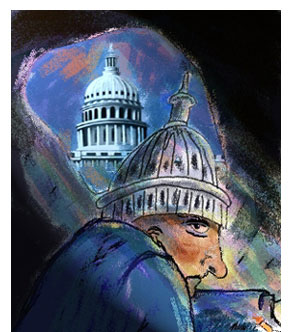
Civil libertarians say the Bush administration may give the military scary new police powers in its secret planning for a bunker-based, post-disaster shadow government.

When the Washington Post revealed the existence of an American “shadow government,” operating secretly in Tora Bora-style mountain bunkers over the six months since Sept. 11, it shocked even some congressional leaders, who learned about it March 1 from the Post, not the Bush administration.

Now civil libertarians on the left and right are raising new questions about the shadow government — about its secrecy, its leadership, and the way it involves the military in domestic roles. In particular, plans to have the military assume domestic police functions in case of national emergency alarm some scholars and advocates, who believe the shadow government could be an early step on the way to martial law.

Obviously there are worst-case scenarios — massive terrorist attacks, nuclear war — in which it’s the government’s duty and responsibility to assure its own continuity, and maintaining order in such circumstances could well demand the domestic use of troops. But critics fear that the present administration might be willing to impose martial law under ambiguous circumstances, citing the fact that the Bush administration has pushed through harsh restrictions on civil liberties like the USA PATRIOT Act, and is already using military personnel to assume police functions.

“It has become clear that the response of this administration since 9/11 has been to try and set up a complete government that is not subject to visibility and accountability, ” says Michael Ratner of the Center for Constitutional Rights in New York. “You have a shadow government operating in complete secrecy, and then you have these efforts, like military tribunals and the Patriot Act, to undermine basic constitutional protections.”

The left-leaning Ratner has counterparts on the right who worry that this administration has been too quick to sacrifice civil liberties in the name of public safety in the last six months. William J. Olson, a conservative lawyer and onetime Bush supporter who counts among his clients the U.S. Gun Owners Association, says its moves since Sept. 11 make clear that the Bush administration has “decided that it doesn’t need to follow constitutional processes.”

The leap from shadow government to martial law may seem alarmist. Certainly the fact that the Bush administration has made plans to deliver the mail, administer government assistance programs, collect taxes and protect public safety in the event of a major terror attack or nuclear war is not in itself alarming, and the shadow government that’s been operating since Sept. 11 is a long way from martial law. According to the Post, up to 150 civilian and military employees are living and working in heavily fortified mountain bunkers. Carved out under Pennsylvania’s Raven Rock Mountain and Weather Mountain in Virginia during the Cold War in the 1950s, these underground cities are home to government officials who rotate through on three-month stints — their identities and even their titles kept secret.

In the event of a massive terror attack, the Post reported, “the underground government would try to contain disruptions of the nation’s food and water supplies, transportation links, energy and telecommunications networks, public health and civil order. Later it would begin to reconstitute the government.”

The White House didn’t invent its shadow government Sept. 11. In fact, in implementing its classified “continuity of operations plan,” the Bush administration was following — at least in part — a script that was first drawn up back in the Cold War days of the 1950s, and maintained during every administration, up through the Clinton years. But at the Pentagon, at the Federal Emergency Management Agency (FEMA) and at the new Office of Homeland Security, officials have been busy updating those plans, particularly the way they relate to using the military as a kind of domestic national police. Sources at all those agencies confirm that domestic military deployment is an integral part of their “continuity of government” planning. And those military-as-police plans, which have been on the shelf at the Pentagon (where they are referred to as the Defense Deployment Plan, or Operation Garden Plot) since at least the 1970s, are classified.

“The Office of Homeland Security is working on the issue” of domestic use of the military in police-type functions, confirms a spokesperson at the Pentagon responsible for “homeland security” issues, but he refused to give any other details.

“That information is not available. It’s classified,” says a spokesperson at the Office for Homeland Security, when asked about the military planning going on there.

Critics complain that most Americans, including members of Congress, learned about the shadow government from the Post story, not from the Bush administration (and even the Post agreed to a White House request not to publish the locations of the shadow government bunkers, though their location has been widely reported elsewhere). Senate Majority Leader Tom Daschle, D-S.D., told reporters after the Post story came out that he was disturbed that he had been told of the secret government by the media instead of by the Bush administration.

“They’re calling it a shadow government, but half the government was being viewed as the enemy,” says Chris Simpson, an American University communications professor who has written several books on national security during the Reagan and Bush administrations. The fact that Bush’s shadow government excluded not only members of the Democratic opposition, but the whole legislative branch, is not something intended by the original “continuity of government” scheme, Simpson notes.

“The authorities in those two locations are not career government employees; they are the assistant secretaries and undersecretaries of Cabinet departments. They’re Bush’s political appointees,” Simpson adds. “And what are they doing? Not just sitting there waiting to be needed. They are planning the next phase of the Bush administration’s anti-terror campaign.”

And at one extreme, that includes planning for martial law, a scary term for the substitution of military forces for domestic police, and the invoking of special emergency laws, such as curfews, preventive detention and the like.

The idea that the government is looking at scenarios that include the declaration of martial law in the U.S., or some part of it, may seem outlandish. After all, the Posse Comitatus Act, passed at the end of Reconstruction by Congress in 1878, would seem to bar domestic police activity by the military. But martial law planning has always been an integral part of the government’s “continuity of government” planning process, whether at FEMA or at the Office of Homeland Security. And martial law has been declared over limited U.S. jurisdictions more than 100 times in U.S. history, the last occasion being in 1941 in Hawaii, just after the Japanese attack on Pearl Harbor.

Earlier versions of the government’s martial law plans during the Nixon and Reagan/Bush years have included provisions for mass arrests and the establishment of internment camps for domestic dissidents (Nixon’s Justice Department had a list, called the ADEX file, of thousands of known dissidents who were to be picked up immediately in an emergency). And today, even the seemingly innocent phenomenon of having National Guard soldiers patrol airports strikes some observers — and even some Guardsmen — as a worrisome federal encroachment on the rights of state and local authorities, and a first step toward some kind of national militia that combines police and military functions.

There are staunch civil libertarians who downplay the likelihood that shadow government planning could lead to martial law. “I’m not sure you can jump from word that the government has implemented contingency plans to start operating a shadow government to talking about martial law being invoked,” says one civil liberties law expert who specializes in domestic military issues — but who wouldn’t go on record downplaying the seriousness of Bush administration martial law planning. And Chip Berlet, who monitors right-wing extremists as director of the Boston-based Political Research Associates, notes that the Pentagon has had martial law plans for years, and he isn’t convinced the current planning marks a departure from what’s come before. “Besides, the reality of government repression under Bush is bleak enough,” adds Berlet.

Senate Majority Leader Daschle, after finally being briefed about the administration’s plans six months late, claims to be satisfied. But his office’s response to questions makes it clear that the shadow government, secreted away in the mountains, remains a purely executive-branch affair. Asked if Daschle and Congress were now being included in the contingency plan, a Daschle spokeswoman said, “I can’t answer that. You’d have to ask the White House. This is a White House operation.”

But isn’t the government composed of three equal branches? Isn’t Congress part of this contingency government in waiting? Since when has a member of Congress referred all questions to the executive branch? “This is a White House operation,” repeated the Daschle spokeswoman.

But some experts are alarmed by reports of stepped-up martial law planning by the executive branch, and they include voices on the right. “Anyone who is going to rely on Posse Comitatus as a protection against military abuse is leaning on a thin reed,” says conservative attorney Olson. He notes that despite Posse Comitatus, laws are already on the books authorizing martial law.

Olson points to Section 32CFR 501.4 of the Code of Federal Regulations, which simply states: “Martial law depends for its justification upon public necessity. Necessity gives rise to its creation, necessity justifies its exercise; and necessity limits its duration. The extent of the military force used and the actual measures taken, consequently, will depend upon the actual threat to order and public safety which exists at the time.”

Nor, says Olson, does establishment of military rule have to result from an order by the president. Under Section 32CFR 501.4, virtually any military officer in a position of authority can make that decision. As the statute reads: “In most instances, the decision to impose martial law is made by the president, who usually announces his decision by proclamation, which usually contains his instructions concerning its exercise and any limitations thereon. However, the decision to impose martial law may be made by the local commander on the spot, if the circumstances demand immediate action, and time and available communications facilities do not permit obtaining prior approval from anybody.”

The operating assumption is that someone in the constitutional chain of command would be in charge of the country in an emergency, of course. But the shadow government is designed to function even if a terrorist act or an act of war were able to wipe out virtually everyone in Washington. That is one situation in which military officials in the bunkers, or elsewhere in the country, lacking a clear chain of civilian command, might start taking the law into their own hands.

Even some National Guard officers have expressed concern about encroaching federal control of their work. “One of the things they’re doing in the Office of Homeland Security is working to unite the separate state authorities over the state Guard into a national command,” says Michael Leventhal, a lieutenant colonel in the New York National Guard. “What they’re doing is establishing the precursor to a national domestic military command, which is scary.”

State National Guard divisions are technically considered to be state militias, under the authority of state governors, not the president, even if they are being paid by the federal government and are performing their duty across the nation. But Leventhal says they are actually already acting as a kind of national police force. He points to the national call-up of Guard units to patrol the nation’s airports and inspect passengers and crews. Reports of excessive force and abusive treatment of passengers and crewmembers, some of whom have been pulled from flights and even detained at gunpoint by some of those M16-toting soldiers, make some people worry about what military rule might be like.

“It’s a short step from having a national domestic military command to having martial law,” says Leventhal, a self-described libertarian Republican whose unit was put on active duty after Sept. 11 to guard New York City-area military armories. “All it would take at this point would be another major terrorist attack or two in the heartland, and that would do it.”

Critics see other signs that the government may be preparing for a military role in domestic affairs. Wayne Madsen, a former communications security specialist for the National Security Agency during the Reagan and first Bush administrations, describes a convention he attended in Washington in early February, hosted by the National Defense Industrial Association, where military special forces and special operations soldiers mingled freely with Justice Department officials, discussing urban warfare and crowd-control techniques and equipment. “There was a lot of talk about things like shooting Spiderman-type nets and about mass arrest techniques,” he says, “none of which would be of much use in the mountains of Afghanistan or the deserts of Iraq. It was pretty clear that the Posse Comitatus Act was being completely ignored there.”

While the “continuity of government” program has never before been put into effect, the idea of declaring martial law was raised recently as a serious possibility by someone who ought to know what he’s talking about: Clinton administration Secretary of Defense William Cohen. In an Oct. 27, 1998, Army Times article headlined “U.S. Martial Law Coming? Cohen Predicts Army Will Patrol Streets,” Cohen warned: “Terrorism is escalating to the point that Americans soon may have to choose between civil liberties and more intrusive means of protection.” He added that the specter of armored vehicles surrounding civilian hotels or governments “could happen here.”

It’s also not the first time the idea has been seriously explored by government officials in recent years.

At the end of the Nixon administration in the mid-1970s, there were reports in the media — most notably a 1975 New Times magazine article by award-winning investigative reporter Ron Ridenhour — that the president, about to be ousted because of the Watergate scandal, actually went so far as to approach some top Pentagon brass to ask if they would support a declaration of martial law, which would have kept him in power. Fortunately, the generals that he reportedly contacted turned him down. More testimony about Nixon’s desperate gambit came out during the Senate Watergate hearings, but the allegations weren’t pursued by investigators.

The hearings also featured testimony about a series of Pentagon war games run during Nixon’s second term, which included mock martial-law exercises and mock mass roundups of dissidents. The code name of those exercises was reportedly Operation Garden Plot, the same name given to the current Pentagon plan being worked on at the Office of Homeland Security, FEMA and the Pentagon. The most recent version of that plan, dated Feb. 15, 1991, was approved during the administration of George Bush the elder. At that time, the secretary of defense was Dick Cheney, now vice president and chief cave-dweller-in-residence.

More recently, in the late 1980s, Iran-Contra scandal co-conspirator Oliver North, then a member of President Reagan’s national security staff, also had FEMA look into the possibility of declaring martial law — and of rounding up dissidents en masse — in the event of major civil unrest should the U.S. government decide (as was being contemplated at the time) to commit troops to battle in the El Salvador civil war.

After martial law was declared in Hawaii in 1941 following the Japanese attack on Pearl Harbor, local agribusiness companies tried to have it extended indefinitely in hopes that it would help them combat local labor organizing, but their efforts were rejected in 1946 by the U.S. Supreme Court. In another case of martial law being used against labor organizing, in 1918 President Wilson sent federal troops into Colorado during a coal labor dispute, and had them disarm the state’s apparently insufficiently reliable sheriffs and National Guard, after which the federal troops oversaw the breaking of the strike.

These examples show the way martial law can be used to serve interests other than public safety, and that history alarms critics who are already suspicious of the Bush administration’s pro-business, anti-dissent agenda.

Nobody would argue with the notion that the government needs to have contingency plans for disasters, and those contingency plans, in today’s world, need to include the possibility of the entire government in Washington being wiped out. The question is, why all the secrecy? If anything, letting an enemy know that America has plans in place to continue with its democratic form of government, no matter what heinous attacks are mounted against it, might act as a deterrent.

To many legal scholars, the administration’s martial law planning, together with the USA PATRIOT Act passed last October (under which anything defined as “aiding terrorists” or “threatening lives or property” could lead to 10 years in jail), cast the shadow government in a more ominous light.

The Center for Constitutional Rights’ Ratner thinks it’s possible there may not ever be a formal proclamation of martial law, in the sense of having the military take over the running or the policing of the country. It could be more of a creeping thing. “If you view martial law as a bundle of rights that get denied, then some of it is here already, with military tribunals and detentions without charges,” says Ratner, who is currently suing the government over its internment of Afghan combatants at Guantanamo Bay in Cuba, and its plans for military tribunals instead of court trials. But eventually, Ratner says, “under martial law any dissent and you get taken off right away.”

Even during the Clinton administration, thanks to the war on drugs, the Pentagon and the White House found creative ways to get around the letter of the Posse Comitatus Act. For example, soldiers have been sent to beef up security at border crossing points. It turns out they aren’t being considered to be in violation of Posse Comitatus because officially they are not armed, and are thus not considered by the Pentagon and the Justice Department to be real soldiers.

But what about the Supreme Court, that final arbiter of and check on executive power? Wouldn’t it guard against executive rule or martial law? In fact, only once out of the 100 times the U.S. military has declared some form of martial law has the Supreme Court stepped in to lift it. That was in 1946 in Hawaii.

“The concept of martial law is fairly wide open,” says Prof. Jordan Paust, a law professor at Catholic University’s Columbus School of Law and a former judge advocate general in the Army. “I don’t think that the Supreme Court has ever acted to limit a lot of evil things that could happen. I really don’t know what restraints there are. I just don’t think that we’ve had enough attention paid to this issue, and that’s a concern.”

Adds Ratner, “The courts have been very reluctant to do anything about martial law or executive power when military action is ongoing.” Meanwhile, with a war on and fears of terrorism at home, there seems to be little public concern about either secret government or encroachments on civil liberties.

“It’s a sad thing,” says the politically conservative Olson. “Today the American people are so trusting of people in authority and in government that it never dawns on them that these might not be men and women of goodwill.”

A victory for Mumia

A court rules that Mumia Abu-Jamal can appeal his murder conviction on three separate grounds.

In a major development in the 24-year-old death penalty case of Philadelphia journalist and former Black Panther Mumia Abu-Jamal, a panel of three judges of the 3rd Circuit Court of Appeals issued a ruling Tuesday that Abu-Jamal can appeal his murder conviction on three separate grounds.

The court put the case, which has been in legal limbo for several years, on a “fast track,” with the defense brief on the three claims scheduled to be filed Jan. 17.

The decision caught both the defense and the Philadelphia district attorney’s office by surprise, because the appellate court had been compelled to consider only one possible avenue of appeal by Abu-Jamal. Pending before the same court is the district attorney’s appeal of the 2001 lifting of Abu-Jamal’s death sentence.

“Today we achieved a great victory in the campaign to win a new trial and the eventual freedom of Mumia,” said a jubilant Robert Bryan, of San Francisco, who took over as lead attorney in Abu-Jamal’s case in 2004.

Bryan said all three claims accepted for argument by the 3rd Circuit panel “are of enormous constitutional significance and go to the very essence of Mumia’s right to a fair trial, due process of law, and equal protection of the law under the Fifth, Sixth and Fourteenth Amendments to the Constitution.”

A spokeswoman for Philadelphia district attorney Lynn Abraham said her office had no comment on the court’s announcement.

Back in December 2001, U.S. District Judge William Yohn overturned Abu-Jamal’s death sentence, saying that the jury verdict form used in Abu-Jamal’s trial had been flawed and that the judge’s instructions to the jury had been confusing. That decision was immediately appealed by the district attorney’s office. At the same time, Yohn had rejected all 20 of Abu-Jamal’s claims concerning constitutional errors in his trial and state appeal process, certifying only one of those claims for appeal to the 3rd Circuit.

Under federal court rules, an appeals court is not required to consider any appeal from a defendant in a capital, or death penalty, case unless that appeal has been certified by a lower court judge.

The only appeal certified by Yohn for appeal was a claim by Abu-Jamal that the jury selection in his case had been racially biased because the prosecutor rejected 10 or 11 of 15 qualified black jurors, using peremptory challenges, for which no reason had to be given. The jury that ultimately convicted Abu-Jamal had only two black members, in a city that is 44 percent black.

The appellate court has agreed to hear defense arguments on the jury bias issue, which is known as a Batson claim.

But the 3rd Circuit also agreed to consider appeals on two other grounds. The first is a claim, rejected by Yohn and not certified for appeal, that the prosecutor in the case, Joseph McGill, had improperly attempted to reduce jurors’ sense of responsibility during the so-called guilt phase of the trial, by telling them that any guilty verdict would be vetted later. As McGill put it in his trial summation, “If you find the defendant guilty, of course there would be appeal after appeal and perhaps there could be a reversal of the case, or whatever, so that may not be final.” In other Pennsylvania cases, including one prosecuted by McGill, the 3rd Circuit has overturned capital-case convictions on the basis of the same wording used in trial summations.

The other uncertified defense appeal accepted for argument by the 3rd Circuit was a claim that the trial judge, the late Albert Sabo, was biased during the Post-Conviction Relief Act hearing. That hearing, which was held in 1995-96 to consider the validity of the facts presented at trial, as well as new evidence brought in by the defense, was controversial. At the time, the Philadelphia Inquirer stated in an editorial that the judge was displaying overt bias against Abu-Jamal.

Any one of the three claims, if upheld by the 3rd Circuit next year, could lead to a new trial for Abu-Jamal, who was convicted of the 1981 slaying of white police officer Daniel Faulkner. The most likely first action on upholding an appeal claim, however, would be an order sending the issue back to Judge Yohn for reconsideration, not an order for a new trial. A finding of bias on the part of Sabo could also lead to a reopening of the post-conviction hearing in a state court, legal experts say.

For Abu-Jamal, who has been in jail since December 9, 1981, and on Pennsylvania’s death row since July 1982, the latest turn of events represents a major breakthrough. Up to now, no court at any level has accepted his arguments that his conviction was flawed. Judge Yohn’s rejection of all the claims regarding the guilt phase of the 1982 trial had appeared to limit Abu-Jamal’s options considerably.

Now Abu-Jamal has three avenues to challenge that conviction, two of which could lead directly to a new trial, and a third that could lead to a reconsideration of evidence or presentation of new evidence.

Meanwhile, the district attorney’s appeal of the lifting of Abu-Jamal’s death penalty is also moving forward, with a brief on that appeal scheduled to be filed with the 3rd Circuit panel on Feb. 16. If the lifting of his death sentence is upheld by the 3rd Circuit, and there is no order for a new trial, the district attorney will have 180 days to decide whether to leave Abu-Jamal sentenced to life without parole or to request a new trial on just the sentencing issue, in an effort to get a jury to impose a new death sentence. The appeals court could also overturn Yohn and order the death penalty reinstated.

None of that is likely to happen, however, while the court is hearing and ruling on appeals of the conviction itself.

There has been considerable turmoil in Abu-Jamal’s case in recent years. In 1999, as his appeal was being considered by Judge Yohn, Abu-Jamal fired his attorneys, Leonard Weinglass and Daniel Williams. The cause of the dispute was a book, “Executing Justice,” written by Williams, which was critical of both his client and of some of his supporters.

Abu-Jamal then hired two attorneys, Eliot Grossman and Marlene Kamish, neither of whom had any appellate experience in death penalty cases. They drove away many of his supporters with demands that they support Abu-Jamal’s claim of absolute innocence, and their efforts to introduce into the case a man, Arnold Beverly, who claimed to be the “real killer” of Faulkner.

Abu-Jamal eventually dropped Grossman and Kamish from his case, the Beverly claim was abandoned, and Bryan was hired.

With the latest decision, a case that during the late 1990s aroused passions across the nation and around the globe, both among Abu-Jamal supporters and among police organizations and their supporters, is likely to be back in the headlines.

Continue Reading Close

Technical expert: Bush was wired

A Bush spokesman tells Salon there is nothing to the story. But as the final presidential debate looms, speculation grows about the mysterious bulge.

Speculation continues to run wild about President Bush’s mystery bulge. Since Friday, when Salon first raised questions about the rectangular bulge that was visible under Bush’s suit coat during the presidential debates, many observers in the press and on the Internet have wondered aloud whether the verbally and factually challenged president might be receiving coaching via a hidden electronic device.

Now a technical expert who designs and makes such devices for the U.S. military and private industry tells Salon that he believes the bulge is indeed a transceiver designed to receive electronic signals and transmit them to a hidden earpiece lodged in Bush’s ear canal.

“There’s no question about it. It’s a pretty obvious one — larger than most because it probably has descrambling capability,” said Alex Darbut, technical and business development vice president for Resistance Technology in Arden Hills, Minn. Darbut examined photographs of the president’s back taken from the Fox News video feed at the first presidential debate in Coral Gables, Fla., as well as 2002 photos of the president driving and working in a T-shirt on his Crawford ranch, which were posted on the White House Web site.

Darbut speculates that the device the president wears is provided by the Secret Service, noting, “They’re not going to have him driving around the countryside on his ranch without being in instant contact with him.”

No one in the White House or Bush campaign, however, has offered such an explanation. In fact, the Bush camp has shed little light on the mysterious protuberance, turning aside questions with dismissive humor or rising tones of exasperation. The president is “a regular guy,” White House chief of staff Andy Card told Salon before the second debate last week. “Maybe his suit had a little lump in it or something.” Campaign spokeswoman Nicolle Devenish took the same line with the New York Times on Saturday: “It was most likely a rumpling of that portion of his suit jacket, or a wrinkle in the fabric.” But Devenish, the Times dryly noted, “could not say why the ‘rumpling’ was rectangular.” Campaign spokesman Scott Stanzel brushed aside a questioner in a Washington Post chat session by saying, “I think you’ve been spending a little too much time on conspiracy Web sites.”

On Tuesday, in response to repeated questions from Salon, the Bush camp finally issued a flat denial. Campaign spokesman Reed Dickens denied that Bush has ever used an electronic device to aid his public speaking, insisting the president was wearing “nothing during the debates.” When asked about the pictures taken at the Bush ranch, Dickens said the president has never used any devices except for cutting tools and earplugs to protect his ears from the high-decibel chainsaw. Nor has the Secret Service outfitted Bush with a hidden communications device, according to Dickens: “He doesn’t need something like that because the Secret Service is always with him. They ride in the truck in the back. Wherever he goes, they’re with him.”

Despite the official denials, the bulge brouhaha is still ballooning. On Tuesday, the New York Daily News produced a master tailor named Frank Shattuck who, after viewing photos from both debates, confirmed, “There’s definitely something there, in between the shoulder blades. I can’t say what it is, but it’s not hidden very well. They should have come to me. I can hide a pistol under the breast.”

In Orlando, Florida, TV station WFTV polled its viewers, asking, Do you believe the accusations that President George W. Bush was wired during the presidential debate? Of 35,000 respondents, only 42 percent answered no, while 36 percent replied yes, and 22 percent said possibly.

Meanwhile, blogs, chat rooms, bulletin boards — and Salon’s letters pages — continue to buzz with discussion about Bush’s possible electronic enhancement. Reports are flying around the Web about earlier televised events where audio glitches allegedly permitted TV viewers to hear someone directing what Bush to say, including his public remarks at the Sea Island G-8 summit meeting in June, his D-day anniversary speech in France, and a New York speech following 9/11.

One thing is certain: During the final presidential debate in Tempe, Ariz., on Wednesday night, all eyes will be on Bush’s back.

Continue Reading Close

The bulge gets bigger

My Salon story Friday about the mysterious rectangular bulge in Bush’s suit jacket during the first debate, which has been rocketing around the Internet, crossed over to the major print media Saturday, with articles appearing in both the New York Times and the Washington Post.

While the White House and the Bush campaign repeatedly blew me off when I tried to elicit some explanation from them for the obvious bulge under the president’s jacket, the Times and Post had better luck.

According to the Times, Bush’s aides first tried to claim that the photo that appeared in Salon and on the Web was “doctored.” When they were forced to admit that the image of the object was clear in the original video feeds of the debate, they changed their story, according to the paper, suggesting that it was nothing but a wrinkle in the president’s jacket. Even the Times itself noted that they failed to explain why the wrinkle had a rectangular shape. The most important piece of information obtained by the Post reporter was a statement by the Bush campaign that the president was not wearing a bullet-proof vest during the debate appearance — one of the most widely offered alternative explanations for the bulge in the jacket.

The Post reported that “Bush’s aides tried to laugh off the controversy, with one official joking about ‘little green men on the grassy knoll.’” Bush campaign spokesman Steve Schmidt told the paper that it was preposterous to say that Bush was getting tips via a hidden receiver, although Schmidt “declined to elaborate or to suggest what could have produced the unusual photo.”

And as Salon’s Tim Grieve reported from the debate in St. Louis on Friday, White House Chief of Staff Andrew Card offered a slightly odd sounding explanation: “Maybe his suit had a little lump in it or something. I’ll tell you, he was dressed for the opportunity to talk to the American people, and I am not aware of anything that was extra-ordinary in what he was wearing.”

Such feeble denials are not helping the story go away. Already a new photo from Friday night’s debate is making the rounds on the Internet. This time the photo of the president’s back reveals what appears to be an oblong hump under his jacket. Some people have noted the jacket is not particularly well fitted (the sleeves appear a little long and the back is wrinkled — both odd for a president in one of the key appearances of his presidency). Speculation that Bush is getting secret help via an electronic transmission will probably not be squelched until the president offers to be searched before the third and final debate next Wednesday. Don’t bet on it.

Continue Reading Close

Bush’s mystery bulge

The rumor is flying around the globe. Was the president wired during the first debate?

Was President Bush literally channeling Karl Rove in his first debate with John Kerry? That’s the latest rumor flooding the Internet, unleashed last week in the wake of an image caught by a television camera during the Miami debate. The image shows a large solid object between Bush’s shoulder blades as he leans over the lectern and faces moderator Jim Lehrer.

The president is not known to wear a back brace, and it’s safe to say he wasn’t packing. So was the bulge under his well-tailored jacket a hidden receiver, picking up transmissions from someone offstage feeding the president answers through a hidden earpiece? Did the device explain why the normally ramrod-straight president seemed hunched over during much of the debate?

Bloggers are burning up their keyboards with speculation. Check out the president’s peculiar behavior during the debate, they say. On several occasions, the president simply stopped speaking for an uncomfortably long time and stared ahead with an odd expression on his face. Was he listening to someone helping him with his response to a question? Even weirder was the president’s strange outburst. In a peeved rejoinder to Kerry, he said, “As the politics change, his positions change. And that’s not how a commander in chief acts. I, I, uh — Let me finish — The intelligence I looked at was the same intelligence my opponent looked at.” It must be said that Bush pointed toward Lehrer as he declared “Let me finish.” The green warning light was lit, signaling he had 30 seconds to, well, finish.

Hot on the conspiracy trail, I tried to track down the source of the photo. None of the Bush-is-wired bloggers, however, seemed to know where the photo came from. Was it possible the bulge had been Photoshopped onto Bush’s back by a lone conspiracy buff? It turns out that all of the video of the debate was recorded and sent out by Fox News, the pool broadcaster for the event. Fox sent feeds from multiple cameras to the other networks, which did their own on-air presentations and editing.

To watch the debate again, I ventured to the Web site of the most sober network I could think of: C-SPAN. And sure enough, at minute 23 on the video of the debate, you can clearly see the bulge between the president’s shoulder blades.

Bloggers stoke the conspiracy with the claim that the Bush administration insisted on a condition that no cameras be placed behind the candidates. An official for the Commission on Presidential Debates, which set up the lecterns and microphones on the Miami stage, said the condition was indeed real, the result of negotiations by both campaigns. Yet that didn’t stop Fox from setting up cameras behind Bush and Kerry. The official said that “microphones were mounted on lecterns, and the commission put no electronic devices on the president or Senator Kerry.” When asked about the bulge on Bush’s back, the official said, “I don’t know what that was.”

So what was it? Jacob McKenna, a spyware expert and the owner of the Spy Store, a high-tech surveillance shop in Spokane, Wash., looked at the Bush image on his computer monitor. “There’s certainly something on his back, and it appears to be electronic,” he said. McKenna said that, given its shape, the bulge could be the inductor portion of a two-way push-to-talk system. McKenna noted that such a system makes use of a tiny microchip-based earplug radio that is pushed way down into the ear canal, where it is virtually invisible. He also said a weak signal could be scrambled and be undetected by another broadcaster.

Mystery-bulge bloggers argue that the president may have begun using such technology earlier in his term. Because Bush is famously prone to malapropisms and reportedly dyslexic, which could make successful use of a teleprompter problematic, they say the president and his handlers may have turned to a technique often used by television reporters on remote stand-ups. A reporter tapes a story and, while on camera, plays it back into an earpiece, repeating lines just after hearing them, managing to sound spontaneous and error free.

Suggestions that Bush may have using this technique stem from a D-day event in France, when a CNN broadcast appeared to pick up — and broadcast to surprised viewers — the sound of another voice seemingly reading Bush his lines, after which Bush repeated them. Danny Schechter, who operates the news site MediaChannel.org, and who has been doing some investigating into the wired-Bush rumors himself, said the Bush campaign has been worried of late about others picking up their radio frequencies — notably during the Republican Convention on the day of Bush’s appearance. “They had a frequency specialist stop me and ask about the frequency of my camera,” Schechter said. “The Democrats weren’t doing that at their convention.”

Repeated calls to the White House and the Bush national campaign office over a period of three days, inquiring about what the president may have been wearing on his back during the debate, and whether he had used an audio device at other events, went unreturned. So far the Kerry campaign is staying clear of this story. When called for a comment, a press officer at the Democratic National Committee claimed on Tuesday that it was “the first time” they’d ever heard of the issue. A spokeswoman at the press office of Kerry headquarters refused to permit me to talk with anyone in the campaign’s research office. Several other requests for comment to the Kerry campaign’s press office went unanswered.

As for whether we really do have a Milli Vanilli president, the answer at this point has to be, God only knows.

Continue Reading Close

Oiling up the draft machine?

The Pentagon is quietly moving to fill draft board vacancies nationwide. While officials say there's no cause to worry, some experts aren't so sure.

The community draft boards that became notorious for sending reluctant young men off to Vietnam have languished since the early 1970s, their membership ebbing and their purpose all but lost when the draft was ended. But a few weeks ago, on an obscure federal Web site devoted to the war on terrorism, the Bush administration quietly began a public campaign to bring the draft boards back to life.

“Serve Your Community and the Nation,” the announcement urges. “If a military draft becomes necessary, approximately 2,000 Local and Appeal Boards throughout America would decide which young men … receive deferments, postponements or exemptions from military service.”

Local draft board volunteers, meanwhile, report that at training sessions last summer, they were unexpectedly asked to recommend people to fill some of the estimated 16 percent of board seats that are vacant nationwide.

Especially for those who were of age to fight in the Vietnam War, it is an ominous flashback of a message. Divisive military actions are ongoing in Iraq and Afghanistan. News accounts daily detail how the U.S. is stretched too thin there to be effective. And tensions are high with Syria and Iran and on the Korean Peninsula, with some in or close to the Bush White House suggesting that military action may someday be necessary in those spots, too.

Not since the early days of the Reagan administration in 1981 has the Defense Department made a push to fill all 10,350 draft board positions and 11,070 appeals board slots. Recognizing that even the mention of a draft in the months before an election might be politically explosive, the Pentagon last week was adamant that the drive to staff up the draft boards is not a portent of things to come. There is “no contingency plan” to ask Congress to reinstate the draft, John Winkler, the Pentagon’s deputy assistant secretary for reserve affairs, told Salon last week.

Increasingly, however, military experts and even some influential members of Congress are suggesting that if Defense Secretary Donald Rumsfeld’s prediction of a “long, hard slog” in Iraq and Afghanistan proves accurate, the U.S. may have no choice but to consider a draft to fully staff the nation’s military in a time of global instability.

“The experts are all saying we’re going to have to beef up our presence in Iraq,” says U.S. Rep. Charles Rangel, the New York Democrat. “We’ve failed to convince our allies to send troops, we’ve extended deployments so morale is sinking, and the president is saying we can’t cut and run. So what’s left? The draft is a very sensitive subject, but at some point, we’re going to need more troops, and at that point the only way to get them will be a return to the draft.”

Rangel has provoked controversy in the past by insisting that a draft is the only way to fill the nation’s military needs without exploiting young men and women from lower-income families. And, some suggest, by proposing military service from middle- and upper-class men and women, Rangel may be trying to diminish the odds of actually using them in combat. But Rangel is hardly alone in suggesting that the draft might be needed.

The draft, ended by Congress in 1973 as the Indochina War was winding down, was long a target of antiwar activists, and remains highly controversial both in and out of the military. Most military officers understandably prefer an army of volunteers and career soldiers over an army of grudging conscripts; Rumsfeld, too, has long been a staunch advocate of an all-volunteer force.

According to some experts, basic math might compel the Pentagon to reconsider the draft: Of a total U.S. military force of 1.4 million people around the globe (many of them in non-combat support positions and in services like the Air Force and Navy), there are currently about 140,000 active-duty, reserve and National Guard soldiers currently deployed in Iraq — and though Rumsfeld has been an advocate of a lean, nimble military apparatus, history suggests he needs more muscle.

“The closest parallel to the Iraq situation is the British in Northern Ireland, where you also had some people supporting the occupying army and some opposing them, and where the opponents were willing to resort to terror tactics,” says Charles Peña, director of defense studies at the libertarian Cato Institute. “There the British needed a ratio of 10 soldiers per 1,000 population to restore order, and at their height, it was 20 soldiers per 1,000 population. If you transfer that to Iraq, it would mean you’d need at least 240,000 troops and maybe as many as 480,000.

“The only reason you aren’t hearing these kinds of numbers discussed by the White House and the Defense Department right now,” Peña adds, “is that you couldn’t come up with them without a return to the draft, and they don’t want to talk about that.”

The Pentagon has already had to double the deployment periods of some units, call up more reserves and extend tours of duty by a year — all highly unpopular moves. Meanwhile, the recent spate of deadly bombings in Baghdad, Falluja and other cities, and increasing attacks on U.S. forces throughout Iraq have forced the U.S. to reconsider its plans to reduce troop deployments.

Those factors — combined with the stress and grind of war itself — clearly have diminished troop morale. And many in the National Guard and reserves never anticipated having to serve in an active war zone, far from their families and jobs, for six months or longer. Stars and Stripes, the Army’s official paper, reports that a poll it conducted found that half the soldiers in Iraq say they are “not likely” or are “very unlikely” to reenlist — a very high figure.

Consider that the total enlistment goal for active Army and Army reserves in the fiscal year ended Oct. 1 was 100,000. If half of the 140,000 troops currently in Iraq were to go home and stay, two-thirds of this year’s recruits would be needed to replace them. And that does not take into consideration military needs at home and around the globe.

“My sense is that there is a lot of nervousness about the enlistment numbers as Iraq drags on,” says Doug Bandow, another military manpower expert at Cato. “We’re still early enough into it that the full impact on recruiting/retention hasn’t been felt.”

The Pentagon, perhaps predictably, sees a more hopeful picture.

Curtis Gilroy, director of accession policy at the Department of Defense, concedes that troop morale is hurting. “There are certainly concerns about future reenlistments. Iraq is not a happy place to be,” Gilroy says. “[But] I think a certain amount of that is just grumbling. What we’re interested in is not what people are saying, but what they do.” So far, he reports, reenlistments and new enlistments remain on target.

Beth Asch, a military manpower expert at the Rand Corp. think tank, agrees that current retention and new enlistment figures are holding up. But she cautions that it may be too soon to know the impact of the tough and open-ended occupation in Iraq. “Short deployments actually boost enlistments and reenlistments,” Asch says. “But studies show longer deployments can definitely have a negative impact.”

While she thinks it is unlikely that the military will have to resort to a draft to meet its needs, Ned Lebow, a military manpower expert and professor of government at Dartmouth College, is less confident.

“The government is in a bit of a box,” Lebow says. “They can hold reservists on active duty longer, and risk antagonizing that whole section of America that has family members who join the Reserves. They can try to pay soldiers more, but it’s not clear that works — and besides, there’s already an enormous budget deficit. They can try to bribe other countries to contribute more troops, which they’re trying to do now, but not with much success. Or they can try Iraqization of the war — though we saw what happened to Vietnamization, and Afghanization of the war in Afghanistan isn’t working, so Iraqization doesn’t seem likely to work either.

“So,” Lebow concludes, “that leaves the draft.”

Purely in mechanical terms, a draft is a complicated and difficult thing to get off the ground. It would require an act of Congress, first, and then the signature of the president. Young men are already required to register with the Selective Service system, but if the bill were signed into law, it would still take half a year or more to get the new troops into the system. Federal law would require the Selective Service to immediately set up a lottery and start sending out induction notices. Local draft boards would have to evaluate them for medical problems, moral objections and other issues like family crises, and hear the appeals of those who are resisting the draft.

Under law, the first batch of new conscripts must be processed and ready for boot camp in 193 days or less after the start of the draft.

But if the mechanics of the draft are difficult, the politics could be lethal for Bush or any other top official who proposed it.

Already, the American public is almost as split today over the war in Iraq as it was about the war in Indochina nearly four decades ago, though not yet as passionately. But a new draft would likely incite even deeper resentment than it did then. In the last war fought by a conscript army, draft deferments for students meant that nobody who was in college had to worry about being called up until after graduation, and until late in that war, it was even possible, by going to grad school (like Vice President Dick Cheney), to avoid getting drafted altogether. In the Vietnam War era, college boys could also duck combat, as George W. Bush did, by joining the National Guard.

But that’s all been changed. In a new draft, college students whose lottery number was selected would only be permitted to finish their current semester; seniors could finish their final year. After that, they’d have to answer the call. Meanwhile, National Guardsmen, as we’ve seen in the current war, are now likely to face overseas combat duty, too.

“If Congress and Bush reinstitute the draft, it would be the ’60s all over again,” predicts Lebow. “It’s hard to imagine Congress passing such a bill, but then, look how many members of Congress just rolled over and played dead on the bill for $87 billion for Iraq and Afghanistan.”

New York Rep. Rangel and Sen. Fritz Hollings, D-S.C., introduced companion bills in the two houses of Congress to reactivate the draft last January, at a time when Bush was clearly moving toward an invasion. While both bills remain in the legislative hopper, neither has gone anywhere.

Even among those who think the public might support a draft, like Bandow at the Cato Institute, few believe Bush would dare to propose it before the November 2004 election. “No one would want that fight,” he explains. “It would highlight the cost of an imperial foreign policy, add an incendiary issue to the already emotional protests, and further split the limited-government conservatives.” But despite the Pentagon’s denials, planners there are almost certainly weighing the numbers just as independent military experts are. And that could explain the willingness to tune up the draft machinery.

John Corcoran, an attorney who serves on a draft board in Philadelphia, says he joined the Reserves to avoid the draft during the Vietnam War. Today, he says, the Bush administration “is in deep trouble” in Iraq “because they didn’t plan for the occupation.” That doesn’t mean Bush would take the election-year risk of restarting the draft, Corcoran says. “To tell the truth, I don’t think Bush has the balls to call for a draft.

“They give us a training session each year to keep the machinery in place and oiled up in case, God forbid, they ever do reinstitute it,” he explains.

“They don’t want us to have to do it,” agrees Dan Amon, a spokesman for the Selective Service. “But they want us to be ready to do it at the click of a finger.”

Continue Reading Close

Page 1 of 5 in Dave Lindorff