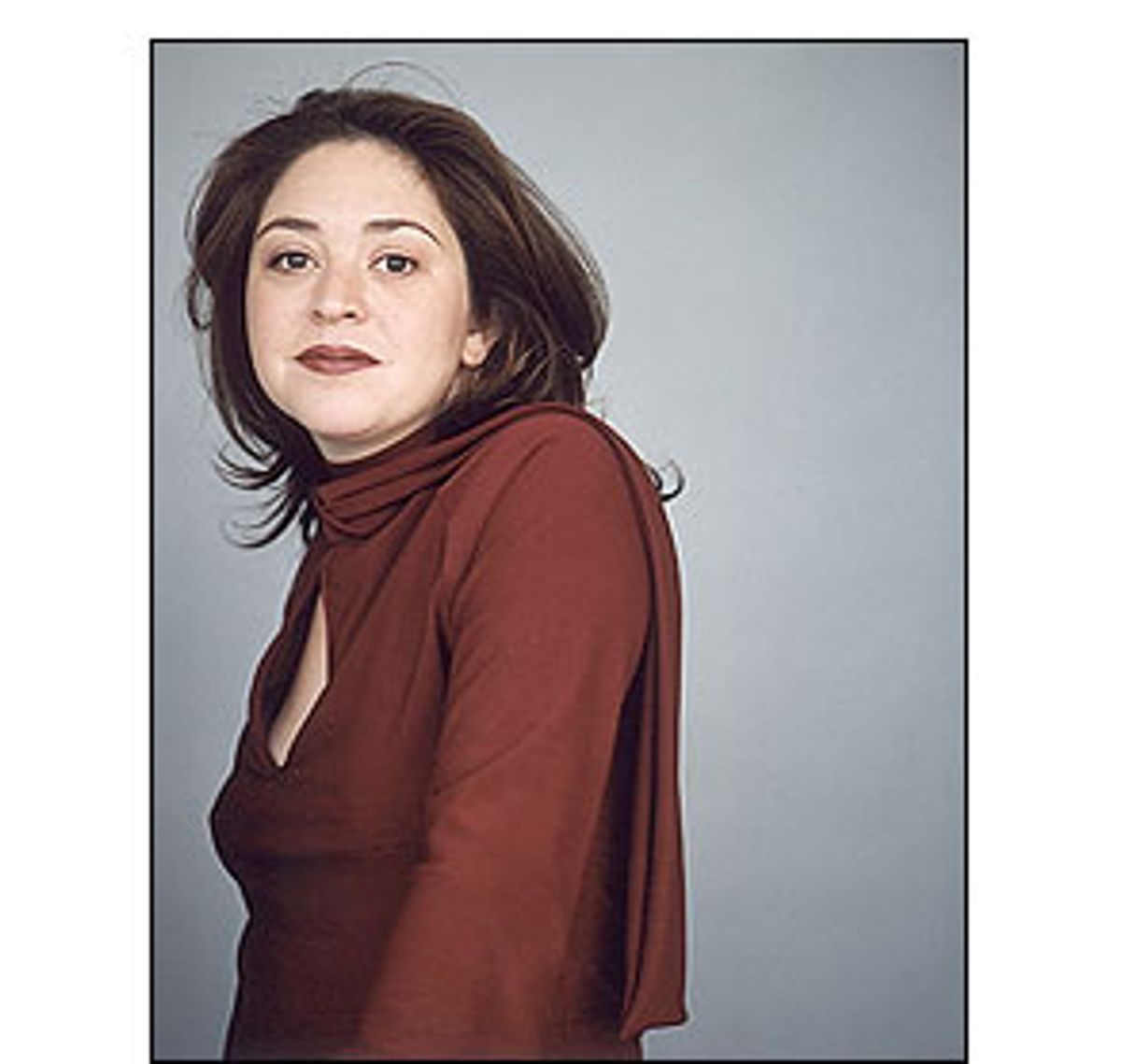
Wanda Jean Allen was executed in January 2001, after spending nearly 12 years on death row in Oklahoma for murdering her former girlfriend, Gloria Leathers. Three months before the scheduled execution, filmmaker Liz Garbus (who previously co-produced and co-directed 1998's "The Farm: Angola, USA") traveled to Oklahoma to document the efforts to have Allen's death sentence commuted to life without parole. The legal arguments hinged on evidence that wasn't introduced in the 1989 trial -- most important, that Allen, as her legal team contended, was borderline mentally retarded. "The Execution of Wanda Jean," the resulting documentary directed by Garbus and produced by Garbus and Rory Kennedy, premiered on HBO Sunday night (it will also run on March 18, March 20, March 22 and March 28).
"Wanda Jean" comes to American TV at a time when issues of mental competence and guilt or innocence are highly charged. In the enormously controversial Andrea Yates case, the prosecution and the defense agreed Yates was mentally ill, yet she was convicted, and sentenced to life in prison on Friday, under Texas' strict insanity defense standard. Throughout the country, death penalty issues, including whether mentally retarded people should be executed, are under scrutiny. In February, the Supreme Court heard arguments in a case involving a Virginia death row inmate who is mentally retarded: the Court is considering the question of whether such a conviction is constitutional. Currently 18 states prohibit capital punishment for the mentally retarded, and stays of execution have recently been issued even in states where there is no such law on the books. And in Illinois, Gov. George Ryan has said he plans to review the cases of all 163 people on death row in his state before his term ends at the end of the year.
Her goal in making "Wanda Jean," Garbus says, was to show a death row inmate as a human being. "People facing the death penalty are not equal to the worst things they've done ... People sit on juries. And it takes a unanimous vote to get a death penalty verdict. So you hope that one person sees the film and says, "You know, it didn't really accomplish much to kill Wanda Jean."
Salon spoke with Garbus recently about the death penalty, her film and the state of documentaries today.
The legal landscape is somewhat different today than it was a year ago -- particularly with the Supreme Court's recent stay of an execution in Texas and the arguments before that court about whether the death penalty should be applied to mentally retarded people. What do you think the outcome for Wanda Jean would have been if her execution date had been set for this year?
The landscape is a little different. Just the other day, Gov. Ryan of Illinois said he's considering pardoning all 163 people who are on death row in his state ... About two weeks ago there was a case involving someone who had borderline retardation in Georgia, whose jury did not know about the mental retardation. It was a very similar case to Wanda Jean's. And Rosalyn Carter and some others got involved with the case, and he ended up getting a commutation from the governor. So if you look at that and you look at Wanda Jean's case, you'd think, Well, maybe given the circumstances and the political moment right now, Wanda Jean would have had a better shot.
But I feel like Oklahoma was pretty set on executing Wanda Jean. That's just me. Oklahoma in some ways was immune to a lot of things, because some of this stuff with the death penalty was already happening a year ago. It did not seem to have a big impact in Oklahoma. It was definitely an environment there of, "Let's get these executions done," because these folks had been on death row for quite a while.
The clemency board felt like Wanda Jean had killed twice, and I felt like they really believed that she was a cold-blooded killer. They were not persuaded by arguments about her mental capacity. I'm not sure that it would have made a difference for Wanda Jean. She had a bad set of cards, and she basically did not get a break along the way, ever. Not from the first moment of her family hiring a private lawyer and him trying to recuse himself from the case and get her a public defender. This was a case where the public defender would have been a better thing for her. And the judge didn't allow that. Her family was essentially unable to help her because of their own mental issues and incapacities. So she couldn't get a break.
Why did you pick this person? And this issue?
When I sat down with Sheila Nevins at HBO, who runs the documentary unit there, we talked about the idea of doing something about a woman on death row. At that point, when we decided we wanted to do something, there were 55 women on death row in America. I just started looking at the different cases. There was a certain kind of case I was looking for. I didn't want to do a case where the person said they were innocent. If the person has claims of innocence, then it's very clear the death penalty is wrong. It's a simple slam-dunk.
I was interested in somebody who had said they'd done it -- then look at the morality of the death penalty in that situation. In looking at the list of names, I came to Wanda Jean Allen. The issues in her case, which were so timely, interested me. When I flew down to Oklahoma and met with Wanda Jean, I was so taken with her and her legal team. And they were willing to work with me.
Did you have some sense that'd she'd be executed, because of the facts and circumstances of her case, the state she was in?
I had a sense that there was a very strong possibility that she would be executed. When I get involved in these cases, I become very sympathetic to the people I'm working with. I became sympathetic to both the victims and to Wanda Jean. And I began to develop sort of unreasonable hopes. The state of Oklahoma clemency board had never granted legal clemency. Yet I, like her legal team and like Wanda Jean, walked in there that day believing there was a shot that she could get clemency. You kind of get swept up in the emotions of it. After the clemency board turned her down, it was pretty clear what was going to happen. My intellectual mind said that she most likely would be executed, but emotionally you begin to have hopes that something will intervene.
Was it a deliberate decision to present her as a sympathetic figure?
You know, you walked into a room and Wanda Jean was extremely charming and charismatic. She had done some terrible things, but a human being is not equal to their two worst actions. She had a whole range of behaviors and capabilities that was more worthy than the two murders she committed. Basically, when I make films, I don't make films about people I dislike. I find that too unpleasant and morally compromising. So I generally have to find something I can relate to and I do bring that out to the audience. Bringing out her humanity, bringing out what was likable about her, was important to me. If I were just to bring out the negative parts of Jean, it's a less interesting story. And it's just not true.
How do you see where Americans stand on the issue of capital punishment? How might this film affect that?
When you ask, "How do people in American generally think about this?" I say they don't. They don't think about what people are like who are on death row. I think that's part of the political incentive -- to keep these folks unknown. That way we'll think, This person is totally different from me, this person is not like anybody I know, and it's OK that they go quietly into the night.
I think by showing that these people are human beings, that they're not equal to the worst thing they ever did -- maybe some of them need to be kept behind bars, but it's really not such a huge social price to just keep them behind bars and not kill them -- that's the goal.
People sit on juries. You hope that people, somebody who sees this film, will think about this. It takes a unanimous vote to get a death penalty verdict. So you hope that one person sees the film and says, "You know, it didn't really accomplish much to kill Wanda Jean." That's the hope.
Was there anything about the issue of the death penalty that you learned or that you were surprised by in making the film?
Because I've been down this road a couple of times in filmmaking, I've been exposed to the deliberations of the boards and the machinations of the midnight executions. The thing that I felt overwhelmingly during the making of this film, because we did spend a lot of time with the victims, was this lingering question, "In whose name is this execution being carried out?" That's the emotion I kept going through, a ticker in my head. The state would claim the execution is carried out in the name of closure and retribution for the victims. And it was so clear that wasn't what was happening here. I found the victim's family not unanimously believing this. It was very moving. They really clarified my feelings about how the death penalty does or does not serve the victims.
Did you first become interested in issues of legal justice, or did you first want to be a filmmaker?
Both. They were intertwined. In college, at Brown University, I was always someone who was a social activist, but I dabbled in experimental filmmaking classes. It became clear as I got into the real world that there was a way to combine these two interests. Specifically, my interest in prisons came through reading a book written by an inmate, Wilbert Rideau. He wrote "Life Sentences: Rage and Survival Behind Bars," and it struck me that this was a way to explore the issue. There had been a lot of prison films made, but a prison film with the guidance of someone like Wilbert Rideau [an inmate in the Angola prison] could be new and special.
I contacted him and that relationship ultimately led to the making of "The Farm." And so the interest in prisons came in many ways through Wilbert. An interest in social justice and activism was sort of always in me. My father is a civil rights and civil liberties lawyer. Growing up, around the dinner table, the discussions were always about these issues.
Would you describe yourself as an activist filmmaker?
I think there are people for whom that term is more appropriate than me. And there are social advocacy films, which are funded by foundations, and can be very clear about their political agenda. I work within the system. This film was financed by HBO, which doesn't have a position on the death penalty, as a corporation.
I'm a storyteller, so no one says you have to be balanced. But I am working within the system, and central to my mission is to be a storyteller first and a social advocate second. Not a lot of people are going to watch my films unless they're good stories. It's kind of a dance between the two.
People believe that documentary films should be the same as other forms of journalism -- balanced, incorporating all views, objective. Do you see that as a problem?
You could make a film about child molesters without talking to the victims, and that would be a valid mission if you had something to say about the child molesters. And that also would make people furious. I think documentary filmmakers [are] not journalists. We are storytellers. The end products of what we do play in movie theaters or on TV for an hour and a half. So they have a different role. There have been people, with "Wanda Jean" or with some other films I've made, who say the victims don't get enough space and I've spent too much time with the perpetrators.
With this film, my mission was really to tell Wanda Jean's story. It was one woman's story. There has been criticism from people who have said that it should be more balanced. I just don't agree with that. I did include the victims in this film, but I could have not included them at all. Again, it was one woman's story. And anybody who's looking to a documentary for objectivity is misguided. There are many other venues where they can find things that are trying to be a lot more objective.
But there is that expectation of objectivity.
Because these are real events. And people have a sense that life has to be fair, and we need to represent each side fairly. But of course that's not what happens in a fiction film. People accept those as stories without balance, necessarily. I think the documentary, particularly verité documentaries covering present-day events as opposed to historical ones, look like news sometimes. So they want that balance, particularly people whose sensibility I've offended.
Do you plan to keep pursuing social justice issues in future projects?
Every film has led to the next film for me. With "The Farm," after spending so much time in the Angola state penitentiary, I felt that I wanted to go and spend time in the juvenile justice system. The juvenile system is supposed to be about rehabilitation and turning people around so they'll be ready to be fully functional adults. I spent time in the juvenile system with boys and actually learned girls are the fastest-exploding parts of the juvenile system. Girls who commit violent crimes are the fastest-growing part of the juvenile justice population. Then I started to spend some time with those girls, and I'm still working on that film. That work led to "Wanda Jean." Now I'm working on another project with HBO, which is in the very, very early stages -- about the human toll of the three-strikes law. It's not about death behind bars the way "Wanda Jean" is, but it is in another way. Maybe I've gotten to the end of that series of "everybody's dying." I think, unfortunately, the American criminal justice system gives me lots of things to sink my teeth into.
Shares