
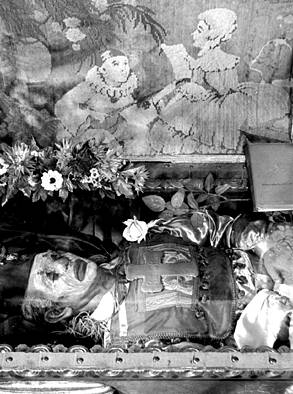

If Federico Fellini and Salvador Dalí had ever collaborated on a funeral service, it might have resembled what the California Institute of Abnormalarts in the North Hollywood section of Los Angeles did a few weeks back. There on a chilly February evening, about 60 mourners, curiosity seekers and full-fledged freaks had gathered for coffee, cake and a clown corpse hermetically sealed in a glass box and displayed onstage in a moldy coffin. According to the Byzantine prayer cards handed out at the entrance, these were the earthly remains of one Achile Chatouilleu, an American circus performer who died in 1912, asking that his body be forever on display in the clown attire and makeup he wore in life.
Attendees of this memorial service for Chatouilleu (whose last name reportedly translates as “French tickler”) gained entrance with a donation of five dollars and a gift for the dearly departed. Canned hams, skeleton dolls, bottles of booze and packages of condoms were but some of the presents proffered by clubgoers, most of whom had learned of the event by word-of-mouth. Often the mouth in question belonged to none other than the C.I.A.’s ingenious impresario Carl Crew, a former actor in his late 30s whose credits include the starring role in the low-budget 1993 flick “Jeffrey Dahmer: The Secret Life,” wherein he quite literally makes meatloaf out of sedated victims.
“Yeah, I guess that’s my calling card now,” Crew told me on one of my trips to the C.I.A. “There were other films I was involved in I liked better, but that’s the one people always mention.”
Crew’s been a friend of mine since I began going to the indie rock/performance art venue five years ago, when it was underground and served liquor without a license. The police eventually raided the C.I.A., closing the dimly lit nightspot for a few years. When Crew and co-owner Robert Ferguson reopened it in 2001 — all operations above board — the once-black interior was painted in garish reds and yellows and decorated with a circus sideshow motif. Crew, a freak show fanatic, put his vast collection of sideshow exhibits and paraphernalia on display. Vintage banners advertising Sweet Marie, a 643-pound femme fatale, share space with the severed arm of a French nobleman, a dead fairy, the skull of the world’s smallest Freemason and the hirsute, severed head of Sasquatch.
Most of these are classic sideshow “gaffs,” or fakes, like the two-headed baby nailed above the bar or the “merman” enshrined in glass nearby. But the clown, according to Crew, is quite real.
“This attorney friend of mine called me up one day on a speakerphone with all his lawyer pals around and goes, ‘Carl, how would you like to lease a dead clown?’ I said, ‘Are you kidding? Of course!’ All the other attorneys just roared with laughter. It took like four months to get the paperwork done, but now I have him for six months. I won’t tell you how much it cost me, but it wasn’t cheap,” Crew said.
I was skeptical he would ever get this clown; once he got it, my incredulity was slow to fade. Sure, lying there under glass in red vestments, a Shriner’s cap and long-faded greasepaint, the brownish body did look like a well-preserved cadaver. The fingernails showed sign of decay, and there was bushy, black hair in the nose — details that would be difficult to fabricate, but not impossible. We were in Hollywood, after all.
I could find nothing online about Achile Chatouilleu, so I pushed Crew for some corroboration. It came in dribs and drabs. Nothing incontrovertible, of course, but enough to make me think that Crew had perhaps produced the genuine article. There were photos, said to be of Chatouilleu while he was still alive, and a ragged, blue turn-of-the-century poster for “The Great London Circus” at Madison Square Garden with Chatouilleu’s name on the bill. Finally, Crew came through with the photocopy of a death certificate stating that Achile Chatouilleu, a “retired clown” born Feb. 3, 1866, died of “chronic nephritis” on Jan. 13, 1912.
Crew asked me not to reveal where Chatouilleu died or the names of his parents, listed as immigrants from Scotland on the death certificate. Chatouilleu was not the clown’s birth name, and supposedly his descendants, who live on a ranch near Yosemite, wish to remain anonymous. But the death certificate and the rest of it could be forgeries. I remained unconvinced.
“You still think it’s a hoax?” asked Crew. “What do you want me to do, slice it open like a pumpkin for you?”
Actually, yes, but since Crew says the body was embalmed in mercury, arsenic or a combination (something mortuaries did long ago, one medical examiner told me), the pumpkin slice would likely prove lethal. I contacted Christine Quigley, author of several tomes on death, including “Modern Mummies: The Preservation of the Human Body in the Twentieth Century” (McFarland & Company). What she had to say might make old Chatouilleu sit up and throw confetti.
“More likely than not it’s a preserved body,” says Quigley. “Because it would be harder to fake something like that than it would be for it to be real. What’s most unlikely are the stories in these kinds of cases. Now, I’ve never heard of this particular mummy, but generally I’ve found that the stories tend to be fabrications because they’re in the carnival circuit. Sometimes carnies bought these mummies from the local funeral home director, who kept them for years hoping the family will claim them. It doesn’t happen anymore, but they used to over-embalm these bodies. That’s why they’ve lasted so long.”
Quigley says that often the bodies became local attractions which people would visit on Halloween, for instance. A carnival operator would come through town, hear of the body and make the funeral director an offer. The corpse then became part of the traveling road show, with an outlandish legend concocted to draw in a paying crowd.
“Sometimes the mortuaries held on to them. There’s one case of a funeral home out in the Midwest which still has the body of this guy George Stein, who died in the ’20s. In fact, they moved recently and took the body with them instead of interring him,” says Quigley.
Indeed, Quigley explains that though the retail sale of corpses no longer occurs legally, there’s nothing necessarily illegal about having one in your possession. Though funeral homes have guidelines to follow, the law regarding what you can and can’t do with human remains can be a gray area, according to the author.
Quigley cited several cases where human remains were used as sideshow attractions. In 1976, during the filming of an episode of “The Six Million Dollar Man” in Long Beach, Calif., the TV crew discovered the mummified body of Old West outlaw Elmer McCurdy in a decrepit fun house where he had been used as part of an attraction. There’s also Marie O’Day, whose body was supposedly preserved naturally in Utah’s Great Salt Lake. A murderess named Hazel Farris is on display in Alabama, and somewhere out there is a corpse with one gold tooth — “Gold Tooth Jimmy.” For Quigley, Crew’s dead clown was one in a long line that includes Mao Tse-tung and Lenin.
But the clincher was my conversation with veteran sideshow operator Jeff Murray, who along with his wife, Sue, has operated sideshows for the past 20 years throughout the United States. His company, Harmur Shows, is based in Ahwahnee, Calif. — also in the Yosemite area, not too far from the circus family that owns Chatouilleu’s body. Murray claims that while on the sideshow circuit he ran across a member of this family who tried to interest him in an odd exhibit.
“They’re basically a gypsy family,” Murray says of the clown’s caretakers. “I don’t even know their last name, but they’ve been around for years. I used to see their son Danny down at Leg Lake when I opened for the spring. His wife was a midcamp, which is the carny term for a palm reader. She always had a booth there. I found out they live not too far from here. He mentioned this stiff they had, but I wasn’t that interested. See, we used to have a show of two-headed babies. Real ones, preserved in formaldehyde. But a lot of showmen started to get busted for transporting them across state lines, so we sold them all to collectors. So when he started talking about this dead body, I had no interest at all because I’d just gotten rid of the ones we had.”
Murray’s never seen the body, but he’d encountered “stiffs” during his travels and had no reason to doubt him. Back in the day, he saw Gold Tooth Jimmy, shrunken heads and pickled babies. He knows the whole history of Marie O’Day and can relate in minute detail other cases of sideshow mummies.
“I thought it was a little strange that they had a dead body, but they said it was a family member, and of course you never know with gypsies. It could be one of those situations where they ended up with this body somehow and made up a story to go along with it,” Murray says.
Taking into account what Murray and Quigley have to say, as well as the condition of the body itself — the way it’s dressed and the documents Crew has for it — I lean toward accepting the artifact as authentic clown carrion, even if part of the clown tale turns out to be myth. Fortunately, Crew says, forensic science may be the final judge. He’s been approached by producers for National Geographic TV’s popular “Mummy Road Show,” who want to X-ray the corpse. Right now it’s up to the family to decide. As for Crew, he’s already on to his next acquisition.
“It’s the body of Alligator Boy, and in mint condition,” he squeals. “Now don’t tell me you want a death certificate for this, too!”
