Sex
The cool one
Jodie Foster is like Cary Grant -- smart, observant and curious about human nature. Those things together lend a fascinating distance to her charm.
Nothing about Jodie Foster has ever seemed stupid or uncool. Even when she was Iris in “Taxi Driver,” her poise was formidable, her fragility like iron.
One of the most admirable things about her idiosyncratic career has been the plain assumption that it would be worse than stupid or uncool not to live comfortably with her own lively, natural intelligence. So she went to Yale and graduated, with the attitude that said, Why should foolish things like being a movie star (or being a figure in someone else’s deranged fantasy) be allowed to interfere with showing that much good sense with your own life?
Equally, in recent years, she has managed more or less to remove herself from the most odious forms of intrusive publicity. She lives a family life, without advertisement or coyness, and leaves it to us to come to our own conclusions. That it has all worked so well is the best tribute to her own faith in being natural, private and smart. And being those three things in the kingdom of movies is nearly without parallel.
Her job is that of actress; and two Oscars so far (for “The Accused” and “The Silence of the Lambs”) tell us how good she can be. However, whereas acting on stage may be a matter of pretense, on film the players have to let the light of the medium into their inner rooms. And Foster’s very intelligence and character — let me call it her nature — set parameters to her work. There are some pretendings that she doesn’t do very well. The same thing was true of Cary Grant once. No one on screen in his heyday was so smart, so observant of others, so curious about human nature, so interesting. Yet all those things together made for a quality — call it coolness — that lent a fascinating distance to his charm.
Well, Jodie Foster opens this week in a movie that is, simultaneously, brilliant and empty. This is a rare and disconcerting combination. For the director, David Fincher, has made “Panic Room” superficially riveting. He loves the medium, the camera, the spaces in the house where this story is set. He loves the dainty cruelty of the narrative situation. He trusts his supporting cast and he knows that Jodie Foster (no matter that she took over from an injured Nicole Kidman at the last moment) is perfect in the lead. Indeed, one of the great pleasures of this film is to see Jodie Foster back to her best after several films where she was uneasy or misused.
Here’s the situation. Foster is the wife of a wealthy older man. They have an 11-year-old daughter. But the man has gone off with another woman — “the bitch” is what Foster and the daughter call her. Still, Jodie has a good divorce settlement, and so she and the daughter find this wonderful brownstone on West 94th Street. They buy it on one viewing, and they look forward to moving in and making it their home.
But there’s one catch to the empty house. It contains a secret chamber, a safe place — the panic room. A small, utterly secure inner sanctum, made out of concrete and steel, with a wall of television screens showing other parts of the house, with a phone and supplies. It’s like a perfect camp for kids. Or is it?
The first night Jodie and the kid sleep in the house, three marauders come by. They didn’t realize the new owners had moved in yet. They are in search of a fabulous treasure left by the previous owner. And where, in that house, would you deposit your treasure? Jodie and the girl scramble into the panic room inches ahead of clutching hands. The steel door slides shut. What next?
Clearly, with a movie that is about nothing except suspense, it would be unfair to go much further. But I don’t think you’ll be disappointed. “Panic Room” works.
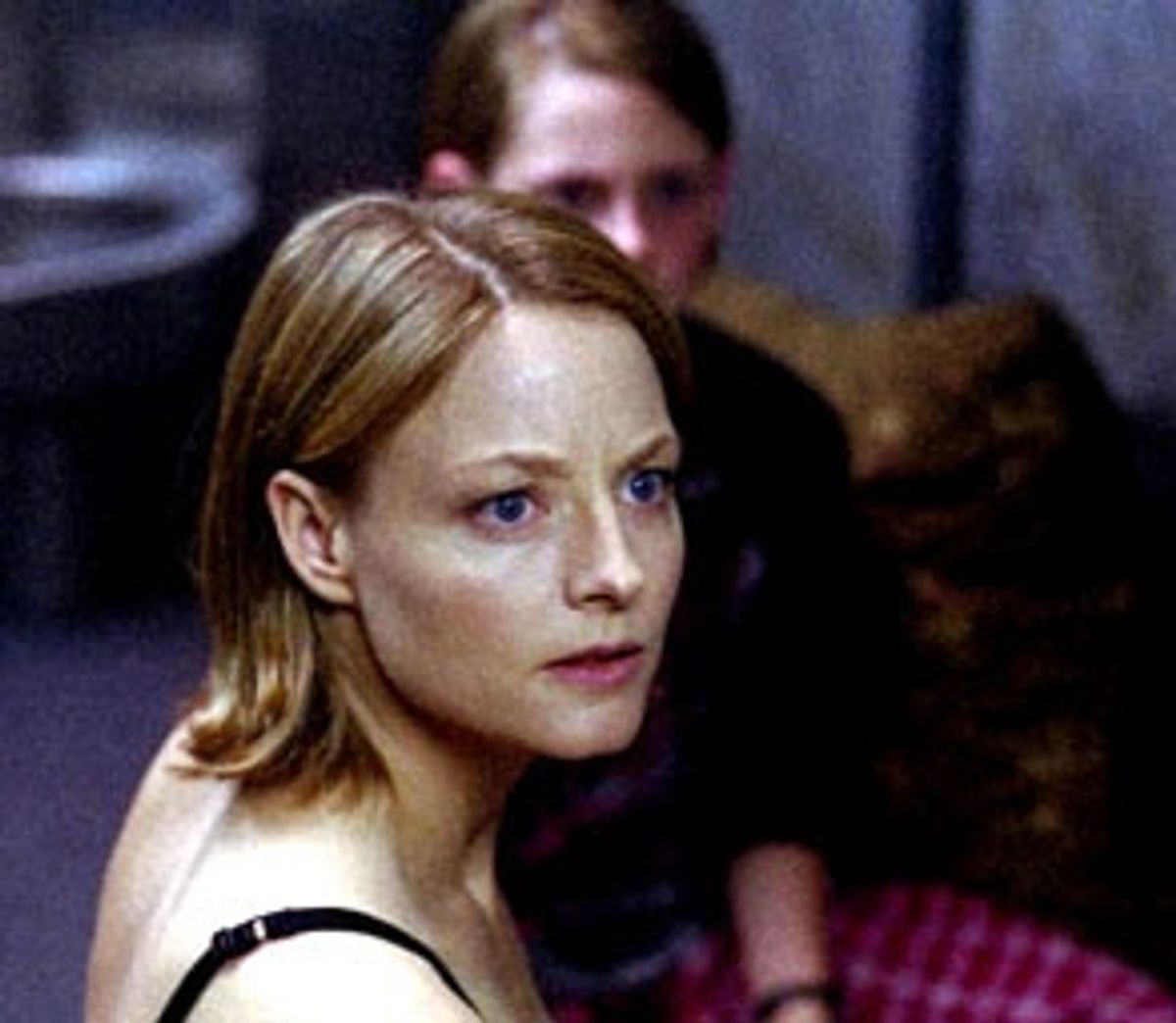
One of the ways it works is, quite simply, the look on Jodie Foster’s face and the desperate measures she takes to keep safe. There are repeated shots of her carved features and saintly eyes in the steely blue light of the panic room, gazing at the TV screens that track the criminals. This is a look we know from “The Silence of the Lambs” — of alarm, fear, apprehension, and the courage that battles with those feelings. And it is something that Jodie Foster does better than anyone else on screen: she endures menace and threat without ever seeming foolish or monotonous, but by taking us ever deeper into her intelligence and nature.
Like any close-up face in a movie that hooks you, it’s a beautiful face (i.e. its meaning enhances or transcends mere attractiveness.) Yet I don’t think the general audience regards Jodie Foster as lovely, as someone they can dream over. She’s too smart, too private, too averse to being soft or pliant. She’s not “sexy”; she doesn’t serve herself up for the conventional dreams of movie eroticism. Nicole Kidman would have made this a very different film (loaded with a threat of rape). Whereas Foster makes it a film about bravery, maternity and her own independence. She may not be sexy, yet sexuality shines out of her, inextricably mingled with resolve and thought.
No need to spell this out. But it’s in the face of the odd emptiness of “Panic Room” that you begin to feel how far the really natural thing (the wall behind Foster’s eyes) has been avoided — and Foster is so good, so passionate in the picture, so candid in her gaze, you may feel the omission as a fault. The role of the child, the daughter, could be (should be?) that of her lover.
David Thomson is the author of "A Biographical Dictionary of Film" (new edition just published), "Rosebud: The Story of Orson Welles" and "In Nevada." More David Thomson.
Massage therapists rubbed wrong by sex talk
A Jennifer Love Hewitt show and the Travolta allegations have masseuses tired of being confused for sex workers
(Credit: iStockphoto/sybanto) Joe, a licensed massage therapist, knows what it’s like having a famous client who expects something extra. He had an Academy Award-winning actor begin gyrating on his massage table before raising his hips in the air to show off his erection. “He was hoping that I would play with him in some shape or form,” he says.
Needless to say, Joe isn’t surprised by allegations by two masseurs that John Travolta got handsy during massages. (Travolta’s attorney has denied all the allegations, and called them “ridiculous.”) “It happens all the time,” he says, and not just with celebrity clients. He frequently encounters men who try to fondle him, usually while he’s working on their glutes or lower back and their hand happens to be level with his crotch. “They think they’re so original, but they’re all so much the same,” Joe says, his voice rising. “They all use the same tactics, the same body movements, the same gyrations and grinding my table, the [heavy] breathing.”
Continue Reading Close
Tracy Clark-Flory is a staff writer at Salon. Follow @tracyclarkflory on Twitter. More Tracy Clark-Flory.
A night at the vibrator museum
Early vibrators were hand-cranked, two-person jobs -- and prescribed by doctors. How far we've come since then
(Credit: Antique Vibrator Museum) I can now say that I’ve used a turn-of-the-century vibrator — on my hand, but still.
The silver, hand-cranked contraption is usually kept behind glass at Good Vibrations’ Antique Vibrator Museum in San Francisco — but staff sexologist Carol Queen made a rare exception. “This is very special,” she whispered, unlocking the case and carefully pulling out Dr. Johansen’s Auto Vibrator, a relic from 1904. The “auto” part is not so much: It was a two-person job, with her having to crank the device’s handle to get it thrumming. Pressing my finger tips to its inch-wide circular platform of pleasure, I was pleasantly surprised by its power.
Continue Reading Close
Tracy Clark-Flory is a staff writer at Salon. Follow @tracyclarkflory on Twitter. More Tracy Clark-Flory.
Maggie Gyllenhaal on sexual liberation
The beloved indie star tells Salon about her "vibrator movie" and why she loves playing transgressive women
Maggie Gyllenhaal (Credit: Reuters/Mark Blinch) When I met Maggie Gyllenhaal about six weeks ago, she was enormously and gloriously pregnant, stretching out on a sofa with her shoes off and feet up in a Manhattan office building. (Since that time, Gyllenhaal and husband Peter Sarsgaard have welcomed their second daughter, Gloria Ray, to the world.) We were there to talk about “Hysteria,” the charming, lightweight feminist farce from director Tanya Wexler that explores a key event in the history of female sexuality: the invention of the vibrator by Mortimer Granville, a Victorian doctor who was seeking to cure the mysterious “female malady” that lends the movie its title.
Continue Reading CloseMother-daughter sexperts
Susie Bright and her daughter, Aretha, make parental talks about sex look easy -- and fun
Most parents loathe talking to their kids about the birds and the bees, let alone pubic hair grooming, faked orgasms and “water sports” — but most parents are not legendary “sexpert” Susie Bright.
Better than talking about these things, she penned an advice column in 2009 with her daughter, Aretha, then 19, for the ladyblog Jezebel. Their answers to questions about everything from porn to Paxil were unflinching but playful, and at times controversial. Now the pair have collected those columns into a new e-book, “Mother/Daughter Sex Advice.” Together, they read as an irreverent version of “Our Bodies, Ourselves” for the Internet age. The mother-daughter team also reflect on what the experience of writing the column was like, and it turns out it wasn’t as weird as many would think: For the most part, it was just a continuation of conversations they had been having throughout Aretha’s life.
Continue Reading Close
Tracy Clark-Flory is a staff writer at Salon. Follow @tracyclarkflory on Twitter. More Tracy Clark-Flory.
On the rack: A cultural history of breasts
Did breasts evolve for lactation or to enhance sex appeal? A new book explores why they matter
(Credit: iStockphoto/NadyaPhoto) It’s hard to be boobs. Sure, breasts are cherished as givers of milk and the pinnacle of sex appeal, but the modern world hasn’t been good to mammaries.
As Florence Williams writes in “Breasts: A Natural and Unnatural History,” they’re the most tumor-prone organ in the human body. They “soak up pollution like a pair of soft sponges,” and transmit environmental toxins to babies through breast milk. “Breasts are bellwethers for the changing health of people,” she says. While we’ve “genetically modified our crops to be able to protect them from the ill effects of pesticides,” Williams writes, “we haven’t yet figured out how to modify our breasts.” Aside from using saline and silicone, of course.
Continue Reading Close
Tracy Clark-Flory is a staff writer at Salon. Follow @tracyclarkflory on Twitter. More Tracy Clark-Flory.
Page 1 of 403 in Sex