Sex
Eve was quite a lady
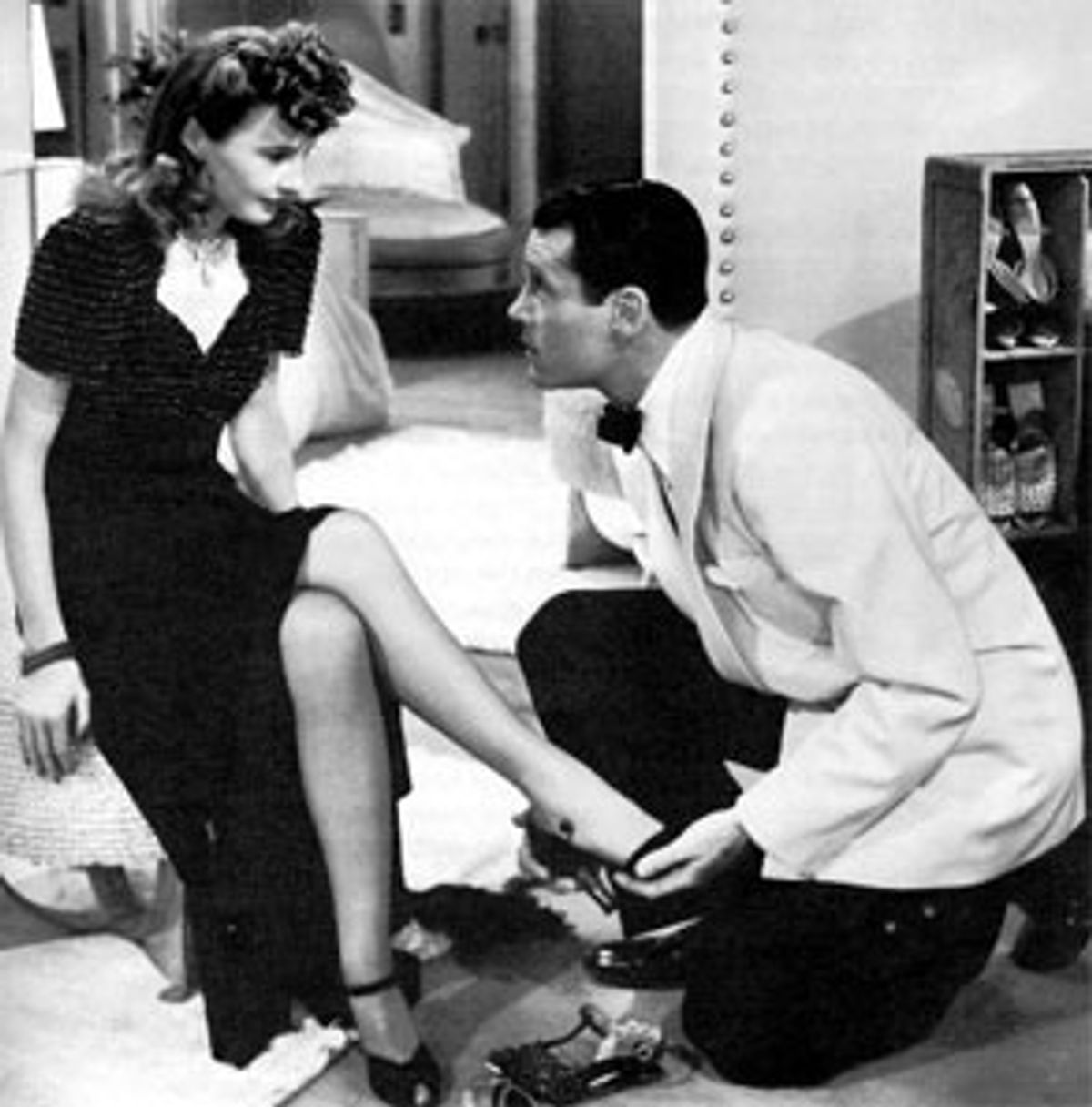
When Barbara Stanwyck's leg pushes up against Henry Fonda's white jacket it is one of the most erotic moments in American film.
Where would the inanely rich and society’s audacious confidence tricksters meet but on an ocean liner, dawdling its way through the still, warm seas? Call the ship the Southern Queen, on its way to New York. Let the rich idiot be Charles Pike, the son of the Pike beer fortune, a rather glum stalwart of the closed mind, and a fellow who has been up the Amazon for a couple of years (or is it all his life?) assisting in research on rare snakes.
There is a prelude to “The Lady Eve” that teaches us how to think about snakes — and it’s rather anti-scientific. In the comic-book style of the very brief credits, we gather that Eve is womanhood, the fruit of the tree is delectable knowledge, while the snake is a smiling smartass who manages to get stuck trying to slide through the “o” in Preston Sturges (did you ever think of getting stuck that way?), and then slides off with the ring on his plump shaft, as if to signal marriage.
Charles Pike has a pet snake (Dr. Freud could not sail on this ship, but knowledge is everywhere), a rather tame little softie that lives in a box and can be fed flies or cockroaches. It’s not a snake in the grass, just a snake in a box. However, the idea of this snake is the one thing that shatters the sang-froid of Jean Harrington — lady, Eve, adventuress and card sharp — who picks up the limp Pike.
Charles is Henry Fonda, Jean is Barbara Stanwyck. The film is “The Lady Eve,” released in 1941, and written and directed by Preston Sturges. As Sturges cast his picture, Fonda had just played the two essential noblemen of his young career — Tom Joad in “The Grapes of Wrath” and Abe in “Young Mr. Lincoln.” Those were movies in which his slightly gangly, slack-kneed way of walking embodied integrity, perseverance and all things wise and honorable. It is an early clue to Sturges’ subversive genius that he should therefore cast Fonda as a learned simpleton likely — again and again — to be tripped up, and fall flat on his face. Charles Pike plays so many scenes on less than his feet.
Straightaway in one of the lounges of the Southern Queen, Jean observes the way in which Charles is stupidly approached by all the eligible young women on board. It is at the climax of this process (and of Jean’s sardonic running commentary) when she trips up the goof as he passes by, and she does it in such a way that, while he sprawls into a passing waiter as if the man were a swimming pool, she contrives to have him snap the heel off one of her sandals without scratching her fine ankle.
This is all she needs to scoop him up and have him escort her to her cabin where he can replace her sandals. I should add that she wears a black evening dress, with a split skirt and a narrow line of bare midriff. He wears a white evening jacket. These costumes are all by Edith Head and are hardly chance, for once in the cabin Jean decides that, really, if he’s to serve as her shoe slave, he must be on his knees while she sits. Thus there is a tight two-shot, a very pretty arrangement of black and white, in which the diagonals (so to speak) are bridged or married by the slight, graceful but intensely suggestive swaying forward of the gray, nacreous shape of her exposed leg, swinging up to be shoed, but pushing against his white jacket like a surgeon’s knife edging into the brain.
If you watch the film a few times, you may notice — and I say this without any disapproval or horror — that Jean’s provocative leg resembles, or evokes, nothing so much as a well-fed yet ravenous snake.
That small intrusion into his “space,” that metaphysical gesture that is her right leg — these are the ingredients of one of the most erotic moments in American film. I realize that you may find this hard to credit in a picture more than 60 years old — for you are (demographically speaking) likely to be young, smart and up-to-date. Never mind, you can surmount all of those conditions with a strict diet of movies like “The Lady Eve.” Indeed, seeing that scene, being left as breathless as Charles, you may feel that you, too, have been too long up the Amazon.
David Thomson is the author of "A Biographical Dictionary of Film" (new edition just published), "Rosebud: The Story of Orson Welles" and "In Nevada." More David Thomson.
Massage therapists rubbed wrong by sex talk
A Jennifer Love Hewitt show and the Travolta allegations have masseuses tired of being confused for sex workers
(Credit: iStockphoto/sybanto) Joe, a licensed massage therapist, knows what it’s like having a famous client who expects something extra. He had an Academy Award-winning actor begin gyrating on his massage table before raising his hips in the air to show off his erection. “He was hoping that I would play with him in some shape or form,” he says.
Needless to say, Joe isn’t surprised by allegations by two masseurs that John Travolta got handsy during massages. (Travolta’s attorney has denied all the allegations, and called them “ridiculous.”) “It happens all the time,” he says, and not just with celebrity clients. He frequently encounters men who try to fondle him, usually while he’s working on their glutes or lower back and their hand happens to be level with his crotch. “They think they’re so original, but they’re all so much the same,” Joe says, his voice rising. “They all use the same tactics, the same body movements, the same gyrations and grinding my table, the [heavy] breathing.”
Continue Reading Close
Tracy Clark-Flory is a staff writer at Salon. Follow @tracyclarkflory on Twitter. More Tracy Clark-Flory.
A night at the vibrator museum
Early vibrators were hand-cranked, two-person jobs -- and prescribed by doctors. How far we've come since then
(Credit: Antique Vibrator Museum) I can now say that I’ve used a turn-of-the-century vibrator — on my hand, but still.
The silver, hand-cranked contraption is usually kept behind glass at Good Vibrations’ Antique Vibrator Museum in San Francisco — but staff sexologist Carol Queen made a rare exception. “This is very special,” she whispered, unlocking the case and carefully pulling out Dr. Johansen’s Auto Vibrator, a relic from 1904. The “auto” part is not so much: It was a two-person job, with her having to crank the device’s handle to get it thrumming. Pressing my finger tips to its inch-wide circular platform of pleasure, I was pleasantly surprised by its power.
Continue Reading Close
Tracy Clark-Flory is a staff writer at Salon. Follow @tracyclarkflory on Twitter. More Tracy Clark-Flory.
Maggie Gyllenhaal on sexual liberation
The beloved indie star tells Salon about her "vibrator movie" and why she loves playing transgressive women
Maggie Gyllenhaal (Credit: Reuters/Mark Blinch) When I met Maggie Gyllenhaal about six weeks ago, she was enormously and gloriously pregnant, stretching out on a sofa with her shoes off and feet up in a Manhattan office building. (Since that time, Gyllenhaal and husband Peter Sarsgaard have welcomed their second daughter, Gloria Ray, to the world.) We were there to talk about “Hysteria,” the charming, lightweight feminist farce from director Tanya Wexler that explores a key event in the history of female sexuality: the invention of the vibrator by Mortimer Granville, a Victorian doctor who was seeking to cure the mysterious “female malady” that lends the movie its title.
Continue Reading CloseMother-daughter sexperts
Susie Bright and her daughter, Aretha, make parental talks about sex look easy -- and fun
Most parents loathe talking to their kids about the birds and the bees, let alone pubic hair grooming, faked orgasms and “water sports” — but most parents are not legendary “sexpert” Susie Bright.
Better than talking about these things, she penned an advice column in 2009 with her daughter, Aretha, then 19, for the ladyblog Jezebel. Their answers to questions about everything from porn to Paxil were unflinching but playful, and at times controversial. Now the pair have collected those columns into a new e-book, “Mother/Daughter Sex Advice.” Together, they read as an irreverent version of “Our Bodies, Ourselves” for the Internet age. The mother-daughter team also reflect on what the experience of writing the column was like, and it turns out it wasn’t as weird as many would think: For the most part, it was just a continuation of conversations they had been having throughout Aretha’s life.
Continue Reading Close
Tracy Clark-Flory is a staff writer at Salon. Follow @tracyclarkflory on Twitter. More Tracy Clark-Flory.
On the rack: A cultural history of breasts
Did breasts evolve for lactation or to enhance sex appeal? A new book explores why they matter
(Credit: iStockphoto/NadyaPhoto) It’s hard to be boobs. Sure, breasts are cherished as givers of milk and the pinnacle of sex appeal, but the modern world hasn’t been good to mammaries.
As Florence Williams writes in “Breasts: A Natural and Unnatural History,” they’re the most tumor-prone organ in the human body. They “soak up pollution like a pair of soft sponges,” and transmit environmental toxins to babies through breast milk. “Breasts are bellwethers for the changing health of people,” she says. While we’ve “genetically modified our crops to be able to protect them from the ill effects of pesticides,” Williams writes, “we haven’t yet figured out how to modify our breasts.” Aside from using saline and silicone, of course.
Continue Reading Close
Tracy Clark-Flory is a staff writer at Salon. Follow @tracyclarkflory on Twitter. More Tracy Clark-Flory.
Page 1 of 403 in Sex