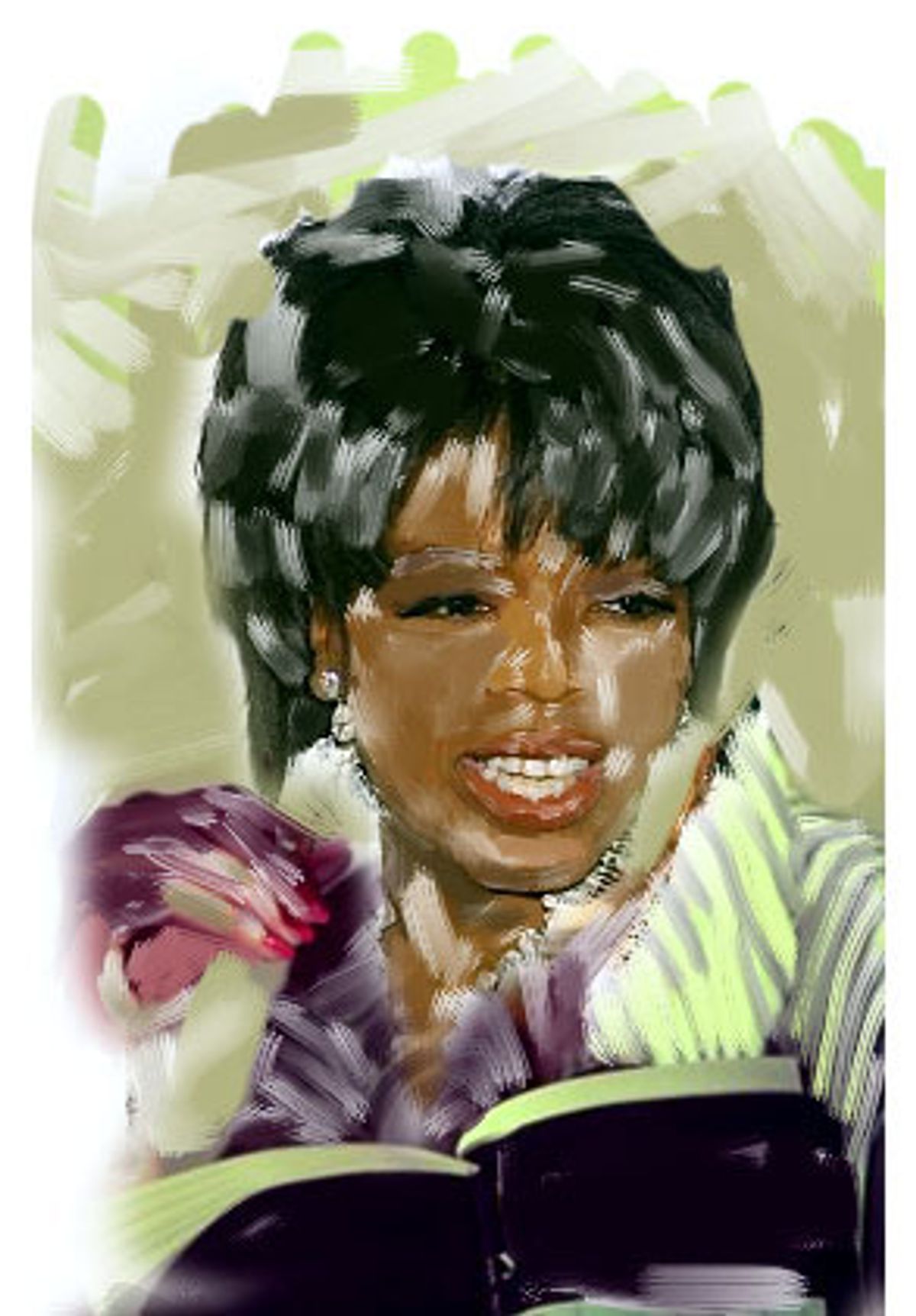
Oprah Winfrey

After Oprah

Her imitators and her critics misunderstand how she sold books -- and why she's such a tough act to follow.

  • more
    • All Share Services

After Oprah

Since Oprah Winfrey announced two weeks ago that she’s ending her television book club, some new players have stepped up to the plate hoping to beat her record in swatting authors onto the bestseller lists. USA Today has announced the launch of a book discussion that will take place both in its Life section and on its Web site, and in June the “Today” show will begin a club in which popular authors will invite viewers to read the works of “undiscovered” writers.

Both media outlets have sizable audiences, but it’s hard to imagine either one matching Winfrey’s influence on book buyers. Her power to bump up a book’s sales figures by as much as a million copies (at the peak of her club’s popularity) tended to confuse observers about the nature of the club itself. Despite its use of the broadcast medium, the Oprah Book Club worked according to an old-fashioned principle. Publishing savants have long known that word of mouth is the most effective way to sell lots of books, especially when those books are novels. The people who spend their money on fiction are mostly women, and most of them tend to try out new books and authors on the recommendations of trusted friends or booksellers.

Winfrey’s book club represented a kind of supercharged word of mouth: In her case, the mouth reached 7 million ears daily. As juicy as that mass audience looks to an aspiring publisher or author, how Winfrey relates to her viewers has been as essential to the success of her book club as the simple fact that she’s got their attention. Winfrey’s core audience feels it has a relationship with her; if they tune in every day, they may spend more time listening to her than they do talking with their sisters or best friends. That relationship may be an illusion of sorts, the kind of phantom connection social commentators find so alarming, but nevertheless its effects are potent. Even people who don’t really watch Oprah feel as if they know Oprah.

And maybe they’re right. Winfrey may be a performer, but her job is to perform herself, and in selecting titles for her book club, she has always seemed to be choosing on the basis of personal taste. She’s giving it up, she told the press, because “it has become harder and harder to find books on a monthly basis that I feel absolutely compelled to share.” Anyone who reads new fiction for a living can identify with this burnt-out weariness — the seemingly endless stacks of mediocre candidates to sift through as the pressure mounts to find an endorsable book. Rumor has it that the book club episodes of “The Oprah Winfrey Show” netted lower than average ratings for the program, so it’s likely that Winfrey persisted with the club as long as she did out of her genuine enthusiasm for the books; when that enthusiasm flagged, so did the club.

Many, however, will be inexplicably happy to see it go. Heaping scorn on the canned uplift and soapy sentimentality of many of Winfrey’s selections has become commonplace — a cheap shot that allows the speaker to demonstrate his or her superior taste without requiring any expenditure of independent thought. I’ve read some Oprah Book Club selections: Some have been fine books, others have left me cold. But regardless of what I — hardly a typical Oprah viewer — prefer in a book, the novels Winfrey picked clearly worked for her audience members, who, despite some drop-off in club-related book sales in recent years, kept coming back for more.

The complaint, often made by literary critics, that Winfrey’s book club was a Bad Thing because on average the books weren’t “good enough” isn’t ultimately that different from the protestation that the club was a Good Thing because at least it got people reading books. Both ideas are based on the belief that books are like moral vitamin pills that must be coaxed down the throats of a reluctant public at all costs. It’s a peculiar, starchy notion — why should reading, say, Nora Roberts novels be more virtuous than watching “The Sopranos”?

And why should reading the kind of highbrow, stylistically complex literary books that Winfrey never picked — W.G. Sebald’s “Austerlitz” or Ian McEwan’s “Atonement,” to use two recent examples — be more improving than reading Roberts? I can’t say that the well-read people in my acquaintance are superior in character to those who prefer thrillers, movies or sports. I’m not even convinced that sophisticated readers — the ones who can recognize and savor the formal and technical achievements of a great writer — have more significant encounters with the books they read than the often naive readers drawn to Winfrey’s club — the ones who care most about identifying with a book’s characters and their experiences. Plenty of the “professional readers” (critics, writing teachers and scholars) I know mourn the days when they plunged into books with all their hearts, rather than at a critical remove.

Is it any wonder, then, that such experts often aren’t very good at persuading occasional readers to pick up a book? Winfrey’s choices were decidedly and unabashedly middlebrow. Like the old Book of the Month Club, like the quintessential middlebrow reader in fact, she sprinkled some literary titles among the less lofty works, but her choice never seemed to be dictated by an author’s critical reputation. While Winfrey wasn’t immune to the notion of reading as an elevating activity — she favored inspiring books about women who overcome hardships, of course — she presented books first and foremost as a source of pleasure. One reason Winfrey was so much more persuasive than those city-wide reading groups currently in vogue is that she said “I loved this book and I think you will too,” not “You should read this book because it’s good for you.” In a society where most authority figures treat books like broccoli, she treats them like chocolate cake.

What’s more, like any book-recommending friend, Winfrey had a track record, and a reputation to uphold. Simply put, she helped people who liked the kind of books that she liked find more of that kind of book. For this, she earned the venomous wrath of those who don’t like that kind of book and thought that she should use her influence to promote the kind of books they liked instead. Yet if Winfrey had pressed “Austerlitz” or “Atonement” — novels by writers’ writers — into the hands of her viewers, they would probably have found those books chilly and baffling. And they would have ceased to trust Winfrey’s recommendations just as they’ve learned to ignore the average literary book reviewer. I love both of those novels, but I’m not under the illusion that even the most popular woman in America can get a fan of “The Deep End of the Ocean” to love them too. (The community of book lovers ought to be a big tent, and there’s room enough for both of us.)

It’s the very consistency, the distinct Oprah sensibility, of Winfrey’s selections that made her club so successful. And the lack of that unifying sensibility makes it unlikely that either the “Today” show or USA Today will be able to replicate the impression, as Winfrey so effortlessly did, of being handed a book by an admired and familiar friend offering her fervent recommendation. It was Winfrey’s endorsement, not the club format itself, that struck a chord with a large population of middlebrow female readers looking for new books to read.

Ask bestselling authors to present the books of “undiscovered” writers to the viewers of the “Today” show? Of course those authors will choose ostentatiously highbrow books in order to demonstrate their literary chops — always a sensitive issue for commercial novelists. At USA Today, the paper’s editors and critics will make the selections — but as knowledgeable as those journalists may be, they’re a faceless bunch compared to the woman whose ups, downs and tears we’ve all vicariously shared and whose tastes we know so well.

I’m hard-pressed to come up with a public figure who could fill Winfrey’s shoes in this regard, yet I can’t join with those who say she has a cultural responsibility to restart her book club. They are part of the books-as-broccoli contingent, whereas to me the great thing about Oprah’s Book Club wasn’t the books she chose — to be honest, I’d probably hate more than half of them — or the fact that she got people reading. It’s that her book club had little to do with responsibility or duty or any other taint of obligation and moral hygiene. She did it because she enjoyed it, and the public spectacle of someone reading for fun — that is, to be amused, thrilled and moved — is a rare thing nowadays. To trudge onward when it’s no longer fun would be a kind of travesty. If the thrill is gone, Oprah, then by all means have a rest. God knows, you’ve earned it.

Laura Miller

Laura Miller is a senior writer for Salon. She is the author of "The Magician's Book: A Skeptic's Adventures in Narnia" and has a Web site, magiciansbook.com.

NBC comedy stars keep themselves relevant after finales

Alec Baldwin and John Krasinski shill baseball hats in viral ads, "Community" character gives Emmy picks, and more

  • more
    • All Share Services

NBC comedy stars keep themselves relevant after finalesYankees vs. Red Sox, Baldwin vs. Krasinski, or "30 Rock" vs. "The Office": who is your favorite?

What do the stars of NBC’s Thursday night comedy lineup do during their summer vacation? Keep themselves fresh, of course. Sometimes it’s a little hard to tell if these guys can separate themselves from their characters, but who’s complaining if there’s a real Ron Swanson or Jack Donaghy walking around?

“30 Rock’s” Alec Baldwin and “The Office’s” John Krasinski have figured out what they’re doing with their off-season, and that’s punching each other in the face about baseball. No, seriously. In this series for New Era Caps, Baldwin goes head to head with Jim Halpert over their Red Sox/Yankees rivalry. So far there have been three spots, and if you play them in succession it’s kind of like watching a crossover episode between the two shows.

Meanwhile, Amy Poehler isn’t the only cast member of “Parks and Recreation” keeping herself in the spotlight. While the comedian is off giving speeches at Harvard, her costar Nick Offerman (who plays her boss and meat-lover Ron Swanson) has been wooing Oprah to come play his first ex-wife next season.  As he told the Huffington Post:

“I think Oprah would be the only, she’s the only person we can think of that might be intimidating to Megan Mullally. It would be so good.”

He then added, “I can assure you if it’s not Oprah, I will quit.”

And while that’s doubtful, Oprah should actually consider it. She did cameo on “30 Rock,” so it’s only fair.

Rounding out the news cycle is Danny Pudi, who plays Abed on “Community.” Anyone who still thinks that show isn’t being taken seriously should check out Variety right now, where “Abed” has been given a column in-character for Emmy season. He’s predicting who will win the awards based solely on his extensive knowledge of television and film (despite never having seen the shows in question), as well as his more savant-like tendencies:

I sort the last four into two groups: a) shows that have won an Emmy, so it seems like they’ll win again, and b) shows that haven’t won yet, so it seems like their turn. Sorting every winner since “I Love Lucy” in 1953:

 B A B B A B A B B AA B B AB B A A B B AA A B A A B B A B B A B AB                              A A B B A A A A B B B B B B A B B A A B

The “ABBA” pattern emerges soon and repeats often, as people’s urge to shake up a system always results in systemic shaking. I totally get it: I once missed a week of school by trying not to touch my chin 7,000 times. The stretches of non-ABBA you see are “cable scares,” like when we just kept giving Emmys to “Frasier” until “Larry Sanders” went away. Think of TV as Rain Man getting through HBO’s smoke alarm by chanting “I like the guy from Cheers.”

The whole article is amazing, and by far my favorite post-finale offering from an NBC comedy actor. Then again, I’m a little biased.

Continue Reading Close

Drew Grant is a staff writer for Salon. Follow her on Twitter at @videodrew.

Pop Torn: 10 pieces of culture we’re feeling iffy about

From "True Blood" to Mark Zuckerberg killing a goat to a purse made out of jerky, this week is all about meat

  • more
    • All Share Services

Pop Torn: 10 pieces of culture we're feeling iffy about

Memorial Day weekend, you guys! I know that I will be happy to wear all my white clothing again, because nothing says “I’ve been to a summer barbeque” like visible condiment sauce all over my clothing.

And with this warm weather comes tons of pop culture news stories that are just to the right of funky. We’ve rounded up some of the stranger stuff that we missed this week, and leave it up to you to decide if maybe being raptured wasn’t such a bad idea.

1. People who think the Onion’s headlines are real: Oh, it happens. And now it’s a Tumblr. (Expect a book deal in the near future.)

2. Abed from “Community” shows up on “Cougar Town”:

Easter egg for the super fans and the people who love Subway.

3. OWN picks up new series, “Don’t Tell the Bride“: Groom and future wife are separated for a month before the wedding; he has to make all the decisions about planning the event. Hope she likes nachos and a boob-shaped cake.

4. Student makes Chanel bag out of beef jerky:

(Photo by Nancy Wu)

Oh what? It’s all cowhide, no matter which way you look at it. Calm down and take a bite.

5. Museum-going men are happier than their counterparts: That 2 percent of the male population must be having a blast.

6. This mommy kitten is hugging her baby kitten:

Yes, dear, it’s very, very cute. Please let me go back to bed now, I have work in the morning. Well, if it’s so great, take a video of it! I’ll watch it later.

7. “Pop-Up Video” is coming back to VH1: Though now it’s just called “tweeting during music videos.”

8. “Jersey Shore’s” Ronnie and the Situation get into a fistfight in Florence: Really, guys? Really? Italy was ready to boot you out before you even showed up, and this is how you show your good behavior?

9. Mark Zuckerberg, woodsman: The Facebook CEO will only eat food he kills himself. His private message to friends on FB just read: “I just killed a pig and a goat.” And not on FarmVille.

10. “True Blood’s” fourth season trailer:Oh great, now I have to deal with witches?

Our thoughts exactly.

Continue Reading Close

Drew Grant is a staff writer for Salon. Follow her on Twitter at @videodrew.

Conan’s Oprah fan taxonomy

O'Brien's guide to Oprah's audience rounds up familiar types, from "The Weeper" to "The Man Who Rocks and Claps"

  • more
    • All Share Services

Conan's Oprah fan taxonomy

Last night, Conan O’Brien celebrated Oprah Winfrey’s final show by honoring “the people who made the The Oprah Show truly special” over the years: her audience members. His team compiled a jokey Oprah-fan classification, encompassing all sorts — from “The Jumping Clapper” and “The Face Fanner” to “The Extremely Alarmed Grandma” and “The Man Who Rocks and Claps.”


Continue Reading Close

Emma Mustich is a Salon contributor. Follow her on Twitter: @emustich.

Oprah’s warm, funny, self-aggrandizing goodbye

Winfrey ends her show with a 42-minute monologue that encapsulates her many baffling contradictions

  • more
    • All Share Services

Oprah's warm, funny, self-aggrandizing goodbye

Oprah Winfrey’s final show summed up everything she’s been about for a quarter century. It was funny, warm, sweet and informative, and felt easygoing even though it was clearly written and rehearsed within a millimeter of its life. The episode had sharing and oversharing, confessions and anecdotes, photographs of Oprah in unfortunate clothes and hairstyles, and callbacks to shows and guests that made a big impression on the host during her journey toward self-knowledge — which, she assured us, was what her boundary-breaking, influential, astoundingly popular stint on daytime was truly about, anyway.

No, wait, scratch that. Her show wasn’t truly about Oprah at all. It was about you. All of you. But especially you, the individual sitting there watching her “every day,” as she said.

She had a message for you, the individual. Several messages, actually — and they were all intertwined: Take responsibility for your life. Be honest with yourself and others. Be responsible for the energy you put out in the world, because that energy comes back around eventually. Also: There is a God, or a life force, and you should get to know him/her/it, because he/she/it can improve your judgment and guide your life.

There was a clip reel of people admitting things on TV that they had never told close friends and family members. They said they were alcoholics or drug addicts, that they had HIV, that they had endured or inflicted spousal abuse. The confessions had a snowball effect and became collectively cathartic, Oprah said: “Little by little, we started to release the shame.”

One of the clips was of Oprah herself circa 1986, revealing that she herself had been sexually abused as a child. Another clip referenced the recent broadcast in which actor-director Tyler Perry said he’d been sexually abused as a child, then led an audience of 200 fellow sexual abuse survivors, all men, while they stood together holding pictures of themselves as kids.

Long sections of Oprah’s final syndicated broadcast, which amounted to a 42-minute monologue interspersed with video clips, suggested a church service, though precisely what kind varied from moment to moment.

Sometimes it felt like Sunday school for kids. Other times it felt like a sermon, or the opening remarks of a self-help group leader opening a meeting in a church basement.  “Don’t wait for anybody else to fix you, to save you or complete you,” she said. “‘Jerry Maguire’ was just a movie. [But] no one completes you. We have seen that with guest after guest. When you accept that you are responsible for your life, you…get….free.”

Still other times the broadcast evoked the famous sequence in “The Adventures of Tom Sawyer” where Tom Sawyer and Huck Finn, presumed dead, attend their own funeral service and hear themselves eulogized. But here was Oprah doing the eulogizing. In an especially unfortunate moment, she suggested that God was responsible for the meeting of her father’s sperm and her mother’s egg. That may very well be true, but if so, it’s true for every other human being as well — and when you put it in the words that Oprah chose, it can’t help but sound oddly messianic.

Oprah’s last words before exiting stage left were, “to God be the glory.”

She talked about how, deep down, she really wanted to be a teacher, and near the end of the broadcast, she introduced her very first mentor, her fourth grade teacher Mrs. Mary Alice Duncan, who was sitting there in the audience, tearing up and grinning.

She said that her guests taught her that there was “no need to feel superior to anybody” because “there is a common thread that runs through all of our pain and all of our suffering, and that is unworthiness, not feeling worthy enough to own the life that you were created for…Your being here, your being alive, makes worthiness your birthright. You alone are enough.”

She said that within each person, no matter what his or her race, creed, color or life experience, is a little voice that asks, “Do you see me? Do you hear me? Does what I say mean anything to you?” That voice, Oprah said, was what she hoped to answer, encourage and embrace over the course of 25 years and 4,561 shows.

It would have been nice if, at some point during the telecast, even a single audience member had been permitted to utter one syllable. There was no dialogue, only monologue interspersed by cheers, laughter and applause. The key to Oprah’s success, she assured us, is that she knows that deep down, everyone wants to be heard. But in this last broadcast, nobody else got a word in edgewise.

It was a final summation in a career which, judged in terms of social good and emotional healing, required no defense. Oprah is a force for good, period. She may inspire love, loathing, bafflement, amusement, irritation, you name it, but there is no possible way to evalute the sum total of her career on TV without concluding that the world is a somewhat better place because she was in it. And yet here she was making a case for herself, Oprah Winfrey for the defense, as if she wasn’t worthy of all this attention and acclaim. As if she didn’t get her own memo. It was poignant in ways she herself probably didn’t intend.

She left her stage, her classroom, her pulpit, unfinished. A work in progress.

Continue Reading Close

Celebrities flock to Oprah’s penultimate show

From Jamie Foxx to Maria Shriver, the stars turn out to celebrate and honor daytime's favorite talk show host

  • more
    • All Share Services

Celebrities flock to Oprah's penultimate showOprah and Maria Shriver.

Oprah Winfrey’s final show airs tomorrow, and today’s second part of her “Farewell Spectacular” saw celebrities turn out in full force, a touching tribute to the woman who has been America’s best friend for 25 years.

Oddly enough, Oprah spent most of her show not trending on Twitter, though “surprise” guests like Tom Hanks, Michael Jordan, Maya Angelou, Jerry Seinfeld, Jamie Foxx, Stedman and Gayle all did. I use quotation marks because there are no surprise guests for Oprah … if Obama himself had taken the stage to wish her well, it would not have been that unexpected.

So perhaps the biggest surprise of today was a heartfelt speech by Oprah’s silent partner Stedman Graham. Looking nervous, Stedman said that he didn’t know of anyone else who could change so many people’s lives and also bring a bagged lunch to work.

Meanwhile, Dr. Maya Angelou’s contribution to the ceremony was a new poem, which she read accompanied by Alicia Keyes on the piano:

“Unplanned and unrehearsed, this big-eyed black girl from Mississippi, showed the world how to look at itself … She listened to the rich and the poor, the famous and the infamous … For 25 years she listened. … She said, ‘Be strong, be kind, and call me Oprah.’ I can. I will. And I shall. Be Oprah. I am. Oprah. Oprah. Oprah.”

Of course, not everyone took the same approach to honoring the living legend. Jerry Seinfeld used his five minutes to complain about his marriage, women in general, and how it’s Oprah’s fault that ladies mock their husbands. Then Jerry took his seat, directly next to Oprah, because they are best friends anyway.

Simon Cowell introduced a musical number where Rosie O’Donnell sang a reworked version of “Fever,” with special appearances by Dr. Phil, Nate Berkus and Dr. Oz (the last of which said Oprah’s gift to the world was teaching everyone about S-shaped poop). Usher, Kristin Chenoweth and Aretha Franklin filled out the non-ironic singing portion of the show.

The oddest moment of the episode was when Maria Shriver joined Oprah onstage with Gayle King to thank her friend for “giving me  … the most important gift of all … telling me the truth.” It was a loaded moment, though if Arnold was watching, the camera didn’t cut to him. This was Oprah’s day, after all.

Continue Reading Close

Drew Grant is a staff writer for Salon. Follow her on Twitter at @videodrew.

Page 1 of 24 in Oprah Winfrey