Race

The browning of America

Author Richard Rodriguez talks about the erotic conundrum of race mixing in America, his strange love for Richard Nixon and why George W. Bush is our first Hispanic president.

  • more
    • All Share Services

The browning of America

“Without race, we wouldn’t have music, movies, prisons, politics, history, libraries, colleges, private conversations, motives. Dorothy Dandridge. Bill Clinton,” writes essayist and journalist Richard Rodriguez in “Brown: The Last Discovery of America.” And yet Rodriguez wants nothing more than to undermine race and usher in the idea of a “brown” — impure, indistinct and contradictory — America. For Rodriguez, the Catholic gay son of Mexican immigrants, “Only further confusion can save us.”

“Confusion” might not be what readers are looking for when trying to make sense out of race and ethnicity. But “Brown,” for the most part, is an optimistic, often romantic collection of essays that reflects what’s already happening in America: A significant number of Americans define themselves as Hispanic, which, Rodriguez points out, is not a race. Americans continue to melt into each other, despite the census classifications and affirmative action programs that intend to deepen color lines.

“Brown” begins with the essay “The Triad of Alexis de Tocqueville.” Rodriguez peels apart the scene from de Tocqueville’s “Democracy in America” in which an Indian and an African slave care for a white child, Europe’s daughter. The memory of this triad hovers over “Brown,” each figure shifting periodically to face one of the other two head-on. How will blacks and Hispanics relate to one another, especially now that the government declares that Hispanics are overtaking African-Americans as the country’s largest minority? Will this browning of America help African-Americans? “What I want for African Americans is white freedom,” Rodriguez writes. “The same as I wanted for myself.”

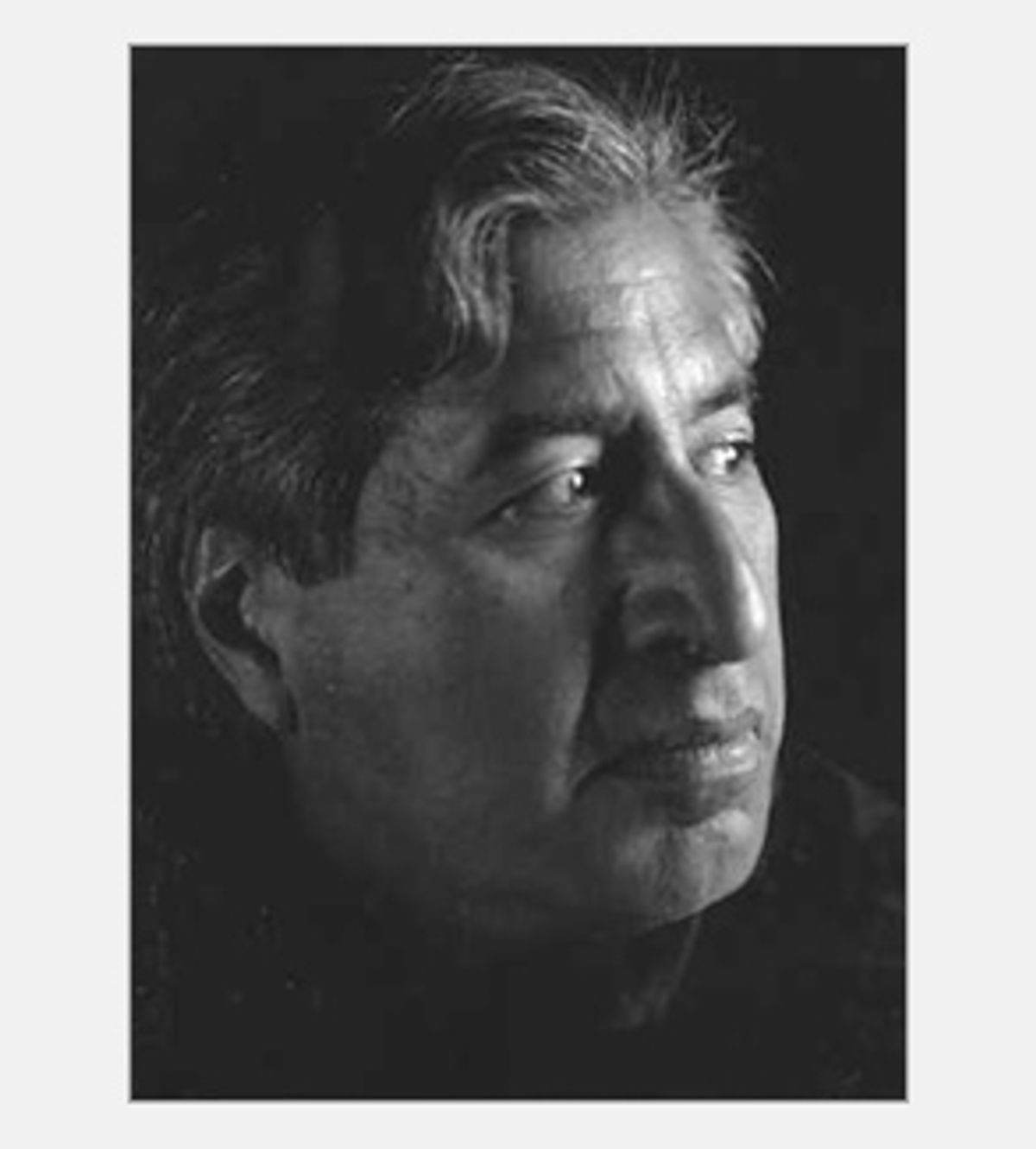
Rodriguez, whose acclaimed memoirs “Hunger for Memory” and “Days of Obligation” are the first two installments in his “trilogy on American public life,” spoke to Salon from his home in San Francisco.

Most people might take a look at this book and think you’re talking about pigment.

Yes. And Latinos.

But you’re talking about “brown” ideas. Can you explain that?

What interests me about the color brown is that it is a color produced by so many colors. It is a fine mess of a color. Initially, I had a sense that most Americans probably regard Hispanics as brown. But my interest was not in the Hispanic part of that observation but in the brown part of it — what is brown? And it seemed to me that the larger questions about America that the color raised is the fact that we are, all of us, in our various colors, our various hues, melting into each other and creating a brown nation. I tried to write a brown book, that is, brownly, by engaging contradiction and paradox, and rhetorical devices that suggest the way that I experience my own life. That is, for example, as the descendent of a conquistador and the Indian — as a Hispanic.

Is that what Hispanic means to you?

I love that word “Hispanic” because it introduces a paradox that I live with: I live in an English-speaking world but as a descendent of the Spanish empire. And as a gay Catholic. All these brown facts of my life, I’ve tried to record in some way, rhetorically, through a brown style.

You mention this tension of being two seemingly contradictory things — gay and Catholic — as well as Hispanic. What does this ultimately do for your American identity?

It could lead to a quandary and to a sense of deep confusion. At some level, especially after Sept. 11 when the book was nearly complete, I did have the sense that brown might become a very dangerous color in the future. Osama bin Laden is a brown man in the way that I was trying to describe, not simply in his pigment. He was raised a cosmopolite. There he is in Vanity Fair at the age of 14 with his extended family, standing in front of the Beau-Rivage Hotel in Geneva, speaking French, smiling for the camera. And then two years later we learn that he doesn’t want to be that, he wants to be only one thing, in a cave with other men who are exactly like themselves. There are indications throughout the world and in this country too that there are people who will react against their brownness by denying it and by trying to make the crooked line straight within themselves. For that reason, it could be a dangerous time.

But for me, the creativity of the moment is exactly announced by the woman who writes to me and tells me that she is the daughter of a New York Jew and an Iranian Muslim. That there are Jewish Muslims in America strikes me as a very interesting thing and potentially very creative. We’re already tasting that on our plate — Chinese Italian food at some chic SoHo restaurant. But what we are only tasting, we have yet to announce in any formulated way. A woman tells me that she’s Korean-African, and then she tells me that’s not even the half of it, she’s a Baptist Buddhist. I tell that to a theologian friend of mine in Seattle and he says that’s impossible. And I said, “But she walks, she exists, and somehow we have yet to hear from her.”

And so is that why you say that the ability to talk about miscegenation is such a freedom, or so important?

In America, we have never been candid about the force of eroticism in our history. Maybe because our whole endeavor was individualistic and not communal. Latin America, by comparison, for all of its races — racism in some ways is more intense there than I’ve experienced in America — has always had a vocabulary for the various possibilities that exist when people meet and create children that have never existed before. But in the United States, Halle Berry wins the Academy Award and we’re not able to say, to this day, that she is a mulatto, which Latin Americans would say quite plainly. There is this reticence and when someone breaks out of that, like Tiger Woods, for example, there is this sense that he is trying to deny or avoid something. The Latinization of the United States, which is proceeding, is going to come in this way — toward a more playful and vivid notion of brown.

But all this resistance goes back to the one-drop-of-blood rule of racial identity, doesn’t it?

Yes, the great scar and great guilt of America was slavery. The profound struggle of African-Americans to overcome the original sin of this country was always written within this black-and-white dialectic. Obviously, the one-drop theory was a part of this — who was an African-American? — in a country where people were beginning to melt. The absurd Jim Crow notion that if you had one drop of African blood you were black — what that did for those of us who were not African, but were brown, was very peculiar.

What do you mean?

The whole experience of growing up brown in this country, where one felt this incredible sense of irrelevance. That little ditty that I used to hear as a boy — “If you’re white, you’re all right, if you’re black, stand back, if you’re brown, stick around” — at once you were completely free because you were outside the main conversation of America, but you were also irrelevant to it.

I remember playing with my cousin, whose father was from India and mother was from Mexico, about what she was. We decided one day — we were children — that she was an Indian Indian. That was the beginning of my knowledge that there weren’t names for what was coming, this new brown meltdown.

And when you were young, you looked to black writers for a sense of identity. Or what were you looking for?

Fundamentally, I was looking for an understanding of myself, but as an American, which is to say I was looking for the most profound story of America. It seemed to me that within the struggle of African-Americans to secure their full freedom in this country, every one of us was implicated. I know some people have found it odd that at an early age I was preoccupied by not Mexican writers, but with the struggle of African-Americans. But there it was. It was the great story of my generation.

Ultimately, it implicated me because the strategies for alleviating the effects of anti-black racism in this country — namely, affirmative action — were extended to people who were not black and to me, a so-called Hispanic, in the 1970s. I became a beneficiary of all that, of all that suffering, of all the demonstrations, of the water hoses and of the bulldogs, and the violence of those years and the determination of a people to stand straight. I, brown Richard Rodriguez, son of Latin America, became the beneficiary of all that, which is the irony of my life.

And obviously you’ve had a problem with this for some time.

I left the university over the issue of affirmative action and I’ve always felt deeply ambivalent about that because I don’t qualify in any way as someone who was the primary victim of racial discrimination in this country.

How do you mean?

I wasn’t. I had a very light-skinned father who looked more European than not. My mother is more Indian-looking. But at a very early age in Sacramento when the family became middle class, we were invited not to be Mexican. The neighbors would start insisting to us that we were Spanish. My mother would always say, “No, no, we’re Mexican.” But in many ways it was clear to us that we were given a way out. In no sense was I held back by discrimination. I just wasn’t.

So why do you believe that it’s irresponsible for the federal government and the media to keep saying that Hispanics are replacing blacks as the largest minority in America?

It’s not only irresponsible. It’s outrageous. It seems to me that we do not replace African-Americans. I owe my existence to African-Americans. I mean that literally. I owe the fact that I have this voice, this determination and this confidence in America to their story, to their lives, to their voices. There is no one who speaks American English who is not indebted to the cadence of their voices. The notion that I replace them is ludicrous. And the notion that one group, which is based on ethnicity, Hispanics, replaces a group that is based on blood or race, African-Americans, is really oranges and apples. It is profoundly disturbing to me that we so misunderstand A) the long heritage of African-Americans and B) the ultimate significance of Spanish in this country, which will be not racial but ethnic.

Is this because we look at groups simply in terms of numbers and population without being sensitive to what “minority” implies?

Yes, that’s exactly right. We’ve only used the term “minority” in a numerical way. I become a minority when I get a job at a newspaper because I am numerically underrepresented, but no one ever asks whether I’m a minority culturally, that is, do I see myself or do I feel myself culturally to be in a minority within the society that I live in? That difference made it possible for middle-class nonwhites in this country to advance as minorities numerically, when they were not cultural minorities. It really fudged the issue; not only did the middle class advance on the backs of the poor, but also we’ve allowed ourselves to ignore the situation of poor whites because they are not numerical minorities. They are in some sense represented in the New York Times or in the White House, but I keep saying to people, “In what ways are Appalachian whites represented in the New York Times?”

How can we avoid this, though? You acknowledge that race is at the center of everything in America. You want to move beyond race entirely then?

Oh yes, I intend to undermine race with this book.

Is that possible? Or are we already in the process of doing that?

Well, here we are, 36 million Americans who describe ourselves outside of a racial category. We describe ourselves as Hispanic or Latinos. That is not a race. When my mother watches Spanish-language television like Telemundo, she watches a show called “Cristina.” There’s this blond woman Cristina in Miami with her audience and we see there are blacks in the audience and whites in the audience and brown people of various mixtures in the audience. And my mother says, “Son Latinos” ["They are Latinos"]. She doesn’t say, “Oh there’s a black man and there’s a white woman.” By virtue of the culture — which is to say the language in this case — she identifies them as all belonging to this term called “Latino” or “Hispanic.” That is radical. And no one has really understood the effect that has on so many people. Sammy Sosa is as legitimately Hispanic as Madonna’s daughter, and in that sense we are undermining the whole notion of race in America.

In “Brown,” you say that, historically, whites define themselves against their perception of black identity. How do whites define themselves in relationship to the idea of the Indian, or a brown person?

It seems to me that whiteness became a kind of freedom, and a kind of emptiness too. A woman called me yesterday when I was on a talk radio show — she lived in Canada and now lives in the United States — and she said when she was in Canada, she had an identity. She was Irish, Danish. Now she’s come to the United States and she’s only white. She has no identity. She’s a blank slate. And I told her that that’s a kind of freedom. What I hope for African-Americans, as indeed for myself, is the white freedom to play black music, or to eat Mexican food, or to leave one’s ancestry behind in New Jersey, to do whatever you want in America. Blacks never had that kind of freedom and it seemed to me there was always this restriction of the black that has now become in some sense self-imposed.

I was just going to bring that up. That’s quite a barrier to moving beyond race.

Yes, African-Americans, for example, criticize each other for straying too far from what is acceptable. I’ve heard teenagers do this to each other — “You’re talking white.”

As far as the Indian … it seems that within that original triad, the Indian represented the elusive figure for the so-called white. The figure of wildness. Appropriately so, when the mythology also assumed that the Indian was dead and, therefore, in some sense, the white men replaced him. Forget the fact that Indians are very much alive in this country and that a lot of them are coming from Latin America speaking Spanish. But within that mythology there was a sense that to be part Indian — even Bill Clinton claims to be one-sixth Indian — was never the same problem, rhetorically, that being part African would have been. The connection to the land and entitlement to one’s place in America … the Indian really had a different station within the whole romance of America. To belong to that was to claim some part of the land.

How do you see blacks and browns interacting with each other in this triad?

We’re in furious competition. For example, in Los Angeles, these demographic changes have created enormous dislocation for African-Americans. All the black neighborhoods in Los Angeles — Watts, South Central — these are all suddenly becoming Spanish-speaking and Hispanic. You saw in the recent election in Los Angeles a very reputable Mexican-American candidate who was just narrowly defeated, largely because the African-American population voted against him. And they voted against him, in part, because there was all this drumbeat in Los Angeles about how Latinos are the sleeping giant, waking up and taking over the city. It was incumbent on African-Americans to say, you know, we are still here. We matter. We are not being replaced. There’s a lot of tension of that sort in this country. Liberals don’t like to talk about it because it doesn’t fit into their notion of the happy rainbow.

Incidentally, there was a riot in Riverside County a few years ago between Hispanic students and black students at a high school. Hispanic students were protesting the fact that Latinos only get one week for history week, and African-Americans get a whole month. Obviously, Hispanics need more history lessons because not to realize that they are already part of African-Americans’ history is to misunderstand the meaning of their own Hispanicism. These are not separate groups. We are African. It is part of what it means to be Hispanic.

What sort of books do you think young Hispanics will look to? Will they seek African-American authors for ideas about identity? Or only Hispanic authors?

Certainly anyone coming of age in later years tended to be compartmentalized, as I am indeed compartmentalized on bookstore shelves as a separate department altogether. And the very writers who created me are in their own little department. They’re on another side of the bookstore. That’s what I resent so deeply, the turning of literature into sociology.

How does this miss the point of literature? What is the point?

To connect you to lives to which you do not belong. The notion that all literature is a kind of membership club that mirrors your face or your sexual orientation or your handicap is an absurdity. I gave a reading at the University of Arizona and the lesbians are waiting for the lesbian poet and the Mexican-Americans come to my reading and never the twain shall meet. It is so antithetical to everything that I loved about literature.

I read in the Washington Post that you’ve stopped reading fiction. Why?

There were suddenly a lot of unfinished novels around my bedroom. Maybe 10 years ago or so. I just lost an interest in narrative. I still don’t understand exactly what that is but in some sense as I developed as an essayist, nonfiction seems to me more urgent, more interesting as a reader, as well as a writer. For example, when there are writers who write both fiction and essays, I tend to prefer their essays. James Baldwin, for example. None of James Baldwin’s novels, with the possible exception of “Giovanni’s Room,” are as interesting to me as his essays. Or Joan Didion. I just can’t finish her fiction, whereas her essays are absolutely wonderful. I always yearn to sit next to Joan Didion the essayist at dinner parties in Santa Monica or on the Upper East Side, but I always end up sitting next to the Joan Didion novel-heroine, who instead, has just had a nervous breakdown.

Does this have to do with something about contemporary fiction in particular?

No, because it’s as true about 19th century [novels]. It’s something to do with the clanking of narrative. I could hear the devices clanking away. I just knew, “Oh God, now I have to be here for 300 pages of this.” And it was also that I belong to an age where we have almost too much narrative. There are too many stories; what we are interested in is what the story means. Which is why in our graduate schools of literature, no one reads novels. They only read critical theory. All of my friends who are in analysis have plenty of stories to tell, but they have to hire somebody to tell them what the story means. There’s that movement to try to deconstruct or decode or make sense of narrative. And in that sense, I think the essay is very much alive because the essay really engages the history of an idea. Within the essay, I dramatize how I come to know something. It becomes a kind of intellectual diary.

Let’s move to Richard Nixon. I was surprised, as I’m sure many people were, to read that you identified with him. Was that it, though? You identified with him?

Yes. I love Richard Nixon. What I knew that night when I was watching him sweat on that first televised debate was that Whittier College [Nixon] would always be defeated by Harvard College [JFK]. That the game was fixed in America. And I knew that in the same years that I was going to professional wrestling matches — that the whole thing was fixed. Columbia University and the New York Times are all in cahoots — the whole game is fixed. Kennedy wins the Pulitzer Prize for a book that he may or may not have written and there’s nothing to be done about it.

There were always those nights in Sacramento at the wrestling matches, when I used to go by myself in my Boy Scout uniform, and the crowd would move its affection away from the hero because we sensed at that moment that he was the villain. He was the liar because the game was fixed, but he always pretended to be virtuous. Whereas Gorgeous George, the bleached blond villain, was in fact telling us something true about himself — that the game was fixed.

There was something about Nixon, his insecurity, his ruthlessness and his crudeness that always struck me as true in the same way, in a way that the Kennedys never satisfied me. They always seemed, in their noblesse oblige, to be spooky people.

Then, Richard Nixon becomes my godfather and teaches me how to cheat in America by playing at being Hispanic. Richard Nixon the Californian — perhaps wanting to undercut the black civil rights movement, but nonetheless begins to describe America in color, as white, black, Asian/Pacific Islander/yellow, American Indian/Eskimo/red and Hispanic/ brown. It is under Richard Nixon’s administration that the whole spectrum now exists. After Nixon, it becomes easier for people to say that you have an ethnicity, you are Hispanic, you are Latino.

I thought you were against those classifications, though.

I disagree with it, but in its acknowledgement that we do not live in a 1950s television world of black and white, it seemed to me that Nixon was saying something important. In actual fact, though, I consider myself brown — of all colors. Brown is not a singular color; it is the metaphor of impurity. By saying that I’m brown I’m saying that I’m Chinese, that I’m Irish, and I have to mean that I’m African.

Did Nixon also have that impact on you because it touched on your sense of the importance of class rather than race?

I was moved by Nixon’s story. And Benjamin Franklin was very important for the encouragement he gave me to strive and to strive and to succeed. That basic American narrative I got from Franklin. But it was Nixon’s conniving and dark eyes that also told me about the scheming that goes on in America. And his willingness to betray his own memory of himself by anointing me Hispanic was part of the seaminess of the whole story. It’s a very complicated affection I have for Nixon. That chapter is probably my favorite. I weep when I come to the end of it. It’s so sad. It’s sad the way that “Citizen Kane” is sad. There’s a dark story in America. Nixon comes very close to telling it for me.

Toni Morrison said that Clinton was our first black president and most people took that as a tongue-in-cheek statement. You write that Bush is the first Hispanic president. What do you mean?

Texas is the first state that seems to be on a north-south axis in a way that New York isn’t. Certainly the intellectual-literary New York that I visit is so preoccupied by London so as to be almost an embarrassment. Maybe the advantage Bush had of growing up in Midland and maybe because the long acrimony between the Mexican and the Texan had such a deep influence on the way Texans understand themselves … in Texas, there is always the sense of the South and the North and the inevitability of that. And I think when George Bush comes up with solutions to our energy crisis that engage Arctic wilderness areas and Mexican oil fields, it’s inevitable for him to think that way. Most other Americans still think on an East-West map.

And I really do think that he has a kind of physical ease of a sort that Clinton had with black audiences. I’ve seen Bush with Hispanic audiences, especially when he’s allowed or allows himself to speak high school Spanish. There’s just this kind of physical pleasure that he has with it. And it’s true. It doesn’t seem to me fake; it seems to me a true joy that he has.

You say that Americans care more about their future than their past and you seem to feel that this is a good thing. But don’t you think that Americans’ inadequate knowledge of their own history is a problem?

Certainly, I speak as a son of immigrants, but that was also a great joy in America that my father did not dwell on Mexico, that we didn’t have to look back and that I didn’t have to become my father. My father made false teeth for a living, that’s what he did. I knew as early as I began to speak American English that that would not be my destiny, that I did not have to have this past, that the whole point of this country was culture and I could move into a new culture. Culture gap. Culture shock. The whole notion that you could change your life that way was really quite amazing to me as a child, which is why I turned to Franklin. He was the son of a man who made candles and the family was large and had no money to send him to school. He was apprenticed at a young age and it broke my heart because that wasn’t what I wanted from Franklin. I wanted the reassurance of his success. A country that had no past meant that you didn’t have to be mired in memory of grandmothers. It was free.

But still people of different backgrounds seem to look for or hold onto some sense of authenticity, which implies that they’re looking for something in the past.

You may be onto something really important. This lack of a sense of history has allowed us a kind of romance with race and ethnicity that is fanciful. I did a documentary some years ago about America and teenagers and the past and all these kids who were announcing themselves as wanting to recover their history, as though it was some reassurance, when everything I’ve ever read about American history is an embarrassment. It’s filled with tragedies of all kinds. The notion that we would study history in order to feel better about ourselves is just ludicrous. But we have this romantic sense because we know it so little, our past really seems noble.

I don’t look to Aztec Mexico for any reassurance about my identity. I’m aware that Aztec Mexico was a decadent society; its bloodlust was so extreme that its ultimate sexual energy was its pursuit of death. There’s nothing in that history for me that leads me to the romantic calendars that you see in Mexican restaurants with the Aztec, almost naked with the feathers coming out of his head, and the Aztec princess at his knees. Nothing of that is convincing to me. History is a terrible, terrible burden which we need to confront, but I don’t think the search for authenticity begins there. In many ways, that’s a false romance that Americans are engaged in — by seeing themselves as black or white or Scottish or Mexican through this search for authenticity.

In the end, you have an optimistic outlook for this browning of America.

In many ways, I do, yes. “Brown” has allowed me to reconcile myself to myself, that is, to allow for the unevenness of my life, to allow for its contradictions, to not have to figure everything out in my life, to see it as whole rather than as partial. Maybe this is some wisdom of middle age too, but I realize now that life is uneven, that I will always be Catholic as inevitably as I will always be a homosexual, that I will always be at odds with my identity, that I will always belong in some odd way to Latin America and that I will always belong to this other place, this country that is not at all like Latin America. That I will have all of those identities and that I will live with them in a brown way. For a man who has struggled with this and has sort of turned his life into an odd exercise in self-laceration, it comes with some great peace, almost as though I don’t need to write anymore.

It’s interesting because you write that our sexual history had so much to do with the violence of our history — meaning miscegenation and so forth — and then in the end, you’re saying that our sexual future might have a lot to do with reconciliation.

Oh, yes. My advantage as this gay little boy was to always know that the most dangerous thing I could say was “I love you.” What I learned from that repression was to notice just how often it occurs in history and to always look for it, especially where it was never announced.

There’s a woman who shows up at my family Christmas every year, this blond lady who comes with all my relatives from India. I keep bothering my mother, “Who is she?” and my mother says, “Why do you keep asking about her? She’s married to your uncle’s nephew. She met him at Berkeley when they were law students. That’s who she is. What do you want to know?”

What I want to know is how did she come to be here? Where does eroticism take us? Where does desire take us? Well, it takes us to this brown Christmas with Dr. Gupta singing Hindu hymns over the turkey and my mother with her American English accented by Spanish. What I realize now was that that woman’s blondness was not an exception to our brownness but was deepening our brownness, was darkening our brownness. Her very blondness was making our brownness deeper and richer.

Suzy Hansen, a former editor at Salon, is an editor at the New York Observer.

Stop-and-frisk, eviscerated

A U.S. district judge exposes the NYPD's harassment strategy as racist, unconstitutional

  • more
    • All Share Services

Stop-and-frisk, eviscerated (Credit: Reuters/Carlo Allegri)
This article originally appeared on AlterNet.

AlterNetThis month, a federal judge in New York dealt a blow to “stop-and-frisk,” a policy that resulted in 685,000 recorded police stops in 2011. Eighty-five percent of those stopped were African American and Latino, mostly youths.

U.S. district judge Shira Scheindlin granted class-action certification to a stop-and-frisk lawsuit against the city of New York, Police Commissioner Raymond Kelly, and Mayor Michael Bloomberg. The plaintiffs allege that the NYPD’s stop-and-frisk policy regularly violates the Constitution by illegally stopping and searching scores of people belonging to a particular demographic — black and Latino. Pending the city’s appeal, the class-action ruling will put stop-and-frisk on trial.

Plaintiffs in Floyd et al. vs City of New York also argue that they were stopped by police who did not have the legally necessary “reasonable suspicion” that they had committed or were going to commit a crime. What’s more, the suit alleges, police often performed frisks, but not because they saw a bulge they suspected to be a weapon, another legal requirement.

In her written decision, Scheindlin said the alleged constitutional violations result not from the actions of rogue officers, but from a policy handed down from the very top. “The stop-and-frisk program is centralized and hierarchical,” said Scheindlin. “Those stops were made pursuant to a policy that is designed, implemented and monitored by the NYPD’s administration.”

Scheindlin’s ruling cites “overwhelming evidence” — a spike in stop-and-frisks and the NYPD’s own words — indicating that at the “highest levels of the department” police are enforcing a policy that leaves behind a trail of daily injustices.

For years, Mayor Bloomberg and Police Commissioner Kelly have used distortions and misinformation to promote and justify a policy that violates the constitutional rights of those who were stopped. Now, the Scheindlin findings have exposed the NYPD game for what it is, an illegal system of quotas and racial profiling imposed on field police from the top of the NYPD.

“Suspicionless stops should never occur,” Scheindlin wrote in her decision, adding that, “Defendants’ cavalier attitude towards the prospect of a ‘widespread practice of suspicionless stops’ displays a deeply troubling apathy towards New Yorkers’ most fundamental constitutional rights.” Stop-and-frisk, which the data shows is a form of racial profiling, violates not only the Fourth Amendment — protection from unreasonable searches — but also the 14th Amendment, which includes the equal protection clause, the plaintiffs charge.

The Scheindlin decision was informative and comprehensive, including a number of important facts and observations. Here are eight important points from the decision.

1. Soaring numbers. The rate of stops has grown exponentially under the Bloomberg administration. Scheindlin’s ruling notes that police conducted 2.8 million documented stops of people between 2004 and 2009, about half of whom were frisked. In contrast, in 1998, Scheindlin explains, NYPD officers made roughly 150,000 stops per year. In 2004 alone, officers recorded more than 313,000 stops, “and since then the number has increased every year except 2007, rising to over 684,000 in 2011.” Scheindlin cites the large increase as evidence of a centralized policy change.

2. No reasonable suspicion. Reasonable suspicion that a person is involved in a crime is necessary for a legal stop. Eighty-eight percent of those stopped, however, are not charged with any crime. As Scheindlin noted, the data shows that “according to their own records and judgment, officers’ ‘suspicions’ were wrong nearly nine times out of ten.”

3. Imaginary bulges. Officers’ suspicions were similarly unsubstantiated when reportedly searching for guns. A “suspicious bulge” was cited as a reason for about 10 percent of all stops, but guns were seized in less than 1 percent. “For every 69 stops that police officers justified specifically on the basis of a suspicious bulge, they found one gun,” the decision notes.

4. Stops for no reason. The absence of a legally necessary, interpretable “suspected crime” cited on official forms grew from 1.1 percent in 2004 to 35.9 percent (more than 200,000 reported stops) in 2009. During those years, “Overall, in more than half a million documented stops — 18.4 percent of the total — officers listed no coherent suspected crime,” Scheindlin wrote, meaning they either ignored the section altogether or did not cite suspected behavior that is indeed illegal.

5. Unlawful stops. Scheindlin writes, “According to their own explanations for their actions, NYPD officers conducted at least 170,000 unlawful stops between 2004 and 2009.” Stops based on nothing more than “furtive movement” or a “high-crime area” were the justifications of at least 100,000 stops, but as Scheindlin says, are illegal due to the Fourth Amendment law protecting Americans from unreasonable search.

6. Racial profiling. The NYPD’s stop-and-frisk program targets blacks and Latinos because of their skin color. Scheindlin admitted the testimony of Columbia University professor Jeffrey Fagan, who found that police stopped blacks and Latinos far more than white residents. Isolated from other factors like crime rates and neighborhood racial composition, racial disparity from racial targeting was statistically significant, strongly underscoring that skin color is the essential factor in determining who gets stopped and throwing weight behind allegations of 14th Amendment violations. Fagan’s research also found that “the search for weapons is (a) unrelated to crime, (b) takes place primarily where weapons offenses are less frequent than other crimes, and (c) is targeted at places where the black and Hispanic populations are highest.” Cops are more likely to list no suspected crime category, or what Scheindlin called “an incoherent one,” like “furtive movements,” when stopping blacks and Latinos than when stopping whites. They also are more likely to use force against people of color.

7. NYPD illegal quotas. Scheindlin links the rising number of stops and the targeting of black and Latinos to NYPD quotas and to Commissioner Kelly’s own admission that the NYPD has a quota policy, albeit disguised. In a recent operations order, Commissioner Kelly explained departmental policy under the euphemism “performance goal.” Kelly said in the order, “Department managers can and must set performance goals,” for “the issuance of summonses, the stopping and questioning of suspicious individuals, and the arrests of criminals.”

The order also explains a weekly review during which a sergeant compares each officer’s monthly “activity” with the “daily assignment,” whereby police who “do not demonstrate activities” — or keep their numbers up — “will be evaluated accordingly and their assignments re-assessed.” In other words, there will be consequences for officers who don’t meet quotas, even though New York labor law says penalizing cops for failing to meet quotas is illegal.

Former NYPD officers turned whistleblowers Adhyl Polanco and Adrian Schoolcraft have collected evidence documenting NYPD quotas in practice. From 2008 to 2009, Polanco, from the 41st Precinct, and Schoolcraft, from the 81st, recorded roll calls revealing supervisors’ and other high-ranking officers’ enforcement of quotas. In Scheindlin’s own words, Schoolcraft’s audio files expose supervisors “repeatedly telling officers to conduct unlawful stops and arrests and explaining that the instructions for higher performance numbers are coming down the chain of command.”

Similarly, Polanco testified that “his commanding officers announced specific quotas for arrests and summons (quotas that rose dramatically between early 2008 and 2009) and for UF-250s” (a term for the forms used in stops), said Scheindlin, “and threatened overtime and undesirable assignments for those who failed to meet them.”

8. Repeat performances. According to the NYCLU, in 2011 the NYPD stopped more young, black men than live in New York; that is, some individuals are stopped and frisked repeatedly. To protect their rights, plaintiffs are seeking “systemic relief” — an end to the unconstitutional practice of stop-and-frisk.

Kristen Gwynne covers drugs at AlterNet. She graduated from New York University with a degree in journalism and psychology.

Continue Reading Close

The future of whiteness

Both Republican and Democratic racial politics are doomed. How culture shifts will reshape American ideas on race

  • more
    • All Share Services

The future of whiteness

The Census Bureau has announced that a majority of new-born infants in the U.S. now belong to categories other than what the U.S. federal government calls “non-Hispanic white.”

While so-called “non-Hispanic whites” still account for 49.6 percent of American newborns, immigration has expanded the Hispanic and Asian categories, while the African-American or black share of the U.S. population has remained roughly constant. Whether they celebrate or dread it, progressive champions of the “rainbow coalition” and white conservative nativists at least agree on one fact: In the future, whites in the U.S. will be a minority.

But what if both the multicultural left and the nativist right are wrong? Definitions of racial identity in the U.S. have changed over time. In the twentieth century, Americans with different degrees of African ancestry who in earlier generations would have been described as negroes, quadroons and octoroons were all lumped together in a single category as blacks. And in the nineteenth century, eminent American ethnologists debated the question of whether Irish-Americans belonged to the same race as Anglo-Americans.

In the 1970s, the federal government came up with the bizarre “non-Hispanic white” label, lumping together Arab-Americans, Norwegian-Americans and Irish-Americans into a single government-created pseudo-race. To compound the absurdity, at the same time the federal government invented a category of “Hispanics” who, as government forms invariably note, “may be of any race.” The artificial “Hispanic” category is even more preposterous than the “non-Hispanic white” category, including blond, blue-eyed South Americans of German descent as well as Mexican-American mestizos and Puerto Ricans of predominantly African descent.

These government racial labels are increasingly out of touch with America’s fluid demographic reality. But for the sake of argument, let us take America’s official racial classifications, all too reminiscent of Soviet nationality labels, at face value. According to polls, a slight majority of Hispanics (or Latinos) identify themselves as “white.” Between 2000 and 2010, the percentage of government-labeled Hispanics who identified as “other race” dropped in percentage from 42 to 37 while those who identified as white rose from 48 to 53 percent.

If self-described “white” Hispanics are annexed to the “non-Hispanic white” group in order to form a single category of “whites” (Hispanic and non-Hispanic), then the emergence of a “nonwhite” majority in the U.S. is postponed by generations and perhaps indefinitely.

What is more, by the third generation, a majority of Hispanics marry outside of their ethnic group, mostly but not exclusively into the non-Hispanic white population. It is possible that their children will identify themselves as “mixed race” or “other race” — categories for self-labeling that have been allowed in recent Census counts. But it is more likely that the unscientific but powerful cultural category of “whiteness” will be enlarged to include Hispanics and Asians and their children as “non-Hispanic whites.”

In a widely-reprinted 1998 article for the New York Times Magazine, “The Beige and the Black,” I pointed out that America’s nonrational caste system has been binary: not white/nonwhite, but black/nonblack. Because “white” really means “nonblack,” the arbitrary white category is infinitely elastic, capable of being enlarged to include practically anybody who is not clearly of black African descent. While Hispanics and Asians have suffered from vicious bigotry in American history, anti-black prejudice has always been the organizing principle of caste in American culture.

As I wrote 14 years ago:

In the 21st century, then, the U.S. population is not likely to be crisply divided among whites, blacks, Hispanics, Asians and American Indians. Nor is it likely to be split two ways, between whites and nonwhites. Rather, we are most likely to see something more complicated: a white-Asian-Hispanic melting-pot majority — a hard-to-differentiate group of beige Americans — offset by a minority consisting of blacks who have been left out of the melting pot once again.

(This is a prediction on my part, not a prescription. Rather than witness the redefinition of whiteness, from Anglo-American to Euro-American to Euro-Latino-Asian American, I would rather live to see a truly post-racist America in which caste is completely expunged from culture and consciousness. But I am reporting trends, not creating them; please don’t shoot the messenger.)

If this analysis is right, then present-day Republican racial politics is doomed — and so is Democratic racial politics.

Today’s Republican right seems intent on treating the ridiculous government category of “non-Hispanic white” as though it represented a core community of  “real Americans,” excluding black Americans and protected from demographic inundation by Hispanics, or “Third World hordes” as the gentlemanly Patrick Buchanan politely calls our fellow citizens of Latin American descent. Quite apart from betraying its roots in the Republicanism of Lincoln and the abolitionists, a Republican Party whose image of the American nation excludes not only blacks but also Hispanics and their descendants is doomed in electoral politics.

Democrats are right about that. But progressives are wrong to imagine that a new “majority of minorities” is about to emerge and create a lasting majority for the Democrats. The success of white nativists in the GOP in driving away Hispanic voters may help the Democrats for a few more electoral cycles, but sooner or later Republican politicians who are tired of losing will challenge the neo-Confederate wing of their party and practice a more racially-inclusive politics of the kind pioneered by George W. Bush and his brother Jeb Bush, with his Hispanic wife and mixed-race children.

Nor should progressives assume that Hispanics and their mixed-race progeny will remain loyal to the Democrats for generations to come. The fact that Anglo-American nativists in the Republican Party in the early 1900s tried to keep their ancestors out of the country does not deter most working-class white “ethnics” of Irish and Italian descent in the U.S. from voting for today’s GOP. Like earlier waves of immigrants, Hispanics are likely to change in their political values as a result of assimilation and upward mobility.

What does this mean for black Americans? On the one hand, the persistence of an informal “white” majority defined in opposition to the black minority would mean further delay in the realization of a truly post-racist America.

On the other hand, black Americans made much more rapid advances during the New Deal/Civil Rights era, when the melting of European ethnic differences created an overwhelming “white” majority for a time, than they have done since mass immigration made them the second largest official “minority” in the U.S. after Hispanics. The truth is that the “rainbow coalition” strategy of uniting minorities has helped other groups more than blacks. Affirmative action in higher education, for example, while doing little to help the majority of black Americans who do not go to college, has benefited upper-middle-class white women, who are part of the white majority (and, if they are affluent, part of the social elite within the dominant group). Programs like affirmative action and minority business set-asides, originally designed to help the descendants of American slaves, lost all moral credibility when they were opened up to white women and recent Hispanic and Asian immigrants, notwithstanding the feeble “diversity” rationale that America’s white oligarchy invented to rationalize them.

It remains to be seen how changing racial conceptions shape American politics. But if demography is destiny, one thing is clear — in the long run, both the diversitarian left and the nativist right are doomed.

Continue Reading Close

Michael Lind’s new book, "Land of Promise: An Economic History of the United States", will be published in April and can be pre-ordered at Amazon.com.

“The Intouchables”: Racial comedy, French style

"The Intouchables" is the biggest foreign-language film of all time. Some critics say it's also racist

  • more
    • All Share Services

A still from "The Intouchables"

Here’s a startling news item: “The Intouchables,” a lively if largely predictable Parisian comedy about a wealthy quadriplegic and his ne’er-do-well immigrant caretaker, has become the biggest international success in the history of French cinema. Indeed, according to some sources — and these things are notoriously difficult to measure on a global and historical scale — “The Intouchables” is now the biggest non-Anglophone film of all time, with a worldwide gross approaching $300 million.

But beyond the business headlines, what’s really fascinating about “The Intouchables” is the way it exposes the gulf in racial attitudes between France and the United States, along with another gulf that’s just as wide, the one that has film critics and cinephiles on one side and popular audiences on the other. Viewers in numerous countries have eagerly devoured this feel-good fable about two men of different races and classes who forge an improbable friendship (dubbed by some wags “Driving Monsieur Daisy”). While the audience for foreign-language film is inherently limited in America, there’s no reason to believe it won’t do well here also. At the same time, heated transatlantic debate has erupted over whether “The Intouchables” traffics in offensive racial stereotypes, with Variety critic Jay Weissberg writing an uncharacteristically angry review that accused the film of “Uncle Tom racism” and compared the Senegalese caretaker character to a “performing monkey.”

When Harvey Weinstein first acquired “The Intouchables” in the wake of its smash success in France, he clearly imagined another dark-horse Oscar contender, in the wake of “The Artist.” The film has racked up audience awards at film festival after film festival, and currently stands at No. 93 on IMDb’s user-generated “Top 250″ list. Omar Sy, the charismatic Afro-French actor who plays Driss, the caretaker, won this year’s César award (the French Oscar equivalent) for best actor, beating out actual Oscar winner Jean Dujardin. But with the looming possibility that “The Intouchables” could spark a divisive, soul-searching racial debate — which was precisely what squelched the Oscar hopes of “The Help” — those expectations have been downplayed. (That isn’t why “The Intouchables” is being released this week, with Weinstein and most of the film-biz aristocracy in Cannes, but the coincidence is oddly useful.)

Let me come clean right now and tell you that I enjoyed “The Intouchables” quite a bit. If you’re looking for a lightweight summer change of pace, with just a smidgen of Continental flair, here it is. Both Sy and co-star François Cluzet (of the hit thriller “Tell No One”) are marvelous, the former playing a guy who’s constantly in motion, both physically and psychologically, and the latter playing a depressed and repressed guy who literally can’t move, but whose real imprisonment has more to do with his spirit than his spinal cord. Don’t go expecting serious French art cinema, please; those who have described this movie as something like a mid-’80s Eddie Murphy comedy dressed up with classy Parisian settings are correct. But here’s the question, and I can’t answer it for you: Is that such a bad thing, in itself?

Once is not enough for a movie that’s made this much money, of course, and Weinstein already has an American remake in the works, possibly to star Colin Firth as stick-up-butt wheelchair dude. The real Eddie Murphy has gotten too old to play the loosey-goosey, pot-smoking sidekick, but there’s no shortage of guys who could do it: Jamie Foxx is the default setting these days, but I’d go for the suddenly hot Kevin Hart from “Think Like a Man.” I’m not claiming it’s aesthetically or sociologically valid to remake a French movie that already feels like a reheated Hollywood throwback, by the way. I’m saying it’s a cruel reality, like Dutch elm disease or Adam Sandler, and there’s no way to stop it.

To get back to the case at hand, I do understand what the haters find so offensive about “The Intouchables.” (The infelicitous English title, by the way, reflects the fact that they couldn’t really get away with calling it “The Untouchables,” could they?) I was pretty taken aback by Weissberg’s vituperative review, and I tend to believe that “Uncle Tom” is one of those expressions that white people should pretty much never use. On the other hand, I can only applaud him for abandoning the balanced, analytical mode of trade-magazine criticism and saying exactly what he damn well thinks. (As for comparing a black man to a monkey — well, I understand what Weissberg was getting at, but it’s an error of rhetoric, the sort of comment that makes nuance and context disappear.) And I know for sure, from hearing friends and acquaintances in and around the movie business complain about this film, that Weissberg is not alone.

I believe that Olivier Nakache and Eric Toledano, the writing-directing duo who made “The Intouchables,” are innocent of any bad intentions. In fact, “innocent” isn’t a bad word overall, for this movie and the worldview it represents. The French may pride themselves on being the most worldly and sophisticated of all people, but the debate in France about race and immigration and multiculturalism — which ramped up sharply after the suburban riots of 2005 — can sometimes sound strikingly naive to American ears. Until very recently, mainstream French opinion has resisted thinking about the nation in anything except homogeneous terms, despite growing Arab and black minorities (both immigrant and native-born) and evident social problems with segregation and discrimination. (The French census, for instance, is prohibited from collecting data on race or religion, so no one really knows how many French people are black or Islamic.)

There can be no question that the characters in “The Intouchables” are stereotypes, in the broad sense. Cluzet’s character, Philippe, is an aristocratic zillionaire who lives in an astonishingly luxurious flat in central Paris. Since being injured in a paragliding accident, he’s lived inside a cocoon of money and privilege, surrounded by antiques and modern art and a bevy of assistants. Sy’s character, Driss, is easygoing, good-hearted, lustful and uncultured, and his passions run toward pretty girls, getting high and vintage American R&B. Philippe hires Driss specifically because Driss doesn’t particularly want the job — he only shows up to get a signature for his benefits card — and feels no pity for Philippe.

Which is actually a pretty good reason. You get where this is going, most likely: Driss is a pretty inept caretaker, at least at first, but is the only person Philippe knows who will relate to him man to man. There’s a bit of borderline-homophobic humor about their enforced intimacy; there are interludes with hookers and fast cars and late-night conversations fueled by booze and marijuana. Driss learns to like Mozart and modern art; Philippe learns to get down with Earth Wind & Fire and gets some valuable tips about chicks. It’s probably fair to summarize this movie as being the story of a paralyzed white man who needs the help of a younger, stronger, more virile black man to reconnect with his own masculinity, and if you want to say that narrative reflects an underlying latticework of racist attitudes, I won’t argue with you. Then there’s the complicating factor that in the real-life story on which “The Intouchables” is based, the caretaker was of Algerian origin, and hence Arab rather than black. (The filmmakers have said they wanted to cast Sy, and built the story around him, but it’s certainly possible to render other interpretations.)

But one can concede all of that while still agreeing with French historian and multicultural activist François Durpaire, who has responded to Weissberg by arguing that the huge success of “The Intouchables” is likely to have positive effects in Europe’s emerging discussion of race and culture, even if the movie relies on crude generalizations. (Durpaire adds that if “The Intouchables” is offensive, so were the “Beverly Hills Cop” movies.) Movies are not meant to be seminars in sociology, after all, and most viewers will receive “The Intouchables” as an upbeat story about two guys from vastly different circumstances who turn out to have a lot in common and help each other, etc., rather than a lesson in racial semiotics.

Perhaps the strongest endorsement for “The Intouchables” has come from aging French ultra-nationalist Jean-Marie Le Pen, who has described it as an allegory about how the future of his nation depends on disenfranchised young immigrants from the suburbs. He thinks that’s a “dreadful” vision, mind you — but, seriously, who knew that guy was so smart?

“The Intouchables” opens this week in New York and Los Angeles, with wider national release to follow.

Continue Reading Close

Can you identify?

Science shows that the only way around some readers' prejudices is to trick them

  • more
    • All Share Services

Can you identify? (Credit: Shutterstock/Salon)

The news of recent research documenting how readers identify with the main characters in stories has mostly been taken as confirmation of the value of literary role models. Lisa Libby, an assistant professor at Ohio State University and co-author of a study published in the Journal of Personality and Social Psychology, explained that subjects who read a short story in which the protagonist overcomes obstacles in order to vote were more likely to vote themselves several days later.

The suggestibility of readers isn’t news. Johann Wolfgang von Goethe’s novel of a sensitive young man destroyed by unrequited love, “The Sorrows of Young Werther,” inspired a rash of suicides by would-be Werthers in the late 1700s. Jack Kerouac has launched a thousand road trips. Still, this is part of science’s job: Running empirical tests on common knowledge — if for no other reason than because common knowledge (and common sense) is often wrong.

A far more unsettling finding is buried in this otherwise up-with-reading news item. The Ohio State researchers gave 70 heterosexual male readers stories about a college student much like themselves. In one version, the character was straight. In another, the character is described as gay early in the story. In a third version the character is gay, but this isn’t revealed until near the end. In each case, the readers’ “experience-taking” — the name these researchers have given to the act of immersing oneself in the perspective, thoughts and emotions of a story’s protagonist — was measured.

The straight readers were far more likely to take on the experience of the main character if they weren’t told until late in the story that he was different from themselves. This, too, is not so surprising. Human beings are notorious for extending more of their sympathy to people they perceive as being of their own kind. But the researchers also found that readers of the “gay-late” story showed “significantly more favorable attitudes toward homosexuals” than the other two groups of readers, and that they were less likely to attribute stereotypically gay traits, such as effeminacy, to the main character. The “gay-late” story actually reduced their biases (conscious or not) against gays, and made them more empathetic. Similar results were found when white readers were given stories about black characters to read.

What can we do with this information? If we subscribe to the idea that literature ought to improve people’s characters — and that’s the sentiment that seems to be lurking behind the study itself — then perhaps authors and publishers should be encouraged to conceal a main character’s race or sexual orientation from readers until they become invested in him or her. Who knows how much J.K. Rowling’s revelation that Albus Dumbledore is gay, announced after the publication of the final Harry Potter book, has helped to combat homophobia? (Although I confess that I find it hard to believe there were that many homophobic Potter fans in the first place.)

Absurd as this tactic may sound, many publishers are already kind of doing it — and catching hell. Although the term “whitewashing” is most often used to describe film and TV adaptations in which white actors are cast as characters who were people of color in the original book, something similar also happens with book graphics. Novels about black or Asian characters have been given cover art that features white people.

Controversies over cover-art whitewashing, and other attempts by agents, editors and publishers to downplay or even eliminate minority characters, have roiled the world of young adult literature in recent years. The author Justine Larbalestier (who is white) wrote a YA novel, “Liar,” with a black heroine in 2009, but her publisher insisted on using a photograph of a white teenager for the cover. Larbalestier took their disagreement public and the ensuing scandal persuaded the publisher to back down. Ursula K. Le Guin, a revered science-fiction and fantasy author who has often chosen dark-skinned people as her protagonists, has had to put up with seeing them depicted as white in cover art and film adaptations for decades.

Publishers argue that they’re only trying to make sure their authors’ books find the widest possible audience. What they mean is that a certain percentage of white (or straight) readers will summarily conclude a book isn’t for them if the face on the cover fails to resemble their own. Sad to say, the publishers are probably right about that. While the readers in the Ohio State study didn’t get to choose the stories they read, many of them were deciding how much to invest in the protagonist and his experiences — how much to identify — on the basis of his sexual orientation or race.

Authors, fans and observers are rightly disgusted by the practice of cover-art whitewashing. It shouldn’t have to be that way. But some commentators on the controversy seem to think that if publishers act as if race or gender or sexual orientation isn’t a factor in what many people decide to read, somehow it will simply stop being a factor. This seems unlikely. If it were so easy to rid people of their prejudices, the world would already be a much pleasanter place. It takes regular exposure to different types of people in the course of everyday life — at school and in the military, the workplace and the neighborhood — plus a whole lot of time and peer pressure to wear bias down.

Well, it takes that — and maybe the magic of storytelling? The readers in the Ohio State study did become more understanding of gay and black people after they were (let’s not put too fine a point on it) tricked into identifying with them. This type of sleight-of-hand is something only a non-visual medium like prose fiction can pull off. It can firmly lodge readers inside an imaginary person’s head without ever showing them his or her face. In Neil Gaiman’s “Anansi Boys,” for example, the narrator never explains that all the principle characters are black, and each reader will come to that realization at a different stage in the narrative. It’s Gaiman’s way of tweaking the very common readerly assumption that defaults all major characters to white unless their race is otherwise specified. (And sometimes not even then, as quite a few young fans of “The Hunger Games” demonstrated by being astonished when a supporting character, clearly described as black in the novel, was played by a black actress in the film.)

Of course, not all readers are white or straight, and the ones who aren’t deeply appreciate novels that advertise the diversity of their characters. It’s about time they got heroes and heroines who looked like them, and novels that speak to their distinctive experiences. They have been identifying with characters across the boundaries of race, gender and sexual orientation from time immemorial, and are masters of the art, but understandably they’d like to give their ninja skills a rest. Furthermore, there are also white readers who prefer variety in their fiction or are deliberately trying to correct the imbalances of the past.

Nevertheless, if you believe, as many Americans have since the days of the Puritans, that books ought to morally improve their readers, then maybe there’s a place for a little judicious whitewashing in the writing and publication of fiction. It has literally been demonstrated to change hearts and minds, at least for a while. That’s more than many consciousness-raising efforts — including righteous lectures delivered by the enlightened — can say.

Further reading

Ohio State University’s research blog on the study of the experience-taking while reading stories

The Booksmugglers blog on notable recent instances of book-cover whitewashing in YA.

Ursula K. Le Guin writes for Slate about the changes made to the race of major characters in the TV adaptation of her “Earthsea Trilogy.”

Hunger Games Tweets, a Tumblr compiling and discussing the response of some fans to the casting of a black actress as a supporting character in the film version of Suzanne Collins’ novel.

Continue Reading Close
Laura Miller

Laura Miller is a senior writer for Salon. She is the author of "The Magician's Book: A Skeptic's Adventures in Narnia" and has a Web site, magiciansbook.com.

Whitewashing, a history

From "Tiffany's" to "Khan," we look at Hollywood's illustrious tradition of casting white actors in non-white roles SLIDE SHOW

  • more
    • All Share Services

Whitewashing, a history

View the slide show

The extraordinary box office success of "The Hunger Games" has launched a heated discussion of Hollywood's peculiar habit of casting white actors in nonwhite roles. Why does this happen? We decided to turn to a very important studio chief for answers -- channeled here by comedian (and "Daily Show" correspondent) Aasif Mandvi.

All I have to say is that whitewashing has been going on since as long as Hollywood has existed — it’s a tradition — and rather than non-white people complaining about it, they should embrace it. It will make going to the movies so much easier and more fun. But there are just a few things you need to understand.

First, stop watching movies as ethnic people and start watching them as white people. There’s nothing that white people like more than seeing other white people in movies and on television. When you go to the movies with your ethnic “judgment” eyes, you miss my point. Watch as a white person, and suddenly your outrage turns to understanding and laughter.

Take a minute to walk to your limousine in my Gucci shoes, and you’ll realize that I’m just trying to make people smile. Mickey Rooney with buckteeth and a crazy accent in “Breakfast at Tiffany’s”? It’s so much funnier than finding a real Chinese actor just talking like himself. Then you’d have to get a screenwriter to actually write genuinely funny lines for that character. You get so much more comedy bang with buckteeth and a funny accent. I mean, it made me laugh. Many people, including myself, were also convinced that Charlton Heston truly was a Mexican/Native American/Egyptian/Ape who talked to God. And I think I convinced a lot of Asians that Genghis Khan really did look like John Wayne back in the ’60s. “Short Circuit” was one of my biggest hit movies and I was completely convinced that Fisher Stevens was Indian. Who knew he was a Jewish guy from New York? That accent was spot on!

My point is, I’m not the bad guy. I’m just the rich guy. When you look at it through my studio executive lens, you understand how important it is that both white people and non-white people believe that Indians, Asians, Mexicans and Arabs are truly just white people in brown makeup. I don’t like thinking that way. I just don’t have the luxury not to. I’m a businessman. White people spend more money on shit than anyone else. (Except on fast food, which is mostly blacks and Mexicans … at least that’s what I have heard. I’m a vegan.) So hey, non-Caucasians, stop buying tacos and start buying Cadillacs.

White people are also cheaper to light than dark-skinned people, and just so you know, you the moviegoer end up paying for that extra cost. Sometimes it’s just too unbelievable to cast an ethnic actor. I turned away a lovely Indian actress once who auditioned for the role of a hobbit. I mean there are no Indian hobbits. Audiences would never believe that.

Now, look: I am trying to do the right thing. America has changed and Hollywood should attempt to portray a truer depiction of the ethnic diversity that makes up this country. The fact that many television shows now hire a certain percentage of non-white actors is a step in the right direction, right? I am even prepared to make a deal with you ethnic people out there. Every time you let me cast a non-Caucasian character with a Caucasian actor, I will give you two or three non-white actors in smaller supporting roles. Why not lead roles? Because I’m trying to make a living here. I have spent a lot of time and money throughout history convincing everyone that white is normal. I have even convinced non-white people that white is better, prettier, smarter, stronger, and that only white people can truly be the heroes. Everyone has bought into it, and now you want me to just abandon all my hard work? OK, I will make an exception for some of you non-whites: If you are a hot Latina, you can be the lead. Why? Because white guys want to fuck Jennifer Lopez.

Here are a few more key elements to remember when watching a movie the way white people have been programmed to react. Laugh at the funny accents, because they are funny. Ignore the source material; I’m making movies, I don’t give a shit about staying true to your comic books. And … hold on! Why the fuck is Idris Elba playing a Norse God!?

To view a slide show of Hollywood’s egregious moments in white-washing, click on the link below — and share your own most memorable moments in the comments. (Slide show by Max Rivlin-Nadler)

View the slide show

Continue Reading Close

Aasif Mandvi is an actor and writer who appears as a correspondent on "The Daily Show with Jon Stewart." He also co wrote and stars in the film "Today's Special" and will be appearing this summer in the films "Premium Rush" and "Ruby Sparks."

Page 1 of 78 in Race