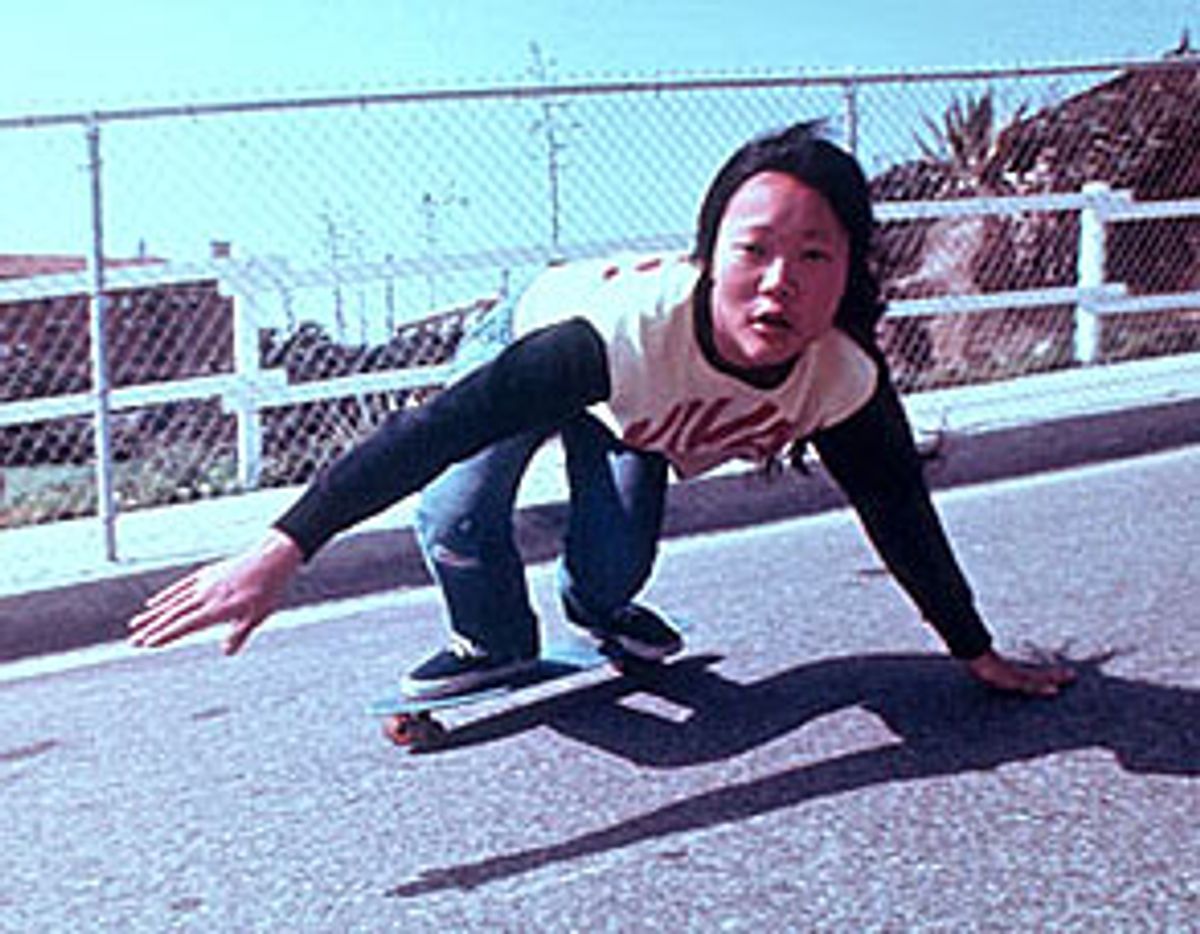
Skateboarding is something between sport and dance, and like both, if it's done well you don't need a story to appreciate it. The grace, the joy, the sheer guts are enough to communicate something about freedom, spontaneity, even youth.
All this is another way of saying that the best parts of "Dogtown and Z-Boys," a documentary by Stacy Peralta about skateboarding in the mid-'70s, are when we get to watch a bunch of scruffy teenagers roll along asphalt streets, concrete playgrounds and backyard pools. There's something so carefree about the way these kids move. Life for them is about surfing and skating, about hanging out with friends, about getting as low to the ground as possible and looking cool. Seemingly unspoiled by parents, jobs or thoughts of the future, these kids are having too much fun to even realize the cameras are watching -- or that someone is waiting to buy a piece of them.
But there are a lot of words and stories to "Dogtown and Z-Boys," and while some of them are genuinely fascinating, the majority of them never outweigh the pictures. That's not necessarily a good thing, even for a documentary with original footage as excellent as this. The film is mostly concerned with a pivotal group of skaters based in Dogtown, a seedy part of Santa Monica and Venice, Calif. Most of these kids were also surfers who hung out around Jeff Ho's Zephyr Surf Shop in the early '70s, and who, with new polyurethane wheels, flat waves and an endless supply of concrete, rescued skateboarding -- a dying pastime of the '60s -- and reintroduced it to a country of teenagers with a fluid style and an aggressive attitude.
The main point of the film is that these kids are responsible for skateboarding as we know it, a thesis that the movie backs up with archival footage, talking head interviews with the grown-up Z-Boys and lots and lots of photos. And Sean Penn, who narrates factoids with all the energy of the cafeteria worker reading the lunch menu for the school hot line. (The involvement of a celebrity like Penn -- a skater who grew up near Santa Monica -- might have helped get the film produced and distributed, but his muffled enthusiasm doesn't do much for the overall quality.)
The earliest parts of the movie set up the fierce, locals-only surf culture of Santa Monica, with its crumbling neighborhoods and a beach towered over by a decrepit abandoned amusement park, a potent image of the California dream chased to the edge of the world by the nightmare of the '70s. We don't meet specific skaters here as much as we meet skater types. Most of them were from rotten homes and lived to surf. When the waves were out they'd hang around Ho's surf shop, or grab skateboards and head for stretches of concrete -- including, notably, backyard swimming pools left empty by a long drought.
As the film explains, the kids started translating surfing moves into skateboard moves. Mostly, this meant that they made the same deep carves and cuts that surfer Larry Bertleman made in the water, got low to the ground and dragged their hands as if touching the inside of a wave. The style was inscrutable to the older skateboarders who rode rigid and upright, hanging their toes off the nose of their boards and riding wheelies. At a 1975 competition in Del Mar, the Z-Boys unleashed their radical, fuck-you street style. In that instant, the film posits, everything changed.
It feels as if every single person interviewed in the film remembers this competition. And their wistful memories give the film a bit of self-mythology -- some faded glory, some nostalgia. And, particularly from Jay Adams, the most naturally talented and financially unrewarded of the Z-Boys, there's also a whiff of melancholy, the kind that you hear from middle-aged men when they look back on a perfect moment of yesterday, a time that slipped past before anyone realized it would, a club that busted almost as soon as it came together, a second before commerce would taint everything.
That's because after the Del Mar competition, the Z-Boys split up as several other skate teams and companies poached the riders. The most talented among the skaters, including Stacy Peralta, Jay Adams and Tony Alva, helped create a skate revival that in turn made them into teenage celebrities.
Looking back, some of the Z-Boys' moves are painfully silly, and when Peralta mocks the straight, '60s skaters riding wheelies and doing handstands on their boards by contrasting them against his dirty, low-slung Z-Boys, he risks giving anyone who has seen a skater kick-flip over a fire hydrant a chance to laugh at his heroes for their now hopelessly outdated tricks. At the same time, Peralta never lets us forget that his skaters are making it up as they go, inventing new moves every time they go out for the afternoon. He also shows how much the skaters believed in style. For them, it didn't matter if you could do a trick if you didn't look good doing it.
"Dogtown" ends with Tony Alva more or less inventing the first front-side air, the move where a skater launches off the top of a pool or ramp, flies through the air and smoothly drops back in. Along with the ollie -- clicking the tail of the board to pop off the street -- it's probably the most important innovation in skateboarding since soft, polyurethane tires replaced metal wheels. It's such a fundamental at this point that you can't imagine anyone inventing it -- it's a move that always was. With the rest of the film behind it, it feels like a huge moment of discovery -- a moon landing, or at least the first basketball dunk.
That's one of the problems with "Dogtown and Z-Boys," this sense of what's at stake. Compounding that is the film's provenance and ego, because we never find out until the end that the documentary was directed by Z-Boy Stacy Peralta, even though we can hear interviewees talk to the interviewer with familiarity. And it's weird when we do find out, because Peralta essentially treats himself as a third-person character. This biography is an autobiography, and it feels a little weird to find this out -- a betrayal of that objective style.
Well, that turns out to be just the first, because there are several more betrayals in "Dogtown." One of them is that the whole film was sponsored by Vans shoes, which most of the skaters wear. We're never told this. Maybe this kind of transparent marketing is the future of filmmaking, and what you need to get a small movie like "Dogtown" produced, but documentaries are still supposed to have a commitment to truth and honesty, and if you can't be upfront in one area, you jeopardize the rest.
Here's another example: The film tells us again and again that these guys were at the root of all modern skateboarding. But the statement is a bit dishonest, really only half-true. If Tony Alva didn't pop out of that pool, someone else would have. That's not a slam on Tony Alva, or the poetry of his aggressive skating, just the myth of Tony Alva perpetuated by this movie (a myth that Alva has used to sell skateboards since his first attitude-based advertisement, admired by Peralta in the film). What the Z-Boys added to skating, definitively, was a sense of style. And what they created out of thin air, with a writer and photojournalist named Craig Stecyk, was the idea that skating is a lifestyle. (And lifestyles can be marketed: That's why the film is sponsored by Vans.)
The problem is that Peralta wants it all, and that it doesn't all add up. Today, skateboarding is about several things. It's about style, about hanging out with your friends and about getting away with something. But it's also about going big -- grinding long handrails, soaring over flights of stairs, ollie-ing from rooftop to rooftop -- and the Z-Boys were never about going big. And for at least 15 years, contemporary skating has been about inventing and executing ever-complicated tricks -- the reason why Tony Hawk is the most famous skater in the world. Again, the Z-Boys might have been inventing tricks every day they dropped into a new pool, but for the purposes of modern skating, they developed two: the Bertleman slide and that front-side air.
The thing is, it wouldn't have said anything less for the Z-Boys if Peralta's film were to admit that they didn't discover modern skating. You can still be a great, influential painter even if you didn't invent the brush. The only thing it does is make us question everything else in "Dogtown and Z-Boys." Is Peralta really telling the truth? Or is he just telling us the truth as he remembers it? Or the truth that's important today? This movie is a sun-dappled documentary about skateboarding, about the thrill of speed, the joy of reckless youth. Turning it into an academic example of the problems of history -- of who tells it and how it gets told -- is a lot less fun.
Shares