Stephen Elliott

Swimming with the online card sharks

In the world of virtual Texas hold 'em, the money is real and so is the addiction.

  • more
    • All Share Services

Swimming with the online card sharks

“Italians come to ruin most generally in three ways, women, gambling, and farming. My family chose the slowest one.”

– Pope John XXIII

I have a poker table that dominates my studio apartment in a seedy neighborhood in San Francisco. I have clay chips that were given to me as a present last Christmas. The difference between the clay chips, which go for $10 a pack, and the cheap Walgreens plastic numbers is palpable.

I grew up playing spades in state homes for wayward youth. In college I won the dorm euchre championship (we cheated, but that’s how you play euchre). My compulsive card playing reflected disastrously on my college transcripts. My friend Louie got me into blackjack laying around our squat in Chicago’s notorious Cabrini Green while the men rolled dice on the sidewalk out front. I lost my last $600 the first time I played poker in West Yellowstone on the way to see my girlfriend in Seattle. Our relationship never recovered.

Grandfather was a cardplayer. The Nazis killed off his entire family and all anybody knows of him is that he worked hard and played cards every day until he died, whittling away his final years playing pinochle for pennies down at the Levy’s center in Chicago. One time he smacked another man in the teeth over 20 cents. Old age made him cheap, but he could still smell a rat.

Now 30, I host a poker game every Tuesday night with anywhere from six to 10 participants. We play low stakes while the hookers scream on Folsom Street down below. My editor likes to come over and stay for every hand, bragging loudly that the pots are too small to merit taking, the bets not worth folding over. My editor drinks too much and has a tendency to lose, and everyone is always happy when he shows up to give us his money. Like most losers, though, my editor wins sometimes too.

Among my group I’m one of the better poker players. We play 10 cent, 25 cent, 50 cent. Some people show up on Tuesdays ready to lose $10. They figure it’s a small price for a pleasant evening with friends. Like my editor, these people are also welcome.

One Wednesday, after a particularly invigorating night of playing, I start searching online for poker tips but find instead poker rooms where I can buy in with real money online against real players, 24 hours a day.

“The safest way to double your money is to fold it over once and put it in your pocket.”

– Kin Hubbard

I put $500 into an account with Firepay, part of Surefire Commerce, a publicly traded company based in Canada. I put it on my credit card and they ask me before I am done if I intend to use the money for gambling. I check the box that says “Yes.”

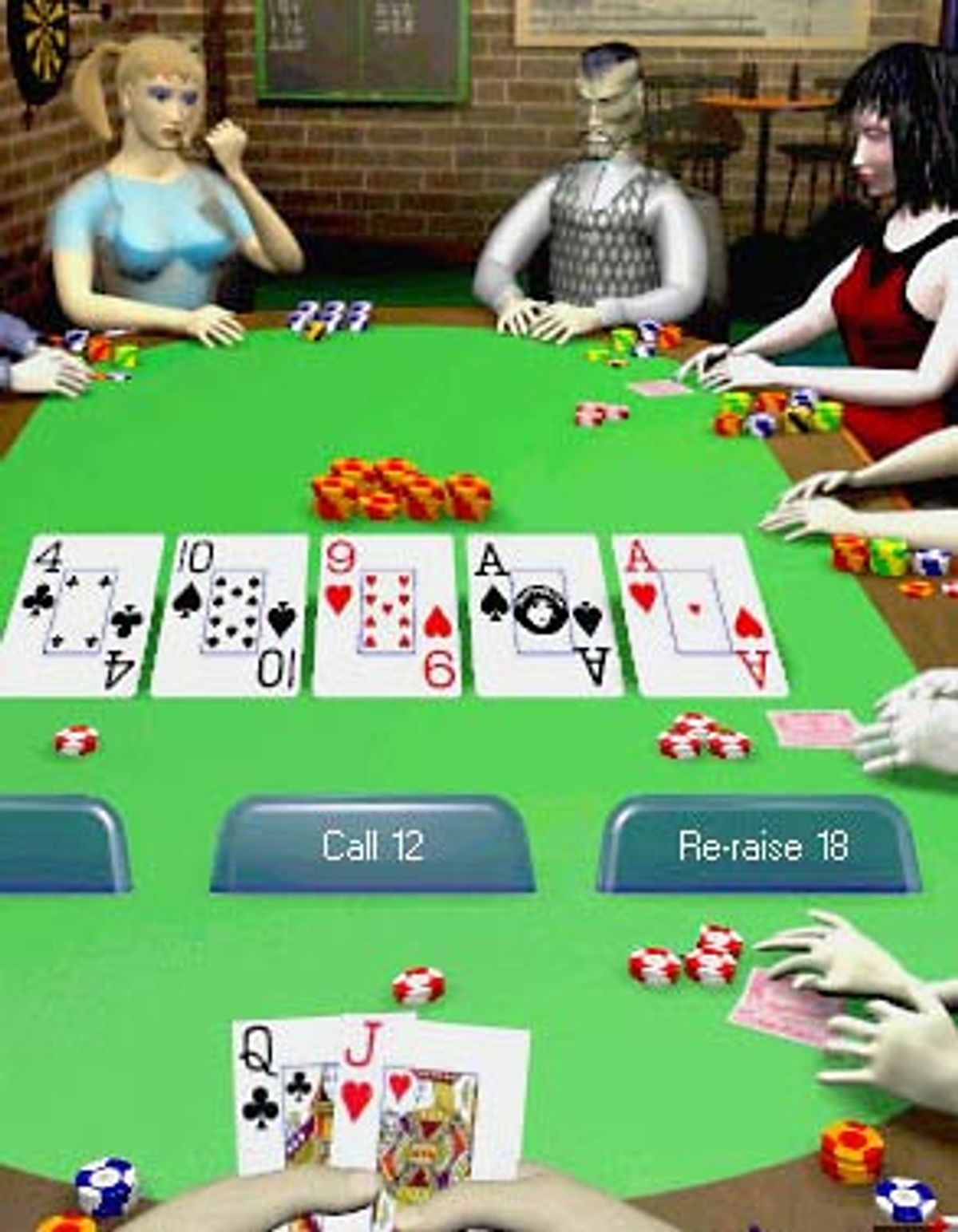
I log onto Pokerroom.com. I don’t have to download any software. I sit at a 3-D table with stereotypical gambling types: the bald man in the bad shirt, the chubby black woman with tight curls, the fat guy with the white suit and cigar. And of course the babe, in the thousand-dollar dress, half cleavage, half legs.

I make rules for myself. Whenever possible I will play as the bombshell. (Very few women play poker so you pretend to be the woman and maybe the guys will give you a break.) I will stay out of the high-roller rooms. I will quit when losing. I will lose my $500 or win $1,000, then I will write an article about winning $1,000 playing online poker and get out for good.

There are five rooms for Texas hold ‘em. $1/$2, $2/$4, $3/$6, $5/$10 and $10/$20. I decide that the suckers are in the $3/$6 room. They have too much money to be bothered with $1/$2, but aren’t good enough to keep up with the high rollers. I want to find a room full of my editor: people who think the stakes are too low to matter, who will stay in when they should fold and chase inside straights with two aces showing.

“God doesn’t play dice.”

– Albert Einstein

Texas hold ‘em is a simple but popular poker game in which the dealer has an incredible advantage and the deal rotates after every hand. Every player at the table is dealt two cards down — hole cards — and then there’s a round of betting. The first two rounds are low, meaning on a $3/$6 table in the first two betting rounds you can only bet in increments of $3, and in the last two rounds in increments of $6. After the first round of betting, three cards are laid in the middle of the table. This is called the flop. The three cards belong to everybody. Then another card is dealt, called the turn. Then a fifth, the river. Between the two cards in your hand and the five on the table, the winner is the one who can make up the best five-card hand — unless everybody else folds, in which case the winner is the last one standing. Everything is determined by how well you play your cards in the hole. In his book “Hold ‘Em Poker,” David Sklansky, a world-class player, says you should never play hole cards worse than a king-9 unsuited (belonging to different suits).

One of the ways you can recognize a sucker is by what they win with. For a player to win he has to show his cards. If a player wins with a 7 and a 2 you know you’ve got a sucker, because while any cards can win sometimes, nobody should pay an ante with a 7 and a 2.

On my second day I beat a player named Morenos with two pair to his two kings. He starts referring to me in the chat rooms as an ass. I don’t respond to his criticism but I don’t go online to get abused. Asleep at night I dream I am at court with my queen, my jack, 10 servants and my grandfather. We’re all wearing velvet shirts with hearts across the stomach. We are ready for anything.

I pull $600 in my first three days in 10 hours of play and find myself hooked.

On the third evening I am out with my closest friends, two couples very much in love. We have a few drinks and then go for pizza where we order a bottle of wine. Everybody decides to go back to Ben’s house and play board games: Boggle, Trivial Pursuit. I say I am going to go home and write a student recommendation. Wendy keeps asking if everything is OK. She says I seem fuzzy. I say, c’mon, I’m the only single one here. Online aces are floating across the landscape of my mind. My friends beg and cajole and rib but my mind is set, I have things to do. I lose $150 standing in front of my iMac, hardly trying in my dulled, drunken state, the moonlight slashing across my walls. The same rules apply: Don’t drink and play poker, anywhere, anytime.

Day 4

“Nobody is always a winner, and anybody who says he is, is either a liar or doesn’t play poker.”

– Amarillo Slim

I wake up on my fourth day, a Saturday. There’s a message on my machine from a girl I used to like but who hadn’t returned my calls. Now she wants to hook up. I don’t feel fresh; in fact, I have a little bit of a headache. I have a plane to catch at noon for a reading in Los Angeles. I was supposed to leave last night but missed my flight. I log on in my socks to check out the action. Major Tom is sitting alone in the $3/$6 room. We spar mano a mano and I find him an easy hustle. I bluff him out for a quick $30. We are soon joined by more players, including SeeMePlayBad sitting in the sexy blond’s chair. It takes me $200 to realize that SeeMe is a ringer, a serious poker player. I scope the online lobby. Early Saturday morning all the $5/$10 rooms are empty. So my theory that the best players stick to the $5/$10 rooms doesn’t wash. Our little $3/$6 room was the only action going, and I was up against a pro. Frustrated again, again I log off, my winnings down from $600 to $250.

This wasn’t how it was supposed to go. If I don’t win $1,000 then I can’t write my article. Worse, I may not be as good a poker player as I like to believe myself to be. If I can’t win $1,000 then online gambling is nothing but a dirty con, and I am a fly caught in its net.

I duck into the $10/$20 room. Two early-morning high rollers are betting back and forth, with the pots reaching upward of $100. Mark W. from Sydney has $4,000 in his account. TPF has only $200. I am down to $250 (I have withdrawn my original $500 stake). I like the action. The low player is running scared. I take the seat immediately to the left of the high roller so I have him in position. (Rule of note for aspiring online gamblers: Sit to the left of the best player at the table. You have an advantage over whom you follow — it’s why the dealer is at the best seat on the table: The dealer follows everybody.) Twenty minutes later I have cleaned TPF out with a full house, 2′s over aces, to trump the three-ace hand she had bet the farm on. These things happen. I am back up $600.

Who is TPF, I wonder, clicking offline. And what am I doing in the high-roller room? That’s against my own rules. Rules in poker, like in writing, like in life, stand to be broken like Buddhist statues in the Afghan countryside. I wonder if TPF is struggling to support a couple of kids, living in a trailer with a 14.4k AOL connection. Does TPF have the money to lose? I doubt it. And all the while, the casino, online like any other, silently pulls its 5 percent rake. That is, the casino pulls $1 out of every $20 clicked into the pot.

On the way to the airport I close the car door on my pinky finger.

The Poker Room is not an American company. In fact, its Internet domain registration lists an address in Costa Rica. Gambling online is not legal in America, so American companies are not allowed to operate online casinos. This drives Harrahs and other big American casinos nuts. As far as they are concerned, American money is being lost to foreign merchants. It’s not enough for these chains and the powerful casino lobby that gambling is now legal in 28 states. The big companies tout the benefits of gambling, as their boats and their rising crime rates sail into communities like Joliet, Ill. They talk about the neighborhood benefits. The fun, the jobs, the economic development. When that doesn’t work, they talk about their rights to a bigger piece of the pie.

Current estimates list approximately 2.5 million people as pathological gamblers, another 3 million as problem gamblers and another 15 million people as at risk. Casinos and lotteries survive on problem and pathological gamblers. The economist Earl Grinols calculated that 52 percent of casino revenues come from problem gamblers. Of course, you never have a problem as long as you’re winning.

Day 5

“He had the calm confidence of a Christian with four aces.”

– Mark Twain

It’s Sunday morning. In five hours I have a reading at a bookstore in West Hollywood and the cafe on the corner offers Internet access for $5 an hour. The $7 left in my pocket buys me in for an hour and a cup of coffee.

TPF is back in the $10/$20 room with $500 in her account. Somebody bought back in because I wiped TPF out yesterday. We play one-on-one but it’s early and she catches me chasing a flush with a pair of queens. It only takes a couple of hands to lose $300 and now I’m staring across cyberspace at TPF, her three dimensional graphics, her cartoonish smile. I type into the chatbox, “I am going to take you.” She types back, “You are not going to take anything, never have.”

The room fills and I play tight. There’s five of us betting $10/$20. But pots are only $50 or $60. This is a room of people that can’t afford to be here. The slow betting proves that. I buy a couple of small pots and sit tight for the monster hand. Then we’re joined by Jeffage with $2,100 in his account. High roller. He bets fast and loose and players drop out but I’m winning and soon it’s just Jeff and I alone. Jeff’s got a tendency to bet and then fold, and once I figure that out it’s time to plug in the vacuum cleaner. By the end of the hour my bank account is at $804, only $196 away from my stated goal.

The cafe waitress is tapping my shoulder when I sit out. You can win or lose $300 in a $10/$20 room in 10 minutes. It’s like driving a fast car through a back-alley shortcut or drag racing in heavy traffic. You get where you’re going quicker, but the harder you speed, the greater the risks.

“Where are you going?” Jeff types in.

“My time is up,” I tell him.

But before I split I take one last look into the lobby. Flushdraw is there as usual. A regular, a steady. So is Major Tom, a sucker, a mark. Morenos is not around, probably sleeping off Saturday’s losses. I’ve got a reading to go to. I have to prepare myself emotionally to talk about my topic, group-home children, wards of the court. A state system that preps our lost children for failure. I’m an expert on this topic. Perhaps I’ll tell my small audience that group-home children, among other problems, are prone to excessive gambling as adults and compulsive behavior. What can we, as a society, do about that?

Day 6

“It is the mark of an inexperienced man not to believe in luck.”

– Joseph Conrad

Major Tom leaves the room shortly after I walk in. I have his heart, and he knows it. It’s early Monday and I resisted the urge to play last night after having two beers and witnessing a spectacular car crash where a pickup truck trying to beat the light at Ninth and Harrison got pegged by a two-door and skidded on its wheels, then flipped over onto its hood.

I follow Major Tom from the $5/$10 to the $2/$4. I’m up $850. I’m so close to my goal I can taste it. It could take hours to make $150 on the $2/$4 table. So I head back to the $5/$10.

There’s a couple of players I’m afraid of in the $5/$10 and the boards are slow. The $10/$20′s empty, making this the high-roller room.

I sit for an hour running between $796 and $904. I fold time and again on jack 7′s, queen suited, two 6′s, only to see two of my cards flop. Playing loose I could have taken $500 easy. But I do notice a trend. With the exception of Roger666, nobody is betting very much and Roger is pulling a lot of small pots. Finally, I’m dealt an ace-4 diamonds. Roger raises and I stay in. The flop brings me two more diamonds and another ace. I have a pair of aces whether I make the flush or not. Better still, I’m one card away from a straight. I’ve got a great hand and all of the “dangers” point in my favor — any additional card that improves the hand on the table improves my hand also. I raise, Roger raises back, I have a fish on the line. The hand ends with a 5-high straight to beat Roger’s three aces, bringing me to within $20 of the end zone. A few hands later I come out of the big blind with two jacks and I call it a day, $1,016 to the good, pure profit for a cumulative workman’s average of $50 an hour over six days of playing.

When I play poker I think about my last girlfriend. Her name was Wilhelmina and she was a bitch. But she released certain chemicals in my brain that felt a lot like folding on a 5-8 suited only to see two 5′s and an 8 follow the dead hand. She made me feel the way a nice girl never could, like a loser with a chance.

I call my friend Laura in Vancouver. I confess to her that I’ve been playing poker online in my apartment for a week. She says that sounds like a bad idea. I tell her actually I won $1,000. She asks me if I’m going to quit. I tell her I intend to. Of course, nobody can see into tomorrow, but I did cash out. Laura worries maybe they won’t send me my check. (They do, two weeks later.) Her consumer confidence is low. Seems to be a lot of holes in the chain, places to fall through. But I figure the casino is already making 5 percent on every dollar that’s bet, and I must have bet at least $20,000 together, so they’ve already made their $1,000 off of me.

In poker the casino is just a middleman, like a credit card, getting in the middle of a transaction, taking a cut and giving nothing back in return. You never beat the casino. Like stockbrokers, the casino gets paid no matter what, win or lose. The $1,000 I took came from real people. And I don’t know if they are rich or poor or what their story is. I don’t know if they can afford it, if they’re guys or girls, or if they’ve ever looked straight into the sun. In fact, the 5 percent we all pay the casino is the only thing any of us have in common for certain.

Worse still, while winning, I realized all the ways a person could cheat playing online. Two people could play together while on the phone, doubling each other’s raises, eliminating cards from play, not a huge advantage but enough to tip the scales. Also, if your connection is severed, you automatically go “all in,” which allows you to play your cards and potentially win, without having to match a bet that your cards don’t justify. Sometimes pulling the plug is the right thing to do. Still, there’re so many suckers in cyberspace, they counterbalance the pros.

In 2000, Harrah’s Entertainment took in $3 billion. All of that without ever producing a product. Maybe if there were no casinos the world would be a better place. But what’s the alternative? Everybody wants to find a way out of the day wage. If asked, I would vote that gambling be illegal everywhere except Vegas. But I wasn’t asked, so of course, I have to get mine too.

The rules of the game

“In a bet there is a fool and a thief.”

– Unknown

Here’s all I have for you if you do decide to go online.
1) Don’t, it’s a bad idea. I didn’t get a thing done last week. Deadlines passed, phone calls went unreturned, my life fell apart.
2) If you think you’re in a room with good players, leave the room.
3) Always stay in with a pair in the hole, even 2′s: Take it to Fourth Street [the fourth flop card] no matter what the cost.
4) Don’t do it, it’s not worth the risk, there are six losers for every four winners, somebody has to lose for the house, the odds are against you.
5) Sit to the left of the chaser, the guy throwing money after every card; this will enable you to pick up double bets on your good hands.
6) Fold when you don’t have it.
7) Don’t drink and play; I know I said that earlier but it’s important. Not a single beer.
8) The dealer seat is worth extra; if nobody has bet yet and you’re the dealer, you bet.

“The track takes 15 percent, but what’s 15 percent of a dream?”

– Charles Bukowski

My interview with murderer Hans Reiser

Five days before the computer genius who killed his wife led police to her body, he was remorseless and angry in defense of his innocence.

  • more
    • All Share Services

My interview with murderer Hans Reiser

I showed up at the Santa Rita Jail during visiting hours to meet Hans Reiser, the Linux programmer found guilty of killing his estranged wife. He was being held in Santa Rita awaiting sentencing and I knew if I was ever going to talk with him, I had to do it before he was transferred to state prison, where the rules regarding media visits are much more strict and it can take months for even relatives to get approval.

The Hans Reiser trial was big news in the San Francisco Bay Area and high-tech community, with both Wired and the San Francisco Chronicle live-blogging the proceedings and the Oakland Tribune assigning a reporter to it full-time. “48 Hours” and “20/20″ both did TV specials. Hans was considered a genius, a minor celebrity in the high-tech community. His filing system was considered by some to be a milestone in computer science. His wife, Nina Reiser, was a gorgeous Russian bride studying to be a doctor in America. Hans and Nina had two children together and a fantastically contentious divorce.

The case had everything the media looks for. For five and a half months, I attended the trial every day. The defense pushed the theory that Nina was hiding in Russia, her disappearance part of some larger master plan. It said charges against Hans were based on circumstantial evidence. Nina disappeared after dropping the children with Hans on Sept. 3, 2006. When told two days later his estranged wife was missing, he refused to talk to the police. They started following him but he engaged in counter-surveillance, driving in circles, pulling over to the side of the road, exiting and entering the freeway. Within two days of being notified Nina was missing, he hired a well-respected criminal defense attorney, William Du Bois. Hans withdrew large sums of money from the bank. When the police found his car — it was missing the passenger seat and rear assembly — they uncovered two books on murder, including “Homicide” by David Simon. Simon wrote about the importance of not talking to the police and how a crime is rarely solved without a body. Without a body, you first have to prove the person is dead. Hans would lead police to Nina’s body on July 7, 2008. But that was still five days away.

Hans was being held in cellblock 9. The visiting area is a row of partitioned cubicles. The visitor and inmate speak over a phone line, face to face, separated by thick, soundproof glass. A couple of reporters had tried to visit and he had hung up the phone on them when they posed their first question, so I knew I wasn’t going to ask him any questions.

He was waiting for me in cubicle 7 wearing bright jailhouse reds. Since the trial, Hans has grown his hair out in a crazy gray bush around his head. He sat across from me with several folders full of paper and a thin silver pen. He lifted the receiver and said he recognized me from court and wasn’t talking to journalists.

“I’m not really a journalist,” I said. “I’ve written a book about you.” This caught his attention. He tilted his head and lifted his eyebrows. What I’d said wasn’t exactly correct. I had written a book, and his story was crucial to it, but the book was really about me. There were other murderers, people I grew up with like Ted Light, who was given 60 years for shooting a homeless man with a crossbow. But a series of strange connections had led me to Hans. The book was half memoir, half true crime.

“How could you write a book about me without contacting me?” he asked.

“It’s not so hard,” I replied.

He said he wanted to see the manuscript before it was published and I told him it didn’t work that way. When he pressed as to why that was I told him it’s one of those things that only other writers understand. It’s just the nature of things. A more complicated explanation would have included that people think they like being written about when they’re talking to a writer, but then they read what was written and their reflection punches them in the face. Janet Malcolm referred to this experience as flunking a test you didn’t know you were taking. Anyway, a 12-person jury found Hans Reiser guilty of murdering his wife. I don’t owe him anything.

He said he still wouldn’t answer my questions unless I put them in the mail to him. I told him I didn’t have any questions and I probably wouldn’t get to see him again. If there was anything he wanted me to know, I said, now is the time.

He spoke for the next 40 minutes. I’d already seen him take the witness stand for 11 days, so my expectations were low. He was endlessly dishonest, self-justifying, and pedantic. But I was curious whether I would learn something about his character I hadn’t known before. I was face-to-face with my murderer for the first time. Part of me wanted to like him, to believe there’s a shred of decency in everyone.

Hans told me the investigator had failed him. He maintained his innocence and said there was a list of people who should be looked into. The first was “Alexia Orange.” (I’m protecting her real name.) He said she had lied about Hans pushing his wife, painting him as an aggressor during a custody hearing. Alexia never testified in Hans’ murder trial. But that wasn’t the point. The point was that he felt like he was mistreated; his concerns hadn’t been taken seriously. Next he named the teachers at the children’s school. They had also fabricated information, he said.

“I requested the PI investigate nearly two dozen people but he didn’t investigate any of them. The teachers gave conflicting stories about a therapist’s report. I’d be really impressed if you could get one of them to confess to making it up.”

It was amazing that Hans thought I might want to impress him. I had spent nearly half a year following his trial. The evidence was overwhelming. He said if I tracked down the teachers he would give me more names. He wanted me to prove myself first.

“Sean never lived in my mother’s house,” he said, referring to something his former best friend had told the police. His wife left Hans for Sean in 2004. In late 2005, she left Sean for someone else. Sean wasn’t called as a witness during the trial, though early in the case he was considered a suspect. It was known that Sean was a sadomasochist. He had been known as a heavy player in the BDSM (bondage and discipline, sadism masochism) community, something reported by TV newsmagazine shows.

“I’m not into BDSM,” Hans said. I could have told him I had written a book about my ongoing experiences with BDSM, but he was already on the verge of hanging up, and he wasn’t interested in knowing anything about me. Hans hated Sean almost as much as Nina, whom he maligned for almost his entire 11 days on the stand. “She worked people,” he had said on the witness stand in March. It was as if he was trying to convince the jury she deserved to be killed.

“We would like it to be true that S/M is neatly compacted inside the mind,” he said. “S/M crosses the wires of pleasure and pain, and those wires run deep. It crosses the wires between loving and hating as well. The result is that the more a sadomasochist cares about someone the more dangerous they are to them.” He thought there should have been more of a focus on Sean’s sexuality during the trial. But we both knew that Sean hadn’t killed Nina.

Everything Hans said reinforced the image I already had of him. He wasn’t interested in what was true, only in whether or not he had been treated fairly. There wasn’t a shred of remorse in his body. He was a sociopath, incapable of caring about another human being. A narcissist. A manipulator who thinks everybody else is stupid. The strangest thing about this murderer is how he never gets away with anything. Nobody ever believes him but he keeps lying anyway. He’s a genius who invented a new way to store information, supervised millions of lines of complex code, and he has no idea how he is being perceived. I wasn’t interested in being his private investigator.

Since being found guilty, he had been trying to negotiate a deal for a reduced sentence in exchange for taking the police to Nina’s remains. He wanted them to drop the charge from murder one to manslaughter, which the district attorney was unwilling to do. It doesn’t seem to bother him that his two children would never know for sure what happened to their doting mother after they last saw her Labor Day weekend 2006, when they were only 4 and 6 years old.

Finally I cut him off. I said I could track down all these people he was talking about. What I found might or might not point to an unfair trial (I doubted it) or mean that his children shouldn’t have been taken away from him. But it wouldn’t mean the verdict was incorrect. Was there anywhere I should look that might hint at his innocence?

“If you’re guilty of murder, who cares if the schoolteacher misremembers something?” I said.

He stopped talking then, looking at me for a second, realizing perhaps that I wasn’t on his side. He gathered his papers. “You can believe whatever you want to believe,” he said, hanging up the phone. He turned his back on me and called for the guard to take him back to his cell.

Five days later, Hans took the police to Nina’s body. He had buried her less than a mile from his house, not far from the trailhead. He lived close to the Redwood Regional Park, a place where you could hike for days. Search and rescue had scoured the area with ground troops and cadaver dogs, but the body was hidden in a shallow grave more than 100 feet down a steep ravine. She had been strangled. His lawyers stated that Hans was remorseful; that he was trying to make things right. I knew that wasn’t true. He had maintained his innocence since being arrested in October 2006. I was the last journalist to interview him before his confession. He wasn’t remorseful, he was angry. He still felt the world owed him something.

Continue Reading Close

How hard is it to write honestly about war?

A haunting, minimalist portrait of modern warfare by former soldier Matthew Eck.

  • more
    • All Share Services

How hard is it to write honestly about war?

Recently, a critic in the Guardian lamented the lack of serious fiction concerned with modern warfare. Where, he wondered, was the great modern war novel?

He was wrong. There are tons of books dealing with the “war on terror,” 9/11, and the new American engagement with the world. I edited two anthologies of fiction dealing with those very issues.

Or maybe he wasn’t wrong. Maybe we just haven’t seen the right book. As Norman Mailer wrote in “Advertisements for Myself,” “Major war novels are not difficult to write — it is just difficult to find writers of sizable talent who come close to war.”

I just finished reading a truly great war novel by a writer of sizable talent who has come close to war. The writer is Matthew Eck, a soldier who served in Haiti and Somalia. His novel, “The Farther Shore,” is a haunting portrait of modern warfare set in an African city governed by warlords robbing the population of international aid. The war Eck writes about is conducted in covert missions — small groups of soldiers guiding bombs from a hidden rooftop — rather than full-scale engagements between uniformed forces.

The old war novels concerned soldiers surrounded by hundreds, thousands, of other soldiers who represented nations fully aware of the engagements and the sacrifices required. Those books were often set in occupied countries, or they climaxed when one large group of men outmaneuvered another large group of men. But war no longer follows those rules. There is no draft. In response to the attacks of 9/11, our president urged the population to keep shopping. Meanwhile, the battlefield has shifted. It has become increasingly difficult to separate friend from enemy. The target is often a sect, a small group within a much larger population. Some of these conflicts are so small they hardly make the news, and we remain blissfully unaware of the men and women that taste blood and fight battles in our name.

Narrated by Joshua Stantz (an average boy becoming a man who was simply looking for college money when he enlisted), “The Farther Shore” opens on a rooftop in a strange city seemingly modeled on Mogadishu in the 1990s. Six soldiers guide bombs down on the city, the plan being to awe the population into surrender, or something like that. The soldiers don’t seem sure. They’re just doing their job.

Josh didn’t mean to find himself half a world away in a hostile city, but that’s where he ends up. When some children trip the booby traps in a stairwell, the soldiers have to get out of the city. However, their van has been stolen and thing go wrong with the extraction, the way things in war so often do. The difficulty is not in getting in, it’s in getting out. The parallels to the quagmire in Iraq are so obvious they defy mention. The result is a haunting, minimalist work painted in surreal shades of desert brown. It echoes “A Farewell to Arms” and “Dog Soldiers” yet remains unique to the new millennium. Eck writes:

The Humvee’s engine finally cut off and the vehicle slowed until we rolled to a stop.

“He’s dead,” said Santiago.

“I know.” I stepped out of the Humvee.

I saw two adults and a child approaching us in the distance. It must have been a family.

I tossed my helmet into the driver’s seat and picked up my 9mm. Sand was blowing in off the desert. I stood there leaning against the hood of the Humvee, the 9mm at my side.

None of the soldiers are heroes, but they’re not villains either. They are not always sure of their targets and they make bad decisions, more circumstantial than not. Some of them don’t make it out, but their death is as random as their cause.

The writing is often beautiful. And modern war has probably never been so fully explored as in this small, relentless novel. Eck never panders. We are not asked to cry, only to go quietly along for the ride.

The army was out there too, massing to the southwest and the northeast, along the main road that ran down the coast and through the city. We were to gauge the show of force against the level of resistance and report on whether the city was awed enough to accept help in forming some kind of government.

This near-perfect book is published by Milkweed Press Editions, a small publisher in Minnesota. Possibly the first great war novel of our generation, “The Farther Shore” will easily be one of the best novels of the year. But the question is, does anybody care? Thirty-five years ago, Nick Ut took a picture of a naked girl burned by napalm running crying down the street in Vietnam. That picture helped end a war. Now Nick Ut is taking pictures of Paris Hilton, crying in the police car as she’s driven back to jail. Novels, photography and art used to be part of the conversation when contemplating murder and death a world away.

The question of the moment is not why American fiction isn’t engaging with the world. It is. The question is why we aren’t paying attention.

Continue Reading Close

Impressions of Paris’ last night in jail

Deranged fans, enraged protesters and garden-variety rubbernecks converge for one big release.

  • more
    • All Share Services

Impressions of Paris' last night in jail

“I hope she’s not crying,” Nick Ut says. “I want pictures of a happy lady. I feel very sorry for her.” It’s night and we’re waiting for Paris Hilton to get out of jail. The journalists are flanked along the walkway leading from the main entrance, kept back by yellow tape. Nick was 15 years old when he started taking pictures for the Associated Press. His brother had been killed in the Mekong Delta while shooting for the AP and Nick took his place.

In 1972 Nick took a picture of a 9-year-old girl named Kim. She was naked, running with her arms spread, 80 percent of her body burned by napalm. The picture won the Pulitzer Prize and hastened the end of an unnecessary war. Thirty-five years later to the day, he took a picture of Paris Hilton crying in a police car, returning to jail. “You look at the pictures,” he says, “they’re very similar. Her hair falls over her brow, both crying, open mouth. Also different. Kim was very poor, 80 percent of her body burned by napalm. Paris was in jail for three days.”

Nick speaks with Kim on the phone every week. Kim now works as a goodwill ambassador to the United Nations.

There are hundreds of journalists here. And tourists arriving. I meet Ashley Moore, who spent seven days in the jail back in September. She’s pretty, a business student at Cerritos College. She couldn’t make bail so she stayed in jail for a week. After she was released the judge dropped the case. She has the Japanese symbol for beautiful on her arm, a rose tattooed on her foot. “That place,” she says, pointing to the jail, “is no place to be.” But here she is, waiting to see Paris get out. She says she has nothing else to do on a Monday night.

I wait inside the jail with Pablo. His girlfriend spent the weekend here. She attacked Pablo. His arm is all bruised and cut. After she attacked him she called the police but they arrested her. He has been waiting three hours. When the sheriff’s spokesman sees me with Pablo he says, “Get out of here. You’re with the media.”

Maybe I am, maybe I’m not.

As it gets closer to midnight the crowd swells. The TV reporters report live. Helicopters hover overhead. The parents pull up in a large black SUV. They have a driver and a bodyguard and the bodyguard seems to know the police well. He’s a big, bald man in a well-tailored suit. He looks like he could have been a football player once. The driver is dark and serious. More tape is stretched, to keep in the crowd. The thrum of the helicopters is like a soundtrack.

“You’re so beautiful, Kathy,” a girl cries from the crowd. The girl looks Spanish or Asian, or both. She’s wearing a tank top, her breasts pushed up.

“Thank you,” Kathy Hilton says. Kathy sits in the car waiting, the window rolled down, bantering with the press. She likes the attention. She plays with her hair.

Then the girl says it again, “You’re so beautiful, Kathy.”

Kathy smiles.

Then the girl says it again and Kathy looks ahead uncomfortably.

“Oh God, please let Paris go free!” a deranged man wails. We are in East Los Angeles near the Imperial Highway, an otherwise forgotten place, an area of Los Angeles frequently referred to as a wasteland.

There are arc lights set up. Lights of all kinds. It’s midnight and everything is bright. The reporters lean over the tape. The paparazzi wait with their cameras strapped over their necks. It has been two weeks since “The Sopranos” ended. Phil Spector is on trial for murder but nobody notices. The newspapers have been filled with reports that Paris served more time than 80 percent of people accused of similar crimes. They fail to take into account that Paris was pulled over three times. That she was swerving. That she had a signed statement saying she knew she was not allowed to drive. That she failed to show up to mandatory classes. The judges have discretion in these cases for a reason. Paris had flagrantly flouted the law. Several days ago she called Barbara Walters at 2 in the morning, 11 at night West Coast time. Nobody seems to think that’s strange. A call to Barbara Walters at 11 at night from a prison cell.

The jail holds 2,200 people. It is full to capacity. There are only eight medical beds. Paris has occupied one of them almost the entire time.

And then she is out. Paris Hilton in tight jeans and a light jacket thrown over a white shirt. She’s smiling, basking in the glow of the cameras. She looks better without makeup. She gets to the car and she is hugging her mother and then the door is open and she is inside and the tape and the barricades go down and the police cannot control the crowd. The car is trying to move, inching away. The paparazzi stand in front of the car taking pictures. Unafraid. Nick Ut stands back in the wreckage of toppled tripods, reviewing the pictures he took. He’s a little man, and this is not exactly his game. But Paris was smiling and happy, exactly as he had hoped.

The police have blocked the parking lot, so we can’t get out. Finally, I’m on the highway again. It’s 1 in the morning and I feel strangely alive. I see the helicopters above the 110, shining their giant lights like tractor beams and I drive toward them.

I met a man from Stopparishilton.com. He said they were working with Al Sharpton. Sharpton had called for a boycott of all things Paris. Sharpton, who once accused Jesse Jackson of smearing himself with Martin Luther King’s blood. Sharpton, who insisted in staying in $500-a-night hotel rooms during his meaningless presidential campaign. Tawana Brawley Sharpton. Sharpton is not the man to deliver us from Paris.

There are more than 50 people waiting at the gates of Paris’ home on the hill above the Chateau Marmont. The streets have been made temporary tow zones but nobody seems to care. They are paparazzi and mainstream media and citizens of celebrity-obsessed West Hollywood. It’s almost 2 in the morning. It’s all very American, just magnified. But Paris isn’t coming home tonight and so I go back to my friend’s house in Little Armenia, where I’ve been sleeping on the couch.

Originally I thought this was a good thing, Paris’ incarceration. It would bring attention to prison crowding, a corrupt sheriff, a justice system that works differently for the rich and the poor. And it did. But it’s not really what this was all about. In the new age we all know how famous we are. How many MySpace friends do you have? How many people read your blog? How many download your video from YouTube? We can be famous now without doing anything, and Paris has done that better than anyone else. We don’t burn down the houses of the rich because we want to be rich. And we shudder and complain about the attention Paris Hilton gets but we talk about her just the same, sometimes in quiet and disparaging tones. We talk about her more than we talk about Iraq and often we talk about how we talk about Paris Hilton when we should be talking about the war in Iraq.

But we don’t.

Continue Reading Close

My day at the Porn Palace

S/M media giant Kink.com stirred up controversy by announcing plans to move its headquarters into San Francisco's Mission District. But for Kink's performers, sex is all in a day's work.

  • more
    • All Share Services

My day at the Porn Palace

Next to a double mirror surrounded by large round bulbs sit Tupperware boxes stacked two and three high, each with its contents marked on white stickers: eyelashes, hair accessories, brushes, empty enema bottles (of which there are two). This is the dressing room for the Kink.com building, also known as the Porn Palace, in downtown San Francisco. This is where people get ready to be filmed for the Web sites Men in Pain, Wired Pussy, Hogtied, Water Bondage, Ultimate Surrender, Fucking Machines, Sex and Submission, and Whipped Ass.

I’m spending the day on Wired Pussy. It’s a Wednesday. I know the people who run Kink.com and I thought it would be an interesting thing to do.

I’m with Satine Phoenix, a model who flew in for the day from Los Angeles. The makeup woman called in sick, so Satine is doing her own makeup. She has skin the color of sand and long, thick black hair. She’s exotic, extraordinarily beautiful. She’s excited to be here, excited that I’m writing about her, excited about life and filled with manic energy.

We’re on the second floor of the three-story building. There are 50 full-time employees at Kink, plus contractors and talent. A profile in 7×7 magazine said Kink.com made $18 million last year. The office is clean and well-lit with an air of efficiency. It if resembles anything it’s a design studio with all the high-end Macs and LCD panels. Except on most screens there’s some kind of porn being edited — women with their legs forcibly spread, mouths held open with steel clamps. Nobody seems to notice.

But Kink will be leaving this building soon. The company recently purchased the Armory in San Francisco’s Mission District. The Armory is a giant building that has sat empty for the past 35 years. Neighborhood activists have been trying to block the move. They say families live in the Mission. But, of course, families live everywhere. Others say the space should be used for affordable housing, but nobody has made a proposal on the space in years. Peter Acworth, the owner of Kink, points out that the Armory was originally a place where men were trained how to kill. What Kink plans to do there is far less obscene.

Today’s shoot is in the warehouse, a smaller studio off Kink’s main offices. The warehouse is intentionally weathered but the equipment is all first-rate, lights, rigs and scrims comparable with anything in Hollywood. There are 11 studios in the Porn Palace, including a barn, a dungeon, a jail cell, a bar (where they also have parties every Friday night) and a hot tub.

Satine works all the time, at least four shoots a week, which should translate to $200,000 annually, though I don’t have the guts to ask. Mostly she does mainstream porn, guy on girl, girl on girl, but she really likes fetish. She also does performance art, body painting, a bondage burlesque and a weekly radio show on KSEXradio.com. I ask if she’s saving for something. “I’m just paying off bills,” she says. “I was an alcoholic. My skin was fucked up all the time because of alcohol and coke. I haven’t had a drink in a year and a half.”

Satine has been doing porn for a year now. Before that she was a stripper in San Francisco. She made her first film in San Jose and immediately moved to Los Angeles to work full time. Kink.com flies her back to the Bay Area once or twice a month.

In the dressing room with us is Princess Donna, the Web mistress for Wired Pussy. Donna is effortlessly beautiful. She has long legs and thick black hair and big eyes that soak in her surroundings. She runs the site and acts as a dominant in most of the shoots. There are four to six updates a month, and 6,000 subscribers pay an average of $30 each. A model from Water Bondage comes into the dressing room. She looks 15, though she’s actually 23, and the wardrobe coordinator helps her into a two-piece latex outfit. Donna advises the Water Bondage model to wear color-stay lipstick and eyeliner that won’t run when they dunk her.

“I can’t wait for what you’re going to do to me,” Satine says to Donna.

- – - – - – - – - – - – - – - – -

In Donna’s office there’s a large flat-panel monitor. On the screen is a still from a recent shoot — Donna on a roof in New York, wearing leopard-print tights and heels. Her foot is on another woman’s head. The woman’s hands are tied behind her back and Donna’s hand is in the woman’s ass. I can see the straining tendons in the woman’s leg, her knees bound, panties around her thighs, surrounded by Word documents and spreadsheet files.

Donna was just finishing undergraduate work at New York University when she interviewed for the position of Web mistress at Wired Pussy. She had already worked two years doing bondage porn and was a high-end stripper before that.

She remembers her first bondage porn shoot. She was tied in a box with another woman, the other woman’s foot tied forcibly in Donna’s mouth.

“I love this job,” Donna says.

Donna asks, “Are you nervous, excited?”

Satine: “Yes. I’m excited.”

Donna: “What have you done since your last shoot with us?”

Satine: “I’ve played a lot in my personal life. Flogging. Rope bondage.”

Donna: “What do you like?”

Satine: “I like duct tape. I love hair pulling and I like being face-slapped.”

Donna: “You do?”

There is one woman on the camera and another shooting stills. That makes four women and me. Donna sits offstage on a wooden crate. She’s wearing a polka-dot dress, a red belt, black heels. Satine sits on a chair, fully clothed, addressing the camera. Every video begins like this, with the talent reassuring the viewers (and regulators) that this a consensual scene. At some point Donna enters, grabs Satine by her hair and pulls her to the floor.

I take my shoes off, sit near the equipment rack. The people are nice, creative, interesting. But I wonder what I am seeing here that I wouldn’t see just watching the video. The food cart full of Luna bars and Odwalla, the camera girls scurrying around the action? Here is one of the obvious questions: Would you let someone do something to you that you enjoyed, for a fair amount of money, on camera? Why not?

When I was 21 and dancing between films at a gay porn theater in Chicago called the Bijou, I was offered a part in a bisexual porn video. The money wasn’t great, only $300. Men don’t make nearly as much as women performers. I backed out at the last minute. I was afraid it would negatively affect me later on. Now I realize it wouldn’t have. Now I realize nobody would have cared that much. I wish I had done it, just to have had the experience.

Donna ties Satine with thick rope, wraps her arms around her back, ties her hair to a hook hanging from the ceiling. Donna attaches a violet wand plate, electrifying Satine’s body so that every time she touches Satine’s nipples Satine receives a shock. Donna has forbidden Satine from speaking and her face contorts in quiet screams.

There will be four setups today with at least a 10-minute break between each. The studio is reserved for four hours and will yield a video roughly 50 minutes in length that can be downloaded by subscribers in segments or streamed in its entirety. Photographs will also be available for download. Subscribers have access to everything and can also leave comments on the shoot, for example, “more pussy licking,” and “you are so fucking hot.” Subscriptions to Kink sites automatically renew and the average subscriber stays for four months. Many subscribers switch between sites.

Between setups Satine and I talk about relationships. She recently broke up with her boyfriend, who didn’t want her doing male-female porn. She wasn’t willing to give up control over her career. “I’m an exhibitionist,” Satine says. “I like it when people watch. And I like boy-girl scenes, I like fucking. This is who I am.”

Much of the action in the second scene revolves around whether Donna is going to let Satine have an orgasm. “Do you want to come, you fucking whore?” Satine’s hands are attached to her ankles, a vibrator between her legs. Occasionally Donna shocks Satine with a cattle prod.

Observation 1: This is not fake. Satine and Donna are truly in role. Satine is feeling submissive and Donna is definitely on top. Donna is hurting Satine; Satine is being hurt.

Observation 2: Everyone here seems to enjoy his or her work. At least today.

Between setups Satine puts on a blue robe that has “slave” embroidered on its chest. I’m on the floor and she’s on the chair resting her feet on my knees. “I’m going to get a benefactor to pay for fake boobs,” she says. “It’s nice when someone will do that for you. I know people that have gotten $2,000 boobs, but it’s not the kind of thing you want to save money on. A good boob job costs $10,000.”

Satine has red marks along her belly where Donna yanked a string of clips she’d attached to Satine’s stomach and nipples. Watching it, I actually felt empathy for Satine. Satine was blindfolded. I saw Donna twisting her fingers through the white string holding the clips. I knew she was going to pull the clips and I knew it was going to hurt. I almost covered my face in my hands.

In the third setup Satine is duct-taped to a rectangular wooden beam. A gas mask is placed over her head. During this scene an electric acrylic plug is slid into her vagina. Donna slaps at it continually, open-handed, occasionally moving to a counter to turn some knobs on the machine, increasing the juice.

For the climactic scene, Satine is gagged and tied with her legs held apart by a spreader bar, her head forward and her hair tied to the front of the trunk she’s squatting on. Donna places voice-activated electrodes on Satine’s ass so every time Satine moans she’s electrified. Meanwhile Donna slaps her between her legs with a cane.

Halfway through the shoot they have to stop because Satine is crying.

No crying is allowed in Kink.com videos.

“I’m sorry,” Satine says. “It just feels so good.”

When the shoot is over Donna asks, “How you doing, baby?”

“My vagina,” Satine jokes with a Russian accent. “She is broken.” After that there is lots of talk, jokes. They talk about various sex toys, the Monkey Rocker. The Sybian. “Seriously,” Donna says. “Every time I would cane you I would get a throb in my pussy.”

- – - – - – - – - – - – - – - – -

When I leave the Porn Palace half an hour later it’s dark and I find that both wheels have been stolen from my bicycle. This has nothing to do with the article except to prove that it’s possible to watch someone shove an electrified plug in someone’s pussy while a thief casually takes an Allen wrench to your transportation on a downtown street. Though that’s also wrong. The Porn Palace is half a block from the largest shopping center on the West Coast, the fashionable Westfield Mall. But a half-block in the other direction is Sixth Street, the last remnant of a downtown that wasn’t always so prosperous. Filled with junkies, transient hotels, outreach centers and shooting galleries, Sixth Street is littered with the limping desperate and the drooling insane.

Which could be a metaphor for porn, an industry in an economic no man’s land. But the porn industry is twice the size of the mainstream film industry, leaving open the question of what “mainstream” really means. You may or may not be into electrified bondage, but if you’re male, chances are you’ve watched porn or bought a dirty magazine in the past year. If you didn’t, look at your friends; they did. Chances are you didn’t tell anybody about the porn you watched. Chances are you’re surrounded by people whose desires you would consider strange if you knew what they were.

San Francisco, with its open sexuality, is the perfect place for a company like Kink.com. But many porn sites are shutting down because of new regulations by the Bush administration. Some that have been closed, like Insex.com, are seeking buyers in foreign countries.

I asked Satine what she wanted to do after this was over, when she was done making porn. She told me she was just gaining experience for a graphic novel she’s writing about her life. She said she wants to move to Japan, open a sea farm. She also wants to live in India and study tantra. She wants to have a restaurant and she wants to document it all via her graphic novels and her Web site.

“Just whatever I decide to do at the time,” she said. “I go in about three-year spans. I might completely change my mind.”

Continue Reading Close

Nude awakening

It was a hot Chicago summer. My stripper year. My heroin year. I had a new college degree and nothing made sense. I was having the best time of my life.

  • more
    • All Share Services

Nude awakening

First there was Toni in his sparkling cocktail dress, serving drinks at Neo on Clark Street. The bar was dark, there were no windows, only a blue-lit clock. Toni had thin legs covered in track marks beneath his fishnet stockings. He brought me elegant looking drinks on a silver tray. I hid in the corners or in the middle of the dance floor. I went to Neo alone and Toni sensed my loneliness and wanted to mother me to health but it didn’t happen. Toni died at three in the morning in a stranger’s apartment in Humboldt Park lying next to a broken needle, blood streaming from his nose, emerald skirt riding in waves across his hips, tights ripped, a slipper dangling from his toe, eyes wide open.

Then there was Toni’s friend Tony. Tony worked at Berlin, had tribal tattoos covering half his body, long, thick black hair like a horse’s mane, and every year the free weekly paper voted him best bartender in the city.

Tony didn’t charge me for drinks either and I hovered near his bar, an oasis next to the entrance. I danced close to Tony. I never wanted to go home. I had friends but they were sleeping, and they weren’t real friends. I said, “What kind of boys do you like?” and he said, “Straight boys” and I smiled.

Tony had a fashion show and I walked the runway at Berlin in striped shorts with thin straps over my shoulders. There were so many people there, all of them high on pills, dehydrated and watching. I danced slowly past them. It was like being perfect, which is always an illusion. I was followed by a man in a straw hat, his gown covered in pale green bulbs. “Do you have any more swimsuits?” I asked Tony. “I want to go again.”

“You are so vain,” he said, patting my ass. I gave him a quick, sly kiss on the lips, before climbing back on the stage.

It was my stripper year. My heroin year. I danced Thursday nights at Berlin. Two sets, three songs, free whiskey, seventy-five dollars, occasional tips. They called me a go-go boy but I was really just decoration, cheap art. I scored heroin on the west side, piloting my giant car through the burnt out landscape, home of the ’68 riots, the stained remnants of an assassination in Tennessee, the empty lots like broken teeth. Trash and parts everywhere, pipes protruding from the rubble, chassis on cinder blocks, men in lawn chairs on corners in front of vacant three flats. I got robbed. I got beat up. Things weren’t going well. Nothing made sense. I was having the best time of my life.

I didn’t make enough money on a podium at Berlin so I danced at the Lucky Horseshoe, a front for prostitutes on Halsted Street. We weren’t allowed to sit between sets. We had to mingle with clients at the bar. We would stand and they would sit. “They like it when you pay attention,” the owner told us. “Open seats are for customers.”

I met a man who bred dogs. He stuck five dollars in my thongs after my first dance. “It’s like selling people,” he said, laying a rough hand on my waist. “Only it’s dogs, so it’s legal.” Then he let out a monstrous laugh.

The going rate was $20 a day plus tips. The going rate was $80 for a blowjob down at the Ram, a dirty theater with private booths, six painted steps below street level a block away. There were sugar-daddies that came to the Horseshoe but it was up to you to parse them from the fakers and dreamers. They said, “What do you want to do with your life? I can help you.” If you were a writer they were an agent. If you were an actor they were a director, a producer. If you wanted to go to school they would give you a place to stay while you got your act together. They knew someone on the admissions board. The clients at the Horseshoe were whatever you might need. But I needed to be found attractive. I needed to be loved unconditionally. And I was very angry about something.

I had a college degree.

This is all true.

It was 1995, the hottest summer on record, or so somebody told me at the time. It’s a fact I’ve never bothered to check. They were carrying dead seniors by the dozen in a phalanx of stretchers from the nursing homes on Touhy Avenue. I lived in a squat above a garage a bullet away from the project buildings. I could make out the top of the Sears Tower from my porch. I had a roommate and during the day we would go to the slab along North Avenue Beach and lie there like seals, diving into the water every twenty minutes or so until the sun went down. We lay on the warm concrete watching the sunset and then the stars. “Life is good,” he said.

Sunday afternoons I danced between films at the Bijou. Twenty minutes of porn then one boy on the stage, one boy in the audience. The men pulled their penises out, stroking themselves, sliding a dollar in my pants with their free hand. The Bijou smelled of bleach. I climbed over the seats barefoot. I was like a spider, crawling along armrests and chair backs, never touching the ground. I stayed away from the older men. They had been around too long. They were looking for a good deal. I paid special attention to a fat boy who sat in the second row. He was probably my age and I felt sorry for him. He was so obese with all this skin falling around his face. His hair was flaxen and I worried that nobody loved him the most. I was projecting my own feelings. I sat on his lap, squeezed his shoulder, kissed his neck. I wanted to be capable of loving him for more than a few minutes but I wasn’t. He gave me a dollar and I hugged him, pulling his nose against my naked chest. “It’s OK,” I said.

There were rooms above the Bijou. Offices, a movie studio. The manager kept a picture of me in his desk drawer. He asked me to act in a bisexual porn movie. I said I didn’t mind. I was put in a room and given five minutes to get a hard-on. This was my audition. The room was giant and empty with slanted beams holding up the roof and great windows looking across Old Town. I jerked off, paging casually through the porn next to the bed. The director burst in with a Polaroid camera. “Yes,” he exclaimed when he saw my hard-on.

The pay was $300. I was told it was very important to be nice to the woman. She was a queen. I wanted the money but I was ambivalent about the film. What I really wanted was to be tied up. I wanted to be humiliated on tape. I wanted women with strap-ons to grip me by the throat and slide inside of me. I wanted to be wrapped in cellophane, like a present, unable to move. That was the kind of film I wanted to be in. But I didn’t know how to say that at the time and people that don’t know how to ask rarely get what they want.

I danced at the Manhole on lights out night. I was four feet above the floor on a square pedestal. I had to be careful not to step over the edge. Hands came from everywhere, palms stretching below my balls, fingers trying to find my asshole. I couldn’t see past the elbows. “Stop it,” I said softly. The music was so loud, nobody heard me.

It was my heroin year. I shot bags next to the couch and slept on the living room floor. I missed a night at Berlin. Then I missed another one. Summer was over. We stopped going to the beach. It got darker earlier. It was almost Thanksgiving. I dated Stacey, a Barbie-doll stripper with a bad coke habit and implants that didn’t take. They felt like twelve-inch softballs inside her breasts. She made $400 a shift. She knew about bars in Cicero that never closed. She crashed her car and the bar maid asked if she spilled her drink. Her other boyfriend was a police officer. “He’s very violent,” she told me. “He wants to put his gun in your mouth and ask you some questions. He broke the lock on my door. Do you want to come over?”

After Stacey I dated Zahava. Zahava came from a good southern family. She had been a pom-pom girl. She had been to finishing school. It seemed like she was always happy. She was the only person I knew with good posture. She wanted me to go to law school. I turned her on to heroin. Years later she would tell me I was the first bad thing that ever happened to her. Zahava said I was handsome. I told her when you’re a stripper you don’t worry about your appearance. You always feel attractive when people are willing to pay to see you naked. It was the biggest lie I ever told. I stared at the other strippers, the bricks in their stomachs, trapezoids like baby mountains. It made me nauseous to think about. I wasn’t good enough looking to dance at the Vortex but they let me in for free. I was low-rent and I knew it. I had an eating disorder and long hair. The only advantage I had over anybody was that I knew how to dance.

I was in a small room with dark wood floors on top of a big house in Evanston near the lake. I took a hotshot and passed out with blood streaming from my nose and foam gurgling at my mouth. Just like Toni a year earlier. My friend turned me over so I wouldn’t choke on my own vomit, then he left me to die.

But I didn’t die. Firemen came the next day. They were strong and good. They strapped me to a chair, carried me down three flights of stairs. “Where’s your family?” the owner of the house asked as they hauled me past her. “What’s your parents’ phone number?” I didn’t tell her. It was the first good decision I made that year. I was paralyzed for eight days and the nurses let me piss all over myself. When I was discharged from the hospital I walked with a limp. I told people I fell down a flight of stairs. Eventually the limp went away but it took time. And it took time to learn how to eat. I lost thirty pounds.

I didn’t strip again. Or shoot heroin. I got a master’s degree. I moved to a ski resort and the clients would sit at the bar unbundling their scarves. I wore black pants, a white shirt, and a patterned vest like all the other employees. We looked like dancing monkeys. Every day someone would stare at the mountains while I refilled their cup. “I wish I could trade places with you,” they would say, maybe dropping a dollar into the plastic pitcher sitting empty on the counter’s edge.

Continue Reading Close

Page 1 of 2 in Stephen Elliott