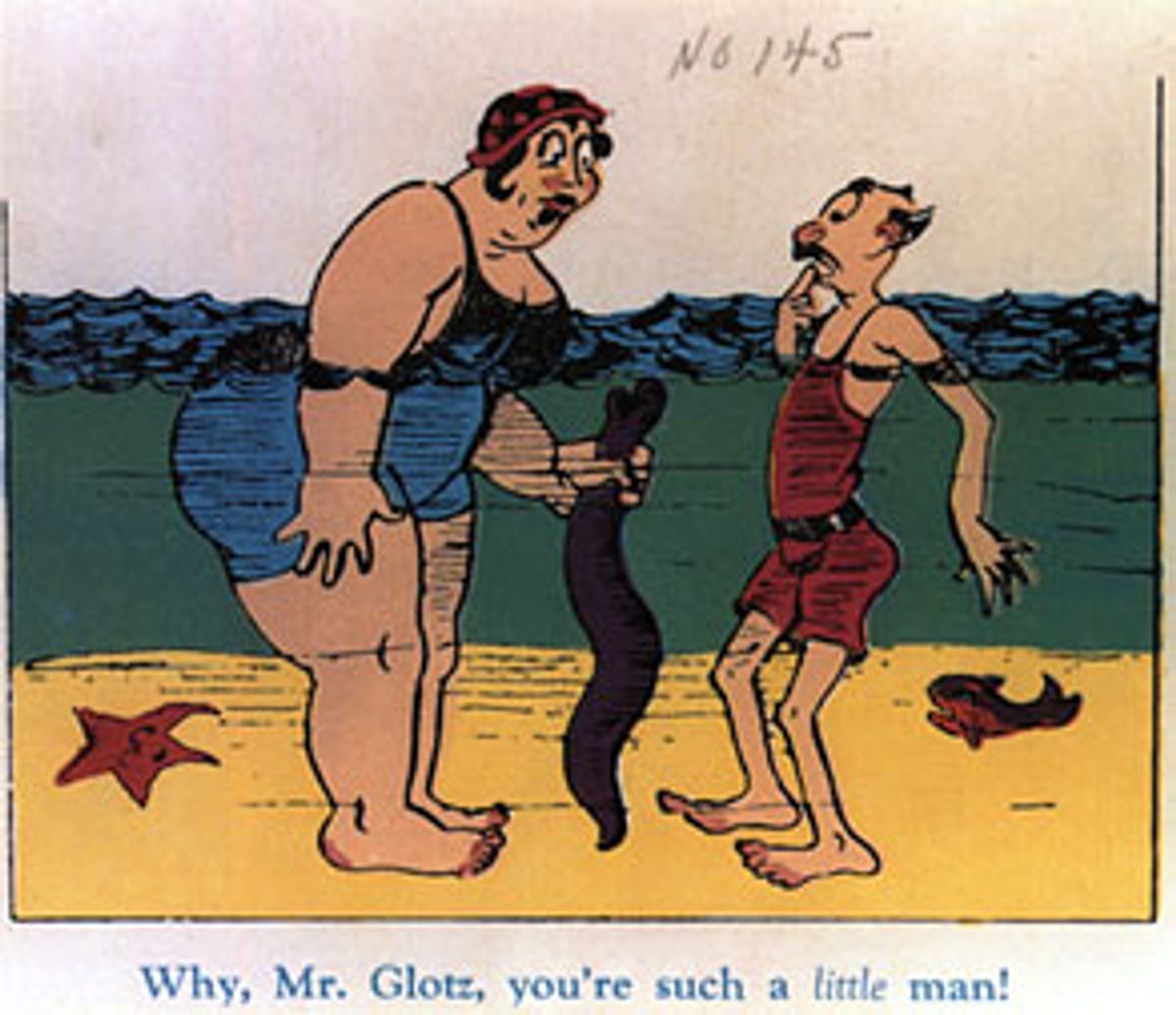
The danger of a serious study of silliness is that it is likely to rob the silly thing of its silliness, which is, after all, a silly thing's reason for being. Consequently, "Sex and Humor: Selections From the Kinsey Institute," 42 images -- photos, old engravings, etchings and cartoons -- from the organization's vast collection of sexually explicit materials, is best approached with what the Homeland Security Advisory System terms a "high," or orange, level of caution.
Whatever you do, resist the temptation to read the short captions that appear opposite the book's splendid dirty pictures or you'll run into something like this, accompanying a French etching of a woman examining a man's genitals with eyeglasses: "Woman examining man's genitals with eyeglasses."
Such curator-speak declarations won't enrich your experience of the book, but they will remind you of my friend Anne's story of traveling around Europe with a companion she later dubbed Jonathan, Master of the Obvious. Jonathan, M.O., was given to pulling up in front of, say, Notre Dame Cathedral and brightly announcing, "That is a big church!" Or looking down from the uppermost platform of the Eiffel Tower and exclaiming, "This thing is tall!" Jonathan, M.O., survived the trip, but just barely.
Still, one must hand it to the creators of "Sex and Humor" for having the courage (or recklessness) to tackle salacious silliness seriously and, at least occasionally, be entertaining, even enlightening, while doing so. The book begins with six (count 'em, six!) essays, followed by the plates, ranging from an 18th century engraving of a man examining a woman's buttocks with an eyeglass (care to guess the caption?) and a 1950s photo of a voluptuous female made of turnips, to an etching from the 1920s depicting nude female warriors firing giant penis cannons and a 1940s photo of a baby lying on a sofa perusing Kinsey's groundbreaking study, "Sexual Behavior in the Human Male."
The first essay is by Catherine Johnson, the Kinsey Institute's curator of art, artifacts and photographs. From her we learn that "Alfred Kinsey was by nature a collector. As a graduate student and later as a professor of zoology at Indiana University, he traveled widely to collect gall wasp specimens in a determined effort to record every possible variation in the species." But Kinsey, nobody's fool, soon discovered a subject even more fun than gall wasps: sex. What's more, it was one with which he could continue to indulge his mania for collecting.
"Kinsey collected materials that used sex to make people laugh," Johnson writes. "One of the earliest items to enter the [Kinsey Institute's] collection was 'The Wonderful Sex Detector,' a device made of plastic, string, and wood that had been purchased in a St. Louis joke shop." OK, maybe that doesn't sound so funny, but "other early acquisitions included several 'man in a barrel' toys (the joke came when the barrel was lifted and the man's large penis popped into view)." Now, that's a knee slapper.
Following Johnson's essay is one by John Bancroft, director of the Kinsey Institute. In "Sex and Humor: A Personal View," Bancroft writes: "This is humor about absurdity and the absurdity of the sexual act as carried out by human beings. There are many variations on the sexual act ... But the basic human sexual act, copulation, is fundamentally the same as the sexual act of most other mammalian species. So it is absurd because we like to see ourselves as not only superior to all other species, but also fundamentally different from them." Stay with me, there's a funny part just ahead.
Leonore Tiefer contributes a piece titled "The Capacity for Outrage: Feminism, Humor, and Sex," which is earnest but also includes some actual humor, such as this from British comic Jenny Lecoat: "He, laboring away, pauses to ask, 'Are you nearly there?' 'It's hard to say,' says she. He plunges on. 'If you imagine it as a journey from here to China, where would you be?' She considers. 'The kitchen.'"
But the essay that -- in addition to the delightfully wacky, filthy pictures -- makes the book worth having is Mikita Brottman's "Gershon Legman: Lord of the Lewd," a short sketch of the irascible one-time book buyer for Kinsey, who went on to write the underground classic "Rationale of the Dirty Joke: An Analysis of Sexual Humor" and a second book, "No Laughing Matter," of really dirty jokes. Legman, who died in 1999, was a piece of work (having claimed that "his own name is a dirty joke -- and an inverted one, since he happens to be a 'tit-man' rather than a 'leg-man'").
Brottman describes Legman as the "Diderot of the dirty joke ... estranged from the established world of academic sexologists and folklorists, and from the cultural establishment in general, mainly because his inability to pander or compromise upset and alarmed many more traditional scholars. Legman's writing is invariably full of angry remarks, virulent asides, value judgments and irrational prejudices [are you loving this guy as much as I am?], and those people used to dealing with the common platitudes of scholarly writing often have a hard time accommodating themselves to the belligerent personality that pervades his brisk, testy style." Hire that man! To help Brottman make her point, Bancroft writes in his own essay, "Certainly Legman's work puts sexual humor in a negative light. I prefer a more positive perspective, no doubt revealing in the process some fundamental differences in our two personalities." No doubt.
Speaking of fundamental differences in personalities, Kinsey soon jettisoned Legman at least partly because of a dispute over that old bugaboo: dick size. "By late 1943," Brottman writes, "[Legman] was exchanging angry letters with Kinsey, at first in relation to a statistical debate about penis measurements and then, consistently, about money." If Mel Brooks is looking for something to match the success of "The Producers," I think we may have stumbled upon it.
The prissiness of the U.S. Postal service finally drove Legman (and his habit of receiving "offensive" material) out of the country to cruel exile on the French Riviera. On arrival, Brottman tells us, the poor chap and his wife were "overwhelmed by the wonderful sight of the bougainvillea." Mentioning this horticultural detail makes us love Brottman as much as Legman. Of course Brottman's willingness to put her subconscious on display is an even more overwhelming sight than those bougainvilleas. It may be that my mind has become besotted with dirty jokes, cartoons and naughty etchings, but Brottman's contention that Kinsey "was hoping to find the kind of person who'd be adept at ploughing through the dusty annals of sexual curiosities ..." seems like a howler specifically concocted to send the more puerile among us into the kind of uncontrollable guilty tittering that would provoke an exquisite slow burn in my long-suffering eighth-grade English teacher, Mrs. Teale.
Be that as it may, the images in "Sex and Humor" make ploughing through its smooth, curving, creamy white pages a titillating treat. There's an assortment of "eight-pagers," little books published secretly beginning in the 1920s with titles like "Torrid Tessie Presents Dixie Dugan in 'Very Potent'" and "Kansas City Kitty," the pages of which, an "editor's note" on its cover explains, "were taken from a Diray [sic] that was found in a deserted apartment: -- that had been occupied by two young Ladies."
There's one of the more fetching (and gymnastic) porn shots I've ever seen: a woman on top, man on bottom number in which the man wears shoes, socks, garters and nothing else while embracing the woman. As he holds a closed umbrella across her back, she balances his bowler hat on her high heel. And there's a cartoon Christmas card from the 1930s of a couple going at it that unmistakably reveals the roots of R. Crumb's vision, complete with small teardrop-shaped projectiles launching from the happy duo's conjoined crotches. The caption of that one helpfully points out, "The illustration has little to do with Christmas, apart from the holly wreath hanging on the wall behind the copulating couple."
"Sex and Humor" is not as fun as it sounds, but there is plenty of silliness once you make it past the seriousness, and it beats the hell out of paging through a volume on gall wasps.
Shares