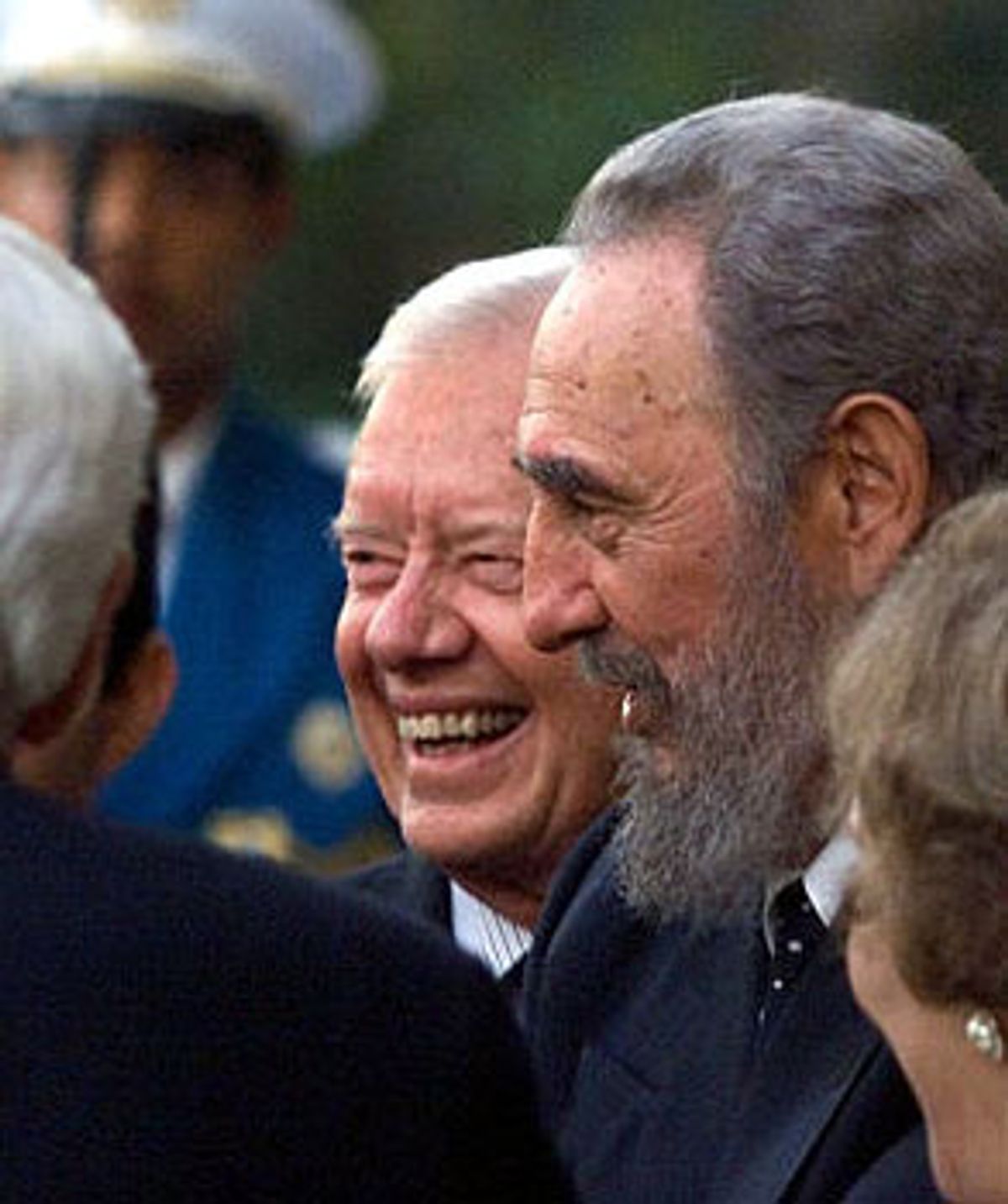
Jimmy Carter

Bravo, Jimmy Carter

His visit can't end Castro's tyranny, Cuba's poverty or the Bush administration's lame policies, but he's the first American politician who has tried to give to Cuba, not just take.

When Jimmy Carter’s feet touched the baking asphalt of Havana’s José Martí airport on Sunday, an amorous and long-delayed honeymoon with the rebel island finally began. Carter’s late-1970s presidency made a huge difference to Cuba, and the former president is still smarter about U.S.-Cuba relations than any other American living today, including the current resident of the White House. When he talks about Cuba, people in both countries listen, and his five-day tour has been almost as historic and monumental as the pope’s 1998 visit, from which Cuba is still enjoying a moderate hangover. Tourists can still purchase (at clearance prices!) the last few olive-drab T-shirts emblazoned with colorful prints of the pope and Castro shaking hands.

You’ll never catch a Cuban wearing one of the pope T-shirts, of course, even at clearance prices. Nobody has the nine bucks (roughly a month’s wages) to waste on such a novelty. Nor will they have the cash to buy the new Carter T-shirts. Those are tourist items. Castro hopes the Carter visit will result not just in T-shirts but also in a new wave of U.S. tourists to buy them, bringing dollars to save the moribund Cuban economy.

For Castro, the world’s foremost media strategist now toiling with his tenth U.S. administration, Carter’s visit has been yet another successful coup fought on the age-old battlefield of newsprint. On the heels of being added to the Axis of Evil by his enemies in Washington, who accused him supporting bio-terrorism — a move timed to interfere with Carter’s visit — Castro got the respected former president to go to bat for him. In a courageous speech Carter challenged the United States to produce evidence of Cuban terrorism and insisted there was none. Of course, Castro also let Carter take to the Cuban airways and talk about democracy and human rights, knowing the openness would play well internationally and not change much domestically. Through it all, Castro had his eye on the prize: Carter’s trip is the latest salvo in a battle to bring back American tourists, and while the battle hasn’t yet been won, the P.R. value of the visit is enormous.

In March 1977, at a time when Cuba was enduring a stretch of poverty very similar to today’s, one of Carter’s first acts was to lift the controversial travel ban on Americans. With the entire economy hingeing on Soviet subsidies, the Cuban people’s faith in Castro’s abilities as an economist had begun to wane before then. The only way out of the mess was to take a stab at tourism as a means to earn the island some hard currency. So the Varadero peninsula, two hours east of Havana, was earmarked in 1976 as Cuba’s first acre of paradise, quarantined specifically for capitalist tourism.

Only 2,500 tourists visited Varadero in 1977. The next year, after Carter lifted the travel ban, the number rocketed to 18,000 — mostly American tourists who came to indulge on the sweetest ribbon of Cuban sand. It was so profitable that the government began banking heavily on tourism as the next big thing, hoping to turn the island into the Caribbean’s new Hawaii.

But alongside the tourism campaign, Castro continued to pursue his satellite wars in Nicaragua and Angola, which created serious strains in Washington. In April of 1982, the Reagan administration reinstated the ban on American leisure travel to Cuba, pulling the plug on the island’s short-lived economic boom. Now 20 years later, the travel ban is still intact, essentially barring all U.S. citizens, with the exception of scientists, journalists, and exchange students, from visiting the island.

Europeans and others still traveled to Cuba, of course, and Castro’s pursuit of tourists became even more aggressive after the Berlin Wall collapsed in 1991 and Cuba’s economy collapsed with it. In 1991, only 350,000 tourists visited the island. By the end of 1999, the regime boasted 1.6 million visitors, providing about one-fifth of the island’s income and surpassing sugar as Cuba’s new crop. The new communist slogan became “With tourism we can win,” and in 2000, 1.8 million came, buzzing in and out of Cuba’s airports at a rate of 5,000 a day.

Yet Cuba appears to be stuck at that number, despite projections that by 2010, 7.5 million visitors would grace its shores. It’s now obvious that because of the global recession and a low visitor-return rate — despite Cuba’s massive investment, tourist amenities are still not what high-end visitors expect, and most people come for the one-time novelty — the numbers are tapering off. The success of Cuba’s economic plan is now absolutely hinged on the forbidden, lucrative, nearby U.S. tourist market.

Enter Jimmy Carter. Castro has been making concessions to the United States since January 1999, when President Clinton began negotiations. He’s courted the U.S. agricultural sector, which has pushed to open trade with this potential $6 billion food market. He’s even reached out to President Bush, expressing sympathy after the Sept. 11 terrorist attacks and not interfering in any way with the U.S. development of the Guantanamo Bay base to house and interrogate al-Qaida prisoners. But he was getting nowhere with a Republican administration beholden to Cuban-exile voters and right-wing ideologues. So in late 2001, Castro made two moves: He purchased $30 million of corn from Louisiana — despite having promised that he’d never purchase “a single grain” of U.S. food until the travel ban was lifted — and he invited Carter to visit.

The timely allegations of the undersecretary of state for international security, John Bolton — that Cuba was providing bio-weapons to the so-called rogue nations of Iran and Libya — were an obvious Miami-orchestrated attempt to derail Carter’s trip, to keep the lid on any agitation to lift the travel ban, and to quash further agricultural trade.

Carter saw through this gambit. He’s seen it all before. In 1977, shortly after he lifted the travel ban, “60 Minutes” aired a segment called “The Castro Connection,” which alleged that Castro was involved with running drugs for the Medellin cartel through Cuba and into the United States. That charge was a staple of Reagan’s policy toward Cuba, and as the Cold War morphed into the war on drugs, Cuba was forced to remain on military alert. The object of war is to never allow the enemy to rest, and Cuba got very little sleep between 1980 and 1999. But in 1999, after finding no evidence — other than hearsay from convicted felons in Miami — that Cuba had ever run drugs, White House drug czar Barry McCaffrey scratched Cuba off the drug-trafficking watch list, and Drug Enforcement Administration officials, along with Coast Guard staff, traveled to Cuba to begin negotiating cooperative efforts in U.S.-Cuba drug interdiction. Cuba’s removal from the drug-watch list was a major blow to anti-Castro conservatives.

Then came Sept. 11. The war on terror replaced the war on drugs, and anti-Cuban animus had to be recast as part of the nation’s fight against terrorists. But rather than be cowed by the allegation that Castro was behind bio-terrorism, the seasoned Carter got pugnacious, denying the charge and demanding that the United States provide evidence.

So what will Carter’s visit accomplish? In the short run — besides sealing Carter’s reputation as a smart, courageous ex-president — it will do very little. In 1998 the pope came and gave much the same spiel, scolding both Castro and the United States for politicking at the expense of the people’s welfare, and almost nothing happened.

For average Cubans, Carter’s visit won’t mean much. Despite Castro’s vaunted literacy, education and health programs, Cubans remain poor, earning an average of 180 pesos, or $9 a month, barely enough to pay living expenses. Things like butter are fading memories from the good old days of the 1980s. Some months there are no beans in the bodegas. Other months there are no peas. Pork is a luxury. Cubans are beginning to realize that until the U.S. travel ban is lifted, there will be no additions to the already scant ration card. The shortages and sacrifices will continue as long as Castro is forced to dump all of Cuba’s tourist earnings back into building hotels in the hope that someday things will change, while he plays a very delicate balancing act between the wobbling faith of his own exhausted people and a desperate need to find more dollars.

Most Cubans like Carter because he means well. And they respect him because he’s always been friendly to Cuba. But his optimism seems almost out of place on an island where a collective pessimism is deeply ingrained. With Carter come good intentions, but the nutritional value of good intentions is negligible for a people subsisting on a meager diet. When Carter began talking about the future to 11 million Cubans on Cubavision TV on Tuesday, much of the island rolled their eyes. They’ve heard all of this stuff about the future and “improved relations” so many times that most have given up on it entirely. The word “future” is such a clichi in Cuba that even Castro bites his tongue now when he gets the urge to say it during speeches, for fear of being taken as senile.

For Castro, Carter’s visit was a big win. It was another grand photo op, upping the Cuban government’s prestige while making the Bush administration look like pushy cowboys. It will likely translate into another handful of illegal American blockade runners with pockets full of dollars who want to see Cuba for themselves. If Carter says it’s safe to visit, then it must be safe. Plus, all those European tourists who were thinking about maybe going to Cuba sometime just saw a little travelogue on CNN. It’s free advertising.

Dissidents in Cuba are praising Carter’s visit, and his meeting with human rights advocates was in fact historic. Still, the 11,000 signatures on the Varela Project petition demanding democracy in Cuba amount to less than one-hundredth of 1 percent of the population. Most Cubans had never heard of the Varela Project until Carter mentioned it in his brave speech Tuesday night, and when Carter leaves, they’ll likely never hear of it again. The former president’s attempt to spread democracy in Cuba was a noble gesture but not likely to have much influence.

What will bring change to Cuba is more pressure from the U.S. business community — which could be spurred by Carter’s visit. Money talks louder than grand gestures, and it’s possible U.S. agricultural and tourism interests will turn up the heat, taking on the waning but still formidable power of the Miami anti-Castro conservatives. In January 1999, a CNN poll found that 75 percent of Americans wish to lift the travel ban, remove the embargo, and normalize relations with the Cuban government. Three years and a new president later, those numbers are increasing, yet Washington has made no progress to meet the desires of American voters.

In fact the Bush administration, fawning over the tiny minority of very powerful Cuban-Americans in Florida, has reversed progress, increasing fines for travel to Cuba even in the face of Castro’s concessions. Next Monday Bush is making a speech to Miami’s Cuban exiles, where he is expected to announce plans to tighten, not loosen, restrictions on travel and trade with Castro’s country.

As for Carter, no matter what happens next, he became the first president to visit Cuba since FDR inspected Guantanamo Bay in 1939, and the highest-ranking statesman to visit since Vice President Richard Nixon went to Havana in 1955. His speech on Tuesday will go down in American and Cuban history for the way it combined criticism of Castro’s tyranny with censure of U.S. policy toward him. More important — and the thing most Americans will miss — is that Carter was the first U.S. politician to come to Cuba to give, not to take, and that in itself is a first in history.

Ben Corbett is writing a book about Cuba.

Not so fast! Obama still hasn’t shaken the Carter syndrome

Memo to the president: In 1980, the economic disasters were at least as damaging as the foreign policy debacles

Jimmy Carter in his famous "moral equivalent of war" fireside chat in 1977.

“It’s Official: Barack Obama is not Jimmy Carter,” writes William Dodson at the New Republic. The Navy SEAL operation in Abbottabad, Pakistan, was “America’s Entebbe,” declares Peter Beinart in the Daily Beast, referring to the 1976 hostage rescue carried out by Israeli commandos at a Ugandan airport. Obama has “defied the Jimmy Carter caricature the right delights in,” observes Salon’s own Steve Kornacki.

These favorable (to Obama) comparisons are not without merit. Operation Eagle Claw, the failed attempt to rescue the Americans held hostage at the U.S. Embassy in Iran in April 1980, marked one the low moments in American military history. A sandstorm rendered three helicopters unable to function, and another crashed into a C-130 transport aircraft during the hasty evacuation, killing six servicemen. The debacle undoubtedly contributed in some part to Jimmy Carter’s failure to win reelection later that year. Carter didn’t personally pilot those helicopters, but his legacy has been stained with the embarrassment ever since.

The contrast with how history is likely to regard Obama’s role in killing Osama bin Laden couldn’t be sharper. The president took a big risk, and it paid off. In the short run, his poll numbers are already up sharply, and in the domain of foreign policy and national security, conservative critics have suddenly lost their footing.

But let’s not get carried away with the Carter comparisons quite yet. There’s  still plenty of room for Republicans to hang the Carter albatross around Obama’s neck. The disaster in Iran wasn’t the only reason that 1980 was an awful, awful year for Jimmy Carter. There was also the not-so-trifling matter of an economy running completely off the tracks.

From mid-1979 to early 1980, gas prices rose 60 percent. By March inflation was surging at a ridiculously high rate of 18 percent. GDP growth fell by an astonishing 10.2 percent in the second quarter, unemployment spiked to 8 percent in the summer, and the bond market completely freaked out over a bigger-than-expected government budget deficit.

A cover story from Time magazine on March 24, 1980, sets the scene:

As Jimmy Carter stepped before the television cameras in the East Room of the White House last Friday, his task was not just to proclaim another new anti-inflation program but to calm a national alarm that had begun to border on panic. Inflation and interest rates, both topping 18 percent, are so far beyond anything that Americans have experienced in peacetime — and so far beyond anything that U.S. financial markets are set up to handle — as to inspire a contagion of fear. Usually confident businessmen and bankers have begun talking of Latin American-style hyperinflation, financial collapse, major bankruptcies, a drastic drop in the American standard of living.

Two months before the presidential election, the economy easily trumped international affairs as the primary concern for voters, wrote W. Carl Biven in “Jimmy Carter’s Economy: Policy in an Age of Limits.”

Reagan was not elected in 1980 because he was viewed as strong by the public in terms of solving the Iranian crisis. When respondents were asked to choose the candidate “best able to handle the Iranian situation” in a poll two months before the election, only 33 percent selected Carter, an unsurprising result; on the other hand, only 39 percent selected Reagan. But the challenger hit a sensitive nerve when he asked voters during a campaign debate whether they were better off than they were four years before. It was not Iran but inflation and unemployment that were the uppermost concerns in the minds of voters. Asked in the same survey two months before the election to identify the “most important problem facing the nation,” 61 percent named “the high cost of living,” while only 15 percent chose “international problems.”

The parallel with Obama doesn’t work perfectly: We’ve already had our financial collapse, major bankruptcies and dramatic standard-of-living drop. So-called core inflation — which excludes food and energy prices — is safely under control. So far, the bond market is shrugging off government deficits that make Carter-era numbers seem ludicrously small, and unemployment is falling instead of rising. But we still shouldn’t be quite so quick to consign the Carter-Obama comparison to the ash bin of history. The economy will tell the tale of Obama’s presidency, and right now, poll respondents think the country is headed in the wrong direction.

Unfortunately for the current occupant of the White House, our economic challenges can’t be solved by merely sending in an elite group of Navy SEALs, despite the pretensions of buffoons like Donald Trump, who told a Las Vegas audience that he would solve the problem of rising gas prices by telling Saudis “you’re not going to raise that fucking price!” That’s a nice sentiment, but falls short in the area of actual implementation. Any military attempt to force Saudi Arabia’s hand would, of course, throw the entire Middle East into utter chaos and likely spark the worst oil shock of all time.

Bivens summarizes a Theodore H. White observation to the effect that “in the Carter years, inflation and the hostage crisis were not unconnected in the minds of voters. The psychological effect on voters was similar; they both contributed to the same sense of helplessness. We couldn’t free the hostages and we couldn’t stop the inflation.”

Obama’s future prospects depend in large part on whether voters feel similarly helpless about their economic status in the next 18 months. One could ask: Why doesn’t Obama apply the decisiveness he devoted to Osama bin Laden to economic policy? But Obama’s challenge is that changing the economic status quo is hard, both because global economic trends are difficult to affect through government levers, and because government itself doesn’t work very well. Getting 60 votes in the Senate is much more formidable than getting past the obstacles presented by a walled compound in Pakistan.

But still, when Obama declared during his deficit reduction speech that he would refuse to extend Bush’s tax cuts for the wealthy ever again, he sounded like the kind of guy adamant enough to launch a risky military operation; whether he has the courage to actually go through and back up his tough talk as an election campaign comes down to the wire in 2012 remains to be seen. His budget negotiation strategy with Republicans smacks a lot more of appeasement than it does ruthless decision-making in the national interest. Has he ever stared across the table at Mitch McConnell and John Boehner with the same gimlet-eyed glare that he demonstrated in the now iconic photograph showing the president and key staff members receiving updates on the Osama raid in the White House situation room? If not, why not?

If unemployment continues to fall and Obama steers his way through the endless budget showdowns without driving the economy back into recession, he has an excellent chance of getting reelected. But all those chest-pumping pundits who think the execution of Osama bin Laden has exorcised all the Democratic nightmare of Jimmy Carter ineffectiveness will be surprised to see how fast the comparisons come back if 2012 proves to be anything like 1980.

Continue Reading Close
Andrew Leonard

Andrew Leonard is a staff writer at Salon. On Twitter, @koxinga21.

How Reaganism actually started with Carter

Think Reagan was the first modern president to preach low taxes, free markets and morality?

Jimmy Carter

The hundredth anniversary of Ronald Reagan’s birth has produced disagreement over his policies among conservatives and liberals, but agreement on one point: Reagan’s presidency marked the end of one era in American politics and the beginning of a new one. An epochal shift indeed took place — but it happened in 1976, not 1980. The Age of Reagan should be called the Age of Carter, in politics and policy alike.

In politics, both Carter and Reagan sought to exploit the “white backlash” in the aftermath of the civil rights revolution that had led many white Southerners and white Northern “ethnics” to defect from the Democrats to support third-party populist candidate George Wallace. Reagan did so by beginning his general election campaign in 1980 in Neshoba County, Miss., where white supremacists had recently fire-bombed a black church and had earlier murdered three Northern civil rights activists, Andrew Goodman, Michael Schwerner, and James Chaney. In a thinly disguised appeal to white Southern racism, Reagan declared, “I believe in states’ rights.”

Jimmy Carter used similar coded language in fishing for votes from white ethnics in the North who objected to blacks moving into their neighborhoods. In an interview with the New York Daily News in April 1976, Carter said: “I see nothing wrong with ethnic purity being maintained. I would not force a racial integration of a neighborhood by government action.” A few days later, questioned about this remark, Carter elaborated: “What I say is that the government ought not to take as a major purpose the intrusion of alien groups into a neighborhood simply to establish their intrusion.” Jesse Jackson called this “a throwback to Hitlerian racism.” Carter not only won a majority of the Southern vote but also did well among white ethnics. (The quotes are from Steven F. Hayward’s “The Real Jimmy Carter.”)

The opportunistic race-baiting of Reagan and Carter was similar to that of the assassinated liberal icon Robert F. Kennedy Jr., who in a May 31, 1968, California television debate with Eugene McCarthy, his rival for the Democratic presidential nomination, said in response to McCarthy’s support for public housing: “You say you are going to take ten thousand black people and move them into Orange County? It is just going to be catastrophic.”

In foreign policy, Carter attacked the Nixon-Ford administration from the right, in the same way that John F. Kennedy in 1960 had accused Eisenhower and Nixon of being soft on the Soviets. Like Reagan, Carter rejected the coldblooded realpolitik of Nixon and Kissinger and insisted that foreign policy had to be based on the promotion of human rights and democracy. Many hawkish neoconservative Democrats hoped that Carter would be their standard-bearer. When President Gerald Ford asserted that Yugoslavia, Romania and Poland were not “dominated” by the Soviet Union in a presidential debate, Carter used Ford’s statement to portray himself as the anti-Soviet hard-liner in the presidential race.

It was Carter, not Reagan, who brought the religious right into national politics. Even though they turned against him later, Carter won the Southern evangelical vote in 1976 by advertising himself as a born-again Christian. Like Reagan later, Carter, the folksy farmer and veteran from Plains, Ga., appealed to the nostalgia of white Americans in the 1970s for a simpler, more rural, more traditional society.

Carter, not Reagan, pioneered the role of the fiscally conservative governor who runs against the mess in Washington, promising to shrink the bureaucracy and balance the budget. Early in his administration, Carter was praised by some on the right for his economic conservatism. Ronald Reagan even wrote a newspaper column titled “Give Carter a Chance.” The most conservative Democrat in the White House since Grover Cleveland, Carter fought most of his battles with Democratic liberals, not Republican conservatives.

Carter, not Reagan, presided over the dismantling of the New Deal regulatory system in airlines, railroads and trucking. Intended to reduce inflation by reducing the costs of essential infrastructure to business, Carter’s market-oriented reforms have backfired, producing constant bankruptcies and predatory hub-and-spoke monopolies in the airline industry, an oligopolistic private railroad industry that has abandoned passenger rail for freight, and underpaid, overworked truckers.

Today’s Democrats would like to forget that supply-side economics was embraced by many members of their own party during the Carter years, while it was resisted by many old-fashioned fiscal conservatives in the GOP. As the economist Bruce Bartlett points out in a history of supply-side economics: “By 1980, the JEC” — Joint Economic Committee of Congress — “was a full-blown advocate of supply-side economics, despite having a majority of liberal Democrats, such as Senators Edward Kennedy (D-MA) and George McGovern (D-SD). Its annual report that year was entitled, ‘Plugging in the Supply Side.”"

According to the chairman of the JEC, Sen. Lloyd Bentsen, who went on to be President Clinton’s secretary of the Treasury, “The 1980 annual report signals the start of a new era of economic thinking. The past has been dominated by economists who focused almost exclusively on the demand side of the economy … [T]he Committee recommends a comprehensive set of policies designed to enhance the productive side, the supply side of the economy.”

The chairman of the Federal Reserve arguably has more influence over the economy than Congresses or presidents. Fed Chairman Paul Volcker fought the raging inflation of the 1970s by hiking interest rates sharply, deliberately causing the worst American recession between the Great Depression and today’s Great Recession. He then encouraged a boom by lowering rates. Volcker was appointed in 1979 by Carter and reappointed in 1983 by Reagan.

In defense spending, as in supply-side economics, Reagan continued what his predecessor in the White House had begun. The reversal in the post-Vietnam decline of American military spending began under Carter, following the shock of the Iranian revolution and the Soviet invasion of Afghanistan. From a starting point of 4.7 percent of GDP, Carter called for raising defense spending to 5.2 percent of GDP in his final budget for fiscal year 1981. The Carter administration called for defense spending to rise even further by 1987 to 5.7 percent of GDP — only a little below the 6.2 percent where it peaked in 1986.

The “Carter doctrine,” which formally made the Persian Gulf a vital interest of the United States, began the transition from the Cold War focus on Europe and East Asia, where the U.S. had fought in Korea and Vietnam, to the Greater Middle East, where the U.S. since Carter has fought five wars — Bosnia, Kosovo, two wars in Iraq, and Afghanistan — as well as numerous minor conflicts like the intervention in Somalia.

While Carter and Reagan disagreed on many things, they shared the neoliberal consensus that continues to provide the common assumptions for presidents of our own day like George W. Bush and Barack Obama. The New Deal consensus, which lasted from the 1940s until the 1970s, included “Modern Republicans” like Eisenhower, Nixon and Ford. Gerald Ford was the last New Deal president and Jimmy Carter was the first neoliberal president. The Great Recession has discredited much of the neoliberal consensus, but no alternative has yet won wide assent among policymakers and thinkers.

Even if Ronald Reagan had not been born a century ago, there would have been some other president in the same era with plain-folks mannerisms who appealed to nostalgia for a simpler past on the part of American voters who were upset by racial and cultural transformations; who posed as a plain-speaking outsider who could rescue Americans from the Washington insiders implicated in scandals like Watergate; who would promise to cut bloated government budgets and free the market from the allegedly suffocating constraints of New Deal era regulation; who would bring morality back to foreign policy and respond forcefully to the perceived aggression of the Soviet Union. A president, in other words, like Jimmy Carter.

Continue Reading Close

Michael Lind’s new book, "Land of Promise: An Economic History of the United States", will be published in April and can be pre-ordered at Amazon.com.

Jimmy Carter speaks on “earth-shaking” Egypt

The former president thinks Mubarak has to go

FILE - In this Tuesday, Oct. 12, 2010 picture, former President Jimmy Carter, left, and OPEC Fund for International Development Director General Suleiman Jasir Al-Herbish, speak in Atlanta, Ga. before signing an agreement worth $1 million to fund the Carter Center's programs to eliminate Guinea worm and river blindness diseases. (AP Photo/David Goldman, File)(Credit: AP)

Former President Jimmy Carter says the political unrest and rioting in Egypt is an earth-shaking event and that President Hosni Mubarak probably will have to leave office.

The former president brokered a peace agreement between Israel and Egypt in 1978. He calls the unrest the most profound situation in the Middle East since he left office in 1981.

The Columbus Ledger-Enquirer reported Carter’s remarks to the Sunday school class he teaches at Maranatha Baptist Church in Plains.

Mubarak was vice president when the peace accord was signed and became president in 1981 when Anwar al-Sadat was assassinated by opponents of the agreement with Israel.

Carter said that as Mubarak’s 30-year rule has continued, the Egyptian leader has become more politically corrupt.

Will Carter finally defeat guinea worm?

The former president has waged war against the disease for more than two decades. The last battle is in the Sudan

In this Nov. 4, 2010 photo, Ajak Kuol Nyamchiek, 7, watches while John Lotiki, a nurse with the Carter Center, bandages the blister on her leg from where a guinea worm is slowly emerging in Abuyong, Sudan. Nyamchiek is a patient at Center’s guinea worm case containment center. Nurses at this center in Abuyong, a village in Awerial County in Southern Sudan’s Lakes state, bandage the worms twice daily, after gently pulling the worms out several inches each time. If they break while they are being pulled out of the swollen blisters, the wounds become infected and the worms withdraw back into the body, prolonging the pain for the victims. (AP Photo/Maggie Fick)(Credit: AP)

Lily pads and purple flowers dot one corner of the watering hole. Bright green algae covers another. Two women collect water in plastic jugs while a cattle herder bathes nearby.

Samuel Makoy is not interested in the bucolic scenery, though. He has an epidemic to quash.

Makoy points out to the women the fingernail-length worm-like creatures whose tails flick back and forth. Then a pond-side health lesson begins on a spaghetti-like worm that has haunted humans for centuries.

This fight against the guinea worm is a battle former U.S. President Jimmy Carter has waged for more than two decades in some of the poorest countries on earth. It is a battle he’s almost won.

In the 1950s the 3-foot-long guinea worm ravaged the bodies of an estimated 50 million people, forcing victims through months of pain while the worm exited through a swollen blister on the leg, making it impossible for them to tend to cows or harvest crops. By 1986, the number dropped to 3.5 million. Last year only 3,190 cases were reported.

Today the worm is even closer to being wiped out. Fewer than 1,700 cases have been found this year in only four countries — Ethiopia, Ghana, Mali and Sudan, where more than 95 percent of the cases are. The worm’s near-eradication is thanks in large part to the efforts of Carter and his foundation.

“I’m still determined to outlive the last guinea worm,” Carter told The Associated Press in a phone interview. The 86-year-old set that goal in the 1980s, when his center helped eliminate guinea worm from Pakistan and other Asian nations.

The Carter Center has battled the worm for 24 years through education and the distribution of strainers that purify drinking water. It has helped erase guinea worm in more than 20 countries, and it believes the worm will follow smallpox — which was wiped out in the late 1970s — as the next disease to be eradicated from the human population.

But Carter staff members say ending the disease in Southern Sudan may prove the most difficult, because of how remote the remaining endemic areas are and the fact that the worm is found in semi-nomadic pastoralists who have little education and low sanitation standards.

Another complicating factor: Southern Sudan is scheduled to hold an independence referendum Jan. 9, a vote that is likely to lead to separation from the Khartoum-based north. The process has been peaceful so far, but any conflict that arises would derail eradication efforts.

As Carter put it: “War and good health are incompatible.”

“There’s no way we can go into an area that is at war,” he said.

Although the Carter Center has been fighting guinea worm in Sudan since 1994, its efforts only made significant headway following the signing of a 2005 peace deal that ended two decades of north-south civil war.

The 20 years of fighting prevented the Carter Center and other authorities like the World Health Organization from conducting a comprehensive assessment of guinea worm here until 2006. Since then, eradication programs have reduced the number of yearly cases by about 90 percent.

The few remaining cases exist in off-the-map places. In many sites, the Carter Center is the only outside presence — no other international or Sudanese organizations have set up shop. Even a government presence is rare.

“We are in the most remote places because that’s where the guinea worm is,” said Doug Tuttle, 31, a technical adviser with the Carter Center who lives in a tent in the village of Abuyong. He oversees a staff of paid field officers and guinea worm volunteers whom he visits on his motorcycle or by walking anywhere from 30 minutes to two hours.

Reaching Abuyong requires abandoning the dirt road for a narrow path hacked through dense woods that was only forged after the Carter Center moved in. On a recent bone-rattling ride to Abuyong in the center’s hulking, Russian-made truck, the vehicle forded flooded ravines as the occasional baboon scampered away.

At the picturesque pond outside Abuyong, Makoy explains to the women that if someone enters the pond with a guinea worm hanging out of a blister, the worm will dump larvae that will mate with the white worm-like creatures — copepods — and render the pond endemic with guinea worm.

Makoy doesn’t use the words “endemic” or “copepods” with the women. His aim is to deliver a more pragmatic message: that filtering water is the key way to avoid contracting the disease.

“This work requires a passion inside you to keep you going day after day. Even if you must repeat the same things 100 times to the same person — education, education, education,” said Makoy, who works for the Southern Sudanese government’s Ministry of Health and has collaborated with the Carter Center since 1996.

Makoy hands both women mesh filters and explains how to use them. Then he repeats a message he has delivered thousands of times — that even one person with a hanging worm who enters a water source can trigger scores of cases in the next transmission season, roughly a year after someone drinks tainted water.

Change is difficult here. As someone who comes from a pastoralist tribe, Makoy knows that cattle herders on the move don’t think twice about drinking from a brown puddle. In a place like Abuyong, where the few water hand pumps each cost thousands of dollars because water lies so deep under ground, accessing any water — infected or clean — is a blessing.

By January, the cattle camp next to Abuyong will have cleared out and the large pond dry. The 500-plus cattle and their keepers will move to the Nile River, where they will remain for the blisteringly hot dry season.

It won’t be until May that some begin to notice red puffy blisters developing on their legs and feet, the sign of a soon-to-emerge guinea worm.

That’s what 7-year-old Ajak Kuol Nyamchiek had to deal with a couple weeks ago as a worm exited her foot at a Carter Center clinic in Abuyong, where worm victims stay while the worms make their painful exits. Nurse John Lotiki slowly pulled the thin, white worm out of the girl as Ajak looked on with pain — and appreciation.

Pulling a worm out is a weekslong process of rolling out the worm by coiling it on a pinkie-length stick, about an inch (2.5 centimeters) a day. Aside from surgery, this centuries-old extraction method is the only way the guinea worm can be removed safely.

Carter, whose center began working in Sudan in 1987, said he knows the people appreciates the work his team does.

“They know we’re working for freedom and they know we’re working for peace,” Carter said. “And they know that we are there to end the plight of diseases that they should not still have.”

——

On the web:

The Carter Center: http://www.cartercenter.org/health/guinea–worm/mini–site/index.html

Continue Reading Close

Jimmy Carter’s Tea Party

An angry right-wing revolting against a Democratic president and "impure" Republicans: We've seen this before

Former president Jimmy Carter fields a question during his news conference in Washington, October 10, 1978.

Jimmy Carter has an Op-Ed in the USA Today that makes an excellent point: The 1970s saw the development of a political movement very similar to the Tea Party of today. Unfortunately, he doesn’t seem to quite understand the nature of that movement.

In Carter’s telling, his dark horse 1976 presidential campaign became a vehicle for Tea Party-ish sentiments. “We capitalized on deep dissatisfaction with the policies and practices of government officials,” he writes, “especially those who served in Washington.” In reality, though, the Tea Party of his era sprang up from the same place and for the same basic reasons as the Tea Party of today. Then as now, the presence of a Democratic president with substantial Democratic majorities fed a conservative revolt (which was also directed at “establishment” Republicans deemed by the right to be too cooperative with Democrats).

When Carter came to office in 1977, Democrats controlled 62 seats in the Senate and 277 in the House. (This was the last time before last year that a Democratic president enjoyed a filibuster-proof majority, although filibusters weren’t deployed nearly as commonly back then.)

Carter found himself on the wrong side of an emotional ideological divide when he began pushing for the Panama Canal Treaty in his first year. The New Right, a growing force within the GOP since Barry Goldwater’s 1964 nomination, screamed that Carter was selling out American sovereignty and demanded that the Senate reject a treaty.

To the burgeoning conservative movement, the canal became a litmus test issue. Ronald Reagan, who had nearly stolen the presidential nomination from Gerald Ford in 1976, helped organize a national “caravan” against the treaty, one that attracted support from more than a dozen conservative members of Congress. But the GOP establishment resisted. Howard Baker, the Senate GOP leader, backed the treaty while Bill Brock, the Republican national chairman, refused to offer party money to Reagan’s caravan. Finally, the treaty passed with one vote to spare — and with Republicans offering the crucial support that put it over the top.

Enraged (and already emboldened by their near-miss with Reagan in ’76), conservatives committed themselves to using the 1978 midterms to take out not just Democrats, but also Republicans who sold them out on the treaty. In this sense, the Panama Canal Treaty can be considered the Carter-era’s equivalent of TARP, which seems to animate today’s tea Party movement more than any other issue.

In the ’78 primaries, conservative activists pulled off a shocking upset in New Jersey, ousting four-term Republican Sen. Clifford Case (a treaty backer) and replacing him with Jeffrey Bell, a former Reagan aide. And in Massachusetts, two-term liberal Republican Sen. Ed Brooke, another key treaty supporter, barely survived a primary challenge from Avi Nelson, a right-wing radio host. And in New Hampshire, Colorado, and Iowa, among other states, the right succeeded in nominating very conservative treaty foes to run against pro-treaty Democrats.

In November, Carter’s Democrats ended up losing 15 seats in the House and 3 in the Senate. It wasn’t a bloodbath like the one Obama’s Democrats are expected to face this year, but this was partly because ideology and party label weren’t so synced up back then. What was more notable was which Democrats lost, and whom they were replaced with. For instance, Sen. Floyd Haskell, a pro-treaty Democrat from Colorado, was ousted by the far-right William Armstrong. (How conservative was Armstrong? A few years later, he was actually touted by activists as an attractive prospect to challenge then-President Reagan from the right in 1984 primaries.) In New Hampshire, Gordon Humphrey took out Democratic Sen. Thomas McIntyre. And in Iowa, after upsetting a moderate establishment favorite in the GOP primary, Roger Jepsen unseated Sen. Dick Clark, who had enjoyed a 70 percent job approval rating just a year earlier.

The ’78 midterms marked a key moment in the Republican Party’s evolution into a cohesive, ideologically conservative party — a transformation that would be sealed with Reagan’s  nomination and election in 1980. Carter is long gone from the White House, but all these years later, we’re seeing something similar at work, with conservatives simultaneously revolting against Democratic  control of Washington and “impure” Republicans. The biggest difference is that today we have a catchy name to describe this.

Continue Reading Close
Steve Kornacki

Steve Kornacki writes about politics for Salon. Reach him by email at SKornacki@salon.com and follow him on Twitter @SteveKornacki

Page 1 of 11 in Jimmy Carter