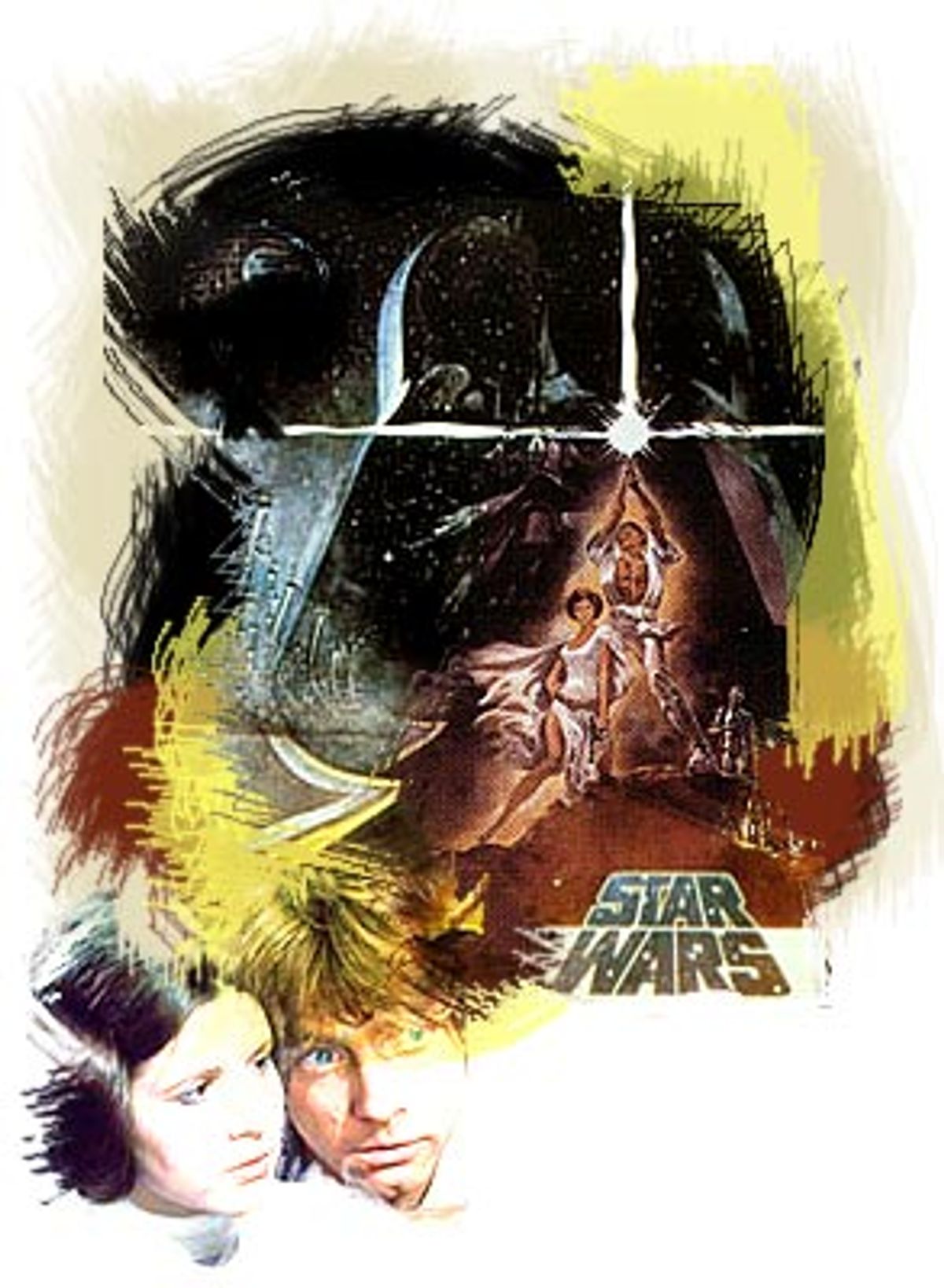
Star Wars

“Star Wars”

Who cares about "Attack of the Clones"? After reinventing popcorn cinema with his giddy space western, George Lucas can do whatever he wants.

  • more
    • All Share Services

It’s not often that our perception of a classic movie becomes transformed two decades after it was first released. Although today’s film reissues often include new footage — either to atone for studio hack jobs, like Orson Welles’ “Touch of Evil,” or indulge bloated director’s cuts, like Francis Ford Coppola’s “Apocalypse Now Redux” — something altogether different has happened to George Lucas’ original “Star Wars.” And I’m not talking about the “Special Edition” released in 1996.

The movie’s extensive back story, existing solely in our imagination for the first 22 years after its release (the revelation that Luke’s father was once a gifted Jedi Knight, for example, or that the fascistic Empire was once a democratic republic) now has been packaged into cinema’s biggest prequels. Now watching aged Ben Kenobi talk to Luke about his days as a young Jedi in “Star Wars” we flash in our minds to Ewan McGregor’s young Obi-Wan dueling Darth Maul in “The Phantom Menace.” When Princess Leia talks of her mother on the doomed planet Alderaan, we picture Natalie Portman’s Padmi Amidala. And Darth Vader is no longer just the mysteriously evil half-man half-machine of the original trilogy, but flesh-and-blood young Anakin Skywalker of Episodes I-III. It’s impossible to watch these characters in the same way.

Because so many were disappointed by “Phantom Menace,” it’s easy to blame Lucas for indirectly tainting our perception of the originals, for the sense of mystery in “Star Wars” achieved through its allusions to the past is now gone. Still, this isn’t fair to Lucas. For starters, the most rabid fanatics of the original trilogy are part of a demographic of adults who were children when the first films came out and had counted on “Menace” to provide a porthole to their childhood. That’s not Lucas’ responsibility. He made one of the greatest movies ever. We can’t expect him to be content creating video games and recording DVD commentary for “Howard the Duck.” No one can tell Lucas that he has no right to keep making “Star Wars” movies, just like we can’t tell the Rolling Stones to quit touring.

Although the prequels may have changed our perception of the original film, they also shed new light on its greatness. “Star Wars” is the ultimate diversion, a movie universe where the three-dimensional complexities of modern life have been boiled down to essential struggles: David vs. Goliath; good vs. evil. It’s a cliché — and a reality — that the film is a religion to its fans. And yet at its core “Star Wars” is an old-fashioned thrill ride. After a long cycle of cynical, ironic films in the late ’60s and early ’70s, the film’s exuberance is one of countless ways that Lucas broke the mold.

“Star Wars” arrived just after Steven Spielberg’s “Jaws” rollicked movie fans and the movie biz by revitalizing the popcorn adventure yarn, simultaneously inaugurating the era of the wide release and massive box office payoffs. Lucas’ film was even more successful; you could say “Jaws” knocked out the old Hollywood and “Star Wars” killed it. But since his film had such unprecedented popularity, Lucas gets blamed for a regrettable industry-wide transformation to the age of blockbusters. Yet as great as the early ’70s era of personal filmmaking (that of “Chinatown,” “The Godfather,” “Five Easy Pieces” and “One Flew Over the Cuckoo’s Nest”) might have been, if the price for continuing that era were not to have “Star Wars,” I would refuse to pay it.

In this publication and elsewhere, the roots of and influences on “Star Wars” have been continually debated. Is it the ancient mythological form seen in works like Homer’s “Iliad” and “The Gospel of Saint Matthew” that Lucas’ film draws from, or is it the 20th century sci-fi of Ray Bradbury and Frank Herbert? Is it Akira Kurosawa samurai films “Star Wars” most resembles, or Flash Gordon serials? How about Carlos Castaneda or “Buck Rogers,” “Quo Vadis” or comic books?

In the end, it just doesn’t matter. The important thing is that Lucas distilled these myriad influences into a vision that is clearly all his own. And as New York Times critic Vincent Canby noted in his original 1977 review, “The way definitely not to approach ‘Star Wars’ is to expect a film of cosmic implications or to footnote it with so many references that one anticipates it as if it were a literary duty. It’s fun and funny.”

With gargantuan spaceships, a bevy of eclectic aliens and a breathless succession of rollicking adventures, “Star Wars” is a fantasy Lucas made for 12-year-olds. “I saw that kids today don’t have any fantasy life the way we had,” Lucas says in Peter Biskind’s book “Easy Riders, Raging Bulls.” “They don’t have Westerns, they don’t have pirate movies … the real Errol Flynn, John Wayne kind of adventures. Disney had abdicated its reign over the children’s market, and nothing had replaced it … [so] I’ve made what I consider the most conventional kind of movie I can possibly make.”

To bring the adventures in “Star Wars” to life, Lucas and his team — which included production designer John Barry, special photographic effects supervisor John Dykstra (who had worked on Kubrick’s “2001″), cinematographer Gilbert Taylor and set decorator Roger Christian — reinvented the special effects industry. Lucas’ Industrial Light and Magic, now a longtime special effects leader, was formed in an old warehouse in Van Nuys, Calif., to bring the film’s story to life. They built the models that would be seen on screen — and they built the equipment to make them. It’s no overstatement to say that Lucas and his team’s leaps in special effects helped revolutionize modern moviemaking. And it isn’t just the shots of Tie Fighters, X-Wings and the Millennium Falcon soaring through space that are spectacular. Lucas’ camera finds moments of startling beauty, particularly on Tattoine, as Luke Skywalker first dreams of adventure — sunset from twin stars shining above — and then, after his aunt and uncle are killed, steels himself for its reality.

The story begins, as all the subsequent “Star Wars” films have, with a massive spaceship crawling into view: This time it’s Princess Leia’s rebel spaceship, with stolen plans of the Galactic Empire’s massive Death Star, running futilely from an Imperial Star Destroyer. In the care of robot droids C3PO and R2D2, the plans are jettisoned onto planet Tattoine where they will eventually wind up in the hands of Luke Skywalker, the movie’s reluctant hero. It’s in Luke’s hands that the “New Hope” of the film’s subtitle will, with the help of Kenobi and Han Solo, be realized.

As has been often discussed, “Star Wars” follows a classic mythological template articulated in Joseph Campbell’s “The Hero With a Thousand Faces”: the call to adventure (“You must come with me to Alderaan,” Obi-Wan tells Luke); refusal of the call (“I’ve got chores to do,” Luke protests); supernatural aid (Obi-Wan saves Luke from the Sandpeople); the crossing of the first threshold (surviving the “scum and villainy” of Mos Eisley Space Port); the road of trials (captured by the Death Star tractor beam); the meeting with the goddess (rescue of Princess Leia); the magic flight (attack on the Death Star); rescue from without (Luke saved by Han Solo); and freedom to live (the medal ceremony).

These themes can be found in countless other works, and that’s part of the point: Some movies succeed by bending or breaking from traditional storytelling forms; “Star Wars” reminds us why these forms endure. And all these mythological antecedents wouldn’t matter if Luke, Han, Leia, Chewbacca, Obi-Wan, the droids and Darth Vader did not have such lasting power as characters, particularly cinematic characters. Luke is the noble young warrior, and Han (said to be modeled after Lucas’ mentor Francis Ford Coppola) is the skeptic; C3P0 and R2D2 are comic relief. Not only does rascally Han perfectly balance out Luke’s earnest naiveti, but he and Leia make a classic screwball comedy pair, recalling Grant and Russell in “His Girl Friday” or Gable and Colbert in “It Happened One Night.” The droids are right out of Laurel and Hardy. Chewbacca is the quintessential sidekick, a Tonto to Han’s Lone Ranger. Vader is Nosferatu leading the Nazis. Yet thanks to the actors involved, they are more than just archetypes. For this and other roles, Harrison Ford has come to be called the Humphrey Bogart of his generation; Fisher is superb; and if Mark Hamill is not exactly a master thespian, can you picture anyone else in the role? Lucas has never been mistaken for an actor’s director, but under his eye the characters perform with the essential mix of earnestness and humor.

Herein lies one of the biggest keys to “Star Wars”: Lucas’ genius for balancing the solemnity of its classic good-vs.-evil struggle with an enthusiastic embrace of innocent goofiness. The dialogue and bland anti-intellectualism may seem embarrassingly trite at times; during production Ford famously said to Lucas, “George, you can type this shit, but you sure can’t say it.” But ultimately, criticizing this movie’s dialogue is like saying “Annie Hall” doesn’t have enough action sequences, or “Schindler’s List” doesn’t have enough romance. The dialogue succeeds in diffusing a story that might otherwise take itself too seriously. Lucas knew what he was doing when he wrote cheesy lines like Luke’s famous bellyache to Uncle Owen after being commanded to do his chores: “But I was going in to Toshi Station to pick up some power converters!” It’s a way of ensuring that the somber weight of this galactic struggle doesn’t suffocate us, as “Phantom Menace” and to a lesser extent “Attack of the Clones” and even the critically preferred “The Empire Strikes Back” sometimes do. Campy yet profound, comical yet electrifying, “Star Wars” is exactly what it wants to be — nothing more, nothing less — and the way it succeeds within its own limitations is part of what makes it great.

At the same time, “Star Wars” is indeed an old-fashioned morality play. Coming just three years after Watergate and amid the heyday of disco and cocaine, it is both of its time and completely contrary to it — while ultimately transcending any time period. Surely plenty of movie lovers who cherished the lone-wolf films that had flourished in the earlier part of the decade couldn’t help feeling alienated (pardon the pun) by this black-and-white portrayal of good vs. evil. Yet each genre or filmmaking style should make us appreciate the other: Some movies diverge from our traditional moral compass, while others ricochet us back. Having Martin Scorsese and Coppola on one end of the spectrum and Lucas and Spielberg on the other is what made the 1970s such a great movie decade. If one type of movie eventually crowded out the other, that certainly is a shame. But don’t blame Lucas and Spielberg if the blockbusters that came after theirs weren’t always as good.

In the end, it is the unbridled enthusiasm Lucas brings to “Star Wars” that, no matter how our perception of it may have changed over the years, makes it all but impossible to avoid being swept away. If the prequels of this era don’t have that same brilliant simplicity, with their handwriting-on-the-wall sense of galactic doom, maybe it’s because Lucas is not the eager idealist anymore, but the sobered middle-aged man who maybe no longer believes so unequivocally that the revolution can be won. If that’s the case, it makes the original “Star Wars” all the more priceless.

Brian Libby has written for the New York Times, Premiere and the Christian Science Monitor.

Trust me on this: “Star Wars”

A New York Mets all-star explains how he plans to pass the power of the Force on to his son. First in a new series

  • more
    • All Share Services

Trust me on this: (Credit: Shutterstock/Salon)
As told to David Daley

I saw “Star Wars” on VHS originally when I was 6. I was just captivated. I would come home every day after school, and before I would do my homework, I would pop it in and watch it, because I was largely alone. Both my parents worked. I remember the play button being green, the pause button was red, and the way the top would pop up and you’d slide the tape in and clank it down. And I remember knowing every line.

As I grew, I began to see “Star Wars” as a metaphor for so much – whether it was the natural depravity of man, or the redemption of man, or the relationship between a father and a son in Luke Skywalker and Darth Vader. That relationship can be broken and redeemed over the course of the trilogy. I really related and connected with it, and it encapsulated a lot of what I want to teach my children – people make mistakes, and they can ultimately be redeemed, even if those mistakes seem egregious, you know, in Darth Vader’s case. That there is a choice to be made between what side you choose in life. Our faith is a big part of our family, so the Force has special meaning for me. There’s just so many things that I think my son would get, that I hope my son would get.

Eli is 5 now, and we’ve watched the first one, but I want it to be a rite of passage – and I want to make sure that I watch it with him. So every year, it’s the next one. He’ll look forward for a whole year to his 6th birthday and “The Empire Strikes Back.” When he turns 7, we’ll watch “Return of the Jedi.” And then we’ll probably start them over. Those first three films were just so pure. (I won’t show him the other ones until later. This is about the three that I grew up with.)

My dog was named Luke Skywalker. Even now when I come out to pitch, they play the “Imperial March.” So I have had some good times with it. The thing that resonates with me, that I want my son or my daughters to cling to, is just that quintessential human emotion of hope that runs through every episode. In fact, I think the title of the very first one is “A New Hope.” I want to be able to communicate that to my son – the essence of what hope is and how you see it played out in the movies. But there’s so much more there. It sets the stage for great conversation. It’s very relatable. Hey, remember when Luke was tempted by the dark side in “Star Wars”? Well, you know — it happens. Here are some ways to deal with it. So it’s perfect.

My favorite is “The Empire Strikes Back,” when Luke finds out who his father really is, and is destroyed by it, just utterly dejected. But his whole being is not destroyed – there’s still hope. That scene: I know there’s still good in you. There’s good in you. I sense it. And, of course, as a kid I remember liking all the fights and the spaceships — all that just makes your imagination go.

When you’re young and in the moment, you’re captivated by the pure entertainment value. I wanted to be Luke Skywalker. I wanted a Princess Leia on my side. But as I grew, I saw it through a different lens. You see so many movies, and you might take something from one, but most you just forget about. What’s neat about “Star Wars,” the trilogy, is that I’ve reflected on that hundreds and hundreds of times, especially since growing into an adult and thinking about life lessons that are relatable and why people develop the way they do. It certainly motivated me to think beyond the box.

My girls are 10 and 8, and they’ve both seen the trilogy. Sometimes I feel like a professor teaching the same class. What’s great now is that we own them, of course. We have them all in HD — we’re not watching them on a scratchy, grainy VHS like I had to all those years ago.

Continue Reading Close

R.A. Dickey is a starting pitcher for the New York Mets and author of the memoir "Wherever I Wind Up: My Quest for Truth, Authenticity and the Perfect Knuckleball"

“Star Wars” like you’ve never seen it before

A new spin on a beloved classic finds its way onto YouTube -- and reminds us of the power of the Internet VIDEO

  • more
    • All Share Services

There are a few great universal truths. People love “Star Wars.” People love making videos. (Just ask the Star Wars Kid.) When in 2009, Vimeo developer Casey Pugh challenged fans to “remake ‘Star Wars: A New Hope’ into a fan film, 15 seconds at a time,” he got an outpouring of beautiful animated sequences, stop-motion extravaganzas, and a lot of people in their living rooms, wearing hoodies. So many hoodies. The final product became “Star Wars Uncut,” an addictively compelling low-fi reimagining of the classic that went on to win  a 2010 Emmy for interactive media, besting websites for “Glee” and “Dexter.”

Now, a year and a half after its Emmy win, “Star Wars Uncut” is getting yet another wave of glory. On Jan. 18, a “Director’s Cut” of “hand-picked scenes from the entire StarWarsUncut.com collection” was uploaded onto YouTube, the entire movie rolled into one gloriously weird, 473-scene work that spans from a Twitter update of “A long time ago, in a galaxy far, far away” to a closing credits sequence with more names on it than a Korean cartoon. In other words, it’s the “Star Wars” you always dreamed of – one featuring your childhood action figures, several bottles of Jim Beam, flying bow ties, and a box of ferrets. If you don’t have two hours to blow watching the whole kaboodle, check out the Star Wars Uncut site, where you can access individual scenes, along with their originals from the film. Fair warning: Once you find Chewbacca’s character page, you’re in for no less a time suck.

In a world where messing around with copyrighted material could, as Andrew Leonard explained recently, “get an entire website shut down,” a treasure like “Star Wars Uncut” — as well as other crowd-sourced gems like the Grammy-nominated Johnny Cash Project — might well become extinct. Fortunately, back in 2010, “Uncut’s” creator Pugh told the New York Times that the notoriously touchy Lucasfilm had given its support to the project from its earliest days. Though he’s bound by a nondisclosure agreement, Pugh affirmed that “Lucasfilm isn’t out to make money on this, and neither am I.”

The lavish attention and effort so many individuals poured into a silly labor of love to one of the most lucrative films of all time speaks of great purity. They did it for no money. For no great glory. Just for the fun of doing something, sharing it with others, and seeing what they came up with as well. For the pleasure of putting a personal stamp on Princess Leia’s eye rolls and Han Solo’s winks. The end result is both insanely cute (that toddler with the Cinnabon hat at the eight minute mark will just about kill you dead) and often, oddly touching. Because within the rousing, rebellious spirit of “Star Wars” the Internet has found yet another way to celebrate the giddy, ragtag joy of collaboration.


Continue Reading Close
Mary Elizabeth Williams

Mary Elizabeth Williams is a staff writer for Salon and the author of "Gimme Shelter: My Three Years Searching for the American Dream." Follow her on Twitter: @embeedub.

What Occupy can learn from the Hunger Games

A leaderless political movement still trying to find its place might look to heroes of dystopian fiction for ideas

  • more
    • All Share Services

What Occupy can learn from the Hunger Games (Credit: AP)

“YOU CAN’T EVICT AN IDEA,” proclaim the banners fronting an otherwise dull building in east London, owned by banking giant UBS but inhabited and decorated by squatters from the Occupy movement. They’ve adapted the phrase from Alan Moore and David Lloyd’s graphic novel “V for Vendetta,” in which the titular terrorist explains his seeming immortality to a detective who has just shot him: “Ideas are bulletproof.” A poster of V’s trademark Guy Fawkes mask smiles eerily at all who walk into the foyer of 8 Sun Street, now dubbed “The Bank of Ideas” and used as a community center. The caption underneath reads, “We are the 99%, and so are you.”

It’s fitting that the Occupy movement should have drawn inspiration from dystopian fiction, an increasingly popular genre for teenagers and young adults in particular. If, as Time magazine suggests, the person of the year was the Protester, the publishing phenomenon was the Dystopia — the story of the dissenter in a repressive society who becomes a revolutionary. The new wave was led by two trilogies, both published from 2008-10: Suzanne Collins’ “Hunger Games” (whose big-budget Hollywood adaptation kicks off in March) and Patrick Ness’ “Chaos Walking” (now being adapted by Lionsgate). Scores of other books and series are now rising in their wake. “V for Vendetta,” from 1988, is an important antecedent, telling the tale of Evey, an adolescent girl in a run-down future London who, indoctrinated by the self-styled freedom fighter V, becomes a thorn in the side of a fascist state. Toward the end of the 2006 film adaptation, hordes of the working class – the 99 percent, if you will – don the Fawkes masks themselves and, led by Evey, stand firm against their oppressors.

Since the film’s release, replicas of these masks have been manufactured widely, and Occupy protesters in the U.S. and the U.K. have often worn them (as have members of the hackers collective Anonymous), both to disguise their faces and show solidarity. But the film is an odd, Hollywood-ized work that the iconoclastic Moore has typically dismissed. In contrast, his book is philosophically more complex than is often acknowledged. Unlike propaganda, literature is difficult to adopt as a template by movements of any stripe, and such is the case with “V for Vendetta.” V is, despite his protestations, is more than just an embodied idea: He’s an ideology, and this makes him dangerous to both the ruling elite and his own followers. And if there’s anything we can learn from dystopian literature, including the work of Collins and Ness, it’s that ideologies can, and should, be evicted.

*

There’s no necessary cause-and-effect relationship between world events and publishing phenomena, but there can certainly be a resonance. Suzanne Collins has said that “The Hunger Games” was inspired in part by coverage of the war in Iraq — and  yet it raises issues of economic inequality, misinformation and corporate greed that are even more relevant now. Collins’ heroine, Katniss Everdeen, is an independent and even ornery 16-year-old who saves her younger sister by volunteering for, and then winning, a telecasted fight-to-the-death competition. Though her feats of derring-do have elements of escapist fantasy, her ultimate goal isn’t to win the Games, but to avoid exploitation: She wants to circumvent the rules and figure out a way to shut down the games for good. Just as Collins and other writers of young-adult  dystopias cleave to the Romantic nostalgia for childhood freedom, they’re raising the stakes of the coming-of-age novel’s traditional struggles with the pressures of growing up and the need to integrate with society. In these dystopias, integration means the death of freedom and imagination, and subjugation to a way of thinking that curbs creativity and stresses survival of the least scrupulous.

The societies depicted in these novels generally fall into one of two broad categories. In the first, as in “Hunger Games,” Ally Condie’s “Matched” (2010-12) and Veronica Roth’s “Divergent” (2011), they’re dystopias masquerading as utopias, where everyone is supposedly provided for through work assignments that keep the plebs docile and benefit the ruling elite. In the second, as in “Chaos Walking” and Jeff Hirsch’s Collins-blurbed “The Eleventh Plague” (2011), they’re post-apocalyptic settlements where the physically strongest and best-organized have taken power and bent all to their will.

All of these books feature adolescent protagonists of generally unimposing physical stature who, at a crucial point in their lives (usually an adult-initiation process of some kind), reject the limited choices they’re offered and learn self-sufficiency instead. They pull together support from other outsider teens and some adults (especially lapsed countercultural hippie-types who remember pre-dystopian life), and make difficult decisions that open the door to a new and better way of life. Thus, they avert catastrophe and avoid the trap of the minimum-wage, dead-end job – or its near-future equivalent.

The formula for self-sufficiency is a familiar one: The protagonists need to rough it, to live for a time off the land as early colonists did, escaping the dystopias’ infantilizing control and surveillance. This connects them with nature both literally and symbolically, putting them in touch with their inner noble savages. From the start of “The Hunger Games,” Katniss hunts with a bow and arrow in the forbidden wild; later, she becomes known as the Mockingjay, after a species of bird who lives there. In “Crossed,” the sequel to Ally Condie’s “Matched,” the protagonist, having lived all her life in suburbia so sanitized it makes Disneyland look like Bangkok, bolts to a Grand Canyon-like back country to join her dark, brooding outsider boyfriend (the opposite of her society’s chosen match for her, who is of course blonde – even in the future, love triangles will keep young hearts aflutter). There, she learns personal independence through physical effort.

But they’re not quite noble savages, because they’re self-aware. In the wild, they find misfits who safeguard learning, hoarding the books and lore that the dystopias have repressed. The Occupy movement often casts itself in a similar light, as its members “rough it” in parks in the middle of cities as if keeping alive a more earthy, simple, honest way of living; their library tents symbolize their devotion to learning from the past as they forge a better way for the future. Indeed, the library is a synecdoche for the movement itself: in Toronto, protesters chained themselves to theirs as it was about to be removed as part of the camp’s eviction; at Occupy Wall Street, the demolishing of the library has been viewed as a repressive dystopian act.

In the wilderness, the dystopian protagonists also encounter rebels – and not necessarily the same people who read books. Unlike in escapist fantasies such as “Star Wars,” where the rebels unambiguously deserve our support as they fight an evil empire with the light side of the force, the rebels in YA dystopias can be as dangerous as those in power. Often the two are mirror images of one another, led by charismatic but delusional figures who seek to wrest power for themselves by violent means and view the teenage heroes as vehicles for them to do so. In “The Hunger Games,” Katniss becomes an icon for the rebels in the legendary District 13 but ultimately distrusts their humorless and pathologically driven leader, Alma Coin; in “Chaos Walking,” Viola (Todd’s girlfriend and female counterpart) falls in with The Answer, a group of terrorists who are healers by profession but are just as adept at setting off bombs, and wouldn’t blink at blowing her up if it achieved their own ends.

The heroes are called upon to navigate between dystopian rulers and rebel would-be-dystopian-rulers; as champions of democracy, they pull together disparate disenfranchised groups in ragtag bands that become as strong as the sum of their parts. In doing so, they demonstrate the power of not being “confined to one way of thinking,” – a phrase used by the mother of the heroine in the pointedly-titled “Divergent,” shortly before she’s violently killed by a zombified soldier. Homogenization is the enemy – which is why it’s odd to find so many Occupy-movement protesters wearing the V mask.

Like the new YA dystopias, Moore and Lloyd’s “V for Vendetta” highlights problems with rebels who have the same aptitude for violence, disregard for collateral damage and distrust of nuanced world-views as the dystopias they fight. V is a vigilante revolutionary for whom any ends justify his means. He takes Evey under his wing as he attacks members of London’s ruling elite, and when she balks at killing people, he then “kidnaps” her and, in disguise as a police officer, tortures her, effectively breaking her down to nothing and then building her back up again in his own revolutionary image. This is the ur-terrorist narrative, which upholds the belief that each person must be shattered and remade to serve a purpose, in order that the same may be done to civilization itself. It’s the strategy employed, in “Chaos Walking,” by the dystopian Mayor Prentiss as well as the opponent he brands a “terrorist,” the bombing-happy healer Mistress Coyle. But neither can ultimately control the book’s dual protagonists, Todd and Viola, whereas in the even darker “V for Vendetta,” Evey becomes V’s disciple, blowing up 10 Downing Street and offering the citizens of London a choice between “lives of your own and a return to chains” – apparently she has read her Rousseau. The bloodthirsty version of freedom she offers them is more savage than noble, and itself suggests another form of imprisonment. The book ends not with the triumphant Evey but rather with the consistently questioning Inspector Finch, who wanders off alone outside London, into darkness and the unknown, rather than choosing one of two unattractive sides.

Finch refuses to let others think for him. He, not Evey, is the analogue to Todd and Viola in “Chaos Walking,” whose strategy of avoiding violence unites their people as well as other species on the planet. In “The Hunger Games,” Katniss ultimately undermines the regimes of both President Snow and Alma Coin, throwing her society into disarray but perhaps helping to usher in what one character calls “the evolution of the human race.” In “Divergent,” where a future society is split up into factions based on personality traits, Tris grows up as Abnegation (forsaking herself), undergoes initiation as Dauntless (having no fear), and saves both factions from destruction by a third (Erudite) by being divergent – rejecting received and rigid modes of behavior and thought. In “The Eleventh Plague,” in the post-apocalyptic aftermath of biological warfare with China, orphaned and distrustful teenager Stephen and his bad-seed Chinese-American girlfriend Jenny secure help from people that their town elders had thought were plotting their destruction. Ironically, in action-packed, plot-driven novels filled with violence, these novels interrogate the practice of using violence (and sometimes torture) as a solution to political and social problems.

Stories of people who are trampled on by competing ideologies and broken by enforced scarcity are certainly apt at a time when the U.S. political system is regularly brought to a standstill by politicians unwaveringly devoted to ideologies, the European Union threatens to disintegrate due to its members’ conflicting demands, divisions between the rich and the poor are ever-increasing, and those with the power to help offer rhetoric instead. The Occupy movement, as a loosely affiliated band of concerned people – Marxists, anarchists, environmentalists, survivalists, and more – has on the whole avoided ideology and embraced diversity and democracy. Some would say its lack of specific goals has undermined it, but the adoption of a V-style oppositional stance surely wouldn’t help. Occupy has done much to cast the U.S. and U.K. as dystopias, as pictures of police in riot gear confronting protestors have proliferated in the media; nonetheless, it needn’t cast itself as the kind of rebel movement that uses repressive strategies similar to those of the ruling elite.

Propped against a wall inside the Bank of Ideas is a placard that reads, “’1984′ was not supposed to be an instruction manual.” Nor, indeed, is “V for Vendetta,” and neither are “The Hunger Games” or “Chaos Walking.” The new YA dystopian novels are thoughtful books, but they don’t offer solutions or blueprints – they merely suggest ways of combating stifling political ideologies. They’re full of different voices, or what literary theorist Mikhail Bakhtin, writing in – and against – Soviet Russia, called “polyphony”: the opposite of propaganda, and the enemy of ideology. Where they resonate with the Occupy movement, it’s in the protagonists’ determination to recalibrate the world around us in creative ways: seeing a bank as an educational institution, a tent as a library, a movement as a gathering of people asking questions, and encouraging ways of thinking by which solutions could be found.

While you can’t – and perhaps shouldn’t – evict an idea, it’s best, as the U.K. singer Nicolette has said, and as these dystopias suggest, to let no one live rent-free in your head.

Continue Reading Close

Today’s must-see viral videos

Watch: James Spader's first promo for "The Office," a "Star Wars" porn parody that's funny, and Lopez's monologue

  • more
    • All Share Services

Today's must-see viral videosA porn parody that's more parody than porn?

1. Paul Rudd is your bad marketing idea man:

Even though “My Idiot Brother” looks kind of terrible, I will watch Paul Rudd do basically anything.

Sorry America, the Rudd backlash hasn’t begun in my heart quite yet.

2. Chris Crocker needs your money for a documentary:

Come on, you guys remember Chris Crocker right?  He’s the “Leave Britney alone!” guy.  Anyway, here’s his Kickstarter project for a feature film.

Dig deep into your wallets, folks! This man’s story needs to be told!

3. George Lopez “jokes” about being canceled (clip starts at 1:30 mark):

Ha … ha? Racism!

Actually, I’m starting to realize why his show got canned. But I’ll watch his final show tonight out of respect, anyway.

4. James Spader will rule “The Office”:

And he’ll be the new star of the show, as this promo suggests

Unfortunately, the clip actually tells us nothing about the character we haven’t already seen, but hey, I could watch it 100 times and it will still be better than half of last season.

5. Safe-for-work “Star Wars” porn parody:

This looks amazing. Why is it funny? I thought “parody” was just another word for “We’re making this beloved show or movie into a porno.”

How they ever found a kid who looks that much like Mark Hamill is beyond me. Two tickets, please!

Continue Reading Close

Drew Grant is a staff writer for Salon. Follow her on Twitter at @videodrew.

“Star Wars” with street cred

Slide show: We talk to artist Nicholas Hyde about George Lucas' influence on contemporary graphics culture

  • more
    • All Share Services

Is there a law on the Internet that says that for every original idea, someone has probably done a “Star Wars” parody of it? There should be. For a story that’s been around for over 30 years, the iconic characters of George Lucas’ films always find ways to appear in the most unlikely of places: in musicals, riding bikes, even in rap music.

Nicholas Hyde is one of the many devoted “Star War” fans who have updated the iconography of his childhood. A  32-year-old artist living in Oregon, Hyde’s prints give those famous “Star Wars” figures some modern street cred: Using crisp outlines and dark shadows, Hyde fashions  portraits of Yoda playing at the turntables, or Boba Fett with an old-school jukebox. It’s like something Kevin Smith might have come up with if he made art instead of movies.

“The inspiration behind my art came mostly from old ’90s skateboard graphics,” Hyde tells me over email. “I loved how they were very iconic and simple, yet made a statement. Evan Hecox and Jim Phillips are some of my favorite artists. The ‘Star Wars’ characters came from the love of the whole story line of the movies when I was a kid. Still to this day, it’s epic.”

“I would describe my work as a mashup … a little bit hood adventure and a little bit space adventure. My first piece was OG1 Kenobi, I think I just watched ‘CB4‘ with Chris Rock and it just kind of clicked. My favorite piece is Darth Fader, though; just the thought of him in party mode and trying to control the galaxy is hilarious to me. “

When asked if he was worried that George Lucas might come after him for copyright infringement, Hyde replied, “I would hope that if my art ever gets in front of G.L., that he would get a laugh out of it. I sold a piece to Mark Zuckerberg’s sister, Arielle. She thought they were funny and that is kind of what I’m aiming for.” 

You can purchase Hyde’s prints of “Star Wars” and other classic movie characters here, here or here.

View the slide show

Continue Reading Close

Drew Grant is a staff writer for Salon. Follow her on Twitter at @videodrew.

Page 1 of 16 in Star Wars