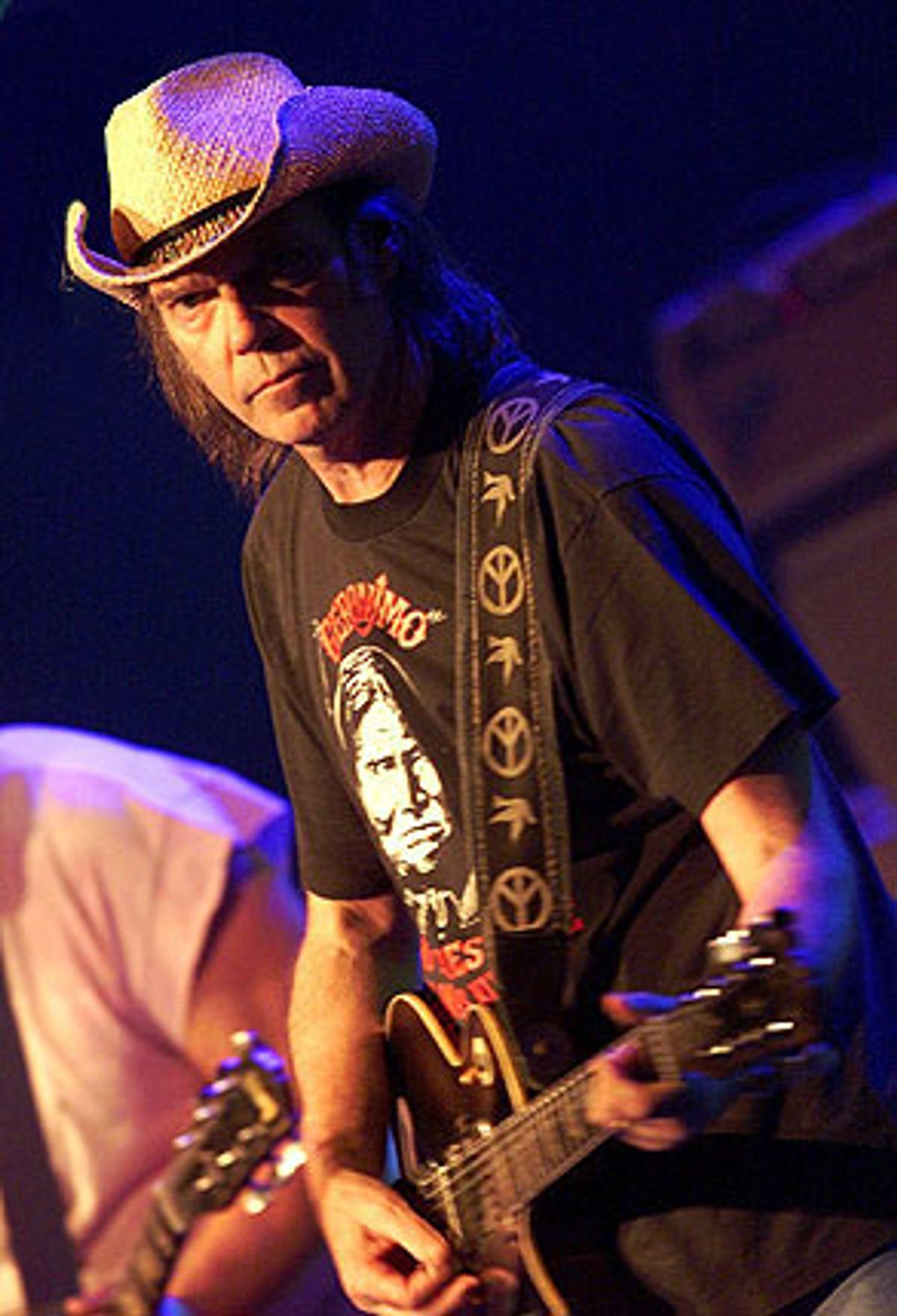
"Shakey: Neil Young's Biography," by Jimmy McDonough is a bruiser. At 786 pages it's longer than "Mandela: The Authorized Biography," by Anthony Simpson or "Mao: A Life," by Philip Short, but then neither Mandela nor Mao played guitar worth a damn. What Young does share with those two, however, is icon status, and after reading McDonough's staggeringly thorough examination of the arch-rocker's life and work, you're convinced he's earned it -- while the people who've orbited around him during his long and tempestuous career all deserve Purple Hearts, several dozen of them each, and a nice quiet place to spend their sunset years.
Tour manager Bob Sterne should get a bucketful of those medals. "Neil's come to me," Sterne tells McDonough, "and said, 'Go get all the set lists and throw 'em in the trash can' -- and he said this to me fifteen minutes before the show. He's not just talking about the band's set list, he's talking about the lighting guys, the sound guys -- every single list in the building." Young's longtime cohort and producer, the late David Briggs, said, "It's not fun at all working for Neil -- fun's not part of the deal -- but it's very fulfilling."
There's plenty not to like about Young in this biography. For that matter, there's plenty not to like about this biography, which is why I was surprised that I ended up liking it -- a lot. When I began reading "Shakey" (the title is the singer's nickname) I didn't expect it would be any more interesting, or readable, than most rock bios. Yet, as I dug into it, it gradually won me over because it's as good a book (albeit a portly one) as I've ever read about how an artist makes art and the wounds he sustains in the process, and the casualties he leaves along the way. That doesn't mean it's nearly 800 pages of the Neil Young blues -- McDonough gets it all: the chaos, the grandeur, the good times and dreary deaths, the alcohol- and drug-besotted recording sessions, the broken hearts and the sheer unfettered joy of a seriously gifted artist, who's madly productive, breathing in the spirit of his time and exhaling his life's work.
Writing intelligently and engagingly about art, especially when it happens to occur in rock music, can border on the impossible. On the one hand you run the risk of descending so far into tediously cerebral deconstruction -- overanalyzing lyrics in the case of a songwriter -- that you suck all the air out of the work. On the other hand, if you're a fan, as McDonough clearly is, you are in danger of producing a vapid hagiography that reads like a book-length testimonial. McDonough's portrait of Young avoids both pitfalls. He makes his admiration for the musician clear, but he also calls him on his bullshit, his thoughtlessness, his recklessness and his failures.
"His single mindedness is inspirational," McDonough writes. "It can also be exhausting. Even frightening. There is a dark side to Neil Young." Gary Burden, Young's friend and art director for many of his albums, puts it more succinctly: "Neil's a real artist, but he's also a ruthless motherfucker." Fair enough, now let's count how many major (or not so major) artists that statement could apply to. Never mind, we'd need a supercomputer to manage the tally.
The point is that what makes the work of significant artists significant in the first place is their willfulness, forcefulness, distinctive (and quirky) points of view and their insistence on having things their way while striving to achieve a sometimes unattainable level of quality. What keeps them going is a preternatural drive fueled by a formidable ego. That Young is an overbearing, difficult, prickly character -- which is what much of the buzz around this book has focused on -- is hardly a shocker. It would be a real revelation if McDonough had found him to be a mellowed-out cuddle bunny, but never fear, the "Godfather of Grunge" (a sobriquet Young disdains) is anything but.
Joel Bernstein, Young's archivist, describes him like so: "Neil does what he wants to do when he wants to do it and doesn't do what he doesn't want to do when he doesn't want to do it." Thanks to this approach, as Young himself contritely admits, he's left a wake of destruction. He's also produced some of the most compelling, thoughtful and courageous work of any popular musician. That he can be wildly inconsistent and sometimes just plain bad -- and then rise, phoenixlike, with a work of brilliance and astonishing quality -- is evidence of his drive to stay fresh and keep inventing. Young occasionally goes down dead-end streets, but it hasn't stopped him from taking roads he's never been on before.
That's a lot tougher than it sounds. As an artist matures, competing with his own past -- taking the necessary risks, upping the ante -- becomes increasingly more difficult, problematic and frightening. Some seek refuge in endlessly repeating themselves, others freeze up. Young seems to have done neither. How he pulls off this neat creative trick year after year and whether or not it's indeed better to burn out than to fade away, are central themes in "Shakey."
Everyone who's heard Young's "Helpless" (which means everyone who's been in earshot of a radio or stereo in the last few decades) knows that he comes from "a town in north Ontario." It was in that town -- Omemee -- that Young, now 56, contracted polio when the virus swept through Canada in 1951. It transformed the pudgy 6-year-old and nearly killed him. "Neil got polio and lost all his girlish curves," Rassy, Young's indomitable mother and a central character in "Shakey," tells McDonough. "Damn near died. Gawd that was awful ... Christ, he looked like hell on the highway. Skin and bones. He never got fat again ... We didn't know if he'd ever walk." When he came home from the hospital "fresh from a disinfectant bath, his black hair in spikes," Young asked the adults, "I didn't die, did I?"
I remember when polio was the terror that stalked the nation, when approaching standing water, say, would earn the harshest of parental rebukes. One of my oldest friends got it in '53 and has been crutching it for half a century; another acquaintance of mine spent most of his 49 years in an iron lung thanks to polio. What an experience like that may do to you -- assuming it doesn't kill you -- is radically alter your perspective and imbue you with a certain bravado and fearlessness, not to mention a sometimes trenchant honesty. Once you've been to hell and back, the things the rest of us find anxiety-inducing -- the scary odds against making it as an artist, for example -- aren't all that scary. Pam Smith, a girlfriend of Young's when he was a teenager, recalls, "Neil was insecure as a person -- I think that's why playing music was so good for him. He had all the confidence in the world in that role."
McDonough's exploration of Young's often tenuous physical state -- he's also epileptic and used to have seizures on stage early in his career -- is one of the more intriguing threads in the book and a key, perhaps, to the singer's sometimes irrational confidence and indefatigable persistence even when those all around him -- Stephen Stills among them -- voiced nothing but discouragement about his abilities. After a 1964 recording session, "engineer Harry Taylor told Young, 'You're a good guitar player kid -- but you'll never make it as a singer.'" Two years later he was touring with Buffalo Springfield, one of the most influential, though short-lived, bands to come out of the '60s. By the mid-'90s he'd signed a five-album contract said to be worth $40 million. Hey, hey. My, my.
Three of Young's principal influences, he tells McDonough in one of the rambling interviews that are sprinkled throughout the book and set apart from the main text with italic type, are guitarist Randy Bachman, a friend from Canada and member of the Guess Who who went on to found the enormously successful Bachman Turner Overdrive, Bob Dylan and the Rolling Stones. "What I really liked about the Stones," Young says, "was Brian Jones and Keith Richards playin' together. Even though Brian Jones was just kind of a bratty, sub-blues kind of guy. He still had the exuberance ... 'Satisfaction' was a great record. 'Get Off My Cloud,' even better record. Looser, less of a hit. More of a reckless abandon. 'Get Off My Cloud' -- I know it's not as good of a song, and I know the performance is probably not as good as the 'Satisfaction' performance, maybe it is -- but the thing about it is it's obviously just such a throw-together song that they came up with on the way to the studio or the night before, y'know? That's what I liked about it. It really sounded like the Rolling Stones."
And that's the Neil Young philosophy in a nutshell: Looser ... More of a reckless abandon ... Not to say he hasn't labored slavishly over his recordings (he and producer extraordinaire Jack Nitzsche took a solid month to lay down the dreamy, symphonic "Expecting to Fly"), but he'll do anything to get that raw, gritty, vital sound. It's one of the reasons, maybe the reason, he's stuck with Crazy Horse (mostly), his ragged but loyal and vigorous band. "A kind of quasi-criminal bunch," as Joel Bernstein describes them, and one that almost none of Young's other musical colleagues -- notably David Crosby and Graham Nash -- have a good word for. (Returning the favor, Young is all but contemptuous of their music; it seems he only deigns to tour with CS&N to continue to pick at his fractious relationship with Stills.)
The book is full of tales of Young running musicians through a "warmup." Once they finish the rehearsal and announce they're ready to record, he says something like, "We just did, that's it. We don't need to do it again." And they don't, that's the cut that goes on the album. Nevertheless, he can be brutally demanding on stage and in the studio where he insists that his sidemen play precisely the way he directs them to. Those who accompany him live in fear of being on the receiving end of one of his disapproving glares, followed by the certain post-performance ripping of a new asshole.
Still, as David Bowie says at one point: "There's youthful redemption in everything he does, a joyfulness about being an independent thinker in America." While no less a misanthrope than Randy Newman adds, "Most people did their best work when they were younger. Neil Young is as good as he ever was, which is quite an accomplishment ... It seems like there's no tricks to him. I don't know if you could name anybody better who came out of rock and roll." And that's the true story of how Neil Young became the subject of a 786-page biography and the Godfather of Grunge, whether he likes it or not.
The formless form of "Shakey," which was sort of annoying early on, is what grew on me until, by the end, it made all the sense in the world. The book's like one of those raging, seemingly shapeless jams that you can't stop listening to where, all of a sudden, all the musicians return to the refrain exactly on the money and you then realize, "Oh, they're not just screwing around, they know precisely what they're doing." Like Young, whose style it mirrors, this bio's excesses, occasional lack of polish, looseness and willingness to let the reader see behind the curtain are what make it work. Could it have been compressed and still have been as good a book? Oh, maybe, but why, what's your hurry? If you want tight, glossy little dramas that get tied up fast go watch TV, scoot off to the Cineplex or put 'N Sync on the stereo. McDonough seems to think Young's stormy, fascinating story is one that's worth taking time with. Turns out he's right.
Shares