
Sex
Those legs, that pout
Kate Moss is a girl out of time, the perfect '60s dream girl who has awakened, like Austin Powers, in a changed world.
The ’60s messed me up good. Not in the ways the decade messed up other people. I was only a kid. But watching ’60s TV, with its glorious celebration of pop that has yet to be recaptured, I got my first notions of female beauty, notions that have penetrated deeper into my psyche than I’d care to admit.
I was nuts about slim girls with long, straight hair (or hair with a little flip at the ends), wearing boots or short skirts or leather. Barbara Feldon on “Get Smart!” and Diana Rigg on “The Avengers” and Anne Francis on “Honey West” were my ideas of female perfection. I think that’s why, years later, when I discovered the music of the French pop chanteuse Françoise Hardy, and saw pictures of her in her suede jackets and white jeans, I fell for her immediately. It’s why I look so affectionately at the long-legged Angela Lindvall in the lovely current confection “CQ.” Watching her as a super secret agent bopping around the moon in white jumpsuit and white fur head wrap makes me want to be her trusted right-hand man, an adoring Willie Garvin to her Modesty Blaise.
And it’s why I’m a sucker for Kate Moss. She’s the most English English model since the ’60s, combining the classless appeal of Twiggy with some of the hauteur of Jean Shrimpton’s high mod poshness. Ah, Moss, with those two prominent front teeth peeking out from full parted lips. Moss, with that long hair, and those sleepy, appraising eyes, ready to surrender to seduction or to signal you to fuck off. Moss is a girl out of time, the perfect ’60s dream girl who has awakened, like Austin Powers, in a changed world.
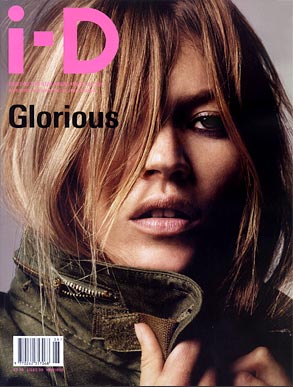
In the June issue of i-D — one of those mindless, tony British glossies whose editorial purpose forever eludes me — in a layout by photographer Craig McDean, Moss is meant to be a hip rejoinder to the celebrations of the queen’s 50th anniversary on the throne. She echoes the Sex Pistols’ greeting on the 1977 occasion of Elizabeth II’s silver jubilee by appearing in a Doc Martens jacket with “God Save the Queen” painted across the back, an affectless deadpan challenge on her face. The words are also painted across a shot of Moss in an army shirt, patchwork Dolce & Gabanna leggings and multitone fishnet tights.
But it’s the ’60s that Moss forever recalls. McDean highlights the connection by printing a few pages of her in full-length overlaid silk screens, like Warhol’s image of Elvis drawing a six-shooter. Moss looks ready for a fight, too, biting her lower lip while the corner of her upper lip is arched in a sneer, one hand holding closed the leather biker jacket worn over black panties, fishnet tights and boots. In another she is swinging her head back while the fringes of a suede vest sway out from the hips. Or she’s clutching the waist of her miniskirt, her hips cocked, a jacket thrown over her shoulder, her mouth in an open pout and her hair piled high and messy like Brigitte Bardot.
It’s the hair that’s the key to Moss’ sex appeal here, even more than the knee-weakening topless shot of her in Tom Ford’s low-slung, hip-hugging bell-bottoms, showing teasing glimpses of fishnet between the eyelets and lace keeping the whole contraption together. Moss’ hair, sandy blond, hangs in a delicious tousle reaching almost to her navel. In shot after shot her hair lies in silken tangles on her shoulders, or a fringe of it obscures her eyes, giving her the image of a girl who’s just risen from bed and is looking at you with a frank, couldn’t-care-less provocation.
“I spent so much time thinkin’ ’bout Eleanor Bron/ In my room with the curtains drawn,” sang Yo La Tengo on their exquisite song “Tom Courtenay.” In these pictures, Moss is the essence of what boys in the ’60s daydreamed about: Pop star, dream girl, a sexy spy in their own feverishly imagined house of love.
Charles Taylor is a columnist for the Newark Star-Ledger. More Charles Taylor.
Massage therapists rubbed wrong by sex talk
A Jennifer Love Hewitt show and the Travolta allegations have masseuses tired of being confused for sex workers
(Credit: iStockphoto/sybanto) Joe, a licensed massage therapist, knows what it’s like having a famous client who expects something extra. He had an Academy Award-winning actor begin gyrating on his massage table before raising his hips in the air to show off his erection. “He was hoping that I would play with him in some shape or form,” he says.
Needless to say, Joe isn’t surprised by allegations by two masseurs that John Travolta got handsy during massages. (Travolta’s attorney has denied all the allegations, and called them “ridiculous.”) “It happens all the time,” he says, and not just with celebrity clients. He frequently encounters men who try to fondle him, usually while he’s working on their glutes or lower back and their hand happens to be level with his crotch. “They think they’re so original, but they’re all so much the same,” Joe says, his voice rising. “They all use the same tactics, the same body movements, the same gyrations and grinding my table, the [heavy] breathing.”
Continue Reading Close
Tracy Clark-Flory is a staff writer at Salon. Follow @tracyclarkflory on Twitter. More Tracy Clark-Flory.
A night at the vibrator museum
Early vibrators were hand-cranked, two-person jobs -- and prescribed by doctors. How far we've come since then
(Credit: Antique Vibrator Museum) I can now say that I’ve used a turn-of-the-century vibrator — on my hand, but still.
The silver, hand-cranked contraption is usually kept behind glass at Good Vibrations’ Antique Vibrator Museum in San Francisco — but staff sexologist Carol Queen made a rare exception. “This is very special,” she whispered, unlocking the case and carefully pulling out Dr. Johansen’s Auto Vibrator, a relic from 1904. The “auto” part is not so much: It was a two-person job, with her having to crank the device’s handle to get it thrumming. Pressing my finger tips to its inch-wide circular platform of pleasure, I was pleasantly surprised by its power.
Continue Reading Close
Tracy Clark-Flory is a staff writer at Salon. Follow @tracyclarkflory on Twitter. More Tracy Clark-Flory.
Maggie Gyllenhaal on sexual liberation
The beloved indie star tells Salon about her "vibrator movie" and why she loves playing transgressive women
Maggie Gyllenhaal (Credit: Reuters/Mark Blinch) When I met Maggie Gyllenhaal about six weeks ago, she was enormously and gloriously pregnant, stretching out on a sofa with her shoes off and feet up in a Manhattan office building. (Since that time, Gyllenhaal and husband Peter Sarsgaard have welcomed their second daughter, Gloria Ray, to the world.) We were there to talk about “Hysteria,” the charming, lightweight feminist farce from director Tanya Wexler that explores a key event in the history of female sexuality: the invention of the vibrator by Mortimer Granville, a Victorian doctor who was seeking to cure the mysterious “female malady” that lends the movie its title.
Continue Reading CloseMother-daughter sexperts
Susie Bright and her daughter, Aretha, make parental talks about sex look easy -- and fun
Most parents loathe talking to their kids about the birds and the bees, let alone pubic hair grooming, faked orgasms and “water sports” — but most parents are not legendary “sexpert” Susie Bright.
Better than talking about these things, she penned an advice column in 2009 with her daughter, Aretha, then 19, for the ladyblog Jezebel. Their answers to questions about everything from porn to Paxil were unflinching but playful, and at times controversial. Now the pair have collected those columns into a new e-book, “Mother/Daughter Sex Advice.” Together, they read as an irreverent version of “Our Bodies, Ourselves” for the Internet age. The mother-daughter team also reflect on what the experience of writing the column was like, and it turns out it wasn’t as weird as many would think: For the most part, it was just a continuation of conversations they had been having throughout Aretha’s life.
Continue Reading Close
Tracy Clark-Flory is a staff writer at Salon. Follow @tracyclarkflory on Twitter. More Tracy Clark-Flory.
On the rack: A cultural history of breasts
Did breasts evolve for lactation or to enhance sex appeal? A new book explores why they matter
(Credit: iStockphoto/NadyaPhoto) It’s hard to be boobs. Sure, breasts are cherished as givers of milk and the pinnacle of sex appeal, but the modern world hasn’t been good to mammaries.
As Florence Williams writes in “Breasts: A Natural and Unnatural History,” they’re the most tumor-prone organ in the human body. They “soak up pollution like a pair of soft sponges,” and transmit environmental toxins to babies through breast milk. “Breasts are bellwethers for the changing health of people,” she says. While we’ve “genetically modified our crops to be able to protect them from the ill effects of pesticides,” Williams writes, “we haven’t yet figured out how to modify our breasts.” Aside from using saline and silicone, of course.
Continue Reading Close
Tracy Clark-Flory is a staff writer at Salon. Follow @tracyclarkflory on Twitter. More Tracy Clark-Flory.
Page 1 of 403 in Sex