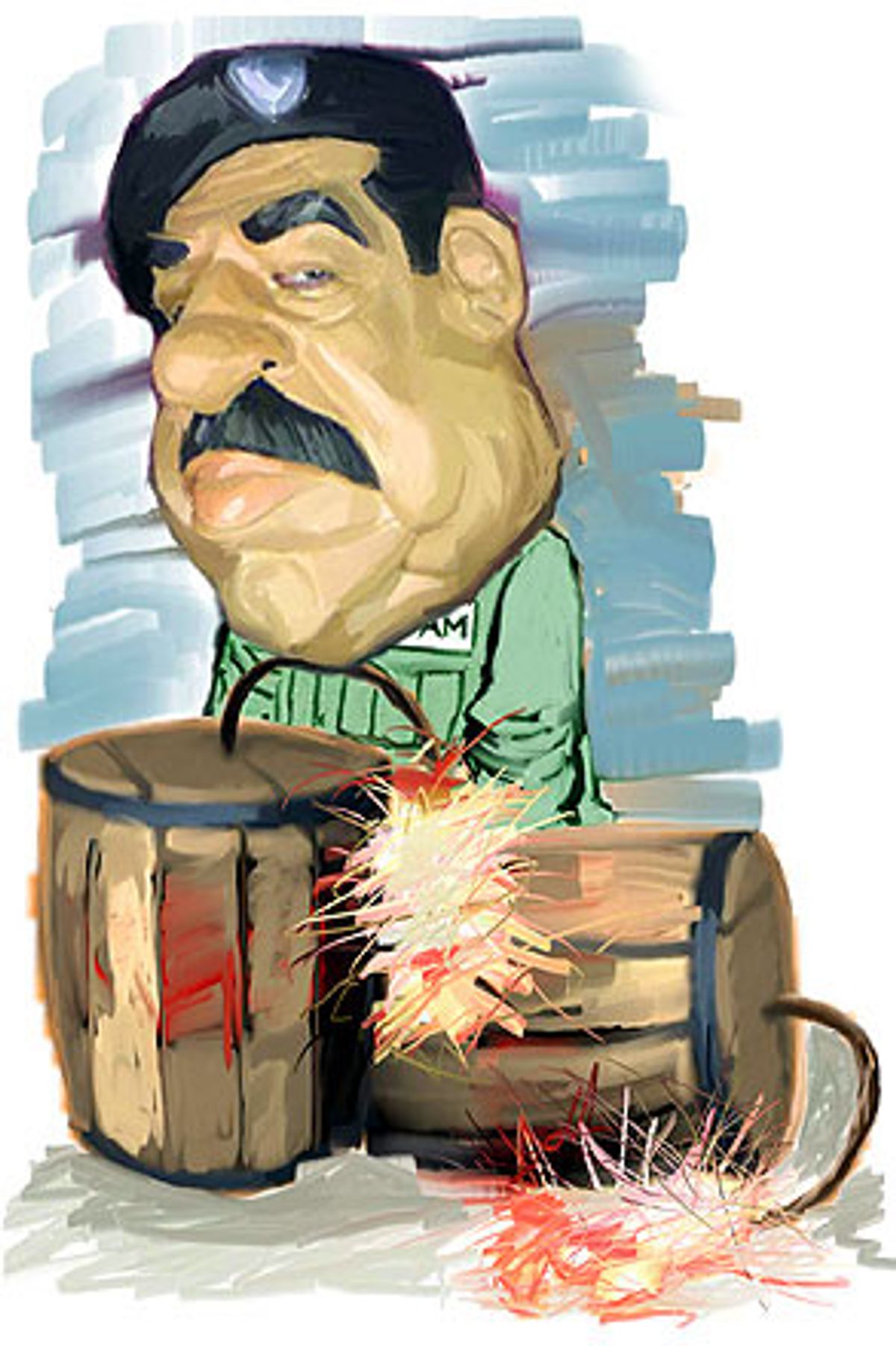
Behind the closed doors of the Bush administration, officials are debating the advisability of invading Iraq, a nation it has accused of sponsoring international terrorism. The announcement that Bush is proposing a new national security doctrine legitimating preemptive strikes against regimes or groups that attempt to acquire weapons of mass destruction has strengthened many observers' conviction that it's just a matter of time before the U.S. acts on the desires of the hawkish side of that debate and moves in to remove Saddam Hussein from power, finally "finishing the job" that many felt was left undone at the end of the Gulf War in 1991. Others are urging caution, or at least more consideration of that fateful step than some U.S. leaders currently seem inclined to take. Sandra Mackey, a journalist and the author of books on Saudi Arabia, Lebanon, the Arab world and Iran, as well as the new "The Reckoning: Iraq and the Legacy of Saddam Hussein," is one of those voices.
The U.S., Mackey argues, must ask itself which is the greater potential danger: the weapons of mass destruction that Saddam probably has and may use, or the radical destabilization of Iraq that is likely to follow if his regime is toppled by the West. She worries that U.S. officials barely understand the nation they intend to liberate and foolishly believe in "some exaggerated expectation that the removal of the despot of Baghdad will solve all of Iraq's problems and all the challenges to the United States in the Persian Gulf." Instead, she insists, however monstrous Saddam is, it's likely that U.S. involvement in his ouster could lead to something even worse: chaos, violence and even more anti-American fury in a region of key geopolitical significance. Mackey, who has traveled in Iraq and throughout the Arab world, describes a nation ravaged and debilitated by decades of tyranny and years of U.N.-imposed economic sanctions, a nation that will need to be painstakingly rebuilt once the tyrant is gone.
Salon spoke with Mackey at her vacation retreat in South Carolina.
Whenever the question of U.S. military intervention in another nation arises, as we recently saw in Afghanistan, there's usually a certain amount of griping from the know-nothing elements of the American public along the lines of "If everybody there hates the government so much but they don't want the U.S. to take it out, why don't the people just overthrow it themselves?" Saddam Hussein is hated both inside and outside of Iraq, yet he's been running the nation for decades. What keeps him from being ousted?
There are at least two reasons. To begin with, the Iraqis are so fragmented into ethnic, sectarian and tribal groups that there's a great fear that overthrowing Saddam Hussein might give your adversary or rival an advantage. This is particularly true among the Sunni population of Iraq, which is roughly 20 percent, and the group that Saddam Hussein belongs to. The Shia Arabs make up 60 percent of the population and there's this rivalry between the groups.
Then you've got the Kurds, who have their own agenda. With all these rivalries, it's very difficult to get together the cross-communal alliances to overthrow a government, particularly a government like Saddam Hussein's.
The second reason is that Saddam Hussein has been able to put the whole country in a prison. His security forces are so extensive. They permeate every aspect of life in the country. They are very good at picking up any plots against Baghdad, and they move very effectively to put those down. I'd also add a third reason. Since 1991 and the end of the Gulf War, the imposition of the sanctions has so decimated the Iraqi economy that survival is all anyone is thinking about. They really don't have the energy to rise up and overthrow the tyrant in Baghdad.
You write that the current problem the U.S. has with Iraq has its roots in what you call "the neglect of and arrogance toward the Arab world" on the part of the U.S., going back to the foundation of Israel. How is what we're facing today the result of that?
For Iraq specifically, we've never looked at it as Iraq itself, but always as a part of another problem, like the Cold War.
We only asked ourselves how we could use Iraq to do something else?
That's exactly right. After the revolution in Iran in 1979, it becomes, How are we going to use Iraq to fend off more Islamic revolution? Then, after the Gulf War, while we were trying to control Saddam Hussein's arms, we should have been thinking of the next step beyond. Is there anything we can do to prepare the Iraqis for the time when he's gone? I think there were some good reasons for the sanctions -- I don't just slam them in the book -- but they destroyed the middle class, and those are the people that you really need to get the society back on track once he's gone.
The U.S. got involved in the war in Afghanistan in the 1980s, but once the Soviets were forced out we abandoned the country to fall into chaos -- and the Taliban and scores of al-Qaida training camps were the result. Do you think we're in danger of opting for another shortsighted action if we intervene militarily in Iraq, something where the blowback consequences could be equally perilous?
Yes. And Iraq is even more dangerous to our interests than Afghanistan. Once the Taliban and al-Qaida are dismantled, the Afghans will have to sort out their tribal conflicts, but it's not going to have a lot to do with the strategic balance. But Iraq is sitting there between the Persian Gulf and the pipelines bringing oil and natural gas out of those new fields in Central Asia, and with Iran in the east and Syria, Jordan and Saudi Arabia all around there, you can't afford chaos. You can't just walk out and leave it. So that means, if there's an invasion, is the U.S. going to be in Iraq for the next umpteen years trying to maintain some order?
In his review of your book in the New York Times Book Review, Fouad Ajami portrayed you as being completely against any military intervention. Is that correct?
Quite the contrary. I think Saddam Hussein is a huge problem. And the U.S. might not have any choice but, at some point, to take miltary action in Iraq. But if we do that, we have got to understand what we're getting into because the political problems after Saddam Hussein is gone are going to be much greater than the military challenge of getting rid of him.
Are the problems of getting rid of him the same as those of simply waiting for him to die or be deposed? Will the same kind of chaos follow regardless? Ajami seems to think you're excessively pessimistic about that.
He doesn't recognize the level of hostility to the U.S. that's in Iraq. I've been in Iraq, and while it's difficult to talk with the people there, you know what they think about the U.S. because of the sanctions and because Saddam Hussein has so brainwashed them that the economic situation is totally our fault. The idea that they're going to be out there flying kites to welcome us into Iraq ...
That seems particularly foolish because the people who did that in Kabul are Central Asians, not Arabs, and they don't have the same history of long-stoked resentment of the U.S.
You need at least some hope that the Palestinian situation will be resolved before you go into Iraq. Those two things are tied together. You have to do one before you do the other.
After World War II, there was so much Western angst about the Holocaust, as there should have been, that when the state of Israel declared its independence in 1948, there really wasn't adequate thought given -- we immediately recognized the state of Israel, even though the State Department warned Truman not to do it. Many of the Jews who were in Israel in '48 and through the '50s were Western Jews who'd come out of Europe and they really understood how to communicate with the West. No one ever paid attention to the Palestinian issue, which was representative to the Arabs of how they had always been treated by the West since the Crusades. The foundation of the state of Israel was interpreted by the Arabs not as justified by the Holocaust but as an extension of Western imperialism in the Arab world that goes back to the Middle Ages. And not just imperialism, but the arrogance of the West, which has regarded Muslim society and Islam as grossly inferior to the West.
You have all of this and you get into the Cold War, with Israel saying that it's the only ally of the West in the Middle East. The Arab states didn't feel as if they had anyplace to go to say what their grievances were regarding Western intrusion into the Arab world and the presence of Israel and the dilemma of the Palestinians. We just sort of ignored all this, and it's gotten to the point today that it's become intolerable to the Arabs, to their dignity. This is an honor-driven society.
That seems to be a legacy of Arab tribalism that Americans often don't understand. Maintaining your honor and your dignity in a tribal culture is really a necessity for survival. An insult is dangerous to more than just your feelings.
That's true. In a tribal culture, to tolerate an insult is to show weakness, which is to invite attacks from your enemies. It's a threat of annihilation. This is something we don't understand when we keep saying, "Why do they hate us?" They're angry with us because they feel we've never given them the dignity that they feel they deserve. Israeli military might and their claims to having made the desert bloom where the Arabs before them could do nothing with it -- that's all seen as the result of the American aid Israel gets. This has been going on for decade after decade, building up hostility to the United States. What's going on right now, the Bush adminstration's attitude toward the Sharon government, is not protecting the United States. It's making more problems for us. My great fear is that the "Arab street," the non-elites of the Arab world, are just going to explode and we're going to have real problems.
You say in the book that ultimately the road to Baghdad runs through Jerusalem. Too much intervention on the part of America anywhere in the Middle East is going to run into big problems as long as the U.S. is seen as unfairly favoring Israel.
One thing we really have to be aware of if we do a unilateral invasion of Iraq is that we're going to destabilize that whole area because the ordinary Arab is going to see that not as an attempt to free the Iraqis, but as a U.S. invasion of an Arab country for the purpose of getting control of Iraqi oil reserves and to protect Israel from Saddam Hussein.
Yet despite all these potential pitfalls, there is an element of the U.S. government that's pushing for an invasion to get rid of Saddam. Who are they and what do you think is driving them?
It's in the Defense Department, certain elements in Congress and certain parts of the conservative press. It comes down to several factors. Donald Rumsfeld is very interested in getting rid of Saddam Hussein because he wants to reduce the amount of money required to keep troops in the Persian Gulf to patrol Saddam Hussein. He's got other reasons, but that's where he's coming from. Paul Wolfowitz and Richard Perle, some of these Defense Department advisory council members, they're ideologues. They would deny this, and I don't know if they even realize this, but they are looking at protecting Israel rather than looking at the long-term interests of the United States. And the country that Saddam Hussein poses the most danger to is Israel.
Then you have the right wing in Congress -- and in the press somewhat -- saying, "America's got to be strong. We don't have to put up with anybody." Then of course, you've got the Christian right, which is fanning a lot of this. To them, any questioning of Israeli political policy is questioning biblical Israel. They believe that the Jews must control Jerusalem before you can have the Second Coming of Christ. Then you've got George W. Bush who has this cowboy mentality, where you've got the white hats and the black hats, without grasping the complexity of all this.
What about the Iraqi National Congress? The Americans who support an invasion often hold them up as the solution to who'll run Iraq once Saddam Hussein is gone.
The INC deserves credit for its diversity. They've got members from almost every group. But the only thing they can all agree upon is that they hate Saddam Hussein. You can't get the INC to go beyond the fact that they're going to have a "democracy," and right out of the box a democracy cannot work. You cannot have one man, one vote. You present that to the Sunnis, and to them that means their annihilation at the hands of the Shia. You have to figure out a very complex political system that tries to address the communal rivalries so that you give people an opportunity to be fairly represented but not be able to just run over the rival groups.
One justification for this possible U.S. invasion is the assertion that Saddam Hussein is mixed up with al-Qaida and other Islamist terrorists. How likely does that seem to you?
I always hesitate to use the word "logic" in relation to Saddam Hussein, but the only thing Saddam Hussein and Osama bin Laden share is hatred of the U.S. Now, that's a powerful emotion, but if you look at it in terms of Saddam Hussein's political ambitions, what he really wants -- he wants to be celebrated in the Arab world as the new Saladin who's striding across the landscape from Egypt to Riyadh. Well, the thing about that is that if he'd been involved in Sept. 11 or the activities of any of these militant Islamic groups, other than maybe just feeding a little bit on the edges, and then come out after Sept. 11 and proclaimed that he was even a little bit responsible for it, the U.S. would have hit him and he would have been gone.
But even bin Laden didn't do that. Whoever did that would be immediately obliterated.
Right. However, if Saddam Hussein had been involved and then stayed quiet, well, who gets all the credit? Bin Laden does. And they are rivals for the same constituency, the Arab street. He'd really be shooting himself in the foot to be big-time promoting Osama bin Laden. Bin Laden is important because he's a charismatic figure, and Saddam Hussein sees himself as a charismatic figure.
He doesn't have admirers scattered all over the Muslim world like bin Laden does, though.
No. His arena is the Arab world. He doesn't have any interest in the Islamic world because he has a certain fear of Islam himself because he's a secularist. Logically, there's no reason Saddam Hussein would be involved with Osama bin Laden, but you have to be careful when you're talking about logic and Saddam Hussein.
Would he be involved in some other kind of terrorism?
I would think he'd be interested in hitting an American aircraft carrier if he could do it, something like the U.S.S. Cole bombing.
To harass the U.S. about being in the Gulf?
To pull the lion's tail. What he seems to be concentrating on is not so much directing things at the U.S. but playing into the Palestinian situation right now, encouraging any strike they can make at Israel, paying the families of suicide bombers. He can support that and get credit for it. That is really to address his core audience, the non-elite Arabs.
Then there's the question of who is Saddam Hussein's designated heir. The story of his family -- the deadly infighting, the wayward eldest son -- it's like the Borgias. Is there really someone being groomed as his successor?
It's impossible to know what really goes on in the inner circle. All we can do is speculate. He's got two sons: Uday is the older one and Qusay is the younger one. You'd expect the succession to go to the older one. Uday, though, is a loose cannon. He's been involved in one ridiculous episode after another and it makes you wonder what his mental status is. The scuttlebutt is that he killed his father's valet for arranging a meeting between Saddam Hussein and the woman who became his second wife.
Saddam Hussein has three wives now, right?
We think. Pretty sure that there are three, but there might be more.
Uday did this out of devotion to his mother, Saddam Hussein's first wife?
Right. I don't want to use the word "evil" because I'm so tired of that word, but Uday seems to have almost a psychopathic personality. He's been accused of taking people who offend him up in a military helicopter out over the desert and pushing them out the door. He's poorly educated and doesn't seem to be real smart.
And he's quite a drinker, by all reports.
Oh, yes! Now Qusay is the younger son and more like his father. He's very intelligent, he's savvy. He works hard and doesn't seem to have done any of these strange things Uday has done. It seems that Saddam Hussein is grooming Qusay to take over for him. Now the question is ...
How's that going to go over with Uday?
Yes. Is he going to just step aside or is he going to use his media empire, which his father gave him, to fight back? He's got a newspaper and some radio stations and he's always issuing statements about the government. He does have a voice. Now if Qusay were to take over after Saddam Hussein's death and he has the military, he could shut Uday down. There are all these rivalries that go on. Supposedly the man who was Saddam Hussein's wife's brother and the son of his mentor was assassinated because he was getting a following that was seen as posing a threat to Saddam.
It's very seldom that a leader can choose a successor and make that work in the kind of environment that Saddam Hussein has created in Iraq. It very seldom survives the person who built it. All these questions start coming up if he starts losing control or if he gets sick or if he dies. Then you just open Pandora's box. As far as the internal politics is concerned, once that starts unraveling, what's going to happen to the tribal alliances, what's going to happen to the security service, what's going to happen to the military?
And then there are these rumors about Saddam Hussein having lymphoma.
Which could be rumors he started to keep his foreign enemies from coming after him, but then that would weaken him internally. It's hard to know.
Saddam Hussein seems to really know how to manipulate all the communal and tribal divisions in Iraq to maintain his power.
Yes, particularly since the end of the Gulf War. Everyone thought that anyone who'd been defeated to the extent that he was in that war simply could not last politically. But he defied the odds by moving very rapidly, pitting group against group -- the Kurds were somewhat out of it up there in the North under the no-fly zone and had a certain amount of autonomy, but certainly as far as the Sunni and Shia were concerned.
Then he went in and revived the idea of tribes, that you were a member of a tribe more than a citizen of Iraq. Then he made all these tribal alliances with kinship groups and then added to that these contrived tribes -- what we might consider a trade association or a labor union. He's given those the aspect of a tribe, with a leader, common interests that Baghdad will meet in order to get the members to support Saddam Hussein. That's kept him in power and also added another level to the disunity of Iraq and the problem of keeping all these people together in a state once the dictatorship has ended.
Tribalism in one form or another is a problem in a lot of Arab nations.
Certainly on the Arabian peninsula, tribalism is still very strong because they really haven't had much of a history of nationhood. Saudi Arabia wasn't really put together in total until 1925. The House of Saud has ruled principly through its own tribal alliances and kinship groups. In the Fertile Crescent, in places like Syria and Jordan, that's a region where you've had one invading army after another running through there. There was Mesopotamia and Ancient Egypt, and then all the invasions from other places -- the Romans, Persians, Byzantines, and then here come the Mongols. It's just been an alley where all the invading armies from east and west have trampled over them. And the way people survived was to pull into kinship groups.
Can you explain how the difference between statehood and nationhood affects the region?
A state is geographic region that's under one government; a nation is composed of people who really feel a sense of affinity with each other: common culture, common language, common religion. Nations tend to develop naturally. What you've had in the Middle East is people who don't necessarily have any identification with each other, because their primary identity was with a tribe, put together within these artificial state boundaries created after the first World War by the Europeans. After World War I, Britain and France took the Ottoman territories of the Middle East and divided them up among themselves. The last of these states finally got their independence after the second World War, so they're really new states. And with this history of tribalism, they've had a really hard time becoming nations. Iraq is probably the worst of the group.
Tribalism seems to be a particular problem when the central government is weak, but Saddam Hussein's government has, historically at least, been fairly strong, hasn't it?
Yes and no. Every government of Iraq has had difficulty holding all the elements of the country to Baghdad. There's always been this force of people on the edge trying to pull away, and of course the major group that's done that in Iraq is the Kurds, who have been in constant rebellion against Baghdad. Probably Saddam Hussein's most successful period was during the oil boom of the '70s, and he wasn't even president then. He was the power behind the Baath party. As awful as the Baath party has been, there was this time when they recognized an opportunity to take all this oil money and invest it in education, infrastructure, healthcare, to really build a nation, and they had the resources to do it. And when you get a benefit from the state, that helps build a nation.
The main thing that happened then was the Islamic revolution in Iran (well, oil prices dipped, but the revolution was the main thing). Saddam Hussein just became paranoid that somehow the Iranian revolution was going to pull off the Shia of southern Iraq and fragment the state. So he declared war on Iran in 1980. It was a disaster, eight years of war. It finally ended in a cease-fire in which neither side won and both lost.
Saddam Hussein had so bankrupted the country at the end of the Iran-Iraq war that he had to have money in order to again give the Iraqi people something that would hold them to Baghdad. He demanded money from the oil states of the Arabian peninsula. Saudi Arabia, the Emirates and so forth were willing to go along with this, willing to buy a peace, but Kuwait balked. And so Saddam Hussein invaded Kuwait. Then you have the defeat of the Gulf War and the sanctions, and so Saddam Hussein has had less ability to hold people to him and so the security forces continue to increase and increase in size.
The interesting question today is how much in control is Saddam Hussein really. It's generally accepted that the only region of the country he has firm control of is the center, Baghdad, Tikrit, that area. The rest of the country (again, I'm leaving out the Kurds), is being held together by these tribal arrangements. He gives the tribal leaders money and arms and they keep their people in check. If something happened that kept him from keeping those tribal alliances functioning, you have to ask are they going to spin off, which has always been the threat in Iraq.
If that happened, does Saddam Hussein have enough military power and security forces to really hold things together? Probably he does, but it's an interesting question.
There's been so much anxiety on the part of Saddam Hussein and others about whether the Shia of Iraq are drawn to Iran, because although it's a Persian state, it's a Shia state, but there hasn't been that much sign of them wanting to do so, has there? In the end, the Shia Arabs seem to feel more of an attachment to Iraq as an Arab nation.
That's right. The Iraq-Iran war proved that the Iraqi Shia were Arabs first and Shia second. The scenario that a lot of people worry about -- that if Iraq starts to fragment Iran might take southern Iraq -- they could, but I think that's the least likely scenario. Now, the Shia could maybe form their own state down there in southern Iraq, but there is this great cultural animosity between Arabs and Persians and I just can't see that the Iranians would particularly want to reach across the border to incorporate all of these Arabs into its territory, or that the Iraqi Shia would willingly join Iran.
How much of the tension between the Shia and the Sunni is about the differences in the actual religious doctrines and practices between the two groups and how much is the result of the history of how they've treated each other?
The conflict is principally political, economic and social, much more than it is theological. There's also this urban-rural conflict that's always been an element in that area going way back to the Mesopotamians and the Ottomans. If you could find a way to level out the economic and political opportunities in the system of Iraq, I don't think theology would make a lot of difference. That's not the root problem.
They might be able to live together as easily as Catholics and Protestants do in this country today?
Sure. In fact, the Shia are simply regarded as inferior by the Sunnis. Some Sunni tribesman out on the desert north of Baghdad regards himself as infinitely superior to some Shia tribesman out on the desert west of Basra.
Even though they might be indistinguishable to an outsider?
Yes! Both of these tribal groups originated on the Arabian peninsula and came up, and while the Sunni came a little bit earlier, they're all the same bunch.
There doesn't seem to be an effective resistance to Saddam Hussein -- no equivalent of the ANC or Nelson Mandela. Why is that?
Because Saddam Hussein has squashed every person who has challenged him. He's also made it very convenient for those people to emigrate, to leave the country, or he's killed them. The people who have left have lost their base in the country because of their absence. The big question for the Iraqis, for the U.S., for the whole region is, How do you rebuild civil society when Saddam is gone? If we continue on this path of talking about an invasion, we've also got to start articulating a vision for the Iraqis in the post-Saddam era.
Shares