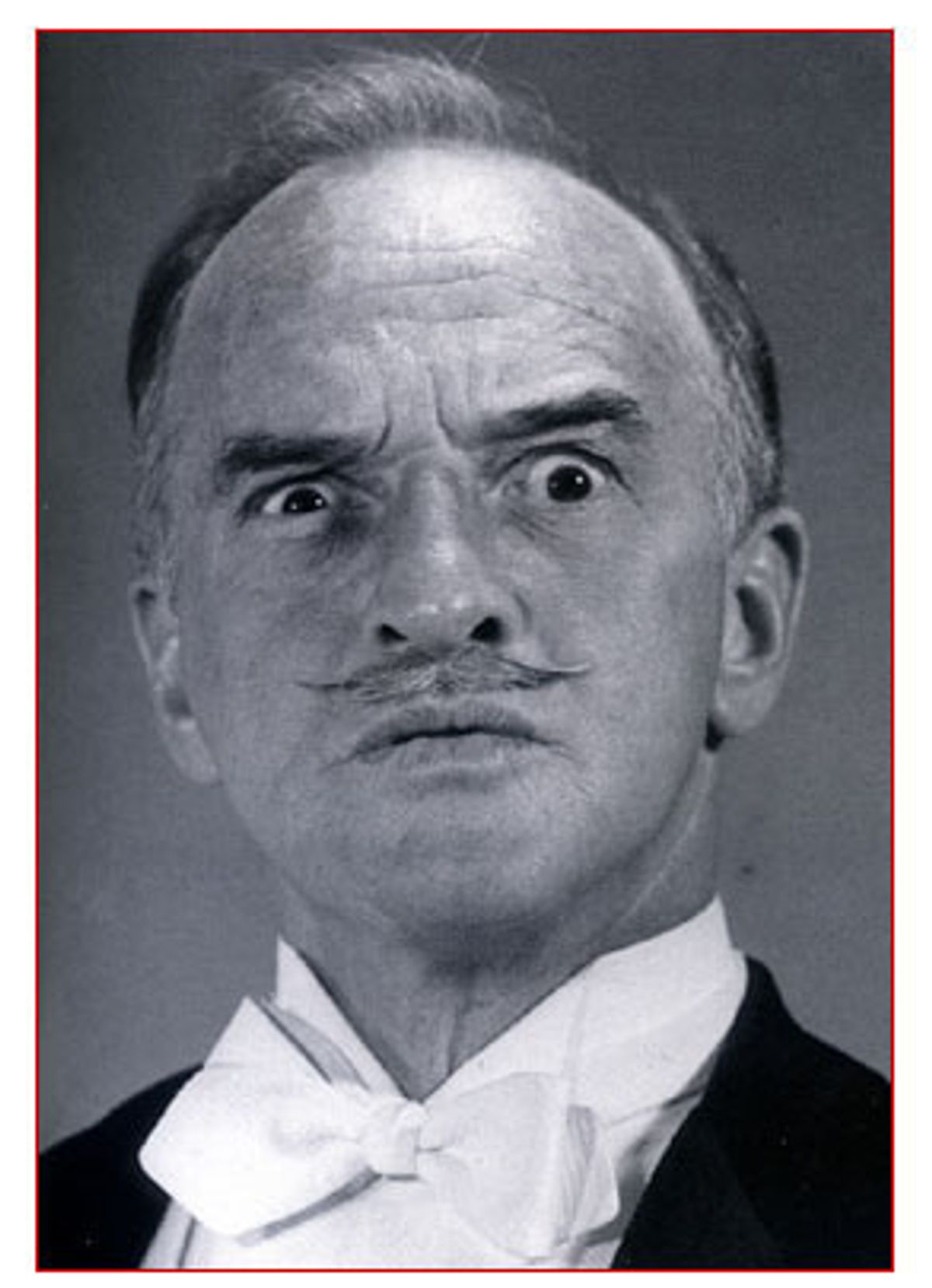
Like its subject, the very existence of "Dig Infinity! The Life and Art of Lord Buckley" is some kind of miracle. Just published this month but well over a decade in the making, the first (and likely the last) oral biography of the humorist, "jazz shaman" and underground legend is one of those books that only gets completed because the person writing it -- author Oliver Trager in this case -- has a preternatural passion (some would say an obsession) for the material, coupled with formidable skills as a researcher and an unholy determination to see the work in print.
When the name Lord Buckley is mentioned, it gets one of two standard responses. The less common is a gleam in the eye, a signal from another member of the secret order of Buckley devotees, often followed by a fevered account of first hearing his Lordship and perhaps an imitation of his loopy lingo, maybe a passage from "The Nazz," his most famous monologue -- a retelling of the story of Jesus of Nazareth in hipster patois ("He was a carpenter kitty ..."). The more frequent response is, "Lord Buckley -- who's he?" It's that reaction that makes the existence of Trager's book and the attention it's getting -- it will be featured on NPR's "Morning Edition" on Friday, June 28 -- slightly miraculous. Because while the members of the secret Buckley cult have always thought that their guru deserved to become less of a secret, that such a thing might actually come to pass, especially 42 years after Buckley's death at age 54 in November of 1960, seemed unlikely at best, which is why the first chapter of "Dig Infinity!" is called "Lord Who?"
Trager answers the question with a call and response litany that fills most of a page, some of which goes like this: "Lord Buckley: the white, six-and-a-half-foot-tall, ex-lumberjack cat who invoked both the manners of the English aristocracy and the street language of black America ... Lord Buckley: the picaresque pill-popping darling of Al Capone ... Lord Buckley: the jazz philosopher who jammed with Charlie Parker ... Lord Buckley: the original viper, the Hall of Fame Hipster, the baddest Beatnik, the first flower child, the premier rapper ... best known for his 'hipsemantic' retellings of Bible stories, Shakespeare soliloquies, and modern poetry in the 1950s."
"Lord Buckley is a secret thing that people pass under the table," novelist Ken Kesey said. "You ask writers who they think is the best writer and they all mention someone above them. Gradually you get up at the top, and you get to Samuel Beckett and not many people have read him. But a lot of people have been influenced by Beckett. I think the same was true of Lord Buckley. There were a lot of people influenced by Lord Buckley who have never heard his material."
Indeed, far too many to count. What Trager has done for "Dig Infinity!" however, is track down people who have heard Buckley and acknowledge his influence, and scores of others who knew him and spent time with him. From Robin Williams, Jonathan Winters, Steve Allen, Studs Terkel, Wolfman Jack, James Taylor, Red Rodney, Ken Nordine, George Harrison, Dick Gregory, Ed Sullivan and Wavy Gravy to Dizzy Gillespie, Jerry Garcia, Judy Collins, James Coburn, Honey Bruce (widow of Lenny), Eric Bogosian and scads more. Virtually all of them testify to his singular gift for magical language, and many point out that he was equally gifted as a hustler and a con man, which only makes the story richer. (To make it richer still, a CD featuring 12 of Buckley's live performances, including "The Nazz," is stitched into the back of "Dig Infinity!")
When I first came across Trager in 1992 I was writing a magazine article about Buckley and he allowed me to quote from several of what became an estimated 500 interviews he conducted for "Dig Infinity!" (Portions of more than 100 appear in the biography.) Since then, we've corresponded sporadically, and he ended up using brief excerpts from two or three interviews I did for the magazine article in his book. I first wrote about his project for Salon in 1995, when this magazine was less than a month old and Trager was already shopping his book around to publishers, but with little luck. "Why did it take so long to get the thing published?" I asked when I called him at his New York home.
"It was hard to get through to publishers," says Trager, who also wrote "The American Book of the Dead: The Definitive Grateful Dead Encyclopedia" and is now editor in chief of the monthly journal Editorials on File. "Having been in publishing all these years myself, I know what the guy at a publisher who wants to sell a project in-house is up against. He has to go to a meeting with all those suits and he's talking about some white guy who died 40 years ago who talked black street talk? I could just see their eyes glaze over, even at the more progressive, open-minded places. You don't normally associate a stand-up comedian with a larger, humanistic agenda, which is what Buckley was about -- along with being a wild guy. Publishers would ask me, 'Who's the market for this? Is it a Beat Generation book, is it a book about comedy, is it about American show business in the middle of the 20th century?' The answer is it's about all that stuff and a lot more." Fortunately, the small New York publisher Welcome Rain stepped up to the plate, though it's unlikely anyone will get rich on the project. "The advance would never even begin to pay me for blank tapes," Trager says, "but it was pretty generous considering the obscurity of my subject matter."
Buckley was a quintessentially American character. If he hadn't invented himself, Mark Twain would have had to return from the grave to do so. "He grew up dirt poor in gold mining country," Trager says. "That a guy like that could end up on 'The Ed Sullivan Show' with stops along the way in the dance marathons and burlesque and vaudeville and swing and bebop and Vegas is really quite remarkable. He lived sort of a hero's journey, to put it in Joseph Campbell-esque terms."
Richard Myrle Buckley, born in the tiny Sierra town of Tuolumne, Calif., in 1906, knocked around the country a bit before becoming a moderately successful performer on the strength of clever, but conventional, comic routines. Then, sometime in the early '50s, he radically transformed himself into the "Hip Messiah," Lord Buckley. He affected a regal manner, often wore a pith helmet, tie and tails, waxed his mustache into long, upturned stiletto points, assembled a royal court and took to bestowing titles -- his wife was Lady Elizabeth Buckley, then there was Prince Owlhead, Lady Renaissance, Prince Lewis (Buckley's aide de camp), Count Jocko Crown Prince of Morocco and numerous others. And he didn't merely invoke the Lord Buckley persona for his performances, he lived it 24-7.
When Jonathan Winters first met Buckley in Las Vegas in the 1950s, "He started calling me Prince Jon," Winters recalls in the book, "and I asked him, 'Why can't it be Lord Jon?'"
"Because, my dear man, I am Lord ... I am Lord Buckley."
And Winters said, "Yeah, I remember you in the forest. You were against the Black Knight and he all but dismembered you with some kind of medieval hand ax."
"Ahh, yes," Buckley said. "Yes, my friend, thank you for remembering."
In the mid-'50s, as Beat culture and Buckley's metamorphosis took hold simultaneously, he became as well known to a certain sector of the population for his abundant eccentricities as for his rhapsodic and transcendent storytelling. Jazz vocalist Jon Hendricks said of Buckley, "He was probably the hippest guy I ever met." But Dizzy Gillespie put his finger on the infectious musicality of Buckley's delivery. "What I liked about him was the way he could recite. He'd say, 'They get on magnabuttasitemin youmakcattabare wa! ...' He was doing rap and scat before anybody." And musician Buddy Jones nailed it this way: "Comedian is not the word to describe him. He didn't come out and use words and have these routines like other comedians at the time. He would play to the house and be able to wing it. He improvised as jazz musicians did."
As Kesey pointed out to Trager, Buckley's masterly transposing of classic stories into hipster argot turned out to have a surprisingly broad influence and underground staying power. Bob Dylan called him "The fuel to my success," and Frank Sinatra crowned him "the most sensational comic of our time." For those who catch the Buckley virus, their enthusiasm often mutates into a desire to proselytize. "When you get bit by the bug," Trager explains, "you want to share it with whoever will listen. Aside from the breadth of his work, the absolute uniqueness of it, there's a message there that is really thousands of years old, basic Golden Rule stuff -- that we should laugh with one another, that we should help one another. A lot of his work also explored the darker elements of the human condition -- [monologues such as] the 'Bad Rapping of the Marquis de Sade,' or 'Murder' -- but they did it with a kind of goodwill that didn't make evil seem benign, but embraced it in a way that didn't deny it existed either. He was dealing with the yin-yang aspects of human character."
Many Buckley fans point to one of his most frequently quoted remarks to make a case for his being a precursor to the evangelizing for tolerance, equality and the power of love that became such a force in the youth movement of the 1960s. At the close of his performances he'd often say: "Before I leave you, I'd like to say to you, people are what it is all about ... they are Mother Nature's brightest flower, her sweetest, purest, most elevating thing that ever was. You are groovy flowers in a garden where I am privileged to stand and share a few moments with you." Says Trager, "If he'd lived, in relative good health, into the age of the Fillmores, it's hard not to believe that he would have been a hippie star of a cooler variety than Timothy Leary or Ram Dass or someone like that.
"And on a purely political basis," Trager continues, "here was a guy who was doing pro-civil rights pieces [such as Joseph Newman's 'Black Cross,' later covered by Bob Dylan] to not necessarily sympathetic audiences in the 1940s, if not earlier. I don't know if that's visionary, but it's certainly brave. He stuck his neck out for what he believed in and contrary to what a lot of people might think, he was not using elements of African-American expression casually. His work addressed not only racial, but all kinds of social inequities head-on. Yet he was able to get it underneath the radar in a way that, maybe, Lenny Bruce wasn't able to. Bruce really stuck it in his audience's face: 'This is the problem.' Buckley had a gentleness about him.
"I feel Buckley was a genius," Trager goes on. "The work itself stands on high, yet it's totally neglected. It isn't even a footnote to a footnote to a footnote. To me he is a great American visionary who should not slip through the cracks anymore."
When Trager talked with Robin Williams, the comedian told him, "Buckley and Lenny [Bruce] were both jazz ... their work was jazz -- verbal jazz ... Buckley, you might even say, was more lyrical or poetic. The first time I really heard Lord Buckley, I thought to myself, 'This is amazing.' It's got layers on it. You can take it on the comic layer and you can just keep getting deeper and deeper with it. The musical layer, the literary layer -- it's full of literary references ... Hearing his work is like hearing the great jazz riffs -- they are full entities unto themselves." And while it would be unfair and pointless to ask, even a musician, to fully appreciate, say, "Kind of Blue" by merely reading the music (Buckley really must be heard), this, the opening to his classic "The Nazz," gives a sense of how his Lordship cooked with words:
"Now lookit here all you cats and kitties out there whippin' and wailin' and jumpin' up and down and suckin' up all that juice and pattin' each other on the back and hippin' each other who the greatest cat in the world is. Mr. Malenkoff, Mr. Dalenkoff, Mr. Eisenhower, Mr. Woozinweezin, Mr. Wyzinwoozin. Mr. Woodhill, Mr. Beechhill and Mr. Churchill and all them hills gonna get you straight! And if they can't get you straight, they know a cat that knows a cat that'll straighten you. But I'm gonna put a cat on you was the coolest, grooviest, sweetest, wailingest, strongest, swinginest cat that ever stomped on this jumpin' green sphere. And they call this hyar cat ... the Nazz."
"It's a fuuny thing with Buckley," Trager says near the end of our conversation. "No matter what word you use to describe him, it fits, but it doesn't fit. I think of it like performance quantum mechanics in a way. If you look for the wave you're going to see the wave. If you look for the particle, you're going to see the particle. If you look for the stand-up comedian, you're going to hear the one-liner. If you look for the visionary, you're going to hear the grand message. If you look for the mystic, the healer, you're going to hear the evangelist. And that's a testimony to his power and genius -- they all apply."
Shares