United Nations

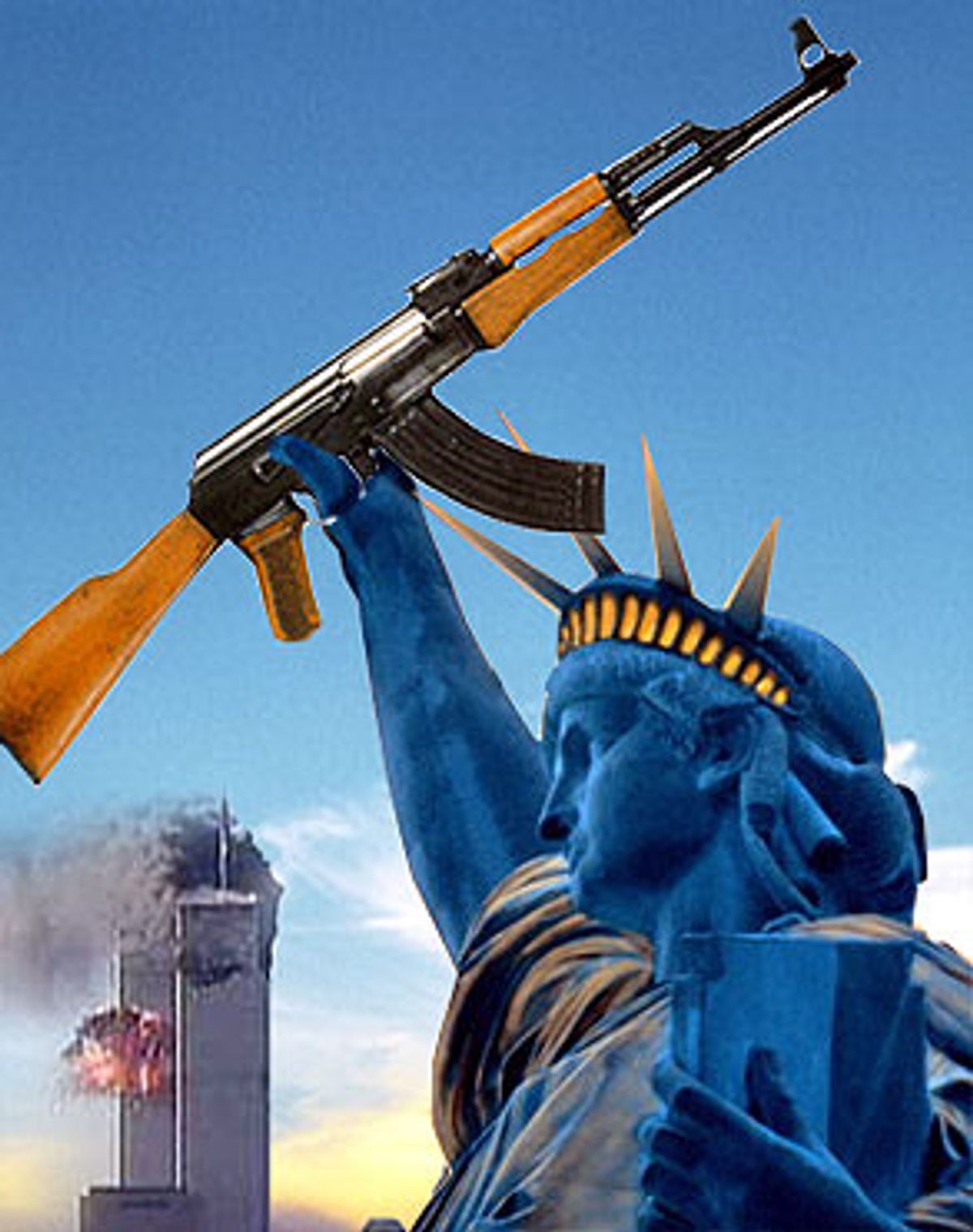
A kinder, gentler militia?

In the aftermath of Sept. 11, fringe militia organizations are recasting themselves as neighborhood watch groups. But old ways die hard.

  • more
    • All Share Services

Topics: ,

A kinder, gentler militia?

It was a small, obscure militia called Project 7, and according to local investigators, its members were stockpiling weapons and plotting mass murder as part of a plan to make Flathead County, Mont., the flash point for world revolution.

First, they would murder local police, judges and prosecutors. When the National Guard came in, they would kill as many troops as they could. When the U.S. government turned to NATO for help, they would take up arms against the forces of the New World Order.

When the alleged plot was discovered and David Burgert, a 38-year-old ex-Marine who owns a sports rental business, was arrested as the mastermind in February, many Montanans were exasperated that their state was in the news yet again as a haven of violent extremists and far-right paranoia. But what set the Project 7 case apart was the angry response from others in the self-styled patriot movement.

“This guy Burgert in Kalispell, this guy is just a miscreant, a little weenie evildoer,” says militia icon James “Bo” Gritz, a former Green Beret. “People who know him say that he’s just a talker, but Tim McVeigh might have been a talker … If they’re gonna talk like they’re gonna break the law, it’s like the Montana Freemen were putting up reward posters for public officials, ‘Wanted Dead or Alive.’ By gosh, you can’t do that.”

Though in decline since the deadly Oklahoma City terrorist bombing in April 1995, militias have been enjoying a quiet upsurge since Sept. 11. While they have tried in recent years to reposition themselves as a force on local political and environmental issues, militia leaders say the attacks and the Bush administration’s war on terrorism have created a new audience for their worldview and new customers for their security training and survival gear.

“Our role, I think, has been more clearly defined now with the threat of foreign terrorism,” says Norm Olson, who founded the Michigan Militia, one of the nation’s largest, in 1994.

Militia watchdog groups agree that Sept. 11 led to an increase in such activity. “I do believe there’s an upswing in interest in militia and anti-government groups,” says Brian Goldberg, Pacific Northwest regional director for the Anti-Defamation League. “Whether that translates into an upswing in action we’re still ascertaining.” With citizens wondering after Sept. 11 if the government is capable of protecting them, Goldberg says, the militias may be emerging from their post-Oklahoma City exile to assume a revised role.

Exactly what that role will be is, as yet, uncertain. Some of the bigger, old-line militias have shifted their focus since the attacks on the World Trade Center and the Pentagon. They’re focused more on battling terrorism, and less on warring with their own government. But they still harbor deep suspicion for the United Nations, the U.S. government and various suspected agents of the New World Order — suspicions compounded by the new intelligence-gathering powers given to the FBI and CIA.

Other groups, however, are marketing themselves almost as neighborhood-watch organizations — opposed to violence, open to all, even willing in some cases to work with the federal government. But coming at such a sensitive time, leaders fear that the Project 7 bust was a setback in the effort to mainstream the militias.

Some who track the groups say the shift may be genuine, or at least partly so. “The central theme of the militia movement had been that the government had been stolen by secret elites and needed to be cleaned up,” says Chip Berlet of Political Research Associates, a nonprofit organization in Boston that studies right-wing groups. “But a lot of these folks come out of a military background, and I think there was a conflicting set of loyalties after 9/11. For some militia leaders, this attack on U.S. soil so horrified them that they shifted.”

That analysis leaves Montana state Sen. Ken Toole, program director of the Montana Human Rights Network, skeptical. In his view, Project 7′s alleged assassination plot shows how conspiracy theories still permeate the militia movement — and how their paranoid threats can turn real. Like others here, he is skeptical about the militia leaders who disavow Burgert and wonders whether the Project 7 leader was in fact conspiring with similar groups in other Montana counties.

“In terms of their worldview — the U.N., the international conspiracies — they’re very closely aligned,” Toole says. Burgert’s “idea that they were going to kill a few cops, then kill a few national guardsmen, then have the Chinese army come over from Canada — all of that is stuff you read pretty regularly in the militia propaganda mill.”

Indeed, the movement’s own statements reveal their internal contradictions. The Michigan Militia has tried to reject the violent, racist, homophobic image that used to distinguish the movement. Visitors to its Web site are greeted by a message proclaiming that the militia doesn’t care “what race you are, what ethnic group you belong to, what your sex or gender is, what your sexual preference is, what your political beliefs are, or what your religious beliefs (or non-beliefs) are.”

Olson echoes the sentiment. But when asked how the homeland-defense program is different from the old training, he replies: “We used to shoot at U.N. flags, but now we shoot at Middle Eastern rag-head terrorists.”

The comment suggests that, even as they try to reinvent themselves, some of the militia groups maintain the character that makes outsiders uneasy.

The Project 7 drama unfolded against a backdrop of snowcapped peaks and alpine meadows not far from Glacier National Park. It’s a landscape that inspires millions of tourists every year, and their spending here is the backbone of the local economy. The landscape also has inspired a fierce local fight over government land-use policy. To understand the local political climate, it is essential to listen to the popular talk show of radio station owner John Stokes, Toole’s arch-nemesis. Stokes is a vigorous proponent of the “wise use” environmental movement — which counts timber and mining interests, off-road vehicle users and others among its chief supporters — and he has no patience for federal land rules. Stokes frequently refers to environmentalists as the “Fourth Reich,” and with former militia leader J.J. Johnson, he recently burned a 12-foot green swastika. Dave Burgert occasionally called in to Stokes’ show.

Project 56 is one of the new breed of militia groups finding fertile conditions in that landscape. Members of Project 56 say they had never heard of Burgert or his group until the arrest. There are parallels, though: Just as the “7″ in Project 7 represents the Montana license plate code for Flathead County, 56 stands for Lincoln County. Founded in 2000, the group is headquartered in Libby, an old mining town recently designated a federal Superfund site.

Project 56 considers itself to be a conservative government watchdog group. Its mission statement says it opposes racism, atheism, socialism, the New World Order and the United Nations, while supporting God, the Constitution, free enterprise and local self-government. Using relatively conventional methods, members have tried unsuccessfully to get their county declared a U.N.-free zone and to pass a “home rule” ordinance that would give local government supremacy over the federal government in some land-use disputes.

The group’s meetings have drawn up to 40 people, a broad blue-collar assortment that includes many with military and police backgrounds. In an effort to show that it is harmless, the group welcomes law enforcement officials and journalists to its meetings. “We have an open-door policy,” says member Ken Short, himself a former cop.

That’s a dramatic departure from the militias of just a decade ago. The roots of the modern militia movement go back at least to the 1970s and 1980s, to the survivalist movement and the Posse Comitatus organization whose adherents sometimes financed extremist political activity with crime. Gun-control legislation, world-trade treaties and talk of a New World Order during the administration of President George Bush I fanned the populist paranoia that often drives the groups. But when federal agents botched standoffs at Ruby Ridge and Waco — with deadly results — interest in the militia movement soared.

Early leaders included white supremacists like Louis Beam of Texas, who advocated a system of small militia “cells” across the country. By 1994, the movement included some racists and anti-Semites but also a large number of less extreme Americans concerned about issues like gun control, alienated by the Clinton administration and seduced by the militia’s dark warnings of a world government conspiracy.

Timothy McVeigh never joined a militia, but he traveled along the fringes of the self-styled patriot movement. After he helped detonate the bomb outside the Oklahoma City federal building — killing 168 people and injuring more than 500 others — the militias were discredited and vilified in public opinion and pushed back to the fringe.

According to the Southern Poverty Law Center, which monitors militias, the “patriot” movement peaked in 1996 with 858 groups across the country. By 2000, the number had fallen to 194, of which 72 were militias.

Several are in Montana counties, and law enforcement officials here say that, Project 7 notwithstanding, there’s hope for productive relations with some of them. “There are other militia groups here in Flathead that are law-abiding, good citizens,” says Sheriff Dupont. “They feel if there ever comes a time when the local police or National Guard need help, they’d be there.”

The Project 7 bust came after a bizarre series of events centered around Burgert, a man well-known locally for his conflicts with law enforcement. Dupont has said that Burgert held a grudge after the sheriff kept him off a county search-and-rescue team because of his past criminal record.

Burgert, 38, was arrested in 2001 for assaulting a peace officer. At the end of last year he had another run-in with police in which he was charged with obstruction and resisting arrest; he was found guilty in connection with that case in late June. Burgert’s own account of the incident, circulated on some Web sites, claimed police tortured him. While he was out on bail in January, Burgert’s wife reported him missing. Word traveled in militia circles that police had killed him, while investigators suspected he faked his own death.

In February, an informant’s tip led Dupont’s deputies to Burgert, and he was arrested only after a seven-hour standoff in the woods. A search of several sites uncovered more than 30 weapons, over 30,000 rounds of ammunition and survival gear. Evidence gleaned from an informant and from dossiers containing personal information about more than 26 local officials — including Dupont — formed the basis for the alleged assassination plot.

At most, investigators say, Project 7 had 10 members. Deputies also arrested Tracy Brockway, a friend of Burgert’s, accusing her of gathering information on potential targets through her job as a cleaning woman for the city of Whitefish police department. She pleaded guilty in May to obstructing justice by harboring Burgert. Shortly after he was arrested, Dupont said he suspected that other members were at large and potentially dangerous, but no further arrests have been made.

Burgert, in a jailhouse interview with the Daily Interlake here, denied there was ever a plot to kill anyone. His attorney, Don Vernay of Kalispell, predicted to Salon that the federal government won’t have the evidence to file formal charges based on the conspiracy allegations.

“Every witness I’ve interviewed says it’s a joke,” Vernay says. “That’s the most overblown story that’s hit the media in I don’t know how long.”

Militia leaders in Montana and nationwide have tried to distance themselves from Project 7 and the attendant media storm. The talk of guns and death lists clearly goes against the image of kinder, gentler militias they’re working to cultivate.

Gritz, a highly decorated Vietnam veteran, has considerable cachet in the patriot movement. He achieved fame in the 1980s for leading unsuccessful forays into Vietnam in search of prisoners of war. In the early 1990s, he helped persuade white supremacist Randy Weaver to leave his cabin at Ruby Ridge, Idaho, after an 11-day standoff left a federal marshal and Weaver’s wife and son dead. A few years later, he claimed credit for helping negotiate an end to the standoff between federal agents and the Montana Freemen.

In the wake of the attacks on the World Trade Center and the Pentagon, he says, militias should be rushing to help the federal government — in spite of their mistrust. And, he says, the militia movement based on government accountability, God and the Second Amendment needs to be wary of the violent racists who would corrupt it.

“Rather than putting face paint all over yourself and camouflage and assault rifles, acting like you’re shooting the FBI and Jews and whatever,” citizens’ groups should instead “be prepared in the event of national emergencies while authorities are overtaxed,” Gritz says.

In Michigan, militia groups are going a step further: They’ve offered the government their expertise in training domestic anti-terrorist forces.

Michigan was a hotbed of militia activity in the early 1990s. It was there, in fact, that McVeigh lived for a time with accomplice Terry Nichols. At one point, the Michigan Militia purportedly had 6,000 members, making it the country’s largest citizen militia. But it fell into disarray after the Oklahoma City bombing. Norm Olson formed a new militia group in Northern Michigan in the late 1990s; lack of interest forced him to deactivate it last July.

After Sept. 11, militia groups in Michigan met to discuss their response to the terrorist attacks. When the Justice Department did not respond to their formal offer to provide anti-terrorist training, they decided to start the training on their own. According to the militia’s online field reports, recent training sessions have attracted several dozen participants.

They offer a range of expertise — from firearms and gas masks to hostage rescue and emergency medical support. “We don’t call them firearms anymore,” Olson says. “We call them anti-terrorist resources.”

However much they change, though, militia groups maintain their roots — and perhaps no person embodies that more than John Trochmann, who lives about three hours west of Flathead County in the little town of Noxon.

Trochmann is a legend as the hard-line leader of the Militia of Montana; he also runs Project 35, which is focused on environmental and land-use issues in Sanders County. Trochmann founded the group after hearing about Project 56 in Lincoln County.

Since Sept. 11, members of the Militia of Montana have been busy. For the first few months after the attacks, militia officials say, their survival-gear was selling briskly — gas masks, chemical suits, anti-radiation potassium tablets — though they decline to release sales figures. And Trochmann has been invited to speak about global events to groups and at preparedness expos in several states.

At home in Sanders County, he says, militia members have been doing their part to help with homeland security, patrolling the Noxon Dam and hydroelectric power facility.

“We’re all in this together,” Trochmann says. “Please don’t believe what the mainstream media’s been saying about us. We have friends who work at the dam, we have friends who live downstream and we have a light switch, too.”

County Sheriff Gene Arnold says he has been in contact with Trochmann, and he appreciates the militia’s informal patrols. “If they’re watchdogs, I think that’s great,” Arnold says. “If they see anything, I expect that to be reported so we can get it to the proper authorities.”

And while he has had differences with the militia in the past, Arnold says, things have been quiet and even congenial lately, and as long as the groups respect the law and do not try to force an anti-government agenda, coexistence and cooperation are possible.

Though Burgert claimed past membership in the state militia, Trochmann says he did not know Project 7 existed until Sheriff Dupont told him about it in mid-February. And while he credits Dupont for making the arrests “without spilling blood,” he has a quick, barbed response to suggestions that there may have been a broader conspiracy.

“We have to remember that the prosecution throws as much manure at the wall as they can to see if it’ll stick,” he says. “That’s just par for the course.”

And yet, Trochmann is evidence that even as the militias try to soften their image and assert new local influence, the old militia character that combines high-proof paranoia with intense hostility for the federal government and the United Nations won’t die easily. While his Project 35 offers itself as a mainstream civic group, his Militia of Montana newsletter, Taking Aim, refers to politicians in its latest issue as “treasonous bastards.”

“One bullet at a time,” it warns, “that’s how you’ll get our guns.”

Earlier this year, Taking Aim began a three-part series on Sept. 11. A fundamental theory — conveyed in stories, first-person accounts, photos and charts — is that the twin towers of the World Trade Center were brought down not by fuel-laden jetliners, but by internal bombs.

“We believe this [the skyjacking and terrorist attack] is a fantasy they want us to believe,” Trochmann says. “We believe wholeheartedly these towers were blown up.”

The upcoming series finale will explore the “Arab connection {or lack thereof},” according to one of Trochmann’s notes in the latest issue. If al-Qaida didn’t attack the towers and the Pentagon, who did? Trochmann insinuates that the U.S. government was involved.

He points to the USA PATRIOT act and other measures that have expanded the federal government’s power to spy on its citizens. The militias have been enduring such scrutiny for years, he says, and so it’s no surprise that the government should extend its reach after Sept. 11. He cites a statement he has just received from a source he describes as a retired CIA agent, warning that Islamic militancy and the “war on terrorism” will be used as a straw man to take away basic American rights.

“Who gains from this terror?” Trochmann asks. “That’s how you have to analyze a crime.”

Olson, in Michigan, is similarly skeptical. “There’s something else going on here, and terrorism is simply a cover story to get something else done,” he says. “My basic theory is that this is a wonderful way to rebuild the CIA and the FBI and the military after it was decimated by our friend Bill Clinton.”

But in Olson’s view, Bush is no better. He rebukes Bush for not talking enough about abortion and for being “a globalist like his daddy.” The Michigan militia’s earlier offers of support for the government aren’t the same as supporting the government, he insists. In fact, he admits his group has an ulterior motive.

“We want to build ourselves up and not invite federal intrusion,” Olson says. “And by calling it a civilian anti-terrorist force, the American people will nod their heads and appreciate what we’re doing and maybe the feds will stay away from us while we try to defend ourselves against whatever the federal government is up to, which I believe is nothing less than the creation of a police state.”

If fear of terrorism helps bring in new members, he concedes, “I’ll go ahead and piggyback that as long as it benefits us.”

Continue Reading Close

Dan Laidman is a writer living in Missoula, Mont.

Is Agenda 21 a U.N. plot to kill the suburbs?

Or is "sustainable growth" a sensible policy demonized by a right-wing conspiracy theory?

  • more
    • All Share Services

Topics:

Is Agenda 21 a U.N. plot to kill the suburbs?McMansions endangered from on high (Credit: iStockphoto/Dmitry Galanternik)

In a resolution approved in January, the Republican National Committee characterized the United Nations’ Agenda 21 as “destructive strategies for sustainable development.” Included in this resolution was the RNC’s condemnation of the “insidious nature” of Agenda 21, and the recommendation by the RNC to adopt this resolution at the 2012 RNC Convention. An increasing backlash against this 19-year-old nonbinding U.N. plan shows how a conspiracy theory can become part of a major party’s platform.

How did a 40-chapter U.N. work plan on sustainable development, published in 1992, foster such a fervent backlash among conservative groups? Agenda 21, first revealed at the U.N. Conference on Environment and Development in Rio de Janeiro in 1992, aimed to address environmental and development concerns through global partnership initiatives. While the plan covered everything from the sharing of educational resources to strategies for economic and environmental development, conservative groups have focused primarily on its fourth section — titled “the means for implementation” — as revealing Agenda 21’s true and, for them, insidious nature.

While a recent New York Times article described anti-Agenda 21 activism as emerging roughly two years ago, the roots of the Agenda 21 conspiracy theory go back at least a decade. As early as 2002 Dr. Stanley Monteith, a Santa Cruz County, Calif., physician, who runs the conservative Christian website Radio Liberty, hosted a series of lectures on the dangers of Agenda 21. An insurance salesperson named  Joan Peros gave a nearly hour-long lecture on the perils of Agenda 21, warning, it “doesn’t matter which party is in power or control … some of our leaders totally understand and embrace the ushering in of a one-world order.”

The paranoia behind such fears was expressed by another guest lecturer on Monteith’s program, Jean Soderman, a self-professed former participant in Local Agenda 21 planning in Santa Cruz. When asked whether Agenda 21 would be worse than what Hitler did, she responded, “Yes. We are controlled by computers now and it has been said … that they have been trying this for two times already … first with Hitler, and it is going to be much, much worse.”

Michael Shaw, also from Santa Cruz and founder of the anti-Agenda 21 website Freedom Advocates, gave a lecture in 2006 at the Eagle Forum Conference in Santa Rosa, titled “Speaking of Agenda 21.” Shaw spoke about the loss of property rights through the ruse of “sustainable development,” and described Agenda 21 as “political globalists … moving toward a form of … state capitalism.  It is an assault on land and that is where we have to stand up and protect our land.”

The anti-Agenda 21 critique entered the conservative mainstream in an October 2009 article in the American Thinker. Scott Strzelcky and Richard Rothschild charged that, through the implementation of “smart growth” initiatives,  Agenda 21 would  force people to relocate into highly urbanized areas — what anti-Agenda 21 activists commonly describe as “stack ‘em and pack ‘em” housing, evoking the image of Soviet-era East Berlin apartments. According to Strzelcky and Rothschild, Agenda 21 will ultimately lead to the demise of the suburban way of life.

Such concerns over the loss of private property rights are not a new phenomenon in the United States. The Wise Use movement in the West of the late 1980s brought together farmers, loggers, industries, religious groups, libertarians and conservatives to oppose the Endangered Species Act and other federal environment laws. According to investigative journalist Jeffery St. Clair, the Wise Use members saw themselves as players in “a high-stakes-chess game” against the environmental movement, whose members were “overtly carrying out a sinister master plan, a vast socialist experiment to depopulate the rural West.” When asked about the evolution of property rights movements, Jeffery St. Clair told me, “in the West, many of the Tea Party activists are the same old Wise Users in new hairstyles.”

But while the Wise Use movement centered around protecting rural and federal lands from perceived government encroachment, anti-Agenda 21 activists are concerned that private property, for them an extension of one’s liberties and freedoms, will cease to exist entirely.

The movement really took off in July 2011 after Glenn Beck devoted a show to those “who had mastered the art of hiding it in plain sight and then dismissing it as a joke.” Beck held up  a copy of United Nations Earth Summit Agenda 21. “Sustainable development is just a really nice way of saying centralized control over all of human life on Planet Earth,” he stated. “Whenever you start unraveling this, it is like an onion … its real intentions are being masked with environmental issues.”

With his patented chalkboard, Beck drew the web of connections that has been fueling Agenda 21 panic ever since: the activities of a group called the International Council for Local Environmental Initiatives, known as  ICLEI — or Local Agenda 21. Started in San Francisco in 1990, ICLEI’s primary goal is to provide consultation, training and information to support sustainable development at the local level.  For Anti-Agenda 21 activists, ICLEI is the real enemy.

As Andrew Cohen wrote in a recent article for the Atlantic:

You would think that the Tea Party, with its disdain for large government, would be delighted with the ICLEI’s emphasis on “locally designed initiatives.” No. To the “Agender” crowd, as they are called, the ICLEI is the local instrument by which the UN forces its “sustainability” agenda upon the U.S.

It’s only within the last few months that the New York Times and the Atlantic have reported on this backlash by anti-Agenda 21 activists against local planning projects. Recently in Florida, a Tea Party group in Citrus County argued against the restriction of boating rights in Kings Bay (designed to protect the Kings Bay manatees). Edna Mattos, the leader of the Citrus County Tea Party Patriots, cited Agenda 21 as being behind this proposed restriction.

At the same time, Agenda 21 has become a talking point for presidential hopeful Newt Gingrich. Speaking in South Carolina on the perils of Agenda 21,  Gingrich decried what he called “taking control of your private property and turning it into a publicly controlled property.” Gingrich has also proposed an executive order “to cease all federal funding of any kind of activity that relates to United Nations Agenda 21.” In addition, bills publicly condemning Agenda 21 have been introduced by Republican state representatives in Tennessee, New Hampshire and Georgia.

Anti-Agenda 21 rhetoric not only plays into fears over the declining suburban lifestyle, but has changed the vocabulary of city planners. Many of the planners that I have spoken with are taking to heart Andrew Whittemon’s recommendations to take the concerns of Agenda 21 more seriously and to speak more clearly.

Whittemon, a professor of planning at the University of Texas, Arlington, said, “Planners can avoid conflict by being explicit about the most direct harms coming to residents and businesses, giving attention to local solutions, and certainly dropping the jargon.”

The impact of the movement is already felt. One city planner I spoke with, who wished to remain anonymous, told me: “The Agenda 21 accusations that we hear in public meetings are the most counterproductive to reaching consensus or middle ground in land use planning. So we are staying away from using words like ‘sustainable development.’”

Continue Reading Close

Liam Hysjulien is a freelance writer. Reach him by e-mail at LiamHAIOTB@gmail.com and follow him on Twitter @Liam_Hysjulien.

Palestinian leader asks UN to recognize state

Mahmoud Abbas defies U.S., Israeli opposition, requests recognition as member state

  • more
    • All Share Services

Topics: ,

Palestinian leader asks UN to recognize statePalestinian President Mahmoud Abbas holds his hands to his face as U.S. President Barack Obama speaks during the 66th session of the General Assembly at United Nations headquarters Wednesday, Sept. 21, 2011. (AP Photo/Seth Wenig)(Credit: AP/Seth Wenig)

The Palestinian president on Friday formally asked the United Nations to recognize a state of Palestine, defying U.S. and Israeli opposition.

The application for full U.N. member sidesteps nearly two decades of troubled negotiations and risks a threatened American veto.

Palestinians won’t seek vote delay on UN bid

President Mahmoud Abbas reportedly won't cave to U.S., French pressure to push back vote on statehood

  • more
    • All Share Services

Topics: ,

Palestinians won't seek vote delay on UN bidFrench President Nicolas Sarkozy, left, meets with Palestinian President Mahmoud Abbas at the Millennium Hotel in New York during the 66th session of the United Nations General Assembly on Tuesday, Sept. 20, 2011. (AP Photo/Andrew Burton)(Credit: AP)

A top Palestinian official said Wednesday that President Mahmoud Abbas had no plans to agree to a delayed vote on his bid for membership in the United Nations, rejecting mounting pressure from the United States and France.

The Palestinians plan to submit their letter of application on Friday when Abbas is to speak to the U.N. General Assembly, but he faced a withering lack of support as the world body opened its annual meeting. President Barack Obama said there could be no “shortcuts” in the quest for Middle East peace, a message that was echoed by French President Nicolas Sarkozy.

“We will not allow any political manoeuvring on this issue,” said Saeb Erekat, a senior aide to Abbas and former chief of negotiations.

Erekat said Abbas had made that plain in discussions with all parties involved over the last three days of meetings in the lead-up to the annual UN global gathering of presidents, heads of state and ruling royalty.

Sarkozy proposed a one-year timetable Wednesday for Israel and the Palestinians to reach a peace accord, part of a concerted push with the United States to steer the Palestinians away from an application for U.N. membership.

Sarkozy spoke shortly after Obama warned against action on the Palestinian bid before there was a peace agreement. He said negotiations, not U.N. declarations, were essential to a lasting peace.

While Obama stopped short of calling directly for the Palestinians to drop their bid for full membership — an effort the U.S. has vowed to veto in the Security Council — Sarkozy sounded a more compromising tone and urged each side, and the international community, to approach the deadlocked process with new ideas and tactics.

“Let us cease our endless debates on the parameters and let us begin negotiations and adopt a precise and ambitious timetable,” Sarkozy told the leaders and officials gathered at the U.N. “Sixty years without moving one centimeter forward, doesn’t that suggest that we should change the method and the scheduling here?”

“Let’s have one month to resume discussions, six months to find agreement on borders and security, one year to reach a definitive agreement,” he said.

A senior European Union official said the proposal laid out by Sarkozy matched one by EU foreign policy chief Catherine Ashton during a meeting with EU foreign ministers on Tuesday. The official spoke on condition of anonymity because of the sensitivity of the discussions.

Abbas’ push for full membership, which he has said would be submitted on Friday, has dominated this year’s U.N. meeting, pushing the U.S. and Israel against a wall of international sympathy for Palestinians. While the full membership bid would meet with a certain U.S. veto in the Security Council, assuming the Palestinians muster enough votes to have it approved, they have succeeded in bringing the issue again to the forefront of the world’s political discussions after years of failed negotiations, bickering and sporadic outbreaks of violence.

Sarkozy said that by setting preconditions, “we doom ourselves to failure. … There must be no preconditions.”

It remained unclear whether the latest proposal would be enough to avert a showdown over statehood that has consumed the U.N. over the past few days and sparked a frenzy of last-minute diplomatic door-knocking by the Israelis and the Palestinians, as well as a flurry of discussions between the Quartet of Mideast negotiators — the U.S., the E.U., the U.N. and Russia.

But the proposal outlined by Sarkozy received a warmer welcome from the Palestinians than Obama’s comments.

Yasser Abed Rabbo, a senior Abbas aide, told The Associated Press that the Palestinians “appreciate the speech and the positions included in that speech.”

“The Palestinian leadership will study seriously the positions and the ideas in that speech,” he said.

Obama’s remarks, however, drew a lukewarm response, with the Palestinian delegation wearing stern and disapproving looks as the U.S. president spoke.

“Peace will not come through statements and resolutions at the United Nations — if it were that easy, it would have been accomplished by now,” the president told U.N. delegates. “Ultimately, it is the Israelis and the Palestinians who must live side by side. Ultimately, it is the Israelis and the Palestinians — not us — who must reach agreement on the issues that divide them.”

Obama showed solidarity with Israel, not mentioning a return to the borders before the 1967 Arab-Israeli war in which Israel annexed territory. The remarks may rile some in the Arab world where mass uprisings against authoritarian regimes have also sparked a new measure of anti-U.S. sentiment. Obama’s words also stood in stark contrast to the image he left behind when he addressed the Muslim world from Cairo in 2009, pledging to improve relations and cooperation.

Senior Palestinian officials said Abbas will reiterate to Obama his decision to move forward with the application for membership that will be submitted to the Security Council. But they also said that the Palestinians seek to cooperate with the U.S. and will be ready to return to the negotiating table once a solid foundation for talks was in place.

Nabil Abu Redeineh said that “peace in the Middle East needs an immediate end of the Israeli occupation” and that the U.S. needs to pressure Israel to immediately withdraw from lands annexed in 1967. The Palestinians are ready to return to talks “the minute Israel accepts” those borders and stops settlement building, he said.

Obama was scheduled to meet later Wednesday with Abbas.

He met earlier in the day with Israeli Prime Minister Benjamin Netanyahu.

With Obama at his side, the Israeli premier said the Palestinian bid to appeal directly to the U.N. was a short cut that “will not succeed.” Netanyahu also lauded Obama for speaking up on principle.

The issue of Palestinian statehood has gained new momentum in the Arab world amid the so-called Arab Spring uprisings that have ousted the leaders of Egypt, Tunisia and Libya and laid the still rocky foundations for a new era of freedom and democratic nations in a region dominated by dictators, monarchs and other entrenched regimes.

Associated Press writers Mohammed Daraghmeh, Amy Teibel and Julie Pace in New York contributed reporting.

Continue Reading Close

Obama should support Palestinian statehood

If the president wants to foster peace and be on the right side of history, he must back the Palestinian U.N. bid

  • more
    • All Share Services

Topics: , , ,

Obama should support Palestinian statehoodA Palestinian waves a flag during a demonstration in the West Bank, Friday, Sept. 9, 2011

BOSTON — President Obama should not veto Palestinian national aspirations in the United Nations Security Council.

The president is not wrong in thinking that this would be better handled in negotiations between the Palestinians and Israel. It would be wonderful if Israel itself were to sponsor a Palestinian state, but this is not going to happen as long as Prime Minister Benjamin Netanyahu is in power.

He has spent his entire career trying to avoid Palestinian statehood with delaying tactics and maneuvers — seemingly willing to negotiate everything anywhere, but in reality putting up every obstacle he can in the path of peace and permanent settlement with the Palestinians.

Not that the Palestinians are guiltless in this stand off. They have had offers and opportunities they have not taken. But the entire Middle East is now in a state of flux and transition, and, as a practical matter, to try to keep the Palestinians frozen in their status as an occupied people without political rights is to ask for serious trouble — both for Israel and the U.S. The next Intifada will be far more destructive than the last two.

As a moral matter it is simply time to let the Palestinians have their state just as Harry Truman recognized that the Jews, after all they had been through in Europe in World War II, should have their state in 1948.

Many Israelis understand this. Former Defense Minister Binyamin Ben-Eliezer told The New York Times that “the world is tired of this conflict and angry at us because we are viewed as conquerors, ruling over another people. If I were Bibi Netanyahu I would recognize a Palestinian State. We would then negotiate borders and security.” But Netanyahu comes from the so-called “Revisionist” wing of Zionism that is reluctant to give up any part of what they consider the biblical land of Israel.

When David Ben Gurion on May 14th, 1948, declared that the state of Israel would come into being at midnight, America responded with de-facto recognition almost immediately. But the Soviet Union came through first with de-jure recognition, something the U.S. did not grant until an elected government had been formed in January of 1949.

Even with the two superpowers onboard, the U.N. Security Council did not grant Israel U.N. membership until May 11, 1949 — a full year after the state was declared — and after a long fight to physically secure its borders.

Palestine might come into being in reverse order — declare sovereignty now, gain admittance to the U.N., and then negotiate the borders with Israel, as Ben-Eliezer suggested.

There are many who say there are dangers involved in a Palestinian state, and they are right, just as those in Truman’s State Department, including George C. Marshall, were right in warning that the creation of a Jewish state would cause a sea of troubles.

And there are those who say that the Palestinian problem is exaggerated, that it doesn’t really matter if they remain an occupied people, because giving them their freedom would not solve all the issues of the Middle East or placate Islamic extremists. And they, too, are right. Giving the Palestinians their state would not solve all the issues of the Middle East, but it would surely help. Again and again, year in and year out, the centrality of the Palestinian problem never goes away. Even General David Petraeus, from his command post in Afghanistan, recognized that Israel’s occupation of the Palestinians was hurting America’s war efforts as far away as Pakistan and Afghanistan.

Richard Perle and David Frum, in their book, “An End to Evil, How to Win the War on Terror,” submit that “in the Arab and Muslim World, the Palestinian issue has never been about compassion, mercy, or even justice. First and always, this issue has been about vengeance…”, i.e., “the destruction of Israel and the re-conquest of the Holy Land.” This might be true of some, but this is akin to saying the Jews in Israel want to take over Jordan just because that was an original “revisionist” goal back in 1947, or because David Ben Gurion once put feelers out to the British and French in 1956 that Jordan should be divided up between Israel and Iraq. Yes, some Arabs still might want to destroy Israel, just as some Israelis want to expel all the Palestinians, but that does not represent the vast majority nor government policy in either Israel or the Arab world.

The Obama administration tried its best to talk the Palestinians out of going to the United Nations to legitimize their state but failed. Given the administration’s record, this failure was entirely predictable. Obama came into office seeming to promise a renewed energy toward trying to solve the Palestinian problem, following President Bush’s near-total support for whatever Israel wanted.

Obama went eyeball to eyeball with Netanyahu over settlements, and the Palestinians saw that Obama blinked first. It was obvious then that Obama might talk a good game, but that the Israeli tail was always going to wag the American dog. The sight of Netanyahu who, having defied and insulted the American president, addressing a joint session of Congress with congressmen and senators of both parties jumping to their feet like jack-in-the-boxes to show their support, was all anyone needed to understand Israel’s power in the American Congress.

The Democratic Party has to be mindful of pro-Zionist political support. But it is in America’s strategic interest, and ultimately in Israel’s interest too, to lance the boil of the Israel-Palestinian conflict.

If it was the right thing to do to recognize the state of Israel when it was first born, it is time now to grant the same rights and privileges to the Palestinian people. The Obama administration is always talking about being on the right side of history in the Middle East. The United States could abstain, if it must, but vetoing Palestinian nationalist aspirations would put us on the wrong side of history.

Continue Reading Close

Serbia arrests last war crimes fugitive

The U.N. charged Goran Hadzic with crimes against humanity for activities during Balkan wars

  • more
    • All Share Services

Topics:

Serbia arrests last war crimes fugitiveFILE - In this Feb. 6, 1993 file photo, Goran Hadzic, who heads representatives of the Krajina Serbs, talks with reporters at the United Nations in New York, United States. It has been reported on Wednesday, July 20, 2011 by Serbian TV station B92 that authorities have arrested Goran Hadzic, the last remaining fugitive sought by the U.N. war crimes court. Hadzic has been on the run for eight years. He is wanted for atrocities stemming from the 1991-1995 war in Croatia. (AP Photo/Bebeto Matthews, File)(Credit: AP)

The last fugitive sought by the U.N. Balkan war crimes tribunal was arrested by Serbian authorities Wednesday, answering intense international demands for his capture and boosting the country’s hopes of becoming a candidate for European Union membership.

Former Croatian Serb leader Goran Hadzic was taken into custody as he met a man delivering him money in a forest in a mountainous region of northern Serbia where many of his relatives live, authorities said. He had dramatically changed his appearance and was armed but did not resist, they said.

Hours later, Hadzic was brought in for questioning at the war crimes court in the capital Belgrade, a key step toward his extradition to the tribunal in The Hague, Netherlands. His lawyer said Hadzic will not appeal the process, paving the way for a quick extradition, possibly within the next few days.

State TV footage showed Hadzic entering the courtroom escorted by guards. He walked slowly, slightly hunched, wearing a gray shirt, short hair and a mustache. His black beard had been shaved.

An unknown figure before the 1991-1995 ethnic war for control of Croatia, Hadzic suddenly rose to prominence through his links to Serbian leader Slobodan Milosevic’s secret police. Put in charge of the self-styled Serb ministate in eastern Croatia, he was seen as a pawn of criminal gangs that collaborated heavily with the secret police and made huge profits from smuggled cars, gasoline and cigarettes.

The Hague tribunal indicted him in 2004 on charges of war crimes and crimes against humanity including the murder, torture, deportation and forcible transfer of Croats and other non-Serbs from the territories he controlled.

Less than two months after the capture of Bosnian Serb Gen. Ratko Mladic, Serbia’s Western-leaning president announced live on national television that “Serbia has concluded its most difficult chapter in the cooperation with the Hague Tribunal.”

“It was our moral duty,” President Boris Tadic said. “We have done this for the sake of citizens of Serbia, we have done this for the sake of the victims amongst other nations, we have done this for the sake of reconciliation, we have done this for the sake of establishing credibility of all societies, not only Serbian society.”

In his indictment Hadzic is accused of responsibility for the 1991 leveling of Vukovar, said to be the first European city entirely destroyed since World War II.

In one of the worst massacres in the Croatian conflict, Serb forces seized at least 264 non-Serbs from Vukovar Hospital after a three-month siege of the city, took them to a nearby pig farm, tortured, shot and buried them in an unmarked mass grave.

A month before about 20 kilometers (12.43 miles) southwest of Vukovar, about 50 Croats who had been detained for forced labor were made to walk through a minefield to render it safe for the Serbs, according to the indictment.

“Upon reaching the minefield, the detainees were forced to enter the minefield and sweep their feet in front of them to clear the field of mines,” it said.

Hadzic worked with paramilitary forces that became notorious for their brutality, including the “Tigers,” led by Zeljko Raznatovic, known as Arkan. In that same month of October 1991, Arkan’s men captured 28 civilians from a police facility in Dalj, tortured them and threw their bodies in the Danube. Arkan was assassinated in a Belgrade hotel in 2000.

Serge Brammertz, chief prosecutor of the Yugoslav war crimes tribunal, said the arrests of Mladic and Hadzic “mark a long-awaited step forward in Serbia’s cooperation.”

EU leaders immediately welcomed the arrest and saluted “the determination and commitment” of Tadic’s government.

“This is a further important step for Serbia in realizing its European perspective and equally crucial for international justice,” said a joint statement by EU president Herman Van Rompuy, European Commission chief Jose Manuel Barrios and foreign policy chief Catherine Ashton.

A tribunal statement said Hadzic will be transferred to The Hague as soon as judicial procedures are completed in Serbia. That normally takes several days.

He will then be brought before a judge to hear a reading of the 14 charges against him. He may enter a plea or delay for a month.

Tribunal president O-Gon Kwon said the arrest was a milestone in the history of the court, which has indicted 161 leaders from the former Yugoslavia since it was created in 1993 at the height of the fighting.

The tribunal has been under U.N. pressure to wind up its cases and close its doors.

Serbian security police found out that Hadzic was meeting a money courier and arrested him Wednesday morning outside the village of Krusedol, Serbian war crimes prosecutor Vladimir Vukcevic told reports.

Until this week, Tadic said, Serbian officials did not know where Goran Hadzic was, despite suspicions that he had been sheltered by former allies.

In the past, Hadzic had narrowly escaped arrest, apparently due to tips from within the Serbian security authorities. Serbia’s post-war authorities have for years faced accusations that they are not doing enough to hunt down the war crimes suspects.

Serbia, widely viewed as the main culprit for the wars in the Balkans, has been working to reintegrate into the international community following years of sanctions and pariah status in the 1990s.

Milosevic was extradited to the Hague tribunal in 2001 and died there in 2006, while on trial for genocide.

Along with Mladic, Serbia has also arrested war crimes fugitives Radovan Karadzic. Both are currently facing war crimes charges in the Hague.

Dusan Stojanovic and Slobodan Lekic contributed.

Continue Reading Close

Page 1 of 42 in United Nations