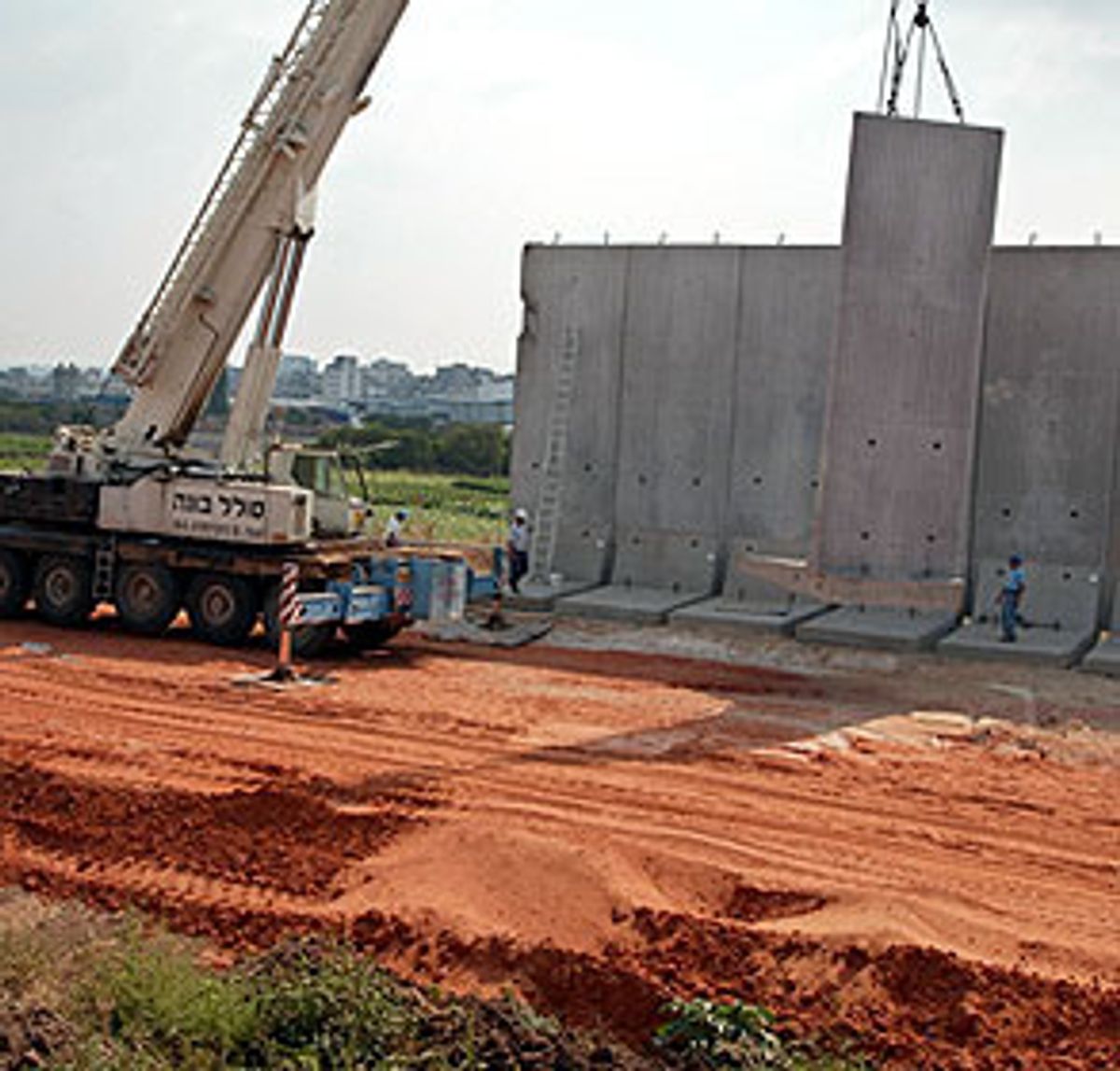
The massive, gray concrete elements of Israel's under-construction "security" wall tower over the fields and a handful of sheds on the outskirts of the West Bank town of Qalqiliya. A segment some 500 meters long snakes around the western edge of the Palestinian area and blots out the clear blue sky for the unfortunate residents of the nearest apartment buildings. The 28-foot-high wall will cover a stretch of two kilometers around Qalqiliya, a town of some 80,000 people that juts sharply out into Israel's narrow "waist." A soon-to-be-opened toll road, Israel's first, closely follows the pre-1967 border, the so-called Green Line, at this point; the authorities say the wall is necessary to protect it against shooting attacks from Qalqiliya. In the end, this section will make up only a fraction of the planned 80-mile barrier along the northern West Bank.
"Sometimes I talk to the Palestinian farmers in the fields," says Erez Rubinstein, the project manager for the mile-plus stretch, "and they complain that they will not be able to see the sunset anymore because of the wall." Rubinstein has been working on the site for more than two months. Despite the generous fee his construction company gets for the job, he wishes he were doing something else. He's talking not only about the danger, although snipers from the Palestinian side have targeted the construction crew several times. Like many Israelis, Rubinstein wishes the wall wasn't necessary, but sees it as the only option left. "When I talk to the people on the other side I don't detect any willingness to stop the terror attacks, so we don't have a choice. For now there is no other solution, but at some point I hope I can tear the thing down again."
Construction of the barrier started last month after Israeli Prime Minister Ariel Sharon finally -- and reluctantly -- gave his assent. The first phase of construction, the northern section, is expected to be ready early next year. Another section, around Jerusalem, is also under construction.
The wall has aroused considerable controversy in Israel. Many right-wing Israeli politicians are opposed to the barrier on ideological grounds: Because the wall will follow more or less the old border between the West Bank and Israel, conservatives fear that it will amount to a tacit acknowledgment that they are two separate political entities. (Many left-wingers support it for the same reason.) To avoid getting entangled with these issues, the Cabinet, including the center-left minister of defense, Binyamin Ben-Eliezer, has emphasized that it will be a security barrier, not a political demarcation.
For their part, Palestinians are mainly opposed to the wall because they feel it will further curtail their already severely restricted freedom of movement. They also say chunks of Palestinian land will be included on the Israeli side of the wall. In a larger sense, they view it as a unilateral attempt by Israel to impose a solution that will enable it to perpetuate its occupation.
Some 30 miles north of Qalqiliya, the village of Barta'a straddles the Green Line. One part of Barta'a is Arab-Israeli; the other, larger part is Palestinian. The division is a result of the fighting that took place in 1948 -- what Israelis call the War of Independence and the Palestinians the Naqba, or Catastrophe. Israel's conquest of the West Bank in 1967 reunited the village and the families that were split up. (The "reunification," of course, was far from complete. It remained easy to cross from East Barta'a to West Barta'a, but East Barta'ans caught by Israeli border patrol checks in West Barta'a can be sent to jail for months. Despitre this, many keep crossing into Israeli Barta'a. The army often carries out identity checks between Israeli Barta'a and the main roads.) Both sides have their own local council, whose chairman in both cases is called Kabha. The difference between the two sides is still stark, though, 35 years after reunification. The Israeli side looks like any Arab-Israeli town or village; it's not as wealthy as most Jewish neighborhoods, but the roads are paved, cars are relatively new, and everything seems to work. West Bank Barta'a is dusty, with roads of sand and mud. Hardly a car is to be seen, and certainly no new models.
Ahmed Ibrahim Kabha, the chairman of the local council in the Israeli Barta'a, points toward a dry riverbed that runs through the village. "That's where the Green Line was and where they wanted to put the security fence." He says he fought hard to keep Barta'a united and on the Israeli side of the fence. He even went to see Ben-Eliezer to persuade the defense minister to include Eastern Barta'a and the village fields on the West Bank on the Israeli side of the fence -- which is what happened. Ahmed Ibrahim is aware of the sensitivity of his story. "I asked some important people on the other side what they wanted and they all said they preferred to be on the Israeli side. But none of them was prepared to speak out in public or write a letter because they were afraid that they would be regarded as traitors."
Hassan Kabha, the chairman of the council of Eastern Barta'a, ridicules the notion that his counterpart had any say in the trajectory of the barrier. "The Israelis always wanted to use the fence to steal our land. You don't think they seriously listened to a few Arabs?" He too wants Barta'a to stay united -- but under Palestinian rule. "We belong to the Palestinian Authority and we hope one day to belong to a Palestinian state. The barrier will not deter us."
Even without the security barrier, the Israelis have already made contact between Barta'a and the rest of the West Bank more difficult. The road to nearby Jenin, the major city in the northern West Bank, has been cut. Hassan Kabha, a physical education teacher in Jenin, says, "The trip used to take 30 minutes -- now it takes two hours if I'm lucky." He has no idea what arrangements, if any, will be made after the fence is finished.
Most Palestinians worry more about the opposite problem -- people who will remain on the West Bank side of the fence but who need jobs or have family in Israel. "People are desperate, they don't have money for food or anything," says Mustafa Barghouti, a human rights activist and political analyst in Ramallah. "They will do very dangerous things to try and feed their families, including crossing the fence. Even now it is dangerous to go to Israel and many people still try." Barghouti accuses Israel of using the barrier, in combination with the encirclement of the Palestinian cities, to finalize a "canton system" in the West Bank. "If the Israelis totally withdraw from the West Bank and Jerusalem, if we have our own state and if the fence follows the green line exactly, most people will not have a problem with it."
While a majority of Israelis currently see the barrier as one of the few options left to them in their fight against Palestinian attacks, some counter-terrorism experts do not agree. Yoni Fieghel, from the Interdisciplinary Center for terrorism research in Herzliya, fears that Israel will become merely reactive behind the fence. "A barrier means that we will be passive, that we will wait behind our walls for the next terrorist attack," says Fieghel. Counter-terrorism always has to be proactive, he asserts. For the same reason, he is also opposed to posting armed guards on all buses. "We have to deal with the terrorist at his point of departure, we have to go in there and prevent them from ever setting out for an attack."
Israeli is currently experiencing a lull in the attacks, with more than a week having gone by since the last bombing. Many people ascribe this to the army's occupation of the Palestinian cities on the West Bank, but Fieghel issues a word of caution. "I don't think that is a long-term solution either," he says. "It will increase resentment, both because of our presence there and because of the humanitarian situation." He advocates quick, in-and-out, intelligence-driven, pinpoint incursions.
Fieghel wants to make it very plain that he does not oppose the barrier for political reasons. Rather, he calls the idea "messianic." The Israeli public often becomes infatuated with these slogans, he says: "Peace Now. Messiah Now. At the moment it is Fence Now." While some analysts say that the barrier should have been built years ago, but wasn't because of political obstruction, he turns the argument around and says that it's only now being built because of pressure from a public that needs to be reassured.
Resentment and motivation are some of the other reasons why a barrier will simply not be effective, according to Fieghel, who served as a colonel on the West Bank. "From my experience with walls and fences around refugee camps, settlements and roads, they just become the focus of Palestinian attacks. They want to show that a fence will not stop them." Then, there is another, much larger group, says Fieghel, agreeing with Mustafa Barghouti. "The motivation of people looking for work in Israel is high; they will keep trying to cross." Attempts by these people to scale the wall will inevitably also make the barrier less effective in stopping attackers, he says.
Advocates of the barrier often point at the successful example of the fenced-in Gaza Strip: Few terror attacks have originated in the Strip. But Fieghel says that's comparing apples and oranges. "The geographic and demographic circumstances are completely different there," he says. "The Gaza fence is more or less straight and in open terrain; the West Bank border follows a complicated route and the Palestinian villages and towns come right up to it."
The Jewish settlement of Sal'it juts out three kilometers into the West Bank, between the Palestinian towns of Tulkarem and Qalqilyia. Miriam Geppner, a veteran resident of the cooperative village that was founded in 1979, says she did not care whether her hilltop oasis of green lawns and trees in a barren, rocky landscape would be included on the Israeli side or not. But it will be, thanks probably to the extraordinary pull of some very high-ranking army officers who live in the settlement. A spokeswoman for the Israeli Defense Ministry confirms that the trajectory was changed after local consultations. She mentions Barta'a; a nearby large Arab town called Um El-Fahm; Sal'it; and the large Jewish settlement of Alfei Menashe, further south. Despite the fact that she lives on a settlement, Geppner regards herself as left-wing and says she would gladly leave her house if a peace treaty demanded it. She seems unaffected by the whole debate. "I just hope that the neighboring Arab residents will not be inconvenienced by the wall," she says.
The Sal'it detour will require an additional six miles of fencing and will cost at least $10 million more. From the manicured lawn of a villa on the edge of the settlement, the route that the barriers will take can already be seen, in a recently carved-out path in the rocky terrain. At one point it snakes close to Sal'it and inserts itself in between the settlement and the Palestinian village Kafr Tsur. A locked gate already cuts off the road between the two worlds. "I have so many friends in the Arab villages near here," says Geppner, "and it is really sad I cannot see them anymore. At one point we wanted to take food to Kafr Tsur but we heard that the people there didn't want to accept anything from Israelis." Her biggest objection to the barrier is that it may sour relations between the settlers and their Arab neighbors still further. "It will not make me feel safer; I have always felt safe here."
Shares