
Mark Simpson

Meet the metrosexual

He's well dressed, narcissistic and obsessed with butts. But don't call him gay.

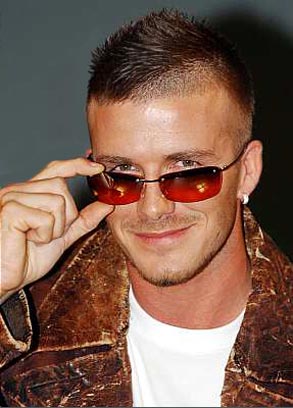
David Beckham, the captain of the England soccer team at this year’s World Cup in Korea and Japan — quite possibly the most famous and photogenic soccer player in the world — recently posed for a glossy gay magazine in the U.K., just before leaving for battle in the Far East.

Well, you can imagine the outcry. The leader of England’s courageous lads tarting around in a pooftah magazine? Handing our enemies such an embarrassing pink stick to hit us with when the nation is girding its manly loins? Well, actually, apart from a few predictable but strangely muted snickers in the tabloid press, the sensation was that there wasn’t a sensation. It was entirely what the British public has come to expect.

You see, “Becks” is almost as famous for wearing sarongs and pink nail polish and panties belonging to his wife, Victoria (aka Posh from the Spice Girls), having a different, tricky haircut every week and posing naked and oiled up on the cover of Esquire, as he is for his impressive ball skills. He may or may not be the best footballer in the world, but he’s definitely an international-standard narcissist, what would once have just been called, in the Anglo world at least, “a sissy.” Hence in that World Cup game against Brazil that kicked England out of the tournament, Becks was the only English player not to be upstaged aesthetically as well as athletically by the Latins.

In the interview with the Brit gay mag Attitude, this married father of two confirmed that he’s straight, but as he admits, he’s quite happy to be a gay icon; he likes to be admired, he says, and doesn’t care whether the admiring is done by women or by men.

All of this is very modern and progressive, I’m sure, and Beckham’s open-mindedness and “equal ops” narcissism has undoubtedly helped to change some — how shall we say? — unsophisticated attitudes in this very male, tough, still largely working-class sport. However, I feel it is my duty to inform you that Mr. Beckham, candid to the point of blatant exhibitionism as he is, is not being entirely honest with us about his sexuality.

Outing someone is not a thing to be contemplated lightly, but I feel it is my duty to let the world know that David Beckham, role model to hundreds of millions of impressionable boys around the world, heartthrob for equal numbers of young girls, is not heterosexual after all. No, ladies and gents, the captain of the England football squad is actually a screaming, shrieking, flaming, freaking metrosexual. (He’ll thank me for doing this one day, if only because he didn’t have to tell his mother himself.)

How do I know? Well, perhaps it takes one to know one, but to determine a metrosexual, all you have to do is look at them. In fact, if you’re looking at them, they’re almost certainly metrosexual. The typical metrosexual is a young man with money to spend, living in or within easy reach of a metropolis — because that’s where all the best shops, clubs, gyms and hairdressers are. He might be officially gay, straight or bisexual, but this is utterly immaterial because he has clearly taken himself as his own love object and pleasure as his sexual preference. Particular professions, such as modeling, waiting tables, media, pop music and, nowadays, sport, seem to attract them but, truth be told, like male vanity products and herpes, they’re pretty much everywhere.

For some time now, old-fashioned (re)productive, repressed, unmoisturized heterosexuality has been given the pink slip by consumer capitalism. The stoic, self-denying, modest straight male didn’t shop enough (his role was to earn money for his wife to spend), and so he had to be replaced by a new kind of man, one less certain of his identity and much more interested in his image — that’s to say, one who was much more interested in being looked at (because that’s the only way you can be certain you actually exist). A man, in other words, who is an advertiser’s walking wet dream.

Beckham is the biggest metrosexual in Britain because he loves being looked at and because so many men and women love to look at him: He’s the future, but also a way of adapting other, less advanced specimens to that future. More to the point, he sucks corporate cock with no gag reflex. A staple of newspapers, men’s magazines, TV advertising and billboards, last year he earned around $8 million for sponsoring various male fashion accessories, such as Police sunglasses.

The Beckham advertising phenomenon, however, goes beyond the usual cash-in, slightly wooden product endorsements of sporting stars. Becks gives the impression that he’d do it for nothing (except the attention); he’s a sporting star who wants to be a model.

Oddly, while Beckham is now officially a gay icon, he’s probably someone that gays would rather be than fuck — all that money, all those free designer clothes, living with a Spice Girl and all those straight men in love with you. Of course, they also like him because imitation is the sincerest form of flattery.

Gay men did, after all, provide the early prototype for metrosexuality. Decidedly single, definitely urban, dreadfully uncertain of their identity (hence the emphasis on pride and the susceptibility to the latest label) and socially emasculated, gay men had pioneered the business of accessorizing masculinity in the ’70s with the clone look enthusiastically taken up by the mainstream in the form of the Village People. Difficult to believe, I know, but only one of them was gay and 99 percent of their fans were straight.

In the Eighties, the moustaches were shaved off and the male body became more smoothly, invitingly aestheticised and commodified by media regents such as Bruce Weber, Herb Ritts and Calvin Klein. Two decades on, and the hairless — perpetually adolescent and available — dazzlingly toothy, muscular, masculine template is still with us, simultaneously a clichi and de rigueur in an Abercrombie & Fitch world. A&F may be looked down upon as middlebrow and middle American by the most refined metrosexuals, but its alarming popularity with straight, beer-drinking frat boys is proof of how metrosexuality has gone mainstream — while its lusciously produced, semi pornographic quarterly catalogues deliver conclusive proof that male narcissism (in photograpic shorthand: Weber-ism), is only ever a post-workout shower away from homoeroticism.

Perhaps this is because nowadays straight men are also emasculated. Female “Sex and the City” metrosexuality has seen to that. Female metrosexuality is the complement of male metrosexuality, except that it’s active where male metrosexuality is passive. No longer is a straight man’s sense of self and manhood delivered by his relationship to women; instead it’s challenged by it. Women are still monarchs of the private world, but increasingly assertive in the public world too. Series like “Oz,” set in a male prison and featuring story lines that revolve around violent buggery, probably look like a kind of sanctuary for some men from the female voraciousness of “Sex and the City.”

And, as the pages of the celeb mags reveal, the more independent, wealthy, self-centered and powerful women become, the more they are likely to want attractive, well-groomed, well-dressed men around them. Though not for very long. By the same token, the less men can rely on women, the more likely they are to take care of themselves. Narcissism becomes a survival strategy; apparently, some men actually buy their own underwear and deodorant these days. Beckham, unlike most metrosexuals, is happily married, though he seems to wear his marriage and even his children as accessories: The name of his first child, Brooklyn, is tastefully tattooed across his back.

Many years ago, Norman Mailer described homosexual men as narcissists who occasionally bump into one another. Which was true, of course. But now that everyone’s gone metrosexual it’s also true of straights. Perhaps this is why straights are almost as promiscuous as gays these days: All those TV dating shows where marriage or even sending each other Christmas cards is the last thing on anyone’s mind; all those youth holidays that appear to have become fortnight-long rum-soaked orgies, while Mum and Dad back home are taking part in wife-swapping parties in the suburbs.

Sometimes it seems as if the only thing holding straights back from full equality with gays is the fact that most restroom facilities are not yet co-ed. Perhaps this is also why hetero sodomy has become such a hot topic of late: These days my straight male friends talk of no other kind of intercourse (though maybe it’s because they think I’m an expert on it). According to the same straight men, the vagina was made not for their penis but for another female’s tongue.

Perhaps because it represents the definition of recreational sex and doesn’t remind them of their heterosexual responsibilities but rather of their homosexual possibilities (the exhibitionism of male metrosexuality is literally asking to be fucked), or maybe because it’s seen as a kind of extreme sport (it involves trusting your life to some stretchy rubber and taking the plunge), anal sex has become the unholy grail of metrosexual sex. The booty has become the pervey focus of so much fashion lately, including those Engineered Levi’s ads featuring men and women with their jeans on back-to-front, zippers over ass cracks.

Kylie Minogue‘s career was recently successfully and spectacularly relaunched as a global brand by her bending over and offering her pert, almost boyish ass literally to the world. A front-page headline on Britain’s most popular national newspaper drooled: “Has Kylie Had a Bum Job?” (One of the most popular taunts used by opposing fans against Beckham used to be “Posh takes it up the arse!!” Now it just sounds like flattery.)

Metrosexuality has also converted Hollywood to its persuasion. Films like “Fight Club” and “American Psycho” and “Spider-Man” exploit and/or negotiate the anxiety created by metrosexuality’s impact on masculinity while of course employing all the advertising techniques that have been used to convert young men to metrosexuality in the first place. This can lead to an irony that loops back on itself: auto-fellatio with arched eyebrows. In “Fight Club,” a film that looks like a feature-length glossy men’s magazine fashion shoot, Brad “six-pack” Pitt, smooth Calvin Klein model turned Hollywood pretty boy, and one of America’s most famous metrosexual males, leads an all-boys-together rebellion against … Calvin Klein, or rather emasculating consumerism.

In “American Psycho,” the antihero serial killer’s problem is presented as his failure to recognize the woman that could civilize him: “Have you ever wanted to make someone happy?” she asks innocently. He doesn’t hear her: He’s too busy getting out his giant nail gun. Making someone else happy is of course an even more impossible quest than making yourself happy — our parents taught us that. But in this case it is rather less likely to stain your white silk sofa.

The “Spider-Man” movie meanwhile offers us the kinky, fetishistic spectacle of a geeky ordinary young man whom no one notices transformed into a raving metrosexual before our very eyes. Apparently injected with steroids and ecstasy by a gay spider, he admires his new buffed body with widening eyes in the mirror, dresses up in a tight lycra gimp suit and runs around a lot on all fours with his arse in the air, after having setting up (Web?) cameras to record his (s)exploits. Peter Parker/Tobey Maguire employs designer drugs, clothes, perverse sexuality and multimedia technology to get people to look at him as he swings between the billboards and skyscrapers from what appears to be his own hardening jism.

In one memorable bondage/mummification-resonant scene he hangs upside down in his gimp suit while Kirsten Dunst peels off the lower part of his mask to kiss him, before replacing it: a perfect example of the new power dynamic between metrosexual men and women and how metrosexual men have to be the center of attention. We’re supposed to believe that Tobey is motivated by old-fashioned virtues of social concern and love for Kirsten but we don’t believe it for a moment. Nor does, in the end, the movie: Kirsten finally offers herself but Tobey declines, realizing that she would come between him and his real love: his metrosexual alter ego in the Day-Glo gimp suit.

American publishing meanwhile is effectively repeating the ironic formula of “Fight Club” and the Brit lad-mags (Maxim, FHM) exported to the U.S. from the U.K. (sorry, another bad habit we’ve passed on to you guys, along with Wang Chung and Ozzy Osbourne). In the editorial these magazines perform a kind of hysterical heterosexuality of tits, beer, sports, cars, and fart-lighting — but the real money shot is the pages and pages of glossy, straight-faced fashion spreads and ads featuring glossy male models selling male vanity; that, after all, is what these magazines exist to deliver. Which is to say, the lad-mags are actually raving metrosexual but still in denial, which is the place that most men are at right now.

Mind you, denial has something to be said for it. It can take some interesting and creative forms — such as Eminem, for example. The “faggot” boy bands that Mr. Mathers hates are definitely metrosexual. And yet Em, who like Beckham can’t resist a big fat shiny lens, who loves to pose half-naked (and drag it up in his videos), and who also wears his children as accessories, is clearly and alarmingly metrosexual himself; we’re all looking at him and he’s meeting our gaze with his pretty, hooded baby-blue eyes. He bitches and moans about all the attention he gets, but succeeds in turning that bitching and moaning into another album.

Eminem poses dreamily for the cover of glossy magazines, but then has a hissy fit when they Photoshop his shirt pink and demands that they pulp their entire print run. The real “Eminem Show” is exhibitionism and passivity masquerading, very attractively, very seductively, as rap-ismo activity — and is probably why most of his songs contain references to being “fucked in the ass.” (And perhaps why his former bodyguard has alleged that Eminem’s wife regularly beat up Slim Shady and not the other way around.)

By way of contrast, the relaxed, faggoty, submissive metrosexuality of David Beckham, posing for gay magazines and more than happy to wear pink shirts — and even pink nail varnish — may be less overtly pathological, and probably represents a more benign or successful adaptation of masculinity to the future, but is a trifle distasteful, not to say occasionally downright nauseating. The final irony of male metrosexuality is that, given all its obsession with attractiveness, vanity for vanity’s sake turns out to be not very sexy after all.

But then, it’s much too late for second thoughts. Metrosexuality is heading out of the closet, and learning to love itself. Even more.

The pop star who hated sex

Was he gay? Bisexual? Or really just celibate, as he claimed? "I'm just simply inches away from a monastery," Morrissey once quipped.

Of all the attention Steven Patrick Morrissey has garnered, he is perhaps best known for not doing the nasty. His abstinence is seen as symbol, proof and cause of his eccentricity. After all, in an age utterly obsessed with and possessed by SEX, such party-pooping is inconsiderate, anti-democratic, downright unhealthy, and, well, positively sinful. And in a pop star who hasn’t been knighted and whose main audience isn’t grandmums, it’s actually heretical.

As Oscar Wilde put it, celibacy is the only real perversion; and in Morrissey’s eyes, this was a good enough argument for practicing it. Like any form of Utopianism, reinventing sex requires you to renounce the thing you want to reinvent. Paradoxically, although celibacy is perhaps the least innocent sexual option — renouncing sex makes everything sexual — publicly it provided Morrissey with the innocence he needed to carry off his seductive-seditious project.

In order to be above sexuality, the prophet of the fourth sex had to be above sex. And in a world which can only, on a good day, conceive of two and a half sexes, the prophet of the fourth had to “take the vows” (and marry not Jesus but himself) to avoid being enmeshed in a dreary, mundane, mind-numbing parochialness. Whatever he did, whatever the mechanics and topography of his nakedness with another person, and the all-important, all-consuming details of whether their genitalia were internal or external, would be taken as the complete explanation of Morrissey himself — what he was, how he wore his hair, how he tied his shoelaces and, of course, the rationale behind his whole oeuvre. He would, in other words, lose control of his own narrative, surrender his own authorship. He would cease to be his own special creation and become instead someone else’s dirty joke.

What do you like in your music?
I can’t forgive anybody a bad lyric really. I like to think a singer is singing with a sense of immediate death. The Gallows Humour, lah de dah. That it’s the last song I’ll ever sing, quite literally. I like singers to sing with desperation.
Humour?
Well you know, desperation, humour, what’s the difference?
Sex?
Well, yes, humour; we’ve mentioned sex.”

– NME, 1989

Celibacy massively enhanced Morrissey’s stardom by turning him into a conundrum, a puzzle that had to be solved. As a highly sexual pop star who renounced sex, he made himself the Rosetta Stone of sex itself and found himself interrogated about his “sex life” like no other pop star had ever been before. (By way of contrast, Boy George’s infamous “I prefer a cup of tea” remark was rather too eagerly believed.)

Where does the anguish and the hate come from?
As with most things, I’m still trying to find out.
Why can you fall in love so easily with images, but not with people?
I’m still trying to find out.”

– Blitz, 1988

In an age fascinated with telling the secret of sex, over and over again, Morrissey had to be made to talk. In interview after interview the celibate star would be pushed up against the wall, bright lights shone into his eyes, and made to explain his alibi over and over again in the hope of catching him out. Tricks mixed with threats mixed with wheedling pleadings in an attempt to get this most uncooperative of witnesses to turn Queen’s Evidence.

You must get a few propositions these days …
Not many! The shock of the whole thing to me is that not many situations do arise. I thought literally queues upon queues would form, but it’s not the case. After the end of a sizzling performance, where people are simply eating each other to get close to the stage, I find myself back at the hotel with Scrabble and an orange. It’s all very curious.”

– Jamming, 1984

What is your ideal sexual experience?
I don’t have a vision of it at all. Why do people ask me questions like this?
Because you ask for it. You’re the only person who can seriously be asked those questions.
Oh, come now.
Is there any sex in Morrissey?
None whatsoever. Which in itself is quite sexy.”

– Blitz, 1988

Well, I don’t believe you haven’t ever gone out with anyone, Stephen [sic].
Well, I haven’t, so put that in your Sony cassette and … [laughs sharply] I really haven’t.
But you’re a human being.
You’ve no evidence of that. Artists aren’t really people. And I’m actually 40 percent papier maché.”

– Melody Maker, 1997

One biographer even announced that he was writing a book about Morrissey’s “love life,” an exceptional, if slightly disturbing, accolade (though, oddly, years later, there’s still no sign of it). Clearly, by making his private life a tabula rasa, Morrissey succeeded in provoking everyone to write all over it.

What is the greatest myth about fame? That someone somewhere consequently wants to sleep with you.”

– Morrissey

Interviewers frequently asked him point blank if he was gay. When this got nowhere, in their terms, some would resort to cutting out the question altogether and just going straight to the answer they wanted. One grilling him for an American rock magazine in the early Eighties announced: “Morrissey is a man who says he’s gay” — without providing any quotes to back the statement up. As a consequence of this, Morrissey and The Smiths were perceived in the US almost from the beginning as a “gay act,” something which did not exactly help them, but rather more importantly it simply wasn’t true. This journalist was merely doing his job, however. He was just simplifying things for his readers, just filling in the gaps, just helping Morrissey “out” — as more and more people have been inclined to do as Morrissey’s career has progressed. Since Morrissey was openly admitting, nay flaunting — in his work — the fact that he wasn’t “straight,” he must, therefore be “gay.” Stands to reason, dunnit?

What these very helpful, very kind people forgot, however, was that the law “what’s not one thing must be t’other,” absolutely correct and inviolable as it is, is a law which only applies to stupid people. And journalists.

Are you gay?
I feel that I am quite vulnerable and that’s quite good enough because I wouldn’t want to be thought of as Tarzan or Jane. … I don’t recognize such terms as heterosexual, homosexual, bisexual and I think it’s important that there’s someone in pop music who’s like that. These words do great damage, they confuse people and they make people feel unhappy so I want to do away with them.”

– Star Hits, 1985

There was that quote in …
Here we go, here we go …
that you were gay or something like that.
Yes I know.
How do you view that?
Well, I just think it’s all so untrue and I think it’s so unfair, I mean, obviously, any kind of a tag I’ll dodge. I’ll really dodge any kind of a tag, whatever it is … I’m not embarrassed about the word ‘gay’ but it’s not in the least bit relevant. I’m beyond that frankly.”

– Australian Radio, 1985

You write a lot about the homosexual experience …
Well … not a lot.
OK, you write a lot about homosexual ‘longing.’
I’ve always said I leave things very open and that I sing about people. Without limitation. And I don’t think that automatically makes me a homosexual.
You’ve always taken offence at that word.
Because it’s limiting and restrictive.”

– The Face, 1990

What about camp flirting?
I never do that.
You do!
I knew you’d stray. I knew as soon as I mentioned ‘camp’ you’d stray from the real meaning of the word. I knew you’d suddenly think of feathers and things like that. No, I don’t flirt. You were there at Wolverhampton, you could see the steam, there was aggression.”

– NME, 1989

Some have pointed to the fact that Morrissey has admitted to both male and female (rather unsatisfactory) encounters in his life and wondered why he didn’t simply announce that he was “bisexual.” Well, perhaps because bisexuality isn’t an escape from sexuality at all, it’s two sexualities. Moreover, it suggests twice the opportunity instead of merely twice the frustration. Yes, Morrissey’s struggle to resist the iron law of “sexuality” which most of the rest of us have to submit to was always flagrantly self-important and lofty. Teenage even. But isn’t that what artists and stars — rather than common-or-garden celebrities — are for? Morrissey’s ambition, his perversity, his sensibility was far too large, too talented, too vicious to be fitted into this harmless, silly, precious, sequinned little word “gay.” (He would assert repeatedly that he had nothing against “g” people themselves, but then who could blame him if he did?)

Have you got a love life?
I’m not answering that question.
Why not?
Because you’re just too nosey, you don’t deserve to know. “

– On “The Janice Long Show” on BBC Radio 2, 2002

Throughout his career the pressure on him to “come out” (with his hands up) increased. This capitulation was allegedly for “Morrissey’s own good,” a contemporary version of that line from old cop shows: “make it easy on yourself, kid.” The skinny spectre of the camp “Carry On” star Kenneth Williams, who claimed not to be interested in sex but admired workmen’s oiled bodies in his private diary, was invoked rather too facilely. Besides, it wasn’t as if Kenneth Williams was someone whose existential problems and narcissistic erotic attachment to his own sexual repression and isolation would have been solved by an appearance on “Gaytime TV,” a cocktail kiss from Serena McKellan and a bottle of poppers. (Well, maybe the poppers might have helped.) People nowadays seem to imagine that ‘sexual identity’ is a place where people find themselves and true love, rather than the place where they lose all hope.

Is celibacy really a victory of guilt over lust?
I wish it was, I wouldn’t feel so badly about it then. In fact, I wish it had any purpose whatsoever. It certainly wasn’t something I ever tried to instil on the public at large — I never expected a massive movement of celibates storming down Whitehall — it was just something that slipped out really. In a manner of speaking.”

– Melody Maker, 1987

By the late Nineties the fashion for “coming out” had reached a feverish pitch; people who had once been happy to hear as little as possible about gayness began to outpace even gayists in their dogmatic insistence on the need for “honesty.” A married British MP caught visiting a male pick-up area was clapped in the stocks by the press, tabloid and “quality,” not because of the homosexual dimension, they claimed, but for his “hypocrisy” and “denial” about his sexuality (he refused to “confess” that he was gay). Even the President of the United States faced impeachment for not coming out about his extra-marital (non-penile vaginal and therefore, under the law of many US states, “sodomitical”) “sex” life. And in 1998 that other sexually ambiguous British pop performer, George Michael, whose shuttle-cock-stuffed shrink-to-fit perma-crotch was launched on the world around the same time as Morrissey’s shrub-stuffed baggy-arsed jeans, was caught “performing” in a public toilet — in a painful pincer movement involving the British tabloid press and the Beverly Hills Police Department.

“Sex is a waste of batteries.”

– Melody Maker, 1986

The refusal up until this time of the “elusive” Mr Michael to make a public announcement about his private life (despite having all but announced his orientation in his more recent work and interviews) apparently amounted to a crime of global proportions. Realizing the game was up, and ever the consummate showman, he responded by giving the public what they wanted — he out-tabbed the tabloids, and confessed all in televised interviews in the US and the UK. By co-operating fully with the authorities — and the public — in regard to his sexuality, he was able to avoid having to express any shame about the arrest, and instead was actually able to go on the offensive and allege he was the victim of police entrapment. He even released an hilariously vengeful single and video called “Outside” which turned his arrest into a celebration of “sexuality” and “public sex.”

Ironically, though, the brightly lit, out-and-proud undeniably catchy “Outside” was so concerned with sunny self-justification and literally shame-less self-promotion it failed to capture anything “outside” at all, and said much less about the real, shadowy nature of desire and compulsions than his “in-the-closet” songs such as “Fastlove” or “Spinning The Wheel.” Or — it goes without saying — any of Morrissey’s criminally ambiguous and evasive “outside” songs. In truth, “Outside” effectively marked the end of George Michael’s career as a serious artist. Not because “coming out” turned the straight world against him, but because, paradoxically, it meant that he could no longer write about “inside” feelings honestly. He could only be a spokesperson.

Were you being slightly flippant when you said your love songs were written from total guesswork?
No, I was being absolutely serious. Which isn’t really funny.”

– Melody Maker, 1985

Perhaps, as many people appear to be convinced, Morrissey is simply lying. Perhaps secretly he is the life and soul of Elton John’s hot-tub parties, has his own booth at Heaven nightclub, possesses Europe’s largest collection of peaked caps, and has a live-in boyfriend who is Kylie Minogue’s personal stylist and colonic-irrigationist. (Funnily enough, no one ever seems to think that Morrissey’s “really” covering up a life of secret heterosexual bliss, even though being outed as straight, i.e. post-Seventies Bowie, would probably be much more embarrassing for him).

But if Morrissey is just fooling us, just “living a lie,” how do you explain his work? How do you explain the obvious, undeniable, massive, throbbing sublimation not just of eros but life into his songs? Why, in other words, would this pathologically, paralytically, criminally shy creature bother to get up on the stage and sing at all?

Despite an acknowledgement of sorts in 1997 that he had finally succumbed, albeit briefly, to some kind of relationship with a young Cockney boxer (and, in all honesty, who wouldn’t?), and heavy hints that celibacy and he had parted company, Morrissey resolutely refused the blandishments of the press and refused to kiss and tell and show the home video — except in his “enigmatic” songs — and the gossip and speculation continued. Perhaps because he was not vulgarly famous enough to warrant the kind of media gang-bang at gunpoint which Mr Michael endured, perhaps because he was not quite as reckless, or perhaps simply because he still didn’t really have much of a “sex life” at all, Morrissey was able to continue protecting and preserving the virtue of his private life — such as it is.

Many of Morrissey’s fans however recognize his celibacy as a saintly gesture and continue to believe in it rather like Catholics believe in the virgin birth (which is to say: “I know very well that …, nevertheless …”). For most of his career it had proved the seriousness of his commitment, even if it was to his own misery. He might perform before a crowd of thousands, he might be mobbed by ecstatic, sweating fans, male and female, eager to hug and kiss him until they were finally dragged away by bouncers, but he returned to an empty bed every night — the perfect vantage-point from which to observe other people’s messy love lives.

“I find that people who are knee-deep in emotion and physical commitment with human beings, I find they’re often totally empty of any real passion … I mean, if we look back on the history of literature, it’s always these really creased, repressed hysterics, if you like, who are enchained in these squalor-ridden rooms, who say the most poetic things about the human race.”

– Melody Maker, 1984

Celibacy, which as has been pointed out by others, actually, pedantically means a refusal to get married, crystallized Morrissey’s image as the loneliest man in the world, and only enhanced his appeal to those proceeding through the loneliest time of life — adolescence. It is a period which is often — even in this day and age when sex is more compulsory than taxes — excruciatingly characterized in the relationship department by lots of thought but little action; a peculiarly pleasurable pain which Morrissey vocalizes as no other has. In publicly eschewing the consolations of coupledom, perhaps the only remaining religious faith in the Western world, he once again displays his genius for turning a powerless, frustrating situation (rejection) into an extremely powerful and satisfying one (rejecting) — again, something which powerless, frustrated adolescents under an entirely inhuman pressure to couple/conform could relate to.

“I constantly spectate upon people who are entwined and frankly I’m looking upon souls in agony. I can’t think of one relationship in the world which has been harmonious. It just doesn’t happen.”

– NME, 1984

Morrissey’s refusal to cop off was not a cop-out but an extremely brave avowal of his understanding of human relations and the futility, as he saw it, of intimacy; his life was the theory and his work was the practice, not the other way round. Pop music was his exhibitionistic route to a virtual, ironic intimacy — which in some ways has turned out to be rather more successful, and certainly longer-lasting, than the usual, “real” variety. When, during a particularly extravagant performance of “William, It Was Really Nothing” on “Top of the Pops” in 1984, he tore off his shirt to show the family audience tucking into their tea the words MARRY ME scrawled in magic marker across his scrawny chest, he was making a proposition to everyone in general and no one in particular — or was it vice versa? Whatever, his proposal was accepted wholeheartedly by millions, many of whom, twenty years on, still remain faithful; countless actual, living human beings have come and gone out of their lives and have been forgotten. But not Morrissey. Even those who think they’re over him, who think they walked out on him or that he walked out on them years ago, know deep down, in those really squidgy bits they don’t let anyone else see, that they’ll never ever be rid of him. The more they ignore him, the closer he gets.

“I’ve still yet to touch perfection … I’ll know it when I do it, and I think it will be totally enchanting to affect other people’s lives with a form of perfection. It will be like marriage!”

– Morrissey, Blitz, 1988

Crucially, Morrissey’s terminal singleness meant that the fans could possess him through his work — which was full of him and his eroticism in a way that his life wasn’t — reassured in the knowledge that there was no one else, no shameless groupie nor jammy live-in lover who could possess him more fully, more authentically, than they. Morrissey’s work and his public performance was, in effect, his “private life.” His songs offered an intimacy which most people wouldn’t inflict on their life-long lovers. Morrissey was a fan who had crossed the bedsit Rubicon and became a star, but he had somehow retained the fan’s greatest defining feature: frustration. He did not act out his fans’ unfulfilled fantasies so much as embody them. His famous celibacy told his fans that he was still one of them, still lying alone on the floor of his bedroom listening to records and moaning mother me smother me — just as they were, even and especially those clever swine who had grown up and got married.

“I’m just simply inches away from a monastery and I feel that perhaps if I wasn’t doing this that I probably would be in one … which of course is a frightening thing to dwell upon.”

– Picture Disk, 1984

Morrissey has no need of sex with people so long as he continues to have it with his audience. Each stage performance is so obviously a sexual release — one of the things which makes his concerts so memorable and so sublimely, indecently unprofessional. If the yelps and yowls and the desperate, ecstatic falsettos on tracks such as “This Charming Man,” “Barbarism Begins at Home” or “Maladjusted” hint powerfully at an orgasmic release, onstage they turn into a form of musical pole dancing — a protruding, curling fleshy tongue, a salacious smile, a sadistic whipping of his mike cable, a coquettish swing of those magnificently inhibited hips, a tempting spasm of his shiftless body, a golden sparkly shirt torn from his back and flung into an audience which, as one, pounces on it and renders it to the tiniest, dampest, most fragrant fragments, while the curious love-object himself lies on the stage writhing around in ecstasy-agony or on his back, legs akimbo airborne or draped over a monitor in an obliging gesture towards his audience. A Morrissey gig is an extraordinary, epic, religious prick-tease. But then, this is the self-conscious nature of his relationship with his audience: “Tell me tell me that you love me/oh, I know you don’t mean it.” (“Tomorrow”)

Do you ever go out dancing, stuff like that?
Heavens no! I can only do that in front of four thousand people. It’s the answer to everything.”

– Morrissey

Morrissey’s celibacy is the symbol of his central contradiction. For all his bravura posturing as the loneliest monk, he can’t quite make up his mind whether he is rejected or rejecting, which is itself the basic and irresolvable problem of self-consciousness. He keeps people at a distance because he feels too good for the world and the people in it, and because he feels he isn’t nearly good enough for the world or the people in it. “I Know It’s Over,” an emotionally exhausting, scourging track on “The Queen is Dead,” begins with the immortal, self-immolating lines: “Oh Mother, I can feel the soil falling over my head/and as I climb into an empty bed/Oh well, Enough said.” Climbing into an empty bed is compared, typically, to a kind of burial; at the same time it expresses the worry that he might go from the womb to the tomb without ever encountering any other kind of intimacy.

“Desire is excruciating to me, and as far as I know that’s all there is. I can’t imagine response, and I can’t imagine being loved by somebody whom one loves.”

– Details, 1992

The joke here, of course, is that for Morrissey there never is “enough said” about the matter, as the whingeing title of the track that immediately follows this, “Never Had No One Ever,” demonstrates. However, in “I Know It’s Over,” celibacy is portrayed as essentially a rejection of life — all his achievements, including his art, are just empty distractions and consolations that, in the end, merely underline even more sharply this basic failure. He taunts himself, asking if you’re so terribly good looking and entertaining “then why do you sleep alone tonight?” the answer the voice in his head hisses is, “because tonight is just like any other night.” You are on your own, he tells himself, with your “triumphs and your charms/while they are in each other’s arms.”

The question “why are you on your own tonight?” is the essential problem of loneliness, the question which solitude asks repeatedly of itself, and which can never be satisfactorily answered, even and especially by someone who has actually chosen loneliness, or at least likes to think he has (when it suits him). It is a constant theme of Morrissey’s work that he would dearly love to be normal, and sex, after all, is something that we hope will render us human.

Which song do you wish you had written?
‘Loneliness Remembers What Happiness Forgets’ (Bacharach-David).

– Q, 1995

Of course, Morrissey’s wish to be normal can be expressed only because there is no chance of it ever being granted; it is another, equally constant theme of his work that he’s glad he isn’t normal. For a man who is a collection of celebrated, creative pathologies and dysfunctions, normality/cure would be a kind of erasure. Morrissey is much less interested in being normal than in the gap between himself and “normality,” as it is this disunity which makes him special, defines his genius and describes the walls of his confinement (and refuge). <I<They may be in each other’s arms, but Morrissey is hugging himself with the lonely but strangely delicious knowledge of his difference.

“What or who is the greatest love of your life?
Next door’s cat.”

– Kill Uncle Tour Book, 1991

In “I Know It’s Over,” he goes on to isolate another contradiction of his celibacy: the perverse anti-faith that a cynical person has in the institution of love, rather like the atheist has in God: “Love is Natural and Real/but not for you, my love/not tonight my love.”

As the capitalisation of “Natural” and “Real” suggest, there is an irony bordering on sarcasm attached to the delivery of these words, but this is probably just a defence-mechanism; the cynical celibate idealist invests Naturalness and Realness with more substance than anyone else, since his whole sense of self (pity) is defined by his separation from these things. Undoubtedly, Morrissey’s appeal to his fans and his repulsiveness to his much larger number of detractors consists of the fact that he has made a home out of his loneliness. It isn’t that Morrissey is happy to be alone but that he is ravishingly resigned to it. Worse, he has made a glamorous career out of telling and re-telling the “secret” most people, quite rightly, do anything to avoid admitting to themselves: “This story is old — I KNOW/but it goes on.”

“If I see a beautiful woman I can be attracted like any man. But I find it very embarrassing. It’s the same whether it’s an attraction to a man or a woman … Human relations don’t work … If I see someone I find attractive, then I flee in the other direction.”

– Les Inrockuptibles, 1995

Like a latter-day St. Sebastiane, exposing his flesh perhaps a little too eagerly to the cruel arrows of outrageous fortune, Morrissey has chosen to represent in himself an unpalatable truth about the contemporary human condition — the impossibility of intimacy. Impossible, that is, except through the laughably false medium of pop music. In this way he has become a symbol of the basic paradox of post-modern life and the terrible curse of self-reflexivity; a symbol which most people would rather not read because within Morrissey’s own eternally adolescent self-dramatisation is a story of their own unhappiness and separateness — a teenage unhappiness and separateness only partly submerged beneath their adult busy-ness and sophistication. For such people, understandably — commendably — determined to get on with their lives and not acknowledge the sadness in it, Morrissey is an unappealing cross between Coleridge’s albatross and A.A. Milne’s Eeyore the donkey: “Oh God, Morrissey … He’s soooo depressing. Have you got any Cheeky Girls?”

However, for those damned or foolish enough to read, Morrissey achieves through his art what his lyrics say is unachievable in life: by symbolizing the impossibility of intimacy, he himself becomes the only person that his fans feel a pure and genuine, “natural” and “real” connection with. This is the very heart of pop’s evil-beautiful transcendence, how the pop star both rises above and stands in for life and love.

You broke all our hearts and never said sorry.
That’s because I never was sorry.
Are you a bad man?
Only inwardly.”

– Melody Maker, 1997

Morrissey himself has few illusions about his condition. For all his determined avoidance of limiting categories and dodging of discourses, Morrissey, the hypochondriac’s hypochondriac, has a keen sense of his own pathologies — diagnosing oneself is all very well, and can in fact be quite enjoyable, since it’s a form of self-obsession; other people thinking they have the right to do so (or worse, write bleedin’ “psycho-bios” about you) is quite intolerable. “Southpaw,” the last track on “Southpaw Grammar” (1995), a wistful and regretful work even by Morrissey’s standards, asserts that a sick boy “should be treated” because he’s “so easily defeated” and seems to speculate whether it is an attachment to “Ma,” or at least a failure to engage with life, which has cost him the kind of “normal” happiness and companionship that more conventionally robust boys appear to have achieved without even thinking (which is, of course, the only way to achieve anything vital and normal). “So you ran back to Ma” he sings, audibly shaking his head, “which set the pace for the rest of your days.” The song ends lingeringly on a closing couplet repeated over and over, like someone murmuring tunefully in their sleep, not sure whether they’re having a wet or a bad dream, until it finally dissolves into wordlessness and a neck-hair bristling guitar outro: “And now there’s something that you should know/The girl of your dreams is here all alone”

Have you ever met the girl of your dreams?
No, I’ve rather met the girls of my nightmares.”

– Les Inrockuptibles, 1995

Continue Reading Close

Who’s the hunted now?

CBS airs images of a dying Diana the same week her Speedo-sporting son makes a splash in the tabs.

In the seven years since she died in a high-speed car crash in a tunnel in Paris, the pictures of the bafflingly mangled black Mercedes that ferried Diana to her death have become almost as famous as its most precious passenger.

Looking at the pictures, snapped at night with flash photography (like many of the pictures of Diana), it’s difficult not to wonder at how such an expensive, glamorous, chauffeur-driven, bodyguard-accompanied limousine could end up such a shapeless mess — or how such a mess could have been a car at all, let alone such a famous one. To wonder how a limo whisking someone from the Paris Ritz could have turned so suddenly into a hearse. To wonder just how mangled the expensive, glamorous Diana was.

But of course, no matter how hard you look at the picture, you can’t see her — she has already been whisked off to the hospital where she would die soon after from “internal injuries” (something we know she had been suffering from for many years, and they were not caused by any car accidents). Until this week, Diana’s expiring body is literally obscene — “off scene” — in a way that much of her life was not.

Standing in for the totaled body of Diana, the wrecked Merc — the ultimate rubbernecking image — has somehow become a symbol not of prurience but of discretion. We all knew that pictures of a dying Diana in the back of the car were snapped by the paparazzi pursuing her moments after the impact, and that these landed on the desks of newspapers the next day. Until the CBS documentary about her death this week, no English-speaking publication or TV station has dared to show us the pictures. The media always has to navigate between catering to public curiosity and voyeurism, and on the other hand avoiding provoking the disgust of their audience — with themselves. “What kind of lady do you take me for?” is ever the response of Dame Public when they feel they haven’t been romanced enough before being given “what they want.” The public could not get enough of Diana — but after her death, they turned out to be as bulimic as the shy, awkward, exhibitionistic, sophisticated girl they voraciously consumed.

Unsurprisingly, the British press has been fairly unanimous in its condemnation of CBS. The left-liberal Guardian denounced the way CBS had plumbed “new depths of prurience”; the Daily Mail thundered on about the “ultimate betrayal.” Much of the media here, though, had few qualms about showing images of, say, mutilated Americans in Fallujah. JFK’s head has, of course, exploded on U.K. prime time more often than fireworks on the Queen’s birthday.

Mohamed al-Fayed, the father of Dodi al-Fayed, Diana’s consort that evening who also died in the crash, ordered his lawyers to write to CBS before the broadcast to make a “personal plea” stating, “We cannot imagine that CBS News would want to be the first enterprise to breach the collected understanding of the media based upon good taste, propriety, decency and sympathy.” Good taste, propriety, decency and sympathy are qualities that Mr. al-Fayed, the Pharaonic proprietor of Harrods and chief retailer of Diana conspiracy theories, is well known as exemplifying.

What is really remarkable is not that CBS showed these images but that these images have not been shown before, that for seven years we have been satisfied with the “discretion” of the mangled Merc in the “tunnel of death,” as empty as her womb (according to the doctor who famously testified at the British inquest that she wasn’t pregnant). Part of the reason why there are so many conspiracy theories is because people don’t want to let go of Diana or her “secret life.”

Diana, queen of the English-gossiping world in the last two decades of the 20th century, the celebrity princess, was anything but discreet herself (CBS was responding to rival NBC’s recent airing of tapes recorded by the princess talking about her marriage and confrontation with Camilla Parker Bowles in the early ’90s). Her life was a series of revelations, ever more dramatic and orchestrated, which left the British monarchy looking rather like her last ride. But this was part of the disavowal of her death that was engaged back in 1997. It was the paparazzi, you see, rather than our own appetite for her — and her appetite for us — that turned Diana the huntress into the hunted, and that ultimately killed her. “They” wouldn’t leave her alone! “They” afforded her no privacy! “They” hounded her to her death! “They” have no decency!

I remember standing with the crowds outside Westminster Abbey in the September sunshine in 1997 as the funeral service for Diana was being conducted. In the passion and the heat a lady fainted. One of the many news teams there began filming the collapsed woman. A posh middle-aged lady shouted out “Have you no decency at all! She’s not well!” As one, we all bristled at the camera crew, who quickly fled. Satisfied, we all went back to the private business of crying in front of the myriad other TV cameras.

There was also much talk after her death about how “the boys” — William and Harry — would not be exposed to the same treatment. And out of “respect to Diana” or rather the public outcry/self-disgust following her death, the boys have been off-limits for much of their adolescence. However, the boys are growing up (William is 21; Harry, 19), and the death of Diana and the collective guilt associated with it is receding into the past. Photos of William having his feet massaged at rugby matches by girlfriends and sharing ski lifts have made their way into the press despite protests from the palace. Most recently the world was ogling pictures of Prince William, heir to the throne, in snug Speedos at a water polo match.

The pictures are eerily reminiscent of some of the most famous images of Diana before her death — snapped on al-Fayed’s yacht in her bathing costume (allegedly after tipping the tabs off herself). Those shoulders, those long limbs, those cheekbones, those flashing teeth, that foggy, English, aristocratic skin. William is being offered to us by the media in almost as sexualized a fashion as his mother, even when taking part in something as innocent and boyish as a water polo match. Much discussion followed about whether tight Speedos and their “anti-grab” material flattered William or not — and whether his wearing them would increase sales. The same Google search that listed these stories also provided a link to a posting on a gay Speedo fan Web site where, on the basis of the tiny picture, someone deduced with scientific precision that William is averagely endowed (“if not smaller — though that may be an effect of temperature”). Tawdry, slightly pervy speculation this may be about the “crown jewels,” but is it really so different from the more innuendo-based noises the respectable press had been full of?

Interestingly, CBS insisted that its pictures of dying Diana were “tasteful” and featured only her “head and shoulders.” The program also featured the French doctor seen attending to Diana in the pictures, assuring us: “I can tell you her face was still beautiful. She didn’t have any injuries on her face.” This is both reassuring and slightly disappointing. You don’t have to be J.G. Ballard to see that horror and glamour are closely intertwined. Celebrities tend to lead car-crash lives, and if they also happen to have car-crash deaths then who can blame us if we want to slow down and take a good look?

Continue Reading Close

MetroDaddy speaks!

In an interview (with himself) the man who introduced us to the term "metrosexual" explains why it conquered the culture, bemoans his own "lesbosexual" style, and critiques "Queer Eye," Howard Dean and Schwarzenegger.

In July of 2002, Mark Simpson introduced Salon readers — and the U.S. — to his impeccably turned-out love-hate child the metrosexual. Here is his definition from that now infamous article: “The typical metrosexual is a young man with money to spend, living in or within easy reach of a metropolis — because that’s where all the best shops, clubs, gyms and hairdressers are. He might be officially gay, straight or bisexual, but this is utterly immaterial because he has clearly taken himself as his own love object and pleasure as his sexual preference. Particular professions, such as modelling, waiting tables, media, pop music and, nowadays, sport, seem to attract them but, truth be told, like male vanity products and herpes, they’re pretty much everywhere.”

Since then the metrosexual has become even more ubiquitous. In this accelerated age he’s grown up in a matter of months and become something Very Big in marketing. Thousands of newspaper, magazine and TV items on metrosexuals have appeared around the globe. There are now more than 25,000 hits for “metrosexual” on Google. Books have been written about him. Several well-known men have “outed” themselves as metrosexual, including Democratic presidential hopeful Howard Dean (to prove metrosexuality has no political preference, California Gov. Arnold Schwarzenegger has also accepted the label). TV has also gone gaga for male narcissism: This summer’s biggest hit TV series was Bravo’s metrosexual makeover program, “Queer Eye for the Straight Guy.” Metrosexuality even appears to have conquered Middle America, at least on “South Park” — in a recent episode, all the town’s males turn metrosexual after watching an episode of “Queer Eye.”

Here Simpson answers some of the many questions he has been asked in the last year about what he has called his “Frankenstein monster with perfect skin, terrorizing and sashaying the globe.”

Why has your term, which you first used 10 years ago, caught on so widely now?

When I wrote about metrosexuality back in the dark days of 1994 most were in denial about this new social problem. Metrosexuals themselves didn’t want to confront who they really were. They were ashamed, not of their love for themselves, of course, but of what the world would think of it. They feared, probably correctly, that their partners and friends wouldn’t understand, didn’t want to understand. Although the media at that time was already full of metrosexual males, all of them were in the closet. There were no open, well-adjusted metrosexuals willing to be role models to young, isolated metros wrestling with their deep yearning for scruffing lotion and Lycra-rich underwear.

So when I returned to the subject on this Web site last year I decided it was time to be ruthless and name names: I outed several leading metrosexuals, including David Beckham, Brad Pitt and Spider-Man. After the initial shock and protests subsided it became apparent that my recklessness had shattered taboos and brought about, if I may say so myself, a seismic shift in social mores. Suddenly, decades of accumulated steam has been released. People now feel able to talk — endlessly — about a subject that couldn’t even be acknowledged before. A chain reaction ensued as hundreds of thousands of metrosexuals around the world who had been cowering in their walk-in closets felt empowered to out themselves — or at least their friends and partners felt empowered to do so on their behalf. In the place of the pathological, slightly pervy-sounding “male narcissist” of the inhibited 20th century, there stood the out-and-even-prouder metrosexual, urban and erotic and very 21st Century Boy. And everyone wanted him.

In the 18 months since that article appeared online, the word “metrosexual” has become almost as ubiquitous as the phenomenon it described. Maybe more so. Metrosexuality is now a textually as well as a visually transmitted disease.

Much of the responsibility for this global epidemic of metrosex-mania, however, lies not with my irresistibly contagious prose, or even Salon’s worldwide e-popularity, but the very canny trend-spotter for a giant global advertising company who picked up the concept and, with the help of some research that seemed to show that metrosexuals really did exist, made over the metrosexual into a marketing tool with which to seduce the world media. Snarky sociology, which is no good to anyone, was transmuted into highly profitable demography, which everyone wants a piece of.

How did you first come up with the term and what did you mean by it then?

When I first deployed the word in 1994 in the Independent, a British newspaper, I did so to describe a new, narcissistic, media-saturated, self-conscious kind of masculinity. This was the version of masculinity produced by Hollywood, advertising and glossy magazines to replace traditional, repressed, unreflexive, unmoisturized masculinity, which didn’t go shopping enough, and which thought — ha! — that it was enough to earn money for wives or girlfriends to spend. In the ’80s it had seemed as if this kind of man only really existed in ads. By the early ’90s, it was already alarmingly clear that life was imitating bad art. At least to someone like me, who had spent too much time thinking about such things.

The concept grew out of my 1994 book “Male Impersonators,” which analyzed the effect an increasingly aestheticized and inauthentic world was having on masculinity. I meant “metrosexual” as cheeky satire, but also as sober social observation. I think it’s unlikely that I was the first ever to utter the word, but it appears that I was the first in print and the first to elaborate a concept behind it. Something I will have to learn to live with.

How do you feel about some people using the term without crediting you?

Relieved, in many cases. In the U.S. I’ve almost been credited too much — at least after Warren St. John at the New York Times took the trouble to “contact trace” and finger me as the source: Patient MetroZero. In the U.K., however, it doesn’t appear as if a single journalist writing about metrosexuals — and there have been scores of them — has bothered to even Google the word. Most have lazily — and cravenly — attributed it to “New York admen.” Which does make you suddenly much more proprietary about your concepts, much less inclined to see ideas as homeless, delightfully fickle, promiscuous things. Maybe the dramatically different response on opposite sides of the pond has something to do with American journalistic professionalism and the fact your country was founded on a literally religious investment in original texts. Or maybe it’s just that it’s much easier to sue in the U.S.

Is there really such a thing as a metrosexual? Or is it just a convenient pigeonhole?

Well, “metrosexual” is a rather ludicrous category, but no more ludicrous perhaps than “heterosexual” or “homosexual.” I’d say he’s as real as either of those categories. Arguably more so. The metrosexual is a recognizable species; you can point to one. Pointing to a heterosexual or homosexual is generally not as easy, without following them home to check. Not least because of the proliferation of the metrosexual.

What do you think of “Queer Eye for the Straight Guy”?

Clearly it’s meant to be “Metrosexuality: The Reality TV Show.” In a makeover culture it’s the ultimate makeover show because what is being made over is masculinity itself. However, the basic premise is, it has to be said, a lie. I know this will come as a shock to millions, but gays are not necessarily more stylish than straight men. Exhibit A: the gay fashion “expert” on “Queer Eye” [Carson Kressley] who dispenses sartorial advice while dressed like the Children Snatcher in “Chitty Chitty Bang Bang.”

And Exhibit B? Well, me. The queer daddy of the metrosexual, ladies and gents, is more of a lesbosexual — though this is no doubt a terrible slight on the stylishness of lesbians. I hate shopping and make one trip a year to a huge out-of-town sportswear warehouse to buy my year’s supply of manmade-fiber clothing. Yes, I go to the gym, but mostly because it’s the only club that will let me in, in my lesbianwear. Urban, fashion-conscious gays accessorizing masculinity and desirability may have provided the prototype for metrosexuality, but they’re the discarded, beta version.

Ironically, part of the reason for the popularity of “Queer Eye” may be that it reassures the audience that the “queer eye” belongs to queers, rather than to the millions of nongay men at whom metrosexual advertising is aimed.

In your original definition, the sexual orientation of a metrosexual is immaterial. Yet in most of the coverage and the marketing literature he is described as straight. Why is this?

Partly, as I say, because all gays are assumed to be stylish and well-presented. This is what “gay” means, apparently. However, describing the metrosexual as being straight is slightly silly. But then, advertising always sells things as being the opposite of what they are. Yes, most metrosexuals go to bed with women, and will only ever go to bed with women, but there is nothing “straight” about metrosexuality. It “queers” all the codes of official masculinity of the last hundred years or so: It’s passive where it should always be active, desired where it should always be desiring, looked at where it should always be looking. That most metrosexuals aren’t gay or bisexual only makes things even queerer. A hetero metrosexual checks out 1) himself, 2) other metros — how else to know what’s “in” this season? — and 3) women that match his key colors. Not necessarily in that order, but then not unnecessarily in that order either.

Perhaps the most interesting thing about metrosexuality is that it represents the beginning of the end of “sexuality,” the 19th century pseudo-science of sexual preference that said that personality and identity are dictated by whether or not your partner’s genitals are the same shape as yours. In a hyperconsumerist post-industrial age like ours, identity and personality are not permitted to be inherent — it would put most ad agencies out of business — and are instead based on lifestyle choices, consumption patterns, brands, social circles. As a measure of this, there are even glossy lifestyle magazines for same-sex and cross-sex couples. Love — and also reproduction — is a lifestyle. The sexual orientation of metrosexuals is obviously important to them and their partners, but their identity is not based on it, and from a cultural-commercial point of view it is almost immaterial.

From a marketing perspective, though, it makes perfect sense to maintain officially that metrosexuals are all straight — after all, advertising is trying to persuade as many men as possible to relax their sphincter muscles, cooing in their ear that there’s nothing gay about being fucked by corporate consumerism. Which, ironically, is true.

Are hetero metrosexuals really latent homosexuals?

Certainly it would make life easier and less worrying for retrosexuals if this were true — and I notice that in certain slightly, shall we say, clenched circles, metrosexual has become another word for “homo” or “fag.” Unfortunately for these threatened types — and also for me — this is just wishful, over-tidy thinking, homophobic housework. Hetero metros are not “really” gay — they’re just really metrosexual. In point of fact, hetero metrosexuals are probably rather less “latent” than retrosexuals. They are, after all, rather blatant — in their flirtatiousness. Their identity is not based on a constant repudiation of homosexuality. What the retrosexual finds repugnant in the metrosexual is his invitation of the gaze — a gaze that is not and cannot be gendered or straightened out. They’re equal-opportunity narcissists.

Homoerotics, rather than homosexuality, is an inevitable and obvious part of male narcissism — just as it is for female narcissism, hence “lesbian chic.” Which is one of the reasons why it has been discouraged for so long. This isn’t to say that most metrosexuals want to go to bed with other men — not even so as to generously share their beauty with the half of the human race so far deprived of it — it’s just that they aren’t necessarily repulsed by the male body in the way that many retrosexuals like to assert, repeatedly, they are. By extension, their interest in women is not necessarily driven by self-loathing or a need to prove their virility; it’s a matter of taste and pleasure. Which I suspect many women find something of a relief, not to mention a turn-on. Though admittedly some women may feel that the metrosexual is too much like competition.

Who best personifies the metrosexual, besides David Beckham?

Tom Cruise. He’s in his 40s now, but he uses all the technology of beauty and fashion to remain a desirable, smooth-skinned, buffed boy with a tarty grin. He’s still Maverick from the definitive ’80s movie “Top Gun.” Actually, he’s still the adolescent with no pants jumping up and down on the sofa in “Risky Business.” Hence the “Missy Impossible” movies are really all about his impossible quest to remain eternally youthful and desirable — and the sex object of his own movies. This is the narrative that all metrosexuals are destined to act out, though most with rather less help from Hollywood makeup artists, filters and CGI. Metrosexuality is just a ticking clock away from mutton-dressed-as-lamb-ness. I understand that in his latest film Tom’s finally grown a beard, but I’ll bet you ready money that it’s full of hair products. Like the metrosexual, there is no “mystery” about his sexual preference — his stunningly successful film career is a testament to his passionate love affair with … Tom.

Is the metrosexual a product of Gen X? That is, having no heroes, does a man then turn inward and start adoring himself?

It’s more a case of having no father. Metrosexuals are all “bastards” inasmuch as they want to be their own special creation, though they perhaps end up being the offspring of corporate culture. They do have heroes, but usually only aesthetic ones. Men who are famous for their looks and style, rather than, say, their political or military achievements. They do admire sporting heroes, but generally only the ones with the best (media) profile and product endorsement deals.

Is Howard Dean, who briefly outed himself as a metrosexual, really metro?

Well, he’s a modern politician. So of course he desires to be desired, particularly by the media. And as we know, the metrosexual is the favorite love object of the media these days. Perhaps Dean also had heard from the marketers about how “female-friendly” the metrosexual supposedly is. I notice, however, that he ran back in the metro closet shortly after outing himself.

Arguably, though, all politicians operating in Western democracies have to be at least a little bit metro these days, to attract flattering media attention as well as female and male X’s. They’re all a little bit Mel Gibson in “What Women Want”: admen trying on women’s underwear and beauty products in the bathroom to “get inside” women’s … minds. Some are less openly metro than others. When Air National Guard absentee George W. Bush dressed up in Cruise’s “Top Gun” costume and used the USS Abraham Lincoln as a giant, nuclear-powered strap-on, that was as brazen an exhibition of cross-dressing as there’s ever been. But it was represented by Bush’s P.R. machine as evidence of his “real,” “down-home,” “all-guy” masculinity.

What about Arnold Schwarzenegger, who has been called metrosexual?

Yes, definitely, but not, as has been suggested, because he wears Prada shoes. As a multimillionaire film star, what else is he supposed to wear? Flip-flops? Rather, Arnie is an example of (early) metrosexuality, proto-metro if you will, because, after watching too many Steve Reeves movies as a boy, he became devoted to his physique, turning himself into a spectacle, a sign, a commodity, one that was eventually noticed and bought by Hollywood — and used to seduce hundreds of millions of other boys around the world into turning themselves into commodities. This is the new American Dream: Don’t live it, become it. Arnie was a new kind of working-class hero, one who works on himself, laboring for aesthetics. As we now know, beefcake can become the most powerful man in the wealthiest — and most metrosexual — state in the U.S. Arnie may have been accused of groping women in real life, but it was mostly men’s bodies that he assaulted and aroused at the movies, which, because these were early days for metrosexuality, had to be “action” movies which frantically disavowed the passivity — and redundancy — of his aestheticized body.

How different is a metrosexual from a yuppie?

A metrosexual would never wear padded shoulders. He’d be wearing a sleeveless shirt to show off his deliciously developed deltoids and designer tattoos. Yuppies, anyway, are now a defunct and meaningless category because since the ’80s everyone in the Western world has become one, or wants to be one. Give or take a few anti-capitalist protesters in balaclavas.

What’s the relationship between metrosexuals and bourgeois bohemians, known as bobos?

A bobo would rather go to a gallery opening than the gym. A metrosexual would probably rather read the Abercrombie & Fitch catalog, or Wallpaper, than David Brooks’ “Bobos in Paradise.”

So, really, what’s the difference between a metrosexual and a homosexual?

Metrosexuals are better dressed. Homosexuals are so last season.

What role will the homosexual play in the future?

Gooseberry.

Do metrosexuals have to be wealthy or middle class?

This is a common fallacy, partly based on the idea that working-class equals authentic and middle-class equals inauthentic. It’s actually a matter of spending priorities. Most metrosexuals in Britain, for example, are probably working class. David Beckham, like most of his male fans, is from a working-class family; he may have rather more money than most and get his togs for free, but this just means that he’s been able to continue his metrosexuality longer and on a larger, more frightening scale than most working-class men. Who, until recently, have had to give up these tendencies when they take on a family.

Partly as a legacy of the now-expired British aesthetic youth movements of teddy boys, mods and glam rockers, working-class men in the U.K. spend more per head on clothes and cosmetics than any other group in Europe. They tend to live with their dear old mums longer than middle-class boys, so much of their income is disposable; and because of their status they tend to be more keen to advertise. They also tend to have a more direct — and historical — relationship to the male body than middle-class boys. Though now they go to the gym instead of doon tha pit, if I can go all D.H. Lawrence on you for a second.

Are metrosexuals really such a modern phenomenon? What about dandies?

A metrosexual wouldn’t be caught dead in a powdered wig — though he might be tempted by the stockings and buckled shoes. Sorry to be pedantic, but dandies were an 18th century phenomenon. Metrosexuals belong to the 21st century. Dandyism was the pursuit of an elite, mostly aristocratic, or wannabe aristo group of men and was largely a way of advertising their wealth, idleness and refined taste. Metrosexuality is a mainstream, mass-consumer phenomenon involving the complete commodification of the male body. It takes Hollywood, ads, sports and glossy magazines as its inspirational gallery, rather than high classicism. The metrosexual desires to be desired. The dandy aimed to be admired. Or at least bitched about.

That said, there are continuities. Oscar Wilde, probably the most famous and most populist dandy of the last century, would have understood metrosexuality and might even have approved of it — he did once declare: “To love oneself is the beginning of a lifelong romance.” Even if he could never have lived up to its exacting, athletic standards himself. It was Wilde’s trial and imprisonment for “gross indecency” at the end of the 19th century that popularized the Homosexual: The word was coined in 1860 — and, like “metrosexual,” is a forbidden and unfortunate conjugation of Greek with Latin. It also symbolized the triumph of the Industrial Age notion that male sensuality, aestheticism and narcissism were pathological, perverted and criminal. At least when you did them right. It was the decidedly middle-class concept of “sexuality” that killed the dandy. Now, fittingly enough, the metrosexual is killing sexuality.

Would the metrosexual still exist if the media didn’t pay attention to him?

No, but then he’s a product of the media, so it’s a trick question. You can’t have metrosexuals without the media; you can’t have a global media without metrosexuals. Metrosexuality is one of the most flagrant symptoms of a media-tized world: The male body was the last frontier and it’s now being thoroughly explored and mapped. Though admittedly, the media’s gangbang of the metrosexual, their own love child, is slightly incestuous, or at least nepotistic.

Have glossy women’s magazines helped create metrosexuality? Do the magazines influence the woman, so that the woman influences the man?

Possibly, though again I think men’s relationship to consumerism and temptation is more direct and not something that we can blame on Eve’s shamelessness. Metrosexual men are the way they are because they like what they see in the mirror. Women’s glossy magazines have had an influence on men mostly via men’s magazines, which have become, like women’s magazines, gender manuals, maps and bibles.

Is metrosexuality related to transvestism or transsexuality?

I suspect the rise of metrosexuality may actually lead to a decline in male transvestism. Or, at least, it will no longer be noticed. Beckham, after all, likes to wear sarongs and his wife’s knickers but is not seriously accused of being a transvestite. In a metrosexual world it will no longer be necessary for men to change sex surgically or sartorially in order to indulge their narcissistic and exhibitionistic tendencies. Which is progress of a kind, I suppose.

Is metrosexuality a sign of male confidence or a sign of weakness?

Very good question. I’m rather conflicted on this one. But then, so is the metrosexual. The answer is: both. Metrosexuality depends on a certain kind of anxiety about identity — as a creation of advertising, the metrosexual couldn’t be anything else. Metrosexuality also represents a switch in the power relations between the sexes and, in traditional terms, an “emasculation” of the male. On the other hand, metrosexuality is a sign of a certain kind of sexual confidence or “liberation” on the part of men — they can express “unmanly” desires they have always harbored but have had to repress for generations. It can also be a way of asserting a new, aesthetic power in an aestheticized world. A wealthy, successful male like Beckham can enhance his success and wealth via a “submissive” metrosexuality, and even be perceived as a better athlete as a result. Someone who looks like a male masseur at a Palm Springs spa can become governor of California.

Did you know that “metrosexual” means “motherfucker” in Greek?

No, but thank you for pointing it out. It does make a certain kind of sense. Metrosexuality is the sensibility of the New Matriarchy. It’s post-Oedipal. Dad is largely out of the picture, replaced by Nike and Playstation. The metrosexual family romance, the cradle of male narcissism, is just Junior and an adoring Mom. It’s why, from a certain perspective, Italians have been metrosexuals for years.

Is a metrosexual a straight man in touch with his feminine side?

This common definition is a more polite version of the “straight men who act gay” line. Implicit in it is the laughably mistaken notion that gay men are by definition in touch with their feminine sides. Actually, male homosexuality could be characterized as less an attraction to men and more of lifelong flight from the feminine — a terror of the womb-tomb and suffocating domesticity. Arguably a straight man is the one who really gets in touch with his “feminine side” — when he gets married. Admittedly, though, gay men — all of them, without exception, even lesbosexuals like me — are no stranger to the phenomenon of male narcissism. And narcissism has been seen as the feminine quality par excellence — even though Narcissus was in fact a bloke.

Again, it was the hallmark of the sublimating 19th century and its division of labor that all desire, beauty, sensuality and “weakness” had to be projected onto the female. It’s why the female nude replaced the male nude in art (the male nude had been dominant since ancient times) and why women became so pathologized. It is the hallmark of a metrosexual world, where the male nude sometimes seems to have replaced the female, that what is masculine and what is feminine are no longer quite so self-evident — perhaps because they never were.

Is the metrosexual a good or a bad thing? You have made fun of him quite a bit.

I have to confess I’ve been something of a deadbeat dad. I’ve been very hard on the metrosexual. I’ve taken some cheap shots, pointed and laughed at him and then abandoned him to the marketing people and the media. I’d like to think I was just trying to toughen him up, but probably it was reverse-Oedipal: I’m just jealous of his complexion and all the attention he gets. He isn’t without some redeeming and naturally attractive features, which I’ve tended to overlook. But as for whether the metrosexual is, in the long run, all things considered, taken as a (w)hole, a good or bad thing, I can’t say. It might be said that metrosexuality represents a certain kind of liberation of the male, but I suspect it’s another kind of enslavement, albeit a better-dressed variety.

The only thing that’s certain about the metrosexual is that he’s the kind of man that the modern world deserves.

Continue Reading Close

Heard the one about Prince Charles and the valet?

Regardless of the truth of the allegations that no one in Britain has heard, the truly shocking thing would be if a royal, public schoolboy or military man here had never enjoyed a spot of buggery in his youth.

“Infamy! Infamy! They’ve all got it in for me!” So shrieked the much-loved camp English comic Kenneth Williams, in his role as Julius Caesar fleeing dagger-wielding assassins in the 1964 British comedy classic film “Carry On Cleo.” Given the alleged camp carryings-on at Buckingham Palace, the heir to the throne of England, Prince Charles, probably knows how Kenneth felt. Oo-er! I mean, what it felt like to be in his position … Er, that’s to say … Oh, flippin’ ‘ell, just gag me with a court order, somebody.

You can’t understand anything about the British psyche until you’ve seen a “Carry On” movie. No less than 30 of these cheap but insistently cheerful films, which made a dirty joke out of every human vanity (and need), were made between 1958 and 1978, with such saucy, sodomy-fixated titles as “Carry On Cruising” (1962), “Carry On up the Khyber” (1968), “Carry On Camping” (1969), “Carry On at Your Convenience” (1971) and “Carry On Behind” (1975). These hymns to the single entendre — for the British there is only one hole, and it’s the wrong one — and orgies of cross-dressing are still played in constant rotation on TV (the cult 1970s BBC TV series “Are You Being Served?” is one example of an unofficial spinoff, and Mike Myers’ “Austin Powers” is another, more lucrative one). Every now and again there is a disastrous attempt to resurrect the series — the latest, “Carry On London,” is due to start filming soon. The British are intimately attached to their sexual repression, especially now that they are officially liberated. Like a famously constipated Kenneth Williams — whose favored catchphrases included “‘Ere! Stop messin’ abaht!,” “Ooh! Matron!” and “Trouble with the bum, you know” — they can’t quite let it go.

Of course, a new “Carry On” movie has already been made. By the British media. And it has been a smash hit. “Carry On up the Valet,” starring Prince Charles, is a sodomy-saturated royal sex farce to end all sodomy-saturated sex farces. Front-page newspaper innuendo lines have talked excitedly about “smears” and “gags” imposed by a royal valet with the name of Fawcett and a judge with the name of Tugendhat. Fnarr! Fnarr! There’s even a “now you see it, now you don’t” guest appearance by the late Princess Diana and her “crown jewels” (kept, of course, in her locked “box”). The plot, as most of the world now knows, revolves around a “shocking sexual act” between Charles and his valet, allegedly witnessed by a nosey “under-valet.” The popular press gleefully publishes pictures that are pure “Carry On” publicity posters: Charles with an apparently limp wrist, or trusty Fawcett standing close behind while Charles discharges his shotgun. Blimey!

Due to various injunctions, we in the United Kingdom still don’t know the precise nature of the alleged “shocking act.” But we are told by the fourth estate, with a heavy-handed archness that even Kenneth Williams would have found difficult to execute, how Charles’ valet, Mr. Fawcett, used to “squeeze out Charles’ toothpaste for him.” In the original “Carry On” films this kind of line would have been followed by a trombone wah-wah-wah noise.

But please, don’t feel sorry for our enforced ignorance or rush to tell us what the precise details of this incident were. Thing is, we Brits don’t really want to know. We don’t want our feverish speculation and titillation spoiled by prosaic facts. We’re perfectly well aware there is this thing called the Internet, that it is peculiarly disrespectful of English injunctions or the royalty, and that probably somewhere by now there is a Web site offering a hardcore 3-D computer-generated simulation of the act, but we’d rather not log on. We’d rather leave it to our overactive imaginations and wagging tongues, thank you very much. British libel laws, much stricter than those in the United States, are not so much the cause of our love of tittle-tattle and innuendo as the function of it. Free speech is all very well, but it isn’t a patch on the pleasure of gossiping over your garden fence, or reading tabloid newspapers.

Besides, we’d hate it if we discovered that the allegation turned out to merely involve polite heavy petting rather than full-on rear-entry conjugation. We Brits love our buggery jokes and won’t let anyone take them away from us. There’s nothing for the British quite so satisfying as talking, gossiping and sniggering about buggery. Except possibly buggery itself. No, actually, thinking about it, even buggery itself has to “come behind” buggery jokes. Buggery jokes are as British as Marmite, Bovril, Bisto … and “Carry On” movies.

Of course, buggery jokes that manage to involve royalty are the nearest thing to sexual satisfaction the British can experience. The British attitude toward sex is much the same as their attitude toward class: So long as you are seen to suffer for it, and consider it some kind of duty, then you’ll be left unmolested. But woe betide you if you get caught actually enjoying yourself. Enjoying yourself is vulgar enough, but enjoying sodomy is as vulgar as you can go. Hence erstwhile pop royalty George Michael’s Beverly Hills arrest for cottaging (as we Brits like, in our “Carry On” way, to call cruising public lavatories) was the last time the British press had so much fun carrying on behind — it was literally the perfect “outing.”

Kenneth Williams was someone whose comic persona depended on his ability to lurch between high and low, posh and common, refined and sodomitical in one gossipy breath — though we always knew he was “really” a poof. Obvious gays who so clearly know their place — or should that be their “position” — have always been very popular in the U.K. Ironically, because they know their place they get ahead: They are all over TV — Graham Norton, a sweaty, reanimated, more explicit but much less funny Irish version of the sadly long-deceased Williams, is probably the most popular TV presenter in the country (and is apparently headed to the United States).

But why do the British love buggery jokes so much? Partly because in their Rabelaisian, excremental way they bring the high low and make a joke of all human sexuality. After all, sodomy is a great prank to play on the body, this alien, rather ridiculous veil of rebellious flesh we all inhabit — and which the British have always, rightly, been rather suspicious of (“Trouble with the bum, you know”). And partly because we’ve never been entirely comfortable with female sexuality — Mrs. Slocombe’s pussy (a running gag on “Are You Being Served?”) is as terrifying a prospect as it is amusing. But mostly, and this is something that seems to have been forgotten, because the English are a martial race. The original Angles/Anglos were rough foreign mercenaries who were hired cash-in-hand to scare off the beastly Vikings but who then decided they quite liked fog, roast beef and “Eastenders” and stayed after their working visas expired. The Normans who arrived later were even more warlike, and fond of their young male pages. Masculine warrior homosexuality, as exemplified by Richard the Lion-Hearted and Gordon of Khartoum, is even more a part of our history than camp followers like Williams and Norton.

It’s only a slight, tasteless exaggeration to say that the British empire itself was built on buggery. Buggery, or at least the ticklish thought of it, permeates barracks, messes and boarding schools, the latter of which were self-consciously modeled on the warrior homosexuality of ancient Sparta. Waterloo was won not just on the playing fields of England but also in her dormitories. In the 18th and 19th centuries, “effeminacy” in England — the “fop,” for example — was a function of being too interested in the ladies. Or just of being French. Winston Churchill, a former First Sea Lord (so he should know), famously described the Royal Navy’s traditions as being nothing more than “rum, sodomy and the lash”; the first leading of course to the second and thence to the third tradition. One of the largest Imperial possessions, the continent of Australia, was literally founded on sodomy: It began life as a “penal” colony, and as late as 1821 men outnumbered women 15 to 1 in New South Wales. The records are full of lashings handed out to men caught carrying on behind, a futile attempt to discourage the unnatural vice. Australia, you see, really was the arsehole of the world.

The transportation of convicts to Australia was eventually ended in large part because of the loud and bitter complaints from clerics and respectable Australians — there were some, apparently — about how widespread the sin of sodomy was among prisoners and how this was lowering the tone of the continent. Perhaps because of an Australian guilty conscience, or ancestral sore arse, today it is a well-known Australian-born media magnate who is most keen to use the “Carry On up the Valet” scandal to ridicule the British in general and bring down the monarchy in particular by lashing them in his newspapers around the world. The New York Post recently ran the puerile headline “PRINCESS CHARLES.” I’d like to see him tell those Outback sheep shearers there’s something essentially effeminate about a spot of situational sodomy.

Of course, being British we don’t need Australians to whip us — we like to punish ourselves for our favorite pleasures. Not only with lashes; the occasional hanging was also handed out for carrying on behind. Oscar Wilde, of course, was famously given two years’ hard labor for “gross indecency” with a member of the lower orders (though arguably his real crime was giving sodomy a good, well-mannered, literate name). When male homosexuality in England and Wales was finally decriminalized by Parliament in 1967 — against the loud protests in the House of Lords of Field Marshal Montgomery, the famous empire homo of El Alamein — the armed forces and merchant navy were exempted. In other words, much of the sodomy going on in the United Kingdom remained completely illegal and therefore still rather enjoyable.

These days Britain no longer has an empire. Its army and navy have shriveled, and in recent years it has become more civilianized and coed. Consequently, in place of the noble lash we now mix our pleasure in buggery jokes with hypocrisy, phony moralism and faux-seriousness. Hence this recent carry-on at the palace has been widely depicted, by liberal and conservative, republican and monarchist, tabloid and broadsheet newspapers alike, as “the worst crisis since the death of Diana” and one that seriously “threatens to bring down the House of Windsor.” So the uncorroborated allegation, by an alcoholic ex-servant with a documented penchant for uncorroborated sightings of homosexual acts — rather like the British media and public, in other words — that he saw Charles being intimate with a male valet is going to end hundreds of years of British monarchy? As Kenneth Williams would put it: “‘Ere! Stop messin’ abaht!”

Regardless of the truth or falsehood of the allegations (which no one has gone on record as saying they believe) the truly shocking thing would be if a member of the royal family, former public schoolboy, and former serving officer in the British Army had never had sexual encounters of any kind with other males. What kind of bloody pansy would that be? A life of pristine heterosexuality might be suitable for the delicate sons of the suburban middle classes — and contemporary Australians — but hardly for a future king of England.

But the press in England today, even the popular press, is irredeemably suburban and middle-class, or owned by Australians, and the alleged act, which even if it did happen would be utterly inconsequential, consensual and legal, has been widely described as “ghastly” and “shocking.” Even the chairman of the Commission for Racial Equality, a professionally politically correct figure, saw fit to talk about this “revolting and sordid gossip,” although if the gossip revolved around an allegation of royal naughtiness with, say, a willing black female servant instead of a white male one, he would be admonishing himself for his own rash choice of words.

Some have prissily suggested that if there is any truth to the rumor it means that a) Charles is gay or at least bisexual and b) this will cause major constitutional problems for the heir to the throne, as the English monarch is also the head of the Church of England.

As you may have heard, the Church of England has been pulling its hair out lately — and scratching its eyes out — over the issue of homosexuality and the consecration of the openly gay Episcopal bishop in New Hampshire. Until Charles helped us out, most of our buggery jokes lately have revolved around the “split,” “rupture” and “schism” that the “big issue” of homosexuality is threatening to cause in the Anglican “base.”

Leaving aside the issue that a spot of male-male sodomy does not necessarily make you “gay” or even particularly “bisexual,” but perhaps nothing more than slightly hung-over and embarrassed the next morning, the Anglican Church should get down on its knees and thank the Lord for buggery, since without it half the church would have nothing to do on Saturday night — and nothing churchy would ever get on TV or in the newspapers. In the largely secular United Kingdom, hardly anyone gives a toss of holy water anymore what the Anglican Church thinks about anything — except homosexuality. Divorce, abortion, adultery, drugs, underage sex — forget it. Who cares what the god-bothers’ opinion is? But buggery? Oh, yes, let’s get the dean of Big Bottomly Cathedral in the studio now, quoting from Leviticus.

This isn’t because we’re impressed by their theological arguments or their serious, pallid faces, but rather because, as you know, we find men in frocks on telly talking about sodomy a real hoot. As the blessed Mr. K. Williams, archbishop of Carrying On Behind, would put it: “Ooh! Matron! Take them away!”

Continue Reading Close

Beckham, the virus

He's one of the most famous humans who has ever lived -- even though he's not that cute, not that smart and not that great a soccer player.

It hasn’t been like this since the death of Diana. Britain has been suffering from a national nervous breakdown ever since David Beckham, handsome icon of the Manchester United soccer team, announced last week that he was leaving to play for Real Madrid. The Sun, the most popular tabloid, set up a Beckham “grief helpline” and claims it has been swamped with calls from distressed fans. One caller said he was considering suicide, while several confessed that they were so upset they couldn’t perform in bed. A man who has “Beckham” tattooed on his arm threatened to cut if off. “I cried myself to sleep after hearing the awful news,” said grandmother Mary Richards, age 85. A London cabby, ever the voice of reason, asked, “Has the world gone mad? He’s only a footballer!” But he was mistaken. A footballer is the least of what David Beckham is.

In the era of soccer that will come to be known as B.B. — Before Beckham — the sport was a team game. What mattered was the club, the team and the player in that order. Then in the mid-1990s, David Beckham — or “Becks” as he is known in that familiar, affectionately foreshortened form with which the British like to address their working class heroes — came along, flicked his (then) Diana-style blond fringe and changed the face of soccer. It wasn’t his legendary right foot that altered the game, but his photogenic face — and the fact that he used it to become one of the most recognizable, richest and valuable athletes in the world, receiving a salary of $8 million per year, earning at least $17 million more in endorsements and commanding a record transfer fee for his move to Real Madrid of $41.6 million.

Beckham’s greatest value is his crossover appeal — he interests not only those who have no interest in the club for which he plays, but those who have no interest in soccer. He is the most recognized sportsman in Asia, where soccer is still relatively new. Possibly only Buddha himself is better known — though Beckham is catching up there too: In Thailand someone has already fashioned a golden “Becks” Buddha. He’s even managed to interest Americans, for God’s sakes. The 27-year-old, tongue-tied, surprisingly shy working-class boy from London’s East End has succeeded in turning the mass, global sport of soccer into a mass, global promotional vehicle for himself, reproducing his image in countless countries. He has turned himself into a soccer virus, one that has infected the media, replicating him everywhere, all over the world, endlessly, making him one of the most famous men that has ever lived.

David Beckham, in other words, is a superbrand.

In recognition of this, Becks was the first footballer ever to receive “image rights” — payment for the earning potential his image provided his club — and got them, to the tune of $33,300 a week. In fact, image rights were the main issue at stake in the record-busting six weeks of contract renegotiations he had with Manchester United last year; his worth as a player was agreed at $116,500 a week almost immediately. Then there’s that $17 million a year for endorsing such brands as Castrol, Brylcreem, Coca Cola, Vodafone, Marks & Spencer and Adidas. And Becks just keeps getting bigger. His trusty lawyers have already registered his name for products as various as perfumes, deodorants, jewelry, purses, dolls and, oh yes, soccer jerseys. Such is the power of the Beckham brand that it’s hoped it can rescue the fortunes of Marks & Spencer’s clothing (a high-end British chain that has become a byword for “dowdy”). But alas, the brand couldn’t save murdered Suffolk girls Holly and Jessica, poignantly pictured last year in police posters in matching replicas of his No. 7 red shirt. When it was still hoped that they might be runaways, the man himself made a broadcast appeal for their return. There was the Becks, eerily right at the heart of the nation’s hopes and fears again.

Beckham has even managed to brand a numeral — 7 — the number on his soccer jersey. A clause in his Manchester United contract guaranteed him No. 7, he has 7 tattooed in Roman numerals on his right forearm, his black Ferrari’s registration plate is “D7 DVB,” and his Marks and Spencer’s clothing line is branded “DB07.” He even queues at No. 7 checkout when he goes shopping. This is often interpreted as a sign of his superstitiousness, but is more an indication of his very rational grasp of the magic of branding. (He may, however, have to settle for the number 77 when he moves to Real Madrid, as the coveted 7 is already taken by Spanish superstar Raul.)

But somehow, Beckham has not yet become a victim of his own success and has managed to remain officially “cool.” Europe’s largest survey into “cool” recently found that Beckham was the “coolest” male, according to both young women and men. Beckham’s status can be attributed to his diva-esque versatility and his superbrand power: “Like Madonna he is very versatile and able to radically change his image but not alienate his audience,” says professor Carl Rohde, head of the Dutch “cool hunting” firm Signs of the Time. “He remains authentic.” Each time he goes to the hairdresser’s and has a restyle — which is alarmingly often — he ends up on the cover of every tabloid in Britain. In other words, whatever Becks does, however he wears his hair or his clothes — or, crucially, whatever product he endorses — he is saying, as Rohde puts it, “this is just another aspect of me, David Beckham. Please love me.” And, of course, buy me. And millions do.

Becks’ greatest sales success, however, was actually on the football field — though less with the ball than with the camera. He’s the most famous footballer in the world, and considered by millions to be one of the greatest footballers of all time, but arguably he’s not even a world-class player. A very fine one, to be sure, but not nearly the footballer we are supposed to think he is — not nearly the footballer we want to think he is. Sport, you might imagine, is the one area of contemporary life where hype can’t win, where results, at the end of the day, are everything. But Beckham has disproved that, has vanquished that, and represents the triumph of P.R. over … well, everything. His contribution to Manchester United was debatable. On footballing skills alone, he is arguably not worthy of playing for the English national team, let alone being its captain. However, in the last decade soccer has become part of show business and advertising. Beckham is a hybrid of pop music and football, the Spice Girl of soccer — hence his marriage to one. He is — indisputably — the captain of a new generation of photogenic, pop-tastic young footballing laddies that added boy-band value to the merchandising and media profile of soccer clubs in the 1990s.

Beckham’s footballing forte is free kicks. This is entirely appropriate, since these are, after all, among the most individualistic — and aesthetic — moments in soccer. Unlike a goal, with a free kick there’s no one passing to you, no one to share the glory with. Instead there’s practically a spotlight and a drum roll. And how he kicks! “Goldenballs” (as his wife, Victoria, aka Posh Spice, reportedly likes to call him) has impressive accuracy and his range is breathtaking — along with his famous “bending” trajectory, his kicks also have style and grace. Long arms outstretched à la Fred Astaire, wrists bent delicately upward, forward leg angled, and then — contact — and a powerful, precise, elegant thwump! and follow-through. An Englishman shouldn’t kick a ball like this. This is the way that Latins kick the ball. Beckham doesn’t just represent the aestheticization of soccer that has occurred in a media-tised world — he is the aestheticization of it. Like his silly hairdos, like his “arty” tattoos, like the extraordinarily elaborate post-goal celebrations he practices with the crowd, almost everything he does on the field is designed to remind you that No. 7 is anything but a number.

Off the soccer field Becks is able to use clothes and accessories to draw attention to himself. And does he. The Versace suits, the sarong, and the sequined track suit that opened the Commonwealth Games dazzled TV audiences and confused some foreign viewers who still thought the queen of England was a middle-aged woman. Essentially, Beckham’s visual style is “glam” — more Suede than Oasis (with a bit of contemporary R&B pop promo thrown in). And like glam rock, which was a British working-class style running riot in the decade of his birth, the 1970s, Beckham, the son of Leytonstone proletarians, has a clear image of himself as working-class royalty, the new People’s Princess (though his “superbrand” power has as yet been unable to sell us his wife, who, post-Spice Girls, remains unpopular and unsuccessful). Hence his wedding took place in a castle; at the reception afterward Posh and Becks were ensconced in matching His ‘n’ Hers thrones, and their Hertfordshire home was dubbed “Beckingham Palace” by the tabloids. Soccer, like pop music, is one of the few ways the British are permitted any success — it is, after all, something both manual and aristocratic at the same time. Becks the football pop star represents and advertises a materialistic aspirationalism that doesn’t appear bourgeois.

Beckham’s tattoos — a literal form of branding — seem to epitomize this. What were once badges of male working-class identity are now ways of advertising the unique Becks brand. “Although it hurts to have them done, they’re there forever and so are the feelings behind them,” Becks has explained. But these are not the kind of “Mum & Dad Always” tattoos his plumber dad and his mates might have had. The huge, shaven-headed, open-armed, “guardian angel” with an alarmingly well-packed loincloth on his back looks more than a little like himself with a Jesus complex. Beneath, in gothic lettering, is his son’s name: Brooklyn. Once his uniform comes off at the end of a match — as it usually does, and before anyone else’s — the tattoos help him to stand out instantly, and mean that he is never naked: He’s always wearing something designer.

Becks clearly enjoys getting his tits out for the lads and lasses — and oiling them up for the cover of Esquire and other laddie mags. While he may look strangely undernourished and fragile in a soccer uniform, as if his ghoulishly skinny wife has been taking away his fries, and all those injuries suggest he’s somewhat brittle, stripped down he looks as lithe and strong as a panther. He doesn’t drink, he doesn’t smoke, he doesn’t do drugs. His body is a temple — to his own self-image — which he never ceases worshipping.

There is however a submissive photophilia to Becks. A certain passivity or even masochism about his displays for the camera, which seem to say “I’m here for you.” Hence perhaps the fondness for those Christ-like/James Dean-like poses with arms outstretched (the cover of Esquire had him “crucified” on the Cross of St. George). Even those free kicks seem to have the loping iconography of “Giant” or Calvary about them. Of course, really Becks is there for him, but it’s a nice thought nonetheless.

To some, of course, he is already a god — literally. In addition to the Thai Becks Buddha, a pair of Indian artists have painted him as Shiva, the Hindu god of destruction. In the Far East, androgyny is seen as a feature of godhead — and so it has here in the West as well since the Rolling Stones. As Becks tells us himself: “I’m not scared of my feminine side and I think quite a lot of the things I do come from that side of my character. People have pointed that out as if it’s a criticism, but it doesn’t bother me.” It’s as if when he was a teenager he looked at those grainy black-and-white ’80s girlish bedroom shrine posters of smooth-skinned doe-ish male models holding babies and thought: I’d like to be like that when I grow up. Becks is the poster boy of what I have termed elsewhere metrosexuality. His hero/role-model status combined with his out-of-the-closet narcissism and love of shopping and fashion and apparent indifference to being thought of as “faggoty” means that for corporations he is a pricelessly potent vector for persuading millions, if not billions, of young men around the world to express themselves “fearlessly,” to be “individuals” — by wearing exactly what he wears. Beckham is the über-metrosexual, not just because he rams metrosexuality down the throats of those men churlish enough to remain retrosexual and refuse to pluck their eyebrows, but also because he is a sportsman, a man of substance — a “real” man — who wishes to disappear into surfaceness in order to become ubiquitous — to become media. Becks is The One, and better looking than Keanu — but, be warned, he’s working for the Matrix.

Ultimately, though, it is his desire that makes him the superbrand that he is. Beckham has succeeded where previous British soccer heroes you’ve never heard of, such as George Best, Alan Shearer and Eric Cantona — a Frenchman who played for Manchester United and is John the Baptist to Beck’s Christ — have failed, and has become a truly global star. Partly because the world has changed but mostly because they didn’t want it as much as he did. Becks is transparently so much more needy — more needy than almost any of us is. The public, quite rightly, only lets itself love completely those who clearly depend on that love, because they don’t want to be rejected. Beckham’s neediness is literally bottomless. Like his image, it grows with what it feeds on. He’ll never reject our gaze.

It’s there in his hungry face. He isn’t actually that attractive. Blasphemy! No really, his face doesn’t have a proper symmetry. His mouth is froglike and bashfully off-center. But what is attractive, or at least hypnotizing in a democratic kinda way, which is to say mediagenic, is his neurotic-but-ordinary desire to be beautiful, and to use all the technology and voodoo of consumer culture and fame to achieve this. His apparent lack of an inner life, his submissive, high-pitched 14-year-old-boy voice that no one listens to, his beguiling blankness, only emphasize his success, his powerfulness in a world of superficiality. That oddly flat-but-friendly gaze that peers out from billboards and behind Police sunglasses looks to millions like the nearest thing to godliness in a godless world. People fall in love not with him — who knows what Beckham is really like, or cares — but with his multimedia neediness, his transmitted “viral” desire, which seems to spread and replicate itself everywhere, endorsing multiple products. Becks’ desire, via the giant shared toilet handle of advertising, infects us, inhabits us and becomes our own.

The British for their part, even those calling tabloid papers in tears to declare their lives ruined now that Beckham is moving to Real Madrid, will survive sharing him with the Spanish for a few years. After all, they’re already proudly sharing him with most of the rest of the world — and basking in his reflected, if somewhat synthetic glory. No one buys our pop music anymore; our “Britpop” prime minister, Tony Blair, post-Iraq, is widely regarded abroad as a scoundrel; our royals, post Diana, are a dreary bunch of sods (even her sainted son William is beginning to lose some of his Spencer spark and glow to the tired, horsey blood of his “German” dad and grandmama); and our national soccer squad has difficulty beating countries with a population smaller than Southampton. But “our Becks” on the other, perfectly manicured hand, is something British the world seems to actually want, badly.

Continue Reading Close

Page 1 of 2 in Mark Simpson