Sex
Freudian flesh
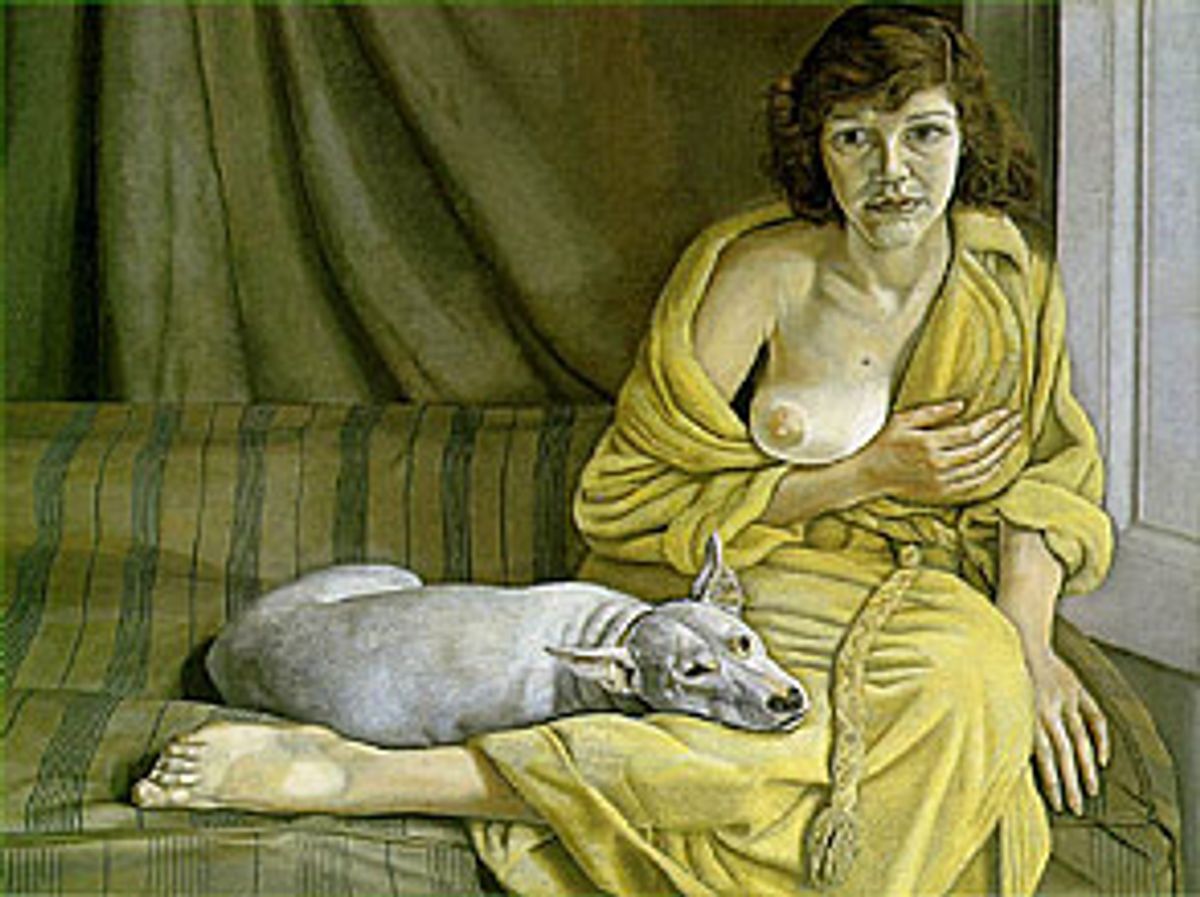
Go to London and look at Lucian's paintings of nudes, which still contain the possibility of love.
Lucian Freud is the son of Ernst Freud, the youngest son of Sigmund — that Freud. Lucian was born in Berlin in 1922, Jewish of course, and so when he was only 11 he and his parents moved to London to escape the Nazis.
Lucian became a British citizen in 1939, and he has been a reclusive figure in the London art world ever since the end of the Second World War. Now, as he turns 80, he is the subject of an immense and very moving retrospective at the Tate Gallery in London.
That’s right — go to London, allow yourself a couple of days at the Tate, take your time, survey the several rooms and the path of his life first before you begin to wrestle with his intimidating pictures. And don’t be overawed or unduly guided by the fact that he is a Freud. Not at first anyway. For this Freud may be the greatest living painter — and he is, quite plainly, one of the visionaries of the body, of flesh, of the mind behind it, and how we need both to see the body yet disregard it.
Don’t be misled: Freud is nowhere near as flagrantly erotic as Egon Schiele; he is never as sentimentally seductive as Balthus; he is drawn to painting people who are not conventionally beautiful or glamorous; and in his grasp of nudity, or helpless nakedness, there is something tragic and challenging. Skin, for Freud, is not just the cream on life’s coffee. It can be the dead weight that we carry to the grave, or the incubus that surrounds us and ensures our fatal destination.
Freud has an eye and a feeling for old people, overweight people, people exhausted by life, the kind of people we might be embarrassed to look at if we glimpsed them in a hospital waiting room. The flesh he paints seems battered, beaten up nearly; and it is that livid pale skin — London skin — that gets too little sun, and too much pulpy, comforting food. These are not bodies you want to fantasize over. They are corpses caught at an early stage.
Yet that’s too gloomy. The retrospective goes back to his youth when he had a yearning for mysterious young women, with almond-shaped eyes. These are not nudes, but close-up faces, floating in a mirror or a dream, and many of them are his first wife, Caroline Blackwood, one of the great seductresses of modern times (her life is told in Nancy Schoenberger’s book “Dangerous Muse”). For Freud, these are hauntingly romantic pictures, as tender as they are hopeful, though touched with the warning instinct that this woman is as much witch as nymph.
It was not really until the ’60s that Freud discovered, or overcame his reticence for, the nude — I suspect he was influenced in this by his friendship with Francis Bacon. But Bacon’s nudes are invariably trapped or imprisoned; they are decomposed or howling at the sense of permanent torture. By contrast, Freud’s figures are passive, prone, stretched out on broken sofas in bare suburban rooms. They seem asleep sometimes (I think Freud has reached a point of not wanting to paint eyes too much), or on the point of waking from some disturbing dream. These people are invariably overweight — like most of us — unlovely, which is not the same as unloved.
And here we come to the most important and affecting thing in Freud. In the age of photography and movies, nudity — or the subject of the nude — has become impossibly overlaid with the armor of fantasy. Such figures are eroticized by being looked at — the pose, the voyeuristic angle, the expression on the face (dreaming of being dreamed about), the perfection of the bodies. In other words, the nude has no purpose save for the invocation of sex. It has come close to losing the possibility of love.
That is a terrible handicap. For the nude can be spiritual, it can be the revelation of a secret, sad self hidden by the sacking called clothes, and it can make decent, honorable and true that nearly universal state that is being unlovely, unsexy (yet desperate for love and sex). Like most of us. But being plain and pale and gross and as helpless as a landed fish does not mean we are not loved. From time to time, at least, we are. Yet in modern movie times it has become hard sometimes to believe that anyone as plain, fleshy and forlorn as us can be loved. That it can happen is, simply, because love has only so much to do with physical attractiveness. What makes Freud such a visionary is that he has rediscovered the blind faith we can muster in feeling for bodies that Vogue and Vanity Fair might flinch from.
Once upon a time, people went to Vienna to see the grandfather — to have their souls saved. You can go to London.
David Thomson is the author of "A Biographical Dictionary of Film" (new edition just published), "Rosebud: The Story of Orson Welles" and "In Nevada." More David Thomson.
Taxing strip clubs for rape
Politicians are holding adult entertainment venues responsible for funding sexual assault services
(Credit: iStockphoto/wragg) It used to be that strip clubs were merely blamed for society’s ills. Now they’re actually being charged for it.
In recent years, measures have been introduced in Georgia, Pennsylvania, Texas, Illinois and, most recently, California to apply special taxes to strip clubs — specifically to fund sexual assault services. Now, even if you aren’t inclined to view erotic entertainment as the source of all evil, this might seem an appropriate aim — who wants to argue against additional support for rape survivors? It would seem even more so when you consider politicians’ and activists’ repeated claims of solid scientific evidence showing a link between strip clubs — specifically those that sell alcohol — and sexual violence.
Continue Reading Close
Tracy Clark-Flory is a staff writer at Salon. Follow @tracyclarkflory on Twitter. More Tracy Clark-Flory.
Massage therapists rubbed wrong by sex talk
A Jennifer Love Hewitt show and the Travolta allegations have masseuses tired of being confused for sex workers
(Credit: iStockphoto/sybanto) Joe, a licensed massage therapist, knows what it’s like having a famous client who expects something extra. He had an Academy Award-winning actor begin gyrating on his massage table before raising his hips in the air to show off his erection. “He was hoping that I would play with him in some shape or form,” he says.
Needless to say, Joe isn’t surprised by allegations by two masseurs that John Travolta got handsy during massages. (Travolta’s attorney has denied all the allegations, and called them “ridiculous.”) “It happens all the time,” he says, and not just with celebrity clients. He frequently encounters men who try to fondle him, usually while he’s working on their glutes or lower back and their hand happens to be level with his crotch. “They think they’re so original, but they’re all so much the same,” Joe says, his voice rising. “They all use the same tactics, the same body movements, the same gyrations and grinding my table, the [heavy] breathing.”
Continue Reading Close
Tracy Clark-Flory is a staff writer at Salon. Follow @tracyclarkflory on Twitter. More Tracy Clark-Flory.
A night at the vibrator museum
Early vibrators were hand-cranked, two-person jobs -- and prescribed by doctors. How far we've come since then
(Credit: Antique Vibrator Museum) I can now say that I’ve used a turn-of-the-century vibrator — on my hand, but still.
The silver, hand-cranked contraption is usually kept behind glass at Good Vibrations’ Antique Vibrator Museum in San Francisco — but staff sexologist Carol Queen made a rare exception. “This is very special,” she whispered, unlocking the case and carefully pulling out Dr. Johansen’s Auto Vibrator, a relic from 1904. The “auto” part is not so much: It was a two-person job, with her having to crank the device’s handle to get it thrumming. Pressing my finger tips to its inch-wide circular platform of pleasure, I was pleasantly surprised by its power.
Continue Reading Close
Tracy Clark-Flory is a staff writer at Salon. Follow @tracyclarkflory on Twitter. More Tracy Clark-Flory.
Maggie Gyllenhaal on sexual liberation
The beloved indie star tells Salon about her "vibrator movie" and why she loves playing transgressive women
Maggie Gyllenhaal (Credit: Reuters/Mark Blinch) When I met Maggie Gyllenhaal about six weeks ago, she was enormously and gloriously pregnant, stretching out on a sofa with her shoes off and feet up in a Manhattan office building. (Since that time, Gyllenhaal and husband Peter Sarsgaard have welcomed their second daughter, Gloria Ray, to the world.) We were there to talk about “Hysteria,” the charming, lightweight feminist farce from director Tanya Wexler that explores a key event in the history of female sexuality: the invention of the vibrator by Mortimer Granville, a Victorian doctor who was seeking to cure the mysterious “female malady” that lends the movie its title.
Continue Reading CloseMother-daughter sexperts
Susie Bright and her daughter, Aretha, make parental talks about sex look easy -- and fun
Most parents loathe talking to their kids about the birds and the bees, let alone pubic hair grooming, faked orgasms and “water sports” — but most parents are not legendary “sexpert” Susie Bright.
Better than talking about these things, she penned an advice column in 2009 with her daughter, Aretha, then 19, for the ladyblog Jezebel. Their answers to questions about everything from porn to Paxil were unflinching but playful, and at times controversial. Now the pair have collected those columns into a new e-book, “Mother/Daughter Sex Advice.” Together, they read as an irreverent version of “Our Bodies, Ourselves” for the Internet age. The mother-daughter team also reflect on what the experience of writing the column was like, and it turns out it wasn’t as weird as many would think: For the most part, it was just a continuation of conversations they had been having throughout Aretha’s life.
Continue Reading Close
Tracy Clark-Flory is a staff writer at Salon. Follow @tracyclarkflory on Twitter. More Tracy Clark-Flory.
Page 1 of 403 in Sex