Adoption

Summers at Camp Ethnicity

Are camps for foreign adoptees just a place for their parents to exorcise white guilt, or do they help the kids develop pride, cope with prejudice and get in touch with their roots?

  • more
    • All Share Services

Summers at Camp Ethnicity

It’s a humid Friday at the YMCA of the Rockies, and the afternoon activities at East Indian Heritage Camp are just getting underway. In a windowless conference room, a group of third-graders — all adopted, all born in India — are sitting on the floor watching a video called “Families in India” while chewing on pretzels. On the TV screen, a little Indian boy is explaining how his family makes dinner, as his mother sits on her haunches over an open fire and shapes naan bread with her hands. If the kids are aware that this is the modest life they might be living had circumstances been different — if they hadn’t been given up for adoption, if they had stayed in India — their faces don’t show it. They fidget and fiddle, paying very little attention to the domestic drama onscreen. In this group, self-awareness appears — at least for the moment — to be limited to immediate needs.

“We want more pretzels!” they cry out to their counselor.

Last year, 19,237 children were adopted from foreign countries and brought to the United States — nearly triple the number of foreign adoptions just 10 years ago. Babies brought to the States from abroad — many of them from Southeast Asia, Latin America, Russia and India — now total nearly 15 percent of all adoptions in this country. Foreign adoption has become enough a part of American life to be the subject of at least one heartwarming advertisement for digital cameras (a couple in an airplane pose with their Asian baby). Tabloids and glossies regularly feature the stories of celebrities who have “imported” infants for adoption.

But as common as they have become, these adoptions are still controversial. The trend still rankles some Americans and raises questions for others, including those who study the growing phenomenon.

Why adopt foreign children when there are so many children awaiting adoption in the United States? Is it a good idea to take a child from her native country? Can an “ethnic” child be raised by white parents without becoming emotionally mired in issues related to their differences? How, for instance, does a white parent help a child of color deal with racism? These questions don’t just come from those who observe the trend of foreign adoption with detached interest; they are typical of adopting families who find themselves raising kids from other countries in communities that are not prepared to deal with them — the parents or the children.

So compelling — and troubling — are the issues related to foreign adoption, that an entire cottage industry has emerged to guide families through the process, providing advice during the adoption phase and help — for parents and, eventually, the children — thereafter. There are adoption therapists and genetic counselors who will “pre-screen” potential adoptees; there are local support groups for parents and kids; there is a flotilla of self-help books, Web sites and magazines; and there are companies that offer families guided trips back to the countries where their children were born.

Then there are the heritage camps.

Heritage camps are an early, and now pervasive, by-product of the international adoption phenomenon. Every summer, across the country, families with adopted kids converge on dozens of camps like Colorado’s East Indian Heritage Camp, for an education in the culture, crafts and ceremonies of their “indigenous” countries. The Colorado Heritage Camp company alone offers camps for kids from Korea, Russia, the Philippines, Latin America, Vietnam, China and East India, as well as, incongruously, an African-American camp. In activity-filled weekend workshops, organizers say their goal is to give adopted kids a way to reclaim a lost, forgotten or maligned ethnic heritage, while providing a community of peers to get in touch with and discuss issues of racism and acceptance.

But the annual East Indian Heritage Camp weekend demonstrates a curious disconnect between the goals of its organizers and the needs of the campers. The pretzel-munching third-graders — along with all the other kids, age 3 through 17 who arrive here with their parents — come across as typical American kids whose “issues” have little to do with ethnic identity and more to do with predictable developmental hassles. The point of the camp is to deal with the kids’ differences, to address issues of identity and assimilation. Yet, in a lot of cases, the kids seem to have coped with, or not yet encountered, those problems. The young ones want pretzels; the older ones want to go home, be with their friends and hone their coolness.

It is tempting to conclude that the camps, rather than resolving existing concerns, are addressing imaginary dilemmas dreamed up by concerned, culturally conscious adults. For the kids, the cultural education is cursory, at best; most seem to enjoy the weekend — camp is camp, after all. Some experts argue that simply being around peers will have a positive long-term impact for adopted children, although no one has really proven that. Others warn that by emphasizing differences, the kids can become aware of, and be dogged by, concerns and fears that they didn’t have before camp. But for the parents, the benefits are clear. Heritage weekends provide relief and support to parents with adopted kids who feel isolated and vulnerable in communities where their families are different; and worried about the impact of differences between them and their adopted children.

As Samir Tailor, a 34-year-old Indian camp counselor, puts it: “It’s almost more about helping the parents than about helping the kids. Being from white America, they don’t have to go through these [race] issues, but the tables are turned here. For the parents it’s more educational, but for the kids it’s more social.”

Lunch on Saturday is a chunky Indian yoghurt soup, rice pilaf and spicey chutneys with turkey burgers; also on the menu is a meal of potato chips and hot dogs. The Indian children, almost without exception, head straight for the hot dogs. Their parents dutifully slurp the Indian soup.

“It smells funny,” says one little girl, wrinkling her nose, as her mom encourages her to try the soup.

“It does smell funny,” the mother agrees, but bravely downs a spoonful anyway.

- – - – - – - – - – - -

The first heritage camp was reportedly founded in the late 1970s by Holt International, a foreign adoption service, at the request of adult adoptee clients who felt they would have benefited from some cultural education as children. But it wasn’t until the 1990s, as foreign adoption exploded, that the heritage camp phenomenon really caught on.

Today, there are dozens of camps tailored for children from a number of countries, although a majority are for Asian or, specifically, Korean children (almost 10 percent of all foreign adoptees are from South Korea). Most camps, like Colorado Heritage Camps, are coordinated by groups of adoptive parents; others, like Holt Heritage Camps, are set up by adoption centers for the families that have used their services. Camps range from short day camps to weeklong sleepover camps; some invite the adopted children only, while others are for the entire family. The curriculum is typically the same for all the camps: a mix of ethnic crafts, dancing, sports, cooking, perhaps a dash of history or language, and a number of discussion groups where kids or parents talk about identity, heritage or adoption issues.

Colorado Heritage Camps, one of the most comprehensive heritage camp companies, runs eight camps every summer. Although the camp was initially founded 11 years ago by a group of parents of Korean children, Pam Sweetzer and her husband Dan — themselves the adoptive parents of two children, from Korea and East India — took over the organization nine years ago and have since expanded to cover an ever-growing range of ethnicities, from Russian to Chinese. Next year, they’ll add a Cambodian camp to the list as a response to the requests of the parents who have attended (many of whom have multiple adopted children from different countries). “They just keep spawning these other camps!” laughs Pam Sweetzer, a friendly blond woman in her 40s.

Sweetzer runs the organization as a nonprofit, and the camps are heavily staffed by volunteers, who include adoptive parents, who help coordinate events, and local ethnic community members, who offer cultural expertise for the workshops and serve as camp counselors for the kids. Every summer, more than 900 adopted children and their parents participate in the camps, along with roughly 1,000 counselors and volunteers.

This year at East Indian Heritage Camp, for example, dozens of volunteers from the Denver-area Indian community have arrived to teach the kids yoga and Indian dancing, mehndi ceremonial tattoos, cricket, cooking, storytelling and Indian cinema. Parents attend cultural workshops like “Indian Caste System” and “Indian Wedding,” as well as group roundtables discussing subjects ranging from attachment issues and adoption advice, to racism and identity issues. Some 165 children are attending this year; almost all of these children are adopted (a small number are their siblings).

East Indian Heritage Camp often seems like a lesson in multicultural political correctness. Parental enthusiasm for slurping Indian soup or learning about the caste system frequently outweighs the enthusiasm of the kids for the same things; perhaps because the parents are already biased toward a cultural education. “The families often wind up embracing the cultural activities more strongly than the kids do: often, they’ve made the decision to adopt from [a foreign country] because they are drawn to that culture, and they want to pass their enthusiasm on to their kids,” says Dr. Dana Johnson, director of the International Adoption Clinic at the University of Minnesota. “But it’s like anything that parents are enthusiastic about: Sometimes the kids embrace it as well, at other times it’s like ‘We have had enough of this stuff.’”

Running through the adult enthusiasm for all things foreign, however, is their concern that their kids might not think that being Indian is cool; that they’d be embarrassed about their place of birth or, worse, resentful. Since the parents themselves usually aren’t Indian, they feel like the next-best place to teach those kids how to feel proud is at a heritage camp. (“Homeland tours,” organized to take families with adopted families back to the country of birth, are another fast-growing response to this need.)

Gregory Keck, an adoption therapist and director of the Attachment and Bonding Center of Ohio, says that heritage camp can serve as “compensation” on the part of white parents who worry they’ve somehow done their kids wrong simply by adopting them. “There’s this idea that we are taking kids away from their culture, and that you can do a number of things to help the child retain their culture, but I don’t think you can,” says Keck. “The fact is that when you leave a culture you are born into and come to America, you grow up as an American kid.”

The parents, for their part, do seem to recognize that their kids are fully American (and Americanized); but they see the camp as an opportunity for their kids to be All-American and Indian — superkids, essentially, schooled in two cultures. Nelly Gupta, a Westchester mother from Dobbs Ferry, N.Y., has come to East Indian Heritage Camp with her Indian-American husband Rishi and their adopted 8-year-old daughter Kiran. Gupta brought her child, she says, because she thought she was “old enough to understand” her heritage.

Gupta says she cried when her daughter carried an Indian flag up to the podium during the opening ceremonies. “I teared up that she might be able to claim, or reclaim, a piece of her identity and heritage,” Gupta exclaims. “She’s an all-American kid. But it’s so important that kids from a third world country feel pride in their heritage — it’s not a Third World hellhole, but a culture that is rich and diverse in its own right. It’s empowering.”

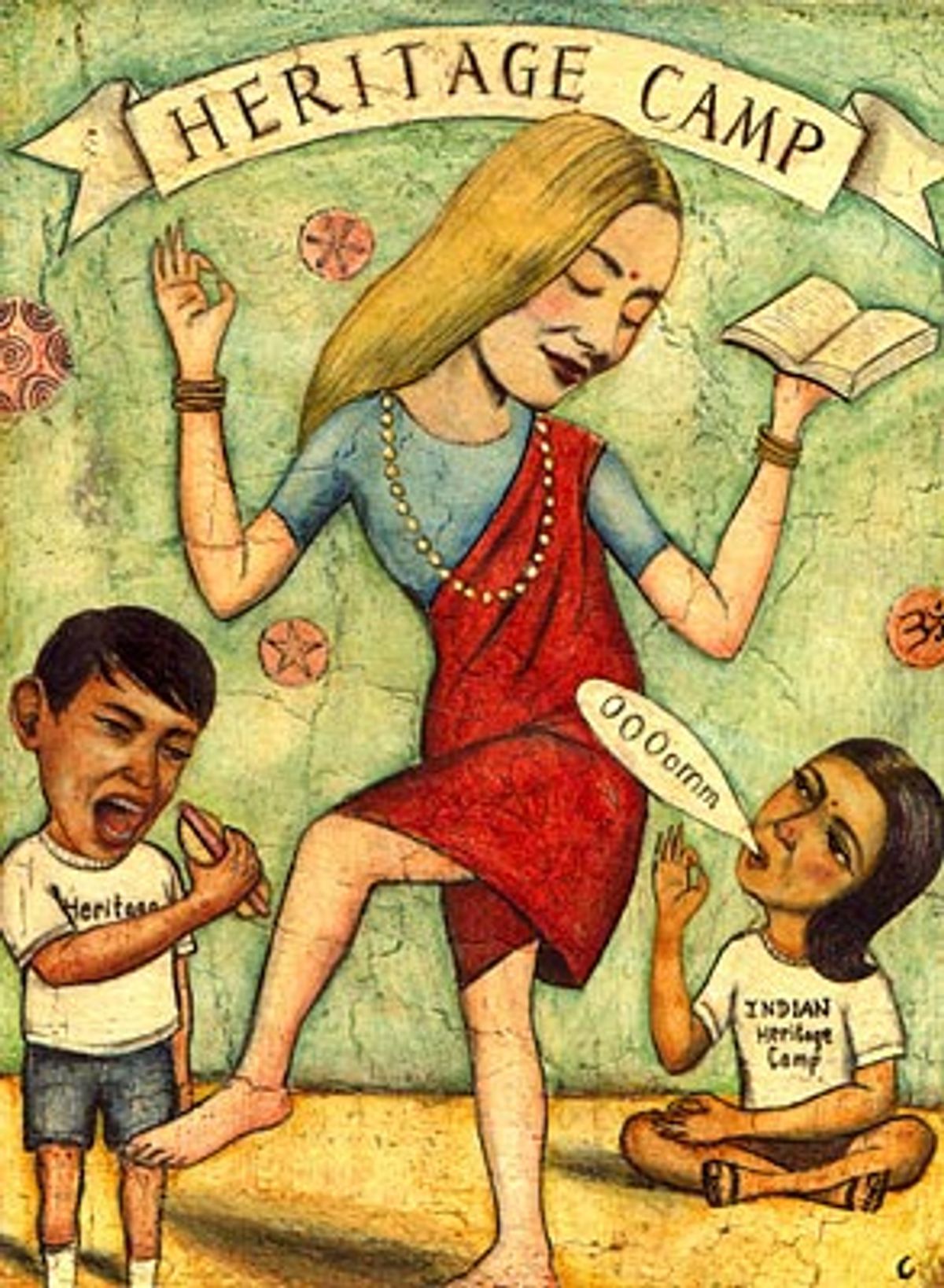
In the afternoon, a group of second-graders are getting a lesson in yoga from a pretty blond instructor, who reads them a story — “How Ganesh Got his Elephant Head” — before leading them through yoga exercises — downward facing dog, standing tall trees. “Do you know what yoga is?” she asks them. “It’s Indian,” offers one little girl, helpfully. “It’s a way to relax your body,” says another.

The kids sit cross-legged, press their palms together and dutifully repeat the “ommm” of their teacher. “Feel the vibrations going through your body,” she says with eyes closed and a placid smile on her face. The children obediently follow her directions, as she explains to them: “Yoga unites your mind and your body!”

- – - – - – - – - – - -

Heritage camps, as long as they take place in the U.S. and last for a week or a weekend, cannot provide an experience that could be called cultural immersion. At East Indian camp, kids rush from class to class every hour, getting brief instruction in a number of subjects that few of them will ever use at home. A child will learn a few yoga poses, but is unlikely to get a historical background of traditional Indian practice. And while the younger children seem to absorb some of the basic ideas — it’s Indian, it relaxes your body — there is little guidance on what it all means.

This doesn’t mean that the kids don’t seem to enjoy what they are doing. The little kids especially tend to throw themselves into the crafts, dancing classes and games. One of the most popular events of the weekend for the small children is what is billed as the Holi Festival; in India, this is the “festival of colors” which welcomes the spring, during which celebrants fling colored powder and water on each other as a celebration of life’s “brightness.” At East Indian Heritage Camp, the kids are simply ushered to a soccer field, where they are handed squirt bottles filled with tempera paint and encouraged to make a total mess.

No one has bothered to tell them what the festival symbolizes — it’s too hard to coordinate, I’m told, since the kids often arrive at the field at different times — but the kids don’t really seem to care. They simply grab the squirt bottles and go wild, until everyone on the field is screaming with laughter and covered from head to sneakered foot in brilliant blobs of paint.

The teens, however, are a different story. Many have been attending for years (a majority of camp attendees are repeat visits). And although they are given the most lenience in their schedules, and attend advanced classes with more cultural context — Indian cooking, cricket, music lessons, history discussions — they can be indifferent, if not resentful, about the whole package.

One afternoon, in a stuffy cabin far from the central gymnasium, teens are being taught how to make rose punch and raita, a dish of cucumbers and yogurt. Some girls cluster around the teacher, Purnima Voria, a dimpled woman in a sari and bindi who talks a little like Martha Stewart with an accent. “Cooking is an art,” she says, carefully arranging peppers on the top of the dish. “Don’t be afraid to take it a little further.” The teenage boys slump in chairs as far away from the table as possible, with the exception of a few boys who seem to be mostly enjoying their close proximity to the girls.

The real activity is outside the cabin, where a group of girls in tight jeans and belly-baring tops — they’ve chosen not to don the required camp T-shirt — sit and flirt with boys in skate shorts and basketball jerseys. Jared Juy, a kinetic 14-year-old who does proudly wear his camp T-shirt, shows an ebullient enthusiasm for the camp in general; but he doesn’t seem to care much for the cultural classes. Mostly the camp is a way to meet girls. “I’ve gone every year since this camp started. It’s great, I get to see all my friends, and girls,” he says, as he wraps his arms around a pretty friend. “The best thing here is freedom from your parents.”

His companion, 16-year-old first-time attendee Tasha Condie from Utah, is less overtly enthusiastic about the weekend; her parents have brought her here at a friend’s recommendation, and although she says she’s having an “OK time,” she would rather socialize than learn how to cook or play cricket. “We need to party,” she explains, “… and they need to bring a TV.”

“They’ll show movies later,” Jared points out.

Tasha rolls her eyes: “Yeah, Indian movies, to be exact.”

At one point, toward the end of the weekend, one of the volunteer camp coordinators has clearly reached her limit with the teens’ apparent boredom. She pulls the teens into a room and begs them to tell her what they would want to do in future years. More culture classes? Language classes? Nothing at all?

One girl suggests Hindi classes; another wants to learn ancient Indian history. But most teens simply nod in agreement with the sentiments of one boy who blurts out: “Let us choose what we want to do, and let us just hang out if we don’t want to do anything.”

Heritage camps are caught in a bind: What they really need to teach is not what it is to be Indian, but what it is to be Indian-American, which can be different for each child, depending on countless factors. The hope is that the kids will go home armed with cultural knowledge that they’ll use to shape their own Indian-American identities. As Susan Soon-keum Cox, vice president of public policy for Holt International heritage camps, posits, “It helps them to understand where they fit in the world: Are they Korean-American or American-Korean? Which goes first? They need to be able to find that balance … go away proud of the fact that they are part of two cultures and identities.”

Identity, however, isn’t acquired through cooking classes alone. So while the culture classes — the sports, the dancing, the games and crafts — are a colorful lure that brings families to Colorado, it’s the discussion groups and socializing with peers that are ultimately the focus of the weekend. Essentially, it’s a support group, candy-coated with Indian cooking and ethnic crafts.

Admits Pam Sweetzer: “The culture stuff is mostly a reason to get them here to meet each other.”

Sweetzer, like a lot of the parents here, is most concerned with making sure that adopted kids “fit in” in the world. And the parents have reason to be concerned: Most families at East Indian Camp seem to come from small, Midwestern communities where there are very few Indian families (or any minorities, for that matter), much less families with white parents and Indian children. They worry, understandably, that their kids will grow up feeling alienated or rejected by white kids, and possibly misunderstood by adults, including their parents.

“For parents who adopt foreign children, it’s a two-way street: You get tsk-tsk faces from older white women, but also all the people of color come up and tell you what a beautiful baby you have,” says Dr. Johnson. “We live in a racist society, and when we think of what our children will face none of us want our kids to face things that will be hurtful; every parent of a child of color is going to be concerned about racial bias. It doesn’t happen very often, so it’s not that pervasive, but those people do exist in society, and nothing is ever going to take that away.”

At East Indian Heritage camp, it’s normal to have an ethnically mixed family; it’s normal to have dark skin. Wanda and Peter Bonnel, a friendly couple from Topeka, Kansas, have been coming to East Indian Heritage Camp for eight years. Their children — a daughter, age 13, and a son, 15 — were both adopted from India. “Only three families in Topeka have adopted Indian kids, so our kids know they are different,” says Peter Bonnel, as he and his wife sit outside sipping beers on Friday night. The kids are roasting marshmallows; the whole family has just attended a concert of classical Indian sitar music. “This camp allows them to be a majority instead of a minority.”

“This is the only place in the world where we are considered a normal family,” agrees his wife, Wanda. “We keep coming to camp to show them it’s OK, there are other families like this. It gets harder [for them to be Indian] the older they get, because they just want to fit in.”

Dr. Johnson points out that it’s important for kids who are adopted from foreign countries to spend time with others of the same ethnicity as they are growing up. Even if they “feel” white and are accepted within their community, at some point — usually once they leave their families for college — they will realize that are identified as “different” from white kids by virtue of their skin color; at the same time, they may not be accepted by other people of color, either, because they are too “white.”

“Kids need to get together with other kids that look like them and respect that, so that when they look in the mirror and see someone from Korea or China or India they think that’s OK,” Johnson says. “The more they can get together with other kids who look like them and have had that experience, the better off they are.”

The kids at East Indian Heritage Camp seem to support Johnson’s thesis; most express a quiet comfort at simply being around other kids who look like them, even if they aren’t eloquently expressive about the race issues at hand. As Tasha Condie puts it, “I feel really comfortable. It’s cool being around all these other Indian kids who are adopted.” Or Chandre Murrell, age 12: “In my school there’s only one other person who is Indian. So coming here is fun.” Her friend, Alysia Larson: “I don’t feel different here; I’m just like everyone else.”

Nineteen-year-old Jancy Turner, a camp counselor who was, until recently, an attendee, says that when she began coming to camp as a 14-year-old, meeting all the other Indian kids was like an epiphany. “Where I grew up, I was the only person with dark skin. I never knew any Indian families, and I didn’t know anyone who looked like me. And then I came here, and everyone looked like me,” she says. “I felt so accepted and right at home — I didn’t have to worry what people thought.”

The parents, struggling with their own issues — chief among them, unfamiliarity with racism — sit in roundtable discussions and worry about how to deal with potential harassment. In one roundtable, parents peppered a group of young Indian men about how their kids would be treated in school. The panelists warned parents that their kids would probably face epithets like “Sand-nigger” or “Camel-jockey.” The parents, in turn, betrayed a feeling of futility as they quizzed the panelists about ways to help their kids cope with such epithets.

“I didn’t necessarily do [my kids] any favors by pulling them out of their culture, bringing them into mine, and expecting them to be peachy keen,” says Sweetzer. “I can listen and understand and feel sad, angry [when they have hard times with other kids], but I can’t really relate to being a minority; I don’t know what they go through. And like anything your kid goes through, you can’t fix it all and you feel helpless.”

At this level, the camps often feel like a place to exorcise white guilt. Parents are aware that their kids might face racism and won’t really be able to fall back on their families for help. The parents, convinced they won’t be able to relate to the pain of prejudice, want at least to expose kids to their heritage as a way to bolster pride and give them strength in their daily trials.

This is the primary goal of one of Colorado Heritage Camp’s more controversial workshops — African-American camp, for white families that have adopted black kids. Unlike the other camps, this one doesn’t really teach much about Africa, since most of the kids were adopted from agencies in American inner cities. Instead, the camp teaches African-American history — soul food cooking, civil rights history, freedom songs — in the hopes of giving black kids and their parents an education in race and the social injustices that children of color in America have endured over time.

Discussions about racism often take place, at least at the Colorado Heritage Camps, in “HeART Talks” designed for individual age groups. Kids take part in roundtable discussions in which they are encouraged to bring up skin color and feelings of difference. The talks are closed to reporters, but camp coordinators say that they can be emotionally cathartic for the participants. Twenty-one-year-old counselor Priya Kumar recalls a teenage girl from a previous year who refused to wear the camp T-shirt or participate in activities. She wore heavy pancake makeup and eye shadow. When she was encouraged to open up in one of the HeART Talks, says Kumar, the girl broke down and said that she had been beaten at school because she wasn’t white: She wore the makeup to hide the bruises.

But not all the kids at camp want to belabor the ways that they feel different; in fact, some kids seem to feel like the camp is forcing race issues down their throat. Abby, a fourth-grader who says she likes coming to camp because she gets to “make friends,” was quite clear about her least favorite part of the weekend: The HeART talks. “Last year some mean woman asked me if I felt dumb because I had brown skin,” she complains. “It hurt my feelings.”

There’s a danger, says therapist Keck, that a kid dragged to a heritage camp and forced to talk about ethnicity will just feel more alienated. By reinforcing differences, kids are made more aware of them. “If the kids don’t want to go, but people say they need to go because they’re adopted and Korean or Indian, most of those kids will wonder they can’t just grow up and go to soccer camp,” says Keck. “These kids do have issues with race, but I often think that [with adults] the race issue takes on a life of its own that is sometimes larger than it needs to be.”

- – - – - – - – - – - -

It’s difficult to determine exactly how heritage camps affect an adopted child’s sense of self and identity, because there are so many different iterations on display. There are little kids who can’t wait to put on their Indian dresses for the final night’s “Spice of Life” dance festival; who prattle on about all things Indian and say they love to come every year. There also are kids who refuse to wear Indian clothes; who sulk on the edge of classes instead of participating; or who are far more interested in flirting with boys than talking about their countries of origin.

“In the world of adoption there are kids who are completely attracted to heritage camps, and others who have no interest — just as I didn’t have much interest in going to my own family’s reunions,” points out Keck. “People have to be careful not to think that heritage camps do more than they do. Unfortunately it’s gotten a bit trendy to have an adopted child and want to send them off to camp, even if they don’t want to go.”

Furthermore, Keck points out that there are many phases in an adopted child’s emotional development — particularly when it comes to skin color and ethnicity. Some younger children, he says, often just want to identify with their white parents, and he has heard stories of kids who sat in their bathrooms trying to “scrub the dark away to become lighter.” But, he says, “most kids end up knowing they are a different race; and then in adolescence there is a new resurgence in identity-seeking.” Other kids, he says, will grow up without ever displaying interest in their heritage or skin color.

One visible benefit of East Indian Heritage Camp is that many of the younger children seem to have soaked up some idea that that it is OK to be Indian, that they don’t need to scrub their skin color away. If anything, they’ve gone to the other extreme: “You talk to the little ones, and ask them where they are from, and they say India, not Colorado,” says Kumar. “They know they are special. They have a sense of heritage, and where they come from.”

The hope of parents is that once the kids happily accept their Indian heritage, life might get easier. Karen Baughn of Glendale, Arizona, the mother of 16-year-old Komal (as well as six other adopted children, from a variety of countries), says confidently that heritage camps have helped her daughter’s self-esteem about being Indian. “Since we started coming to camp, being Indian doesn’t bother her anymore,” says Baughn. “She hasn’t had any identity issues, she fits right in, even though she’s the only East Indian at her high school.”

But despite her mother’s assertions, it’s clear why Komal fits in so well at school: She’s a beautiful teenage girl, trendy and cool in her crop-tops and jeans. When Wanda Bonnel shares a story about how her daughter went through an “Indian phase” in fourth grade, wearing Indian clothes to school every day, Baughn looks up in shock. “My daughter wouldn’t be caught dead in Indian clothes,” she says. “She wants to look just like everyone else.”

And that, of course, is the crux of the issue at heritage camp. The kids, raised like typical American kids, want to fit in with other kids at their schools. But fitting in sometimes has less to do with skin color and more to do with simply being just like everyone else in your class: dressing right, looking pretty, saying the right things, listening to the right music. And while there are certainly kids at camp who will have serious identity issues or problems with racism, and whom these heritage camps could help, many of the older kids like Komal seem already to have done a fine job of assimilating despite their parents’ concerns.

After all, the hope of “fitting in” and “being just like everyone else” is exactly what parents can never truly promise, regardless of whether their kids are adopted. Sure, bringing kids to heritage camp could bolster their confidence, give them new avenues of self-exploration and a better awareness of what their skin color means; it also clearly reassures parents that they’ve used every resource available to families in their situation.

As Dr. Johnson puts it, “I can’t really think of a downside of a culture camp.” But whether three days at a heritage camp can change the quality of the other 362 days of the year is impossible to know.

Janelle Brown is a contributing writer for Salon.

Stop diagnosing my son

When we adopted Jake at 7, we waited years before letting a psychologist label him. Others haven't been so kind

  • more
    • All Share Services

Stop diagnosing my son (Credit: Shutterstock)

“Sounds like your son has Asperger’s syndrome,” she said. “Have you ever thought of that?”

I looked back at my son, hanging upside down on the monkey bars. “Sounds like you have Asshole syndrome,” I said. “Have you ever thought of that?”

In my head, I said that. What I said out loud was something like, “We think he’s just Jake, and that’s good enough for us.”

“Well, he might have Asperger’s,” she pursued. “And you should have him tested.”

“Well, you might be a bitch,” I said, in my head. “Is there a test for that?”

My actual words were, “We’re not interested in labeling him at this point.”

I was standing under a tree with a woman from our home-school play group when this dreaded “developmental milestones conversation” occurred. Her son had all his multiplication facts memorized; mine still hadn’t memorized addition facts. Her son was complimented for being polite; mine often ignored other children’s personal space. Her son was reading three grade levels ahead; mine was reading three below.

Well-meaning folks, I discovered, were happy to share their unsolicited pop psychology diagnosis of my son, certain I’d be grateful for the 15 seconds of thought they put into it. In modern American culture, we are quick to participate in the labeling melee. Someone’s “ADD is kicking in,” and another is “so OCD,” and their boss is “obviously bipolar.” It’s common lingo. So why not label a kid who seems a bit different?

But it was this labeling issue that smacked me in the face when I became a parent.

In 2002, my husband, John, and I traveled to Ukraine to adopt our son. Jake was 7 ½, weighing 35 pounds and speaking rapid Russian, he raced into our lives like a little tornado. The adoption process prepared us for disabilities. We were told Jake had “psycho-motor delay,” a common catch-all meaning “he might be slightly behind.” He couldn’t read or write, not even his own name.

The typical route for most parents adopting older children from a foreign country is to have their kids evaluated as soon as they return to the States. We hesitated. “Of course he’s going to have delays,” John said. “He’s lived in an orphanage his whole life and he’s the size of a 4-year-old.” Before a professional informed us what was wrong with Jake, we wanted to let Jake show us who he was on his own.

The first weeks at home were thrilling and exhausting. Jake explored everything. He played with our two German shepherds, he flipped light switches off and on and off and on. He opened the front door and ran into the street with the dogs. He touched everything and sniffed everything else. He hugged anyone who showed him kindness, including the baggers at the grocery store.

He was curious, joyful and supremely energetic. He pounded trees with sticks, broke branches off the bushes to use as play swords, did flips off his bed, tried to do pull-ups off the bathroom towel bar. He enchanted and amazed us.

But he was also fidgety. As I began working with him on numbers or letters in brief sessions, our son demonstrated the attention span of a flea.

“He might have ADHD,” I told John. “He just can’t focus on anything — unless it’s something he really wants to do, like build with Legos.”

John could relate. As an adult he self-diagnosed his ADHD and understood what it was to grow up unfocused. With Jake’s 12-word English vocabulary and overabundance of energy, we decided to home-school him, at least until he caught up.

That first year was glorious. We went to the zoo every two weeks as part of animal study. We caught bugs in the backyard and took nature hikes. We cooked. We sang. We danced. We worked on letters, numbers and sounds. Jake thrived, and we kept going.

But after two and a half years, we hit a plateau. Jake was stuck. And I couldn’t figure out how to unstick him. John and I began to believe a diagnosis might help now, if only because it would help us figure out how to help him.

His assessment was no surprise. It included ADHD, dyslexia, dyscalculia and auditory processing disorder. Overwhelmed but determined, I hoarded books from the library, talked to specialists and surfed the Web for techniques and curricula that would match his multiple diagnoses — and the boy I knew.

And a new question arose: What do we tell Jake?

I’ve talked to many parents, of both adopted and biological children, who’ve struggled with the same dilemma. Our kids usually know they’re different, but they often don’t understand it.

Some parents bust out the clinical terms and explain each: ADD, OCD, SID, ADHD, Asperger’s, autism. The alphabet soup of the multi-diagnosis becomes part of the family’s regular dialogue. Others take a less scientific approach, focusing on their child’s gifts and differences rather than deficits. We wanted to celebrate those differences, but also understand and work around his deficits, making certain he sees there’s a place for him in the world. Where was that line between cold analysis and sugarcoated truth?

John and I tried to find a middle road that explained his diagnoses but focused on his uniqueness. So ADHD became: “You have a turbo-charged jet engine that likes to move fast.” Dyslexia was: “Your eyes sometimes flip words around like a carnival ride, which makes it hard for you to see what’s actually on the page.” And auditory processing disorder was: “Sometimes things float in the shallow end of your mind for a while before they go in deep so your brain can make sense of them.”

I think these gave Jake a sense of peace. But that didn’t mean we didn’t have problems. A few months later, mid-morning of an early fall day, the kitchen table was stacked with school books and laptops, mugs of hot tea, and plates scattered with pumpkin muffin crumbs— and Jake was in the throes of a full-scale math meltdown.

“There’s something missing in my brain,” Jake wailed. “I’m missing a wire somewhere that ruins my thinking. I think God made a mistake on my brain.”

“Jake,” I said his name clearly and firmly, and as lovingly as possible, “there is nothing wrong with you, and God does not make mistakes.”

We pushed math aside for the day and took the dogs for a walk. Outside, I told Jake a piece of his story, our story. A story he’d heard before.

“On the day we met you,” I said, “your dad and I were amazed by your joyfulness. Here you were, abused and practically starving, yet you decided you would find joy in life. Now your dad and I are here to help you remember the Jakeness deep inside you — and to help you work on everything else. You don’t have to survive on your own anymore. You have a mom and dad — and five dogs who love you. And you know how much those dogs love you!”

The smile returned to Jake’s face, and we talked about happier things. In the weeks following, I consulted with experts, researched new curriculum, and tried to focus on what was right about Jake rather than what was wrong about Jake.

Friends helped in ways they couldn’t possibly understand. Every few weeks, someone shared a story about Jake’s happy spirit — how he’d walked all the way across the room to say hello to them or told another kid not to make fun of someone, and I stored these nuggets as precious jewels, never knowing when we’d need affirmation that other people saw the specialness in our son, too.

About a year later I turned a corner in our home-school co-op just in time to see Jake scamper down the hallway, peek into a classroom, pound on the door and run away. “Jake!” I whisper-shouted.

“Oh, that’s your son,” a voice said from behind me.

One of the co-op board members gazed at me down the hallway. “Yes,” I said, “that’s Jake.”

“He’s completely out of control,” she declared.

My skin prickled. “He has boundary issues,” I said, “but he’s not completely out of control.”

“No, he’s completely out of control,” she said. “I know exactly what he needs.”

“I bet I can tell you exactly what you need,” I declared, in my head. Instead, she rattled on while I entertained thoughts of stuffing her into a supply closet.

Aloud, I mumbled, “Thanks so much.”

I retracted my claws and headed toward the multi-purpose room to reprimand my son. I found him helping a harried mom of seven with her unruly toddler. There would be ample time to scold, but just at that moment, it was time to appreciate what my son was doing right.

Continue Reading Close

Debra Hanlon is a former high school English teacher and community college composition and literature instructor, now a home-school mom. She lives in northern Illinois with her husband, her son and their five German shepherds. Her occasional blog is LifeItIs.org—Insights and Incidents.

How do I tell my daughter she’s adopted?

Can't we just forget about that little detail of her parentage?

  • more
    • All Share Services

How do I tell my daughter she's adopted? (Credit: Zach Trenholm/Salon)

Dear Cary,

I am perhaps the happiest person who has ever written to you. My life is full and I am at peace and I have finally reached a balance that eluded me all my life. How did this happen? Well, at the age of 38 I adopted a baby. She was a day old when I held her and she came home with me when she was 3 days old. The paperwork took months but that’s not important.  I have worked very hard all my life, forever chasing goals, climbing the corporate ladder, traveling and working internationally. But I was literally sick of it. Neither the money nor the travel meant much. I hated the constant politicking and the random viciousness of work life. I saw no escape. I couldn’t imagine dropping out and then I went through a severe illness that left me unable to bear a child. I had a nervous breakdown. I am lucky enough to have a supportive husband, who while not acknowledging the possibility of a breakdown, did everything physically possible to make me better. I stopped working. I was completely washed out, I would be suicidal if that did not require an effort and the ability to feel. And then like a miracle I got my baby. I remember being quite ambivalent when I went to meet her. Yet, something clicked when I held her. I felt a sense of fierce belonging I have never felt before and I know my baby knew me too. She was and is amazing. She never cried as an infant. Except for food. She is very loving, brave, curious, smart, speaks two languages at 2 and a half. OK I am blabbing. I mean, now she is a handful. She is not perfect. She runs around in an airplane, gets hyper in malls, and goes crazy if she hears the sound of a packet of crisps, but I see an awesome person in the making. A kiss can still make my day. And we do believe in manners and discipline and naughty corners, so she is not spoiled or anything.  The past two and a half years have been blissful. My husband is a great daddy and I suspect my daughter’s heart belongs to him, but that’s cool. I am just incredibly lucky. My friends who knew me as the hard-driving MBA are amazed that I am happy as a stay-at-home mom, a choice my younger self would have derided. Actually my daughter goes to daycare twice a week and she would be happy there, so I can easily go back to work, this is no spiel for motherhood.

My circumstances were unique and who knows if I would have been this happy if I were a teenage mum with no support.

The only problem, Cary, is that despite being educated and well informed, I can not imagine telling my daughter that she is adopted. I thought adoption is so cool, I would be transparent.. Many times people talk of adoption as some altruistic act, but my lil monstah has given me more than what I could ever give her. It would be selfish to even want to be the center of her life, but she truly is the love of our lives. Seriously every parenthood cliche has come true for us.

I felt such a  possessive primal emotion from the first, which really surprised me. I don’t think you can be a mum with all the sleepless nights and life changes, without this bonding; she is mine and I am hers. From the start I started getting irrationally offended when friends referred to it. I cut off someone because she said “oh, she has really taken to you.” Like, why should she not, she is my daughter. I regret that this was shared with the whole family and I had a bit of a showdown where I made it clear that this is not something we discuss or even refer to whenever we meet or ever. Everything I read tells me that this information should be shared early. However, I also read that adopted children grapple with the issue, agonize over it. I mean, why should my lovely daughter have to deal with something her peers do not? Also, her birth mother cannot be traced. The information will really not help her get her genetic or medical information. If after a childhood of happy memories she does come to know, would it really shock her so much? Surely she would be strong enough to deal with it then. I had a tough childhood and teenage years. I was never close to my parents. Now I acknowledge that this could partly be my fault. All kids go through a rough teenage when they hate their moms, don’t they? What if knowledge of adoption compounds this angst? Leads to greater estrangement? I am going crazy, Cary, I can’t think straight. Isn’t love enough? Have you seen how the press always refers to the Cruise kids or the Jolie-Pitt kids as “adopted kids”? It makes me so angry.   I just want to be her mother, not her adoptive mother. And I want to give her a perfect childhood, though I realize it’s not wholly up to me. Already she has her own life and friends and soon she will go to school and my daughter can’t help but be independent. I am happy except when this issue comes up. What’s wrong with me? Am I turning into the crazy mom?

Can’t We Just Forget About It?

Dear Can’t We Just Forget About It,

What would you learn if you learned you were adopted?

You would learn that what you thought was true wasn’t true. It would be more a kind of unlearning than learning. It would be an acquisition of not-knowledge.

Maybe it would be like learning that most of the universe is dark matter and dark energy. You would have to start over. That might not be a bad thing. You might  acquire a new, more flexible notion of selfhood.

For one thing, you would have to conclude that you are not your genetic origin, right? Ideally, you would learn that you are a unique being, much loved, who came to be in a particular family here through unique circumstances.

But it isn’t as simple as that. We envision the unbroken line of success leading back to some early forms of human being and then back beyond them to advanced apes and less advanced apes and back and back and back to archaebacteria, the very earliest life forms. We see ourselves in a continuum, and we find comfort in imagining ourselves before we were born, and the lives of those who gave birth to us. We love deeply these images of those we take to be our parents. So it is a big disruption to what we thought was true, to what we thought we could depend on.

And it’s not a simple thing, for we are not simple creatures and we are not computers; we do not just know things and move on. We are haunted.

Old lovers haunt us. Things that might have been haunt us. It’s the season of haunting and we are haunted by ghosts.

It’s how we handle the ghosts that counts. There are always going to be ghosts in our lives. You may be adopted or not; you don’t really know where you come from. No one does. Your daughter, once she realizes she did not come out of your womb, might take some wise comfort in realizing that those who feel they know exactly who they are don’t really know, either. It’s much more complicated. Maybe this will be a gift to her; it will stretch her mind, her self-concept.

My best friend in junior high found out he was adopted and it bothered him. I don’t think it was the fact that he was adopted. I think it was the way his parents handled it. The being-adopted part of it just stood in for a much larger grievance.

You are a good parent. You love this child and as far as you are concerned she’s your daughter and that’s that. That’s pretty powerful. She belongs to you. She’s yours.

If someone along the way should whisper to her this secret, and if she should become confused and ask you, then you can tell her that she’s your daughter and you’re her mom and you love her. There’s no question of who’s her mom. Who else would be her mom but you? You don’t need to deny the truth but you can direct her to what is important and away from what is not important. You love her and she’s your daughter. That is what’s important.

And if at a certain more advanced point in her evolution you must discuss the biological details of whose womb she came out of, well, discuss. What’s wrong with that? It would be disrespectful to lie to her, wouldn’t it? Then you may get into the difficulties of the hard fact that her birth mother cannot be traced. Well, there is another mystery that if handled well could be a kind of enlightenment: For who among us can say with any certainty that our origin is not in some way a mystery to us?

Let’s put it this way: What does it matter whose car we came in? We’re at the party now.

We step out and there are glittering lights and a carpet and we walk up the steps to be greeted by old friends and new. Whose car did you come to the party in? What does that matter? We’re here. Let’s find the coat check.

Tricky moments will come to pass in time, or not. What else can you do but handle them with love?

Right now, you are happy, and she is loved, and you are loved in turn, and these other things, let them be. Let them be for now. Let time and circumstance decide. The basic truths are enough for now. You love her. She loves you. You’re happy. She’s your daughter. You’re her mom.

Continue Reading Close
Cary Tennis

Cary Tennis writes Salon's advice column, leads writing workshops and creative getaways, publishes books, writes an occasional newsletter and tweets as @carytennis.

Join Cary's Online Writing Workshops

What my mom told me before she died

She always refused to talk about my birth mother. Was she finally ready to open up?

  • more
    • All Share Services

What my mom told me before she died

Having been adopted in New Jersey, I was never able to obtain my original birth certificate. Growing up, I would beg my adoptive mother for any tidbit of information about my birth mother until one day, shooting her foot through the kitchen wall, she screamed, “Don’t ever ask me that again.” For years I went on believing I was the product of rape or incest, or that my birth mother just wanted to get rid of me. I never fantasized about being the daughter of famous celebrities unable to raise me for fear that an illegitimate birth might ruin their careers. I reconciled myself to not knowing the truth, and I thought that was the end of the story until my mother lay on her deathbed.

When it became clear that her two-year battle with cancer was drawing to a close, my mom put a lot of effort into apologizing to me. As I sat by her beside, trying to comfort her now that we knew she was near death, she told me, “I know I was a bitch to you.” The confession came as a surprise, but I smiled, figuring it was the morphine talking. Maybe the drug gave her the freedom to let go of her pride. “You were a lovable bitch,” I responded, with a wink and a smile. But inside, my heart was breaking. Why couldn’t she have apologized years ago? We could have had so much time to rebuild our relationship.

We both laughed. For the first time in years, maybe ever, we opened up to each other. In this dreary hospital room, with its green walls and its threadbare divider curtains, with its IV drip and heartbeat monitor, my mom, for the first time in memory, wasn’t judgmental. When she told me she was proud of me, I had to wonder: Why did she wait until now? I felt so much pain growing up, but I couldn’t tell her how she had hurt me. Not now. Not when she was dying.

A week before she passed away, she told me about a lockbox hidden in her bedroom closet. “There are important papers in there,” she said. Then she gave me the secret code: “Your daddy’s birthday.”

For the first time in my life, I felt nervous being alone in my childhood home. As I prepared myself to open “the secret hidden box,” I felt my heart pounding in my throat.

Balancing on a chair in front of the closet, I reached past the stacks of hat boxes, the silk scarves, the leather gloves; my hand touched metal. I pulled out the box, placed it on my mother’s quilted bedspread and stared at it.

I took a deep breath and rotated the first cylinder to “6.” The second was already in the correct position. After easing the third cylinder into place, I felt the lid release and slowly open. It was filled with papers. Insurance documents. Itemized lists appraising the trinkets my parents collected: jewelry, furs, monogrammed silverware, the china my father shipped over from Hungary during the war. “My inheritance.”

 As I worked my way through the documents, my heart stopped: “Adoption Papers.” The piece of paper listed my birth name. I could hardly read through the hot tears that filled my eyes. After removing my fogged-over contact lenses, I was able to examine the hand-typed court documents drafted so many years ago. While I studied the pages, one memory came to mind.

“Don’t ever ask me that again,” she’d yelled, so many years ago. Had she told me where this box was so I’d find the papers and open up a dialogue? Did she want me to ask her about this now? She had apologized for all of her cruelties. She realized she had been unfair. But was she ready to talk? Was that the reason she told me about the box?

I returned to the hospital the next morning expecting her to ask me about it. Did you find the box, do you have any questions? I’m ready now to answer anything. But she never mentioned the lockbox and I didn’t have the heart, or guts, to bring it up there, on her deathbed. I wasn’t going to do or say anything to upset her. She had to be the one to broach the subject. I waited.

In the end, no matter how many disappointments my mother had in her life, she couldn’t bring herself to talk to me about her greatest disappointment of all: that she could not give birth. She said nothing and I said nothing.

She died the following week. We never discussed her secret.

Continue Reading Close

The daughter we both wanted to keep

After years of trying to conceive, I was thrilled to adopt a girl. I never dreamed her mom would ask for her back

  • more
    • All Share Services

The daughter we both wanted to keep

After every appointment at the fertility clinic, I would have a nightmare. It didn’t matter if the appointment had gone well (New medicine to try! Your ovaries are huge!) or if the appointment had been torturous (Internal ultrasound! Ooops! The doctor was just called out to deliver a baby. You’ll have to come back). The dreams that followed that night were never good.

I would toss and turn, trying all my tricks to get to sleep. I laid my hands flat, open, underneath my pillow. I smoothed my hair behind my ears, I bent my legs slightly, and I swept my foot back and forth, caressing the sheet. I stilled my breathing, then matched it to the motion of my foot. I willed myself to breathe deeper, to let go …

- – - – - – - -

I wasn’t surprised, but clearly everyone else was. I looked again at the bundle in my arms. I felt joyful and tender as I rearranged the tiny blanket around her. I cooed to her, my little sweetheart. She didn’t stir, still exhausted from the delivery.

I said quietly to the room, “You could be happy for me.”

The nurse said, “It’s a kitten. You delivered a kitten.”

“She’s beautiful,” I said. Then more firmly, “We’re going to be fine.”

I heard clucking tongues, spilling pity. Two nurses stood by me, trying to take her from me. I petted her cheek, turning over names in my mind. Could I call her the same name I had chosen for a human baby — Emily? Maybe just Emmy. I whispered it, and she sighed softly. “Then Emmy it is,” I said. I looked up, ready to confront them,”I want you to treat her like any other baby on this unit, or you will hear from my lawyer. She’s my baby, and I love her.”

“But she’s not a real baby,” the charge nurse said.

“This isn’t right, honey,” said the plump nurse. “Let us take her, and you can try again.”

“I have been trying for seven years!” I screamed. “This is my baby. She’s beautiful, and she’s mine, and I will not give her back. “

When I woke up, I had a sore throat.

- – - – - – - -

When we first met Daria, the birth mother, at Big Boy’s, I thought she looked like Mariah Carey. She had blond, streaked hair, big, aqua-colored eyes (they had to be contact-enhanced), and high cheekbones. She smiled at us as though she knew us. Well, of course she did. We had sent her our adoption portfolio, full of pictures and personal history. She knew the colleges we attended, the size of our home, our family history, our medical history, even our dog’s name, for Christ’s sake. We knew only her first name, a few vital statistics, and that she was pregnant.

“There she is,” I whispered, and we both rose to greet her. I noted the slight drag of her right foot, but I tried not to look at it. I remembered that on her medical sheet, she said she had had a slight stroke after her last pregnancy.

I smiled at her and extended my hand. “I’m Lydia,” I said, and then shoved Sean forward, eager for him to take the lead for me. He shook her hand and looked at me. He never had accepted responsibility easily. What was I thinking?

I grabbed the flowers we had bought on the way up, trying to cover my embarrassment for him. “These are for you.”

Daria looked surprised.

“You said your favorite color was purple,” I said, pointing to the delphinium and iris.

“And you remembered that?” Daria asked, referring to our previous phone conversations, where we had asked everything from, “What’s your favorite color?” to “Do you have any communicable diseases?” I had remembered every answer; obviously, she had not even remembered the phone call.

“Thank you. They’re pretty,” she said. I had been hoping for more.

She was pretty too. Sean pulled out a chair for her, and Daria sat down, oblivious to my stares. She was wearing a tan sundress that ballooned away from her. She wore heavy ’80s makeup, foundation that had been carefully tinted, blue eyeliner that matched her stunning eyes, blush striped to her hairline, and lipstick with a glossy finish. It wasn’t garish, but it was practiced and perfect. She wore little jewelry, except for a blue topaz ring that was boldly expensive. I hoped the father of the baby had given it to her. I wanted the baby to have been conceived in love.

- – - – - – - -

On the day that we were to give Emma back, James and I went down to the lake. It was about 85 degrees, and the sun was just starting to warm up. I took care to shield Emma from the sun, making a tent of sorts with her blankets. James was playing in the sand, “Making tracks” he called it, cutting tributaries down to the water. He asked me to play with him, but I said no rather sharply, and he got the message.

I looked down at Emma and at the lake. Both were still. I knew I should pray. I knew I should cry. I knew I should clasp her to me and rock and cherish her and memorize her every bone. I couldn’t do any of it.

I felt movement before I heard it, and turned to the swamp to my left. Seven blue heron rose from the reeds, perfectly spaced. They called and crackled; I know of no other word for it, maybe it was their wings beating or maybe it was the wind vibrating, but as they rose, the weather, the wind, the cloud, the bird, and my hope gathered as one, and flew.

James was already staring, and I lifted Emma’s blankets, and this I swear: She opened her eyes and saw her first miracle. It was the first of many in her young life. Fortunately, I was there to see them all. For I was, eventually, legally named her mother, although it took an 18-month court case and all our life savings to be so. But that is a nightmare that deserves its own story.

Continue Reading Close

Was Obama nearly put up for adoption?

U.S. Immigration files reveal Obama's father expressed plans to give up the president as a baby

  • more
    • All Share Services

Was Obama nearly put up for adoption?President Barack Obama speaks as he hosts military fathers and their children for a screening of Disney/Pixar movie 'Cars 2' in the South Court Auditorium of the Eisenhower Executive Office Building on the White House complex, Wednesday, June 15, 2011. (AP Photo/Pablo Martinez Monsivais)(Credit: AP)

President Barack Obama’s parents may have planned to put their son — the now president — up for adoption. The Boston Globe’s Sally Jacobs, whose book on the life of Obama’s father will be released next week, wrote in the Globe Thursday about U.S. immigration files which indicate the elder Obama planned to give up his child.

“Subject got his USC wife ‘Hapai’ [Hawaiian for pregnant] and although they were married they do not live together and Miss Dunham is making arrangements with the Salvation Army to give the baby away,” read a memo written by an administrator at the Honolulu office of the U.S. Immigration and Naturalization Service.

The memo, which dates from April 1961, was released by the Homeland Security Department in response to a Freedom of Information Act request made by the author.

Jacobs notes that it is possible that the elder Obama made up adoption plans simply to appease immigration officials, who were allegedly concerned about the Kenyan student’s “playboy” lifestyle. Sources close to Obama’s mother, Ann Dunham — including her uncle — told Jacobs that Dunham had always been committed to bringing up her son and had never mentioned adoption.

Similarly, former White House press secretary, Robert Gibbs, told Jacobs that the president had never before heard of his parents’ adoption considerations and did not believe that his mother actually ever contacted the Salvation Army.

Continue Reading Close

Natasha Lennard covers the Occupy movement for Salon. A British-born, Brooklyn-based journalist, she has been covering Occupy Wall Street since before the first sleeping bag was unrolled in Zuccotti Park. One of the first journalists arrested at an Occupy action, she has managed to enrage Andrew Breitbart, Rush Limbaugh and Glenn Beck. You can follow her on Twitter (@natashalennard), and email her any Occupy updates/videos/ideas to natasha.lennard@gmail.com

Page 1 of 14 in Adoption