CNN

Too hot to handle

The New York Fire Department suffered a communications breakdown on Sept. 11, and hundreds of firefighters died. Why are so many journalists ignoring the story?

  • more
    • All Share Services

Topics: , , , ,

Too hot to handle

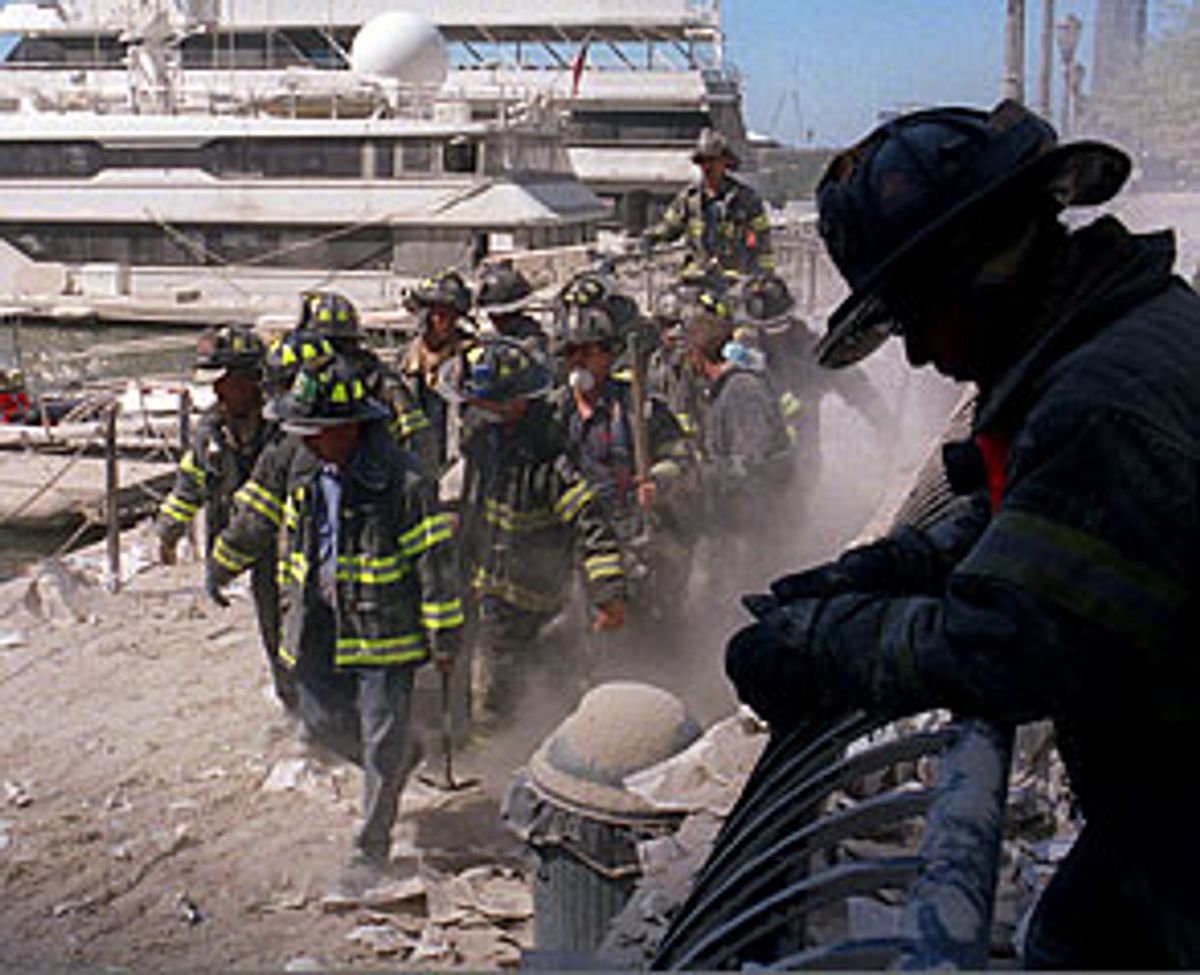
In the wake of last September’s terrorist attacks, journalists have filed thousands of stories covering virtually every angle of the historic event and its broad impact. Yet as the first anniversary approaches, one crucial story remains strangely underreported. It involves the Fire Department of New York, universally praised for the extraordinary sacrifices its members made that day.

Vanity Fair immortalized them in a portrait. Last fall NBC turned its emergency-rescue drama “Third Watch” into a stirring tribute to the true-life heroics of New York rescue workers, and last month the network aired a prime-time FDNY special, “Firehouse.” New York firefighters will soon be honored with a new U.S. postage stamp, and Bruce Springsteen sings their praises on his new CD.

In a prologue to a new book of Sept. 11-related FDNY photographs, called “Brotherhood,” former New York Mayor Rudy Giuliani insists “not a single firefighter died in vain that terrible day.” Instead, Giuliani compares the firefighters to the soldiers who stormed the beaches of Normandy in one of the decisive battles of World War II. “They were responsible for orchestrating the most successful rescue operation in the history of our nation,” Giuliani writes of the modern-day heroes.

Yet behind that brave face of selfless heroic deeds, now almost uniform agreement has emerged within the fire-service community that the FDNY’s rescue effort on Sept. 11 was seriously flawed and that perhaps dozens, if not hundreds, of firefighters died unnecessarily when the twin towers collapsed.

It’s an important story, and one that both Giuliani and the current mayor, Michael Bloomberg, have fought to suppress. But with one notable exception, news operations in New York and nationwide haven’t aggressively pursued it. Eager to document the FDNY’s bravery and sacrifice that day, and filling their pages and the broadcasts with stories heavy on heart-wrenching sentiment, most news teams have failed to soberly examine what went wrong or whether the staggering firefighter death toll could have been avoided.

Clues have been leaking out for months. FDNY Deputy Chief Charles Blaich last January conceded at a public fire-safety seminar that commanders had “lost control” of the rescue process at the World Trade Center. And in an interview with Salon, Blaich said the critical presentation has cost him a promotion. Yet only the New York Times has aggressively pursued the story, weaving together a bleak portrait of a fire department that, while battling a disaster few could have ever imagined, was crippled by mechanical breakdowns as well as errors in judgment.

Newsday and the New York Daily News have broken only isolated stories; the Daily News has been faulted more recently by critics for showing too much deference to the Fire Department and City Hall. National news organizations have largely failed to ask pointed, disquieting questions about the World Trade Center emergency response and what the breakdowns said about the leadership of former Mayor Giuliani.

“The press is not doing enough to ask tough questions,” complains Sally Regenhard, whose son Christian, a rookie New York firefighter, died in the terror attack on the World Trade Center. “I’m very dissatisfied with the press — I expected so much more. Where’s ’20/20,’ or ’48 Hours,’ or ‘Frontline’ on this story? Even the New York Times, which is running all this stuff, seems to be trying not to step on toes. I wish they would step on toes. Toes are crying out to be stepped on. But there’s this aura around the Fire Department and everybody’s untouchable.”

The Times’ stories have been based in part on leaks from a study released Monday by the McKinsey & Co. consulting firm. The findings are stunning: FDNY chiefs were working with defective radios and often could not communicate their orders to evacuate. The same radio system had failed eight years earlier, during the 1993 terrorist attack on the World Trade Center. Caught up in the confusion and urgency of the moment, hundreds of on- and off-duty firefighters streamed into the towers without checking in with superiors, making it virtually impossible to keep track of their locations.

And through it all, the Fire Department was not communicating with the Police Department — apparently, the fruit of an age-old turf battle. After the south tower had collapsed, NYPD officers in helicopters were relaying at 10:07 a.m. that the north tower looked like it too, was about to fall. Twenty-one minutes later it did, killing at least 120 firefighters, many of whom had no idea the south tower had fallen or that the north tower’s demise was inevitable.

“I can remember talking with a high-ranking fire officer from the West Coast, who’d been to New York, and his comment to me was, ‘The truth will probably never be known because [the rescue effort] was a such a fiasco,’” says Janet Wilmoth, editor of Fire Chief magazine.

Before Sept. 11, the Fire Department of New York had lost 752 firefighters in the line of duty during its 136-year existence. During a single morning late last summer it lost another 343 members.

The concern now among some firefighter family members, fire safety experts, and even some journalists, is that if most of the media continue with their timid ways by ignoring the story and abandoning their traditional role of public watchdog, important lessons will not be learned, and the FDNY might repeat its deadly mistakes from Sept. 11.

Regenhard, co-founder of the Skyscraper Safety Campaign, insists she doesn’t expect the press to point fingers over such an emotionally charged topic. “Nobody’s blaming the firefighters for doing their job,” she says. “I’m criticizing the lack of a plan. The audacity to send my son and 343 innocent victims in when they knew they couldn’t communicate. What was learned from 1993? I’m expecting the media to bring these questions out to the public, and they’re not. They’re more focused on investigating [Martha Stewart] a woman who cooks for a living and her stock sales than into how 343 firefighters died.”

“The media are being overly deferential,” agrees Charles Jennings, an assistant professor at John Jay College of Criminal Justice at the City University of New York, where he teaches fire science and protection management. “The press has shown an understandable, but inappropriate, concern about stirring up emotions in the Fire Department. But ultimately they’ve done a terrible disservice to the public and to firefighters because nobody’s applied pressure to the Fire Department to make changes or document what went right and what went wrong” on Sept. 11.

Jimmy Breslin, the longtime New York City columnist, currently writing for Newsday, calls the media’s reluctance to puncture the cloak of heroic inevitability surrounding the FDNY’s Sept. 11 deaths a disgrace. “Three-hundred and forty-three firefighters die” he fumes, “and nobody fucking says anything?” In several of his columns, Breslin has blamed Giuliani for not getting the Fire Department radios that worked and for not fixing the endemic communication problem between the police and fire departments.

He also blames a new generation of journalists for coverage that fails to provoke passion. “The big thing in the press is total absence of anger. They’re the best-educated people we’ve ever had but there’s nothing inside them to get mad. They’re sheep,” he said in an interview. “Name one person at a newspaper or on TV who got mad about firefighters dying by city negligence. Where, among the millions of sob stories about funerals, show me one phrase raised in anger. There’s a famous saying you don’t hear in this country much anymore. ‘The hottest place in hell is reserved for those who pursue neutrality in times of crisis.’ That goes for the fucking press, too.” One prominent New York journalist, speaking on the condition of anonymity, is equally blunt: “Everybody’s a hero [and] anything that doesn’t fit into that scenario is left out.”

It’s hard to imagine another recent news story that has so much raw emotion and mythology wrapped around it. The New York Times came up against that mind-set last October when a reporter wrote that official counts listing the number of dead at 5,000 to 6,000 were too high and that the actual toll was probably closer to 3,000. “Giuliani lit into it,” recalls Times metro editor Jonathan Landman. “It didn’t make sense, but it wasn’t just Giuliani. The high [fatality] number for many people was a sacred number even though it wasn’t true. And I think the same irrational holding-on-of-myth was true in the case of the emergency response.

“It’s undoubtedly true that hundreds of emergency response people acted with enormous bravery that day. It’s also true — it’s the conventional wisdom now — that it wasn’t well coordinated. Somehow it’s hard for some people to accept those two things, that a careful look at emergency response is not inconsistent with the bravery of that day.”

Others, however, suggest critics should take into account the enormity of the events last September when analyzing the coverage. “The situation in New York was so unique in so many ways,” says Marko Bourne, executive officer of the U.S. Fire Administration. “I don’t know if anybody knows what the ground rules are, including the press, to say when do you start asking hard questions.”

“We probably haven’t been as analytical as we might’ve been with another story,” says Steve Paulus, senior vice president and general manager of NY1, the city’s all-news cable channel. “I don’t think the media as whole has distinguished itself in analyzing the event. But it’s still an open, gaping wound. There hasn’t been a day since last Sept. 11 when my staff hasn’t been affected by the story in some way.

“No matter what we do with this story you’re going to upset somebody,” Paulus adds. “If you ask hard questions people are unhappy. If we don’t ask hard questions people are upset.”

And the fact there’s so little government investigation into the matter means the press does not have a natural story line to track. “It’s not as though agencies are falling over themselves to find out what happened,” says Landman at the Times. “It’s a little odd. After the Titanic and Pearl Harbor there were extraordinary inquiries, with 1,200 and 1,300 pages of public transcripts for the Titanic inquiry alone.”

Currently, the Times is suing the city of New York for access to hundreds of written and audio records related to the Fire Department response on Sept. 11. Bloomberg’s administration has argued in court that releasing the information could hinder the prosecution of Zacarias Moussaoui, the only person charged as a Sept. 11 conspirator.

The press in this case does have its defenders. Rep. Anthony Weiner, D-N.Y., who has been closely involved with the World Trade Center cleanup, praises the coverage to date as “extraordinary.” And Jerry Nachman, MSNBC talk-show host and former New York Post editor, also gives the New York press high marks for its probing, post-Sept. 11 work. “I don’t see any soft-pedaling over the coverage, or a reluctance to cover the story,” Nachman says. He suggests press complaints from FDNY family members are examples of “displaced sorrow into rage.”

Newsday reporter Graham Rayman, who has been covering the WTC cleanup and examining the Sept. 11 rescue effort, disagrees with the premise that news stories haven’t detailed serious FDNY failings on Sept. 11. “I think there’s been quite a lot of articles written that looked at the response and raised questions about the response and why wasn’t it better,” Rayman says.

Last year, the New York Daily News did important stories about how commanders were unable to communicate with firefighters, and how chiefs discussed the possibility of the twin towers collapsing very early in the response mission. Newsday reported that, several years ago, a prominent World Trade Center safety expert suggested that the city’s fire, police and emergency medical agencies stage a training exercise for the scenario of an airplane slamming into the twin towers. The training session was never staged. And in January, the New York Times printed excerpts from internal FDNY interviews, part of an oral history about the Sept. 11 mission, which often highlighted how little went right that morning.

But given the deaths of 343 firefighters in one disastrous day, the small number of probing news stories seems a response that doesn’t match the magnitude of the event.

Members of the fire service community, as well as New York journalists, note that this year the New York Daily News in particular seems to have shrunk away from a story that should have been a natural. The blue-collar tabloid has served as the unofficial paper of the New York Fire Department, as well as the NYPD, for nearly a century.

“It’s the first newspaper you see in the back room of any fire house in New York,” says New York native Glenn Usdin, chief of the Lancaster, Pa., Fire Department and president of the officer training institute, Command School. “Maybe because the New York Times is not the paper of record for the FDNY, it felt more comfortable taking a more critical look at the department,” says Usdin. “That’s something the Daily News has not been able to do.”

Blaich, the FDNY deputy chief, adds: “I’ve been very surprised the Daily News hasn’t followed through with much at all.”

Says former Daily News columnist Breslin: “They should’ve done the story and they didn’t. The voice of the people? They don’t care about the people or the Fire Department. They only care about Giuliani.”

Daily News spokesman Ken Frydman dismisses the comments of Breslin and other journalists as competitors with an ax to grind. As for the Daily News’ FDNY coverage since last September, “we’ve covered it fairly and objectively, with no reluctance. We have never shied away from tough articles,” he says. “Call any firehouse in the city and ask them which paper they think has covered this story better.”

Nonetheless, the paucity of serious reporting about the FDNY’s response to the attacks was illustrated last January when Blaich gave a presentation at a John Jay College seminar about problems the department faced that day. It was there he told the audience that commanders had “lost control.” The revelation caused a ripple among the local press — the New York Post gave it 400 words the next day — but was virtually ignored by the national news organizations.

“It’s kind of scary my presentation was considered news — the attack was in September and I spoke in January,” Blaich says now. “I assumed everybody knew there were command and control problems that day. Any reporter worth his salt and who’d ever been to a fire scene should’ve known there was serious communication problems that day.”

Although asked by the FDNY to give the presentation, Blaich, a 33-year department veteran, says the truth-telling hurt his career. “I’ve been told point-blank, ‘Don’t expect any advances because you gave that speech,’” he says. An FDNY spokesman declined to comment on Blaich’s claim, saying he was not aware of the substance or context of the conversation in question.

The McKinsey study was commissioned shortly after Blaich’s presentation, and the Times used them as a jumping-off point for its epic July 7 story on Page 1. It portrayed in stark detail how the lack of communication, both between FDNY commanders and their men, as well as the FDNY and NYPD, certainly cost firefighters their lives that day. Among the most damning conclusions was that even after the first tower collapsed, scores of firefighters in the remaining tower were seen resting in stairwells minutes before it fell, apparently unaware of how dire the situation was.

“If that’s not a story, what the hell is?” asks Neil Munro, editor of the Oakland Press in Pontiac, Mich.

On July 11, Munro wrote an editorial for the Oakland Press, one of the few of its kind to appear anywhere in America, calling attention to the FDNY’s tragic failings: “Despite the fact that the department’s leaders had concluded from the outset that the World Trade Center fires were ‘unfightable,’ crews were sent in with fighting it in mind. Scores of off-duty firefighters put on gear and rushed to the scene without telling anyone in authority they were there. On-duty personnel in some cases refused to stay away.”

The column was quickly picked up by Firehouse.com and soon firefighters nationwide, upset with terms Munro used like “mob,” “cowboys,” and “foolhardy,” deluged the Press with angry e-mail. Munro subsequently apologized in print for the “harsh and unfair” wording. But, he insisted: “The danger in the aftermath of such a disaster is that tears will get in the way of the need to ask tough questions and make tough decisions for the future.”

That’s not a message being heard by the national press. Eleven months after the terrorist catastrophe struck, television news in particular continues to show little or no interest in any FDNY story that does not begin and end with bravery.

Professor Jennings notes CBS’s prime-time special earlier this year built around raw footage of the twin towers attack shot by two French brothers who at the time were making a documentary about FDNY firefighters. Time and again it showed FDNY chiefs in the WTC lobby trying in vain to radio firefighters climbing the stairs. “CBS turned the program into an entertainment piece,” says Jennings. “That’s fine, but why didn’t they tie it into “60 Minutes” and have a panel discussion afterwards to analyze what happened and ask, ‘Did we learn anything?’”

Even after the details of the FDNY controversy had been explicitly laid out in the New York Times in July, cable television hosts still seem oblivious. That was highlighted earlier this month when former New York Fire Commissioner Thomas Von Essen made the rounds on TV talk shows promoting his new book, “Strong of Heart: Life and Death in the Fire Department of New York.”

CNN’s Paula Zahn mentioned the “second-guessing going on about why so many New York City firefighters lost their lives that day.” But she quickly attributed the controversy over defective radios as “union sniping,” and then urged Von Essen: “Let’s come back to the individual stories of bravery.”

Appearing later on “Connie Chung Tonight,” the host vaguely mentioned “some plaguing questions” about the FDNY rescue effort, without explaining to viewers what the questions were. Even the most dedicated CNN viewer would have been hard-pressed to figure out what the “plaguing questions” were, since the all-news channel has steadfastly avoided that FDNY topic. During two appearances on Fox News, interviewers never pressed Von Essen about the death toll. And on the “CBS Morning Show,” Von Essen was gently questioned about whether, when he looked back on the day when 343 firefighters died, he “wished, obviously, that it had gone differently.”

One curious counterpoint is especially telling: Months before Sept. 11, network news programs lavished attention on the FDNY when three of its men died during the devastating Father’s Day fire at a Queens warehouse. NBC’s “Dateline” aired an extensive piece chronicling the deadly fire. Three nights later, ABC’s “Nightline” dedicated an entire program to the topic. To date, neither network news program has examined the details surrounding the 343 firefighter deaths on Sept. 11.

Some observers suggest that when the one-year anniversary has passed, more journalists will take up the FDNY story. “I think then we’ll see more detailed examination,” predicts Paulus at NY1.

For Sally Regenhard, too much time has already been lost with too few questions about what happened on that bright September morning. Even now, she doesn’t know which tower her firefighter son was in when he died. “Time is the enemy of any investigation. People get sick and tired and want to forget about it,” she says. “You have all these people waving the flags saying isn’t it great, they [firefighters] are heroes, and talking about angels flying around. But they’re not dealing with the real issues. The response was a hopeless debacle. The Fire Department’s system is broken and terribly dysfunctional, and we’ve avoided that elephant in the room.”

Continue Reading Close

Eric Boehlert, a former senior writer for Salon, is the author of "Lapdogs: How the Press Rolled Over for Bush."

Is Kirk Cameron “brave” to condemn gays?

Piers Morgan defends the actor's anti-homosexual stance VIDEO

  • more
    • All Share Services

Topics: , , ,

Is Kirk Cameron Kirk Cameron and Piers Morgan (Credit: Reuters/Fred Prouser/Keith Bedford)

Having Piers Morgan call you brave is like having Rick Santorum call you smart. You’ve got to consider the source. So when the CNN host and Murdoch apologist told TMZ what he thought about former “Growing Pains” actor turned evolution naysayer Kirk Cameron’s comments on Morgan’s show Friday night, Morgan was restrained to the point of admiring. “He was honest to what he believed,” Morgan said. “It’s a very contentious issue. I think that he was pretty brave to say what he said.”

And what, precisely, were Cameron’s bold remarks? When prodded on the subject of same-sex marriage on Morgan’s CNN show, the Christianity-themed movie star and father of six said that “I believe that marriage was defined by God a long time ago…. Do I support the idea of gay marriage? No, I don’t.” And when Morgan asked if he thought homosexuality was a sin, Cameron hedged a bit, refusing to use the word “sin” but declaring, “It’s unnatural, it’s detrimental and ultimately destructive to so many of the foundations of civilization.” Maybe “sin” would have been a nicer way of putting it.

Cameron’s remarks — along with his assertion that if one his children came out to him, “I would say … just because you feel one way doesn’t mean you need to act everything you feel” — were not greeted with universal applause. Over the weekend, GLAAD started a petition to “Tell Kirk Cameron it’s time to finally grow up,” calling him “out of step with a growing majority of Americans, particularly people of faith who believe that their gay and lesbian brothers and sisters should be loved and accepted based on their character and not condemned because of their sexual orientation.” Perez Hilton, speaking for much of the Twitterverse, referred to the interview as a “spew” of “homophobia and bigotry.” But as Hilton notes – and anyone familiar with Cameron’s hyper-evangelical ways would likely agree – “Did anyone really expect less from him?”

That’s where Morgan comes in. He knew exactly what a guy who’s currently on a “marriage tour” — and shilling a new documentary that says that “something is sick in the soul of our country” – would say. It was not going to sound like the lyrics to a Lady Gaga song. Accepting a person’s right to say things, even stupid things, isn’t the same as condoning them. Speaking to TMZ, Morgan described Cameron’s statements as what many would argue is “an antiquated view” and asserted, “I think that you can take the biblical thing too far.” On CNN, Morgan told Cameron directly that if one of his own children admitted that he was gay, “I would say, ‘That’s great, son, as long as you’re happy.’”

Unlike the even-more-loathsome Rush Limbaugh, Cameron wasn’t going out of his way to personally attack an individual, or to denigrate anybody in the name of a repulsive stab at humor. He was just answering a question. Morgan is correct in his assessment that Cameron’s response was an authentic one, and that there is a kind of bravery in that. It doesn’t make that kind of thinking good or right or decent, any more than it makes Morgan less of a hack for noting it. We may be demoralized by Cameron’s answer, and rightly decide that such rhetoric needs to be challenged. We can refuse to support his films. But in the fight against intolerance and hypocrisy, what we can’t do is ask a man a question point blank — and then be outraged when he answers it truthfully. All we can do is fervently hope that with the right amount of tolerant persuasiveness, one day he might be able to give a different one.

Continue Reading Close
Mary Elizabeth Williams

Mary Elizabeth Williams is a staff writer for Salon and the author of "Gimme Shelter: My Three Years Searching for the American Dream." Follow her on Twitter: @embeedub.

Wolf Blitzer writes perfect political blog post

CNN anchor predicts election will involve lots of disagreements and possibly impolite exchanges of words

  • more
    • All Share Services

Topics: , , ,

Wolf Blitzer writes perfect political blog post Developing at this hour, reports of nastiness (Credit: CNN)

You know that computer program that automatically generates baseball game reports based on box scores? Wolf Blitzer is like an extremely primitive and unsophisticated version of that, for political news. (Or “news.”) Today, the CNN anchor takes to “Blitzer’s Blog” to report that the 2012 election campaign has been very intense. He also predicts that it will get more intense later, when it gets closer to the general election.

BLITZER’S BLOG: It’s going to get nasty!

By Wolf Blitzer, CNN
(CNN) – If you think it’s been a rough ride for the Republican candidates during this current campaign season, just wait. This will be seen as child’s play once the general election campaign begins.

I’ve said this before but I’ll say it again: the war of words between President Obama and his campaign supporters versus the eventual Republican nominee and his supporters will be fierce.

Even though there has already been a lot of talking and stuff happening during this political campaign, you won’t believe how much additional talking and arguing there will be as it continues. I have said in the past that Barack Obama and the person running against him will say things at and about each other, and I am saying it again. Things will be said.

If you think Wolf Blitzer’s blog post about the intensity of this campaign is finished, just wait. He quotes three lines from last night’s debate, then writes four more one-sentence paragraphs:

And that’s just for starters. Just wait for what’s coming.

By the way, the president and his supporters will not be shy in fighting back.

And like the Republicans, they will have hundreds of millions of dollars to finance attack ads.

Get ready for a brutal political season.

I am, Wolf! I am!

THIS JUST IN TO THE SITUATION ROOM: Every other political blogger has retired from political blogging to curate Pinterests about sandwiches instead, because Wolf Blitzer just made our jobs redundant.

The only remaining question is whether Wolf Blitzer is a better blogger than his Fox counterpoint in incisive online commentary, Greta Van Susteren. As long as CNN insists on “copy editing” Blitzer, we may never know for sure.

Continue Reading Close
Alex Pareene

Alex Pareene writes about politics for Salon and is the author of "The Rude Guide to Mitt." Email him at apareene@salon.com and follow him on Twitter @pareene

Nancy Grace is more terrible than ever

Wild and unfounded speculation about Whitney Houston's death is a new low for the HLN host VIDEO

  • more
    • All Share Services

Topics: , , ,

Nancy Grace is more terrible than everNancy Grace (Credit: AP/Chris Pizzello)

Cable news depends on colorful characters to draw eyeballs in between those reminders that there are “no new developments” in the real stories of the day. But even in a sea of distinctive jerkwads – your Erin Burnetts and Piers Morgans and Bill O’Reillys and Megyn Kellys –  HLN host Nancy Grace never fails to distinguish herself. And just when you think she can’t find new depths to plumb, along comes the Whitney Houston story.

Grace, the woman who has made an entire cottage industry out of her indignation over Casey Anthony, who paints herself nightly as the avenging angel of poor dead Caylee, has never been one to trade in subtlety — or, for that matter, facts. CNN had to settle a wrongful death suit after the mother of a missing child killed herself after being browbeaten on her show. (The parties agreed that Grace “engaged in no intentional wrongdoing.”) She fearlessly championed the prosecution’s side in the Duke lacrosse team rape case, blithely referring to “the victim,” and went ballistic over the very notion that the accused might be innocent. (She then conveniently remained quiet on the subject after the case was dismissed.) This, folks, is a woman who has guilt-tripped abduction victim Elizabeth Smart for not playing along with her interview tactics. And even after a jury found Casey Anthony not guilty last summer, she has held on to the story like a dog with a bone, insisting that “I told the truth,” luxuriating in descriptions of “the backdrop of 2-year-old Caylee’s decomposing body just a few houses down from where Tot Mom put her pillow every night,” and excoriating Anthony for – rich irony alert –“generating interest in herself.”

Yet apparently there just aren’t enough kidnapped babies and alleged gang rapes out there to keep Grace satisfied. She’s turning her attention now instead to the mysterious death of a diva. Grace, who famously said last summer that she knew more than the “kooky jury” on the Anthony case, now seems to know more than the L.A. coroner’s office. Despite word that foul play is “not suspected at this time” in Saturday’s death of Whitney Houston, Grace isn’t so sure. On Monday she appeared on CNN to ponder, “Who, if anyone, gave [Houston] drugs following alcohol and drugs.” That itself isn’t a crazy question, though it is a bit of a reach – a suggestion that the story of a superstar dying alone and surrounded by prescription bottles just isn’t sexy enough. Not when surely there’s a villain on the loose for Nancy Grace to bring to justice. Cue dramatic theme music!

Medical accountability is to be considered whenever someone dies who may have had drugs administered to him or her. Just ask physician Conrad Murray, who was convicted of involuntary manslaughter in the death of Michael Jackson. But where Grace, in her totally Nancy Grace-like way, went totally bananas was when she asked, “Who let her slip or pushed her underneath that water? … Who let Whitney Houston go under that water?” Uhhhhhmm… Whitney Houston?

The sad desperation of news networks, and their flailing competitiveness in a glut of information overload, is rarely pretty to watch. But Grace isn’t just some blowhard, saying provocative things to get a rise out of the viewership. She’s a full-on loose cannon, a disseminator of disinformation and an ego gone rogue. That CNN and its sister network HLN continue to permit her to spew her wild speculations, to proudly flaunt her flat-out contempt for the facts as they are known, and to engage in character assassination long after a not guilty verdict has been rendered in a court of law, is blatant and arrogant recklessness. Unchecked, how long before Grace decides she knows who “pushed” Houston under the water? How long before she’s on another crusade, deciding who is a victim and who is a perpetrator? How long before a real criminal investigation or trial is tainted because of her nightly yammering?

After her jaw-dropping segment Monday, CNN anchor Don Lemon had to leap into fire-dousing mode, issuing a hasty reminder that “This is not CNN’s reporting. We don’t know that to be true.” Here’s a crazy idea – you shouldn’t be talking about things you don’t know to be true on a network with the word “news” right there in the middle of it. And CNN shouldn’t continue to provide a platform to a woman whose self-interest makes a mockery of journalistic credibility.


Continue Reading Close
Mary Elizabeth Williams

Mary Elizabeth Williams is a staff writer for Salon and the author of "Gimme Shelter: My Three Years Searching for the American Dream." Follow her on Twitter: @embeedub.

Wolf Blitzer presents “A salute to politicians”

CNN anchor can't help admiring those brave, hardworking candidates

  • more
    • All Share Services

Topics: , , ,

Wolf Blitzer presents Wolf Blitzer (Credit: CNN)

Wolf Blitzer, the face and droning monotonous voice of CNN’s breaking news coverage, has written the finest blog post of the year, so far. Blitzer has penned “A salute to politicians,” because, really, someone had to.

“I know it will probably sound weird,” Blitzer begins, “but I admire these politicians who put themselves out there before the American public knowing full well that all their warts will be exposed big time.” We have a breaking news alert for you here in the Situation Room: Situation Room anchor Wolf Blitzer admires members of the political ruling elite.

Politicians, you see, should be admired, because even though they are by and large rich, they still work very hard, every couple years. So says Wolf Blitzer in his essay on politicians, “I admire politicians, by Wolf Blitzer.”

Most of them already have lots of money. They could easily coast at this point in their lives and sit back and relax.

Instead, they are working hard on the campaign trail.

Sometimes people have to do stuff they don’t want to do, unless they have a lot of money. Usually people with a lot of money like to play golf, because playing golf is more fun than going to work. If a person with a lot of money goes to work, he must like work a lot. Even though sometimes work is hard:

I’ve seen them in action, and it’s tough. They get up early in the morning and go to sleep late at night. They have to deliver the same stump speech over and over and over again, and then answer an endless amount of often annoying questions at town hall meetings, at diners and from reporters such as me.

Next time you think about criticizing a politician, step back and think about how early he woke up this morning, and how many times he had to give a boring speech. He might have even had to deal with Wolf Blitzer! Now don’t you feel guilty?

Blitzer hits his main theme — it’s admirable that politicians actually get out of bed and do things even though they are rich — once more and names the politicians he is specifically saluting:

Mitt Romney, Rick Santorum, Newt Gingrich, Jon Huntsman, Ron Paul and Rick Perry could have taken the easy path and relaxed and enjoyed life. Instead of playing golf and hanging out with their children and grandchildren, they are working hard trying to get the Republican presidential nomination. In the process, they are bitterly attacked – often for good reason.

In their pursuit of more power these already powerful men have allowed themselves to be scrutinized and even occasionally criticized, which is quite a sacrifice.

This salute to politicians even ends in the most perfectly CNN-y way possible, by presenting two vague and conflicting viewpoints and refusing to adjudicate between them:

Why do they do it?

I know what they say. They say they are interested in public service and want to help the American people. They say they believe in what they are trying to achieve.

The cynics say they have huge egos and are simply seeking power and glory.

That is certainly true of some politicians.

But having covered many of them over the years, I also know some are trying to do the right thing, and I salute them.

“Some say politicians are power-hungry narcissists, others say they are noble public servants. Both sides could be part right, some of the time, most likely.”

The sole disappointing aspect of Blitzer’s salute is that it includes no musical tribute.

[Via Glenn Greenwald]

Continue Reading Close
Alex Pareene

Alex Pareene writes about politics for Salon and is the author of "The Rude Guide to Mitt." Email him at apareene@salon.com and follow him on Twitter @pareene

Our creepy, endless fascination with Casey Anthony

"Tot Mom" resurfaces in a new video, and the cable-news universe remains as gleefully obsessed as ever VIDEO

  • more
    • All Share Services

Topics: , ,

Our creepy, endless fascination with Casey Anthony (Credit: Gavonlaessig)

It’s been six months since a Florida jury found Casey Anthony not guilty in the 2008 death of her 2-year-old daughter, Caylee. Since then, the woman who spent three years awaiting trial behind bars — and in the glare of the news spotlight – has kept a low profile. Considering the lingering questions about her innocence, the intense public resentment over the verdict, and a steady stream of death threats, her hibernation is hardly a surprise. But perhaps some part of Casey Anthony has missed the attention.

In a new video — ostensibly recorded in October but which did not emerge until Thursday — a now blond, bobbed and bespectacled Anthony narrates a four-minute “diary” entry about her new life. She says she’s “extremely excited” about her future and new computer – being able to Skype, take pictures, and “finally have something that I can finally call mine.” What she doesn’t mention? The child she used to call her own.

Though Anthony, still on probation in Florida, makes no mention of her exact location, her parents said Thursday they were “concerned” the video might endanger her. It has definitely stirred up the usual outrage from the most predictable mouthpieces. In other words, CNN is stoked. For Nancy Grace, the video has been like a late Christmas present, an opportunity to froth like she hasn’t frothed about “two-year old Caylee’s decomposing body” since last summer. Trotting out her favorite nickname for Anthony, Grace opined that “I think this is very simply Tot Mom Casey Anthony and her lawyers, possibly, injecting themselves back in the national media because nobody’s touching her offer for a paid-for interview with a 10-foot pole.” She added that: “It’s all about Tot Mom… generating interest in herself.” Dr. Drew Pinsky, meanwhile, eagerly pointed out her “narcissism and … issues of judgment.”

Out in the wider world, meanwhile, the public reaction has been mostly an excuse for another outpouring of revulsion against the lady one MSNBC commenter called “the most hated person in the U.S.A.” Also unsurprising — and straight-up gross — is that Anthony has her fair share of rabid admirers. On the shudderingly self-proclaimed “#1 Casey Anthony Fan site,” reaction toward the “smokin’ hottie” and her video has been considerably warmer. Or, as one commenter put it, “I would love to rock your world sometime.”

But why did the video emerge now, and who is Anthony really communicating with? Is this a public statement or truly a private “diary”? Anthony’s lawyers told a Florida Fox affiliate that “Casey has maintained some notes on her thoughts for personal use, especially for counseling. She did not release this video to YouTube and does not know how they got it. It could not have been legally obtained and was not authorized.” And John Riley, the man who runs a “Boycott Casey Anthony” Facebook group and first posted the clip, told Nancy Grace Thursday that he found the clip on a few pay-per-view sites and “kept looking and looking and looking” until he found it for free. He says he posted it “so there would be no money made off it.” Try to get your head around the idea of someone clawing doggedly around the Internet for four minutes of what Anthony  promises “will be as tedious as my audio recordings have been” and you begin to appreciate the apparently endless fascination this woman still holds.

Anthony’s “tedious” four minutes don’t reveal much about the inner workings of someone found not guilty of killing her daughter. They do seem in line with thoughts of someone recently released from jail – the simple relief of having one’s own possessions, the pleasure of having a dog. And she might well be circumspect about talking about her child and her trial, even on a supposedly private “video log,” if her lawyers have coached her to be. So is her video a case study in narcissism, a private moment from a “smokin’ hottie,” or just personal thoughts before a counseling session? The answer is simple. It’s whatever you already thought. Though Casey Anthony says, “Things can only get better,” minds aren’t changed as easily as hair color. “It’s surreal how things have changed since July,” she declares at one point in the clip. Then she adds, as if speaking for both herself and everyone watching, “and how many things haven’t.”

Continue Reading Close
Mary Elizabeth Williams

Mary Elizabeth Williams is a staff writer for Salon and the author of "Gimme Shelter: My Three Years Searching for the American Dream." Follow her on Twitter: @embeedub.

Page 1 of 32 in CNN