Rock and Roll

A cool cowpoke gets political

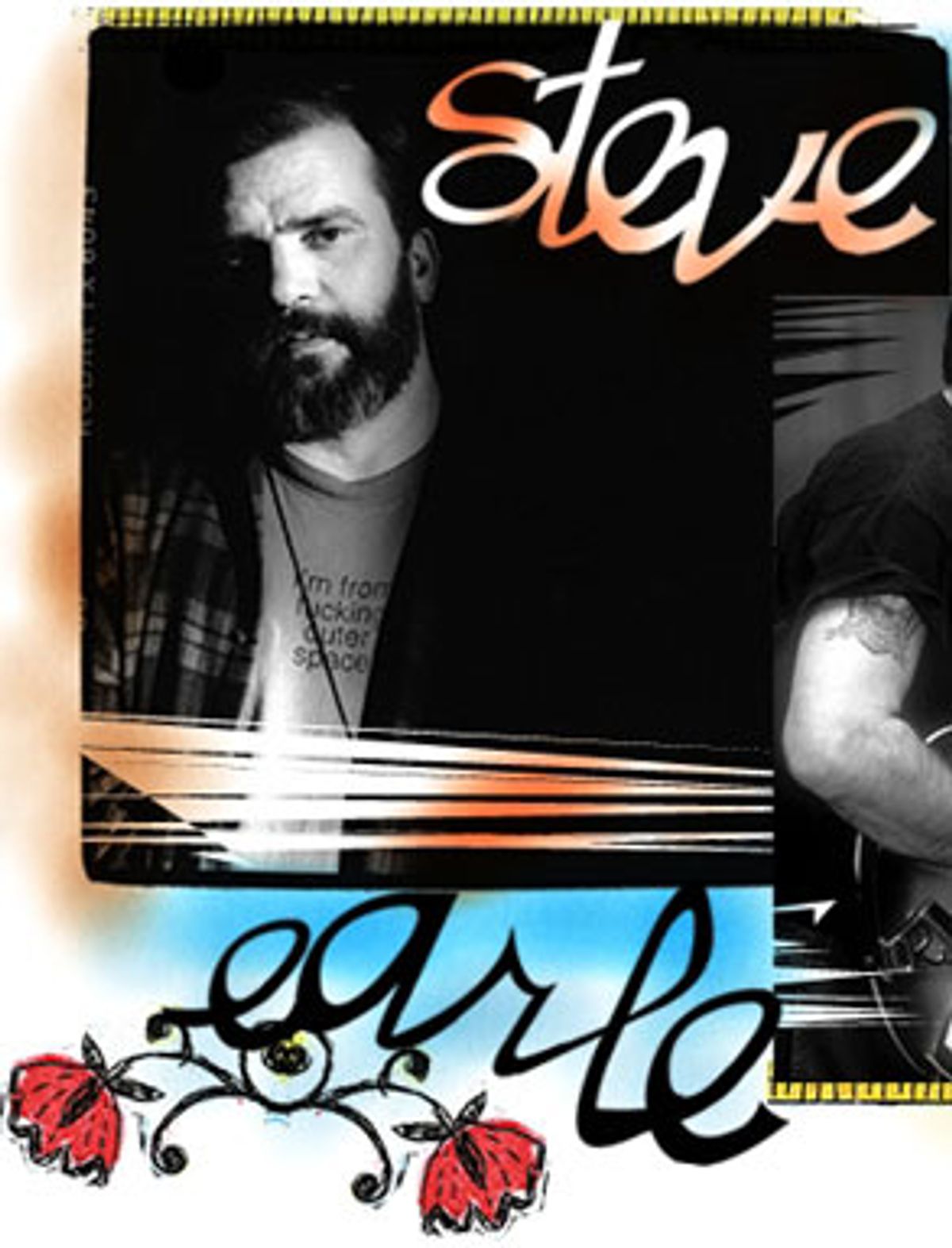
Steve Earle, a new disc under his belt, talks about his tumultuous career -- a hair-raising ride that has included many wives, an ugly romance with heroin, and watching a man die.

Not too many record-company execs ask for overtly political albums from their artists, particularly in a time of high-intensity American boosterism. But that’s exactly the directive that renegade roots rocker Steve Earle received from Artemis Records owner Danny Goldberg before Earle started his latest disc, “Jerusalem,” due in stores this month.

Of course, when the artist is Earle, it is hardly necessary to ask for potentially combustible material. Since his debut in 1985 with the rough and ready, honky-tonkin’ “Guitar Town” — designated by some as the salvation of country music — Earle has chosen to go against the flow. Instead of reveling in the cool cowpoke image that came with the release of “Guitar Town,” Earle moved on to rock ‘n’ roll, a phase that culminated with the 1988 Top 10 rock-radio hit “Copperhead Road” from the album of the same name. He kept rocking the country cradle, creating urgent, rootsy, roadhouse tunes about lonesome losers with beat-up lives, which drew many comparisons to Bruce Springsteen’s blue-collar characters.

But as he pressed into new creative territory, Earle began to tempt the fates, developing a serious heroin addiction and a habit of marrying and divorcing women with troubling frequency. By 1990, when he released the aptly named “The Hard Way,” Nashville was ready for him to disappear. And he did. For four years, he didn’t write any songs, instead spending his days chasing down dope. He was on the last of his five wives by then.

In 1994, Earle was arrested for drug possession and went into rehab. Since then, he’s released six critically acclaimed discs in six years; started his own record label, producing albums for everyone from Lucinda Williams to Bap Kennedy; written “Doghouse Roses,” a book of short stories; founded the BroadAxe Theatre, the acting company in Nashville that will premiere Earle’s first play, “Karla,” about Karla Faye Tucker, a born-again Christian who was executed in 1998 in Texas. In his spare time, Earle has devoted time to working for the elimination of land mines abroad, and the abolition of the death penalty at home.

His name has become synonymous with the latter cause, particularly since he befriended Jonathan Nobles, a convict on Death Row in Texas with whom he became pen pals. Earle witnessed Nobles’ 1998 execution and has written a number of tunes about the death penalty, including “Over Yonder (Jonathan’s Song)” for Nobles and “Ellis Unit One” for the “Dead Man Walking” soundtrack.

“Jerusalem” features a few more prison tunes as well as a rant on the dilution of baby-boomer values, and a song that’s already brought Earle a barrage of criticism — “John Walker’s Blues.” The song’s story is told from the perspective of convicted American Taliban fighter John Walker Lindh, and contains such lyrics as “If I die, I’ll rise up to the sky/ Just like Jesus” and “we came to fight the jihad and our hearts were pure and strong.”

Earle, relaxing in the Manhattan offices of his record label, took a few minutes earlier this week to discuss Truman Capote, drug addiction, why poetry is like bluegrass, Bruce Springsteen, the dogs of Galway, why FarmAid works, and if there’s a cure for being a Texan.

How did you become interested in politics?

I just grew up in a time when songs were pretty political. It was the ’60s, early ’70s; the Vietnam War was going on. I was too young to play in places that served liquor when I first started, so I played in a coffeehouse and the local underground newspaper was published upstairs. My politics were really radical when I was younger and then I moderated like everyone else does when they start having kids.

What’s different for me is that I nearly died. That makes you look at things differently. That’s what “Christmas in Washington” [from 1997's "El Corazón"] was about. It was about politics, but it was a very personal political song. It was about me waking up one day and realizing that maybe I was right in the first place, that maybe there isn’t any reason for someone to go hungry in the richest country in the world, that maybe we need to start thinking about what our grandchildren will do when the United States isn’t the most powerful country in the world.

You know, I still write more songs about girls than anything else. But I don’t have it in me to go out of my way to write songs that aren’t about anything. I wasn’t raised to do it like that.

Have you recaptured your youthful intensity?

I think I have. I’m pretty politically active at this point in my life. I mean, I’m involved in an organization called the Justice Project, which requires me putting on a suit and going to Capitol Hill to talk to people about the death penalty.

Is that a satisfying experience?

It’s not satisfying. It’s frustrating, but it makes me feel like I’m not doing nothing. And I’m not comfortable with doing nothing.

How surprised were you when your label asked you to make an overtly political record?

When [Grammy-nominated] “Transcendental Blues” came out (in 2000), Danny Goldberg said to me, “I would never tell you how to make records, but …” He was looking for a way for me to distinguish whatever my next record would be from “Transcendental.” This was before Sept. 11. I thought he was crazy. I wasn’t inclined to do that, but I was very, very impressed and felt very safe and very supported. Then Sept. 11 happened and I found myself writing that political album.

This is the first time I haven’t had an adversarial relationship with a record company. And I’ve been OK with that. Artists have always had to fight. Michelangelo didn’t particularly get along with the Vatican. He needed the money.

Are you surprised about the fuss over “John Walker’s Blues”?

I’m only surprised that it started more than a month before the record came out. Anyone who listens to the song knows that I’m not telling you to send your kids off to the Taliban. Taking it out of context, listening to snippets of it and then railing about Jesus and patriotism is just sort of silly.

Didn’t you once say you’d leave Tennessee if there was ever an execution there?

I caught some shit from several people about that because I didn’t leave [after Robert Glen Coe was executed there in 2000 -- the state's first execution since 1960]. What happened was I met [live-in girlfriend] Sara and I can’t leave.

But we’re starting to get somewhere with that movement. There’s a moratorium in Illinois and a moratorium in Maryland as of about several weeks ago. People are starting to realize that [the death penalty] is expensive and that it doesn’t do what it’s advertised to do.

The death penalty will die of natural causes just like it did in the ’60s. If we didn’t do shit, the death penalty would go away eventually. But right now, all the abolition movement is trying to do is hasten that demise so that fewer people die.

It’s not just the people dying, it’s also what it does to us every time we kill someone. It affects all of us. Certainly it affects the people whose job it is to go get the people out of their cells no matter how hard they fight, how loud they scream, and kill them. That affects those people for the rest of their lives. I’ve witnessed an execution. This is not an abstract for me. It’s a really ugly thing. It scarred me for life. I’m still recovering from it. I have dreams about it.

Are you glad that you witnessed it?

No. I don’t know how I could have avoided it. I don’t recommend it to anyone. I had two revelations. One was that I needed to tell other abolitionists who are asked if they want to do this to really think about it, that it’s not what they think. It’s more damaging than they could possibly imagine. The other thing that surprised me was the amount of empathy I had for the people who had to participate in the execution. No matter what lip service they give or what rhetoric they attach to it — they’re finding now that people who work in death row units where they do executions, especially Texas where they do a lot of them, that most of them eventually burn out and change their minds about the death penalty.

How did you start writing letters to death row prisoners?

I wrote [the song] “Billy Austin” [about a death row inmate] and then inmates and people from the movement started writing me. I’ve always opposed the death penalty. I just grew up that way. It’s never, ever made sense to me.

One of the biggest influences on me as a child was that my dad was involved in a letter-writing campaign. And he probably supported the death penalty or at least thought it was justified in some instances. But there was a guy in San Antonio who was charged with killing a kid whose family had a lot of money. The rich kid was riding around in a car with a gun. This was the early ’60s when everybody wanted to be Sharks and Jets. The other kid got hold of the gun and killed the rich kid, whose family hired a powerful lawyer to prosecute the case, and my father didn’t think that was fair so he wrote a letter to the governor. It was the first action I ever witnessed against the death penalty. My father was an air-traffic controller and kind of a regular guy.

Then a few years later I saw “In Cold Blood.” The way Perry Smith’s execution is portrayed in that film — I read above my level as a kid so I immediately went out and got the book — the indignity and inhumanity of it was really apparent to me even when I was 10.

The thing that disgusted me is that there’s a scene where they’re getting ready to execute Smith and they’ve got him in a harness. He’s worried that he’s going to soil himself; he’s heard that happens. So he wants to go to the bathroom, and they say, “No, we don’t have time.” Finally the priest intervenes — “For God’s sake” — and they hurry and get him out of the harness and then strap him back up again. It was just obvious to me that it was hurting everyone. And it was a pretty realistic portrayal from what I understand from all of my own research. Truman Capote is really an interesting cat. I mean, it’s just a really, really great book. It made a big impression on me.

You’ve been working on your own novel, right?

I haven’t worked on it in a while because I’ve been working on this play and that goes into rehearsals Sept. 1. The novel will be the nonmusical project for probably the next couple of years. During the tour, I’ll work on it, but probably not every day. But when the tour is over, I’ll probably sit down and finish it.

You recently spent a year writing daily haiku, too, didn’t you?

I’m struggling with that right now. I didn’t write those to publish ‘em. But Tony Fitzpatrick, the artist who does all my album covers, he and I are talking about putting together a book of that haiku. There would be some connecting prose pieces because it’s kind of a journal. It’s 366 days, because I fucked up and did it during a leap year, and 366 haiku. They’re in a little notebook and I just wrote the date and where I was so it’s kind of interesting in that respect.

I haven’t written any haiku since. I haven’t written any poetry since, but I’ve been wanting to write some longer poems again. When I started the haiku thing, all the other poetry went on the back burner, but I’m growing interested again. Poetry is the hardest thing that there is. It fascinates me so I want to write more of it.

It’s certainly an underappreciated art.

It’s like bluegrass. Deciding to be a poet is a hardcore decision. It’s saying, “I’m going to do something that’s really hard, that I’ll never master, and that will never make me a fucking dime.” Bluegrass and poetry have a lot in common.

You think you’ll make another bluegrass album?

Probably. I’m just not the type of person to make one when everyone else is making one. I guess I don’t look quite as crazy as when I made [1999's] “The Mountain” [with the Del McCoury Band].

How do you decide which format any story you have will be written in?

It’s really taxing sometimes, but you can do it. I probably learned from Tony Fitzpatrick and Terry Allen more than anyone else that it’s really important to do stuff outside of your core craft. I think it keeps you fresh in your core craft.

Terry is a songwriter who makes these really wacko records that are always on small labels. He wrote “New Delhi Freight Train” [for Little Feat] years ago and his day job is as a sculptor. He works on a fairly large scale with metal and he also does these wired-for-sound kinetic sculptures. He’s the reason that Joe Ely, Butch Hancock and Jimmie Dale Gilmore are who they are because he was their teacher.

I had just finished “Doghouse Roses” and I was working on the play and I actually had started on the novel and we were doing land-mine dates on the West Coast and I hadn’t seen Terry in a long time. He was there and I told him about everything I was doing and he said. “Cool. Man, don’t you do any visual art?”

And I don’t. I don’t have any aptitude for it at all, which is odd because I’m the only one in my family who doesn’t. My father paints beautifully and my brother did when he was younger. The most I have is bonsai, which is a visual art that God helps with.

I love Terry’s attitude, though. I really kept my head down in songwriting and songwriting only until this sort of second lease on life that I got. Originally, writing prose was an exercise because I’m scared of not writing because I didn’t write for four years. It turns out that all I have to do is not spend my whole day running around trying to find dope and I write just fine.

Writers fear blank paper more than anything else. I’ve been really blessed that I’ve had something to say and that people have been pretty supportive of me when I step outside of music.

How’d you get into the bonsai?

Probably through haiku. Part of it was this dream that I had before I fell in love again and moved another girl into my house who started putting stuff everywhere and decorating everything. I had this dream of this really uncluttered Japanese environment in my house. That’s all gone to hell. Girls, they decorate.

My girlfriend says bonsai is the only time I shut up, but she’s never been fishing with me. I do shut up when I’m fishing, too. You get up in the morning and that’s generally when I’m messing with the trees. And sometimes the thing to do is nothing.

I’ve got maybe too many trees. I just lost two because I was in Europe and my son managed to kill two and Sara has a black thumb, too, so every once in a while when I’m on the road I’ll lose one. I probably have nine trees now. I’ve had 16 or 17.

It makes you look at trees differently. When I see a full-size tree now, I look at it differently. I’m looking at why the trunk does what it does and speculating on what makes it do that. Bonsai is an illusion. You’re seeing this miniaturized version and sometimes it’s not what it seems. Sometimes it’ll look great, like a deciduous tree will look great in the summer and springtime but when the leaves fall you can see that the limbs have been amputated and it’s an illusion. It’s kind of a cool thing.

Why did rehab work in ’94?

I was ready. I was sick of it. I knew about the program and I just didn’t know how to stop. My grandmother and grandfather on my mother’s side were both in the program. You can’t say A.A. or N.A., traditionally. I can say 12-step program and it’s important that I say that because what happened to me was so public.

I still do exactly what I did almost eight years ago. I go to meetings. I call my sponsor. When I’m home, I go five or six times a week. I try to go every day. An hour a day, the program is my spiritual system. It’s the only one I have still. It’s absolutely the centerpiece of my life.

That’s interesting. From your work with haiku and bonsai, it sounds like you have an Eastern sensibility trickling in.

I’d be a really bad Buddhist. I really hate to kill things now but I don’t mind that other people kill them so I can eat them. I think it would be really hard on me to get that introspective. My spirituality boils down to that there is a God, and it ain’t me. That’s what’s important for me to remember.

Our attempts to be God are where we fuck up. When we start trying to control shit or control the illusion that we control things, it’s bad. The vast majority of times I still want to control everything and I wear myself out and then I have these moments where I’m able to literally let it go and those are the best times.

It happens automatically for me in a ballpark. It sounds weird but ballparks are the most tranquil structures human beings have ever built. For me, more than any church, more than anything else.

I’m a huge Yankees fan. I was 6 years old in 1961 and that’s what you got on TV in Texas was the Yankees. But I’ll go to any ballpark, it doesn’t matter. We have a triple-A team in Nashville and I go a lot. I can walk in and it happens almost immediately. As soon as I get to the top of the steps and see the green, I start feeling better. The shape of the fields, the colors, everything about ‘em, I love ‘em.

Ever get sick of the Springsteen comparisons?

No, it’s flattering. Springsteen came along at a time that was really difficult for singer/songwriters, but he was just so good that he broke through. I think he’s the best out there. His body of work speaks for itself. And the way “Guitar Town” was written to be a record, with a beginning track and an end track, was the direct result of me seeing the “Born in the U.S.A.” tour and listening to that album a lot. It’s seen as the record where he became an icon in the commercial world, but it’s his most political record. It was very misinterpreted at the time. I still think it’s his best.

Who gave you your first guitar when you were 11?

My uncle, who is five years older than me. He was living with us at the time. I started to learn to play upside down because he’s left-handed. Then he got a new guitar and he gave me his old one.

And then you split when you were 16?

I started to run away from home when I was 14. I feel bad because my parents were really great parents and they never did anything to me to make me want to run away.

By the time I was 16, the FAA was starting to computerize air-traffic control and they decided to retrain my dad for data systems so he had to go back to Oklahoma City to go to the academy. I had dropped out of school by that time and had a gig at night and a job building houses during the day. I didn’t want to go to Oklahoma and they knew they couldn’t make me go anywhere so they helped me find an apartment and we went and celebrated my birthday three months early because we always went to a Mexican restaurant for my birthdays and off they went.

My relationship with my parents improved immediately after I moved out of the house. I was hard to be around. My family is really close and the only time I haven’t gotten along with my parents is between 14 and 16 and I think everyone can say that. And I was 14 in 1969, right at the peak of when everyone was not getting along with their parents.

How did you discover your love of Ireland?

Irish and Scottish music is such a huge part of country music so it was sort of natural. And Ireland is a place where I’ve done really well, so we’ve played there a lot, so that got me there.

I’d been hearing about Galway since the ’80s and finally got there in the ’90s and fell in love with every dog that had a bandanna around its neck and a Frisbee in its mouth. It’s my kind of town. It’s a university town and a tourist town. Artists have been living in the margins of places like that forever.

You’re there a lot?

I go when I can and I try to stay three or four months at a time. I go when I’m finishing a project. I wrote most of “El Corazón” there, half of the book there, several of the songs that ended up on “Transcendental” were written there. If I hadn’t fallen in love with a girl who has two small kids whose father lives in Tennessee, I’d probably be living there now.

You grew up outside San Antonio, but you were born in Virginia. Is it true that your grandfather sent soil from Texas to where you were born in Virginia so the first soil your feet would touch would be Texas soil?

It’s true. My father sent dirt when my two boys were born. My granddad sent his youngest son — he was 15 and had never been out of Jacksonville, Texas. He put the poor kid on a train to Virginia with a garbage can full of dirt. His instruction was that the dirt be under the fucking table when I was born. It took a great big arm and nose and mustache to keep that from happening. And they took a picture of that and I have pictures of it when my boys were born and my dad sent dirt.

It’s funny about Texas. I’ll always be a Texan because there’s no cure for it. Probably if there was, I’d take it. There are a lot of things about Texas that really bother me and more each time I go back.

Like what?

The death penalty is the big one, but it’s not just that. I think a good way of looking at it is that Texas has changed. As conservative as Texas is on some things, there was this odd time in the ’70s when Willie Nelson moved back to Texas from Nashville and I stopped getting my ass kicked.

For a while I got my ass kicked because I wore cowboy boots and I had long hair. All of a sudden, Willie comes back and at first there was trouble because Willie would have a concert and hippies would show up. I once saw a bunch of guys dancing on the dance floor and a bunch of kids sitting there and one guy dancing was kicking at people and Willie stopped the show and said, “There’s room for some to sit and some to dance.” He just didn’t put up with it.

Willie’s genuinely serene. FarmAid works because Willie doesn’t want to hear about it not working. Texas got to be a really, really cool place. But it only went so deep. And it went away again quickly.

I’ll always be a Texan and I’ll always be an American. I may not always live in the U.S., but I’ll always be an American. The government can’t decide whether I’m an American or not.

“Janie Jones”: Smirky rock star upstaged by kid

Terrific performances and a big heart rescue father-daughter fable "Janie Jones" from rock 'n' roll cliché

Abigail Breslin and Alessandro Nivola in "Janie Jones"

When a hulking, bearded road manager played by nifty character actor Peter Stormare comes backstage before a gig to tell mid-level indie-rock frontman Ethan (Alessandro Nivola) something important, the musician insists he share the bad news with the whole band. “We’re a family,” intones Ethan, a smooth, hard-partying character with a permanent smirk and a prep-school slouch. That word’s about to bite him in the ass, since the news is that a junkie ex-girlfriend Ethan claims not to remember (a nice little cameo for Elisabeth Shue) has shown up with a teenage daughter he never knew existed. What’s more, the ex is heading for rehab, or so she says, and young Janie (Abigail Breslin) has nowhere else to go.

That’s the setup for writer-director David M. Rosenthal’s “Janie Jones” — “just like the Clash song!”, as one of Ethan’s bandmates says brightly — which may bear a general resemblance to other indie dramas about screwed-up parenting or the rock ‘n’ roll lifestyle, but is very much its own sharp and funny creation. Maybe it won’t hurt “Janie Jones” too much that it hits less than a year after Sofia Coppola’s “Somewhere,” in which Elle Fanning’s deadbeat dad was Stephen Dorff’s soulless movie star, given that nobody went to see that. If the emotional music of Rosenthal’s film seems familiar, as Ethan’s relationship with Janie moves from utter denial to grudging acceptance to a strange dependence, the movie works because it’s essentially an old-fashioned two-hander for a couple of subtle and terrific actors.

At first Ethan claims that he can’t possibly have a kid, and only takes Janie under significant duress from an Arkansas cop, who is otherwise going to summon family services and order a paternity test. At the same time, you see him sizing Janie up, a troubled expression moving across his messed-up, pretty-boy face. (I think Nivola is just too snaky and intelligent-looking to be a movie star, despite his abundant talent; he’s like Bradley Cooper for nihilists.) Looking at her, Ethan sees an alternate existence as a dad, husband and reasonable adult that he completely missed, and is forced to confront the usually rhetorical question of what the point of it all was in highly concrete form.

As for Breslin, she redeems the slightly underwritten role of Janie, who’s already had to grow up too fast and is meeting her supposedly famous father just in time to watch his career hit the rocks. From almost the moment they meet, it’s Janie’s shy, resilient toughness that sustains Ethan, rather than the other way around. Her prickly humor and refusal to be wounded are what convince him, more than anything else, that she must he his daughter. She rescues him from an ass-kicking in a biker bar, joins him on stage after he’s driven his entire band away, and gives him a hard time about flirting with “the cougars of the Plains states.” (Ethan, offended: “They weren’t cougars!” Janie: “Oh, yes they were!”) Janie also proves to be an asset, in the most literal way possible, during Ethan’s tense reunion with his estranged mother, a Chicago society woman named Lily (another terrific cameo, this one from Frances Fisher).

Nivola and Breslin perform their own songs creditably, both separately and together, and “Janie Jones” depicts the actual tedium of a grade-B rock tour as no movie has since Bruce McDonald’s justly legendary “Hard Core Logo.” Coming up with the right balance of redemption and realism to conclude this improbable father-daughter fable was always going to be tough, and Rosenthal’s ending feels a bit too contrived for these immensely convincing, human, damaged characters. That aside, “Janie Jones” is a compelling and unpretentious indie built around two wonderfully layered performances and straightforward storytelling. Give it a listen.

“Janie Jones” is now playing in New York and Seattle, and opens Nov. 4 in Los Angeles, with other cities to follow. It’s also available on-demand from many cable and satellite providers.

Continue Reading Close

Grammys’ 10 greatest moments

Gaga's cocoon, Cee Lo's Muppets duet, Arcade Fire's triumph -- the performances that blew us away

Lady Gaga performs at the 53rd annual Grammy Awards on Sunday, Feb. 13, 2011, in Los Angeles. (AP Photo/Matt Sayles)(Credit: AP)

There’s something almost touchingly awkward about the Grammys. It’s music’s biggest night, but its eternally flailing combination of staid industry awards gala and “Whoooooooo, let’s put on a show!” always makes for compelling train wreck theater. Is it possible to slap together the VMAs and the CMAs in one night, bringing Barbra Streisand and B.O.B. and Miranda Lambert and God help us, Train, together for something that aspires to be a beautiful mess and not just a conventional mess? Not yet. This year was an intensely restrained affair — unusual for a show in which every production number seemed to involve tons of smoke and giant, ceiling-licking flames. Yet despite no truly epic moments of rock ‘n’ roll bad behavior, the evening still had its standout moments of weirdness, awfulness and even, on occasion, true entertainment. Herewith the ones too memorable to channel-surf through.

The Aretha Franklin tribute

Paying R-E-S-P-E-C-T to the Queen of Soul, who is recovering from cancer, Christina Aguilera, Jennifer Hudson, Florence Welch, Yolanda Adams and Martina McBride belted out a medley of her biggest hits like it was VH1 Divas night — and this time it was not a competition. (If it had been, Welch assuredly would not have won.) It was a typically Grammy-like mix of the stodgy and the trying-to-be-relevant, notable mostly because Aguilera redemptively remembered all the words she’d been obliged to sing. And when diamond-encrusted Aretha herself appeared via video to express regret she couldn’t attend in person with an uncharacteristically humble, “Next year, OK?” it felt like the show was ghoulishly exploiting the possibility that she might not.


Lady Gaga

You can just imagine the agony of Grammy organizers figuring out how to introduce Gaga’s brand-new, determined-to-be-the-gay-national-anthem single “Born This Way.” Damnit, she sang with Elton John last year; what other openly homosexual, flamboyant people in the music business are there? Cue Ricky Martin, speaking of “a song about loving who you love and being who you are.” Emerging like a butterfly or member of Spinal Tap from her cocoon, Gaga whipped Madonna’s Blonde Ambition-era ponytail back and forth, jutted out her artificially pointy shoulders, and at one point played an organ festooned with heads. It was theatrical, absurd and derivative. It was also a rousing, infectious statement of solidarity and pride.

Mumford and Sons, Avett Brothers and Bob Dylan

Mumford and Sons’ rollicking, joyous rendition of “The Cave” could make a temporary believer out of even a Bieber fan, and as just half of the one-two punch that included the Avett Brothers’ fierce “Head Full of Doubt, Road Full of Promise,” it seemed even more luminous. That Dylan then trotted out for a dry, statesman-like rendering of “Maggie’s Farm” would have been superfluous were it not for the clearly psyched accompanying growlings from the two obviously thrilled younger bands. 


211213212512


Uploaded by yardie4lifever2. – Explore international webcam videos.

Eminem

Reprising his oil-and-water VMA duet of “Love the Way You Lie” right down to the folded arms, Eminem seemed ablaze in contrast to Rihanna’s yodely cool. But when Dr. Dre showed up to parry with him for “I Need a Doctor,” the two old pals bounced ferocious energy off each other in the evening’s most riveting moment. No wonder Eminem looked genuinely stunned when he later won for ‘The Recovery” — he was probably still coming down from all the adrenaline he and Dre were radiating.


Bruno Mars, B.o.B., and Janelle Monae

In a decidedly retro-themed evening, the powerful trinity managed at once to be old school and exuberantly bright young things. Backed by a lush string section, Mars’ and B.o.B.’s “Nothin’ on You” proved itself even more so to be one of the most sweetly, sincerely romantic ballads to come along in years. (And it will likely long hold the title of greatest love song to include a reference to paying taxes, ever.) Going old school to the point of black and white for Mars’ “Grenade” and finally busting full out for Monae’s crowd-surfing rendition of “Cold War,” it was a soulfully show-stopping extravaganza. Bonus points for B.o.B.’s monocle.


2112132494


Uploaded by yardie4lifever2. – Explore international webcam videos.

Muse

Not that their freaky, destroy the banks or money or whatever that mini riot of a performance of “Uprising” was about didn’t have its charms. But the real highlight Muse brought to the evening came soon after, during their acceptance speech for best rock album, when Matt Bellamay gave a shout-out to his “beautiful pregnant girlfriend.” Congratulations on fertilizing Kate Hudson, dude. All this and a Grammy too.


Muse – Uprising: 2011 Grammy’s


Uploaded by Viperous_Fox. – Watch more music videos, in HD!

Cee Lo Green, Gwyneth Paltrow and some Muppets

Belting out what would for the rest of the evening be referred to by presenters as ‘The song otherwise known as ‘Forget You,’” Green, dressed as Elton John at the height of his “Muppet Show” giant turkey/knight in shining armor-era, transformed his anthem to bitterness into something “Yo Gabba Gabba”-level warm and cuddly. Adding to the oddness was the slinky, “Glee”-reprising Queen of Goop, who shimmied in the discarded, feathery remnants of Green’s costume and solidified her place as the luckiest non-singer to ever sing at the Grammys. Absurd as the whole thing was, damned if Paltrow and Green didn’t look as if they were having an absolute hoot. Rock ‘n’ roll? No. A shamelessly, awesomely wacko version of a gloriously profane ditty? That was clear from the moment the two bleated “Whyyyyyyyyy?” into each other’s faces.


Cee Lo Green, Gwyneth Paltrow- Fck You (Live Grammy Awards)


Uploaded by wonderful-life1989. – Explore more music videos.


Mick Jagger

Sure, haters gonna hate. But paying tribute to the late “Mr. Solomon Burke” on “Everybody Needs Somebody to Love” and strutting around like a man one-fifth his age, the 67-year-old Jagger was as pouty, as whippet-sleek, as inexhaustible and as shiny as ever. Vocally on his game, Jagger was enough to wake up the show and remind five decades’ worth of Stones fans why this man is the dictionary definition of “rock star.” And if you doubt that an elder showing that much pure chutzpah is no mean feat, you need only have waited a few moments to endure the legendary Barbra Streisand’s brutally flat rendering of “Evergreen” just minutes later.


John Mayer, Norah Jones and Keith Urban

Honoring new Grammy Hall of Fame inductee Dolly Parton, the trio did a stripped-down version of Parton’s achingly lovely “Jolene.” When did the white-clad, shaggy-haired Mayer morph into Johnny Depp? It’s a mystery for the ages. But the quiet surprise of the trio’s performance was a standout in an evening of pyrotechnics and robotic choreography.

Arcade Fire

In a sweaty, stadium-worthy performance of “‘Month of May,” Arcade Fire rocked their hearts out while a troupe of bike-riding ersatz-hooligans broadcast the action on their helmet cameras. It was far from their most powerful performance, a showing so earnestly serious it verged on silly. But, moments before they would win for album of the year, the Canadian band’s first time out at the Grammys marked a transformation that trumped even Gaga’s chrysalis act. By the time they closed out the awards with “Ready to Start,” radiant with victory for album of the year, they had officially crossed over from that lush, moody group you play in your bedroom to Springsteen and U2 territory. And as the credits rolled, America was now gazing on the biggest band in the world. 

Continue Reading Close
Mary Elizabeth Williams

Mary Elizabeth Williams is a staff writer for Salon and the author of "Gimme Shelter: My Three Years Searching for the American Dream." Follow her on Twitter: @embeedub.

“Nowhere Boy”: John Lennon, before the Beatles

Aaron Johnson plays the future Beatle as an angry, near-delinquent teen in a compelling family melodrama

Aaron Johnson as John Lennon

John Lennon would have turned 70 this week, and amid all the memorials and digital re-releases, fans should not overlook British artist-turned-filmmaker Sam Taylor-Wood’s surprising “Nowhere Boy,” a story about Lennon’s teenage years in Liverpool that’s adapted from a memoir by Julia Baird, his half-sister. “Nowhere Boy” is itself in danger of being swamped by tabloid headlines, largely because Taylor-Wood, who is 43 (and a woman, if you’re wondering), recently had a baby with fiancé and rising star Aaron Johnson, who is 20 years old and plays Lennon in the film. So let’s all cluck about that for a few minutes and then get back to this restrained and appealing movie, which is a whole lot less a rock ‘n’ roll biopic than a working-class kitchen-sink drama in the grand English tradition.

Here’s what I wrote about “Nowhere Boy” last January after attending the film’s Sundance premiere, with the celebrated couple in attendance. (I’ve made some edits for clarity and context.)

There is no more mythologized figure in the history of pop culture than John Lennon, unless it’s Lennon’s teenage idol, Elvis Presley. So I wasn’t even sure I wanted to bother with Sam Taylor-Wood’s “Nowhere Boy,” a retelling of Lennon’s late teen years in Liverpool, just before the creation of the Beatles. I’m glad I did. Aaron Johnson’s hulking, almost loutish performance as the angry young Liverpudlian may displease some Lennon-worshipers, but the movie is an elegantly rendered surprise. This is a classic British family melodrama, anchored by one of the subtlest, richest roles in Kristin Scott Thomas’ impressive career.

Johnson plays the 17-year-old Lennon as a boiling pit of anger and yearning. He’s almost desperate for approval and affection (and convinced of his own genius) but covers that most of the time with a mask of sardonic, often cutting humor. “Why didn’t God make me Elvis?” he jokes to his party-girl mother, Julia (a lovely, vulnerable performance from Anne-Marie Duff). “I’ll get the bastard back for that.”

Julia’s answer — “He was saving you for John Lennon!” — reads on the page too much like movie dialogue, but Duff pulls it off. Matt Greenhalgh’s adept and concise screenplay, based on a memoir by Lennon’s half-sister, Julia Baird, generally avoids such pseudo-prophetic moments. (Greenhalgh also wrote “Control,” Anton Corbijn’s film about a doomed rock icon from a different era, Joy Division singer Ian Curtis.)

If this Lennon seems like an arrogant little shit, sometimes irresistible but often insufferable, Johnson and the filmmakers have based that characterization largely on Lennon’s own reflections, particularly in post-Beatles interviews. More broadly, this Lennon is an almost archetypal angry young man or rebel schoolboy of British Isles fiction and drama, a Liverpool cousin of Stephen Dedalus or the kids in Lindsay Anderson’s films, dreaming of escape from his strangled, provincial environment.

But as I mentioned earlier, “Nowhere Boy” isn’t just about aspiring rock god John Lennon, and how he meets a couple of guitar-playing schoolmates named Paul (Thomas Sangster) and George (Sam Bell) and starts a skiffle band called the Quarrymen. Those things happen in the film, and Sangster is wonderful in limited screen time, playing 15-year-old McCartney as an angel-faced, serious-minded prodigy. “You don’t seem much like a rock ‘n’ roll guy,” John taunts him. “Why?” asks Paul. “Because I don’t run around smashing things up and acting like a dick?”

That stuff is essentially context for the film’s central drama, the three-way, push-pull relationship between John, his damaged and flighty mother, and his redoubtable Aunt Mimi (Scott Thomas), who raised John after both his parents abandoned him at age 5. Mimi is a fortress of middle-class English propriety against the heavily Irish, heavily working-class landscape of Liverpool. She refuses to grieve after her beloved husband dies (“It’s just the two of us now, so let’s get on with it,” she tells John), runs a rigorous household of proper teatimes and dinnertimes and is of course predictably suspicious of John’s rock ‘n’ roll dreams. You watch Scott Thomas as Aunt Mimi and as the deranged French housewife in the recent “Leaving,” and she barely seems like the same person; I’m not sure there’s another living actress with this breadth and range.

“Nowhere Boy” is less concerned with a boy’s first steps toward stardom than with his first steps toward emotional maturity, and those lessons are all provided by Mimi, not by John’s irresistible, unstable and profoundly unreliable mother. Julia takes him on day trips to Blackpool, dances with him to Screamin’ Jay Hawkins records, showers him with borderline-inappropriate affection and then disappears, both emotionally and actually. Mimi, on the other hand, put in the hard work of preparing a brilliant but deeply wounded child for the heavy lifting of manhood — and the film makes a strong case that without her influence John Lennon would never have become John Lennon. Scott Thomas’ delicate, ferocious performance captures a woman quietly at war with herself, who begins to realize that her vision of respectability may not fit the remarkable young man in her care.

A packed house of Sundance civilians and celebrities, including Elton John, gave “Nowhere Boy” an extended ovation, and then sat reverently while Taylor-Wood delivered droll anecdotes about her phone conversations with Paul McCartney and Yoko Ono, who both, slowly and incrementally, gave the film their blessing. “I’d be shopping in the supermarket and, oh my God, it’s Paul — Sir Paul! — on the phone,” she told us. “He’d just give me some little tidbit, something he remembered about John or about Mimi, and then he’d hang up.”

“Nowhere Boy” is now playing in New York and Los Angeles, with wider national release to follow.

Continue Reading Close

“Lips Unsealed”: Belinda Carlisle comes clean

The pop singer talks about kicking drugs years after she was "sober" and why the Go-Go's couldn't exist today

Belinda Carlisle in 2006.

For close to 20 years, Belinda Carlisle led a double life. Even as she sang carefree, upbeat pop classics as the lead singer of the Go-Go’s, Carlisle wrestled with shyness, a dark past of abuse and a spiral into serious drug addiction. Later, when her hard-partying ways became the stuff of tour circuit legend, Carlisle presented herself to the world as clean and sober when, in fact, she continued to stay up till dawn at clubs and do lines while her husband was asleep. It took a vision of her own death from overdosing, in 2005, to motivate her to finally give it all up.

Her new memoir, “Lips Unsealed,” talks about drugs and rock ‘n’ roll, of course, but it also touches on more recent challenges — the failure of her latest albums to crack the U.S. charts (“A Woman and a Man,” “Voila”), as well as raising her son while digging through feelings of self-loathing and supporting him after he came out. Salon called Carlisle to talk about lying in the spotlight, being airbrushed by Playboy, and why music sucks today.

One of the big surprises of this book is how long your problems with drugs lasted — you only became sober in 2005. What was it like to hide that?

It was horrible. I never said I didn’t drink in interviews, but people assumed that I didn’t and I wouldn’t correct them. I just let it go. I never said that I don’t do anything, I just didn’t tell the whole truth. Towards the end, when it was obvious there was something wrong, it was really shameful. There was one point five or six years into my so-called sobriety that I would just say that I was applying the 12 steps to my life, because I knew I couldn’t say that I was sober. It was such a blatant lie. It was embarrassing.

Why did you decide to confess all that in your memoir now?

I just thought it was time. I felt at this point I had the time to do it, and I had this sort of clarity to take a look back and write a book that’s not just a rock ‘n’ roll dirty laundry story — though of course there has to be a little bit of that. I wanted to write more of an inspirational book about how one can make changes late in life, and about how it’s possible to overcome abuse, addiction and self-sabotage. I’ve been through it all.

I noticed a strain of what might be called mysticism in your book. You talk about a ghost, a black bird that’s an omen, and being drawn toward black magic when you were younger. What are your feelings about spirituality?

I was forced to go to church when I was young. I didn’t buy the whole Bible thing. To me, that didn’t make any sense at all. Even when I was a really little girl, about 7 or 8, I would just kind of roll my eyes. But at the same time, in even the darkest moments, I knew there had to be something. When I turned 40 I started exploring that. When I finally did get sober, I made a list of 20 ways I had been protected in my life and that just nailed it. I looked at it and realized there was no reason I should be alive right now. There are too many weird little things that have happened in my life. I have my version of what my god is. I know it’s not conventional; I take a little bit of everything and mix it all together. It’s an important part of my life, and actually always was, I just never realized it.

Drugs led you down some unusual alleyways. What was the scariest situation you found yourself in?

Oh, god. My encounter with the coke dealers in Brazil was pretty wild. I was in Brazil looking for coke. I was so out of control, I don’t even really remember the fine details. All I know is that I met a very prominent politician’s daughter who pointed me in the direction of a guy I could get blow from. And then I ended up in what was basically a drug mill at a penthouse apartment overlooking Ipanema Beach at 2 in the afternoon. It was so hardcore, there were guns everywhere. It’s amazing that I’m not dead, honestly.

How did your son react to the book?

He loved it. When I go to [AA] meetings I bring him because I want him to know about the nature of the illness. So he wasn’t that surprised. I mean some of the stuff he was kind of like “Wow!” But he can handle it. In some ways, he’s more mature than me.

You posed for Playboy a couple of years ago and were surprised when you saw how much they had airbrushed you. What was it like to get those photos back?

I was bummed out. I think the originals looked better than the airbrushed versions. Some of them were real and some of them were just ridiculous. I remember a friend looking at one of the pictures of me and saying, “God, I wish I had a butt like that!” and I said, “Me too!” [Laughs]. I don’t know where they got it. It was a great experience, but the result could have been better. I remember reading a letter that got sent to the magazine that said something like, “I bought this Playboy hoping to see a beautiful, voluptuous woman and all I got was a character out of Shrek.” I thought that was hysterical.

The Go-Go’s began in the L.A. punk scene, but now you’re thought of mostly as a pop group. How do you feel about that legacy?

I think a lot of people don’t know the origins of the Go-Go’s. They assume that it’s like a Spice Girls thing that’s been put together by some Svengali. But it started with five of us kids sitting on a curb having no idea how to do anything, no musical experience or training, not even knowing how to plug guitars into amplifiers. And we went from that to becoming the biggest band in America two and a half years later. People think of the Go-Go’s as the girl group that sang silly little pop songs, but really, if you delve into the lyrics, a lot it is very dark. I’m really proud of the punk background. If it wasn’t for the punk scene, the Go-Go’s would never have existed. I would never have existed.

Today, there’s no outlet for kids. With the punk thing, anybody could be in a band and be terrible. You could not know how to play music and stand there onstage and get shows. If you improved as you went along, that was great. If you didn’t improve, that was great. These days, a band like the Go-Go’s couldn’t exist because we wouldn’t have any outlet to be seen or heard or learn as we went along. We wouldn’t have the avenues to do any of that.

You encountered a lot of resistance from the punk scene when the Go-Go’s started getting big. How did you respond to those accusations of selling out?

All of us were affected by not being able to go home again. We weren’t able to fit in after we came home from these tours, or at least I certainly wasn’t. You could never admit in that scene that you wanted to be successful, that you wanted to make lots of money and be a rock star because it wasn’t cool. That’s one of the reasons why Margot [Olaverra], the girl who Kathy Valentine replaced, didn’t work in the band because she wanted to stay true to the punk roots and really, we just wanted to be successful.

The Go-Go’s kicked down a lot of doors for women musicians. Do you see any glimmers of that spirit in any bands today?

No, I don’t. I don’t dig through record stores anymore. There may well be people I don’t know about. But I think in the climate of music today, in the age of “American Idol,” music now tends to be more about marketing rather than artistry. There is some amazing stuff, but for the most part I think we need a new punk rock revolution. We need something to shake everything on its head. Right now everything is sterile, it’s really stagnant. The stuff that you get fed in the mainstream is pretty much horrible.

Margaret Eby is a frequent contributor to Salon. Her work has appeared in Bookforum, Interview Magazine, and the New York Times Local blog, among other publications. She lives in New York.

Continue Reading Close

Margaret Eby is an editorial fellow at Salon.

The Rolling Stones’ forbidden documentary

"Exile on Main St.'s" rerelease is revelatory, but even better is the concert film quashed for four decades

Mick Jagger in San Francisco in 1972

The remastered sound of the Rolling Stones’ “Exile on Main St.,” reissued this week to much carefully orchestrated fanfare, brings the decadent double album out of the dank basement and out into the light. The clatter of Charlie Watts’ sticks on the rim of his drum kit rings out like horse’s hooves on “Hip Shake,” and Mick Jagger’s voice rises out of the famously murky mix on “Torn and Frayed.”

But “Exile’s” sonic polish is small potatoes compared to what awaits on the DVD available only with the album’s “super deluxe” (and super expensive) edition. Sandwiched in between excerpts from Steven Kijak’s making-of documentary, which screened at Cannes this week, and a pair of clips from Hal Ashby’s concert doc, “Ladies and Gentlemen, the Rolling Stones,” is 11 minutes from Robert Frank’s legendary and elusive “Cocksucker Blues,” the quasi-documentary that the Stones have effectively suppressed for nearly four decades. Owing to ongoing legal difficulties, the rest of “Cocksucker Blues” is unlikely to see legitimate release, but many of those who’ve seen it regard it as one of the greatest rock movies ever made.

The Stones hired Frank, the still photographer best known for the stark monograph “The Americans,” to document the run-up to “Exile’s” 1972 release and the accompanying tour, the band’s first U.S. jaunt since their disastrous free concert at Altamont Speedway, a would-be Woodstock where a man was fatally stabbed in the middle of “Under My Thumb.” After holing up in the basement of Richards’ chateau in the south of France, where much of “Exile” was recorded, they were ready to meet their American public again, and they wanted Frank along for the ride.

It’s hard to know what the Stones expected from Frank, whose previous films, including the Beat landmark “Pull My Daisy” (1959), showed little interest in conventional narrative of either the fiction or nonfiction variety. (At one point, Frank theorized he was chosen because his friend Danny Seymour, who appears in the film, was adept at procuring hard drugs, which made him a valuable commodity in the Stones’ circle.) In any case, the Stones didn’t like what they saw — or at the very least considered it unwise to release. According to one account, Jagger told Frank he liked the film but worried that “if it shows in America, we’ll never be allowed in the country again.” The band successfully sued to prevent the release of “Cocksucker Blues,” with showings limited to those at which Frank was physically present (a requirement that has been slightly loosened in recent years as the 85-year-old Frank’s ability to travel has been curtailed). Video was verboten as well, of course, although VHS bootlegs and now Internet downloads have always been within the reach of the curious and determined. It’s also made appearances on various streaming video sites, although its tenure is inevitably short-lived.

“Cocksucker Blues” is infamous for its scenes of debauchery, like an incipient orgy on the Stones’ private plane where women shriek as their shirts are pulled off and Jagger and Richards bang instruments like a satanic house band. (Carefully edited snippets appear on the “Exile” DVD, although the Glimmer Twins now seem to preside over a mild outbreak of tickle fighting.) But such spectacles would hardly have damaged the reputation of a band whose image was based in excess. And besides, the Stones are absent for many of the movie’s most notorious scenes, including those in which unidentified hangers-on stick needles in their arm and a sperm-spattered naked woman sprawls on a hotel bed and fingers her crotch in postcoital reverie.

What was perhaps more damaging — and, to the outside observer, most intriguing — is just how dull the life of the world’s biggest rock ‘n’ roll band could be. At times, Frank goes out of his way to portray the drudgery of life on the road, as when he intercuts footage of a couple shooting up in a hotel room with scenes of Keith Richards quietly playing cards. In one sublime sequence, included on the “Exile” DVD, a lugubrious Richards makes a slurred and unsuccessful attempt to order a bowl of fruit from a woman in a Southern hotel.

KEITH RICHARDS: Do you have any fresh fruit?

ROOM SERVICE: Well, like strawberries or blueberries?

KR: Strawberries and blueberries.

RS: How many orders?

KR: Would you send up, like, a bowl?

RS: Oh, no. It goes by the order.

KR: That’s very comp … Why don’t you just make a nice selection of fruit and send it up. You know, use your own discretion.

RS: Well, look, you’ve got two melon. Will I send you one order of strawberries and one order of blueberries, then?

KR: Have you got a … What about an apple?

RS: Apple? Well, I can get you an apple, yes.

KR: Can you get us, like, three apples?

RS: [Pause] Just a minute, please.

There’s concert footage as well, much of it astonishing; many fans regard the 1972 tour as the Stones’ finest hour. It’s a shame the “Exile” DVD only shows us the second half of their duet with Stevie Wonder, who toured as their opening act, picking up with “Satisfaction” but omitting the segue out of Wonder’s “Uptight (Everything’s Alright).” But the vividly colored stage performances only heighten the dolorous feel of the black-and-white behind-the-scenes footage. In his novel “Underworld,” whose third section is named for the film, Don DeLillo described it thus: “The camera phalanx in the tunnels. People sitting around, two people asleep in a lump or tripped out or they could be unnoticeably dead, the endless noisy boredom of the tour — tunnels and runways.”

The torpid tenor of “Cocksucker Blues” is in marked contrast to the antic frenzy of “Charlie Is My Darling,” Peter Whitehead’s documentary of the Stones’ 1965 Irish tour, which has also never been released on video in its entirety. “Charlie,” which turns up on YouTube from time to time, is a far more lighthearted affair, somewhere between the Beatlemaniac antics of “A Hard Day’s Night” and the arm’s-length vérité of Wolf Koenig and Roman Kroiter’s “Lonely Boy,” their sociological portrait of a young Paul Anka. Scoring his footage with marching-band arrangements of the Stones’ greatest hits, Whitehead’s tone is gently mocking but also genuinely fascinated, particularly by the band’s cross-generational appeal. Eager grannies and self-serious undergrads turn out to see them as well as frenzied teenagers, whose fervor sometimes puts them in physical jeopardy. The film shows fans rushing the stage and jumping on various band members, and one unlucky woman being carried out on a stretcher.

Given that “Charlie” has been released on DVD, but with all the songs edited out, the likely culprit for its unavailability is the thorny subject of music rights, the same factor that kept Robert Altman’s “California Split” and Monte Hellman’s “Two-Lane Blacktop” off the shelf for years. But by the time of “Cocksucker Blues,” the Stones owned everything with their name on it, including their songs and the film itself. The quality of the excerpts on the “Exile” DVD obliterates the equivalent sequences in bootleg copies, suggesting that a decent print and a digital transfer of at least sections of it are somewhere in the vaults. It’s unlikely, almost unthinkable, that the entire movie will ever see proper release, and perhaps that’s as it should be. “Cocksucker Blues” makes sense as samizdat, a blurry, blue-tinged artifact passed from one person to the next, surfacing briefly on one website or other but always being taken down, shoved back underground. But then, as Jagger sings on “Exile’s” first song, “The sunshine bores the daylights out of me.”

Continue Reading Close

Sam Adams writes for the Los Angeles Times, the Philadelphia Inquirer, the Onion A.V. Club, and the Philadelphia City Paper. Follow him on Twitter at SamuelAAdams or at his blog, Breaking the Line.

Page 1 of 6 in Rock and Roll