
Sex
“Morvern Callar”
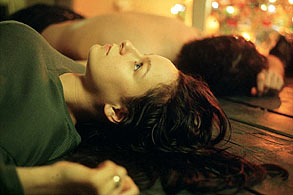
Samantha Morton comes to life in a deeply introspective film suffused with intimate naturalism. Plus she lounges around in her underwear.
What is a Morvern Callar? A shy water bird sometimes seen (or only heard) in the Scottish isles? Some kind of intrusive fundraiser on your phone system? Or the soothsayer in a new quietist religion that is drifting through south London?
None of the above: Morvern Callar is a young woman who lives and works as a supermarket shelf-stacker in some dismal Scottish town. She’s also the leading character in the new film by Lynne Ramsay (“Ratcatcher”), which, strangely, was not chosen for the New York Film Festival, but which I want to recommend.
Ms. Callar seems to wake up one morning to find her lover dead. We never learn why he’s killed himself, and Morvern isn’t unduly involved in that matter. It’s odd, too, that the young man has no friends or relatives who call in, wondering what’s become of him or the novel he was writing. But the novel is there on his word processor, the very place where a farewell note to Morvern urges her to send the book to publishers. She does so — but only after deleting his and putting her own name on the title page.
But the young man leaves a bit of money, too, enough for her to take a holiday in Spain with her girlfriend, Lanna. She has a hotel fling there with a young man, she deepens her rapport with Lanna, and she seems aroused by the heat and mystery of Spain. There’s a feeling of the world opening. But she is also sought out by two London publishers who offer her 100,000 pounds for “her” novel. She goes back to Scotland and then sets out for London.
A lot of things don’t happen. Neither she nor we get any sense of what the novel is like. She never reads it, let alone attempts to stretch herself into the role of being its author. And she never comes close to being found out. What happens to the body of the young man, you may ask? Well, Morvern cuts him up in bits and pieces and buries them in the wild Highland hills, unobserved. That this story situation is so fanciful, or dream-like, is undercut by the intimate naturalism of the filming, by the way Morvern so often lounges around naked or in her underwear, and by the vacant radiance of Samantha Morton in the central role.
Now if you add the story evasions (or gaps) to the extensive nudity, you might suspect that this is an independent movie short on ideas, except for those about getting made. Not so. This is actually a deeply felt story about a young person coming to life (despite the trigger of death), and it’s about feelings, or a kind of spirituality, that transcend narrative details. That said, I don’t think it would have a chance of holding the screen were it not for Ms. Morton. She played the pre-cog Agatha, in “Minority Report,” and she has the potential to be a very considerable actress, no matter that she is hardly pretty in a conventional sense, let alone glamorous. There are times with this movie when the gap between Ms. Morton and the regular concept of “movie star” leaves the picture like a kind of reflective diary or a communion between Morvern and her inner thoughts.
Except that that’s not quite right, either, for there are moments when she is ravishing in a film that seems to offer that kind of beauty (as much inner as outer) as the adventure or the test of maturity toward which Morvern Callar is tending. There could easily be another film growing out of this situation (it comes from a novel by Alan Warner), one that could reach as far as London, and end in wild comedy or grave tragedy. Morvern Callar might become a better novelist than her boyfriend. She might be exposed as a fraud. But for the moment of this intriguing, very sensual, truly introspective film, she is on the cusp, wondering how far she can carry the experiment with self. Samantha Morton may mean more to us one day than Lynne Ramsay; still, “Morvern Callar” is a fascinating picture and I look forward to seeing it open in American theaters.
This article has been corrected since it was first published.
David Thomson is the author of "A Biographical Dictionary of Film" (new edition just published), "Rosebud: The Story of Orson Welles" and "In Nevada." More David Thomson.
Massage therapists rubbed wrong by sex talk
A Jennifer Love Hewitt show and the Travolta allegations have masseuses tired of being confused for sex workers
(Credit: iStockphoto/sybanto) Joe, a licensed massage therapist, knows what it’s like having a famous client who expects something extra. He had an Academy Award-winning actor begin gyrating on his massage table before raising his hips in the air to show off his erection. “He was hoping that I would play with him in some shape or form,” he says.
Needless to say, Joe isn’t surprised by allegations by two masseurs that John Travolta got handsy during massages. (Travolta’s attorney has denied all the allegations, and called them “ridiculous.”) “It happens all the time,” he says, and not just with celebrity clients. He frequently encounters men who try to fondle him, usually while he’s working on their glutes or lower back and their hand happens to be level with his crotch. “They think they’re so original, but they’re all so much the same,” Joe says, his voice rising. “They all use the same tactics, the same body movements, the same gyrations and grinding my table, the [heavy] breathing.”
Continue Reading Close
Tracy Clark-Flory is a staff writer at Salon. Follow @tracyclarkflory on Twitter. More Tracy Clark-Flory.
A night at the vibrator museum
Early vibrators were hand-cranked, two-person jobs -- and prescribed by doctors. How far we've come since then
(Credit: Antique Vibrator Museum) I can now say that I’ve used a turn-of-the-century vibrator — on my hand, but still.
The silver, hand-cranked contraption is usually kept behind glass at Good Vibrations’ Antique Vibrator Museum in San Francisco — but staff sexologist Carol Queen made a rare exception. “This is very special,” she whispered, unlocking the case and carefully pulling out Dr. Johansen’s Auto Vibrator, a relic from 1904. The “auto” part is not so much: It was a two-person job, with her having to crank the device’s handle to get it thrumming. Pressing my finger tips to its inch-wide circular platform of pleasure, I was pleasantly surprised by its power.
Continue Reading Close
Tracy Clark-Flory is a staff writer at Salon. Follow @tracyclarkflory on Twitter. More Tracy Clark-Flory.
Maggie Gyllenhaal on sexual liberation
The beloved indie star tells Salon about her "vibrator movie" and why she loves playing transgressive women
Maggie Gyllenhaal (Credit: Reuters/Mark Blinch) When I met Maggie Gyllenhaal about six weeks ago, she was enormously and gloriously pregnant, stretching out on a sofa with her shoes off and feet up in a Manhattan office building. (Since that time, Gyllenhaal and husband Peter Sarsgaard have welcomed their second daughter, Gloria Ray, to the world.) We were there to talk about “Hysteria,” the charming, lightweight feminist farce from director Tanya Wexler that explores a key event in the history of female sexuality: the invention of the vibrator by Mortimer Granville, a Victorian doctor who was seeking to cure the mysterious “female malady” that lends the movie its title.
Continue Reading CloseMother-daughter sexperts
Susie Bright and her daughter, Aretha, make parental talks about sex look easy -- and fun
Most parents loathe talking to their kids about the birds and the bees, let alone pubic hair grooming, faked orgasms and “water sports” — but most parents are not legendary “sexpert” Susie Bright.
Better than talking about these things, she penned an advice column in 2009 with her daughter, Aretha, then 19, for the ladyblog Jezebel. Their answers to questions about everything from porn to Paxil were unflinching but playful, and at times controversial. Now the pair have collected those columns into a new e-book, “Mother/Daughter Sex Advice.” Together, they read as an irreverent version of “Our Bodies, Ourselves” for the Internet age. The mother-daughter team also reflect on what the experience of writing the column was like, and it turns out it wasn’t as weird as many would think: For the most part, it was just a continuation of conversations they had been having throughout Aretha’s life.
Continue Reading Close
Tracy Clark-Flory is a staff writer at Salon. Follow @tracyclarkflory on Twitter. More Tracy Clark-Flory.
On the rack: A cultural history of breasts
Did breasts evolve for lactation or to enhance sex appeal? A new book explores why they matter
(Credit: iStockphoto/NadyaPhoto) It’s hard to be boobs. Sure, breasts are cherished as givers of milk and the pinnacle of sex appeal, but the modern world hasn’t been good to mammaries.
As Florence Williams writes in “Breasts: A Natural and Unnatural History,” they’re the most tumor-prone organ in the human body. They “soak up pollution like a pair of soft sponges,” and transmit environmental toxins to babies through breast milk. “Breasts are bellwethers for the changing health of people,” she says. While we’ve “genetically modified our crops to be able to protect them from the ill effects of pesticides,” Williams writes, “we haven’t yet figured out how to modify our breasts.” Aside from using saline and silicone, of course.
Continue Reading Close
Tracy Clark-Flory is a staff writer at Salon. Follow @tracyclarkflory on Twitter. More Tracy Clark-Flory.
Page 1 of 403 in Sex