American Idol

Slaves of celebrity

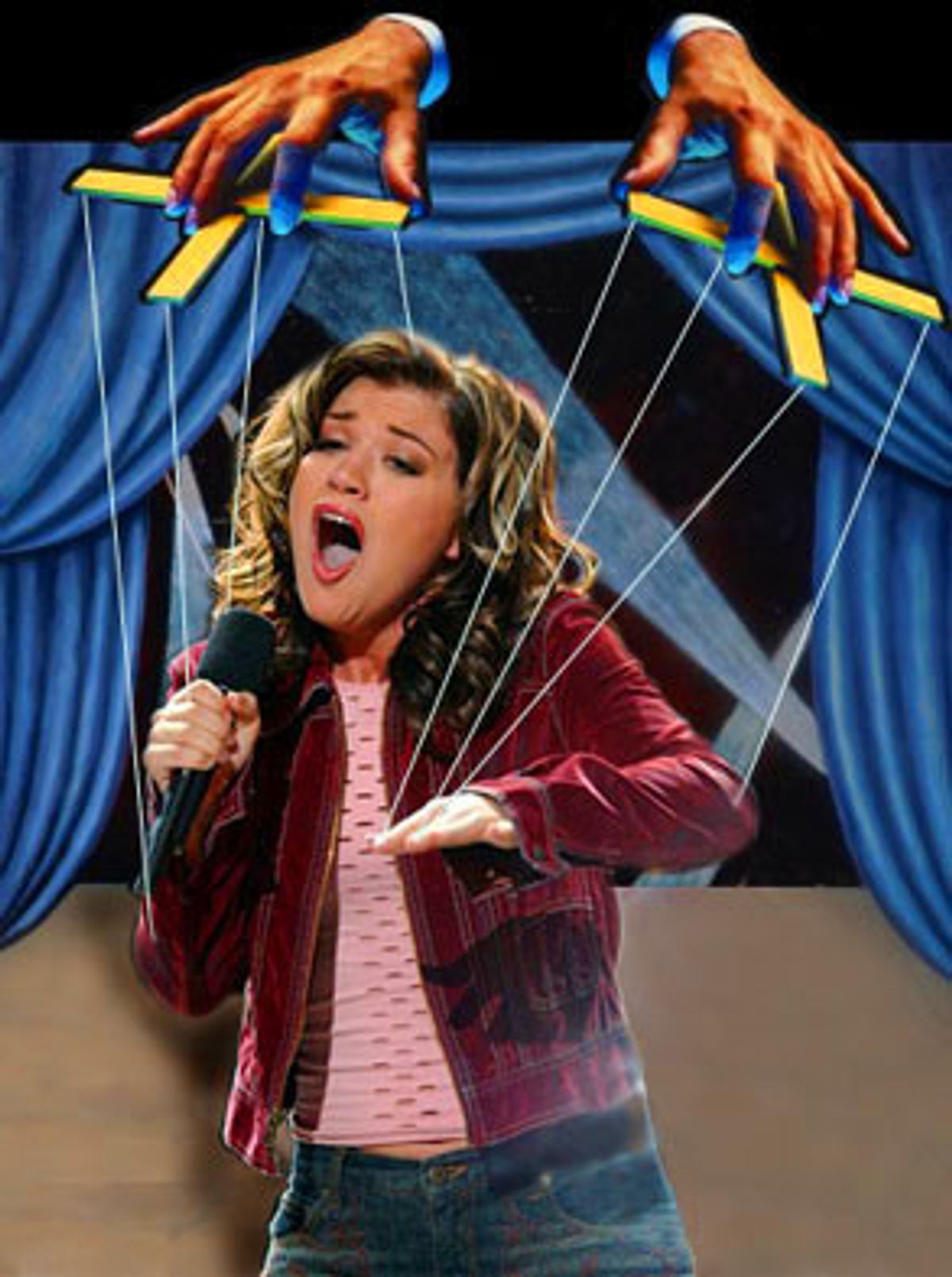
Kelly Clarkson has a golden future, right? Maybe so. But the "American Idol" winner and her fellow finalists had to sign virtually their entire careers away to the show's producers for one shot at stardom.

  • more
    • All Share Services

Slaves of celebrity

Hope, uncertainty, euphoria, disillusionment: This is a familiar career arc for pop stars caught in the manufacturing cogs of the star-making machine, from Ronnie Spector and the Monkees to the Spice Girls, Backstreet Boys and O-Town.

Will this be the fate of winner Kelly Clarkson and the other finalists of Fox’s summer smash “American Idol: The Search for a Superstar”? At first glance, Clarkson would seem to have it made. This week sees the release of her first chart-bound single, “Before Your Love/A Moment Like This.” But Clarkson is less an artist, in the old-fashioned sense, than the extruded product of an impersonal manufacturing process.

Clarkson and the other finalists signed an unusually onerous contract with 19 Group, the production company headed by British pop entrepreneur Simon Fuller. These young performers are wrapped up for recording, management and merchandising under the most restrictive terms imaginable: Their careers are literally not their own.

Since 19 and Fox have declined to respond to questions about their contract with Clarkson and the other finalists, or the extent to which they control their careers, perhaps the best place to look is the public record.

Before the Sept. 11 anniversary, the New York Times reported that Clarkson wanted to withdraw from a scheduled appearance singing “The Star-Spangled Banner” at a commemoration held at the Lincoln Memorial in Washington. Friends and critics had reportedly questioned turning a somber occasion of national mourning into a promotional opportunity. Clarkson was quoted as saying, “I think it is a bad idea … If anybody thinks I’m trying to market anything, well, that’s awful … I am not going to do it.”

In the same Times story, Tom Ennis of 19 Management said that “he would allay Ms. Clarkson’s concerns and that she would sing the anthem on Sept. 11.” She sang.

Clarkson probably had no choice. According to the version of the contract one entertainment lawyer posted to the Internet, Fuller and his company own the names, likenesses, voices and personal histories of the “Idol” finalists, “in or in connection with” the show, forever. 19 Group can use that material however it wants, even if it’s false, embarrassing or damaging.

If contestants reveal anything to anyone about the workings of the show or the contract they signed, they’re liable for damages “in excess of $5 million.” Their recording, management and merchandising companies, needless to say, are all owned by 19 Group — a fundamental conflict of interest familiar to anyone who has studied the machinations of the music biz.

For some observers of the business, the “Idol” contract doesn’t seem like that big a deal. Industry veteran Bobby Poe, of record label and management company Pop Music Records, argues that the massive exposure Clarkson got from her TV appearances probably made this one-sided contract worthwhile.

“Kelly Clarkson has immediately been catapulted to the rank of media superstar,” Poe says. “If she delivers with a viable recording career, then she will have all the leverage she will ever need to write her own ticket in the near future.”

Kenneth Freundlich, a prominent Los Angeles entertainment lawyer who has examined the 14-page contract that was presumably signed by all the “American Idol” contestants, says, however, that Clarkson and her fellow finalists are “surrounded by what appears to be the worst rendition of the industry, after being voted on by a public with no knowledge of the story within the story.” How many of the millions of viewers who voted for Clarkson or any other contestant, he wonders, would willingly have signed their own sons and daughters up for such a career of music-industry servitude?

Simon Fuller (not to be confused with acerbic “American Idol” judge Simon Cowell), the 42-year-old impresario of 19 Group, is the latest in a long line of British pop Svengali figures, dating back at least to Larry Parnes in the 1950s.

Parnes specialized in discovering attractive teenage boys, grooming them for the British faux rock ‘n’ roll market, then assimilating them into traditional showbiz following the Elvis Presley model. (Of course Elvis was an authentic rock ‘n’ roller who was “self-created,” and as a result never had the rocker fully assimilated out of him, but that’s a different story.) Among Parnes’ stable of “stars” were Tommy Steele, Marty Wilde and Billy Fury, along with less luminous figures like Dickie Pride, Duffy Power and Johnny Gentle.

Fuller’s career as a manager began in 1985 when he established 19 Management, named after the company’s first single release, Paul Hardcastle’s techno-pop hit “19.” According to the company’s Web site, “’19′ has attracted a unique collection of expertise in people who work together to integrate and leverage activity across television, music, film, merchandising, music publishing, recording, artist/writer and producer management, sponsorship and promotion,” resulting “in the creation of over 50 No. 1 singles and 25 No. 1 albums.” Fuller created and managed the Spice Girls and the global television and pop music “brand” that is S Club 7.

“Branding” is what the deeply tanned and black-bouffanted Fuller — who has been invited to the White House later this month by President Bush — is all about. Lucian Grainge, chairman and chief executive of Universal Music U.K., recently told the Financial Times:

“[Fuller] has redefined the role of a manager for the 21st century. He treats pop acts as brands, to be exploited over different media, rather than performers who make money only by selling records and playing concerts. He’s a genius — he makes everyone else look like complete amateurs.”

The phenomenon that is “American Idol” began three years ago in the U.K. as “Pop Idol,” conceived and produced by 19 in association with Fremantle Media. “Pop Idol” and “American Idol” followed the same formula: mass auditions of over 10,000 hopefuls pared down to 50 contestants, then winnowed down to a final pair by viewers voting over the phone. On-air judges — in the U.K., Cowell was joined by Nicki Chapman, Pete Waterman and Dr. Fox; in the U.S. it was Cowell, Paula Abdul and Randy Jackson — critiqued the performances and became personalities in their own right.

In the February “Pop Idol” finale between Gareth Gates and Will Young, almost 9 million people voted, and Young, a 23-year-old student from Hungerford, was anointed as Britain’s newest superstar. “American Idol’s” Sept. 4 finale, matching Clarkson against the preternaturally cheerful Justin Guarini, drew 22.5 million viewers and delivered Fox’s highest rated nonsports night ever among young adults.

So Clarkson is on top of the world with a record deal, management contract, public performances and nothing but blue skies ahead, right? Perhaps. But let’s have a look at some of the more exciting fine print in the “American Idol” contestant contract, which was posted on the “Pho” e-mail group by Los Angeles music attorney Gary Fine.

Fine came into possession of the contract when the mother of a young man who was interested in being on the show brought it in for his perusal. The contract had been presented on a “take it or leave it” basis and the man had been given a couple of hours to make a decision. Fine told him not to sign.

“1. I hereby consent to Producer’s filming, taping and/or recording of me for use in and in connection with the Series … I acknowledge and agree that Producer will be the sole and exclusive owner of all rights and material filmed, taped, and/or recorded pursuant to this Agreement.

“… I hereby grant to Producer the unconditional right throughout the universe in perpetuity to use, simulate or portray (and to authorize others to do so) or to refrain from using, simulating or portraying, my name, likeness (whether photographic or otherwise), voice, singing voice, personality, personal identification or personal experiences, my life story, biographical data, incidents, situations and events which heretofore occurred or hereafter occur, including without limitation the right to use, or to authorize others to use any of the foregoing in or in connection with the Series …

“… I understand that, in and in connection with the Series, I may reveal and/or relate, and other parties … may reveal and/or relate information about me of a personal, private, intimate, surprising, defamatory, disparaging, embarrassing or unfavorable nature, that may be factual and/or fictional.”

In other words, the producers can record any and all behavior of the contestant “in and in connection with the series” and use the contestant’s likeness, voice and any or all biographical material, whether true or false, any way they want to. The producers own all this material forever and “throughout the universe.”

“2. Confidentiality/Disclosures: Any and all information disclosed to or obtained by me concerning or relating to the Series, the contestants, the events contained in the Series, the outcome of the Series and/or contest, Producer, the Network and the terms and conditions of this Agreement shall be strictly confidential.

” … I acknowledge that any disclosure of such information will constitute a material breach of this Agreement and will cause Producer and the Network substantial and irreparable Injury and will cause substantial damages in excess of Five Million Dollars ($5,000,000), entitling Producer (and/or the Network, as a third party beneficiary of this provision) to, among other things: (a) injunctive or other equitable relief, without posting any bond, to prevent and/or cure any breach or threatened breach of this paragraph by me; (b) recovery or disgorgement of the monies and other consideration, if any, I received in connection with such disclosure; (c) forfeiture of any and all cash and prizes that I may have been entitled to for participating in the Series; and (d) recovery of the Producer’s and/or the Network’s damages, including but not limited to, lost profits and other consequential damages, to the extent permitted by law, and attorneys’ fees and court costs incurred to enforce this paragraph.”

Absolutely all information regarding the show and this contract is confidential. If the contestant breaches this confidentiality it will cause damages assumed to be in excess of $5 million. The producers can recover such damages, anything gained by the contestant from such a disclosure, the contestant’s winnings from the show and any actual additional damages caused by the disclosure.

“5. Future Agreements: Notwithstanding the other provisions of this Section C, I understand and agree that in the event I am one of the final ten (10) contestants in the Competition, I will be required to enter into the following agreements: (a) an agreement with 19 Recordings Ltd. (or an affiliated company) for my exclusive services as a recording artist; (b) an agreement with 19 Merchandising Ltd. for the use of my name, likeness biography in connection with advertising, endorsement, merchandising and sponsorship; and (c) an agreement with 19 Management Ltd. for the management of my career as an artist. I understand and agree that, unless I am the individual selected as the winner of the Competition, such agreements shall become fully effective only at the election of 19 Recordings Ltd., 19 Merchandising Ltd. and/or 19 Management Ltd.”

Each of the 10 finalists was required to enter into agreements exclusively with 19 Recordings as recording artist; 19 Merchandising for advertising, endorsements, sponsorships and merchandising; and 19 Management for the management of his or her career. All this was entirely at the option of the 19 companies, save for the winner, who was guaranteed this result.

“6. ‘World Idol’: I acknowledge and agree that, should I win the Competition and subject to my availability at the time of the Producer’s request, I shall participate in a ‘World Idol’ program where winners/contestants from the ‘Pop Idol’ and/or ‘American Idol’ competition in other countries or other versions of the Series shall compete against each other and, provided that I appear on the ‘World Idol’ program, I agree to accept a total fee of One Thousand Four Hundred Dollars ($1,400.00) in full and final consideration for my appearance in such program and the grant of all rights in relation thereto on the same terms and conditions set out hereunder.”

This one’s amazing. Basically, if I win “American Idol,” I promise to appear on the “World Idol” show — for a total fee of $1,400! All the provisions of this contract will apply to that show as well.

It’s clear that, in the words of Gary Fine, this is a “particularly aggressive” contract. But isn’t this par for the course? Isn’t this the way the business works?

That argument can certainly be made, although you won’t hear it from Fox, 19′s home office in England or 19′s P.R. representatives in the U.S., none of whom responded to numerous inquiries regarding the “Idol” contestant contract. Bobby Poe, who recently became the manager for Jessica Garlick, a finalist on the U.K.’s “Pop Idol” (after 19 declined its option), explains how the show helped launch his client’s career.

“The attention Jessica got on ‘Pop Idol’ led to her being chosen as the U.K.’s entry in the Eurovision competition last spring,” he says. It also led to Garlick’s single on Columbia/Sony, which went to No. 13 on the U.K. charts — not bad for a previously unknown 21-year-old from Wales. “I would say, in this specific case, the massive exposure far outweighs the initial, let’s say, unbalanced terms of the contract,” Poe concludes.

If exposure is the be-all and end-all, Poe is undoubtedly right. But what if Clarkson, Garlick, Guarini or any of these other young artists have other goals, including some input into the direction of their careers?

“The artist-manager relationship is the most important one in connection with the artist’s career,” says Gary Fine. “The artist needs someone fighting for them with regard to certain career decisions. The cozy relationship between 19 Management Ltd. and 19 Recordings Ltd. would create serious conflicts, and almost certainly remove any real ability for 19 Management to support tough decisions on behalf of their artists if the sister record company is opposed to them.

“Name and likeness provisions, merchandising and product endorsements are very sensitive issues for artists,” Fine goes on. “The problem here is exacerbated because the artist is under an agreement with 19 Merchandising in addition to 19 Recordings and 19 Management. Given what a brilliant marketing guy Simon is, and the fact that his track record would indicate that money is his primary interest, I would be uncomfortable giving this marketer the leeway he is entitled to under these provisions.”

Fine’s fellow L.A. music attorney Kenneth Freundlich, who was quoted above, is also highly critical of the contract and its ramifications. He notes that the contract omits a routine provision: the advice to consult your own lawyer or forever waive your right to complain later that you didn’t. “Perhaps this was left out so as not to suggest to a contestant something she might not otherwise have thought of,” he says. He wonders whether the absence of this provision might make the “American Idol” contract ultimately unenforceable.

“There is a place for a show like this to reap benefit from its winners,” Freundlich continues. “But the artist’s career should be pure free agency from the start. These kids, like most artists, will get one shot at it. It should be the best shot that their independent representatives can find and negotiate, not one thrust at them by the show.”

Simon Fuller and company have already won big, earning a rumored $1 million per episode from Fox, along with additional money from the show’s telephone-voting system and various sponsorship deals. A compilation album featuring the 10 “American Idol” finalists will be released next month, with DVD and videocassette to follow. A Fox special from Las Vegas is set for broadcast Sept. 23, while a 28-city tour for the finalists will kick off Oct. 8 in San Diego.

The Financial Times has reported that Clarkson and Guarini will appear in a film written by Kim Fuller, who happens to be Simon’s brother. “Before Your Love,” Clarkson’s first single, was co-written by Cathy Dennis, a songwriter managed by — you guessed it — Simon Fuller.

Eric Olsen is the editor of Blogcritics.org.

“American Idol”: Riveting despite itself

We all knew Phillip Phillips would win. Yes, the judges are nuts. So why did I feel real emotion anyway?

  • more
    • All Share Services

The final episode of any season of “American Idol” is always a smiling show of force, a confetti-laden massacre of time. After a nearly 40-episode season, along comes the gargantuan finale, an enormous spectacle that contains exactly one minute of real content — when the winners are announced — and two-plus hours of filler. Last night’s episode was nominally about who would be declared the winner of the 11thseason of “Idol” — Phillip Phillips, the humorously named yet handsome guitarist with a twang in his voice and shirts cut to display exactly the appropriate sliver of chest hair, or the huge-voiced, personality-less 16-year old Jessica Sanchez. But sleepily good-looking white guys (and Scotty McCreery) have won the last four seasons of “Idol,” and Phillips was pretty much a lock before the night even began. And so it is a commendation to the near-military professionalism of “Idol” that somehow, for the last half-hour or so, I was riveted to the screen.

The beginning went by in a busy, boring blur. Ryan Seacrest in his tuxedo informed the crowd that 132 million votes had been cast this year (the number of votes cast in the last presidential election: 129 million. Though that doesn’t count teenage girls voting over and over and over again for a guy named Phillip Phillips.) John Fogerty and his mop top of dyed dark hair clanked his voice against Phillips for a while. One of this year’s contestants kept distracting me from the group numbers with her uncanny resemblance to Florence Henderson. Chaka Kahn flirted dangerously with camel toe. Steven Tyler was filmed playing with a three-toed sloth, revealing that he and a three-toed sloth have the exact same hairdo. Jennifer Lopez performed a medley in a sparkly dhoti.

And then Ryan Seacrest invited former contestants Diana Degarmo, who was 16 when she was the runner-up in Season 3, and the long-haired Ace Young, a contestant in Season 5, up onstage. They waved hello, and Young said, “This has always been home to us, and I felt this was the perfect place to ask a simple question.” Ryan chirped, “Dim the lights!” And then Young proposed to a surprised-looking Degarmo — with the help of David Webb jewelry. (Never forget your sponsors.) “I love you to death, you’re my best friend, and I will do anything in my power to have the most unimaginable, amazing life together, if you’ll have me. Diana Nicole DeGarmo … will you … marry … me?” he asked on bended knee. She nodded yes, the “Idol” theme music swelled, and these two newly engaged people, having significantly boosted their chances of getting some reality show company to pay for their wedding, embraced onstage as the show hurried mercilessly, ceaselessly on, this time to the thematically appropriate duet  “You’ll Never Walk Alone.”

A wave of emotions crashed over me. I realized I had been screaming at the television. (“Nooooarghhhahaahaeeeee” or something like that.) While this was, on a human level, so ill-advised — what is wrong with doing private things in private???— it was also undeniably entrancing television. The “Idol” machine had struck again. What if these two kids had chosen to get engaged off camera? In the relative privacy of, say, a Cheesecake Factory? Would we, the audience, have been forced to watch a supercut of Steven Tyler’s most lascivious comments instead? One of Jennifer Lopez saying sweetie over and over again? Or just more commercials? When I thought of it this way, I could almost appreciate the utilitarian sacrifice of Degarmo and Young’s privacy and dignity: The entertainment of the many outweighs the needs of the few.

But this engagement was not the highlight of this episode. No, the ever crafty “Idol” had waiting in the wings a tactical tour de force: Jennifer Holliday, the Tony Award-winning actress who originated the role of Effie in the Broadway production of “Dreamgirls,” and so is the ur-performer of “I’m Telling You I’m Not Going,” that canonical musical competition song and a number the teenage Jessica Sanchez  has been singing for nearly her whole life. Holliday and Sanchez came onstage to do a nominal duet of the song, which turned into an extended solo. (Sanchez’s willingness to let Holliday steal this number right out from under her is the most likable thing she’s done all season.) Holliday, who looks like she can dislocate her jaw on command, and at various points seemed poised to inhale Sanchez with no need for chewing, absolutely destroyed this song, and did so in such joyful, reckless disregard for what she looked like while doing so  — here are some gifs of her in the act — that it almost wiped out the sourness of the engagement sequence. Here was a public act, one that was meant to be public, performed with such passion, it felt private: Who can possibly know what is going on inside of a person’s body or mind when they are as possessed by anything as Holliday was by this song?

When Ryan Seacrest finally told Phillip Phillips he had won, after 10 o’clock at night, he picked up his guitar and began to sing. Ever since Kelly Clarkson cried her way through “A Moment Like This” in the show’s first season, the winner is expected to perform their new single at the end of the show.  But halfway through “Home,” Phillips broke off, to sob. The background singers kept singing, and the confetti kept falling, but Phillips didn’t even try to get back on the mic. For about a minute, he stood on stage, quiet music playing in the background, trying to pull himself together, to do what was expected of him. He couldn’t. He didn’t sing again. Instead, he walked offstage to his family, who pulled him into a big group hug, inadvertently hiding his face from the cameras. At which point, I think that I got something in my eye.

Continue Reading Close
Willa Paskin

Willa Paskin is Salon's staff TV writer.

Ryan Seacrest’s bland ambition

He's an asexual icon for traditional cultural conservatism, boring his way into the hearts of millions

  • more
    • All Share Services

Ryan Seacrest's bland ambition (Credit: Fox/Benjamin Wheelock)

Imagine, for a moment, that Dick Clark had died in 2002 instead of 2012. How would his obituaries have been different? In most ways, there would have been little change. In the last decade, Clark has continued with the ventures he’d been known for, hosting and producing a New Year’s Eve broadcast, various radio programs, game shows and TV specials. But there would have been two big differences. The first thing was Clark’s 2004 stroke, and his courageous return to public life despite a speech impediment modulating his famous voice.

And the second? The second is Ryan Seacrest.

Seacrest appears in Clark’s obits like the Boswell to Clark’s Samuel Johnson, quoted instead of family members as the apparent authority on Clark’s life and legacy. His tribute to Clark on “Idol” the night after his death became a news story in and of itself. For years, Seacrest had been slowly positioning himself as the new Dick Clark, taking over as the host of the New Year’s broadcast when Clark was ill, and modeling his career after Clark’s by taking ownership stakes in radio shows and TV ventures. Seacrest has become so entwined with Clark’s story that when news of the death broke, it was hard not to picture Seacrest kneeling in some dark rite, screaming to the heavens as Clark’s power possessed him, “Highlander”-style.

The problem with this image is that it’s far too interesting to have anything to do with Ryan Seacrest, a man who has made a career out of being professionally boring. If we’re going with a sci-fi reference, it’s easier to think of him like the bureaucrats in “Brazil,” toiling away in some back office, looking up briefly as an intern arrives to tell him the news, nodding curtly, shedding a single tear, and immediately returning to work. (During his tribute on “Idol,” he said that Clark was “in a better place saying, ‘Hey, let’s get on with the show, OK?’”) Seacrest is not someone who does dramatic things in fields. He is a person who stands in places of no place and intones blank words like a priest performing some long-deprecated rite. And he’s been very, very successful at it.

Seacrest’s extraordinary rise, so counter to the prevailing trends of the time, points to a current of artistic and social conservatism in the mass audience that persists despite the relentlessly progressive story we like to tell ourselves about the march of culture.

Like Clark, Seacrest got his start in radio. Clark’s early jobs were in an industry where local was king, getting spots at small-bore stations in upstate New York and only going national when “Bandstand” was picked up for TV distribution. Seacrest, however, came to radio just as it was being deregulated and local stations were being eliminated in favor of national conglomerates like ClearChannel. As such, he was able to move to Los Angeles and, at the age of 20, take over a morning radio show that became nationally syndicated. He followed that up with his own form of conglomeration, taking over the weekly “American Top 40″ from Casey Kasem in 2004, and launching his own new programming ventures, like “On Air With Ryan Seacrest,” a four-hour block he records daily and which is distributed to more than 150 stations nationwide.

But his big break was “Idol.” Premiering in 2002, it at first seemed an unlikely phenomenon. Why would anyone want to watch a “Star Search” where the contestants didn’t change? The country did not lack for pop stars, after all: Between “Total Request Live” and Radio Disney we were experiencing something of a bumper crop in those years. The success of “Idol” speaks to both the unalloyed effectiveness of its format and something deep in the national mood at that moment. Bathed in post-millennial anxiety, and eager as always to avoid discussing the possible causes of and responses to a national tragedy, “Idol” seemed to reflect our best selves. It was meritocratic (the best will win, regardless of their social position), individualistic (only single singers, no messy bands), populist (the people vote), and aggressively cheerful.

Key to that success was Seacrest. The judges represented the business aspect of the transaction, the reward at the end. The voters were America, of course. But Ryan was the Idol. For struggling amateurs, he was the end product they were training for, smooth, professional and unchallenged, a perfect pop product encased in a suit. While the contestants’ images varied, Seacrest’s presence on stage was a constant reminder of what the producers had in mind when they talked about a pop star.

There have long been rumors that Seacrest is gay. It’s hard to know what to do with these, exactly, but there is something undeniably unsettling about his sexuality. The image he projects is that of a non-threatening teenage boy, a pre-pubescent heartthrob like Ricky Nelson, David Cassidy or Justin Bieber. But Seacrest, who has dated Teri Hatcher and Sheryl Crow, is decidedly post-pubescent. He is, as they say, a grown man. Merv Griffin, who hired him to host a children’s computer-themed quiz show called “Click!” in the mid-’90s, said that “he had this spiky haircut, and we knew all the little girls in the audience would love him, and they did.” And they do. And he doesn’t care. Which is, maybe, a big point in his favor.

But it’s a point against the audience. All teen idols grow up, and as moral panicky as the process can be (“I’m Not a Girl,” etc.), we’ve seen it happen enough times now to know that part of the pleasure of a non-threatening teenager is knowing the threat they will inevitably become; Justin Bieber is fascinating because we want to see how it all spirals down. For Seacrest to stay in that neuter state reflects a childish, eyes-closed denial of reality among those audience members who still like it. The last decade has seen a remarkable opening of public discourse about all kinds of sex; currently the news media is tirelessly (and tiresomely) covering a story that basically amounts to “Hey, some people like bondage!” Adult sexuality is at least an option for our public conversations now, and lots of openly gay celebrities have remained idols in their own way, able to publicly pursue relationships without having to maintain the facade of blank sexlessness. But if Seacrest, the Delphonic seer of conventional wisdom, is in fact gay (or sexual at all) and truly thinks breaking face would kill his career, then maybe he’s right. For all the recent gains we’ve made, there’s a sizable portion of our fellow citizens who would much rather have Ricky Schroder stay a boy. Whether you want to have Seacrest or be him, he is selling the troubling fantasy that desire doesn’t have to be dirty.

Throughout a decade in which celebrity scandals were everywhere, Seacrest himself remained steadfastly above the fray. The scandal boom was great for entertainment news, but unstable workers are bad for the entertainment business. Scandal-plagued actors may get more publicity, but they make it a lot harder for a production to get insured, and the harder it is for the talent to hit their marks, the longer it takes to make the product. You never had to worry about that with Seacrest. A tireless worker and consummate professional, a morality clause would just be superfluous for any contract you might want to strike with him. In a decade of turmoil, Seacrest was the rock, the thing you could always depend on.

But since when has good TV been about dependability? The fun of watching “Idol” is its anarchy, whether it’s Paula’s looseness and Simon’s free-form contempt, an unknown amateur maturing into a star or flaming out under pressure, or the direction of each season, which producers, for all their tinkering, ultimately leave in the hands of the audience. “Idol,” at its best, is a show that can genuinely surprise everyone. In the midst of that glorious chaos, Seacrest stands apart, a stable center. His ability to parlay that personality into lucrative positions on other shows indicates that stability is what a certain portion of the audience wants. And that’s worrisome.

During an authoritarian period in American politics, culture was the lone bright spot. It seemed to be rapidly democratizing: corporate conglomerates were failing, user-generated content was everywhere, and even highly controlled mediums like TV were expanding their offerings to become far more adventurous. But no shift brings everyone along with it, and as easy as it now is to find people who like “Mad Men,” cultural progressives are haunted by fears about what everyone else is watching. Maybe, like Glenn Beck said, we really are surrounded; certainly a lot of people seemed to watch “Two and a Half Men.” Seacrest is like your square brother who went into banking: His success makes you wonder if the cultural power you feel when you’re with your people is really all that strong. Despite the fact that Ryan Seacrest has never done anything even slightly objectionable, people hate Ryan Seacrest. And that’s why.

“Idol” has, inevitably, begun to wane in influence and audience. As the paying audience for pop music massively declined during the ’00s, “Idol” had been able to stay ahead of the curve by making it about competition and narrative rather than music. But that audience had broken down too, splintered into niches by the expanding array of entertainment options. This should have spelled doom for Seacrest, eternally a mass-market guy. But he saw it coming, saw that the family-friendly audience he served would soon just become one market among many, and formed Ryan Seacrest Productions in 2006. His major hits so far have all involved the Kardashians, but he just signed a big new deal with Comcast, and more could be on the way.

If Dick Clark is an eternal teenager trapped in a ‘50s image of adolescence, Seacrest is a teenager from 2002 who’s persisted across time, simultaneously trying to please parents and safely experience more sensual pleasures from the standpoint of a moment when America had a serious interest in being pure and virginal. He’s achieved this by splitting his personality across business ventures, appearing as a squeaky-clean host on TV and radio while using his production company to push delightfully trashy reality fare like “Keeping Up With the Kardashians.” When we look at Ryan Seacrest, we see innocence; when we look at Ryan Seacrest’s productions, we see naughtiness framed as a secondhand experience. A man so averse to scandal that he takes pains to present himself as asexual, Seacrest is one of the few remaining examples of television’s “Least Objectionable Programming” doctrine, a remnant of the era of mass audiences. His particular evil genius has been to recognize that you can do just this but for every audience. Give the family hour what it wants, give the late-night gossipers what they want, and keep it all firmly separate with plausible deniability.

Continue Reading Close

Michael Barthel is a PhD candidate in the communication department at the University of Washington. He has written about pop music for the Awl, Idolator, and the Village Voice.

“American Idol’s” niceness problem

With toothless judges and 24 forgettable finalists, the venerable talent contest slips behind "The Voice"

  • more
    • All Share Services

Steven Tyler, Jennifer Lopez and Randy Jackson (Credit: Fox)

Two big things happened on “American Idol” last week. First, the top 24 contestants were chosen. They were a largely bland, unsurprising bunch, selected by one of the most toothless panels of judges on TV, but they’ll still be the ones viewers will vote on for the rest of the season.

More significantly, perhaps, “Idol” was usurped (just barely) as the top show on TV by a fresher-feeling copycat, “The Voice.” There’s actual enthusiasm for the biggest hit on NBC in years and waning excitement around “Idol,” whose tired format in its 11th season is undermined further by judges who have been sweetened into acting all nice, all the time.

Throughout this season and last, the three “Idol” judges loved just about every audition home audiences were allowed to see. Nobody was terrible, or awful, or the worst thing anybody ever heard, to use the phrases of Simon Cowell, whose brutal honesty made the show in the first place.

That left with Cowell, leaving the teddy bear Randy Jackson as the meanest of the three, of all things. And the worst he’ll ever say is, “Dawg, singing is just not for you.” But mostly all he, Jennifer Lopez and Steven Tyler will ever say to the rare reject is “You’re not quite ready, sweetheart” or “Come back next year.”

Cowell was a record producer who didn’t have time for the bad, and no inclination to encourage the mediocre. More than that, he acted as if he had something on the line in considering these voices. The present judges, especially the marquee names, have no such urgency.

This far into the show, every remaining contestant seems a reminder of a past one: DeAndre Brackensick has the flowing curls of a Jason Castro (but a better voice); teary father Adam Brock the bespectacled look of Danny Gokey with blue-eyed gospel voice of Taylor Hicks. Fifteen-year-old Eben Franckewitz has the pre-puberty voice of a David Archuleta or some kid from “America’s Got Talent.”

There’s one guy with an unfortunate Vanilla Ice haircut and another who seems a little unstable until he’s allowed to play drums while singing; a third has just discovered he is the biological son of the lead singer for the truly terrible ’80s band Flotsam and Jetsam – a little flotsam off the old jetsam, if you will. It’s my favorite fun-fact about any contestant and he’s the last offspring of a famous person, since Jim Carrey’s daughter didn’t make it through Hollywood week.

Hollywood week was so hellacious this season, OSHA may want to investigate labor violations, since it pretty much forces newly formed groups to practice into the evening. So when they do perform, they’re sick or falling into the orchestra pit, or both.

If the current season has a voice of conscience it may be Heejun Han, who makes frank comments about the process and other contestants as if he’s not part of it, until it’s time for him to sing.

All of the guys are pretty good singers and already have an edge over the much more generic group of young women. Among them is David Leathers, an adorable round-faced kid with a voice like young Michael Jackson and the nickname “Mr. Steal Your Girl,” who is so obviously right for the show he plays the role Melanie Amaro played on “X Factor.” Her ouster was so glaringly mistaken, she was asked back to the show and won.

To get back on, Leathers will have to beat a giant with a soulful voice and another deep-voiced country kid with too big a cowboy hat (like the one who won Season 10 – can you remember his name now?).

The top 12 women, by contrast, seem too similar in their passable voices and smiley good looks — even their names are ridiculously similar: There’s a Hollie, a Hallie, a Haley and a Baylie. There are a few country belles in there, should audiences hanker for some more Lauren Alaina, who was runner-up last year in the all-country finals.

Among the women, there seems just a single standout: Big-voiced Jennifer Hirsh, who could be held back only because of her normal, healthy and non-traditional (that is to say: non-size zero) look. Unless voters with a long memory won’t mind harkening back to the first “American Idol” winner Kelly Clarkson, who by the way will be serving this season as a mentor … on “The Voice.”

Continue Reading Close

Is a teen “Idol” star suddenly too skinny?

Lauren Alaina celebrates becoming "extra small." Her weight obsession might send other girls an unhealthy message

  • more
    • All Share Services

Is a teen

Rest easy, America. Lauren Alaina, the 16-year-old “American Idol” runner-up, has lost 25 pounds. In an interview this week with Us, the country crooner — whose debut album is perched just below “Idol” castmate Scotty McCreery’s on the Billboard top-10 — talks about “changing my diet” and learning “correct portion control” to achieve her newly slimmed-down physique. Whew, now she can be a real star.

Naturally, the online and print tabloids have eagerly celebrated her triumph — noting how weight loss success “does a body good” and marveling that “her figure is looking fabulous.” Reminder: This is copy written by adults — about a 16-year-old-girl. Suddenly I’ve lost my appetite.

Alaina tells Us that in addition to cutting back and doing “lots of squats,” she’s also relied on the low-carb, high-protein food delivery service Sunfare. And in an interview with Taste of Country, she admitted that she also has a personal trainer.

A young woman with a show business career and a deep-pocketed record label has every right to, as she puts it, better herself. Likewise, there’s nothing wrong with learning portion control, especially in a country where super-size is the norm and restaurant plates run to the size of manhole covers. And physical fitness is a sadly diminishing priority in too many young people’s lives.

Health and weight are not the same thing, however. And excuse me, but I don’t recall ever hearing a peep about the diverse bodies among other “Idol” contenders, including the generously proportioned Jacob Lusk. Alaina’s maxim that “you have to do it for yourself” sounds like a positive message of encouragement to other adolescents struggling to make healthy choices. But she’s also said things like: “I’m 10 pounds from my goal — almost there! I wear size small and extra-small now!” What’s 10 pounds less than extra-small? Lauren Alaina’s goal weight.

Earlier this month, Alaina told “Access Hollywood” that, “as a girl, a teenage girl, without even wanting to, you constantly compare yourself to other girls. It’s like I was in this competition with all these beautiful girls. Sometimes it would swallow me up. I would compare myself to those other girls to the point where it would make me sick, because I’m not like heavy, heavy, but I’m not the skinniest girl in the world.” Don’t worry, Lauren. Just a few pounds and a little more slavering encouragement from the celebrity press, and you will be.

Continue Reading Close
Mary Elizabeth Williams

Mary Elizabeth Williams is a staff writer for Salon and the author of "Gimme Shelter: My Three Years Searching for the American Dream." Follow her on Twitter: @embeedub.

The night my family won “American Idol”

It was just another night in the cheap seats -- until a random encounter turned everything around

  • more
    • All Share Services

The night my family won Haley Reinhart, Scotty McCreery and Lauren Alaina.

On a Wednesday evening last March, my daughters and I had an “American Idol” campout in our living room. I made hot dogs and microwaved s’mores as we watched the contestants croon through a crowd-pleasing roster of Motown hits. The next morning, my father-in-law died. That night, the girls and I gathered again in the living room, huddled on the couch in our pajamas, and watched Casey Abrams sing just a few bars of “I Don’t Need No Doctor” to be granted reprieve from elimination.

For a decade now, “American Idol” has been winning fans with its weekly wallop of suspense and surprise, along with a fairy-tale conceit that fortune can smile on even the most obscure among us. It was a message that never really resonated for my family and me until this past season, when its variety show shtick turned out to be a surprisingly effective balm for our heartaches. The competitive song showdowns of James and Paul and Naima got us through a lot of rough, tearful nights, and so a pilgrimage to see our vocal heroes on their Idols Live tour seemed like an inevitable indulgence of grief therapy. And this week, after a new round of doctor visits, setbacks and concerns for loved ones, we had found ourselves clinging again to the prospect of awkward dance moves and Journey covers. Yet before last night, I’d never imagined how potent the show’s magic could be.

My daughters and I had never been to Newark’s Prudential Center, but as we stepped inside from a torrential summer downpour, we nonetheless instinctively beelined for our usual seats. Remember where Harry and his friends sat for the Quiddich World Cup in “Goblet of Fire”? That’s always us. Forget the nosebleed section — on my budget, it’s strictly the altitude sickness section for my kids. My children are accustomed to open rehearsals, Shakespeare in the park and college football games that start at halftime, when they let you in free. So accustomed are they to tickets that read “partial view,” they instinctively roost next to the back exits even at the movies.

Despite my daughters’ — and my own — genuine excitement at being part of the enthusiastic crowd, of getting to hear Pia, Lauren, Jacob and the rest belt out a few favorites, my heart sank as I approached our seats, located in an altogether different ZIP code from the stage. I wished, just once, to be someplace other than the last row. “Idol” had been a bright respite in an unbearably bleak period of illness and loss. I couldn’t resist a pang of envy for the families striding front and center, the ones swarming the concession stand for $30 souvenir books. “This is awesome,” I told the girls as we headed to the ladies’ room before the lights went down, “but sometimes I wish I could give you more.” Then a funny thing happened.

No sooner had the words left my lips when a man with an “Idol” staff badge casually nodded to us and asked, “You excited for the show?” And when my girls and I whooped in the affirmative, he asked, “Would you like to meet the Idols?”

As a skeptical New Yorker, I gave the only logical reply. “Look, dude,” I said, “I don’t have any money.”

“I’m not asking for money,” he said, handing us badges. “Come downstairs after the show for the meet and greet.” He was already walking away by the time we could sputter amazed thanks.

And so, after the show, a group of us — some clearly with connections and some just randomly selected goobers like us — found ourselves ushered through the bowels of the Prudential Center. We wended our way through a long tunnel until suddenly, there at our feet, was Lauren Alaina, plopped down on the floor signing autographs for a group of rapt fans. There was Casey Abrams, giving an ecstatic bear hug to fellow former contestant Brett Loewenstern. There were Pia Toscano and Haley Reinhart, hands on hips and posing for photographs. It was like opening a door to Wonderland. For a brief, happy time, the girls snapped pictures and gave eager, giddy hugs to the young men and women they’d passionately championed week after week all season long. (James Durbin, perhaps due to the Asperger’s and Tourette’s that can make socializing in crowds a challenge, wasn’t present.) My younger child, her loyalty to Lauren still fierce, refused to even approach this year’s champion, Scotty McCreery, preferring instead to engage in a serious bout of high-fiving with Jacob Lusk. Eventually the crowd thinned, and two train rides and much, much later, the kids made it to their beds, exhausted and exhilarated and still insistently wearing their badge-festooned T-shirts.

A few minutes with the stars of a TV-show-based musical revue won’t cure cancer, and they sure as hell aren’t a substitute for a lost family member. But that time last night was something else for my family, something nonetheless important. A little entertainment. A little bit of grace.

Soon after I was diagnosed with cancer, a friend who’d had his own harrowing year emailed me a few words of wisdom. “I’ve discovered the answer to ‘Why?’ is ‘Because,’ and the answer to ‘Why me?’ is ‘Why not you?’” he wrote. “So let people do astonishingly generous things for you. Know why? Because why not you?” As my beloved says, “Every time I have a worst-case scenario, I have to do a wildest dream come true as well. Every negative projection deserves a positive one. It’s only fair.” I like those odds.

Life is random and surprising. But it’s wonderful to remember that it’s often not just in the “oh crap, assume the crash-position” way. Sometimes you find a quarter on the sidewalk. Sometimes a friend calls right when you’re thinking of her. And sometimes, a fairy godmother in the form of a New Jersey security guard plucks you from the back row to backstage. Why? Why not? For no better reason than just because it’s your lucky night.

Continue Reading Close
Mary Elizabeth Williams

Mary Elizabeth Williams is a staff writer for Salon and the author of "Gimme Shelter: My Three Years Searching for the American Dream." Follow her on Twitter: @embeedub.

Page 1 of 16 in American Idol