
Campaign Finance

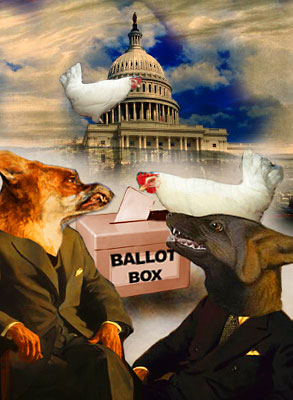
The foxes guarding democracy’s henhouse

Remember the McCain-Feingold campaign reform bill? The ideologues who control the Federal Election Commission are gutting it.

  • more
    • All Share Services

Topics: , , ,

The foxes guarding democracy's henhouse

It’s no secret that Bradley Smith opposes almost any effort by the federal government to regulate campaign finances. He’s written, spoken and testified before Congress on his belief that campaign finance laws unconstitutionally restrict speech, help incumbents while hurting challengers and generally cause more problems than they solve. He has even written a book titled “Unfree Speech: The Folly of Campaign Reform.”

After arguing for years that election reform laws should be repealed, the former law professor today finds himself in a curious position: He is a member of the Federal Election Commission, charged with enforcing the U.S. campaign finance laws that he has long opposed. And with a majority of his colleagues on the six-member panel, he appears to be working to systematically undermine the McCain-Feingold campaign reform law, which was supposed to impose dramatic new limits on the power of “soft money” in American campaigns.

Smith and the other commissioners in his camp say they are simply writing the rules required to make the law’s definitions precise, resistant to court challenges and discouraging to frivolous or politically motivated attacks. But after a series of controversial votes last June — and with a new rule-making session just beginning at commission headquarters in Washington — critics say the commissioners have adopted a set of regulations with such narrow definitions and significant exemptions that the soft money floodgate will remain open, or at the very least, easy to circumvent.

Sen. John McCain and the other sponsors have blasted the FEC’s interpretation of the law, charging that the commissioners have ignored the will of Congress and exceeded their authority. “Their conduct has been the most disgraceful I’ve seen in 20 years in Congress,” McCain, an Arizona Republican, told Salon. “They’re clearly violating both the intent and the letter of the law. They say they are writing their regulations on the basis of constitutionality. That’s not their job. That’s the job of the courts.”

Sen. Russell Feingold, D-Wis., expressed similar frustration in a statement to Salon. “With its eyes wide open and in the face of strong criticism from both the sponsors of the law and groups that support it, the FEC has opened loopholes in the new law before it even takes effect,” he complained. “This is not a legitimate exercise of regulatory authority and something must be done about it.”

For years, critics across the political spectrum have warned with increasing urgency that hundreds of millions of dollars in unregulated “soft money” was corrupting the political process, allowing free-spending special interests to buy access and influence with lawmakers that other people or groups could never match. McCain-Feingold was intended to help purify the process by clamping down on the riches that get funneled to political parties and political action committees every election cycle.

While McCain and his allies may be dismayed by the commission’s actions, they shouldn’t be surprised. According to a Salon investigation, the commission has been criticized almost since its inception in 1974 as a poorly camouflaged tool of the two major political parties. Critics derisively call it the Failure to Enforce Commission, or, more simply, FECkless. In a two-year study released this May, a task force of public policy specialists, former commission officials and legal experts found the agency so flawed that they recommended it be scrapped and replaced with something less political and, presumably, more functional.

Now, to the chagrin of critics, this little-known but high-powered agency is slamming headlong into the most sweeping campaign finance law in almost 30 years. This week, the commission turned its attention to revising rules for political advertising — a process which, critics say, will likely mean finding a way to continue the abuses that plague campaign advertising in federal elections.

“If there’s one thing the FEC has done over its lifetime, it’s protect the political parties,” says Paul Sanford, a former commission attorney and current head of FECWatch, an oversight group run by the nonpartisan Center For Responsive Politics, a nonprofit based in Washington.

To be sure, groups ranging from the Republican National Committee, the National Rifle Association and antiabortion groups to the AFL-CIO and the American Civil Liberties Union have filed suit over various provisions of the bill. And the commission itself defies easy partisan breakdown — two veteran commissioners appointed by President Reagan, the conservative Republican icon, are the strongest reform advocates on the panel.

But the majority of FEC commissioners today are political ideologues or party insiders who often appear more intent on catering to the parties’ interests — and the interests of big money — than in protecting the public’s interest in having fair and honest elections. At least four of the commissioners — Chairman David Mason, Vice Chairman Karl Sandstrom, Smith, and Michael Toner — have expressed opposition to current campaign finance law. And three of them — Mason, Smith and Toner — openly opposed the bill as it moved through Congress. Only the Reagan holdovers, Danny McDonald and Scott Thomas, seem to support the laws they are responsible for enforcing.

But if the will of the membership seems to contradict the spirit of federal campaign laws, critics say, that may be by design. Fred Wertheimer, executive director of the watchdog group Democracy 21, says the problem is simple: The commission was supposed to be a paper tiger, and it is. The members, who are paid a set income of $130,000 a year, are chosen by the same politicians they are supposed to regulate. Commissioners like Smith are selected for their ability to soften the campaign laws and preserve the parties’ power, Wertheimer says, not for their ability to aggressively enforce the law.

“You don’t have people with enforcement backgrounds being appointed,” Wertheimer says. “You don’t have people who come from state ethics agencies or other ethics backgrounds appointed to this commission. You have people who are sent there with an implicit if not explicit mandate to protect the members of Congress and the political parties who sent them there.”

Reformers had been pushing federal lawmakers since the early years of the 20th century to regulate campaign spending and practices, but with little effect. That changed with the 1971 Federal Election Campaign Act, the law that sets campaign contribution limits and requires timely contribution disclosures from federal candidates.

The law was amended after the Watergate scandals in 1974, giving birth to the Federal Election Commission, which is charged with investigating campaign abuses and, when it finds violations, either seeking fines or recommending that the Justice Department pursue criminal investigations. Under the law, the commission is the only body allowed to file suit against federal campaigns.

The concept of “soft money” was born in 1978, when the commission issued an opinion that allowed state political party activities affecting both state and federal races to be paid for with a mix of regulated and unregulated funds. A year later, the commission cleared the way for the national parties to raise unregulated funds for similar mixed state-and-federal campaign activities. Enron, for example, would be allowed to give millions to various state or national party committees and not have the donations be covered by the strict federal donation limits that presidential campaigns are subject to. These party committees can then spend the money on advertising, facilities, get-out-the-vote drives or other activities that end up benefiting the party’s presidential candidate.

“Gradually,” says Commissioner Thomas, “the party committees figured out that, hey, you’ve got a lot of states where you can give an unlimited amount to a party committee. Corporations can give, unions can give … Very influential federal legislators got involved in raising the soft money and it became suddenly a real players’ game, with huge amounts of money coming in. And the FEC, stemming from that 1978 decision, is largely responsible for getting it going.” Later, Thomas says, Congress reinforced this game with legislation that officially sanctioned such activities.

According to the campaign watchdog group Common Cause, during the first 18 months of the current election cycle, national parties raised over $300 million in soft money. That is an 18 percent increase over the amount raised in the first 18 months of the 2000 election cycle (a presidential cycle) and nearly three times the amount raised in the last comparable election four years ago, according to the group.

Critics identified problems in the system years ago, but early efforts to reform the commission were undermined in Congress. The commission originally had been structured to avoid partisan enforcement actions. No more than three of the six commissioners could be from any one party, and a four-vote minimum was required for any commission action. At first, the president was given two appointments, with two going to the majority leadership in Congress and two others to the minority leadership.

In 1976, the Supreme Court ruled that the process violated presidential appointment powers. Because the Federal Election Commission has the power to administer and enforce the law, the court ruled, commissioners are officers of the United States, similar to top executives at the FBI or the Securities and Exchange Commission. Therefore, the court said, the election commissioners have to be nominated by the president. Congress then restructured the appointment process to a more traditional formula in which the president made the appointments and Congress approved them. Practically, though, little changed. The president usually defers to congressional leadership for four of the seats, and Congress has been known to retaliate if the process doesn’t run smoothly.

Commissioner Bradley Smith is a contemporary case in point.

Smith, a law professor, had written numerous articles against campaign finance regulation and reform in journals and newspaper editorials, and found himself a favorite witness of reform opponents on Capitol Hill, most of them conservative Republicans. Eventually, Sen. Mitch McConnell, R-Ky., approached Smith about an appointment to the commission. McConnell is among the most outspoken critics of campaign finance reform in Congress, and has already filed a lawsuit attacking McCain-Feingold as unconstitutional.

Mississippi Republican Sen. Trent Lott, then the majority leader, sent Smith’s name to President Clinton for appointment. Clinton initially balked at putting such a strong critic of campaign finance regulation on the commission, but when Lott delayed the confirmation of Clinton’s choice for U.N. ambassador, Richard Holbrooke, and threatened several judicial appointees, the president relented.

Clinton thereby found himself in the odd position of simultaneously nominating and disparaging Smith. “I don’t like it,” Clinton told reporters in a 2000 news conference covered by the Associated Press. “But I decided that I should not shut down the whole appointments process and depart from the plain intent of the law, which requires that [the commission] be bipartisan and, by all tradition, that the majority make the nomination.”

Wertheimer and his group, Democracy 21, put together a task force of experts in 2000 to study the commission’s history and problems. Members of the team came from a range of backgrounds and included experts from such places as the Brookings Institution, Harvard Law School, Common Cause, and one former federal election commissioner. In its findings, the task force detailed a series of spectacular enforcement breakdowns. It also named the politicized nature of the appointment process as a key problem.

While the commission this week announced record fines against players in the 1996 Clinton-Gore campaign for illegally soliciting foreign money, that action may have been a cover for mounting attacks against its leniency. Critics say such enforcement is the exception and not the rule.

One of the more serious debacles took place when the commission investigated both the Clinton-Gore and Dole-Kemp presidential campaigns’ use of television advertising in the 1996 campaign cycle. The commission’s general counsel found that both campaigns had run ads illegally coordinated between the candidates and the political parties, which had been paid for with soft money. The Clinton-Gore camp alone used over $47 million in illegally coordinated campaign ads, according to the report. Despite strong evidence of wrongdoing, and the recommendations of its own staff, the commission failed to pursue charges against either campaign. Even a fine, critics point out, would have discouraged such illegal coordination in the future.

“Those kinds of things involve enough spending that it really could have impacted the election result,” says Thomas, who voted in favor of enforcement. “And yet the commission … did nothing.”

Even as the Democracy 21 investigators were at work, ambitious bipartisan measures to overhaul the system were being advanced in Congress by Sens. McCain and Feingold and by Reps. Christopher Shays, R-Conn., and Martin Meehan, D-Mass. McCain and Feingold waged an epic seven-year battle to get their landmark campaign finance reform bill past fervent opposition. In late March, the supporters outmaneuvered the opponents for a final time, winning legislative approval for a bill formally known as the Bipartisan Campaign Reform Act. Public support for the measure was so strong that President Bush was compelled to sign it into law despite his earlier opposition.

The main thrust of the measure was to choke off soft money. The bill prohibits federal candidates and national parties from raising or spending soft money, even for state party activities. The president, for example, is prohibited from asking rich donors to give contributions over $25,000 to state party committees. Additionally, the law puts a check on state party usage of soft money to influence federal elections — money used for advertising mentioning a candidate, or get-out-the-vote drives, for example. The bill also places new restrictions on the kind of advertising that can be done by special interest groups close to an election. The bill has other provisions, such as raising the maximum individual restriction limits and further tightening restrictions on foreign donors, but the heart of the law is its attack on large, unregulated contributions.

But while a legal challenge was inevitable, a challenge from the Federal Election Commission was predictable, too. The bloc of four reform opponents was in place and they were facing their biggest challenge — and a cursory review of their résumés makes clear that even Bush’s signature was no guarantee that the law would be put into effect.

  • Bradley Smith has never been a Republican activist, but as a professor at Capital University Law School in Columbus, Ohio, he gained notice in Washington for his frequent articles blasting campaign finance reform. McConnell views his recruit as an ideal choice for the commission.

    “Professor Smith is a First Amendment scholar and the most qualified commissioner in the history of the Federal Election Commission,” McConnell said in a prepared statement. “His constitutional expertise is particularly needed at an FEC that has a dismal string of losses in federal court. I believe the FEC needs at least one commissioner who understands the First Amendment and respects Supreme Court precedent.”

    Smith sees himself as a civil libertarian pulling for the underdog. In his view, campaign finance regulation restricts speech, is vulnerable to loopholes and helps incumbents at the expense of challengers. In a commentary written for the Wall Street Journal in March 2001, after his appointment, Smith accused McCain and Feingold of a cynical ploy to silence critics with their bill’s advertising restrictions.

    Contrary to the findings of Democracy 21, Smith, like McConnell, says the commission has been too aggressive in the past, venturing into areas where it has repeatedly been struck down by the courts.

    “I certainly wasn’t chosen for my partisanship,” he says. “I was selected because there was a great number of people in Congress who I think represent a great many people in this country who felt this commission had gone the wrong direction and needed a voice that would pull it back to the center.”

  • FEC Chairman David Mason was deeply involved in the Republican Party prior to his 1998 appointment. He served in both Ronald Reagan’s and former President George H.W. Bush’s defense departments, and has served on the staffs of several House and Senate members, all Republicans. He ran for the Virginia House of Delegates on the Republican ticket in 1982, but lost.

    In a report for the conservative Heritage Foundation titled “Why Congress Can’t Ban Soft Money,” Mason made his objection clear: “Congress should recall that existing practices are direct responses to previous attempts to regulate political activity. As ‘hard money’ (direct expenditures on campaigns) was limited and regulated, activists simply changed tactics … The real solution to the problem of soft money lies in minimizing, not expanding, government controls.”

    Mason did not return calls for comment.

  • Michael Toner is the most recent commission appointee, taking the post during a congressional recess in March — two days after Bush signed McCain-Feingold. Toner’s choice represented a slight departure from the traditional appointment process, in that Bush chose him rather than support the Republican congressional choice, former commissioner Daryl Wold. But critics were hardly relieved by Bush’s break from tradition. Like Smith and Mason, Toner has denounced campaign finance reform, though not as often or with as much furor. And he is much closer to the Republican Party apparatus.

    Immediately before his appointment, Toner was general counsel at the Republican National Committee, which soon would file suit to overturn the reform law. Before that, he was general counsel on the Bush-Cheney presidential campaign. He also worked as a counsel to the Dole-Kemp ticket in 1996.

    It was during his time with the Republican National Committee that Toner publicly opposed the McCain-Feingold bill. “Democrats are driving legislation that will put a stake through the heart of grass-roots and voter-education initiatives,” he told the Associated Press in July 2001.

    Like Smith and Mason, Toner has issued assurances that his views of campaign finance, and his relationship with the Republican Party, will not unduly influence his actions on the commission. In fact, Toner said in an interview that his involvement with the GOP is an asset to the commission.

    “I think my having worked in the trenches, advising candidates, political staff, the RNC — people who’ve had to deal with all these regulations — about what they need to do [is] a healthy and positive perspective,” he says. “You’ve got to tell people what they can and cannot do. The rules have got to be made as clear as possible.”

  • Democrat Karl Sandstrom was appointed in 1998. Before that he was chairman of the Administrative Review Board at the Department of Labor and served on the Subcommittee on Elections in the Democrat-controlled House during the late ’80s and early ’90s. He doesn’t have the ideological baggage that his Republican counterparts do, but he has largely voted like them, shying away from strong enforcement action, refusing to pursue action in the Clinton and Dole television ad fiascos and asserting himself to water down McCain-Feingold.

    Sandstrom’s actions seem to stem from a belief that attempts at campaign finance regulation are so complicated that enforcing them is often impossible. His common refrain is that laws need to be made clear and “concrete” before they can be enforced.

    “Before we can enforce the law the public must be made aware of what the law is,” he said in a recent interview. “People active in politics are [sometimes] uncertain as to what the rules are. That is not a healthy situation. Either people proceed at some risk or they do not engage in political activity because they are fearful they might violate an uncertain standard.”

The cautious approach and the narrow interpretations are frustrating — sometimes maddening — to their two colleagues, Scott Thomas and Danny McDonald. Both, surprisingly, were appointed by President Reagan, and both have been bluntly critical of the majority.

“I view my role as primarily trying to give my colleagues the courage to enforce the law as Congress intended,” Thomas said in an interview. “At least from my perspective, commissioners are spending too much time trying to figure out ways not enforce the law, or to enforce it in a way that is focused only on rather insignificant little cases, and finding ways to drop the big cases.”

Between now and year’s end, the commissioners will preside over a complex process in which the rules of campaign finance reform will be drafted, studied, subjected to public hearings, reviewed, amended and then approved in a public vote. Thus far, only the rules on soft money have been reviewed and approved by the commissioners, but in that process, critics see a grim harbinger of things to come.

Initial drafts by the commission staff provoked only modest debate, and most controversies seemed to be quelled by the last proposed draft. But in the final session, spread over four days in June, the commissioners introduced and approved a set of amendments to the draft regulations that bloodied the law. “Watching the final soft money rule-making was like watching a stock market crash from the trading floor,” says Paul Sanford of FECWatch.

The meeting was held in the Federal Election Commission’s public hearing room in Washington, a room packed with commissioners, lawyers, staffers and an audience of more than 100. Those who attended watched a lesson in how fine-print changes in the law — seemingly insignificant — had the effect of a counterrevolution.

As drafted, the rules blocked federal candidates from raising or directing soft money, prevented national political parties or organizations related to them from doing the same, and generally curbed soft money’s influence on federal elections. But scores of amendments were introduced, one at a time, each weakening the law, and many passing by the same 4-2 vote.

When the commissioners tried to settle on what it meant to “solicit” donations, the commissioners’ general counsel, Larry Norton, offered a common-sense approach: Solicit means to “request, suggest or recommend” that a donation be made. Sandstrom flatly rejected that language, asserting instead that “solicit” means a candidate must explicitly “ask” for a donation. Norton shot back: “It doesn’t seem to me to take a great deal of cleverness to … persuade a person to make a contribution, without coming out and asking. I think this definition has the potential for great mischief.”

The reform opponents mustered four votes to pass the amendment.

In its effort to stop national political parties from using shell organizations to get around the new law, McCain-Feingold states that such organizations, when created or run by the parties, would also be covered under the law. But Toner moved to open a potentially huge loophole: Any organization created before the law took effect Nov. 6 would be exempt, as long as it was no longer controlled by the party after that date.

Again, the reformers were incredulous. “[The FEC] will allow the parties to set up these organizations, and perhaps provide them with some funding, and then after November these groups can operate however they like, and they’re not subject to the same soft money restrictions that apply to the parties themselves,” Sanford says. “The rules are a recipe for them to do this. It’s a big, giant sign in 6-foot letters that says: ‘Do this.’ And they’ve painted it on the Capitol dome. If party committees aren’t doing this, they need to have their eyes checked.”

And Sanford appears to be correct. The Washington Post reported just weeks after the meeting that the national parties were already moving to set up soft money shell organizations for use after November.

Toner counters that it’s ridiculous to hold someone accountable under a law for things they do before the law takes effect. “What basically developed was a concern that people would be prosecuted next year for conduct that they’re doing now that is legal under current law,” Toner says. “If you’re going to have a transition period, than what you’re doing now, if it’s legal under current law, should have no bearing on if it’s legal next year.”

When the June rule-making session was finished, campaign finance advocates were outraged. “You have so tortured this law, it’s beyond silly,” Commissioner Thomas, one of the Reagan-era veterans, told his colleagues. McCain and the bill’s other sponsors agreed, and they blasted the commission’s actions.

“The Federal Election Commission has taken upon itself the task of rewriting the newly passed McCain-Feingold/Shays-Meehan bill,” the four said in a joint press release the day after the rules were issued. “This is not a role given to the FEC by Congress, or by the Constitution … Many of the amendments adopted in the past two days simply ignore the law. They show that a majority of the FEC is willing to flout congressional intent and substitute its own policy preferences. The country deserves better, especially from an unelected body.”

Despite such a dressing-down by the congressmen who created the bill, the four commissioners who rewrote it were unapologetic. “They don’t understand the regulations that they’re criticizing,” Smith says of the sponsors. “At times they either don’t understand their own bill, or they’re trying to get the commission to do things that they didn’t think they could put in their bill and get it through Congress.”

Thomas disagrees. “I’d be happy to sit down with anybody at any time, and take the provisions of the statute and the legislative history and the comments we got, and show how the approach that my colleagues took doesn’t coincide with the language or intent or the legislative history,” Thomas says. “In virtually every occasion when that kind of an issue came up, four commissioners took the position that was: ‘Let’s interpret the law in a way that will allow more of the soft money to come in and continue.’”

McCain and the other sponsors will likely file a resolution in Congress seeking to have the rules overturned. They have also said that they are considering filing a legal action against the commission. But both avenues will be difficult at best. The resolution would need approval in both houses of Congress and would have to be signed by the president. A lawsuit will have to prove that the rules were “arbitrary and capricious,” a standard that campaign finance advocates say can be achieved, but only after a long detour through the courts.

And even as McCain and the other sponsors pursue these efforts, the commission is likely to chip away at the law in different areas as it continues in the five other rule-making sessions that are likely to last until the end of the year. So far, the draft rules in areas like advertising appear to be far less controversial than the final soft money rules, but critics are mindful that most of the objectionable changes on soft money rules came at the last minute.

There is one bright light on the horizon for Sanford and other reform proponents: Sandstrom is set to be replaced in October by Ellen Weintraub, a former counsel to the House Ethics Committee and the wife of Feingold’s legislative staff director; that change will almost certainly alter the balance of power. Bush approved the nomination only after McCain threatened to vote against Bush’s judicial nominees.

Far from solving the commission’s problems, however, the change may only result in gridlock. Many critics insist that the only way to really solve the problems of the Federal Election Commission is to disband it. The Democracy 21 task force recommended replacing the commissioners with a single, long-term administrator. That, the authors said, would force the president and Congress to appoint an executive who is more powerful and less partisan.

McCain says he may pursue some type of restructuring of the agency, in hopes that one day the campaign reform law will become what it was intended to be. “It took Russ [Feingold] and I seven years to get this law passed,” he says, “and we’re not going to quit. It may take another seven years to get it enforced properly, but we’ll win over time.”

Continue Reading Close

Robert Capps is a fellow in investigative reporting at Salon.

Trump’s other GOP pals

Mitt Romney isn't his only friend in the Grand Old Party. Meet the other Republicans whom Trump backs

  • more
    • All Share Services

Topics: , ,

Trump's other GOP pals

While Mitt Romney is catching plenty of flak for standing by Donald Trump as he tells anyone who will listen that Barack Obama was born in Kenya, the presumed GOP nominee is hardly the only candidate who has benefited from Trump’s starpower and deep pockets.

In fact, even though virtually every Republican presidential candidate kissed Trump’s ring, it’s further down the ballot where he has had the biggest financial impact. He gave $5,000 to Connecticut GOP Senate nominee Linda McMahon last year and $30,800 to the National Republican Senatorial Committee (NRSC), the campaign arm of Senate Republicans, which did not return a request for comment.

On the House side, he gave $2,500 to Rep. Ed Royce’s, R-Cal., reelection effort; another $1,000 to Tea Party favorite Rep. Allen West, R-Fla.; and $2,000 to Rep. Peter King, R-NY. And while he’s given to Democrats in the past, including Senate Majority Leader Harry Reid, all of Trump’s donations in this year’s election cycle were to Republicans, including Romney ($2,500) and disgraced former New York Rep. Chris Lee, who resigned after being caught looking for sex on Craigslist. (Trump gave $500, which appears to have been returned.)

Trump has been especially involved with West, whose campaign did not return a request for comment. The “Apprentice” star appeared with the congressman at a Tea Party rally in Florida last April, and West even said he was open to being Trump’s vice presidential pick if the real estate mogul somehow won the GOP nomination. West told Newsmax at the time that he hoped Trump was “very serious” about his presidential bid. West also accepted $2,500 from Joseph Farah, the birther editor of World Net Daily, in 2008. (It’s Farah’s only political donation the past three cycles.)

But perhaps no candidate has closer or deeper ties to Trump than McMahon, who also did not immediately respond to a request for comment. McMahon made her money through the WWE professional wrestling league, which her husband founded.

Trump has been involved in the sport for years, which suits his flamboyant and phony image. Wrestlemania IV and V were both held at Trump Plaza, and a video that made the rounds on Twitter yesterday shows Trump tackling Vince McMahon at Wrestlemania 23. Trump and two beefy wrestlers hold down and restrain McMahon before shaving his head to wild cheers from the packed arena.

Trump’s ties to Linda McMahon became a campaign issue earlier this year when Democrat Chris Murphy slammed his opponent for taking Trump’s money. “That’s right, the man who led the charge to see President Obama’s birth certificate, report cards and test scores has set his sights on Connecticut’s Senate seat,” Murphy campaign manager Kenny Curran said in a fundraising email to supporters in February. The Connecticut Democratic Party even cut a web ad attacking McMahon that featured Trump.

Continue Reading Close

Alex Seitz-Wald is Salon's political reporter. Email him at aseitz-wald@salon.com, and follow him on Twitter @aseitzwald.

John Roberts’ Gilded Age SCOTUS

Jeffrey Toobin shows how the Citizens United ruling challenged a century of efforts to rein in corporate power

  • more
    • All Share Services

Topics: ,

John Roberts' Gilded Age SCOTUSJohn Roberts (Credit: AP/Pablo Martinez Monsivais)

The most important revelation in Jeffrey Toobin’s 10,000-word New Yorker piece on Chief Justice John Roberts’ takedown of campaign finance laws in the Citizens United case is the extent to which modern conservatism is trying to restore the Gilded Age. That was a time when corporations had more rights than individuals, when a conservative Supreme Court did its best to protect those corporate rights, and wealth and corruption ran unchecked. Of course, we live in a neo-Gilded Age, when income inequality is more pronounced than at any time since the Great Depression, and the Roberts court’s decisions in the Citizens United case helps bring us all the way back to those bad old days.

Much is being made of Toobin’s revelations about the dramatic internal political divisions and infighting within the court triggered by the CU decision (more on that later). But what I think is most politically significant in Toobin’s piece is that it shows the dramatic rightward – and backward — march of Republicanism over the last 30 years. In January 1982, Ronald Reagan famously wrote in his diary, “The press is trying to paint me as trying to undo the New Deal … I’m trying to undo the Great Society.” Reagan was anxious to unravel the anti-poverty programs Lyndon Johnson pushed into place (though not Medicare), but he collaborated with House Speaker Tip O’Neill to pass payroll tax increases to stabilize Social Security for the next 50 to 60 years.

Today’s Tea Party, of course, is going after what’s left of the Great Society and the New Deal too, trying to privatize Medicare and Social Security and undo the labor protections passed by Congress and many states in the wake of the Great Depression. But the Roberts court wants to go back even further, to the Progressive Era, when some politicians in both parties recognized that the omnipotence of Gilded Age robber barons had to be curbed – and that campaign finance regulation was a good place to start.

Back then a conservative Supreme Court majority also disagreed with that Progressive reform push. In an 1886 tax case it first held that the 14th Amendment’s equal protection laws applied to corporations. In its 1905 Lochner ruling, striking down a New York law limiting bakery workers to a six-day 60-hour week, it declared such regulations a breach of contract rights, an “unreasonable, unnecessary and arbitrary interference with the right of the individual to his personal liberty or to enter into those contracts in relation to labor which may seem to him appropriate or necessary for the support of himself and his family.” As Toobin observes, “In simple terms, the majority in Lochner turned the Fourteenth Amendment, which was enacted to protect the rights of newly freed slaves, into a mechanism to advance the interest of business owners.”

Progressive era reform also included campaign finance regulation, starting with the 1907 Tillman Act, which prevented corporations from directly contributing to campaigns. The Court let the act stand, but over the years a series of rulings by conservative majorities have managed to establish that money is “speech,” and though contributions could be regulated, expenditures – speech – could not.

Toobin shows decisively that the court could have kept its decision on Citizens United quite narrow. Attorney Theodore Olson wasn’t seeking to strike down McCain-Feingold, but to clarify that it applied to television commercials, not to 90-minute political “documentaries” such as “Hillary: The Movie” (a shriekingly negative “documentary” on the woman who was expected to be the 2008 Democratic presidential nominee). But in oral arguments the conservative justices sought to broaden their purview, and Roberts helped them along. “As the Chief Justice chose how broadly to change the law in this area, the real question for him, it seems, was how much he wanted to help the Republican Party,” Toobin writes. “Roberts’s choice was: a lot.”

After taking a shot at drafting the CU ruling himself, he later assigned it to “swing vote” Anthony Kennedy, whose views on campaign finance regulation reliably put him with the conservative majority. Assigned to write the dissent, outgoing Justice David Souter accused Roberts “of violating the Court’s own procedures to engineer the result he wanted,” Toobin says. That’s when Roberts took the extraordinary step of asking that CU be re-argued – though with five justices already committed to a sweeping attack on McCain-Feingold, the outcome of those re-arguments were never really in doubt.

And indeed, Kennedy again wound up writing the majority opinion, which found that “The Court has recognized that First Amendment protection extends to corporations” since 1886, and that in McCain-Feingold “the Government has muffled the voices that best represent the most significant segments of the economy.” It’s unclear from the context whether Kennedy is saying what he seems to be – that corporations “best represent the most significant segments of the economy.”

Justice John Paul Stevens, a moderate Republican once on the court’s more conservative end, wrote in his dissenting opinion, “Five Justices were unhappy with the limited nature of the case before us, so they changed the case to give themselves an opportunity to change the law.” Stevens’s dissent continued for a record 90 pages.

At bottom, the Court’s opinion is thus a rejection of the common sense of the American people, who have recognized a need to prevent corporations from undermining self-government since the founding, and who have fought against the distinctive corrupting potential of corporate electioneering since the days of Theodore Roosevelt. It is a strange time to repudiate that common sense. While American democracy is imperfect, few outside the majority of this Court would have thought its flaws included a dearth of corporate money in politics.

Toobin’s conclusion is no less scathing: “The Roberts Court, it appears, will guarantee moneyed interests the freedom to raise and spend any amount, from any source, at any time, in order to win elections.”

It’s worth noting that the most spirited opposition to Citizens United is coming from Montana, where the ties between Gilded Age corporate abuse and campaign finance regulation are perhaps the most explicit. Copper mining interests essentially owned the state in the late 19th and early 20th century, but Montana Progressives pushed a tough campaign finance law as a way of clawing back control of their state from the “copper kings,” who Mark Twain wrote “bought judges and legislatures as other men buy food and raiment.” Montana’s state Supreme Court upheld that 1912 “Corrupt Practices Act” in January, putting the state on a collision course with SCOTUS. Gov. Brian Schweitzer has been one of the most articulate voices against Citizens United, and supports a state ballot initiative that would ban corporate money in politics and make it state policy that corporations are not people.

“Montana’s going first, but we have before,” Schweitzer told the Huffington Post earlier this month. “It was Montana in 1912 that banned corporate money from our elections. We don’t mind leading and we believe it has to start somewhere. This business of allowing corporations to bribe their way into government has got to stop.”

But in a world where the Citizens United decision is precedent, it’s hard to imagine that ballot measure surviving a legal challenge. Toobin’s piece makes clear the stakes in the 2012 presidential race as vividly as anything else does: American democracy can’t survive the appointment of more justices like Roberts, Sam Alito and Antonin Scalia, who mainly serve the interests of corporate America. Mitt “Corporations are people, too, my friend” Romney can be expected to give them company in the years to come if he wins the White House.

Continue Reading Close
Joan Walsh

Joan Walsh is Salon's editor at large.

ALEC attacks shareholders

Documents reveal that the shady group is helping corporations block new efforts to limit their political spending

  • more
    • All Share Services

Topics:

ALEC attacks shareholdersPresident George W. Bush, left, is introduced by Rep. Kenny Marchant prior to speaking at the American Legislative Exchange Council in 2007. (Credit: AP/Pablo Martinez Montsivais)

Should shareholders have a say in how much money corporations give to candidates, super PACs and dark money groups? The American Legislative Exchange Committee, or ALEC, doesn’t think so.

ALEC is best known for giving moneyed special interests a hand in crafting “model legislation,” including the NRA-backed “stand your ground” laws that have touched off a furor in the wake of the Trayvon Martin shooting. But a trove of internal documents obtained by the advocacy group Common Cause shows that the group’s activities are far more varied than was previously known; it does everything from issuing boilerplate press releases to flagging how lawmakers should vote on given pieces of legislation.

It also lobbies actively to scuttle shareholders’ rights – specifically to limit their ability to weigh in on political giving. Last year, for instance, New York state lawmakers introduced a pair of bills requiring corporations to get shareholder approval before making donations to politicians or outside groups, such as super PACs. Backers argue the measure would provide crucial safeguards for investors. “Giving shareholders a voice ensures that their money isn’t used for political purposes they don’t agree with or that are detrimental to the corporation,” explains Adam Skaggs, a senior counsel with the Brennan Center for Justice at New York University law school.

Nevertheless, ALEC’s Public  Safety and Elections Task Force — which has since been disbanded amid the outcry over stand your ground — sent out an “issue alert” to its New York members urging them to vote the measure down. Among other things, the document, which was dated Feb. 15, 2011, argued the bill imposed “oppressive and impractical requirements on corporations,” which restricted corporate free speech and thus could “deter and delay these entities from participating in political debate.”

“Not only do these burdensome requirements impede upon First Amendment rights, they are also unnecessary,” the memo continued. “Shareholders always have the option of voting out board members and removing management who engage in independent expenditures contrary to the interests of the company and its owners … Legislation punishing speech stifles uninhibited public debate and undermines the very purpose of the First Amendment.” The effort was apparently successful: The New York legislation is currently stalled.

ALEC’s advocacy on the issue apparently began shortly after the Supreme Court’s landmark Citizen’s United decision. In September 2010, the group issued a resolution in support of the ruling, which focused largely on limiting shareholders’ ability to weigh in on companies’ newly unencumbered political contributions. Among other things, it advocated barring shareholders from suing corporations based on their political activities on the ground that civil suits were merely “designed to silence corporate speech.” Some of ALEC’s critics find this argument puzzling. “The idea that the owners of a corporations — and, make no mistake, shareholders are the owners — shouldn’t have any influence over their political activities is absurd on its face,” says Lisa Graves, executive director for the Center for Media and Democracy.

But lawmakers have apparently taken ALEC’s recommendations to heart. Under pressure from the organization, last year at least nine states legislatures — including those in Massachusetts, Michigan, Minnesota, New Hampshire, North Carolina, Ohio, South Dakota, West Virginia and Wisconsin — jettisoned bills requiring companies to seek shareholder approval for their political giving, according to research by Common Cause. The group also found that ALEC’s top-spending corporate members have devoted nearly $16.5 million to shaping legislation in these states over the last decade. (ALEC did not respond to requests for comment.)

In the absence of legislation, many shareholders are taking matters into their own hands and launching campaigns to force corporations to be more transparent. Nearly a third of all shareholder resolution in 2012 call for more disclosure on political giving, according to a report by the investor advocacy group As You Sow, which also notes that “unruly” investors, outraged that their money is secretly being used to fund dark-money movers like the U.S. Chamber of Commerce, plan to turn out en masse and “occupy” annual shareholders meeting. The implications of this trend are far reaching. “Besides giving shareholders what they need to hold corporate managers accountable about how assets are being used, shareholder disclosure would provide the general public with information about who is trying to influence how they vote in the general elections,” explains Skaggs of the Brennan Center. This kind of transparency could be a game changer, since the power of dark-money groups hinges at least partly on their ability to mask the agenda and funding behind their work.

Continue Reading Close

Mariah Blake is a writer based in Washington, DC. Her work has appeared in Mother Jones, the Nation, the New Republic, Foreign Policy, the Washington Monthly and the Columbia Journalism Review, among other publications.

The super PAC small donors

Forget the "mega-donor." Meet the Americans who are cutting Mitt Romney's super PAC tiny checks

  • more
    • All Share Services

Topics: , ,

The super PAC small donors (Credit: Salon/AP)

The political operatives running Restore Our Future, presidential candidate Mitt Romney’s deep-pocketed super PAC, probably didn’t know it, but Aug. 10, 2011, was something of a historic date for their organization. On that day, eight months after receiving its first recorded donation, and well on its way to raising $20 million, Restore Our Future received a gift of $25 from a Reno-based investor — what appears to be the first time that Mitt Romney’s super PAC had ever received a donation of less than $1,000.

Seeing as how its main function is to cut checks for hundreds of thousands of dollars in advertising — and how the whole ethos of the super PAC, down to its very name, is of and for the mega-donor — that Restore Our Future would get so small a gift in the first place seems a little insane. After all, the super PAC receives 97 percent of its donations in amounts of $25,000 or more, according to an analysis by the New York Times. Yet in the remaining months of 2011, eight additional donors would make small donations while scads more wrote out five-, six- and seven-figure checks. Already this year, there are a few dozen more.

So who are these enterprising micro-donors, who gave $50, $25, even $10 to a $43 million super PAC? I called a few, and as it turns out, wealthy Romney supporters aren’t the only ones drawn by the promise of unbridled spending. But nor were they all Romney superfans. Rather, the small donors to big money fall somewhere in the middle — like the big guns, they’re willing to do what it takes to oust Barack Obama from the White House. Like the rank-and-file of modest means, they’re not all sure that Romney is tough enough to do it.

Take Nancy Moening, a retiree in Florida who gave Restore Our Future $25 in January. Moening said that she is not so much pro-Romney as she is anti-Obama, and she was glad to give to a group that will blanket the airwaves with an anti-Obama message. Moening couldn’t recall exactly what prompted her to donate, but she was positive it was a news item about the president that would have fired her up — it couldn’t have been something Romney did, she explained.

Barbara Pope, a Georgia realtor who gave Restore Our Future $75, chose Romney’s super PAC over his campaign because she fears Romney is not the hard-sell type of candidate. “That’s not his m.o. He has incredible strengths but he won’t be the one to sound the horn.” Then there’s the fact that Romney’s campaign can’t coordinate with the super PAC — if they can’t commingle money or messaging, she reasons, both arms of the Romney effort need her support. She repeats this a few times for emphasis.

“Restore Our Future has more flexibility in what they do. They can basically do anything they want and they can do more with the money they have,” said one Colorado donor, who gave $250 and did not want me to use his name. “It’s good to be the bad guy.”

Others were less impassioned. David Sneed, a North Carolina resident and registered Democrat, likes the fact that Restore Our Future’s ads showed a “clear contrast” between Romney and his GOP competitors. He gave $25 to the cause. Another donor, film location scout Ryan M. Place, didn’t even seem to like Romney all that much. He just liked being a part of the process. “[Restore Our Future] has spent over $40 [million] so far on the vain statesman and scandal-free, whitebread, Harvard-grad, private equity enthusiast,” Place wrote in an email. So Place spent $25, to finance “Mitty the Unmittenable Mitten Romney via Restore Our Future,” as he put it. “His campaign certainly doesn’t need my money but it makes me feel good to donate.”

There was lots of hedging — a few donors weren’t sure who was spending more strategically, Romney’s campaign or his super PAC, and so they doubled down just to be on the safe side. There was one disillusioned Newt Gingrich fan who wanted to fund the effort to muddy the former speaker’s name. (To my disappointment, I was unable to reach the Massachusetts donor and possible Ron Paul convert who gave $17.76). There were many euphemisms for negative advertising, and explanations as to why these ads were a necessary evil to the race. Really, the one thing that they pretty much did all have in common was their utter confusion as to what made me so curious about small donors to super PACs in the first place. As Moening put it, not a little dismissively, “I don’t know why that’d be interesting.”

When asked whether it felt a little strange to give to an organization so clearly meant for super-donors, most of them took this as a challenge to the legal right to unlimited giving.

“I don’t have any disdain for people who’ve had the benefit of capitalism,” said Pope (sounding, more so than at any other point in our conversation, like a true Romney fan). Added another donor, “It doesn’t bother me how much money someone gives. That’s their right.” Still another had never thought about it — and didn’t see why I would have.

Others didn’t think much of the disparity.

“That’s kind of how I feel donating in general, because I’m not contributing some astronomical amount,” Justin Copeland, a legal assistant who gave $25, said. “But every little bit helps.” Sneed felt the same. He knew that most donors to Restore Our Future gave up to millions at a time. “But I also knew that if people give more small contributions, it’ll make an impact,” he said.

Refreshing an approach to political giving as this is, it’s unclear whether that’s true in practice. Every little bit certainly helps the Romney campaign, which buys line items like plane tickets, mouse pads and pencil cups. For them, $5 still has some buying power compared with the maximum donation of $2,500. But $5 to Restore Our Future, compared with the $3 million Bob Perry gave on a single day in February — or even the relatively modest $250,000 checks from Bain Capital executives — not so much.

For me, chatting at length with Restore Our Future’s small super-donors caused me to reevaluate the notion of the small donor entirely. I was on the fence, for instance, about contacting Gary Chartrand, a marketing group executive who’d given $260.01. That’s far from an astronomical donation, but it’s a little more than the minimum amount that would be publicly reported by the FEC, had he given to Romney’s campaign. In that case, my dilemma was solved when I realized that his gift of $260.01 actually brought his total Restore Our Future giving to a healthy $50,260.01 — but, all things being equal, that is still “small” in the super PAC world.

Then there was John Atherton, who’d given $500 to Restore Our Future. Atherton, an affable Poughkeepsie, N.Y., retiree, explained that he’d made a donation to Restore Our Future after he’d maxed out with the Romney campaign. That brings his total giving to $3,000. “So I wouldn’t call myself a small donor,” he told me.

Maybe not. But if I were just glancing at Restore Our Future’s latest receipts — where Atherton’s $500 contribution is nestled between the Apollo Group, $75,000, and Rod Aycox, $100,000 — you could have fooled me.

Continue Reading Close

Molly Redden is a reporter-researcher at The New Republic.

The GOP’s nuke-dump donor

Harold Simmons has given the most money to Republicans this election. Could his nuclear-waste dump be the reason?

  • more
    • All Share Services

Topics: ,

The GOP's nuke-dump donorHarold Simmons (Credit: Tom Fox/The Dallas Morning News)

In the fall of 2004, Dallas-based Waste Control Specialists applied for a license to build a low-level nuclear waste dump in Andrews County, Texas, a dusty oil patch along the New Mexico border. In its filings and press releases, the company argued that the site was ideal because it sat atop “500 feet of impermeable red-bed clay,” meaning there was virtually no chance of radiation leaking out and tainting the water supply.

Still, there were reasons to be wary. Maps from the Texas Water Development Board showed the site sitting directly above the Ogallala Aquifer, a massive but shallow underground reservoir, which sprawls beneath eight Great Plains states and supplies roughly a third of the nation’s irrigation water. If large quantities of radiation were to seep into this water table, the effects could be devastating. After WCS’s application came up for review, however, something curious happened: The board shifted the official boundaries of the Ogallala, a move WCS claims in its official correspondence was based partly on data the company provided, though Water Board spokeswoman Samantha Pollard argues this isn’t true. “The reevaluation stemmed from work done for the development of groundwater availability models and related projects,” she says. As it turns out, five of the board’s six members had been appointed by Gov. Rick Perry, who’s taken more than $1.2 million in campaign contributions from WCS’s owner, Harold Simmons.

Moving the Ogallala was not enough, however, to keep the project from running into snags. As part of the licensing review, a group of technical staffers from the Texas Commission on Environmental Quality spent three years sifting through data from WCS and the roughly 600 boreholes it had drilled. In the end, they found two water tables dangerously close to the site — in fact, one was 14 feet or less from the bottom of the trench where WCS intended to bury the waste. Based on these findings, in August 2007, four of the team’s engineers and geologists sent a memo to the director of TCEQ’s Radioactive Materials Division, warning that groundwater was “likely to intrude” on the proposed facility, possibly causing radiation to seep into the water supply — details that were later reiterated in a meeting with senior management. “It was clear that the problems with the site could not be fixed, and that any radioactive material stored there was probably going to leak,” recalls Glenn Lewis, a technical writer who was part of the team. “It was just a matter of time.”

Nevertheless, two months later TCEQ’s executive director Glenn Shankle recommended that the commissioners who head the agency and have final licensing authority give the project the go-ahead. He then ordered the dumbfounded technical team to begin drafting the license. After laboring over the details, in January 2009 the commission, which is made up entirely of Perry appointees, voted 5-to-1 to approve the license. The same month, WCS hired Shankle as a lobbyist. “What happened in this situation is that politics worked to get an unqualified company a license to operate a low-level nuclear waste facility,” concludes Lewis, who along with two other team members resigned in protest.

Why bring this up now? Because the WCS saga offers a window into the often murky political motivations of its owner, Harold Simmons, a man with the power to sway this year’s presidential race. An 80-year-old billionaire who grew up in an east Texas shack with no running water, Simmons amassed his fortune largely by staging aggressive corporate takeovers and running polluting businesses, many of them in heavily regulated industries. And he has spent his money liberally on conservative causes. This election season alone, Simmons has donated more than $18 million to conservative super PACs, making him the deepest of the deep-pocket super PAC donors who are upending electoral politics.

Unlike fellow mega-donors Foster Friess and Sheldon Adelson, Simmons isn’t partial to any single candidate or political cause. He’s given generously to the super PACs backing all the top Republican presidential contenders. And he’s the No. 1 donor to Karl Rove’s super PAC, American Crossroads, which is supporting Republicans across the board. Simmons says it’s his loathing for Barack Obama that’s driving him to spread his money around. “Any of these Republicans would make a better president than that socialist, Obama,” he told the Wall Street Journal recently. “Obama is the most dangerous American alive.”

But there may be another motive at work. Simmons has a history of giving far and wide to grease the wheels for his business ventures — particularly his nuclear waste repository. And a raft of changes in the pipeline at federal agencies could determine whether the site is eligible for billions of dollars in new contracts.

The Nuclear Regulatory Commission, for example, is considering allowing depleted uranium (more than a half-million tons of which are languishing at sites around the country) to be discarded in shallow land burial sites, like WCS, even though the National Research Council and some independent scientists suggest it’s better suited to more secure repositories. Similarly, the Department of Energy is weighing options for disposing of what is known as “greater-than-class-C” waste, the most radioactive low-level nuclear debris. In the past, it was generally considered too dangerous to dump in shallow land sites, but that route is now on the table.

These deliberations, which began under the Bush administration, aren’t meant to be political. But progress under Obama has been halting, particularly on the NRC front. In fact, in January the NRC voted to abandon the depleted uranium rulemaking track it had been on since 2008 — a track favorable to WCS — and go back to the drawing board.

Then there are the lucrative nuclear-waste disposal contracts the DOE parcels out to private companies. Typically, they’re negotiated piecemeal and cover about a million cubic feet per year, but right now there’s a much larger prize for the taking: a five-year contract for up to 27 million cubic feet of debris scattered among our national labs. WCS lobbyists are pounding the halls of Congress and the DOE in a bid to sway the outcome. Simmons may be betting that having Republicans in office — particularly ones whose victory he bankrolled — could tilt the odds in his favor, as it has in the past.

- – – – – – - – – – – – – -

Waste Control Specialists started out as a run-of-the-mill hazardous waste dump. The company’s original owner, Ken Bigham, had designs of breaking into the nuclear waste market to cash in on the dismantling of the nation’s Cold War stockpile, but he lacked the money and political clout to push the project through. Then in 1995, a lobbyist Bigham worked with in Austin suggested he join forces with Simmons and tap his deep political connections. The pair eventually struck a deal, under which Simmons paid Bigham $25 million for a controlling stake in the company. In 1996, WCS applied with the Texas Department of Health for a license to build a processing and storage facility for radioactive waste that was awaiting permanent disposal and approached TCEQ for permission to dispose of waste from federal programs. Initially, the answer from both agencies was a resounding no. In fact, the Health Department called WCS’s proposal “severely deficient.” That December, Roy Coffee, a top aide to then-Texas Gov. George W. Bush, who has benefited from more than $4.2 million in Simmons family donations, met with the TCEQ’S director. One week later, the agency changed course, saying it was open to WCS’s Texas facility accepting federal waste, pending approval by the TCEQ commissioners. The license for the processing plant was granted the following year.

But this was just a steppingstone toward WCS’s real goal of remaking itself as a permanent nuclear waste repository, with a view toward landing lucrative government contracts. According to Texans for Public Justice, a nonpartisan group that tracks money in Lone Star politics, in 1999 WCS published a study of “emerging market opportunities.” It found the company could earn nearly $40 billion by handling waste for three federally funded programs. The problem with this plan was that, under Texas law, private companies were barred from operating nuclear waste dumps. WCS tried to get around this hitch by lobbying Congress and the DOE to override the ban and contract directly with the company. According to a 1998 investigation by the Dallas Morning News, Simmons and his associates even managed to persuade their allies in Congress — all of whom had taken large sums from Simmons — to block the promotions of a key DOE staffer who opposed the plan. When the DOE refused to give in to these tactics, WCS sued the agency.

At the same time, the company assembled a powerhouse lobbying team in Austin and began pushing to rewrite Texas law. Between 1995 and 2003, WCS spent more than $2 million lobbying the Texas Legislature — part of a shock-and-awe campaign that rattled the Lone Star State. “They rolled over us like a steamroller,” says Tom Smith, who directs the Texas office of Public Citizen, an advocacy group that fought the legislative changes. “I’ve been lobbying for 20 years, and I’ve never seen anything like it.” Simmons and his employees also gave hundreds of thousands of dollars to Texas politicians. In 2003, the Texas Legislature voted overwhelmingly to allow privately owned nuclear waste dumps.

Simmons, meanwhile, began wading into presidential politics. In the run-up to the 2004 election, he gave nearly $84,000 to Republican candidates, committees and PACS. He also sank $4 million into the Swift Boat Veterans for Truth smear campaign, which torpedoed John Kerry’s presidential prospects. Perhaps Simmons was put off by Kerry’s tough talk; the otherwise mild-mannered candidate turned into a fire-breathing crusader when the subject turned to nuclear waste. He promised to block the Yucca Mountain repository, which he called a symbol of “recklessness,” on the grounds that it sat above a freshwater aquifer and proposed warehousing radioactive debris where it was generated rather than trucking it to far-flung sites for disposal.

Once Bush had beaten Kerry at the polls, Simmons chipped in $100,000 toward his inaugural ball. The Bush DOE, meanwhile, granted WCS a $15 million contract to store residue from a plant in Fernald, Ohio, that had processed uranium for nuclear weapons. The DOE maintains the decision was not politically motivated. “The subcontract for storage and disposal of the Fernald silo residues was awarded competitively by the Energy Department’s site contractor when it became clear that the initial plan to dispose of the waste at another DOE facility was not feasible,” the agency said in a statement. Nevertheless, it was a curious choice, given that the plant had been owned by another of Simmons’ companies, NL Industries, before being taken over by the federal government for Superfund cleanup in 1992 — a process that has cost taxpayers $4.4 billion.

It was also during this era that WCS applied for the license to operate its nuclear waste dump, which was later approved over the objections of Lewis and other technical staff. In its P.R. materials, WCS has cast the detractors as a “small group” of rabble-rousers who opposed the project and “launched a public misinformation campaign in an effort to slow the company’s progress.” As for the safety concerns TCEQ staffers raised, WCS spokesman Chuck McDonald insists they have no merit. “We’ve sunk nine years and $500 million into this project. We had 600 core samples taken at every conceivable depth,” he says. “There is no threat to any water supply.” McDonald adds that the only water found anywhere near the site was brackish and sealed off from major aquifers: “They could age date the water and it was 16,000 years old. That moisture had been sitting there since the last ice age.”

The license WCS finally received in 2009 covered two facilities: one for commercial waste from Texas and Vermont (the two states have a joint-disposal agreement), and one for waste from federal agencies. It also allowed WCS to accept the more dangerous B and C classes of low-level radioactive debris — something no other facility in the country can do.

For Simmons, the license was a godsend. Within months of it coming through, Forbes ran its annual ranking of the richest people in America. The blurb on Simmons, who clocked in a few slots above Ross Perot and George Lucas, noted that he had lost $1.4 billion in the previous year, but that he was “planning to make it back with [his company’s] recently approved low-level radioactive waste disposal license.” As part of its deal with the state of Texas, WCS got to operate the dump for 35 years or more, assuming it met periodic licensing obligations, and keep the bulk of the profits. (Andrews County also got 5 percent.) The state and federal government would then take over and manage the site in perpetuity. While WCS has to put up roughly $140 million in “financial assurance” to cover closure, “corrective actions” and post-closure maintenance, it has managed to persuade the state to accept mostly stock from another Simmons-owned company in lieu of cash for the first five years. And critics argue $140 million is not nearly enough to cover ongoing costs. “WCS is going to walk away and the state will be left holding the bag for thousands of years,” says Lon Burnam, a Democratic member of the Texas House of Representatives and a stalwart opponent of the dump. WCS also prevailed upon the generous folks of Andrews County to put up $75 million in bonds to help finance construction. (Two Andrews residents later sued, saying the bond referendum, which passed by a meager three-vote margin, was riddled with irregularities. But the lower courts sided with WCS, and the Texas Supreme Court, whose justices have received more than $90,000 in Simmons donations, declined to hear their appeal.)

Still, WCS was not satisfied. Under the terms of WCS’s license, the commercial waste facility was capped at just over 2 million cubic feet, only enough to meet about a third of Texas and Vermont’s needs. Nevertheless, the company began lobbying the Texas Low-Level Radioactive Waste Disposal Compact Commission to let it truck in commercial waste from the 36 other states that have no place to dump their radioactive debris. In late 2010, the commission proposed amending its bylaws to make this possible, but not everybody was on board. Two of the commission’s eight members openly opposed the plan, and two Republican appointees who supported it were about to be replaced by the incoming Democratic governor of Vermont. (As part of the joint-disposal agreement, Vermont gets two commission seats.) According to Reuters, after it became clear that the commission might deadlock, Gov. Perry’s office offered one of the detractors, Austin resident Bob Gregory, a coveted appointment as a university regent. Naturally, this would mean relinquishing his commission post. Gregory declined. So in January 2011, shortly before the Vermont Republicans’ terms expired, the commission — the bulk of whose members were Perry appointees — called a vote. Gregory pleaded with his fellow commissioners, saying it was “beyond preposterous” to ram the proposal through without even reading the 5,000 public comments. Nevertheless, the measure passed by a 5-to-2 margin.

Simmons, meanwhile, began currying favor with state-level politicians around the country. According to data from the National Institute on Money in State Politics and Texans for Public Justice, he has poured more than $400,000 into state-level races outside Texas since 2005, almost all of them in states that have commercial nuclear power plants and no waste repository. “When you look at how he’s moving his money around to other states, there’s a very clear pattern,” says Texans for Public Justice research director Andrew Wheat. “He’s targeting politicians who can serve his financial interests.” The same is true in Washington, where Simmons has been dumping tens of thousands of dollars into congressional campaigns. He’s also promised to sink another $18 million into conservative super PACs between now and Election Day, meaning his giving this campaign season will outstrip the rest of his career combined.

Simmons is coy about the motives behind this outpouring. As he told the Wall Street Journal, “You never talk about what you want when giving money.” But he’s been in the game long enough to know that, in politics as in business, timing matters. And for WCS this is a deciding moment. Last November, the Andrews plant celebrated its grand opening with an elaborate ribbon-cutting ceremony, featuring cameos by several politicians. In his remarks, delivered from the edge of a gaping pit, WCS president Rod Baltzer trumpeted the fact that it was the first new radioactive waste dump in the United States since the 1980s. “This has never been done before, and in my opinion I don’t think it will be ever done again,” he said. “There’s just a unique set of characteristics that this facility, and the community — and the ownership — has provided.” Later this month, trucks packed with radioactive debris will begin rumbling into the facility, and the true test of Simmons’ grand scheme will begin.

Continue Reading Close

Mariah Blake is a writer based in Washington, DC. Her work has appeared in Mother Jones, the Nation, the New Republic, Foreign Policy, the Washington Monthly and the Columbia Journalism Review, among other publications.

Page 1 of 36 in Campaign Finance