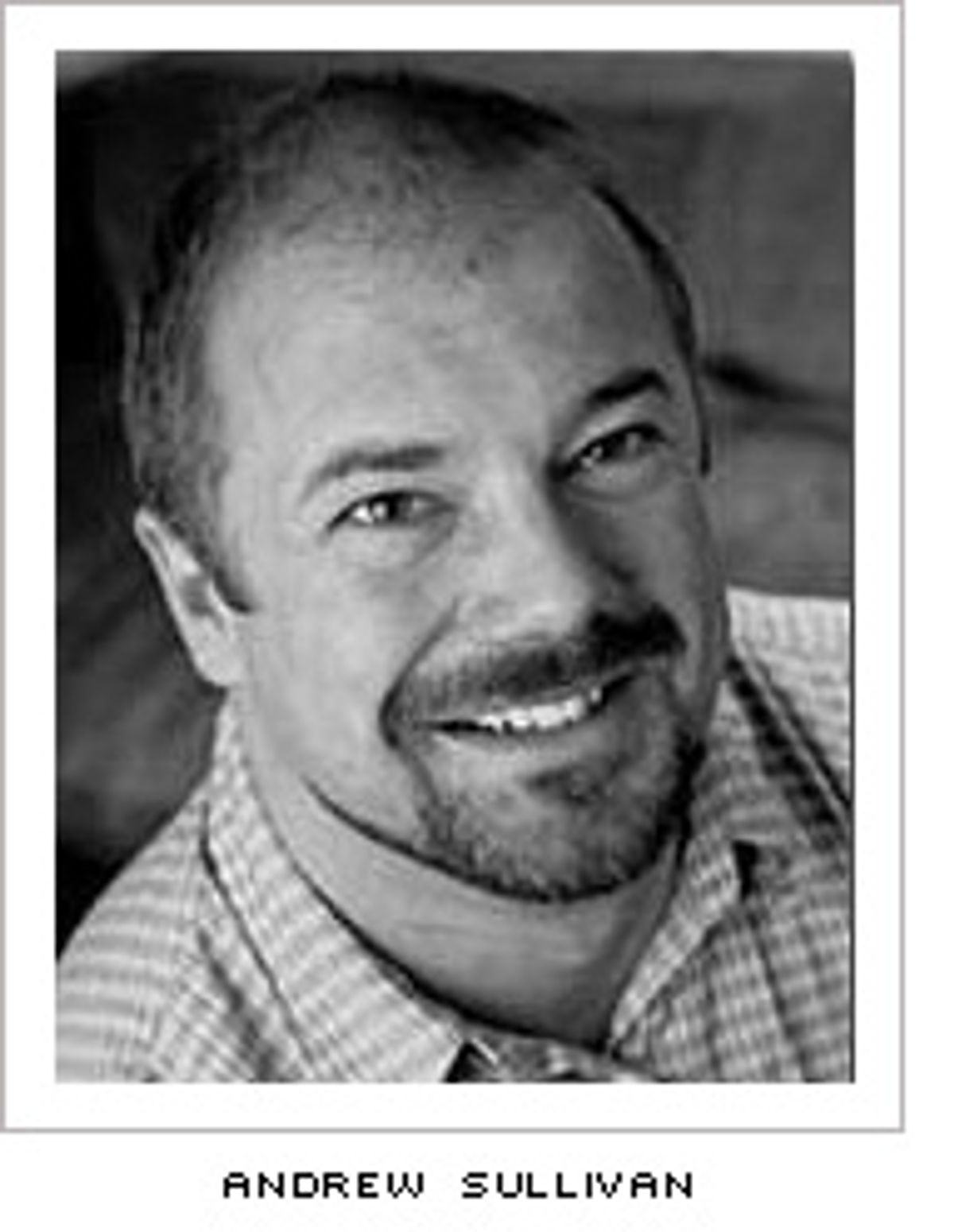
Andrew Sullivan
The imperialism canard
The far right and far left find agreement on the Iraq war. And couldn't be more wrong.
At some point, given the increasing desperation of the antiwar polemicists, the code word “imperialism” had to come up. And so it has. In what is to me a deeply clarifying alliance, the hard right and the hard left agree on this: The war on Iraq is an imperialist war.
In the inaugural issue of his new magazine, American Conservative, Pat Buchanan bemoans the history of imperialism, and how overreach undid “the Ottoman, Russian Austro-Hungarian, and German empires in World War I, the Japanese in World War II, the French and the British the morning after.” Which leads Buchanan to the following prediction: “We will soon launch an imperial war on Iraq with all the ‘On-to-Berlin!’ bravado with which French poilus and British Tommies marched in August 1914.”
Not to be outdone, Gary Kamiya, yet another Salon lefty boomer, vies with Buchanan in his isolationist fears: “By word and deed — breaking treaties, disdaining allies, declaring America exempt from international law, announcing a new doctrine of preemptive force — the Bush administration has shown its desire to establish the United States as, in effect, an imperial power, the new Rome. After Sept. 11, an angry and triumphalist America is to be answerable to no one. Flaunting our 3,000 dead like a crusader’s banner, we will march against foes wherever we may find them, our unchallengeable military and invincible rectitude giving us the right and might to do whatever we want. Deus lo volt!”
The political corollary to this fast-accelerating meme is Rep. Jim McDermott, D-Wash., fresh from his tour of Baghdad, where he did all he could to give aid and comfort to one of the most brutal dictators in world history. “This president is trying to bring to himself all the power to become an emperor — to create Empire America,” McDermott pronounced last Sunday. He was referring to Bush, not Saddam, natch.
But is the United States these days anything like an actual empire? Being an empire, after all, does not merely mean that you are extremely powerful, militarily, economically or culturally. It means, if it is to mean anything concrete, the appropriation of others’ territory, goods and people at the barrel of a gun. Even one of the milder empires in world history, the British Empire, was essentially an imposition of brute force on large parts of the globe in order to generate wealth and cheap goods for the domestic market. The people subject to such imperialism have no role in their own future, no sovereignty over their own country, no right to their own goods and services. Under any viable definition of imperialism, the colonies provide tribute to the center, as the fledgling American colonies once did to London. And they have no choice.
Once you spend a couple of minutes thinking about this, you realize that the notion of “Imperial America” is dangerous nonsense. Take Afghanistan. Has the United States annexed the country, as the Soviets and British once did? Have the Americans put large numbers of troops in there to control the entire country? Did they impose a government by force? Are they busy plundering the place for its natural resources? Nope. They liberated the country from an invader, they helped set up a domestic council for a democratic Afghanistan and, far from bilking the place for treasure, they have actually spent millions rebuilding the country, with no direct quid pro quo. An exception? Hardly. Remember Germany and Japan? How many imperial powers have sunk fortunes into colonies only to allow them complete independence, even to the point of resisting American foreign policy?
Some leftists and rightists concede this but argue rather that free trade itself is a form of imperialism. But, as the 19th century protectionist and imperialist Tories could have told you, the critical point about free trade — once fiercely defended by anti-imperialist liberals — is that it’s voluntary. No one is being forced to trade right now with the United States, or anyone else, for that matter. Without military coercion in order to appropriate goods, there’s no imperialism by any reasonable definition of the same.
What about McDermott’s implicit point: Is Bush trying to exercise powers of war and peace in ways that make him a de facto Caesar of the New World?
He is asking for no more powers to wage war than many other presidents before him, and Congress has a huge say in what emerges. Bush couldn’t even get the networks to cover his major war address Monday. Somehow, I think Caesar had an easier time of it.
And remember how reluctant this president once was to wage war at all. In the campaign, he was clearly less interventionist than Gore, asked for less defense spending and urged America to be a “humble nation.” He changed because war was declared on us. And his current war proposal is, if anything, explicitly anti-imperialist.
Who, after all, is Saddam? He’s a man who presides over a fake nation, contrived by British imperialists; a man who tried to invade and annex Iran; and then tried to invade and annex Kuwait and Saudi Arabia. He, unlike Bush, has no constitutional authority and will never be subject to popular criticism or resistance. Deposing him is therefore the precise opposite of what Buchanan and Kamiya and McDermott claim. It’s an anti-imperialist venture. And because such ventures invariably have the people on their side, this is yet another war that the anti-imperialist hegemon, America, will almost certainly win.
I am bear, hear me roar!
The feminized men of "Queer Eye for the Straight Guy" and "Queer as Folk" do not represent the maturing gay male culture. The truth is much hairier
I was flattered at first. A burly, stubbled, broad-shouldered man, who could barely keep tufts of hair from sprouting from under his T-shirt corners, leered at me across the bar. He was drunk, alas. But it was five minutes to closing and this was Provincetown in July. “You know what I think is so fucking hot about you?” he ventured. I batted my eyelashes. “Your pot-belly, man,” he went on. “It’s so fucking hot.” Then he reached over and rubbed.
It was Bear Week in Ptown. Bear Week? Well, where do I begin? Every time I try and write a semi-serious sociological assessment of the phenomenon, I find myself erasing large amounts of text. Part of being a bear is not taking being a bear too seriously. And almost every bear and bear-admirer I asked during the festivities came up with different analyses of what it is or might be to be a “bear.” But no one can deny that bears are one of the fastest growing new subcultures in gay America — and that their emergence from the forests into the sunlight is culturally fascinating. Quite what it means for the future of gay America is another thing entirely. But my, er, gut tells me it’s, er, a big deal. So here’s my own idiosyncratic, CIA-unapproved take on what this new and obviously growing phenomenon in the gay sub-subculture amounts to.
Continue Reading CloseA great day for liberty
In his dissent from the Supreme Court's historic decision in the Texas sodomy case, angry Antonin Scalia was right about one thing: The next step is gay marriage.
June 26, 2003 marks a turning point in the long debate about the role of gays and lesbians in American society. We’re now a part of this country. Our relationships no longer labor under the burden of illegality.
The court did strike down a Colorado anti-gay measure in 1996, and the 6-3 decision in that case, Romer vs. Evans, was the first sign of where this conservative Supreme Court was heading. But the new consensus was always fragile and needed subsequent support. Now, with Thursday’s ruling on the Texas criminal sodomy law, the court has given it. As the apoplectic reactionaries on the far right have been pointing out, four of the six justices who just established that gay people have as much right to privacy as straight people were appointed by Republicans. This was a bipartisan decision that represents a huge cultural shift, a recognition, quite simply, that gay people are human beings who deserve dignity and equality under the law.
Continue Reading CloseJohn Derbyshire’s poisonous paranoia about gays
The National Review columnist says homosexuals corrupt any institution in which they have power. I try to ignore right-wing bigots, but this deserves an answer.
I’m usually sanguine when it comes to liberal hyperventilation about bigots on the right. Yes, they exist. But no, they do not define conservatism and, even if they did, they are best countered by argument, not insult or marginalization. And then there’s the case of National Review’s John Derbyshire, a writer with a real following among civilized conservatives and published with regularity in the most popular conservative Web site, National Review Online.
So what to say about his latest offering, attacking two openly gay Episcopal bishops? Its philosophical premise is actually one shared by many on the left: that individuals are sometimes best not judged by their own capabilities or merits but by their membership in a group. Here’s a section of this argument:
Continue Reading CloseShocking silence
In Iran, a grass-roots, student-run, anti-theocracy movement has reached critical mass. So why doesn't the U.S. left care more about it?
Something truly extraordinary has been going on in Iran these past few months and especially in the past couple of weeks. A grass-roots, student-run, anti-theocracy movement has reached some sort of critical mass. The enemy is the religious right of Iran, the group of murderous mullahs who have run their country into the ground and now have to answer for their godly tyranny to a new and populous generation of under-30s. Suddenly, we have the possibility of regime change in a critical country without war and without the intervention of the United States.
Continue Reading CloseIdiocy of the week
It was originally reported that 170,000 priceless artifacts were looted from Iraq's national museum. That number now stands at 33. Will overeager Bush critics issue corrections?
The New York Times has been taking on a lot of water lately. So let’s add another bucket.
Back on April 27 of this year, the Times’ cultural critic, Frank Rich, weighed in on the calamity of the alleged ransacking of the National Museum in Baghdad. Rich opposed the war to liberate Iraq, preferring that Saddam stay in power if that’s what it meant to oppose the Bush administration. But he really let rip when in the aftermath of the liberation, the National Museum appeared to be looted. Original press reports cited the loss of 170,000 priceless artifacts. Of course, even as Rich conceded in his column, “[t]here is much we don’t know about what happened this month at the Baghdad museum, at its National Library and archives, at the Mosul museum and the rest of that country’s gutted cultural institutions.” We had no inventory of what had been lost, no reliable account of where the treasures might have been stored, how widespread the looting was, and so on. The situation in Baghdad was chaotic.
Continue Reading ClosePage 1 of 6 in Andrew Sullivan