
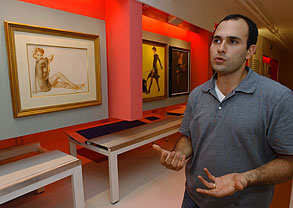

The first thing I noticed about the Museum of Sex during a visit last Sunday, a day after it opened, was the monochromatic color scheme. The place looks bleached. White paint, still smelling freshly applied, graces every wall, every ceiling, floor and corner. Even the speakers that offer audio commentary for the museum’s first exhibit, “NYC Sex: How New York City Transformed Sex in America,” are the color of snow.
Clearly, founder Daniel Gluck would like us to believe this is a museum that will make sex clean, fresh, sanitized — intelligent and academic. Ignore the frosted windows that keep passersby from seeing what’s inside. This is a cultural institution with a mission “to preserve and present the history, evolution, and cultural significance of human sexuality.” (Note: Salon has a marketing relationship with the Museum of Sex.)
Titillation is not the goal. Unlike the Sex Museum in Amsterdam, with its brothel-like red walls and lights, New York’s lily-white Museum of Sex aims to inform — and its first exhibit has several Ph.D. advisors to prove it.
Raising sex from the gutter is perhaps a noble and important goal. If the museum manages to inspire an intelligent debate about America’s ongoing struggle with sexuality and sexual policy, everyone with sexual instincts will probably be better off. But in its first iteration, the museum has overreached. “NYC Sex” feels rushed, overeager in its seriousness and just plain haphazard. The curators have unearthed a handful of extremely interesting aritifacts — antique tin condom containers from the ’30s, for example — but they don’t hold together as a coherent, focused exhibit. There’s potential here, lurking in the comprehensive collection of text, object, video and sound, but the exhibit feels not quite mature, like an adolescent who’s groping a lover for the first time.
Part of the problem comes from the topic itself. An exhibit on sex in New York is a bit like an exhibit on art in Paris — there’s just too much ground to cover. The show starts in the 1840s, with the murder of a prostitute in a downtown brothel, and moves progressively through the “terror sex” that followed Sept. 11. Between these two poles there lies Anthony Comstock (the vice crusader Congress empowered in 1873 to close down brothels and rid the country of pornography); Margaret Sanger and her birth control advocates; the rise of the Ziegfeld Follies, burlesque, then stripping in the ’30s and ’40s; stag parties and films; pictures of early butch/femme lesbian culture; Paul Cadmus’ male nude photographs; Christine Jorgensen, a male G.I. turned 1950s female media sensation; “the kink of Wonder Woman”; fetish wear and its move from the fringe into the mainstream, as seen in Catwoman’s black leather outfit.
This is sex in New York before the 1960s. By the time the show reaches the era of the sexual revolution, two and a half floors have been filled. Only one room is dedicated to the ’60s through the present, which is a shame, because it relegates AIDS to a single panel filled mainly with letters from city officials to bathhouse owners, who rebelled against being shut down. Pornography, and the rise and fall of its critics, garners only a few feet of display space as well. “Deep Throat” is mentioned as a turning point in America’s relationship with porn, but was New York a hotbed of appreciation or criticism? And where did the critics go — did porn change or have feminist values changed instead?
These inquiries are left unanswered. Other unanswered questions also came to mind as I traipsed through the museum. The most basic was simply, where am I supposed to go next? The exhibit was organized in rows that followed a chronology (I think) but there was no directional guidance. At one point, I found myself reading about how “the Minskys” were closed down before I discovered that they were four brothers who cornered the stripping market in the late ’20s; at another point, my audio guide was telling me about brothels while I stood in front of a skull that was ravaged by syphilis.
Much of the disorganization can probably be chalked up to opening-exhibit jitters. A sign near the entrance asks viewers to excuse the museum’s appearance because it’s still a work in progress — a point I was glad to have seen while exiting, if only to explain the empty display cases that I kept wondering about.
It should also be noted that curating an exhibit on sex in New York is nothing like curating an exhibit on Picasso, where the works can be easily found and borrowed with the right connections. Finding a way to display references to an act most often done in private — in a city that often erases its past to make room for the future — is no easy task, particularly if you work for the only museum dedicated to this kind of thing.
From this perspective, the show looks like an achievement. After all, there are several fascinating items and tidbits of information. The small array of Paul Cadmus photographs, for example, look crisp and beautiful, both intimate and artful. The information tying butch culture to the jazz singers of the ’20s, particularly Ma Rainey, also came (to me at least) as an interesting surprise. And most visually impressive of all was the sexual apparel: the early S/M leather, the royal blue satin Playboy bunny outfit, and my personal favorite, an antique burlesque gown studded with gold cosmetic jewels and diamond-shaped mirrors. I also couldn’t stop staring at an intriguing black-and-white photograph from the ’70s that showed a group of preppy men and women drinking and smoking while watching a naked woman masturbate on a sheetless waterbed. (Talk about capturing the sexual revolution on film!)
But what’s frustrating about “NYC Sex” is that these significant informative gems end up buried. The show’s overambitious breadth, lack of organization and the noise (every single display case seems to come with a blaring speaker) drown out the items that have something to teach, even as the pristine white walls and humorless curating let nearly everything recede quickly into oblivion. Viewers would have been better served by a focused exhibit on, say, sexual clothing — the coverups we’ve considered a turn-on from the 19th century on.
I hope at some point the Museum of Sex will tackle this kind of narrow, visual subject. But in the meantime, visitors are treated to a sprawling survey of sex that’s wide in scope and occasionally interesting, but ultimately shallow. The potential for brash color, coy sensual genius and yes, academic inquiry is all there. But for now, the white walls dominate.
