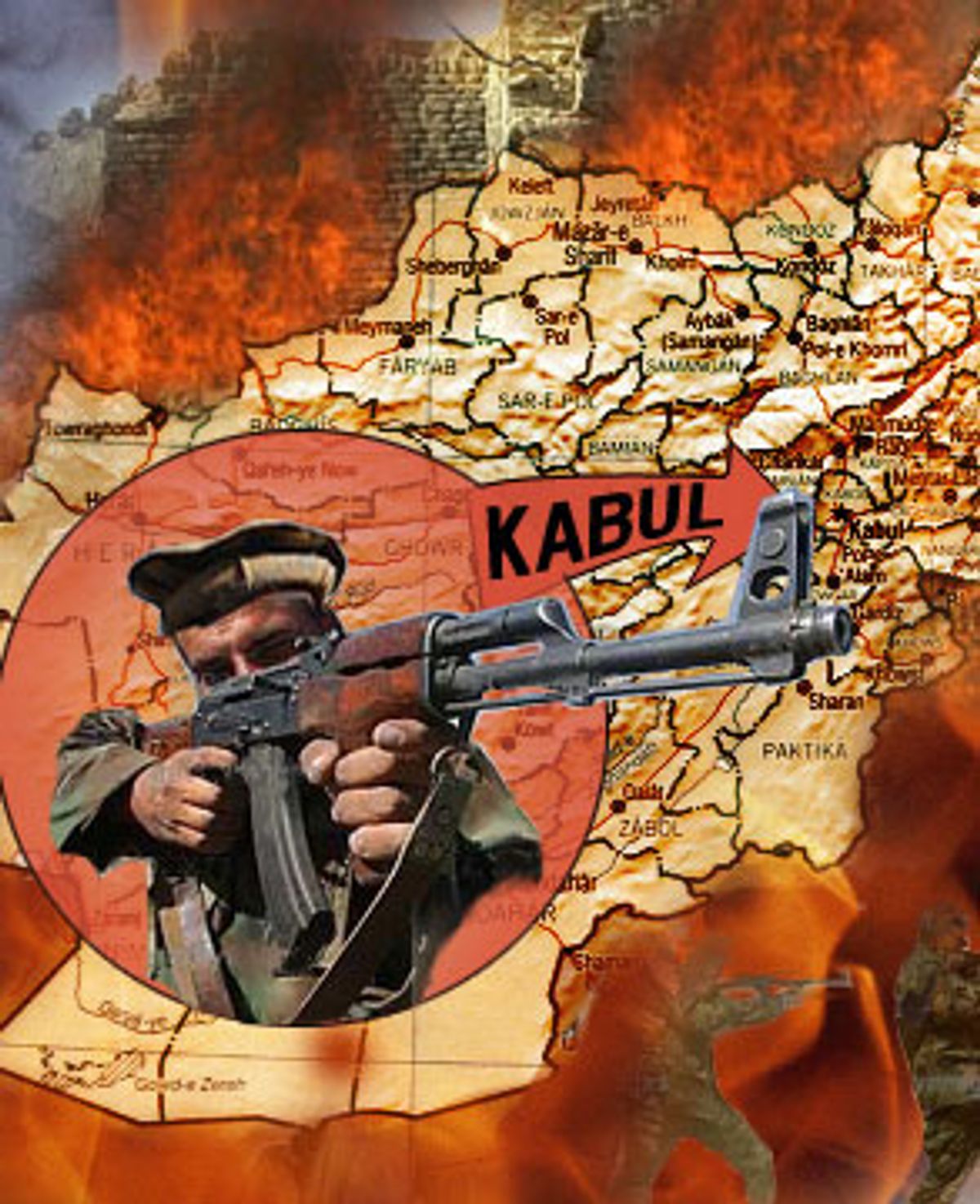
Afghanistan

Partying while Afghanistan burns

While Westerners dance at end-of-the-world raves, the country slips back toward anarchy -- and the Bush administration does nothing.

  • more
    • All Share Services

Partying while Afghanistan burns

These are the days of wild parties in Kabul, strange celebrations at the end of the world. Journalists, aid workers, diplomats and soldiers all go, and late in the afternoon at the Mustafa, the hotel where most of the freelance journalists end up, everyone tries to figure out which of the competing situations has the most promise.

The events thrown by the major news agencies always turn out to be the best supplied and least restrained by far. At the news houses, in their secure walled compounds in the Wazir Akhbar Khan, the high-rent area of the capital near the U.S. Embassy, there is always good liquor and music in fantastic abundance. Hundreds of Westerners, alerted by e-mail and satphone, show up early and dance until the midnight curfew, raving but without the chemicals, and then they either find a place to crash for the night or pile into cabs and race back to their hotels so they can get past the men with guns before curfew descends. Being stopped at a checkpoint by illiterate, stoned soldiers with Western women in the car is out of the question and the nervous Afghan drivers know this and floor it, gunning their engines through the heavily guarded traffic circles. From the back of one of their beat-up Corollas, late one night after a situation at the BBC house, I watched the black mountains of Kabul race by at 90 miles an hour, the driver putting the most unbalanced and mercenary Boston cabby to shame.

Partying in the Wazir Akhbar Khan is surreal and weightless for a Westerner who has just come in from the darkness and violence of the unstable border zone. It’s a twisted version of Los Angeles: Every house has a spacious garden, some of the compounds have pools, and all of them have Afghan staff to cook, take care of security and do whatever needs to be done, and the staff are almost always pious old men, dignified and ready to help, protective of the foreign women in their houses.

Meanwhile, outside the walls of the great houses, beyond the range of the John Coltrane tracks and the warmth of single malt Scotch, Kabul and all of Afghanistan are steadily sliding back into chaos and civil war.

The seeds of the current government’s destruction were sown by the American-backed victory over the Taliban, and nourished by the Bush administration’s failure to devote the necessary resources to rebuilding Afghanistan. Before the bombing ever started, those knowledgeable about Afghanistan warned that massive postwar reconstruction would be necessary to prevent the nation from once again becoming a terrorist breeding ground. They warned that ancient ethnic and tribal tensions, in particular between Tajiks and Pashtuns, could quickly rage out of control. All of their grim predictions of postwar anarchy are coming true — and America is doing nothing.

The central problem is the enmity between the Tajiks and the majority Pashtuns. Once the largely Tajik Northern Alliance took Kabul, Pashtuns who had backed the Taliban did their best to get out of the way, many fleeing to the crowded refugee camps in Pakistan. The Pashtuns who weren’t political, who just wanted a better life like the rest of the city’s residents, now find themselves discriminated against, the objects of scorn heaped on them by a victorious and sometimes brutal minority. Since Afghanistan is roughly 60 percent Pashtun, with many Pashtun living near border regions close to Pakistan, a larger conflict is virtually inevitable.

Pashtun warlords like Gulbuddin Hekmatyar harness Pashtun disaffection with the new Afghan regime, and by extension the West and the United States. They will have a ready supply of recruits if Pashtuns give up on politics and turn to violence. Just a few days before the Sept. 5 bombing in Kabul and the assassination attempt on President Hamid Karzai, Hekmatyar — a famous anti-Soviet fighter with strict views on Islam and a hatred for the West — issued a call for Pashtuns to rise up against the infidels and the new government. Hekmatyar’s aim is to set up a harsh Islamic state in Afghanistan after driving out the non-Muslims. Hekmatyar has supporters in the Pashtun provinces and has been rumored to be moving around the lawless region that lies along the Pakistani frontier.

If the U.S. invades Iraq, and continues its near-abandonment of Afghanistan, support for a larger anti-Western jihad could come not just from Afghanistan but from anywhere in the Islamic world — Saudi Arabia, Iran, Egypt or Pakistan, the nation that spawned the Taliban and at least one of whose intelligence agencies has a long history of radical Islamist leanings.

After the war against the Taliban ended, the promise of a massive international aid package made many Afghans feel optimistic that peace and security would be restored after more than two decades of bloodshed. Now, one year after the foreign intervention started, with only a fraction of the promised foreign aid delivered — America ended up pledging only a paltry $296 million — confidence in the American-backed regime of Hamid Karzai is fading fast. Unsolved bombings and assassinations have rocked the capital, and all indications are that they are not the work of al-Qaida or Taliban supporters but internal enemies of Karzai’s regime — perhaps his own defense minister. Outside of Kabul, Karzai has no control whatsoever.

International aid, promised back in December 2001, was supposed to begin restoring Afghanistan’s devastated infrastructure, boost its economy, provide for emergency humanitarian needs and calm ethnic and political tensions — in a word, rebuild it. But there is little evidence of much nation-building here. A few weeks ago, Kabul’s electricity supply was worse than it had been in January. As recently as Sept. 11, 2002, Jalalabad was also without a steady supply of power, with people resorting to generators or simply working in the dark. A drive from Jalalabad to Kabul on Sept. 12 revealed no construction crews visible, no one seriously taking up the cause of public works. The roads had the same number of beggar children as they did in November.

“The distribution of aid has been very inefficient and spent in an ineffective way, and did not create jobs or markets as we expected and did not demobilize the thousands of young people in service to the warlords. This has been a total failure for the reconstruction program,” said Daoud Yaar, a lecturer in economics at California State University at Hayward. Hayward is home to a large Pashtun community. Yaar expressed deep concern that if major changes are not made within the current Afghan government and the distribution of aid in Afghanistan, the consequences would be severe. “I’m worried about Karzai, American lives and the future of the country. It could fall back into the hands of fundamentalists. Not the Taliban, but different fundamentalists this time.”

Disturbing reports of a rift between Mohammed Fahim, the Tajik defense minister, and Hamid Karzai, who himself is a Pashtun, underline the weakness of the new government. In Kabul, there is open speculation that forces within Karzai’s own Cabinet were connected to the assassination of a key Pashtun government minister and Karzai ally, Hajji Qadeer, and possibly other crimes. Many people within the Pashtun community singled out the defense minister as being responsible, although none of them had direct knowledge of any plots. Still, the rumors are not easy to dismiss. The two men have been rivals for at least a decade. Mohammed Fahim was the intelligence chief of the Northern Alliance and has acquired enormous power as the Afghan defense minister. Fahim has also refused to disarm, keeping large weapons caches in the Panjshir Valley.

Karzai, in contrast, has few soldiers under his direct control and has been closely guarded by U.S. personnel since the Sept. 5 attempt on his life. Many Pashtuns feel that Fahim is trying to consolidate his control over the capital, and that some of the violence can be attributed to his political ambitions.

When asked what he thought about the odds for the long-term survival of the Karzai government, Daoud Yaar said, “Everything now depends on how prudent the United States is. If the U.S. succeeds in bringing Fahim over to democracy and creating a better balance and gives the Pashtuns due respect, and then starts massive reconstruction efforts, there is a good chance that Karzai will survive. If the imbalance persists, the warlords will continue to become stronger on a daily basis.”

Anyone in Kabul will tell you that Mohammed Fahim, the man at the top of the Northern Alliance pyramid, is the real power in the Afghan government. As defense minister, Fahim controls a large intelligence agency that operates outside the presidential sphere and reportedly answers directly to him. Hamid Karzai’s political life, and quite possibly his actual life, depend on limiting Fahim’s control over the intelligence agencies and the defense ministry. But his success at this endeavor has been uncertain at best, and he may have to rely on his unpredictable friends in the U.S. government for help. In any system that claims to represent the population of Afghanistan, Pashtuns must make up a larger percentage of government positions than they currently hold, but Fahim’s men are Tajiks and the Pashtuns are relegated to other, less influential posts. Any change in the ethnic balance would work against Fahim, so he has resisted it — a stance that places him at odds with the elected president. And if fighting broke out between forces loyal to Karzai and Fahim, it is warlords like Gulbuddin Hekmatyar and the other Islamists who would reap the political benefits.

Then there are the unsolved bombings and assassinations that take place with depressing regularity. Spokesmen for the foreign ministry claim that these are all the work of al-Qaida, but it seems much more likely that violent factions within the new government are responsible. And they continue to go unsolved. Just a week before we arrived, on Sept. 5, a large car bomb had detonated in a crowded area of the city, killing 30 people; on the same day, Karzai barely survived an assassination attempt in Kandahar. No one has taken responsibility for either act.

The bitter truth is that the security situation in the capital is worse than it was in January, and this is not purely due to outside forces like al-Qaida or returning Taliban fighters trying to destabilize the new government. The violence is coming from within.

Here’s what you learn when you spend time with Pashtuns in Kabul. When Aman Khan and I arrived in the capital on September 12, after driving in from Nangarhar province, it just happened that our cab had Jalalabad plates, and on that afternoon, we were pulled over by soldiers and police and searched five times. It didn’t take us long to notice that a pattern was developing. We would drive a block, get stopped, then drive another block, only to go through the whole performance again. The slack-jawed soldiers, on finding out that Aman, my translator and friend, was a Pashtun (they can tell by looking at him), immediately wanted to see the registration papers of the car, hassling him, getting hostile, then searching the car and demanding to see his identification. Aman could do nothing to placate them despite the fact that all his documents were in order, and then, finally, the soldiers told him in no uncertain terms to get out of town. “You see,” Aman said to me, “I’m an Afghan and this is how they treat me. There will never be peace in Afghanistan. Never.”

A few minutes later, when two young women came up to the car and asked for a ride to Microrayon Four, a nearby neighborhood, Aman told them in Dari that he was sorry, we couldn’t take them because he was from Nangarhar and a Pashtun, and the police wouldn’t let him move around the city. When he explained it to them, he spoke quietly because he was ashamed. That night, it took four tries to find a hotel that would rent a room to Aman — the men at the door kept telling him to get lost or quoted stratospheric prices. This happened on one day, an average day, to an educated man and a former soldier who had fought against the Taliban in Nangarhar province. During the war, Aman had distinguished himself by leading the unit that secured the governor’s mansion.

Entering Kabul felt like crossing the boundary into a bubble of unreality, a hopeful vision of the way the country could work if everyone pulled together and the aid money was put to proper use. This, of course, was a first impression and it turned out to be dead wrong. I was simply overly impressed by the construction cranes that dotted the horizon.

International aid money flows into the capital, but most of it never makes it out. Fought over by warlords, taxed, delayed, squandered and mismanaged, funneled into the long winding guts of bureaucracies, only a fraction of it ends up where it is intended to. In Kabul, aid agency employees drive sparkling Land Rovers and defense ministry officials cruise in new Toyotas with tinted windows. Back in Kunar province, I’d spoken to three tribal soldiers at the Nawa pass border crossing who said they hadn’t been paid in more than six months. When I asked them why they stayed at their posts, one simply told me that it was his duty to guard the border and that love of his country kept him there.

Later, on the way back from driving south toward Jalalabad, I saw a man lying in the dust in the road, thin as a rail, with an IV coming out of his arm. There were no hospitals, no clinics available, no one with proper medical training, and so the man was left on his own. Hundreds of scenes like this demonstrate that the aid package hasn’t made it far out of Kabul. If the aid agencies are asked about it, they will give a predictable but reasonable reply: The provinces aren’t secure, they are too dangerous. I did see the UNHCR handing out bags of wheat to returning refugees, but there are no Westerners around unless you count U.S. soldiers: no Red Cross, no Medecins Sans Frontieres.

The fact is that less than a year after the celebrated demise of the Taliban, Afghanistan is experiencing a low-grade war, a bubbling pot of violence and anarchy that only the U.S. military presence is keeping from boiling over. The moment the international presence scales down in the capital, the very second that U.S. military attention drifts away and westward toward Iraq, ambitious men within the new Afghan government will kick off a bloody snatch-and-grab operation, leaving a large number of civilians dead, and they will take anything that is not bolted down and then shell the rest, a replay of the mid-’90s when Kabul was laid to waste. It will be the same people doing it, another tragic irony. No one can predict the future, but this is how it feels in Kabul, and everyone I asked, whether journalist or Afghan national, agreed that this was what was coming. Conflicts are breaking out all over the country, but Afghanistan isn’t a story any more, so most of these battles and the reasons they are being fought are going unreported. And as Iraq looms, Afghanistan will shrink even more. When I left Kabul, the big agencies were already scaling back their news bureaus, the great unblinking eye of the media making plans to look at something else.

On Sept. 26, only 60 miles from the northern city of Mazar-e-Sharif, fierce fighting broke out between the forces of two warlords who are both nominally part of the Karzai government. A recent Reuters article described the breakdown between the men as a disagreement over the demilitarization of the city: Because it was a wire story, the writer could not take note of the irony. Just 100 miles south of Kabul, on Sept. 27, a renegade warlord named Padshah Khan Zadran threatened to reoccupy the city of Khost, a town his forces controlled for several months before the legitimate governor succeeded in running him out of town on Sept. 9.

As renewed fighting has plagued Khost and Mazar, other parts of Afghanistan are ready to follow suit, making the Karzai administration appear weaker with each passing day. The writ of the U.S.-backed government, as most people here readily admit, does not extend beyond the outskirts of Kabul, and without U.S. military intervention it cannot coerce the warlords to lay down their arms. Up until now, peace has been the norm because the warlord-governors of each province have been waiting to see how they will fare in the government, but there are signs that they are growing disappointed with their take. In the past, Karzai has relied on negotiation rather than force to maintain security, but in the case of Padsha Khan Zadran, this strategy has begun to fail.

The day after Zadra issued his threat, Saturday the 28th, at exactly 9 p.m., I was working at my desk in the Mustafa when the second Kabul bomb went off. The hotel shook and the pressure wave rolled over us and pushed the windows in and then pushed them out again as it passed. Nothing broke, but the sound was spectacular. It wasn’t anything like the sound of an air strike. This was deeper, more like a tympanum drum in the orchestra, a rolling big finish in a symphony. Up on the roof of the hotel, people were eating dinner when it detonated and somebody I didn’t know pointed in the direction of the blast and, laughing for the benefit of his friends at dinner, said to me, “Make sure you tell me all about it when you get back,” and then took an enormous bite of lamb kebab and a hit of smuggled Heineken. The sound came from the direction of Wazir Akhbar Khan. Until we arrived at the scene, I was sure that the target of the bomb was the American Embassy, but it wasn’t.

Outside the Mustafa, photographer Steve Connors and I waited for Paula Bronstein, a photographer for Getty, to drive up. Ten minutes after the explosion, we climbed into her car and followed the police vehicles with flashing blue lights down the main streets, giving directions to the driver but not knowing precisely where the thing had gone off. As we followed the police cars, hurtling through intersections, we started to see Afghan soldiers running down the street with their weapons up, shouting at other journalists. We ignored them and instead looked for the armored vehicles of the international forces because they would certainly be on their way to secure the scene, and we didn’t have to say that we were less worried about Italians or Turks than the Fahim’s soldiers, because the foreign soldiers can control themselves most of the time and the Afghans can’t. Paula’s car rattled and swayed down the dark streets at 50 miles an hour and we looked out the windows at everything and nothing. Finding the site of the blast was like swimming up a river in the dark, through sirens and all the chaos and disorder, and as we got closer to the site, we saw Afghans had come out of their stores and houses and were just waiting to see what would happen next. They were listening for a second, more powerful bomb, because in the textbook practice of terror, there’s often a small device that draws people to the scene, and it’s the second one that finishes them off.

We found the ISAF armored personnel carriers parked in front of an apartment building called Microrayon Two, along with a hundred soldiers, some of them Italians. No one knew what was going on. One Italian soldier mumbled into his radio, “Everything’s calm here,” but in fact it was grade A mayhem, broken glass falling from the shattered windows of the apartment block and dazed residents moving in every possible direction. We followed the soldiers around back to the lot behind the building, through cordons of confused Afghan police who just let us through, while Paula and Steve were running and getting their camera gear together as they got close to the scene of the crime.

The bombers put the device behind the apartment building, in an empty lot a hundred feet from the tower block, blowing in all of its windows, sending glass flying toward families who had just finished their evening meal. Remarkably, no one had been killed. Glass kept falling down, and slowly, the residents were getting it together, taking an inventory of the wounded, getting them to the hospital in ambulances and cabs. The wire services reported that only five had been wounded, but it was more than that, and when I saw the blood it didn’t seem trivial or so easy to write off as a non-event, an attack which somehow didn’t live up to the bloody bombing on Sept. 5. Inside the apartment complex, one young girl stood in her house and told me in a calm voice how worried she was, and showed me the gash on her hand from the flying glass.

We wanted to see the crater, and by this time there were more Afghan soldiers who formed a line to keep us out because they finally had received instructions from somewhere, and when Paula tried to get through to get a picture of the crater (it was 12 feet wide), one of the soldiers grabbed her breast and she immediately took a swing at him and connected with his face, and the line of them surged and buckled, the whole crowd of stickmen with their automatic rifles.

At 9:30, we were still trying to understand where we were in the city, and the 15-year-old son of a police captain, who spoke a little English, told me that the complex just across the ruined lot was the offices of Military Intelligence and the bomb had been placed under a wall that separated the Military Intelligence building from the apartments. The mud-brick wall took most of the blast on one side, and left the government building untouched, reflecting the explosion’s energy outward to the apartment complex. The bomb had certainly been a message, carefully arranged so that it wouldn’t kill anyone, just cause panic and destruction, but the message isn’t known; there’s only the fact that it happened.

After the attack, Reuters and other news agencies didn’t give the bombing much space, a column inch or two, but the Microrayon Two blast certainly points to violent breakdowns within the Afghan government and not infiltrating al-Qaida or Taliban forces. (It’s almost certainly not al-Qaida: the terror organization never does anything that small, and the fact that no U.S. target was involved also makes their involvement less likely. It’s slightly more plausible that it was the work of the Taliban, but the same strictures apply. Moreover, the fact that the bombing appears to have been a message fits better with the internal-faction theory.) The most plausible theory, perhaps, is that the bombing was a message aimed at Mohammed Fahim, the minister of defense, or at members of his intelligence agency, whose building was a mere 10 yards from the explosion.

At the Wazir Akhbar Khan hospital, Zaina Naeeb, injured by flying glass and still bleeding from the gash that covered her head, waited for a cab to take her home, but she didn’t make a sound, and when I think about it now, none of the wounded cried or shouted or panicked. And Zaina, Mohammed Naeeb’s wife, who would have been killed if the glass had flown a centimeter in a different direction, waited quietly with her husband as he held her IV, then waited quietly while Paula took photographs of her, but she couldn’t stop shaking.

Phillip Robertson is reporting from Iraq for Salon.

Memorial Day’s lessons in amnesia

If nothing else, the holiday allows us to reflect on our commitment to forgetting bloody conflicts

  • more
    • All Share Services

Memorial Day's lessons in amnesia (Credit: Carly Rose Hennigan via Shutterstock)
This piece originally appeared on TomDispatch.

It’s the saddest reading around: the little announcements that dribble out of the Pentagon every day or two — those terse, relatively uninformative death notices: rank; name; age; small town, suburb, or second-level city of origin; means of death (“small arms fire,” “improvised explosive device,” “the result of gunshot wounds inflicted by an individual wearing an Afghan National Army uniform,” or sometimes something vaguer like “while conducting combat operations,” “supporting Operation Enduring Freedom,” or simply no explanation at all); and the unit the dead soldier belonged to.  They are seldom 100 words, even with the usual opening line: “The Department of Defense announced today the death of a soldier who was supporting Operation Enduring Freedom.” Sometimes they include more than one death.

They are essentially bureaucratic notices designed to draw little attention to themselves.  Yet cumulatively, in their hundreds over the last decade, they represent a grim archive of America’s still ongoing, already largely forgotten second Afghan War, and I’ve read them obsessively for years.

Into the Memory Hole

May is the official month of remembrance when it comes to our war dead, ending as it does on the long Memorial Day weekend when Americans typically take to the road and kill themselves and each other in far greater numbers than will die in Afghanistan.  It’s a weekend for which the police tend to predict rising fatalities and news reports tend to celebrate any declines in deaths on our roads and highways.

Quiz Americans and a surprising number undoubtedly won’t have thought about the “memorial” in Memorial Day at all — especially now that it’s largely a marker of the start of summer and an excuse for cookouts.

How many today are aware that, as Decoration Day, it began in 1865 in a nation still torn by grief over the loss of — we now know – up to 750,000 dead in the first modern war, a wrenching civil catastrophe in a then-smaller and still under-populated country?  How many know that the first Decoration Day was held in 1865 with 10,000 freed slaves and some Union soldiers parading on a Charleston, South Carolina, race track previously frequented by planters and transformed in wartime into a grim outdoor prison?  The former slaves were honoring Union prisoners who had died there and been hastily buried in unmarked graves, but as historian Kenneth Jackson has written, they were also offering “a declaration of the meaning of the war and of their own freedom.”

Those ceremonies migrated north in 1866, became official at national cemeteries in 1868, and grew into ever more elaborate civic remembrances over the years.  Even the South, which had previously marked its grief separately, began to take part after World War I as the ceremonies were extended to the remembrance of all American war dead.  Only in 1968, in the midst of another deeply unpopular war, did Congress make it official as Memorial Day, creating the now traditional long holiday weekend.

And yet, when it comes to the major war the United States is still fighting, now in its 11th year, the word remembrance is surely inappropriate, as is the “Memorial” in Memorial Day.  It’s not just that the dead of the Afghan War have largely been tossed down the memory hole of history (even if they do get official attention on Memorial Day itself).  Even the fact that Americans are still dying in Afghanistan seems largely to have been forgotten, along with the war itself.

As the endlessly plummeting opinion polls indicate, the Afghan War is one Americans would clearly prefer to forget — yesterday, not tomorrow.  It was, in fact, regularly classified as “the forgotten war” almost from the moment that the Bush administration turned its attention to the invasion of Iraq in 2002 and so declared its urge to create a Pax Americana in the Greater Middle East.  Despite the massive “surge” of troops, special operations forces, CIA agents, and civilian personnel sent to Afghanistan by President Obama in 2009-2010, and the ending of the military part of the Iraq debacle in 2011, the Afghan War has never made it out of the grave of forgetfulness to which it was so early consigned.

Count on one thing: there will be no Afghan version of Maya Lin, no Afghan Wall on the National Mall.  Unlike the Vietnam conflict, tens of thousands of books won’t be pouring out for decades to come arguing passionately about the conflict.  There may not even be a “who lost Afghanistan” debate in its aftermath.

Few Afghan veterans are likely to return from the war to infuse with new energy an antiwar movement that remains small indeed, nor will they worry about being “spit upon.”  There will be little controversy.  They — their traumas and their wounds — will, like so many bureaucratic notices, disappear into the American ether, leaving behind only an emptiness and misery, here and in Afghanistan, as perhaps befits a bankrupting, never-ending imperial war on the global frontiers.

Whistling Past the Graveyard of Empires

If nothing else, the path to American amnesia is worth recalling on this Memorial Day.

Though few here remember it that way, the invasion of Afghanistan was launched on a cult of the dead.  These were the dead civilians from the Twin Towers in New York City.  It was to their memory that the only “Wall” of this era — the 9/11 Memorial at Ground Zero in lower Manhattan — has been built.  Theirs are the biographies that are still remembered in annual rites nationwide.  They are, and remain, the dead of the Afghan War, even though they died before it began.

On the other hand, from the moment the invasion of Afghanistan was launched, how to deal with the actual American war dead was always considered a problematic matter.  The Bush administration and the military high command, with the Vietnam War still etched in their collective memories, feared those uniformed bodies coming home (as they feared and banishedthe “body count” of enemy dead in the field).  They remembered the return of the “body bags” of the Vietnam era as a kind of nightmare, stoking a fierce antiwar movement, which they were determined not to see repeated.

As a result, in the early years of the Afghan and then Iraq wars, the Bush administration took relatively draconian steps to cut the media off from any images of the returning war dead.  They strictly enforced a Pentagon ban, in existence since the first Gulf War, on media coverage and images of the coffins arriving from the war fronts at Dover Air Force Base in Delaware.  At the same time, much publicity was given to the way President Bush met privately and emotionally — theoretically beyond the view of the media — with the families of the dead.

And yet, banned or not, for a period the war dead proliferated.  In those early years of Washington’s two increasingly catastrophic wars on the Eurasian mainland, newspapers regularly produced full-page or double-page “walls of heroes” with tiny images of the faces of the American dead, while their names were repeatedly read in somber tones on television.  In a similar fashion, the antiwar movement toured the country with little “cemeteries” or displays of combat boots representing the war dead.

The Pentagon ban ended with the arrival of the Obama administration.  In October 2009, six months after the Pentagon rescinded it, in an obvious rebuke to his predecessor, President Obama traveled to Dover Air Base.  There, inside a plane bringing the bodies of the dead home, he reportedly prayed over the coffins and was later photographed offering a salute as one of them was carried off the plane. But by the time the arrival of the dead could be covered, few seemed to care.

The Bush administration, it turns out, needn’t have worried.  In an America largely detached from war, the Iraq War would end without fanfare or anyone here visibly giving much of a damn.  Similarly, the Afghan War would continue to limp from one disaster to the next, from an American “kill team” murdering Afghan civilians “for sport” to troops urinating on Afghan corpses (and videotaping the event), or mugging for the camera with enemy body parts, or an American sergeant running amok, or the burning of Korans, or the raising of an SS banner.  And, of course, ever more regularly, ever more unnervingly, Afghan “allies” would turn their guns on American and NATO troops and blow them away.  It’s a phenomenon almost unheard of in such wars, but so common in Afghanistan these days that it’s gotten its own label: “green-on-blue violence.”

This has been the road to oblivion and it’s paved with forgotten bodies.  Forgetfulness, of course, comes at a price, which includes the escalating long-term costs of paying for the American war-wounded and war-traumatized.  On this Memorial Day, there will undoubtedly be much cant in the form of tributes to “our heroes” and then, Tuesday morning, when the mangled cars have been towed away, the barbeque grills cleaned, and the “heroes” set aside, the forgetting will continue.  If the Obama administration has its way and American special operations forces, trainers, and advisors in reduced but still significant numbers remain in Afghanistan until perhaps 2024, we have more than another decade of forgetting ahead of us in a tragedy that will, by then, be beyond all comprehension.

Afghanistan has often enough been called “the graveyard of empires.”  Americans have made it a habit to whistle past that graveyard, looking the other way — a form of obliviousness much aided by the fact that the American war dead conveniently come from the less well known or forgotten places in our country.  They are so much easier to ignore thanks to that.

Except in their hometowns, how easy the war dead are to forget in an era when corporations go to war but Americans largely don’t.  So far, 1,980 American military personnel (and significant but largely unacknowledged numbers of private contractors) have died in Afghanistan, as have 1,028 NATO and allied troops, and (despite U.N. efforts to count them) unknown but staggering numbers of Afghans.

So far in the month of May, 22 American dead have been listed in those Pentagon announcements.  If you want a little memorial to a war that shouldn’t be, check out their hometowns and you’ll experience a kind of modern graveyard poetry.  Consider it an elegy to the dead of second- or third-tier cities, suburbs, and small towns whose names are resonant exactly because they are part of your country, but seldom or never heard by you.

Here, then, on this Memorial Day, are not the names of the May dead, but of their hometowns, announcement by announcement, placed at the graveside of a war that we can’t bear to remember and that simply won’t go away.  If it’s the undead of wars, the deaths from it remain a quiet crime against American humanity:

Spencerport, New York

Wichita, Kansas

Warren, Arkansas

West Chester, Ohio

Alameda, California

Charlotte, North Carolina

Stow, Ohio

Clarksville, Tennessee

Chico, California

Jeffersonville, Kentucky

Yuma, Arizona

Normangee, Texas

Round Rock, Texas

Rolla, Missouri

Lucerne Valley, California

Las Cruses, New Mexico

Fort Wayne, Indiana

Overland Park, Kansas

Wheaton, Illinois

Lawton, Oklahoma

Prince George, Virginia

Terre Haute, Indiana.

As long as the hometowns pile up, no one should rest in peace.

Tom Engelhardt, co-founder of the American Empire Project and the author of ”The American Way of War: How Bush’s Wars Became Obama’s“ as well as ”The End of Victory Culture,” runs the Nation Institute’s TomDispatch.com. His latest book is ”The United States of Fear“ (Haymarket Books). To listen to Timothy MacBain’s latest Tomcast audio interview in which he discusses what Americans should consider remembering on Memorial Day, click here or download it to your iPod here.

[Note on Further Reading: For those interested in exploring the history of Memorial Day, there’s no better place to visit than the always fascinating website History News Network.  For carefully put together records on American and NATO deaths in Afghanistan, visiticasualties.org.  Simply to keep up on American war news, not always the easiest thing in the mainstream media these days, make sure to visit Antiwar.com (as I do daily).]

Continue Reading Close

Tom Engelhardt, co-founder of the American Empire Project, runs the Nation Institute's TomDispatch.com. His latest book, "The United States of Fear" (Haymarket Books), has just been published.

Where the wounded are

Wars don't just cause casualties among soldiers, they drain medical staff. I traveled to see the costs firsthand

  • more
    • All Share Services

Where the wounded areA soldier is prepared for an operation at Landstuhl Regional Medical Center. (Credit: Reuters/Kai Pfaffenbach)

The weather’s getting warmer in Afghanistan and the war there is heating up again. That means – as it has meant every year for more than a decade — that the pace will quicken at the Landstuhl Regional Medical Center in Germany. More casualties will be brought to this largest American military hospital outside the United States. The Critical Care Air Transport teams and their C-17 Globemasters will fly in from “downrange,” as they call the Afghan battleground, and the injured will be brought by ambulance bus from nearby Ramstein Air Force Base to the hospital front door.

I spent a few days at Landstuhl recently, one of a group of writers from the Writers Guild Initiative, part of the Writers Guild of America, East Foundation (Full disclosure and just to add to the confusion: I’m president of the Writers Guild, East, the union with which the foundation’s affiliated).

For the last four years, the foundation has been conducting writing workshops. The project began with professional writers from stage, TV and movies mentoring veterans from the Iraq and Afghan wars, working with them on writing exercises and projects ranging from memoirs and blogs to children’s books, screenplays and sci-fi novels. Recently, in collaboration with the Wounded Warrior Project, the foundation started similar workshops with caregivers, the loved ones of veterans helping them through the aftermath of catastrophic injuries.

Now, Wounded Warrior had asked some of us to come to Landstuhl to meet with the medical staff there. Some 3,000 strong, military and civilian, they work ceaselessly in what has become one of the busiest trauma centers in the world, helping between 20,000 and 30,000 patients a year (not just from the battlefield, but also military and their dependents from all over Europe, Africa and much of Asia).

Landstuhl is where the victims of the 1983 bombing of the U.S. Marines Corps barracks in Beirut were brought; Bosnian refugees from the Sarajevo marketplace bombing in 1994, too, wounded from the American embassy bombing in Kenya in 1998 and the 2000 attack on USS Cole. During the first Gulf War, more than 4,000 service members were treated at Landstuhl, as have been men and women fighting in the Balkans and Somalia. Since 9/11, the hospital has treated coalition troops from 44 different countries.

They compare this hospital to the center of an hourglass; it’s the midpoint between a combat injury and treatment in the field and then subsequent care back in the States or other home country. Or it’s where a service member is treated and then sent back into battle.

The staff at Landstuhl sees the wounded at their worst. Many who arrive suffer from multiple injuries – “polytrauma” so extensive that several teams of surgeons with different specialties – neurological, thoracic, ear and eye, facial reconstruction and orthopedic, among others — may work on an individual patient, often simultaneously. Bodies are blown apart or crushed by IEDs, grenades and suicide bombs, but so skillful are the medical teams there, so advanced the techniques and technology, Landstuhl’s survival rate runs as high as 99.5 percent. (The survival rate among American wounded in World War II was 70 percent.)

But all that success takes a toll. One of the little discussed but potent side effects of war is what’s called combat and occupational stress Rreaction or secondary traumatic stress disorder. Compassion fatigue.

After all the years of fighting in Iraq and Afghanistan, many of the doctors, nurses and other staff at Landstuhl are exhausted or worse. Given what they’ve seen — the horrific wounds and amputations, the infection, agony and grief – some walk around “like zombies,” one therapist said. Feelings of empathy and kindness yield to loneliness, despair and burnout.

Many of the compassion fatigue symptoms are similar to post-traumatic stress disorder  – physical effects like headaches, gastrointestinal problems, reproductive troubles, as well as mental  — nightmares, flashbacks, anxiety, emotional distance, isolation and more.

Working with physically damaged men and women who are so deeply traumatized rubs off. The emotional rawness is contagious. A hospital handout on PTSD understatedly reads, “When life-changing events occur, perceptions about the world may change. For example, before soldiers experience combat trauma, they may think the world is safe. Following combat, a soldier’s perceptions may change — a majority of the world may now seem unsafe.”

That’s why returning vets may reflexively search alongside a U.S. interstate highway for roadside bombs, only shop at Walmart at 3 in the morning, or worry to excess that their children’s school will be attacked by terrorists. And it’s why after hearing the stories of their patients, reliving the horrors of war, watching them endure pain and sometimes countless operations, medical practitioners can suffer from the same fears — whether it’s the surgeon who heals the wounds, the psychiatrist who probes the mind for the source of anguish or even the clean-up staff decontaminating and removing the blood from surgical tools.

Combine that with homesickness, the high operational tempo of Landstuhl, the low tolerance for mistakes, the downtime when the mind takes over and remembers every awful experience. It’s a dangerous, often unhealthy mix.

And so, on a Saturday morning, we writers sat down with a bunch of men and women who work at Landstuhl and other nearby medical facilities. There were 14 of us and t32 or so of them. We broke into small groups – two writers working with a group of two to four hospital staff.

My colleague Susanna and I mentored four – a male Army nurse and a female Navy nurse, a physical therapist and a developmental pediatric psychiatrist. We weren’t there to interview or pry; they would tell us what they wanted us to know when they wished, their stories slowly emerging from conversation and the brief writing exercises we gave them.

The male nurse had been in Special Ops, the Navy, Marines and Army; he was reluctant to talk of what he had experienced but wanted to examine themes of good and evil in an epic novel. The physical therapist told us she wanted to explore the mind-body connection, perhaps with a blog; the Navy nurse spoke of her feelings for the soldiers she took care of from the Republic of Georgia, the former Soviet state, now independent. (By the end of the year, Georgia, aiming at membership in NATO, will have some 1,500 troops in Afghanistan.) She had learned how to bake for them the Georgian national dish, khachapuri, a cheese-filled bread; now she wants to write a cookbook.

For two days, we talked and they wrote, we recommended books and movies, they told us about the ones they loved. Tears were shed as stories and memories came to the surface, many too private to relate here. Over the coming weeks and months, we’ll stay in touch via email and meet again; trying to be of assistance as they write to express their thoughts and feelings, to tell their stories.

Do the workshops help? Hard to measure, but intuitively it feels as if they do, that in the talking and writing comes self-awareness and some measure of equanimity. And selfishly, for those of us who serve as writer-mentors, the benefits are enormous and fulfilling.

But the statistics are alarming. According to NBC News, “The Pentagon counts more than 6,300 American dead and 33,000 wounded in action in Iraq and Afghanistan. A Rand Corp study estimates that as many as 300,000 post-9/11 veterans suffer from PTSD or major depression, and about 320,000 may have experienced traumatic brain injuries, mainly from bombs.” The number of civilian fatalities in Iraq and Afghanistan remains uncertain but a Brown University study last year reported at least 132,000.

Meanwhile, there are still nearly 90,000 American troops in Afghanistan.  More will die and be wounded. President Obama has pledged their complete departure in 2014.

But even after that, the work at Landstuhl will go on. There are still nearly 300,000 American military personnel overseas, plus family members. Landstuhl will take care of many of them. And, says one of the hospital’s surgeons, with a sigh of resignation, “There will always be the Middle East.”

Continue Reading Close

Michael Winship is senior writing fellow at Demos and a senior writer of the new series, Moyers & Company, airing on public television.

NATO invites Pakistan to summit

A sign that Islamabad is ready to reopen its western border to NATO troops on their way to Afghanistan

  • more
    • All Share Services

NATO invites Pakistan to summitOil tankers, which were used to transport NATO fuel supplies to Afghanistan, are parked at a compound in Karachi, Pakistan, Tuesday, May 15, 2012. NATO on Tuesday invited Pakistani President Asif Ali Zardari to the alliance's summit in Chicago, after signs that the country could be moving to reopen its Afghan border to NATO military supplies. (AP Photo/Shakil Adil)(Credit: AP)

ISLAMABAD (AP) — NATO on Tuesday invited Pakistan’s president to the upcoming Chicago summit on Afghanistan, the strongest sign yet that Islamabad is ready to reopen its western border to U.S. and NATO military supplies heading to the war in the neighboring country.

Pakistan blocked the routes in November after American airstrikes killed 24 of its troops on the Afghan border. The attack sent ties between Washington and Islamabad to new lows, threatening regional cooperation needed for negotiating an end to the Afghan war.

The U.S. expressed regret for the airstrikes and has been quietly pressing Pakistan to reopen the routes over the last two weeks. Washington and NATO stepped up those efforts in recent days by making it clear Islamabad would not be welcome at the two-day summit beginning Sunday in Chicago unless it did so.

NATO Secretary-General Anders Fogh Rasmussen phoned President Asif Ali Zardari on Tuesday afternoon to invite him to the meeting, according to a statement from the Pakistan government and NATO.

“This meeting will underline the strong commitment of the international community to the people of Afghanistan and to its future,” NATO spokeswoman Oana Lungescu said in Brussels, where the alliance is based. “Pakistan has an important role to play in that future.”

In Islamabad, Zardari’s spokesman Farhatullah Babar said the president would consider the invitation, which he said was not linked to any reopening of the supply lines.

The invite came hours ahead of a meeting in Pakistan of civilian and military leaders to discuss the supply line blockade. A lawmaker said participants would consider reopening the routes. Their recommendations would be sent to the Cabinet, which will meet on Wednesday to formally approve the decision, he said on condition of anonymity to discuss the sensitive matter.

A NATO diplomat in Brussels, also speaking condition of anonymity for the same reason, said the invitation to Zardari was meant as an inducement to the Pakistani government to reopen the borders.

By maintaining the blockade, Pakistan’s teetering economy risked missing out on millions of dollars in international development and loans, as well military aid. It was also facing the prospect of being left out of discussions on the future of Afghanistan.

The blockade forced NATO to reorient its logistics chain to more expensive routes across Russia and Central Asia. While the war effort has not suffered, the Pakistani routes will be more important in coming months as NATO begins to pull out of Afghanistan, with a 2014 deadline for the withdrawal of all foreign combat troops.

Pakistan sought to use the deadly American air strikes in November to extract new terms from the United States in what has always been a tense and largely transactional relationship. The government has said it wants more money from the U.S. and NATO for hosting the supply routes, something Washington has indicated it could do.

The country’s parliament also demanded an apology from Washington for the border incident, and an end to America’s drone strike campaign against militants in northwestern Pakistan, but neither appears likely, U.S. officials say. Negotiators from both countries have been discussing the drone strikes, which are unpopular in Pakistan, but Washington has said it will not stop them because they are vital to keeping al-Qaida on the defensive.

Pakistani Foreign Minister Hina Rabbani Khar said Monday that Islamabad had made the right decision to close the border, but strongly suggested that it was time to reopen it, saying that Pakistan couldn’t afford to alienate the world for much longer.

Pakistan has some bargaining power of its own because its cooperation is seen as important to striking a peace deal with the Taliban and their allies in Afghanistan that would allow foreign troops to withdraw without sending the nation into further chaos.

The weak government risks some backlash from nationalist and Islamist groups, as well as militants, by reopening the supply lines. But the powerful army, which has influence over much of the country’s media and some of its most firebrand politicians and clerics, is likely to tamp down the outrage.

More than 50 heads of state will attend the meeting in Chicago, including President Barack Obama who will be speaking in his hometown.

In Kabul, Afghanistan’s deputy foreign minister Jawed Ludin said there are “some positive signs from Pakistan.”

“It may be resolved today or tomorrow, but as it stands, it’s still unresolved,” Ludin told reporters on Tuesday.

___

Lekic reported from Brussels. Associated Press writers Deb Riechmann in Kabul and Munir Ahmed in Islamabad contributed to this report.

Continue Reading Close

Afghanistan, I can’t quit you

My mom pushed me to join the Marines. Now that she's gone, I'm still drawn to war zones

  • more
    • All Share Services

Afghanistan, I can't quit youA child flies a kite in Kabul on Tuesday Mar. 27, 2012. (Credit: Geoffrey Ingersoll)

The heat. That’s what I remember most. Shimmery and bright. Blinding. Stifling. Heeee-eeaat.

The kind that’s not just on you, wrapped around you, but balled up and pulsing inside you — a desert blanket with teeth. It’s a type of heat that makes your skin cry and your eyeballs sweat, even in the shade; heat like a predator you can’t run away from.

I notice it right as I get off the plane — not just the degrees but also the dust. Dust you can smell, kicked up by a thousand years of struggle. In a region this old, I’m sure each breath carries a dose of unintended history: Inhale, Alexander the Great; exhale, the Ottoman Empire; inhale, the USSR; exhale, the Taliban.

And now, at 90,000 troops, it’s America’s turn.

I have my own history.

A week from now, it’ll be a year since my mother passed. Horrific car accident, traumatic brain injury. It wasn’t the first TBI I’d seen, but I hope it’s the last.

She’s the reason I and my brothers joined the Marines.

The last time I was in a war zone, though, it was Iraq. Anbar. Operation Iraqi Freedom. I was also a journalist — Marine combat correspondent, a Private Joker, like Full Metal Jacket.

“Get rid of that peace pin and get with the winning team, kid,” the Colonel says to Joker.

Yeah that was me, Raptor Man and Joker rolled into one person, hopping around the combat zone with a camera. By the end, I could tell you the type of helicopter approaching just from the sound alone.

I remember we were all terrified of roadside bombs. Nothing could rip the life out of you as quick as an improvised explosive device. Practically invisible. Pressure plates. Propane tanks. Shaped charges and command det. Incendiary bombs frying the flesh right off your bones, and tank mines turning tons of Humvee steel into an indistinguishable mess, quick as a red-light-running SUV.

Mom’s car was like that, nearly indistinguishable. Her crimson “Marine Mom” plate was bent and hanging from the front. In the backseat, purchased moments before impact, was a mangled case of Rolling Rock, the beer we all loved to drink together when the boys and I were home. When it happened, Mom was getting ready for us to come home again. The green glass from the bottles spread around the demolished Ford at a scarred Pennsylvania crossroad.

She told me once that she had cried every night during my first deployment in 2006. I deployed again in 2008. Long before I even went to bootcamp, though, she had told me she always pictured me living out of a backpack in some foreign country, carrying around a camera and a notepad.

I land in Kabul with a bit more than that. I have a pelican case of camera gear, a backpack, a duffel bag and an old Corps Alice pack. Double of everything; redundancy is key.

The big difference here is that I don’t have the Marine Corps to back me up. I’m alone in my own zone, no Conex box full of extra camera bodies, batteries and lenses. What I have is what I got.

I’m used to freedom. During deployments as a combat correspondent, or “CC,” I had an almost insane amount of freedom. I could be in Baghdad on Sunday, Ramadi on Wednesday, and Mosul by the weekend. I was one of a very select group of “non-rate” entry level Marines who could justifiably look in a colonel’s eye and ask, “Why?”

Also, I had a top-down, bottom-up view of the battlefield. I was included in high-viz command briefs as well as presence patrols.

The only problem was the multilevel public affairs web, a dicey bureaucracy hell-bent on “happy glad” editing and stories that reflect rosily on the command staff. It’s like the scene in “Full Metal Jacket,” written by a former combat correspondent in a short story called “Short Times”:

“So you didn’t see any enemy bodies, no casualties?” says the public affairs officer.

“They must have carried them all away,” says Joker.

“No blood trails?”

“It was raining.”

“Well, throw in one casualty, say, a dead officer; grunts love to read about dead officers,” says the PAO.

“How ’bout a General?”

Yes, I’ll admit, Military Public Affairs was a spin machine I desperately wanted to be free of. Full of “command messages,” clever omissions and helpful little edits.

Criticism at all was out of the question. I guess the idea was that we got enough of that from the civilian side of coverage. But to even call what we did “coverage” would be a bit of a misnomer. It was more like public relations with a journalism arm.

It’s like this. Ribbon cuttings: The General stands there smiling in front of a new clinic, and I take the standard big-scissor picture — snap. He and some Iraqi leader shake hands then — snap snap — and everyone’s happy right? But there are no details about how much we paid and how long it took to finish the project. I can’t even mention that there’s no electricity or acknowledge the smell of shit in the air, wafting from a waterless outhouse just meters from the building.

I saw a little boy come running out of it, smiling, excited the Americans came to visit, and I walk over to take a look inside. A huge pile of human shit intermixed with, strangely enough, pages from prominent American magazines. A smeared Vogue cover; I think I see Esquire, too, and then Johnny Depp peers at me from between turds, flies kissing his face like teenage girls probably do to their posters back home.

It was all so very strange, ignoring details like this, simply because “civilian journalists” don’t want to reflect harshly on command or the military, in general.

Don’t get me wrong, though, I’m not here to pull the rug out from anyone’s feet. I’m not looking for a runaway general, or a hard-hitting expose.

See, I understand that despite what the news media, pundits and commanding generals say, the reality of war is wall-to-wall gray. It may look cut and dry, good and evil, right and wrong, but on the ground, the moral abyss that stretches between weapon sights and targets contextualizes even the most distilled aspect of human struggle: Kill or be killed.

Death, like a black hole, distorts everything around it.

Speaking of death, once I arrive in Kabul city, what I’m wishing for is a little more security. As an independent operator, I’m not as comfortable as I once was rolling around with 50 well-armed 19-year-old Marines.

My travel isn’t so structured. Sit. Stand. Sleep. Get the bags off the truck, Private. Move the bags over here. Now over there. Eat. Form up. Go away. Get together. Load up. Strap in. I said: Strap. In. A C130 from Kuwait, and then you’re in the shit.

Not so now. I land in Kabul a disoriented mess. I’m not with DynCorp or Raytheon. I’m not a former SEAL with Blackwater. There’s no burly white guy waiting at the gate with a sign bearing my name.

I’m a freelance journalist. I have to rely on some tiny, jumpy Afghan who’s looking to make a quick buck to help me get my bags, fill out forms and register with the government. Then my “fixer,” a journalist facilitator, shows up with his driver and car.

Still, they are Afghans, it is not a Humvee and I am not surrounded by armed service members who are eager to dispatch my enemies.

I’ve come a long way from being that aimless college grad living in his mom’s basement. I remember I had recently become a Teach for America reject. She called me upstairs not long after I got the rejection letter. It was the afternoon. I probably still had bed hair, my breath a mixture of cold pizza and coffee.

I’ll never forget her ultimatum: “Either you go back to school …”

With my habit for whiskey? No. No more school.

“you get your teaching credentials and teach down by your father …”

In South Carolina, nah, I’ll pass. What’s the last one?

“or you enlist in the Marines.”

What? Really?

“I know a recruiter …” — undoubtedly from her days as a high school front desk secretary — “Gunnery Sergeant Fannel. You can call him right now if you want.”

Hmmm … “What’s the number?”

Years later, seeing me as a success, my two brothers would follow suit.

When I do finally meet a service member in Kabul to pick up my media credentials from the local base, he drives out of the entry control point in a lumbering “hard skin” vehicle (one that looks like a regular SUV except it’s armored).

He gets no farther than about 50 feet from the ECP, parks and gets out. He’s totally covered in protective equipment.

I see now how ridiculous we Americans sometimes look to the locals. Obsessed with protection to the point that the protection itself actually makes us slower and more apt to trip, stumble, or get caught up — in a lot of ways more vulnerable.

Also, it acts as a very ostentatious barrier between us and the Afghans.

This is not the first time I get the perspective of the locals. Another big difference this time is that I’ve given myself a week in the mix before I have to meet up for my flight out to Camp Leatherneck and the Marine units with whom I’ll embed.

So I have a week to tool around Afghanistan, free as a bird flapping in the breeze, and my perspective is not solely limited to that of the military. It’s important, I believe, to talk to the people and get to know them. I think the Marines would agree that talking to the people was no small part of their success in Anbar during the “Awakening” in ’07 and ’08. I hope it will be a part of my success as a reporter, this time on the civilian side.

The first time I was in Iraq, I’ll admit that I hated all of them. A deep, scornful hatred, like black syrup pumping thick through my heart. A hawk that eats foreign policy hawks for breakfast, I wanted to glass the whole country.

Second time around, tasked with transition teams, I got to know a lot of Iraqis. Picked up a little Arabic. I began to understand them as a people, their generational struggle to exist beneath the iron arm of Saddam’s royal tyranny.

You can Monday-morning-quarterback the shit out of our operation — whether it was legal or not, how it was handled, etc. But in between the lines of the opinion sections of the Wall Street Journal and the New York Times, it’s prudent to understand that real people with families, mothers, fathers, sons, daughters, dreams and nightmares — actual human beings — are trying to exist and cope with a never-ending cycle of trauma.

The Iraqis used to laugh at the American concept of post-traumatic stress disorder. Actually laugh. They’d say, “PTSD? Look at our children; they’ve grown up with PTSD.”

The Afghans are no different. In fact, they’re worse.

I cruise out west, to Kunduz, to the farms and the bazaars. I talk to farmers, fishermen and kids. Inside the city, I talk to prominent businessmen and city officials. In the park, I talk to regular citizens and even senior citizens as they play chess.

I go up into the mountain slums and give bubblegum to the children. I ask them what they want to be when they grow up, what they learn at school, and who their heroes are.

“John Cena!” Yells one kid, scrunching into a wrestler pose and smiling.

What amazes me is the amount of hope. It’s understandable when a kid in New Jersey tells you he wants to be a firefighter or a doctor. Every kid here either wants to be a doctor or an engineer. It strums a chord of sorrow in me so deep that it takes all I can to ignore it; as I watch a toddler paw through an open sewer, it takes all I have to keep a straight face while I carry on a conversation with children who have lived nothing but war.

The city scene is what we would think of as post-apocalyptic. So is most of the countryside and suburbs, all the bazaars and farms. There is tinge of post-apocalypse everywhere. Not like Iraq, though. In Iraq, in Baghdad, they remembered once that their city was beautiful.

Here it is not so much post-, but also during, maybe even pre-. Even the parents of those children grew up in war. The Russians held ground in the ’80s. The Taliban ran a regime of fire in the ’90s. Now unfinished, unoccupied buildings dot the landscape as proof (alongside the looming U.S. withdrawal deadline) that the crooked fingers of 2008′s economic apocalypse reach even into the darkest depths of war.

And once we go, where does that leave them? Most of them think Pakistan or Iran will take over. The optimists hope Russia or China will gain influence. Either way, the vast majority want the U.S. to stay.

It’s funny, they refer to their country as the football field where armies come to compete for global dominance.

Regardless, I find they are a proud, strong and courteous people. They are also willing to fight for their country, which I find out once I get to Delaram II, a Marine base in Helmand.

After spending a week in Kabul and the surrounding area, I meet up with my military liaison and catch a flight south, to Camp Leatherneck and then down to Delaram II, to embed with a Marine Advisory Team.

I realize things are really different once a Marine — one who would have drastically outranked me –calls me “sir.”

“You don’t have to call me sir, dude. Geoff will do just fine.”

I realize I’ve just called a Gunnery Sergeant “dude.” Yes, as opposed to being a guy in uniform with a camera, now I’m just a guy with a camera. The distance, regardless of my history, is palpable, typified by an intelligence lieutenant who stammers through an interview, unsure exactly of what to divulge.

Finally, for me, it begins to sink in that the phrase, “Once a Marine, always a Marine,” is literally just that: a phrase.

The unit here is “advising” a brigade of the Afghan National Army. My first day there, the Afghan army simultaneously repels an enemy assault and finds some IEDs. They do both to a degree satisfactory to Marine standards, except they bring the IEDs back on the base, sending the Marines into a tizzy.

Marine explosive ordinance disposal appears to take care of the bombs (it turns out, they were inert anyway), and I find myself an interpreter so that I can talk to the Afghan chain of command. I think I’m going to focus on them more than the Marines, who are due to leave in the next two years anyway.

Inside the Afghan command center, I am alone, aside from the interpreter. No Marine Gunny. No PAO.

So there is freedom, and there is also more of a degree of objectivity, but objectivity is a relative concept. I know I have more latitude, but I also have more time. There’s no quota. I can focus on whatever I want (there’s a motorcycle-riding General here whom I’ve pretty much pegged for my next piece).

I guess that just leaves the question: Why? Why did I come back?

I’ve wondered that myself quite often. I remember on that last plane ride out, after my second deployment, there was a soul-deep sigh when the bird finally left the ground. Thank God, I thought, I have all my fingers and all my toes, all my limbs, all my skin, and I’m out. I don’t ever have to come back.

But here I am. Again.

Maybe I want action. Or maybe it’s that writers write what they know. It could even be that I miss the Corps. But that’s not quite right.

I know that I want to offer a voice to voiceless people. I know that I want to see the truth — report the truth — in depth. And I know that, if not for anyone but my little brothers, I want to tell the stories of 19-year-old Marines — Americans who were as old as those Afghan children when the planes took down our towers.

The truth is I don’t really know why. It could be many things.

It could even be my mother, whom I still see in my dreams, and the drive to be the man she dreamed me to be. I wish the nearest Rolling Rock wasn’t 4,000 miles away.

Continue Reading Close

Geoffrey Ingersoll is a freelance journalist, documentarian, writer, photographer, and veteran of Operation Iraqi Freedom. He is the recipient of the Sam Stavisky Award for Combat Reporting.

What Obama didn’t mention in Kabul

Just outside the Afghan capital, the Taliban is in control and preparing for a wider war

  • more
    • All Share Services

What Obama didn't mention in KabulPresident Barack Obama addresses troops at Bagram Air Field, Afghanistan, Wednesday, May 2, 2012. (AP Photo/Charles Dharapak)(Credit: AP)
This article originally appeared on GlobalPost.

MAHMUD RAQI, Afghanistan — The office of Kapisa’s governor sits high on a hilltop overlooking the provincial capital, Mahmud Raqi. It has a beautiful view of the river below and the mountains, trees and fields that stretch into the distance.

Global PostBeneath the tranquil surface, however, lies a grim truth. Just outside town roadside bombs are planted to target NATO convoys.

This is one of Afghanistan’s forgotten battlegrounds, a place quietly unraveling as Washington debates the future of the war. Behind the calm facade is a strategically vital part of the country with a fragile security situation that shows every sign of worsening.

Kapisa is barely an hour’s drive north of Kabul, yet two of its seven districts have been in insurgent hands for years, according to local residents, politicians and officials. One is Tagab, where the Taliban stop and search vehicles, run a shadow judicial system and stage regular attacks on foreign and Afghan troops.

“The government does not have control there. I am the representative of the people and I cannot go without employing very heavy security,” said Al Haj Khoja Ghulam Mohammed Zamaray, deputy leader of the provincial council.

Conditions are arguably even more extreme in Alasay. A June 2009 U.S. embassy cable published by WikiLeaks described the militants as having “relative freedom of movement well inside putative secure areas” there. With NATO having since left the district, that has not changed. Elders and members of parliament all insist the Taliban walk openly in the local bazaar.

Similar situations can be found across rural Afghanistan, but history shows events in Kapisa are of particular concern. Guerrillas resisting the Soviet occupation in the 1980s traveled here from safe havens in Pakistan, via the provinces of Kunar and Laghman. It put them within striking distance of the Afghan capital and Bagram air base — then an important Russian facility and now a huge U.S. installation — as well as the main highways connecting Kabul to the north and east of the country.

Speaking to GlobalPost, Abdul Jabar Farhad, a former mujahideen commander serving in the security forces, said “it’s the same story today” and the insurgents are now establishing crucial forward positions in Kapisa in preparation for a wider war.

Attempts to stop them have proved ineffective so far. In September 2010 the government launched the High Peace Council nationwide to help negotiate with rebel groups and persuade their men to lay down arms in exchange for financial aid and vocational training. It finally opened an office in Kapisa earlier this year. The man hired as the local head was Mawlawi Abdul Momin Muslim, who once fought against the Taliban regime. He must now convince his old enemies to accept the constitution.

He admitted people here often have more faith in the rebels than the corrupt government. “The Taliban will sit with them, issue serious orders and solve their problems,” Muslim said.

Initial efforts to win over local residents have also backfired. When NATO delivered leaflets to villages announcing his appointment, insurgents called him to complain that the propaganda was written like a military decree, rather than an offer of reconciliation.

It is a common grievance among Afghans that foreign soldiers have never understood their culture. In a spectacular example, U.S. troops stationed at Bagram in February burned copies of the Quran. Despite a swift apology from NATO, the incident caused nationwide protests and less than a fortnight later the anger in Kapisa was still palpable, neither forgiven nor forgotten.

Haji Mohammed Ibrahim, aged 84 and from Tagab, summed up the mood when he said, “If someone has disrespected your religion, your holy book and your women, they are not your friends anymore.”

In contrast, the Taliban have long possessed the ability to tap into the innate piety of life here. One elder recalled watching an insurgent deliver a sermon at a mosque in Alasay. Members of the audience were so moved by his speech, they cried.

This is not to say the Taliban are supported everywhere in Kapisa. The province is split along faultlines that date from the Soviet era. Tensions between two rival mujahideen parties are contributing to the violence. Fighters linked to Hizb-e-Islami are now swelling the Taliban’s ranks, while members of Jamiat-e-Islami hold key official posts, allying themselves to the government and by extension the occupation.

Ethnicity also plays a role in the unrest. Pashtuns and some Pashayi make up the bulk of the resistance. Tajik areas remain predominantly safe. The worry is that these divisions will grow when NATO leaves.

A small American military reconstruction team is based locally but the majority of foreign troops here are French. They are due to depart in 2013. The forces that remain may not be enough to prevent conditions from deteriorating.

Kapisa’s governor, Mehrabuddin Safi, said he has only 900 to 1,000 police and roughly 1,200 Afghan soldiers to protect a population of 700,000. Pro-government militias have been set up to boost the numbers. He was confident that with greater manpower, and improved training and equipment, he would be able to maintain security.

“This is our country, this is our province,” he said. “We have to look after it.”

Only time will tell if such optimism is misplaced, but the omens are not good. A combination of afflictions has left people struggling to survive. The foreign troops are increasingly mistrusted and opinion of the local authorities is little better, giving the insurgents free reign at the gates of Kabul.

Mohammed Farouq, a villager from Tagab, suggested what may be the future for Kapisa when he described a commander in the Afghan army verbally abusing women and deliberately firing mortars at civilians.

“If he is captured by us does he hope for mercy? There is no hope for mercy then,” he said. “But if we can’t do anything, then one day, if he is going somewhere, we will inform the Taliban.”

Continue Reading Close

Page 1 of 122 in Afghanistan