
Music
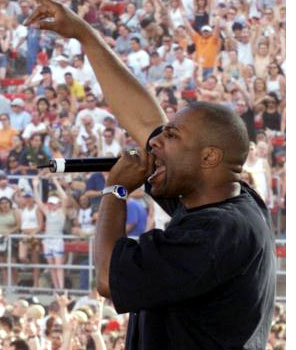
Jam Master Jay, 1965-2002
The pioneering DJ of Run-DMC was a godfather of '80s Adidas rap-rock -- but he was no thug.
He’s a one man band, in his own right
Jam Master jams to the broad daylight
No instruments needed, just two record players
A stage, a crowd and two rhyme sayers
–Run-DMC, “Jam Master Jammin’”
I got an e-mail from a New York friend last night with nothing but the lines “Man, Jam Master Jay? This hurts more than Tupac, more than Biggie — hell, this hurts more than Wellstone.”
Jam Master Jay, born Jason Mizell in the middle-class Queens, N.Y., neighborhood of Hollis, was the DJ in the legendary ’80s rap band Run-DMC. He was shot and killed in a Queens recording studio on Wednesday night. We don’t know what chain of events led to Jay’s death yet. But it’s one thing to take out ‘Pac and Biggie, as devastating as those killings were to the hip-hop world. At the risk of taking thug rap at its own word, when you live by the sword, you die by the sword. Jay was 37, a married man with three kids and no particular reputation as a thug or a hard case.
He had earned the right to grow old with grace — or even without it — to limp onstage and scratch arthritically and regale the next generation, and those to come, with stories about how they just don’t get it. We had earned the right to shake our heads indulgently at him, now that he’s been overtaken by Mixmaster Mike and Qbert and the scratch virtuosos who, like all the best children, left their father in the dust.
Forget Aerosmith. Forget “Walk this Way,” MTV and the damned Rolling Stone cover.
By the end of the eighties, if you were a kid growing up in New York or New Jersey or Connecticut — or in my case, all three — no matter what your name was, there was nowhere you could go without having someone holler out, “Mary, Mary, why you buggin’?” It was practically the Coney Island mating call. LL Cool J, Run-DMC, Grandmaster Flash, this was boardwalk rap, Adidas rap, boomboxes-the-size-of-a-Buick rap. The Beastie Boys were still punk rockers who couldn’t play their instruments. Adam Yauch couldn’t have found Tibet on a map, and neither could I.
Run-DMC — if you need a history lesson, Jay formed the group with Run (Joseph Simmons, brother of rap entrepreneur Russell Simmons) and DMC (Darryl McDaniels) — were hip-hop at its most innocent. OK, so maybe it wasn’t so innocent. Maybe all those rumors about Def Jam Records being a money-laundering operation were true. And maybe it’s time for us to accept that at the end of the world, it won’t be cockroaches and Cher but cockroaches and Rick Rubin. But I was sure as hell innocent. And the sound of a needle scratching on vinyl wasn’t the subject of a National Public Radio segment or the soundtrack to a new Gap ad. It was the sound of rock ‘n’ roll being reinvented for a new generation.
In 1984, when Run-DMC hollered out, “We’re live as can be but we’re not singing the blues/ We got to tell all y’all the good news,” the good news was that rap and rock were never going to be the same. As for the bad news, well you heard it again on Wednesday night.
Sheerly Avni is a freelance writer living in Oakland. More Sheerly Avni.
Trust me on this: David Bowie’s “Hunky Dory”
The Old 97's singer credits Bowie's brilliant "Hunky Dory" for rescuing his adolescence and inspiring his career
(Credit: Benjamin Wheelock) Dear Kiddos,
Hey, you turkeys. Listen up. I need you to listen for five minutes. I’m going to impart a little wisdom. You can take it or leave it. For what it’s worth, I’d rather you took it.
The advice is this: David Bowie’s “Hunky Dory” is a perfect album, and, since perfect albums are a rare commodity, it is worthy of deep and repeated listenings.
I’m listening to “Hunky Dory” as I write this. How many times have I listened to this, my favorite record? Like a million? And it never gets old.
Continue Reading CloseRhett Miller is the lead singer of the Old 97s. His latest solo album, "The Dreamer," will be released on June 5. More Rhett Miller.
Illustrating the ’60s music revolution
How one book captured the spirit and art of the cultural transformation -- as it was happening
“When did music become so important?” That’s Don Draper from last week’s “Mad Men,” set in 1966. Later in the episode he turns off “Tomorrow Never Knows,” from the Beatles album “Revolver,” and walks out of the room.
Protest music’s odd conservative turn
A 100-track, four-CD Occupy collection assembles generations of icons. So why does it sound shapeless and safe?
“In this hour of the ever-changing season, may our tears not douse the fire in our hearts.”
That’s a guy named Michael Pless singing “Something’s Got to Give.” Even without hearing the song, you can surely imagine the essential elements: Plaintive acoustic strumming, an earnest vocal, and an air of polite outrage to match the stilted syntax and hoary platitudes. Welcome to “Occupy This Album,” the collection of protest-minded songs released by Occupy Wall Street. Sprawling across four CDs and a slew of bonus digital tracks, this behemoth set includes 100 (why not 99?) new and previously released tracks from artists representing a range of generations, genres, backgrounds, settings, and styles. Folkies join hands with rappers; ominous post-rock marches alongside peppy radio pop. There’s spoken-word poetry, tribal percussion, earnest singer-songwriter fare. Even a bit of jazz.
Continue Reading CloseDonna Summer: Disco diva and rocker
If you only knew the singing sensation by her 1970s smashes, you barely knew her at all
There is so much about Donna Summer that we didn’t know… and not just the cancer that took her life. Let’s start with her relationship to rock. Summer is quite understandably known as a disco singer, and quite rightly so. It was disco that made her, and she, as perhaps disco’s highest profile performer, who helped to shape the genre. But like a number of other disco artists — Nile Rodgers and Bernard Edwards of Chic, the vocal trio Labelle and Chaka Khan all come to mind — Donna Summer was also a rocker. Yes, she grew up singing gospel, but she began her professional career as a ’60s rocker. She would describe this as her Janis Joplin phase, and she did indeed sing in a group that performed at the Psychedelic Supermarket — Boston’s version of Bill Graham’s Fillmore. She then went on to play a hippie in the Munich production of the rock musical “Hair,” and sported an enormous Afro inspired in large part by her hero, the black radical activist, Angela Davis. Although the disco music that she made with producers Giorgio Moroder and Pete Bellotte, and engineer Harold Faltermeyer provoked a fierce backlash from some aficionados of rock, this was a foursome that, as critic Dave Mash pointed out, functioned as a rock band, one in which Summer played a pivotal role as singer and songwriter. And then there is her singing. Listen to her hit “Hot Stuff,” and tell me that Summer could not sing rock.
Continue Reading CloseAlice Echols, a professor of English, and the Barbra Streisand Chair of Contemporary Gender Studies at the University of Southern California, is the author of four books, including "“Hot Stuff: Disco and the Remaking of American Culture." More Alice Echols.
Donna Summer, Queen of Disco, dies at 63
The "Last Dance" singer passed away after a battle with cancer
NEW YORK (AP) — Disco queen Donna Summer, whose pulsing anthems such as “Last Dance,” ”Love to Love You Baby” and “Bad Girls” became the soundtrack for a glittery age of sex, drugs, dance and flashy clothes, has died. She was 63.
Her family released a statement Thursday saying Summer died and that they “are at peace celebrating her extraordinary life and her continue legacy.”
Summer gained prominence during the disco era of the 1970s, and released a number of albums that have reach gold or platinum status, including the multiplatinum “Bad Girls” and “On the Radio, Volume I & II.” Her No. 1 Billboard Hot 100 hits include “Hot Stuff” and “MacArthur Park.”
Her sound was a mix of genres, and helped her earn Grammy Awards in the dance, rock, R&B and inspirational categories.
She released her last album, “Crayons,” in 2008. She also performed on “American Idol” that year with its top female contestants.
Page 1 of 284 in Music


