Sean Wilentz

How the Confederate flag flap helped the GOP

Democratic governors in South Carolina and Georgia lost at least partly because of their courageous stands against a divisive symbol of racism.

  • more
    • All Share Services

How the Confederate flag flap helped the GOP

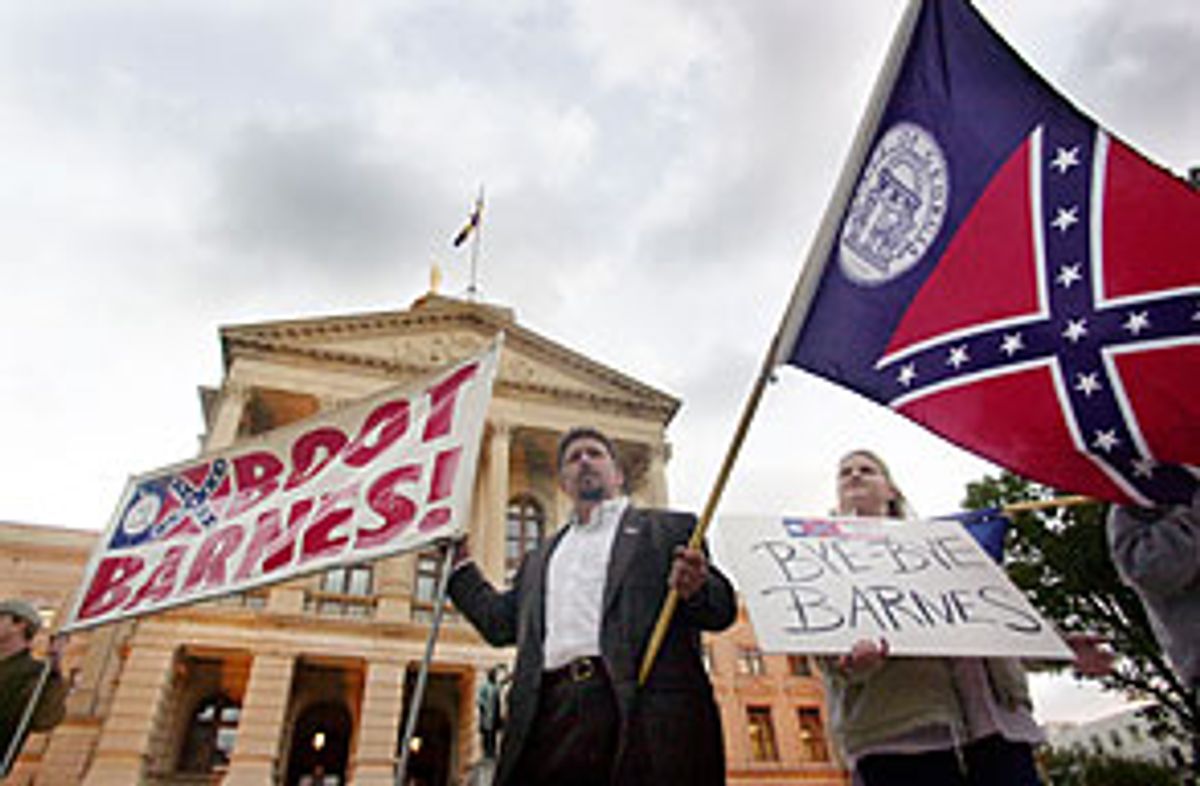
The Republicans’ historic victories in last week’s midterm elections owed a great deal to a surge in white voter turnout in the rural South, notably in South Carolina and Georgia, where incumbent Democratic governors, as well as U.S. Senate candidates, went down to crushing and surprising defeats. One factor largely ignored by the media was the way the ongoing controversy over the official display of divisive Confederate emblems also helped to galvanize angry white voters. So while Democrats debate whether their stance on Iraq hurt them last week, Republicans ought to worry about whether their debt to pro-Confederate flag voters might have gained them victory now at the cost of future races.

In 2000, South Carolina’s Democratic Gov. Jim Hodges approved the removal of the Confederate battle flag from atop the Statehouse dome and its relocation to a less conspicuous location on the capitol grounds. A year later, Georgia Gov. Roy Barnes forcefully won legislation that redesigned the state flag, vastly reducing the battle flag’s presence. Those relatively cautious compromises — neither man banished the flag entirely — marked the culmination of campaigns led by the National Association for the Advancement of Colored People and various corporate, church and tourism groups, for whom the old symbol had become both offensive and embarrassing. Hodges and Barnes presented the changes as sincere efforts at racial reconciliation, to help, Hodges said, “the descendants of slaves and the descendants of Confederate soldiers join together in the spirit of mutual respect.”

As everyone understood, but rarely said outright, the conflict involved history far more recent than the Civil War. Georgia officials had placed the Confederate emblem on the state’s flag in 1956, as part of their massive resistance to desegregation. South Carolina followed suit in 1962 by hoisting the battle flag to its place of sovereignty over the capitol. Hodges’ and Barnes’ decisions to remove those insignias involved not the breaking of ancient custom but a symbolic resolution of the bitter contests in what historians have called the Second Reconstruction of the 1950s and 1960s.

But some white recalcitrants saw the compromise as a threat and a disgrace. The nation caught a glimpse of their horrified reactions when they intruded upon the 2000 South Carolina Republican presidential primary. Pressed about where they stood on the impending lowering of the Confederate flag, both George W. Bush and John McCain refused to criticize those forces, led by the Sons of Confederate Veterans (SCV), that were resisting the change. (Sen. McCain has since expressed regret over his position.)

While the rest of the nation moved on to other concerns, the flag issue continued to agitate voters in South Carolina and Georgia and elsewhere in the South. SCV activists in Georgia mounted what they called “Project Wave,” erecting 24-foot flagpoles flying the old emblem all over the state, and hounding Barnes whenever he made public appearances. A South Carolina neo-Confederate group, the League of the South, urged voters to topple the man they began calling “the Turncoat Hodges.” Smaller controversies over Confederate displays broke out and seeped into politics from Virginia to Mississippi.

Republican politicians then exploited the issue, with all its blatant racial overtones. The Georgia GOP gubernatorial candidate Sonny Perdue, backed by Georgia Republican state chairman and former Christian Coalition head Ralph Reed, upheld the honor of those who died defending slavery, and pledged that, if elected, he would push for a statewide referendum to restore the old flag, nearly two-thirds of it taken up by the Confederate emblem. In South Carolina, GOP hopeful Mark Sanford accused Hodges of lying to the voters about the lowering of the Statehouse flag. The tactic worked like a charm, especially in Georgia where the Democrat Barnes had been expected to win reelection handily. The election returns clearly show that rural white voters switched in droves to vote Republican, and that the flag controversy was one important reason why.

“That flag issue had some life; it clearly did have an impact,” said University of Georgia political science professor Charles Bullock. The chairman of the Georgia Grassroots Republican Action Committee, Anthony Scott Hobbs, agreed, noting, “I think there was a backlash.”

Many other issues certainly helped decide these elections, ranging from proposed school reforms in Georgia to alleged malfeasance of state agency officials in South Carolina. Last-minute campaign appearances by President Bush helped mobilize the rank and file. His immense popularity in the South, thanks to his handling of the war on terror, gave Republican candidates an enormous boost. But neo-Confederate activists also remembered Bush’s stance on the flag flap in 2000, which many interpreted as a quiet endorsement of their efforts. At least they know he never publicly regretted his position, unlike McCain. As ever, in politics, substance and symbolism proved impossible to disentangle.

They remained entangled on election night, when a victorious Sonny Perdue, appearing against a backdrop of Confederate emblems, jubilantly exclaimed, with dubious taste, a line from an old black spiritual made famous by another Georgian, Dr. Martin Luther King Jr.: “Free at last! Free at last! Thank God Almighty, free at last!” Since then, Gov.-elect Perdue has backed off from his pledge to restore the old flag, and said with a straight face that the issue was only a “small” reason for his victory. And so his campaign appeals seem to have been just a cynical ploy, in a long tradition of Southern racial demogogy.

In William Faulkner’s play “Requiem for a Nun,” a character remarks mordantly: “The past is not dead. In fact, it’s not even past.” And so in American politics — and not just in the South — the past is the present and perhaps the future too. Old scars continually reopen as fresh wounds. The ghosts of the 1860s and the 1960s get conjured up anew on the political stump. Efforts at racial reconciliation remain blocked by political pandering to old fears, divisions and prejudices.

It is a sobering thought to consider, especially for Republicans of goodwill. Once they recover from their celebrating, they might want to take stock of everything that helped lead them to great victory in the last election, and ask themselves how much of it truly makes them proud.

Why Hillary Clinton should be winning

Under a winner-take-all primary system, Hillary Clinton would have a wide lead over Barack Obama -- and enough delegates to clinch the nomination by June.

  • more
    • All Share Services

Why Hillary Clinton should be winning

The continuing contest for the Democratic presidential nomination has become a frenzy of debates and proclamations about democracy. Sen. Barack Obama’s campaign has been particularly vociferous in claiming that its candidate stands for a transformative, participatory new politics. It has vaunted Obama’s narrow lead in the overall popular vote in the primaries to date, as well as in the count of elected delegates, as the definitive will of the party’s rank and file. If, while heeding the party’s rules, the Democratic superdelegates overturn those majorities, Obama’s supporters claim, they will have displayed a cynical contempt for democracy that would tear the party apart.

These arguments might be compelling if Obama’s leads were not so reliant on certain eccentricities in the current Democratic nominating process, as well as on some blatantly anti-democratic maneuvers by the Obama campaign. Obama’s advantage hinges on a system that, whatever the actual intentions behind it, seems custom-made to hobble Democratic chances in the fall. It depends on ignoring one of the central principles of American electoral politics, one that will be operative on a state-by-state basis this November, which is that the winner takes all. If the Democrats ran their nominating process the way we run our general elections, Sen. Hillary Clinton would have a commanding lead in the delegate count, one that will only grow more commanding after the next round of primaries, and all questions about which of the two Democratic contenders is more electable would be moot.

Unlike the Republicans, the Democrats in primary states choose their nominee on the basis of a convoluted system of proportional distribution of delegates that varies from state to state and that obtains in neither congressional nor presidential elections. It is this eccentric system that has given Obama his lead in the delegate count. If the Democrats heeded the “winner takes all” democracy that prevails in American politics, and that determines the president, Clinton would be comfortably in front. In a popular-vote winner-take-all system, Clinton would now have 1,743 pledged delegates to Obama’s 1,257. If she splits the 10 remaining contests with Obama, as seems plausible, with Clinton taking Pennsylvania, West Virginia, Kentucky, Indiana and Puerto Rico, and Obama winning North Carolina, South Dakota, Montana, Oregon and Guam, she’d pick up another 364 pledged delegates. She’d have 2,107 before a single superdelegate was wooed. You’d need 2,208 to be the Democratic nominee. That would leave her barely a hundred votes shy, and well ahead of Obama. It is almost inconceivable that she would fail to gain the required number of superdelegates easily. No more blogospheric ranting about Clinton “stealing” the nomination by kidnapping superdelegates or cutting deals at a brokered convention.

But Clinton does not now have 1,743 delegates. According to CNN estimates, Clinton has about 1,242 pledged delegates to Obama’s 1,413. Most of that total is based on the peculiar way that delegates are apportioned in 2008. Some of it is because Obama’s backers are using the same kind of tactics as George Bush’s camp used in Florida in 2000.

Crucially, Team Obama doesn’t want to count the votes of Michigan and Florida. (And let’s note that in a winner-take-all system, Clinton would still be leading in delegates, 1,430 to 1,257, even without Michigan and Florida.) Under the existing system, Obama’s current lead in the popular vote would nearly vanish if the results from Michigan and Florida were included in the total, and his lead in pledged delegates would melt almost to nothing. The difference in the popular vote would fall to 94,005 out of nearly 27 million cast thus far — a difference of a mere four-tenths of 1 percentage point — and the difference in delegates would plummet to about 30, out of the 2,208 needed to win. Add those states’ votes to the totals, and take a sober look at Clinton’s popular-vote victories in virtually all other large states, and the electoral dynamic changes. She begins to look like the almost certain nominee.

The exclusion thus far of these two vital states has come about because of an arbitrary and catastrophic decision made last year by Howard Dean and the Democratic National Committee. Two democratic options are available to clean up the mess: Either relent by including the existing Michigan and Florida results or hold new primaries there.

Yet in this, as has happened more than once this primary season, the Obama camp’s reaction has not been to clean up the mess the party has created, but to benefit from it. Given the original primary outcomes in Michigan and Florida, Obama has rejected the idea of certifying the results. Although Obama’s supporters conducted a stealth “uncommitted” campaign in Michigan after he voluntarily removed his name from the state ballot, and even though, contrary to DNC directives, his campaign advertised in Florida, Clinton still won both states decisively. This leaves open the option of holding new primaries in both states. National and state party officials have announced that such revotes could be conducted.

Yet the Obama campaign has stoutly resisted any such revote in either state. In Michigan, Obama’s supporters thwarted efforts to pass the legislation necessary to conduct a new primary. In Florida, campaign lawyers threw monkey wrenches to stop the process cold, claiming that a revote would somehow violate the Voting Rights Act, and charging that a proposed mail-in revote would not be “fraud proof.” (Obama himself, it’s important to note, proposed a bill in 2007 to allow for mail-in voting in federal elections.)

Instead, Obama’s campaign has tendered the startling proposal that he arbitrarily be allotted half of the votes already cast in Michigan and Florida. Of course, a large number of these votes — more than a quarter of a million in Florida alone — were not cast for Obama. He simply proposes that the party add these votes to his total, as though they were rightfully his. Saying that votes already cast for other candidates should go to him is a bold power grab, worthy of the Chicago machine organizations that claimed the votes of the recently deceased, their names gleaned from the voting rolls. By any definition of democracy, those votes do not belong to Obama; nor do they belong to Hillary Clinton, nor to Howard Dean. They belong to the voters. Obama can no more lay claim to them legitimately than his supporters can declare he has won the nomination before the remaining primaries take place.

Now consider the delegate count and its connection to the popular vote. In Nevada, Clinton also won a popular majority, despite pressure from union officials on the rank and file attending the caucuses to vote for Obama. Yet Obama claims, on the primary electoral map posted on his official Web site, that he actually won Nevada — presumably because rules that gave greater weight to rural than urban votes mean he won a marginal edge in the Byzantine allotment of the state’s delegates. Why, in deference to the clear-cut Nevada popular majority, doesn’t Obama cede the majority of the state’s delegates to Clinton? Because, according to the rules, he’s entitled to those delegates. But why are the rules suddenly sacrosanct and the popular vote irrelevant? Might it be because the rules, and not the popular vote, now benefit Obama? And what about Texas, another state where Clinton won the popular vote but has not been awarded the majority of pledged delegates? Once again, for Obama, the rules are suddenly all-important — because the rules, and not the popular majority, now favor him.

Obama’s totals thus far have come in great part from state caucuses nearly as much as from actual primaries. (Eleven out of the 30 states and other entities he has won held caucuses, not primaries. Washington held both, as did Texas, where Obama won the caucuses and lost the popular vote.) Of the two systems, caucuses are by far the less democratic — which may be why there will be exactly zero caucuses in this fall’s general election. By excluding voters who cannot attend during the limited times available, the caucuses skew participation toward affluent activists and students, and against working people, mothers and caregivers, and the military. Clinton’s victories, by contrast, have come overwhelmingly in states with primaries, not caucuses. Obama is certainly entitled to the delegates he won in the caucuses. But he can hardly, on that account, claim that he is clearly the popular favorite.

In 2004, Democrats lost most of the states where Obama’s delegates come from now. The Democrats are likely to lose most of those states again in 2008, no matter how much his supporters speak of winning crossover votes. (Idaho and Wyoming, for example, where Obama won caucuses, are not going to vote for either Clinton or Obama come fall.) Of the remaining states that Obama has won, only one is a large state with a considerable number of electoral votes — his home state of Illinois. Clinton has won the popular vote in all of the other large states — and has done so in primaries, not caucus decisions. The arithmetic here is simple: Because of the flawed system, the delegates from the states that Obama has won, many of which vote strongly Republican, represent far fewer Democratic voters than those from the states Clinton won.

Finally, there is the disquieting question of acknowledging what kind of democracy will determine who wins the presidency in 2008. Strong arguments could be made that, in a thoroughgoing democracy, voters choose presidents with a direct, plebiscitary system. The candidate who commands a majority (or, perhaps, a plurality) of the popular vote nationally wins the election. But, interesting as they might be as an academic exercise, such musings are irrelevant to the politics of 2008. We have a winner-take-all system, but it operates on a state-by-state basis (except in Maine and Nebraska, where it’s winner-take-all by congressional district). Like it or not, we will choose the president under the indirect and fractured democracy of the Electoral College.

Obama has tried to reinforce his democratic bona fides by asserting his superior electability, and by claiming that Clinton’s supporters are more likely to back him in November than vice versa. The polls, however, show otherwise. And even more important, the polling data on the electoral vote totals show an outcome very different from the one suggested by Obama. The latest state-by-state figures (as of late March) updated from SurveyUSA, indicate that if the election were held today, Clinton would defeat McCain in the Electoral College because of her lead in big, electoral-vote-rich states such as Florida, Ohio and Pennsylvania — and McCain would beat Obama.

In the final analysis, though, the fights inside the Democratic Party aren’t really about either an ideal American democracy or the American democracy that actually exists. According to the Obama campaign, democracy is defined as whatever helps Barack Obama win the Democratic nomination. There is nothing intrinsically wrong with a candidate arguing this way. But everybody should see it for what it is — not something new or transformative, but one of the oldest ploys in the playbook of American politics.

Continue Reading Close

Don’t know much about history

Condoleezza Rice dismissed the Aug. 6 PDB that warned of al-Qaida attacks against the U.S. as "historical." She was dead wrong -- and as a historian herself, she has no excuse.

  • more
    • All Share Services

National Security Advisor Condoleezza Rice is a professional historian and political scientist. And so it was especially noteworthy when she testified under oath last week that the famous president’s daily brief on al-Qaida from Aug. 6, 2001, contained “historical information based on old reporting” that did not warn of new attacks against the United States. If anyone in the White House should know the difference between “historical” and non-historical information, and its importance, it ought to be Rice, the former provost of Stanford University.

It turns out that Rice’s testimony was misleading and possibly false. The PDB — subsequently declassified after intense public pressure — certainly contains then-current information based on continuing investigations. It specifically refers to “patterns of suspicious activity in this country consistent with preparations for hijackings or other types of attacks, including recent surveillance of federal buildings in New York.”

Rice’s mischaracterization seems to have been overlooked or forgiven by the press corps. To a citizen, this is shocking. But to a historian, Rice’s conception of “history” and “historical information” is equally so.

What is a historical document? At the most simple-minded level, it is something that contains information about past events. To a historian, it is much more than that. It also contains clues about what may or may not have happened after the document was created. Those clues require interpretation, in conjunction with other historical documents. The document, in a historian’s hands, talks about much more than the events it describes or the person who was describing it. It is part of a chain of evidence that goes into making reasoned judgments about earlier and later events as well.

Read this way, the Aug. 6 PDB is a fascinating and alarming historical document. It states:

  • For the previous four years, Osama bin Laden had stated repeatedly that he wanted to follow up the 1993 bombing of the World Trade Center in New York and “bring the fighting to America.”
  • One of the American targets that bin Laden had specified was Washington, D.C.
  • Bin Laden was personally aware of the failed millennium bombing plot of 1999 that targeted Los Angeles — an operation encouraged and facilitated by one of his top al-Qaida lieutenants.
  • As of Aug. 6, 2001, al-Qaida “apparently” maintained within the United States “a support structure that could aid attacks.”
  • Bin Laden “prepares operations years in advance and is not deterred by setbacks.”
  • There was, on Aug. 6, 2001, current information that suggested al-Qaida was preparing for “hijackings or other kinds of attacks” in the United States, with New York buildings a possible target.
  • The FBI was engaged in over 70 investigations related to bin Laden, including an intelligence tip-off from three months earlier “saying that a group of Bin Laden supporters was in the US planning attacks with explosives.”
  • The information here is straightforward: Bin Laden has threatened to attack the United States, specifically Washington; he has been implicated in earlier attack plots against the United States; he bides his time; there are reports that his agents are currently in the United States planning hijackings or attacks with explosives. But put all of that together with the generalized but frightening intelligence “chatter” reported to Rice over the summer of 2001 about an imminent huge attack by al-Qaida against the United States, and the message is clear: Something spectacularly bad was in the works on Aug. 6, 2001, that had to be taken seriously.

    Rice, and apparently President Bush, read historical documents like this one very differently. As she testified last week, the “historical information” of the PDB had little significance. The “history” was just old news, of no great importance. We’d known about bin Laden’s intentions for a long time. So what?

    To which a historian replies: So everything! The “historical information” contained in the Aug. 6, 2001, PDB took on entirely new meaning given what else was there and given the other intelligence flooding into Washington. It wasn’t just that bin Laden had made threats: He had tried to carry out those threats and was apparently trying again, big time. Such was the situation at the time — not in 1997 or 1998, but on Aug. 6, 2001.

    Had Rice put her historical training to use, she would have seen this — and, one hopes, counseled the president that something more than passivity was required. But she didn’t. Perhaps she is not so sound a historian after all. (The American Historical Review’s notice of her first book, a study of Russia and the Czech army after 1948, charged that Rice “frequently does not sift facts from propaganda and valid information from disinformation or misinformation” and that she “passes judgments and expresses opinions without adequate knowledge of the facts.”) Or perhaps she decided to put aside her historian’s skills in service to the president.

    When questioned after his election about the more sordid features of his 1988 “Willie Horton” campaign, the elder President George H.W. Bush dismissed critics with a breezy remark: “That’s history.” A similar disregard for the actual significance of history and “historical information” seems to have guided his son and his son’s top advisors in August 2001. And it seems to have guided the current national security advisor in her misleading testimony last week. More than anyone else in the White House, she should have known better. The scary thing is that maybe she does.

    Continue Reading Close

    The media gets impeachment wrong again

    Even as journalists admit "The Clinton Wars" reveals the insanity of the right-wing crusade against the president, they're dismissing the book as "history."

    • more
      • All Share Services

    The media gets impeachment wrong again

    Five years ago, I testified before Congress that history would harshly judge the unconstitutional impeachment drive against President Clinton. My position was fairly mainstream among American historians. By the time I testified, nearly 500 had signed a letter I helped to write with the distinguished scholars Arthur Schlesinger Jr. and C. Vann Woodward, deploring the impeachment on historical and constitutional grounds. Soon thereafter, a group of more than 400 leading legal scholars, including Cass Sunstein and Laurence Tribe, issued a similar statement.

    Not surprisingly, Republicans lambasted both the historians’ letter and my testimony, as did journalists and pundits playing amateur historians inside the right-wing media echo chamber. A group of 90 writers — only three of them historians, but with a heavy contingent from the right-wing think tanks plus partisan ideologues from the Reagan and first Bush administrations, such as C. Boyden Gray — composed a counter-statement attacking the historians. But a wide range of editorial writers and columnists in the so-called “liberal media” also denounced the historians for being “gratuitous” “condescending” and “partisan.”

    The historians’ verdict was clear: The impeachment drive against President Clinton lacked constitutional and political legitimacy. The journalists’ opinion was equally clear: The impeachment was legitimate, and the historians were really a fusty collection of liberal elitists who had no business sticking their noses into public affairs.

    Now an extraordinary thing has happened. Journalists from across the political spectrum are finally acknowledging that impeachment was mostly a partisan crusade on trumped-up charges to bring down a popular president. “From the viewpoint of history,” the conservative Andrew Sullivan wrote recently in the New York Observer, “it’s going to seem deranged.” They have conceded that numerous allegations noisily leveled against Clinton and repeated endlessly in the news media of which they are a part have turned out to be bogus.

    The occasion for this sea change in conventional wisdom is the publication of Sidney Blumenthal’s “The Clinton Wars” and the response to it. (I should note that Blumenthal and I have been friends ever since we both wrote for the New Republic, that I read and corrected some of “The Clinton Wars”‘ background historical material in manuscript, and that I, along with Schlesinger, Sunstein and others, am treated kindly in the book.) But what has struck me, now that the reviews of the book have started pouring in, is how an old pattern has reappeared in a new form: Historians and journalists disagree about the book’s import.

    Even as journalists admit that Blumenthal has the goods to prove what a right-wing circus impeachment really was, they dismiss his revelations as score-settling, and worse — as “history.” The spectacle of the media, having gotten the story wrong in the first place, dismissing the book that gets it right is stunning, even to someone who lived through the actual impeachment.

    Meanwhile, the most respectful reviews have come from historians — Robert Dallek in the New York Times Book Review and David Greenberg in the Washington Monthly. Though not uncritical, both warmly praised the book’s reconstruction of the historical record and called it the place to start in order to understand the Clinton presidency. Once again, the historians get the story right.

    Journalists have attacked Blumenthal, a controversial figure in Washington press circles, for writing a memoir they deem a courtier’s brief — too one-sided, partisan and uncritical of Clinton. History is of less interest to these journalists than Blumenthal’s personality, his devotion to the Clintons, and various trivial matters of great import to the news media, like whether “Hardball” host and Clinton-hater Chris Matthews really did lobby for the job as Clinton’s press secretary.

    Yet in working up their ad hominem cases against Blumenthal, even his journalist critics concede that the book’s exposure of the partisan campaign against Clinton that culminated in the impeachment is accurate and persuasive.

    A sampling:

    Andrew Sullivan in the New York Observer: “The real value of this book is in its portrait of Mr. Clinton’s foes … .[T]he account Mr. Blumenthal gives of the haplessness and priggishness of Kenneth Starr is riveting stuff. The testimony of Sam Dash, Mr. Starr’s ethics advisor, is particularly damning. The insane attempt to actually bring down a President over perjury in a civil suit has not yet been more vividly evoked.”

    Janet Maslin in the New York Times: “Certainly “The Clinton Wars” can point to baseless, breathless news coverage as a catalyst to the Kafkaesque.”

    Lev Grossman in Time: “Blumenthal’s abiding theme is that Clinton’s presidency was the victim of a right-wing political cabal that manipulated the media and the legal system to make mountains out of dunghills, and he makes a surprisingly convincing case by doggedly following countless news stories and allegations to their origins in tainted, planted, unfounded, retracted, distorted, misleading and plain nonexistent evidence.”

    Bill Bell in the New York Daily News: “No question, the Clintons were dogged by some extremely malignant, ignorant and hypocritical extremists, funded by a few rich conservatives … .Beyond the settling of grudges and slights, though, is a bigger, dramatic story — of the impeachment itself — and Blumenthal’s riveting account is sharp, spare and focused. It pulses with the energy of clashing ideologies and strategies and is propelled by the force of the legal, political and reputational stakes involved. It sets the standard for subsequent reports, including the one his Oval Office boss is writing.”

    Joseph Lelyveld in the New York Review of Books: “Blumenthal holds your attention when he pieces together the various components of what Mrs. Clinton called a “vast right-wing conspiracy,” from Little Rock enemies and haters to the lawyers of the Federalist Society who worked their connections to the Office of the Independent Counsel to shift its focus from real estate to sex … .Disgraceful things did happen. On more than one occasion, an Internet gossip columnist did set the agenda for mainstream news organizations. Stories without sources did gain instant currency. Some were fabricated.”

    Clearly, looking back, the anti-impeachment historians get to say we told you so. But the more disturbing point is this: Impeachment isn’t just “history.” Some of the key “right-wing fanatics” who peddled “tainted, planted, unfounded, retracted, distorted, misleading and plain nonexistent evidence” that led to a “Kafkaesque” political “show trial” have more power than ever in politics and the media — and have, it seems, actually benefited, personally and politically, from their attacks on the Constitution. The current corrected revised accounts by journalists leave the misimpression that only a few marginal right-wing zanies of passing importance were involved in the illegitimate effort to bring Clinton down. As the now uncontested facts around impeachment show, that is hardly the case.

    Four examples:

    One of the chief members of the “cabal of right-wing fanatics” was Theodore Olson, who, as counsel to the rabidly right-wing American Spectator, oversaw the notorious Arkansas Project that spread some of the most vicious lies about Clinton. (Olson was also one of the supposedly impartial “experts” who signed the petition attacking the historians in 1998.) In testimony before the Senate, Olson denied any involvement in the Project — but that testimony was later fully documented as false. Yet Olson is now solicitor general of the United States, appointed by President Bush and approved by the Senate during the confusion that accompanied Sen. Jim Jeffords’ defection to the Democrats in 2001. Among Olson’s current tasks is selecting hard-right nominees for the federal judiciary, with whom the Bush administration is now trying to pack the courts. Many of those nominees are, like Olson, closely connected with the radical activist circles within the Federalist Society, the right-wing lawyers’ group that also produced several of the so-called “elves” who plotted Clinton’s downfall.

    Rep. Tom DeLay of Texas did more than any House Republican to coerce his colleagues into supporting impeachment. DeLay privately threatened moderate Republicans who would not go along, using right-wing fundraisers and 60 designated whips to do his dirty work for him. “Coming out of the election,” Republican congressman Peter King later said, “I didn’t hear anyone discuss impeachment. It was over. Then DeLay took over.” One by one, the moderates caved in to what DeLay and his minions were calling “the Campaign.” At the time, DeLay was the House majority whip. Since then he has been promoted for his “deranged” attack on the Constitution by being named House majority leader.

    In 1998, Bret Kavanaugh was a conservative lawyer on the staff of Kenneth W. Starr’s Office of Independent Counsel. He coauthored the salacious so-called Starr Report that became the basis for the illegitimate articles of impeachment — and the basis for Starr’s aggressive testimony to Congress, in violation of the Constitution, that led the office’s chief ethics advisor, Samuel Dash, to quit in protest. Today, Bret Kavanaugh is deputy legal counsel at the Bush White House.

    In 1995, Michael Chertoff was chief counsel for Sen. Alphonse D’Amato’s Senate Whitewater Committee that churned endless baseless allegations against the Clintons. Since then, he has served as Attorney General John Ashcroft’s assistant atop the Department of Justice’s criminal division (and a leading force behind the authorship of the so-called PATRIOT Act) and been nominated by George W. Bush to the federal bench.

    There also are continuities between impeachment and present day politics in conservative funding circles and in the news media. Richard Mellon Scaife has been, by now, thoroughly exposed as the financier behind numerous false stories about the Clintons that led to the impeachment drive, both in his newspaper the Pittsburgh Tribune-Review and in various other outlets, including the American Spectator. If history has tracked anyone down, it is Scaife. Yet that has not prevented him from continuing his funding of “extremely malignant, ignorant, and hypocritical extremists” — or shamed numerous respectable institutions, including Johns Hopkins University and the University of Chicago, into declining his support.

    The story of the media’s complicity in the impeachment drama is more complicated. Historical ignorance, cynicism, self-importance, conformism, gullibility, careerism, hypocrisy, pride, and assorted other human frailties contributed in varying degrees to what Maslin calls the “breathless, baseless news coverage” of the time. History has judged and will judge some media participants more severely than others. Those who unprofessionally suppressed crucial pieces of evidence — including the independent Resolution Trust Corporation report that exonerated the Clintons over Whitewater as early as 1995 — will bear a heavy burden.

    Near the top of the list for condemnation will be the multinational media conglomerate run by Rupert Murdoch, including the Weekly Standard, the New York Post, and (in conjunction with Roger Ailes) Fox News. Even before the Lewinsky story broke, Murdoch’s outlets remorselessly hyped malevolent stories about the Clintons — from Whitewater to Travelgate — even after they were proven to be false. In 1998 and 1999, their slanted coverage of the impeachment drama performed a singular disservice to the truth. They have never corrected their numerous false reports, let alone apologized for them. Yet the Murdoch empire is now flourishing. Thanks to Bush administration rulings, its control over an increasingly concentrated and centralized media is likely to grow.

    Slowly but surely, most recently with the publication of “The Clinton Wars,” historical facts have changed the prevailing wisdom of the chattering classes about the impeachment of Bill Clinton. Historical research, now recognized as accurate, has made the journalists’ original accounts look tendentious and often false. In the battle begun in 1998 between historians and journalists over the facts of the case and the legitimacy of impeachment, the historians have won.

    But the journalists’ insistence that we all put the matter to rest is itself a continuation of the partisanship and hopelessly confused logic that drove the impeachment effort in the first place. That insistence amounts to amnesty for abuses against the Constitution, some of which were committed by persons who now help to run the country, and who are utterly unapologetic for what they did. It is less a pardon than a willful act of forgetting that lets the guilty off the hook — and that leaves them and their rackets, unchallenged, in power.

    Abraham Lincoln once remarked that none of us can escape history. That includes those who conceived, aided and abetted the unconstitutional impeachment of Bill Clinton. The trouble is, many of those people are still very much with us, have been amply rewarded for their crimes, and continue to wield extraordinary power. History will condemn the rest of us if we do not now, at last, hold them accountable for what they did.

    Continue Reading Close

    The racist skeletons in Charles Pickering’s closet

    President Bush dumped Trent Lott because of his segregationist baggage. So why is he fighting relentlessly for a judge who has refused to come clean about his own bigoted past?

    • more
      • All Share Services

    The racist skeletons in Charles Pickering's closet

    When Senate Democrats voted last March to reject Judge Charles Pickering’s nomination to the 5th U.S. Circuit Court of Appeals, Majority Leader Trent Lott called the vote “a slap at Mississippi, my state.” In fact, the bitter party-line vote on Pickering revolved around the same issues that would bring down Lott nine months later: Mississippi’s shameful history of racism, and the pro-segregation politics practiced by state Republicans like Pickering and Lott in the 1960s.

    Pickering has long tried to downplay and even disavow that history, in sworn testimony to the Senate during his first confirmation hearing in 1990, and again in 2002. Since 1964, the year he switched from the Democratic to the Republican Party, the Mississippi judge told the Senate last year, he “was involved and [has] been involved in trying to establish better race relations” in his home state. His supporters have gone even further, calling Pickering, in Kentucky Sen. Mitch McConnell’s words, a man with the “resounding virtue” of “moral courage,” who “had to deal with white citizens and politicians who resisted integration and civil rights.” But Democrats weren’t convinced by the way Pickering recast his history, with Sen. Charles Schumer of New York calling his civil rights record “troubling.”

    Now, with Republicans back in control of the Senate, President Bush has resubmitted Pickering’s nomination, and he’s got a new shot at joining the crucial, conservative bench on the 5th Circuit. But there’s also new evidence that Pickering has lied about his efforts “to establish better race relations” in the 1960s, discovered in the papers of Pickering’s former law partner, the devoted segregationist J. Carroll Gartin.

    The new evidence, housed at the University of Mississippi Library, shows that Pickering’s decision to defect to the Republicans — a key turning point in his public career — came at the strong urging of Gartin, who as lieutenant governor from 1956 to 1960 and again from 1964 until his sudden death in 1966 was a leading member of Mississippi’s notoriously racist Sovereignty Commission. Gartin’s papers — including his personal letters and other private documents, plus memos, press releases and news clippings from the time — also confirm, in more detail than ever before, that Pickering became a Republican in 1964 to protest the national Democratic Party’s support for civil rights and its attacks on segregation — a motive the judge refused to acknowledge in his testimony last year.

    A decision on Pickering’s nomination could come as early as this week. The GOP is so determined to crush Democratic opposition to Bush’s more conservative appointees that Senate Majority Leader Bill Frist is trying to change the filibuster rules, and on Friday Bush demanded that senators vote on his nominees within 180 days. Pickering’s nomination isn’t currently scheduled for a hearing, and it’s possible Republicans will push for a vote without one. The Pickering nomination could become a test case in the escalating war over judicial appointments between the White House and Senate Democrats. The new revelations found in his law partner’s papers could well strengthen the Democrats’ hand. Pickering could not be reached for comment about the Gartin papers, and Sen. Orrin Hatch of Utah, the Judiciary Committee chairman, did not return calls.

    Even without the new evidence from Gartin’s papers, Pickering’s testimony had already yielded some troubling contradictions, distortions and apparent falsehoods — a pattern of dissembling that calls into question his fitness for the federal bench. And Gartin and the Sovereignty Commission have been the subject of many of Pickering’s most dubious public statements in recent years, including statements given under oath.

    In 1990, for instance, when he was successfully nominated as a federal judge for the southern district of Mississippi, Pickering testified that he had had no contact with the commission and knew little about its operations. This was false, as the commission’s subsequently released files show. In 2002, Pickering attempted to correct his false testimony, saying that he had contacted the commission in 1972 because he was concerned about possible Ku Klux Klan infiltration of a union in his hometown. This too was false: Commission records show that Pickering actually contacted the commission about union infiltration by a well-known civil rights organization, not the KKK.

    Also in his 2002 Senate testimony, Pickering tried to portray Gartin as a “progressive” political leader and not a racist. This too, as he grudgingly conceded — though only in part, under close examination by Illinois Sen. Richard Durbin — was false. Pickering also insisted that when Gartin ran for governor in 1959, his opponent Ross Barnett was the recognized segregationist candidate and that being insufficiently pro-segregation was why Gartin was defeated. Under Durbin’s questioning, Pickering asserted that Gartin’s philosophy on segregation was not “as radical as [that of] Ross Barnett.”

    Maybe most remarkably, in a contentious exchange with Wisconsin Sen. Russ Feingold, Pickering again and again refused to answer questions about whether he left the Democratic Party in 1964 because of the party’s belated but brave moves on behalf of integration. Pickering dodged Feingold’s questions every way imaginable and never gave an answer.

    The Gartin papers provide plenty of answers to all of those questions. First of all, they show why Pickering went to so much trouble to try to play down Gartin’s segregationist history, revealing Gartin’s previously unknown “conversion” of Pickering to the Republican Party, as part of the lieutenant governor’s quiet, behind-the-scenes collaboration with the Mississippi GOP. Gartin himself stayed where most political power was in those years — he remained a Democrat, sympathetic to segregationist Alabama Gov. George C. Wallace, but instrumental in delivering Mississippi resoundingly to Barry Goldwater in 1964.

    The new evidence also shows the extent to which Pickering dissembled about Gartin’s 1959 campaign. Gartin’s papers show that the race pitted two confirmed pro-segregationist candidates against each other, and in his campaign Gartin accused Barnett of being softer on integration than he was. The papers also show that when Gov. Barnett took the most radical stance of his career, over the desegregation of the University of Mississippi, Carroll Gartin stood proudly — and publicly — by Barnett’s side.

    Gartin’s papers show conclusively that, contrary to McConnell’s description, Pickering himself was one of those “white citizens and politicians who resisted integration and civil rights,” not someone working to oppose such forces. Instead of “trying to establish better race relations” in the 1960s, Pickering worked to support segregation, attack civil rights advocates who sought to end Jim Crow, and back those who opposed national civil rights legislation, above all the landmark Civil Rights Act of 1964. Or, in the words of a public statement he signed in 1967, Pickering wanted to preserve “our southern way of life,” and he bitterly blamed civil rights workers for stirring up “turmoil and racial hatred” in the South.

    In the wake of the Trent Lott debacle, when the Mississippi senator lost his leadership post for publicly praising Strom Thurmond’s 1948 segregationist presidential campaign, much was made of the fact that President Bush’s criticism helped push Lott to resign. It was said to be the Republican Party’s attempt to detach itself from the politics of racial division that’s made it acceptable for Southerners like Lott to deliver votes by praising the symbols of their racist past, from Confederate flags to Thurmond’s disgraceful Dixiecrat candidacy. And yet within a month of Lott’s resignation, Bush re-nominated Pickering, a Lott crony who left the Democratic Party for the same reason Thurmond did — to protest its support for integration.

    The fact that in 1967 Pickering testified, cursorily, against a violent Ku Klux Klan leader — an incident much cited by his supporters — hardly offsets his record of supporting segregation. In Jim Crow Mississippi, segregation was preserved thanks to the work of crude and violent racists as well as sophisticated, conservative racists who fought for their goals with different methods. Although sometimes at odds over tactics, both groups bitterly battled efforts to give blacks civil rights. In the 1960s, Charles Pickering, like Carroll Gartin, was one of the sophisticated segregationists — a fact that he and his backers are now trying to suppress.

    Fully appreciating the importance of Carroll Gartin and his work “converting” Charles Pickering to the Republican Party requires understanding Mississippi politics of 40 years ago. It has long been a matter of public record that Pickering supported the lily-white pro-segregation Mississippi Regular Democrats in 1964, the official state party organization. The so-called Regular Democrats openly discriminated against blacks and excluded them from party activities and meetings. In 1964, black Mississippians, with some white supporters, organized the Mississippi Freedom Democratic Party (MFDP) and selected their own slate of delegates to represent the state at the Democratic National Convention in Atlantic City.

    The conflict between the rival slates became an event of national importance, highlighted by the electrifying testimony of MFDP delegate Fannie Lou Hamer before the convention’s credentials committee. It’s not an exaggeration to call Hamer’s remarks a pivotal moment in American history. President Lyndon Johnson offered a compromise giving the MFDP two at-large seats and pledging that the Mississippi party would support the national ticket and eliminate racial discrimination in future delegate selection. Neither slate of delegates agreed to the deal, and in dramatic fashion, the all-white Regular delegation walked out of the convention hall. And some of them walked out of the Democratic Party.

    The walk-out came at a time of prolonged political crisis in Mississippi. The summer of 1964 was the Mississippi Freedom Summer, when with the aid of white and black supporters from around the country, pro-civil-rights Mississippians attempted to register blacks to vote and to participate in the precinct, county and state conventions of the Democratic Party. (It was this effort that led to the creation of the MFDP.) Political tensions rose early in July, when Johnson signed the landmark Civil Rights Act into law. There was also violence in Mississippi that summer, most notoriously the murder of three civil rights workers, Andrew Goodman, James Chaney and Michael Schwerner.

    During the weeks after Johnson signed the Civil Rights Act and before the Democratic National Convention, several leading Mississippi Democrats either endorsed the Republican national ticket or joined the Dixiecrat candidate, South Carolina Sen. Strom Thurmond, in leaving the Democratic Party altogether. Their statements were often couched in code words — resisting the Democrats’ alleged “socialism” was one of the most common — but the issue was clear. They rejected what they saw as unjust federal efforts to end racial segregation in Mississippi. The fight was not about foreign policy, or tax rates, or anything other than racial segregation.

    After the Democratic convention in late August, more pro-segregation Democrats either announced their support for the Republican ticket or left the Democratic Party, blaming the attempted compromise in Atlantic City and its offer of token recognition to the civil rights Mississippi delegates.

    One of the most conspicuous pro-segregation Democrats was Lt. Gov. J. Carroll Gartin. As lieutenant governor, he wrote to Arkansas Gov. Orval Faubus to express his admiration and support for Faubus’ defiance of federal authority in the Little Rock school desegregation crisis of 1957. Eight years later, the year before his death, Gartin praised Alabama’s segregationist governor, George C. Wallace, for his “great American message.”

    Between those dates, Gartin devoted himself fully to the segregationist cause. In 1959, pledging himself as a “total and absolute segregationist,” Gartin ran unsuccessfully for governor in the Democratic primary against Ross Barnett, who would go on to great notoriety during the violent desegregation crisis at the University of Mississippi in 1962. One of Gartin’s chief arguments in that campaign was that, unlike Barnett, whom he called “a headline segregationist,” he, Gartin, was “a successful segregationist.” (“Mr. Gartin believes in speaking low and carrying a big stick,” one piece of campaign material declared about segregation. “Mr. Barnett believes in speaking loud with no stick at all.”)

    Gartin did not confine his segregationism to the campaign stump. As lieutenant governor in the 1950s and 1960s — and as a leader of the Mississippi State Sovereignty Commission, the semi-secret state agency dedicated to resisting integration and the civil rights movement — Gartin endorsed massive resistance to desegregation. In 1962, when his former primary opponent, Gov. Barnett, defied federal authority during the Ole Miss crisis — which quickly degenerated into mob violence — Gartin made a point of sending a wire to Barnett to pledge his support and congratulate him for his “determination to keep our schools and colleges open and segregated.” And when faced, in 1964, with a choice between token integration leading to an eventual dismantling of racial discrimination inside the Democratic Party, and the continuation of segregation, Gartin sided unequivocally with segregation.

    At least one of Pickering’s current supporters, the columnist Bill Minor of the Jackson (Miss.) Clarion-Ledger, has asserted that Gartin “had little to do with the [Sovereignty] commission’s operations,” despite the glaring public record to the contrary. Among other things, Gartin, in connection with the commission, directed an unsuccessful effort to destroy Tougaloo College, the only racially integrated institution of higher learning in the state, in 1964. Gartin’s leadership role in the commission is amply documented in the commission’s now opened files.

    After the Atlantic City Democratic convention, Gartin accused President Johnson of personally “master-minding the insults” directed at the white segregationist Regular Democrats. He urged voters to support the Republican presidential candidate, Barry Goldwater, who had opposed the 1964 Civil Rights bill.

    The new evidence reveals, in addition, that some time before the Democratic convention Gartin was meeting with officials of the Mississippi Republican Party concerning the upcoming election, and promising to help give the voters a “clear choice” in November. As part of fulfilling that promise, Gartin undertook what he later described as an important effort — what he called “converting” his law partner, Charles Pickering, to the Republicans.

    Gartin himself held back from switching parties, although one Republican leader wrote him to extend an invitation, noting that “we need you and your guiding hand on our side also.” But Gartin saw no problem in working hand-in-glove with the Republicans behind the scenes in order to ward off the menace of desegregation — and to deliver to the Republicans his pro-segregation law partner, Pickering.

    As he wrote to Republican Party official F. Hobson Gary on Sept. 21, 1964: “This boy, Charles Pickering, is a very able person and I think he will mean a great deal to the Republican party in Mississippi.” Gartin went on to say: “Personally, I have been so busy converting my law partner lately that I haven’t been out too much, but I still think Goldwater will easily carry the state.”

    It is clear from his papers that Gartin prevailed upon Pickering not simply to reject Johnson’s candidacy because of his civil rights stands, but to reject the Democrats entirely and join the Republicans — and to help offer Mississippians what Gartin called “a clear-cut choice” in the election.

    Yet if Carroll Gartin was the “guiding hand” behind “converting” Pickering, the young lawyer was not a thoughtless convert. Far from putty in his mentor’s hands, Pickering thought and talked a great deal before making his decision. By Gartin’s account, Pickering kept him “busy.” But finally, Pickering was convinced that, in the wake of the national Democrats’ moves on civil rights, both pragmatism and principle dictated that he leave the party and join the Republicans, whose presidential candidate had conspicuously voted against the Civil Rights Act of 1964 — and who went on to win nearly 90 percent of the Mississippi vote in the fall election.

    When he announced his switch, Pickering, not surprisingly, said nothing about Gartin’s role in his conversion. But he made it clear, albeit sometimes by code words, that the national Democratic Party’s embrace of civil rights was the chief reason he decided to bolt. Although his “converting” may have begun before the convention in Atlantic City, he cited the convention’s attack on the segregated practices of the Mississippi Regular Democratic Party.

    “The people of our State,” Pickering told a local newspaper at the time he switched, in a report cited during his 2002 Senate testimony, “were heaped with humiliation and embarrassment at the Democratic Convention. And this has convinced me beyond a doubt that Mississippians do not now and will not in the future have any useful place in the National Democratic Party.”

    Pickering went on to say in a UPI report, dated Sept. 10: “I see in the Republican Party our only hope of rescuing our national government from an ever increasing tendency toward socialism.”

    That was exactly the way other defecting pro-segregationists in Mississippi had defended their decision since Johnson’s signing of the Civil Rights Act in early July.

    What difference do these revelations make? At minimum they shed new light on Pickering’s repeated evasions and misrepresentations, in sworn testimony before the Senate, about his activities and Gartin’s political views. It wasn’t entirely clear why Pickering gave so much incorrect or misleading testimony about Gartin and about the Sovereignty Commission in which Gartin was such a powerful force. The newly discovered evidence sheds light on the matter: Clearly Gartin was a far more important influence on Pickering’s political thinking and decision-making in 1964 than Pickering has ever publicly divulged.

    In 2002, Pickering attempted to portray Gartin as a progressive who was not a racist. What we know now is that, in trying to cover up Gartin’s past, Pickering wasn’t just covering up for his late law partner: He was covering up for the man who, more than any other, was responsible for his bolting the Democratic Party in 1964, a major event in Pickering’s career. That is, he was covering up for himself. But it’s worth looking closely at how evasive Pickering was about his own reasons for leaving the party.

    There were several recurring themes in Pickering’s 2002 Senate testimony. He repeatedly insisted that remarks from 1964 should not be judged from today’s perspective. Yet he also repeatedly airbrushed the historical record to make it seem far more benign than it was. In his opening statement, for example, he cited former Mississippi Gov. Paul Winter saying that Gartin was not a racist. Only under intense questioning by Sen. Richard Durbin did Pickering partially back off from that claim. When Durbin provided a sheaf of evidence showing Gartin loudly proclaiming his segregationist views, Pickering admitted that “those were racist statements, without a doubt.” But he insisted that no state leader could have been elected in Mississippi at that time without supporting segregation — implying that Gartin was an otherwise decent and progressive political leader.

    Pickering was even more evasive and misleading in his testimony about his own racial reasons for leaving the Democratic Party. During Pickering’s single day of testimony before the Senate Judiciary Committee, on Feb. 7, 2002, Sen. Russell Feingold of Wisconsin asked him to discuss that decision in detail. Pickering dodged every effort to get him to say whether he understood at the time that the Mississippi Regular Democrats were “humiliated” by President Johnson — the supposed reason he left the party — for a defensible reason: They systematically excluded and discriminated against blacks.

    At first, Pickering simply ignored Feingold’s question. He talked about Gartin, calling him “a progressive leader of that time” — without ever mentioning Gartin’s direct influence on his decision to switch parties. He also talked vaguely about “the difference between political decisions and political statements and judicial decisions.” But the issue wasn’t the connection between judicial and political decisions, it was how truthful Pickering had been in his sworn testimony about his own past.

    Feingold did not let up. Twice more, in different formulations, he raised the logical question: How could Pickering have been so passionate in supporting the Regular Democrats at Atlantic City and not known that they were a racist delegation, representing a party that systematically kept blacks from voting in its precinct, county and state party gatherings?

    Pickering replied that he had long felt that African-Americans should have been allowed to vote and that he had never participated in preventing blacks from voting. But no one had ever charged Pickering with personally barring blacks from precinct meetings or polling places. And he offered no explanation to square his alleged support of black voting “even before” 1964 with his die-hard support for the Regular Democrats. Amazingly, he again dodged Feingold’s question.

    The senator tried one last time, asking Pickering whether he recognized that the activities of the Mississippi Democratic Party in 1964 were discriminatory and unconstitutional.

    And Pickering again ignored the question, saying again he now regretted his statements of 40 years ago and would not make them today, but evading Feingold’s specific query entirely.

    Senators may have another chance, perhaps as early as this week, to follow up — although the White House offensive to speed the process along seems geared specifically to preventing any such follow-up. That is all the more reason for senators to resist the administration’s speed-up — a speed-up that in the case of Charles Pickering, like the case of Bush court nominee Miguel Estrada, now amounts to forcing a judgment before all the relevant documentation has been carefully examined and debated by the Senate.

    The latest evidence from the Carroll Gartin papers confirms that Pickering and his supporters are attempting to deceive the Senate and the nation about Pickering’s past. Instead of making a clean breast of his personal history and explaining how his views on race and segregation have evolved, the judge and his supporters have resorted to obfuscation, euphemism and false testimony. They have stressed — and, as others have shown, exaggerated — Pickering’s meager testimony against a Ku Klux Klan leader in 1967, in an attempt to make Pickering a beacon of moral courage. They have featured the testimony of black Mississippians who support the Judge Pickering they know today.

    But the events of nearly 40 years ago, and Pickering’s attempt to obscure them, have a direct bearing on how we judge the truth of Pickering’s Senate testimony — and thus on his fitness to serve on the federal court of appeals. It’s true, as Pickering and his supporters say, that we can’t judge people today by what they believed in another, less enlightened era, two generations ago. Had Pickering come completely clean about his past, explaining honestly when and why his views had changed, these issues would not likely have lingered. But as we’ve known since Watergate, the coverup is often worse than the crime.

    It is clear that Pickering and his supporters have suppressed some facts, misstated others, and otherwise twisted the record to make it appear as if Pickering was someone he was not in the 1960s. His law partner’s papers tell the real story. But these papers have only recently been discovered. Senators should be entitled to ask Pickering to explain the difference between his testimony and what Gartin’s records reveal, before they decide his fate.

    Additional reporting by Laura McClure.

    Continue Reading Close

    The Democratic Party needs Mondale even more than Minnesota does

    The GOP has long relied on its senior lawmakers to wield power on Capitol Hill. But savvy veterans have been in short supply on the other side of the aisle.

    • more
      • All Share Services

    In his last-minute, make-or-break debate appearance on Monday, Minnesota’s Democratic Senate candidate Walter Mondale presented himself as the voice of experience, the wise elder who could see through his opponent Norm Coleman’s fashionable bipartisan posturing and call Coleman to account for his actual, conservative positions. Just as he once famously challenged Gary Hart (“Where’s the beef?”), Mondale told Coleman, “Let’s cut the fluff” — dismissing his calls for congressional bipartisanship as a Republican cover to stack the courts with right-wing ideologues.

    “What you’re doing is sticking with the right wing and pretending to change the tone,” chided Mondale. Later the tough political veteran reminded reporters that campaigns are not a “tea party,” adding, “The fact is we do have these differences. The public needed to know about them, and we had to be direct in order to do it.”

    Beware of telegenic Republicans who airbrush their subservience to the ascendant right wing; longtime leadership in government service is not a handicap but a huge asset; energetic glibness is no substitute for know-how and unshakable principle: Those were Mondale’s underlying debate themes, from start to finish.

    They are arguments that, though directed at the voters of Minnesota, have significance beyond the immediate turbulence of the midterm election in which Mondale has suddenly found himself.

    If Mondale is returned to the Senate — his “sweet spot,” as he has called it — he will bring the institutional memory that this party, with the exception of the venerable Robert Byrd of West Virginia, has long lacked — and that the Republicans, to their great advantage, have long enjoyed.

    Mondale will also bring the kind of robust commitment to traditional Democratic values that has been hard to find in the party.

    Mondale is the direct political legatee of Hubert Humphrey. He was one of the Senate architects of the Great Society’s enduring achievements. He represents at once the frustrated idealistic hopes and the more practical political side of the Carter presidency. Mondale is a firm internationalist in foreign policy, with a wealth of experience, ranging from his days in the Senate to, more recently, his tenure as President Clinton’s ambassador to Japan. By returning to the Senate, he would bridge the eras from Mike Mansfield’s reign to Tom Daschle’s. And he would do so from an immediate position of power within the Senate as assistant president pro tempore — an office that, as a former vice president, he would assume automatically.

    Historically, this linking of past and present has proved essential to getting things done in the Senate. Henry Clay, the greatest senator of the 19th century, brought to bear more than 40 years of experience in brokering compromises between the North and the South. Along with Daniel Webster and John C. Calhoun, Clay formed what historians call the Great Triumvirate, with each man, in his own way, providing essential, hard-won experience for their respective parties.

    The recent Republican Party has had the good political sense to honor and deploy this kind of continuity with such Senate leaders as Strom Thurmond and Bob Dole — men who, respectively, have represented the Southern strategy going back to the Dixiecrat party and rock-ribbed Midwestern Republicanism. And that continuity has served the Republicans well in working with a White House filled with well-seasoned political hands, including Dick Cheney and Donald Rumsfeld, who have long experience at both ends of Pennsylvania Avenue.

    The Democrats, however, have suffered from breaks in generational continuity, shattered traditions, and the discrediting of their experienced eminences. They have shown an unfortunate impulse to slight and even reject those leaders who have lost national elections — an impulse that dates back to the intra-party turmoil of the Vietnam War era.

    During the Kennedy-Johnson years, Senate Democrats were not only able to work with a White House that knew how Capitol Hill worked, but they also had a wealth of veterans to help guide and instruct them, not least Lyndon Johnson himself, the former master of the Senate. By contrast, having to deal with a fractious Democratic Congress largely unschooled in both party and Senate traditions made Carter’s job far more difficult. The same sorts of difficulties plagued Clinton when he assumed office.

    Walter Mondale is far more than the carrier of Paul Wellstone’s legacy. As Wellstone did, he represents the Democratic-Farmer-Labor Party’s traditions and agenda. He is the kind of gray eminence who has been in short supply among Senate Democrats over the past three decades.

    Mondale hopes that he can convince Minnesotans that they need a man of his accomplishments and memory and wisdom to represent them in the Senate. Senate Democrats need him, with all of those qualities, just as much, and maybe more.

    Continue Reading Close

    Page 1 of 2 in Sean Wilentz