Music

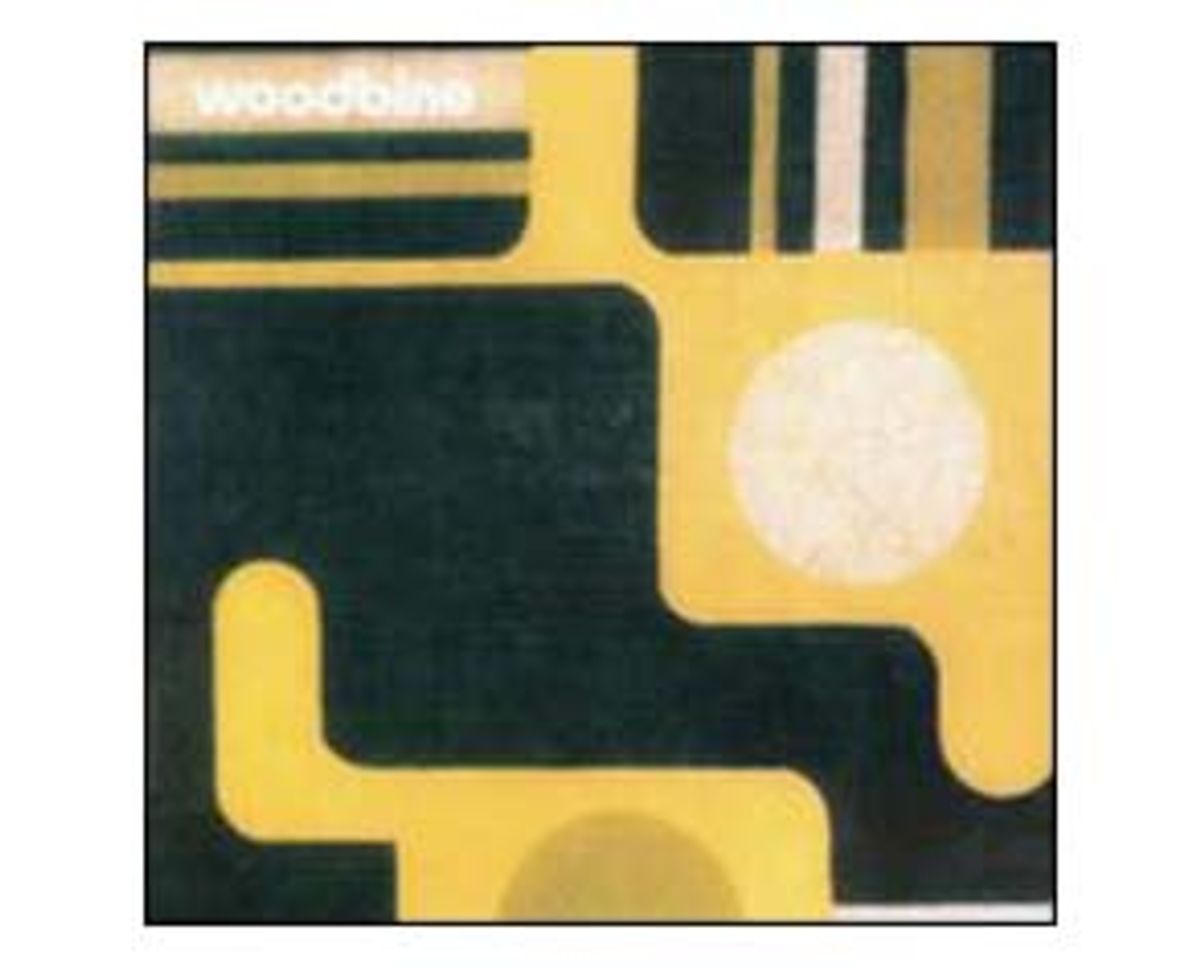
Woodbine: “Woodbine”

The U.K. trio's beautiful, hallucinatory pop songs are the stuff the most fascinating, strangest dreams are made of.

Woodbine
“Woodbine”

Out now on Domino Records

Birmingham, U.K., trio Woodbine, whose heritage traces from London Punjabi-rock act Cornershop and Blackpool punk band the Membranes, took a drug-addled three years between signing with Domino and delivering a first single. But their self-titled debut L.P. followed quickly, thanks in part to some production help from Jennifer Herrema and Neil Hagerty of Royal Trux (aka Adam and Eve)– who never met the band but still enjoyed free rein in remixing Woodbine’s quirky, hallucinatory songs.

Juxtaposing the familiar with the impossible, this album is as surrealistic as it is sublime. Woodbine employ softly shaken maracas, a randomly hit woodblock and a heavily processed tambourine to create the percussive foundations of their songs. Searing noise-guitars confront singer Susan Dillane’s angelic vocals. Goats and tropical birds float in and out of a laugh-track dreamscape, and tinkling bells mingle with wah-wah peddle and fuzz bass.

Woodbine have found themselves likened to a hodgepodge of artists, among them Saint Etienne, Opal, Spiritualized, and Nick Drake — and this release has critics scrambling for comfortable handholds again. But while they indulge in the occasional cunning musical quotation (“Complete Control” humorously references Jim Beattie’s “Adventures in Stereo”), Woodbine are that rare band that takes its cue from no one and defines a unique nexus of beauty with utter strangeness.

Donna Summer: Disco diva and rocker

If you only knew the singing sensation by her 1970s smashes, you barely knew her at all

There is so much about Donna Summer that we didn’t know… and not just the cancer that took her life. Let’s start with her relationship to rock. Summer is quite understandably known as a disco singer, and quite rightly so. It was disco that made her, and she, as perhaps disco’s highest profile performer, who helped to shape the genre. But like a number of other disco artists — Nile Rodgers and Bernard Edwards of Chic, the vocal trio Labelle and Chaka Khan all come to mind — Donna Summer was also a rocker. Yes, she grew up singing gospel, but she began her professional career as a ’60s rocker. She would describe this as her Janis Joplin phase, and she did indeed sing in a group that performed at the Psychedelic Supermarket — Boston’s version of Bill Graham’s Fillmore. She then went on to play a hippie in the Munich production of the rock musical “Hair,” and sported an enormous Afro inspired in large part by her hero, the black radical activist, Angela Davis. Although the disco music that she made with producers Giorgio Moroder and Pete Bellotte, and engineer Harold Faltermeyer provoked a fierce backlash from some aficionados of rock, this was a foursome that, as critic Dave Mash pointed out, functioned as a rock band, one in which Summer played a pivotal role as singer and songwriter. And then there is her singing. Listen to her hit “Hot Stuff,” and tell me that Summer could not sing rock.

Summer, who was strikingly beautiful, made some very steamy — some would say X-rated — music, most memorably with her first hit, 1975’s “Love to Love You Baby.” With Summer’s groans, moans and gasps powering the track, it broke new ground in its sexual explicitness. Promoted by her record company in explicitly sexual terms, and giving performances that made Tina Turner’s look tame, Summer soon found herself tagged the “Linda Lovelace of pop music.” She had seen this coming. In fact, she had not wanted to be the singer on that track, and agreed only to record the demo, and only then in a blackened studio where she sang, imagining that she was Marilyn Monroe giving herself over to orgasmic ecstasy. After producer Moroder convinced her to let him use her vocal, her record label president, seeing its bedroom potential, demanded a long-playing version that left the media debating whether the singer came 22 or 23 times. Rock critic Robert Christgau poked fun at the record with a review that consisted of three questions, “Did you come yet? Huh? Did you come yet?” Other reviews were more disparaging. But “Love to Love You Baby,” like much of her music, put female desire front and center in a way that it wasn’t in most rock music. Indeed, Summer’s music is inseparable from second-wave feminism’s emphasis on women’s sexual empowerment.

There is so much to say about Summer, who could have been a full-fledged personality had she not been pigeon-holed and dismissed as a disco tart. I was once on a radio program with her and, believe me, she was nobody’s fool. She described the “star-making machinery” as well as anyone. After she had already became famous she told Rolling Stone that her career sometimes felt like “this monstrous, monstrous force, this whole production of people and props that you’re responsible for, by audiences and everything that rules you until you take it upon yourself to be a machine… And at some point a machine breaks down.” Fame, she observed, diminished her, making her feel like nothing so much as a “commodity.” After falling into a debilitating depression and attempting suicide, she took control of her life again through Christianity.

In a way, I think one hears Summer confront her own commodification on her marvelous record “Bad Girls.” Although the music in the final, released version suggests otherwise, Summer isn’t celebrating prostitution on “Bad Girls.” Rather, she is confronting what she shares with those streetwalkers. “Now, you and me are just the same,” she sings.  And if Summer sounds unusually exuberant as she yells out to a john, “Hey, mista, have you got a dime?” perhaps it’s because Summer understood what it meant to be made into a commodity and reduced to a seductive whisper. Tellingly, in a television interview some years later, Summer noted that “Bad Girls” marked the moment when she stopped being an object and became a subject. Let’s hope that in her death she inspires more writing that fully acknowledges the intelligent subjecthood of this disco diva and kick-ass rock and roller.

Continue Reading Close

Alice Echols, a professor of English, and the Barbra Streisand Chair of Contemporary Gender Studies at the University of Southern California, is the author of four books, including "“Hot Stuff: Disco and the Remaking of American Culture."

Donna Summer, Queen of Disco, dies at 63

The "Last Dance" singer passed away after a battle with cancer

NEW YORK (AP) — Disco queen Donna Summer, whose pulsing anthems such as “Last Dance,” ”Love to Love You Baby” and “Bad Girls” became the soundtrack for a glittery age of sex, drugs, dance and flashy clothes, has died. She was 63.

Her family released a statement Thursday saying Summer died and that they “are at peace celebrating her extraordinary life and her continue legacy.”

Summer gained prominence during the disco era of the 1970s, and released a number of albums that have reach gold or platinum status, including the multiplatinum “Bad Girls” and “On the Radio, Volume I & II.” Her No. 1 Billboard Hot 100 hits include “Hot Stuff” and “MacArthur Park.”

Her sound was a mix of genres, and helped her earn Grammy Awards in the dance, rock, R&B and inspirational categories.

She released her last album, “Crayons,” in 2008. She also performed on “American Idol” that year with its top female contestants.

The perfect Beatles double bill

Martin Scorsese's George Harrison documentary may be expansive, but 2009's "Nowhere Boy" is more insightful

Stills from "Nowhere Boy" and "George Harrison: Living in the Material World"

If I were the Texas School Board in search of the one text that could justify teaching “intelligent design,” I would use the Creation Myth of the Beatles as my sole curriculum.  It is a story oft retold with wonder, as it defines the word “supernatural.” Two musical prodigies of staggering gifts, with complementary personalities, just happen to meet in the same fairground, and just as casually decide to change the world. They soon meet a third musical force of nature, and, just before they march from their secret fortress, they add the final element to what is now an impregnable weapon of mass musical distraction.

In the words of noted musicologist Steve Jobs, “It was the chemistry of a small group of people, and that chemistry was greater than the sum of the parts. And so John kept Paul from being a teenybopper and Paul kept John from drifting out into the cosmos, and it was magic. And George, in the end, I think provided a tremendous amount of soul to the group. I don’t know what Ringo did.”

If Jobs had to ask what Ringo did, well, it proves every genius has a blind spot. But the ineffable mystery is this. There are many precedents for single geniuses that spontaneously combust into existence (see Dylan, Bob, or Hendrix, Jimi), but how do four extraordinary elements come together to produce a world-changing hydrogen bomb of musical genius? I’ll leave the Texas School Board to explain that to me. Or, watch the two films in this week’s double bill.

Today marks the DVD release of “George Harrison: Living in the Material World,” the four-hour Martin Scorsese dissection of the life and offhand times of George Harrison. The film’s compiler — not really director (more on that later) — Martin Scorsese, knows from musical genius and genius in general, being something of one himself. His last core sample on this subject, “No Direction Home,” spent four hours getting as close to the genesis of Bob Dylan’s genius as the artist would allow, which is to say, not very. It wisely did the next best thing, which was just showing Dylan being Dylan, while a chorus of friends and acquaintances tried to figure it all out. Nobody came close, of course, and Dylan’s own interview was conducted by his manager, Jeff Rosen, with all of the hardball questioning one would expect of Fox’s Chris Wallace interviewing John Boehner. Scorsese did the best he could – and that is very good indeed – overseeing a compilation of found objects in something that resembled a narrative structure. But in Dylan’s case, good is never good enough. Essential viewing if you are a Dylan fan, but ultimately, a museum artifact, where Dylan’s infinity of talent is definitely not on trial.

Scorsese’s follow-up, “George Harrison: Living in the Material World,”  is not really much different, though, ironically, one of the very few things left out in this tragical history tour was the impact of Harrison’s long creative and personal association with Dylan. The Beatles Creation Myth is front and center here, and as a duly authorized by the Harrison estate project, the archive material takes the viewer on a ride through the highlights. But only in the back seat. Paul McCartney and Ringo Starr are both interviewed at length on both Harrison and the journey they took together, but they offer few new insights. Ringo Starr lets down his guard only once, when he remembers his last encounter with his dying comrade, but that guard is soon posted again, and the show goes on. Knowing the forensic details of a magic trick does not do that trick any favors, and there’s little magic to be found in the first half of this film.

The second half of the film that deals with George coping with that ever-so-awful burden of huge fame and unlimited wealth drags on longer than the interminable jams that rounded out Sides 5 and 6 of the vinyl of “All Things Must Pass,” and while Harrison emerges as the hero of his own life, we ultimately agree with him that there were compelling reasons why his private life should have stayed private.

Sometimes, as I am sure Scorsese knows, bootlegs reveal far more than official releases, and the weight of being an “Authorized Release” somehow diminishes the end result. Scorsese doesn’t put much of his own skin in the game, and acts less as a director here than a detached observer, and that detachment prevents us from connecting with a story that defined a cultural renaissance. One longs to see Scorsese on fire, beating the creative process into submission in the way that Nick Nolte’s abstract painter bashed out a canvas to Dylan’s 1974 apocalyptic version of “Like a Rolling Stone” in the underrated anthology “New York Stories.” It takes one to know one, and in “George Harrison: Living in the Material World,” as in his other musical hagiographies, Scorsese seems almost embarrassed to confront genius on his own terms, in that secret language he’s privileged to share with his subjects.

A much scruffier and ultimately more revealing insight into the Beatles Creation Myth comes from the 2009 “Nowhere Boy.” This movie is set entirely in those moments when a strange kind of human alchemy transpired, in the grimy laboratory of Liverpool. No attempt is made to explain how the magic happened, but the viewer gets the distinct sense “why.” It’s ironic that one of the most insightful glimpses into the real George Harrison in “Living in the Material World” comes from a long excerpt from “A Hard Day’s Night,” where George stumbles into an advertising focus group, and returns the cynical condescension he is given with a far more withering detachment. The fact that this scene is wholly fictional does not diminish its insight – and the same thing can be said for “Nowhere Boy.”

Based on a memoir by Lennon’s half-sister, Julia Baird, the film was endorsed and informed at extreme arm’s length by Yoko Ono and Paul McCartney, and is far better for their lack of involvement. Lennon is inhabited, not played, by Aaron Johnson, and at no time does Johnson’s performance descend into mere impression. Johnson just “is” – and within a few moments of his first on-screen appearance, you are transported back to 1955, and present at the creation. Primal rock ‘n’ roll fills the air, and a rough beast slouches on its way to be born, and Johnson’s Lennon puts a face on that creature. The film’s director, Sam Taylor-Wood, married the much younger Aaron Johnson after she completed the movie, and her primal attraction does seem justified.

All the bases are covered. The eternal fights with Aunt Mimi, played with prim precision by Kristin Scott Thomas. The strange, almost sexual attraction between Lennon and his uninhibited mother, Julia. And of course, the legendary 1957 first meeting with Thomas Brodie-Sangster’s Paul McCartney. Entire books have been written about this July day at a school fair, where the world turned on its axis. As a card-carrying Beatlemaniac, with a mail-order degree in advanced Moptopology, I noticed that “Nowhere Boy” got all of the details just exactly right, down to the checkered shirt that Lennon wore on that meeting day, and even a brief glimpse of the photographer who took the now iconic picture that is the only record of that day when the world turned inside out. George Harrison’s later back-of-a-bus passage into legend is also documented adroitly, though here, as was sadly the case in the life of the Beatles, Harrison plays a supporting role.

But in ways that no authorized documentary can hope to attain, “Nowhere Boy” gets the human dimensions of the Beatles myth just right. The shimmering brilliance, tragic vulnerability and occasional brutality of Lennon comes through, and the telepathic connection that bound the Beatles together somehow extends to the viewer. Even if huge dramatic licenses are taken, they are not abused. The John Lennon in “Nowhere Boy” is often referred to as a “dick” by his peers – but in this film, the wavering line between “dick” and “genius” is navigated with a drunken precision.

Stanley Kubrick once said that “sometimes the truth of a thing is not so much in the ‘think’ of it, as in the ‘feel’ of it.” “Nowhere Boy” has that feel, and that touch, and brings us as close as we are likely to get to “feeling” the reality behind the myth.

Continue Reading Close

Punk’s cultural revolution

Pussy Riot's masked women have become icons of Russia's anti-Putin movement -- and turned the genre on its head

Seven members of the band Pussy Riot (Credit: Wikipedia)
This piece was originally posted on The New Inquiry. Follow TNI at @newinquiry and subscribe to TNI Magazine here.

Russia Today, the politsiya and Western punks alike all want to know: Who is Pussy Riot, when is their next gig, and where can I get their album? Despite having no releases or merchandise for sale, no tour dates, no Myspace or even recorded music, the band of masked women who perform only aggressive guerrilla shows has achieved a level of punk legitimacy not reached since the era when the combination of bleached hair and three chords was on its own automatically scandalous.

The New InquiryThe days of the Fraternal Order of Police suing the Crucifucks, Tipper Gore taking on the Dead Kennedys, and black metal goblins burning churches are long past. Punk is now no more a social threat than some leftist fringe group selling poorly designed newspapers. And yet, with three of its alleged members now imprisoned and facing seven-year jail sentences, the pastel-balaclava-wearing, sloppy-guitar-playing riot grrrls have become an icon of a brewing cultural revolution in Russia.

Pussy Riot’s now famous performance of Punk Prayer in Christ the Savior Cathedral in Moscow’s Kremlin, which earned them the personal ire of both the Orthodox Church’s patriarchate and Vladimir Putin himself, was a call for the Virgin Mary to become a feminist and exorcise Putin. Other feminist and anti-authoritarian performances included disrupting a fashion show by taking over a catwalk, performing unpermitted in a posh boutique, and playing a song called “Freedom to Protest — Death to Prisons” on the roof of a building in a Moscow prison complex to jailed anti-Putin protesters.

Last week a “Party Riot Bus” circled Moscow blasting punk rock and stopping for news conferences and performances calling for the release of the imprisoned band members. Riot grrrl matriarch Kathleen Hannah released a video pledging her support to the band, telling her fans she would “see you out in the streets.” A concert in Tallinn, Estonia, to support the band drew several notable politicians, including President Toomas Hendrik Ilves.

On the flip side, counterprotesters have attacked supporters in Moscow, focusing on removing the masks of female supporters. An anti-Pussy Riot rally was held the same day is Krasnodar, drawing an estimated 10,000 calling for a “moral revival” in the “fatherland.”

The band has derived their success — and scorn — by turning contemporary punk culture on its head. Where punk was once relegated to musky basements, squats and other shabby makeshift venues, Pussy Riot makes all public spaces — the streets, the metro, the church — their stage. While punk bands play for punks, Pussy Riot plays for commuters, police  and clergy. While punk bands seek fame with glamorous pseudonyms and outlandish rock star antics, Pussy Riot is masked. While punk bands engage in nihilistic lyricism, Pussy Riot’s songs are direct attacks on the confines of their authoritarian state and patriarchy. Since punk fell from the pop charts in the early ’80s, it has been sent on a quest to define and sustain its own identity, creating punk houses, venues, record stores and community centers, resulting in the introverted and self-obsessed situation of the sub-genre today. Pussy Riot does precisely the opposite.

It is fitting, then, that one conservative Russian website translated Pussy Riot to “Uprising of the Uterus.” What was once scandalized, forbidden, subaltern, rises from its rightful caste hidden and below and speaks in the very locations of its oppressing power. Who are these women, these punks, to perform, to pray, to protest in sacred locales? To desecrate is one of punk’s existential tasks. The smashing of sacred relics conjures society’s most archaic reactions: in this case, imprisonment, public shaming, flogging, concerns of Satanism, witchcraft, hysteria.

Punk has needed a Pussy Riot for so long. In many ways, it is the literal projection of the riot grrrl movement, which employed satire and third-wave theatrics to intervene in the traditionally macho and misogynist punk scene. It succeeded in creating a new type of punk — the grrl — but, until now, it had never successfully caused a riot.

Through the 2000s, bands have unsuccessfully attempted to wreck cultural terror. There was San Diego’s the Locust, who wore masks and bodysuits similar to Pussy Riot, played noisy and aggressive punk, but were not actually anonymous, nor were their lyrics directly political. The band shocked a lot of punks and sold a lot of records, but had very little cultural impact outside their genre. Black metal-heads became enamored with the “Cultural Terrorist Manifesto,” which also has had seemingly no effect. In 30 years, punk had perfected only gestures.

Perhaps part of the reason punk has begun to lash out so effectively in the former Soviet Union is the nature of the extreme oppression in Russian society. I spoke to Moscow anti-fascist Kostya about the dual dangers to the Russian anarchopunk — the right wing and the State:

I came up with the scene when it was possible to organize a strictly antifascist show, and you could be sure that only the right people will visit it. But still there was a danger of being attacked by Nazis before or after the show. Today it continues, but the situation is even worse. First of all, nobody fights with the fists, you’re more likely to be stabbed or shot with a traumatic gun. Secondly, and what is worse, there is strong oppression from the state and police. The situation in Russia isn’t stable, that’s why the government tries to control all the young people who can be dangerous today or in the future. They always try to put the same number of Nazis and anarchists in prison.

Kostya tells me Russia has its own anti-activist police force, called the “Department of Fighting Extremism.” Along with the threat of right-wingers burning down political squats or punk venues, the result has been a neutralized public face for the punk scene. All radical politics have been forced underground. It is no surprise, then, to see it return masked.

In 1977 the Ramones toured America like an Armed Struggle cadre of cultural terrorists, all dressed alike, playing the simplest and loudest music yet formulated. They not only invented punk that year, but they planted it everywhere they went. Punk’s success was its virility; reproducing with such ease that soon there were Ramones at every corner of the globe.

Reacting to increasingly technical progressive rock, the Ramones liberated the guitar to the world. Pussy Riot has taken this communization a step farther. To be a “member” of Pussy Riot, you don’t need to be able to play guitar or even to know the original band. As one member, Garadzha, told the newspaper Moskvkie Novosti: “In principle anyone can join.” You don’t even need to sing very well, she continues. “It’s punk, you just scream a lot.”

What would be the shape of punk outside the confines of the world of rock music? If Pussy Riot is any indication, it appears at scenes of intense banality or oppression. They have appeared on the catwalk, on top of a prison and of course at the altar. They sound something in between a streetpunk band (Blatz’s Fuk Shit Up is the first thing to come to mind) and an battle-worn activist giving an impassioned speech through a megaphone. The precarity of their performances gives a new spin to the typical speedy bursts of punk — the songs need to be so short because they could be apprehended any second.

Everything about the band is similarly practical. The rawness of their sound reflects the semi-improvised site-specific nature of the songs. Their masks obscure their identities from police detection. Their bombastic performance (use of fire, flares and the iconic punch-dancing) makes up for the lack of amplification. While other novel punk bands form their own stylized front against the limits of society, society’s limits seems to have fully formed Pussy Riot.

Perhaps antagonistic counterculture, once self-ghettoized within the margins of society, is beginning to coalesce into a new political form, one that transcends both its anti-social roots and the populism that activism too often demands. The Occupy movement is the most obvious example, but disruptive feminist and queer situations similar to those created by Pussy Riot have occurred in the United States over the last several years. The radical queer group Bash Back! disrupted service at a Lansing, Mich., megachurch, making out on the pulpit and dropping pro-queer flyers. Repetitive comments by law enforcement official that rape is a result of women’s attire lead to massive anti-rape and sex-positive “Slut Walk” protests last year. With a new right-wing offensive against women escalating to the withholding of contraception and forced transvaginal ultrasounds, the coalition between the church and authoritarianism is as relevant in the United States as in Russia. Could time be ripe, then, for some of the aforementioned agitators to arrange a Pussy Riot U.S. tour?

The New Inquiry is an online journal of social and cultural criticism. Every month,TNI releases a subscription-based magazine for $2, available for download in both PDF and e-reader formats. The New Inquiry Magazine, No.3: “Arguing the Web” (April, 2012) is available now! Support TNI and subscribe for $2 here.

Continue Reading Close

A.M. Gittlitz is a fiction writer, essayist and bike delivery boy living in Brooklyn, New York. He formerly wrote for Arthur Magazine blog, and a contributer to Death Panel Press and Modulo Magazine.

Long live the boy band!

One Direction is the latest group to create carefully manufactured hysteria among young girls

One Direction

Like James Bond movies, fad diets and literary feuds, they are an ever-renewing part of the fabric of our pop culture lives. The hairstyles may change and the pant legs widen or retract, but the boy band — just dreamy enough to send preteens shrieking through their orthodontia, but bland enough to make their just slightly older siblings groan about how much they suck — will never die.

Yet not since the halcyon days of smooth harmonies and awkwardly choreographed moves known as the ’90s has the boy band enjoyed quite a moment like this. There’s U.K. import the Wanted. There are Nickelodeon stars Big Time Rush. There’s even the classic do-they-or-do-they-not-qualify-as-a-boy-band boy band Hot Chelle Rae. And smiling nonthreateningly near the top of both the Billboard album and single charts, there is the inescapable, planet-dominating One Direction (who, it was announced this week, will soon be getting their own Hasbro dolls).

Aside from their requisite forward-blown Bieber hair, everything about One Direction has existed since boy band time immemorial. The inoffensively pleasant sound. The carefree beach-themed videos. The roster of four or five just-distinctive-enough guys to assure vehement lunchroom battles over who qualifies as the cute one. None of that’s an accident. The boy band generally does not form organically in somebody’s garage, born of the fire inside a handful of comrades to rock the hell out.

Sure, sometimes, the group may consist of classmates, like Philly’s Boyz II Men, or siblings, like Hanson, the Jonas Brothers, the Osmonds, or the Jackson 5. But more often, the boy band is a calculated venture, designed expressly to capitalize on the nascent hormonal drives of young females. It originates when someone answers a casting call or forms a business plan. The Monkees began with an idea for a TV show about a Beatles-like quartet. Menudo managed to keep rolling for two decades thanks to an ever-changing roster of fresh boy meat brought in when the veterans aged out. The Backstreet Boys came together via a newspaper ad in Orlando, America’s cradle of theme parks and make-believe. And One Direction formed when a bunch of U.K. “X Factor” competitors pooled their resources.

To be in a boy band is to enjoy a precarious kind of fame. The adulation and the sales success are usually as fleeting as the cusp of adolescence itself. Boys become men. Even Boyz II Men become men. Sometimes, those boys go on to become a Ricky Martin or Justin Timberlake, with a thriving, mature career. Sometimes, they coast for years on their youthful moment of fame, like Bobby Brown or Nick Lachey. And sometimes, they just wind up being that guy from Color Me Badd. Yet when you’re armed with good looks, good hair and a few remedial moves, it must be a sweet ride for however long it lasts. Just this Thursday, Big Time Rush boastfully declared themselves the “Best Boy Band of All Time,” a claim that the now-lurching-toward-middle-age 98 Degrees will have to challenge when they reunite for a tour this summer.

Someday, those sweet kids from One Direction, the ones whose “What Makes You Beautiful” homage to hair-flipping is currently pushing you to climb the walls faster than the song can climb the charts, will have thinning hair and beer guts. They’ll do an oldies tour for their die-hard devotees. And by then, their older and settled former fans will understand why their moms still shout “That’s my jam!” when New Edition comes on the radio, or their grandmothers cried the day Davy Jones died. It’s because you never forget your first love. And for a lot of girls, it’s clear who that person was. It was the cute one.

Continue Reading Close
Mary Elizabeth Williams

Mary Elizabeth Williams is a staff writer for Salon and the author of "Gimme Shelter: My Three Years Searching for the American Dream." Follow her on Twitter: @embeedub.

Page 1 of 283 in Music