Music

All that you want to leave behind

U2 spent the '90s making rebellious music that strayed into weirdness and irony, but a new compilation sticks to the band's trademark earnestness.

  • more
    • All Share Services

Topics:

All that you want to leave behind

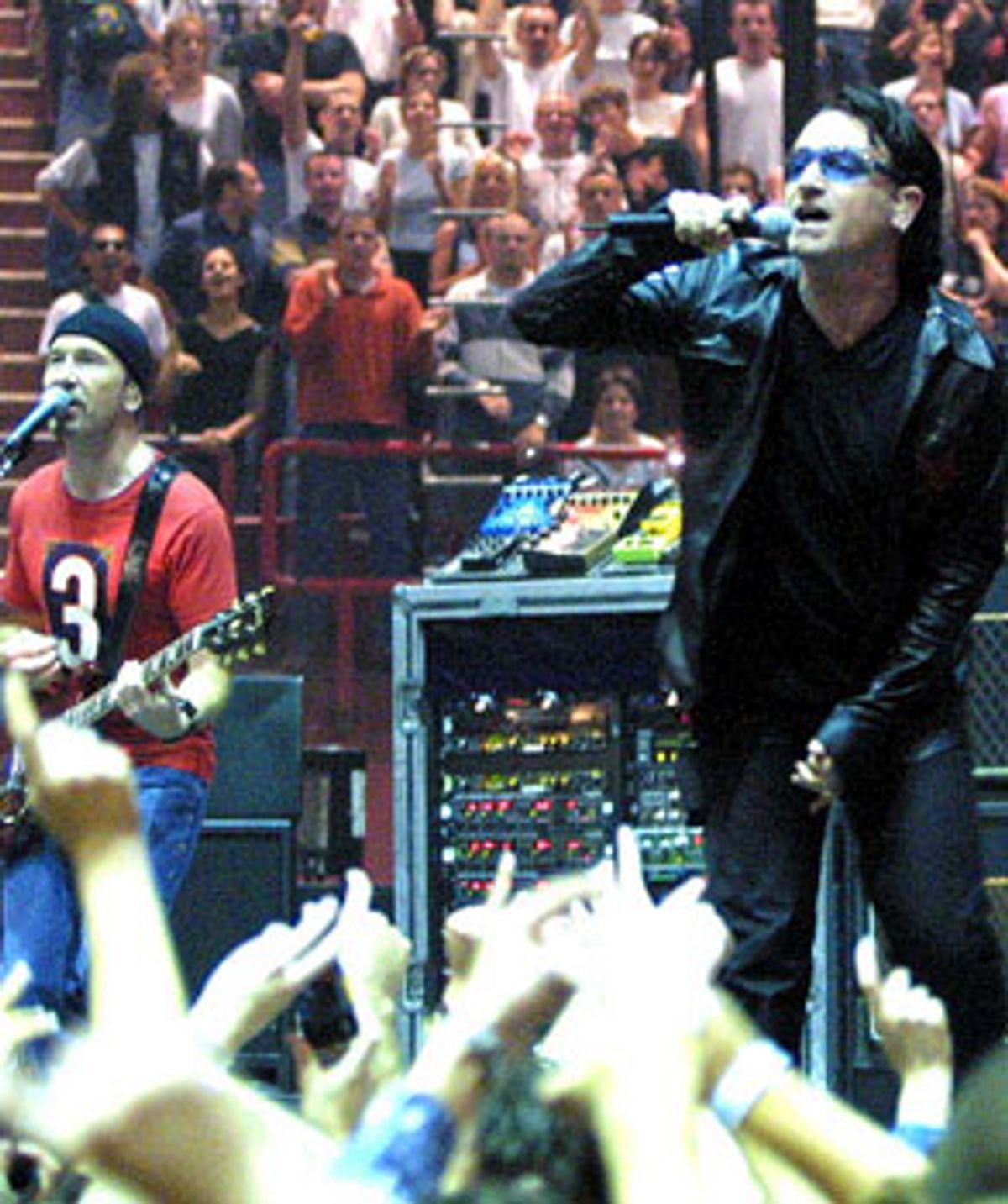
Underneath U2′s patriotic flag-waving and global peacemaking, at heart the four lads still want to be rebellious Irish teenagers. What other explanation is there for what happened to them during the 1990s? During the ’80s the band was scrappy and brash, steadfastly ignoring the plastic passion of new wave with politically charged idealism and tilting activism. After conquering most of the free world with “The Joshua Tree” in 1987, the band members fit comfortably into their roles as straight-faced rockers, saving humanity with soaring anthems and bleeding hearts on their sleeves.

Then, in their version of getting a tattoo, staying out all night drinking cheap beer and skipping out of gym class for a smoke, the foursome spent the next decade running away from a reputation. No longer the polite young men you could proudly take home to Mom, their very public descent into irony and weirdness was fascinating to watch. The band released the electro-buzzed “Achtung Baby” (1991) and Bono transmogrified into a debauched devil on the Zoo TV tour. On “Zooropa” (1993) the Edge mumbled the cold “Numb” to a keyboard line borrowed from proto-new wave band the Normals’ “Warm Leatherette.” And then there was the Popmart extravaganza, a Day-Glo train wreck of synthesizers, larger-than-life Golden Arches and a mechanized lemon — a sort of experiential version of the kaleidoscopic and commercially sour “Pop” (1997). After the long-haired, doe-eyed earnestness and genuine faith of ’80s warhorses like “With or Without You” and “Sunday Bloody Sunday,” U2′s winking excess and ironic, “Is this a joke?” sensibility were difficult to swallow.

All said, U2′s “The Best of 1990-2000″ should be less cohesive and a lot harder to digest than its predecessor, “The Best of 1980-1990.” The techno-fried tracks on a bonus 13-song disc of B-sides that was packaged with “1990-2000″ during the first week of release are certainly patchier. However, the 16 songs included on the single-disc A-sides compilation are surprisingly much tamer than the four full-length albums from which they are plucked. Call it revisionist history or selective remembering, but “1990-2000″ has obviously been processed and manipulated through a massive earnestness filter. In a way, this collection exposes an all-new irony: That for all their slick-sell posturing, U2 was pretty serious all along. Or at least that’s the intended message.

Instead of “Zooropa’s” trance-inducing title track or the hectic urban chaos of “Lemon,” we hear the dreamy, tick-tock lullaby of “Stay (Faraway, So Close!)” and a delicate, almost a cappella “The First Time.” “Pop” is similarly pruned: The new mix of “Gone” is closer to the band’s loose live version, minimizing squealing synths in favor of sparse piano chords and Adam Clayton’s bass. “Staring at the Sun,” often reworked into an acoustic tune in concert, emphasizes Larry Mullen Jr.’s drums and random dapples of guitar and synth high in its own remix, underscoring its desolate atmosphere. While first-rate compositions, both give little hint of “Pop’s” messy bursts of mechanical fireworks.

Of course, some of U2′s bizarre artifacts just can’t be swept under the rug. The new version of “Pop’s” glittery all-night party “Discotheque” — heavier on the funk — and a slightly tweaked remix of “Numb” both betray their automaton origins. And you wouldn’t want to change a few relics, such as “Hold Me, Thrill Me, Kiss Me, Kill Me,” their excellent “Batman Forever” soundtrack contribution that oozes lust, pulsing with a jagged riff.

As a whole, “1990-2000″ accurately delivers the essence of “Achtung Baby,” reproducing its vulnerable declarations of love, erotic dance-floor artifice and doses of decadent seduction. All of that is included here in three songs: the ballad “One,” the apocalyptic come-on “Until the End of the World” and the hypersexual “Even Better Than the Real Thing.” The goal with the rest of the collection seems to be to amass something as undated, as unembarrassing even, as “Achtung” as a whole.

This likely explains why all three songs from “Pop” appear remixed. Stripped away to chords and lyrics, “Pop” is quite possibly one of U2′s most gut-wrenching albums; its cheesy electronics fail to hide the anguish of “Wake Up Dead Man,” “Please” and “Mofo.” But today it also seems like the musical equivalent of U2′s goth phase, the band awkwardly trying out keyboards and vocal distortion like a teenager messing with fishnets, dyed black hair and the Sisters of Mercy.

In retrospect, U2 didn’t waver as much as we thought during the Clinton years. For a rock band, they were properly unconventional — even rebellious. Just as grunge rock began to grumble with angst, Bono stretched into the top of his vocal range on “Ultraviolet (Light My Way).” Later, their spate of “Achtung”/”Zooropa” remixes predated the short-lived electronica boomlet in the States by almost five years. And then, when boy band and Britney fluff infested the pop charts with disposable confections, U2 arrived with “All That You Can’t Leave Behind,” a no-frills rock celebration of guitars, bass, drums and vocals.

Oddly enough, there are only two tracks — “Beautiful Day” and “Stuck in a Moment You Can’t Get Out Of” — from “Behind,” both trumpeted as a return to their guitar-band roots. (What about “Walk On” and “Elevation,” the epitome of the uplifting songs picked for “1990-2000″?) Maybe that’s U2′s mischievous rebelliousness peeking through serious passion. That would help explain the inclusion of “Miss Sarajevo,” their collaboration with Luciano Pavarotti from the “Passengers: Original Soundtracks 1″ fake film score album.

But judging from the flashy techno populating the bonus B-sides disc, U2 prefer to hammer home their defiant teenage outlaw side on this half of the collection. “Salome (Zooromancer Remix)” sounds vaguely like Duran Duran’s “Save a Prayer” after an extended bit of chilly disco, while “Dirty Day (Junk Mix)” is an odd collage of sound with old pal Brian Eno on keyboards. “Even Better Than the Real Thing (Perfecto Mix)” and “Numb (Gimme Some More Dignity Mix)” are saturated with gospel choir vocals of early ’90s house music, and “Discotheque (Hexidecimal Mix)” cribs a crash-and-burn synth echo from the Chemical Brothers’ “Setting Sun.” Only a few tracks — in particular the hushed “North and South of the River” and “Your Blue Room” — tone down the frenzy for more solemn reflection.

While not terribly groundbreaking in terms of danceable electronica, these songs nevertheless are a more honest representation of U2′s music from the 1990s. The samples and big beats twist the band’s comfortable sound in new directions. The songs aren’t always successful, but hearing them now, warts and all, is a welcome diversion from the frustratingly simplified recasting of the band on the A-sides disc.

The main thing “1990-2000″ reveals is that U2 seem trapped by the mythology of their own earnestness. This carefully selected A-side collection feels like the members of the band have resigned themselves to the fact that they are best when writing passionate, uplifting songs. With the exception of bonus disc innovations, even their attempts of rebellion — “Miss Sarajevo’s” arias and the glitzy keyboard explosions on “pop” — feel sanitized, occurring within the constraints of their larger-than-life, iconic image so that the compilation will flow well.

This is interesting because the oddball deviations and experiments on the bonus disc are more valuable than the limited edition availability. It proves that U2′s club kid and jaded hipster phases just led them right back to the end of the 1980s — right back to the type of music that made them successful and famous in the first place. The problem is that now U2 is trying to rewrite that story. Because “1990-2000″ is the band’s version of themselves as they want to be remembered. Burn those yearbook photos, ignore the wraparound shades and toss out that giant citrus fruit, because the 1990s were simply a wrong turn down an otherwise straightforward path. No harm done, no integrity damaged, right?

Well, no. Unfortunately, “1990-2000″ also shows that the earnest U2 of 2002 isn’t the same earnest U2 of 1987. The two new songs on the collection, “Electrical Storm” and “The Hands That Built America” (from the upcoming Leonardo DiCaprio movie “Gangs of New York”) buttress the point. Both are gorgeous: The William Orbit mix of “Storm” swells with choruses that climax in a crash of guitar and Bono’s yearning falsetto, and “Hands” screams with cinematic schmaltz and sweeping strings. At the same time, the emotional content of both songs is abstract, tugging at the heartstrings with vague declarations like “Storm’s” “Let’s see colors that have never been/ Let’s go to places no one else has seen.” These songs are cookie-cutter U2: Start with guitar chime, cue grand choruses, now end with a big crescendo and universal revelation. Despite how moving they sound, they emerge somewhat hollow and empty.

Even more disheartening, they sound contrived and somewhat complacent, which was what U2′s changes in the 1990s were supposed to prevent. The band members said they didn’t want to become caricatures of themselves, spitting out the same echoey chords and 4/5 songs album after album. Striking those ironic poses had its price — it stole the innocence and purity that made the earnestness of their early music so magical and true.

The forced solemnity found on “1990-2000″ is a sort of conformity that’s antithetical to what the band has always stood for, and negates the limitless freedom of sound that made U2 great in the first place. Pass me some Maybelline and crank up that Bauhaus; I feel like a couple of spins of “Pop” are in order.

Continue Reading Close

Annie Zaleski is the managing editor of Alternative Press magazine.

“Duets”: “Idol” via “Project Runway”

ABC's new "Duets" is super nice, has no clear rules -- and insists on calling Robin Thicke a superstar

  • more
    • All Share Services

Topics: , ,

“Duets,” ABC’s tardy attempt to fashion a musical competition show of its very own, debuted last week. Perhaps hoping no one would notice just how late it had arrived to the “American Idol” knock-off party if it behaved like it had always been there, it premiered with no explanation of its own rules. (“Oh, you must know all about me already! I have been standing by this punch bowl all night. Really!”) In the not highly rated debut, Kelly Clarkson, Robin Thicke, John Legend and Sugarland’s Jennifer Nettles — a quartet referred to at every possible opportunity as “superstars”—  each selected two amateur singers with whom to perform a duet. The amateurs then received feedback from the other superstars on their performances. At the end of the night the eight contestants were ranked on a “chart.” How were the rankings on the chart determined? What were they a measure of? Would the contestants at the bottom be kicked off the show? Would the contestant at the top win something? Would the contestants in the middle have to perform a cappella while doing an interpretative dance about the word “superstar” and hanging from a trapeze? Who could say? No one who watched the show.

Tonight’s episode of “Duets” then, in which the rules are largely, if not entirely explained, effectively works as a do-over. Each week, the performances are graded — anonymously — by the superstars, and it is their feedback that determines the amateurs’ chart standings. (There is a moment in tonight’s episode when the first performer of the night is told her place on the chart. Anti-climactically, it’s the top one, because she is the only person yet to have sung. “Duets” is still working out its showmanship kinks.) Starting next week, the two contestants at the bottom of the chart will have to face-off in an a cappella duel (no trapeze sadly), and the loser will be kicked off the show. In six weeks’ time, “Duets” will go live and the audience will begin to vote on the outcome of each episode. (As to how the victor of the duel will be determined or what the ultimate winner will win, see the “not entirely explained” clause above.)

When written out, these rules may sound boring enough to seem like the sort of yawn-inducing information a TV show could reasonably hope to spare its audience. But they matter. On all the other major singing competitions, after the winnowing down of the audition rounds — those dark weeks when it becomes clear that America lacks for neither competent singers capable of melisma or the disturbed and delusional — it’s the audience that decides who stays and who goes. On “Duets,” for the next six weeks four relatively articulate performing professionals will be the deciders. “Duets” is temporarily putting off the rowdy, democratic voting process, and its tendency to favor sleepy-eyed white boys, to practice the more aristocratic style of expert judgment found on Bravo’s competition shows. “Duets” may be ABC’s answer to “Idol” and “X Factor,” but in rare moments, it’s also the singing version of “Project Runway.”

Though the four judges are too nice (they start and finish each comment with something like, “I love you,” or “you’re great”) they are also informed. They give feedback — the singing is pitchy, too perfect, too scared, the mic is too close, the dancing is bad. “Duets” does not embrace the sort of serious crit sessions seen on “Runway,” “Top Chef” or “Work of Art,” and it would be much better if it did. The judges seem up to it — not only does Kelly Clarkson effortlessly remain more likeable than anyone who has ever appeared on reality TV, I suspect that there is a Nina Garcia lurking inside of John Legend, whose high standards and perfectionism are belied only by the goofy, childish, wide-eyed expression he gets whenever he is watching a performance he enjoys. Real criticism would also rescue the show from its current in-between state, in which it drags on like any bloated musical performance show, but without the energy or stakes of one since, thus far, “Duets” is pre-taped.

The judges’ participation adds a nice new wrinkle to the format. Though it may mean that we will never get to know the amateur contestants well (this show could be called “Singing with the Stars,” despite the reversal of expertise), it should fuel some future sharp exchanges. Kelly Clarkson may not want to lay in to a reality TV contestant, but she can feel no such compunction about digging in to the over-confident Robin Thicke.

That the judges are performers delivers the same message –albeit at a much softer, less-compelling volume — as those Bravo shows: Talent is great, but greatness is hard, hard work. Robin Thicke may seem most concerned with making himself appear sexy, and Jennifer Nettles may not be able to contain her inner cheeseball, but they, like Legend and Clarkson, are professionals in the most complimentary sense of the word: reliable, knowledgeable, focused, dedicated. What they demand of their duet partners is surely nothing compared to what they demand of themselves. Clarkson, especially, is the embodiment of this. Exactly a decade ago she won the first season of “American Idol,” and she is now back on reality TV mentoring the two least polished, most insecure contestants on “Duets.” She chose them, she says, because they both reminded her of herself. She may be right, but they have lots and lots of work to do before before I see it.

Continue Reading Close
Willa Paskin

Willa Paskin is Salon's staff TV writer.

Riot porn from Kanye and Jay-Z

The music video for "No Church in the Wild" depicts a graphic riot scene and shows the resonance of dissent

  • more
    • All Share Services

Topics: , , , ,

Riot porn from Kanye and Jay-Z

There is a name for videos capturing particularly dramatic riot scenes — the sort with fire, tear gas, charging police horses, careening masked crowds and, often, a hardcore backing track. We call it riot porn. I’ve always thought it’s a bad name. Not because the street scenes — shot from Egypt to Oakland to Greece — aren’t titillating spectacles (and pornographic in that sense), but because all porn — good or bad, exploitative or sex-positive — is staged for the filming. Riots very much are not.

In this sense, the new music video for Kanye West and Jay-Z’s track “No Church in the Wild” is the best actual riot porn I’ve ever seen. The video, directed by Romain Gavras, is five minutes of a graphic, fiery and entirely staged riot. It opens with a young man lighting a Molotov cocktail and lobbing it at a line of riot cops as masked comrades behind him raise their arms in support. Filmed in Prague, but presented as a non-specific yet decidedly European urban battleground, riot cops on horses violently beat the masked crowd, who fight back with fire and fists while Greco-Roman statues look on. Were it not for the surprising appearance of a chained elephant amidst the fray in the video’s final frames, the footage looks (almost) like something straight out of Athen’s Syntagma Square. Jay-Z and Kanye don’t feature in the video at all, which makes artistic sense: I’d be more surprised to see Hove in a riot than a two-tonne elephant.

So what to make of riot porn brought to you by those hip-hop moguls and emblems of excess Jay-Z and Kanye? As I noted last year when purveyors of eau-de-date-rape Axe came out with a scent called “Anarchy”, the depiction of anarchism and riotousness in commercial ventures are at least “a nod to the popularity of dissent.” Gavras, who directed the “No Church in the Wild” video, has long riffed on the idea of social upheaval and fierce state repression in his work. His short film for rapper M.I.A’s “Born Free” told the story of U.S. military forces brutally rounding up and executing ginger-haired civilians. The message was lost on no one, and the video was banned from YouTube. Gavras offers a stylized, gritty and startling depiction of social rupture; that his brutal vision of a street riot is deemed popular and consumable enough to accompany some the most mainstream of music is worth consideration. It’s not just anarchists getting off on riot porn anymore.

This isn’t entirely new: There was the Levi’s jeans commercial last year that featured a young man in Levi’s squaring up to riot cops under the tagline, “Now is our time.” The ad was pulled from British television in light of the summer riots in London. The video for Kanye and Jay-Z’s anthem with Rihanna, “Run This Town,” also featured gangs in black bandanas — but it was a far cry in terms of realism and police-on-protester brutality from the riot scenes in “No Church in the Wild.”

My friends at the New Inquiry magazine, Malcolm Harris and Max Fox, have argued that riot imagery and revolutionary calls in products can serve as genuine threats to capitalism, even though they may be expensive ad campaigns or music videos. In a published dialogue between the two (which is well worth reading in its entirety) Fox and Harris agree that subway ads and select lyrics from pop songs are ample materials for would-be rioters. So, while some might see the depiction and glorification of rioters in a hip-hop video as exemplifying capitalist recuperation (even Molotov cocktails can help sell records now!), Harris and Fox suggest that these images can be reappropriated by anti-capitalists — after all, the accessibility of a music video featuring a riot suggests, at the very least, that this sort of dissent resonates. Indeed, Harris quipped on Twitter today, linking to the Jay-Z and Kanye video, “Oh hey, capital, are you sure that’s such a good idea?” and continued to joke about whether the hip-hop artists endorsed black bloc anarchism. We don’t need to make new anti-capitalist propaganda; Kanye and Jay-Z can have Romain Gavras do it while they accidentally offer up revolutionary slogans in their otherwise problematic lyrics. The bridge for “No Church in the Wild”, sung by Frank Ocean, is an insurrectionist two-liner: “I live by you, desire; I stand by you, walk through the fire.”

Of course, none of this is to say Kanye or Jay-Z should be praised as agents for revolutionary change. Jay-Z, aside from celebrating a life of unadulterated excess, is a key voice behind developer Bruce Ratner’s controversial Atlantic Yards project in Brooklyn, which has been widely criticized for pushing people out of their homes and failing to provide affordable housing and jobs. Meanwhile, Kanye is a famous jerk; he walked by Zuccotti Park once to check out Occupy Wall Street last year, but, again, he is mainly a jerk.

And, it’s worth noting, that the way in which the rioters are glorified in the music video is problematic. I question Gavras’s decision to only feature male rioters. It’s a common criticism of black bloc tactics that they alienate women and perpetuate a masculinist expression of anarchist street actions. Problems of patriarchy in radical scenes certainly abound — indeed it’s an issue too huge to really address here. Suffice to say, however, women across the world who have fought riot police in the streets might take issue with Gavras’s ubiquitously male scene.

But what strikes me the most, and what might make a lot of anarchists and other proponents of street confrontation feel pretty smug, is that Kanye and Jay-Z have the resources to produce pretty much any kind of spectacular music video imaginable. And they opted for riot porn.

Watch the “No Church in the Wild” video below:

Continue Reading Close

Natasha Lennard covers the Occupy movement for Salon. A British-born, Brooklyn-based journalist, she has been covering Occupy Wall Street since before the first sleeping bag was unrolled in Zuccotti Park. One of the first journalists arrested at an Occupy action, she has managed to enrage Andrew Breitbart, Rush Limbaugh and Glenn Beck. You can follow her on Twitter (@natashalennard), and email her any Occupy updates/videos/ideas to natasha.lennard@gmail.com

Quick Hits: Anoushka Shankar performs ISHQ

Legendary sitarist and daughter of Ravi Shankar performs live at New York's City Winery

  • more
    • All Share Services

Topics: , , , , ,

There was a time when Anoushka Shankar’s music fell under her father’s shadow — how could it not, when you play the sitar and your father, Ravi Shankar, just happens to be the most famous sitar master in the world?  But Anoushka has established herself as an extraordinary musician in her own right, with her own distinct voice. In London she recently won the Songlines Music Award for Best Artist of 2012. Her new album, “Traveller,” finds her exploring the common roots of Indian classical music and Spanish flamenco.  She says the technical challenges were formidable, but the music explodes with an intensity that makes it all sound natural — and beautiful.

And as she explains to SOUND TRACKS reporter Arun Rath, she managed to get it all done through the pregnancy and birth of her first child, who now travels with her on tour.


Trust me on this: The Beatles’ “Let It Be”

The acclaimed author hopes his daughter finds her own musical path but still felt proud when she loved the Beatles

  • more
    • All Share Services

Topics: , ,

Trust me on this: The Beatles' (Credit: Johnathan M. Thomas via Shutterstock/Salon/Benjamin Wheelock)

How many more of these stories about dads playing music for their children? Every Father’s Day this story comes around! The kid agreeably listens to the beginning of the Goldberg Variations, and then repairs to his bedroom to play with blocks. The kid, no matter how we spin it, ex post facto, is not the center of the story. The dad is. Did I ever pay attention when I was the kid myself? My dad foisted Beethoven on me when I was in grade school, 9th Symphony. He also had a liking for show tunes. Neither rubbed off on me, not Beethoven, not show tunes.

What I remember is when my parents bought that brand-new album “Abbey Roadand played this LP on their brand-new faux-antique console hi-fi, right about when they were separating. That had some impact. I can remember feeling like “Golden Slumbers,” McCartney’s brief, melancholy lullaby from that Beatles album, was a lullaby for me in a time when I could have used one.

Well, now I am a dad myself, and I don’t want to make my daughter have to listen to stuff she doesn’t want to listen to (though, in fact, I have tried to sneak Sun Ra onto the stereo in her presence). I don’t want her to feel that music is an intergenerational chore. I would do almost anything to make sure that music, for her, is something to love.

And yet: Nothing makes me happier than when my daughter does take to a particular piece of music on her own. Recently, e.g., she became obsessed with a very excellent tune by the Pogues. It was “If I Should Fall From Grace With God,” which my daughter refers to as the loud-and-fast song. As in: Papa, play the loud-and-fast song. No delight is more delightful than dancing to the loud-and-fast song with a 3-year-old specialist in the pogo.

And yet, sometimes, it must be observed, the sadder songs are the more genuine songs, or: there are times when the sadder songs come into focus, or: perhaps affirmation in a song is a thing of which one should always be suspect. And so there was a day recently that I was spending the day with my daughter, just me and her, and after all the usual pastimes had been exhausted I said, at last, falling into the trap of so many dads, We still have a few hours here, how about we listen to some music?

I put on “Let It Be.” By the Beatles. In fact, I put on the song “Let It Be.” And I’m talking about the version from “Let It Be,” the Phil Spector production, not the George Martin-produced single that you can find easily, not the “Let It BeNaked” version, which I actually love, too, because I like hearing how guitarist George Harrison thought about what he did on the various recordings. I played my daughter the “Let It Be” I knew best, and which had bludgeoned me much as “Golden Slumbers” had, back in the day, when things at home were coming unglued.

I played the song for her while I was making her a sandwich. It’s really unusual for a 3-year-old to stop moving, unless she’s asleep, and my daughter was not asleep. But she was pretty still. She was transported by the song. Look, you have heard this song 10,000 times, I have heard this song 10,000 times, we are somewhat impervious to the charms of this song, even though it’s a very beautiful song, but when you play it for someone else, in this case someone else who has never heard the song at all, you get back something lost, the original emotional freight of the thing. And with “Let It Be,” which is apparently about a dream Paul had about his dead mother, and, self-evidently, also about the Beatles breaking up, it is hard not to feel that the title, the refrain, is sung with real insight, a real understanding about what it feels like to need the sentiment expressed therein. There really is a lot of misunderstanding and disagreement and dispute in the world, all of it essentially pointless, our time here is so brief, and it would be better if we could all just …

Now, when you’re 3, a sentiment of this kind has maximum impact when repeated, but it’s repeated a lot here, in the song, over and over, and my daughter picked it up quick, the theme, but not so quick that she didn’t want to hear the song again, and so I played the song again, and finished making the sandwich, and then she wanted to hear it again, and I played it again, and then again, and on the third or fourth repetition, that plaintive, moving quality had begun to empty out again, and I was just hearing the song I had heard 10,000 times, and then my daughter asked for it a few more times. We played it six times. That first day. And we have played it more times since. Papa, play that “Let It Be” song.

What’s it like to have resounding success in the dad-playing-music-for-the-kid sweepstakes? I am not sure I want my daughter feeling like she has to like something just because I played it for her. I would like to provide an opportunity, make the music available, then step out of the process, so that she’s absolutely liberated, so that she has self-determination in the matter of her musical interests. That way she can die for Uncle Rock or Dan Zanes if that is what she wants. But I can’t deny, and especially not here, the sense of pride that I feel when she likes something that I too liked, once upon a time in the suburbs. I hope she can do the same when she’s a parent. Maybe one day she’ll share with me things she likes with the same enthusiasm. And maybe one day I can sell her on Sun Ra.

Continue Reading Close

Rick Moody is the author of five books, including "Demonology."

Concord Music Presents: Joe Walsh – “Wrecking Ball”

Joe Walsh performs "Wrecking Ball" live at the Troubadour in West Hollywood, CA

  • more
    • All Share Services

Topics: , , , ,


"Wrecking Ball" is off Joe Walsh's new album, Analog Man, available June 5th. Pre-order now on CD and vinyl, plus exclusive T-Shirt bundles.

Page 1 of 285 in Music