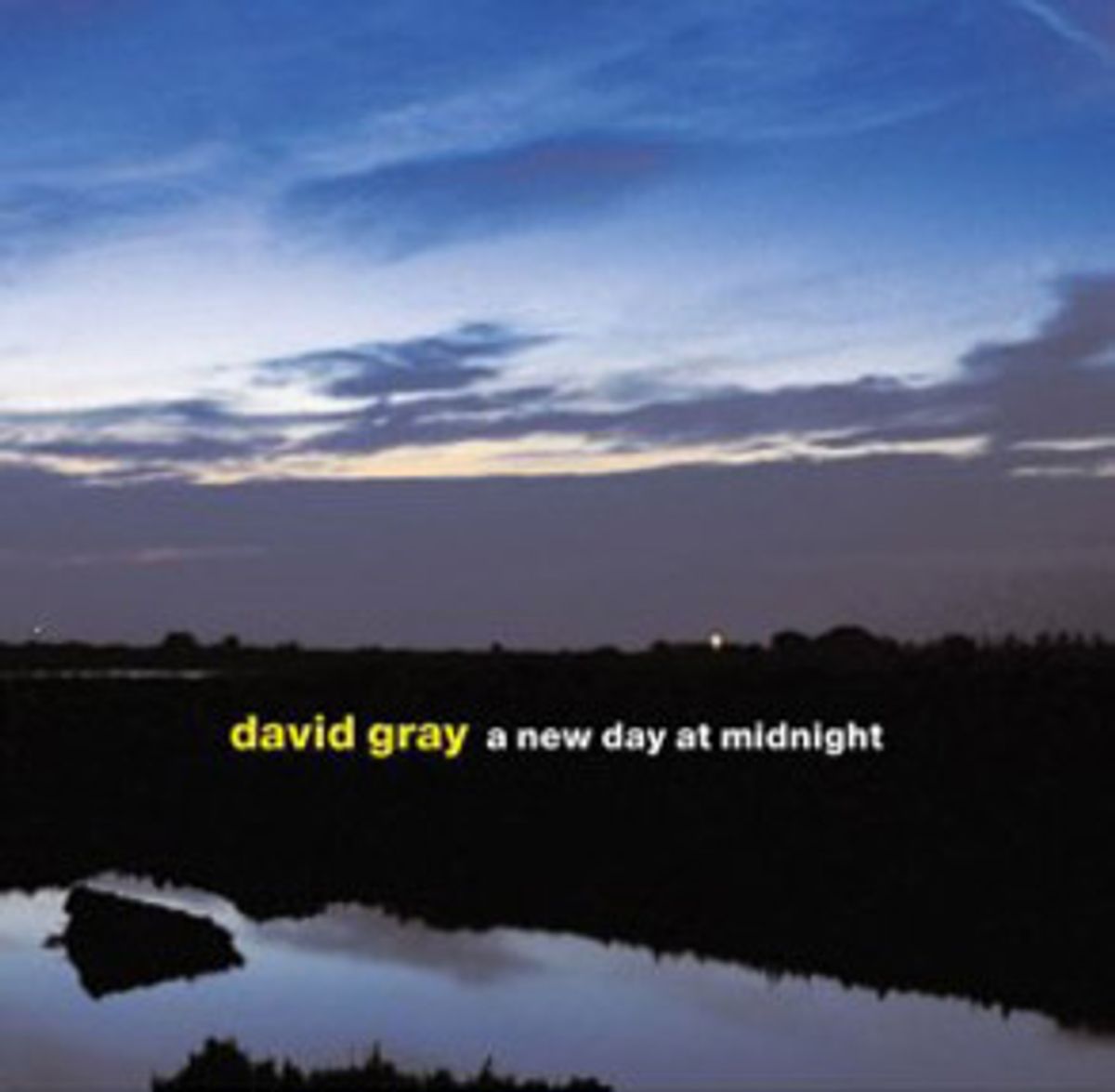
David Gray “A New Day at Midnight” Out now on RCA Records
Nine years after the release of his first album, David Gray has finally come into his own as a bona fide pop star — kind of. Though he is still barely known in the United States, Gray is a celebrity in Britain, and unlike that of so many other British pop musicians, his fame is well-deserved.
Gray’s latest release, “A New Day at Midnight,” is a work of exceptional songwriting, performance and production. His compositions are infused with depths of soul and peaks of maturity not usually found in such a young pop musician. Gray gave glimpses of his composing talent on earlier releases, but on this album he shows a more developed, refined ability and assembles 12 consistently high-quality tunes. No single track stands out like “Babylon” did on 1999′s “White Ladder,” but each song is vibrant and powerful.
The production values have taken a big step up from “White Ladder,” and — like folk-rocker Billy Bragg’s past two high-production CDs — the sound on “New Day” is polished but not at all too slick. Gray uses the same instrumentation as on his last album, mixing folky acoustic melodies with synthesized techno rhythms. It is a potentially ruinous combination when leaning too heavily in one direction or the other, but Gray pulls it off brilliantly.
In seventh grade I owned the cassette tape of “Whitney,” the second album by Whitney Houston, which was true of pretty much every 12-year-old female in America. I played the hell out of that tape. I used to spend afternoons in my bedroom, lip-syncing those songs to my bedroom wall, because that’s the kind of kid I was. Always longing for an imaginary audience. I did not want to be a writer back then, or the president of the United States. I wanted to be a pop star. And in 1987, there wasn’t any pop star more elegant or talented than Whitney Houston. Daughter of a gospel singer, niece of an R&B legend, smashingly beautiful — she was practically anointed by the gods for greatness.
The song I loved the most on that tape was “Didn’t We Almost Have It All.” Fourth song, first side. I would perform the song to the wall, then rewind it and perform it again. Play, rewind, repeat. I can still hear the squiggle of the tape in my head as I pressed on the jam-box button just long enough to find the song’s opening once more. This is a lost art in the age of the iPod, but back then, knowing how many seconds to rewind a cassette was a sign you truly understood its rhythms. You had literally learned the music backward and forward.
“This again?” my brother would ask as the tinkling synthesizers kicked in. My brother was a metalhead, who loved the righteous anger of AC/DC and Judas Priest and did not give a rip for the likes of Whitney Houston.
He did not get a choice in the matter. Here is how the song begins:
Remember when we held on the rain, the nights we almost lost it?
Once again, we can take the night into tomorrow
Living on feelings, touching you I feel it all again
It’s a bit mundane, frankly. It’s a fill-in-the-blank tale of a broken relationship. Funny how every love story sounds the same but feels so different when you’re inside it. That’s the poignancy of love stories, I guess. You’re never alone. Then again: You’re never unique.
But this song is all about the chorus. It is a song constructed almost entirely of its irresistible chorus — half a dozen times in less than five minutes — and the chorus launches a mere 45 seconds in. No foreplay, no footsie under the table, no lingering glances and sighs. This song grabs you by the collar and sticks its tongue down your throat.
It’s a really fantastic chorus, by the way. It’s OK to sing along:
Didn’t we almost have it all, when love was all we had worth giving?
The ride with you was worth the fall, my friend. Loving you makes life worth living.
At 12 years old, I had never been in love. I had never even kissed anyone. And so it’s peculiar that I experienced this song so powerfully. The agony. The crashing emotion. The ka-pow of it all. Why did I feel it so intensely? What was it teaching me? I wonder if all these songs of woe and regret didn’t warp my sense of romance. I wanted to grow up and fall in love, but more to the point: I wanted to grow up and lose that love, because that’s when the real drama began. I understood, even then, the delicious pain of being brokenhearted.
The chorus returns, a little different this time:
Didn’t we almost have it all, the nights we held on till the morning?
You know we’ll never love that way again. Didn’t we almost have it all?
This song climaxes so quickly. Not even a minute into it, and we’re already basking in Whitney’s vibrato, the glorious burst of sustained sound that would become her signature. The woman could push a note like nobody else, squeeze it and feel it up till the listener wanted to cry for mercy. But when you peak this early, it’s hard to know where to go next. The excitement is unsustainable, and for the next three minutes the song will throw out its back trying to one-up itself — a series of elevated key changes, strings atop swell. The song wants you to know the singer is bleeding.
For the moment, though, it pulls back. Whitney’s voice grows subdued. We get more of the back story, which, naturally, is like every back story we’ve ever heard.
The way you used to touch me felt so fine
Kept our hearts together, down the line
A moment in the soul can last forever, comfort and keep us
Help me bring the feeling back again.
I can understand why people hate Whitney Houston. I mean, these lyrics are dreck. It’s cooler to love the big, dirty riffs of Van Halen, the gritty excess of Guns N Roses. But I still find the stadium ballads of the mid-1980s strangely moving. The REO Speedwagon, the Air Supply, the Chicago, the Bryan Adams. The cheesy, lighter-held-aloft songs. They are not clever. They are not sly. They have the temerity to be earnest and unblinking, nothing but a desperate plea to be loved. Like a boyfriend who dims the lights and scatters rose petals in the bathtub. Please, baby, come back to me.
Or, as Whitney Houston sings it:
Didn’t we almost have it all? When love was all we had worth giving?
The ride with you was worth the fall, my friend. Loving you makes life worth living
I finally did fall in love in my sophomore year. He was sweet like my father, charming like my older brother. I still adore him. We drove around in his Chevy Nova listening to David Bowie and Elvis Costello. I began to understand that Whitney Houston was bad and not to be encouraged. We made fun of “I Will Always Love You,” the No. 1 song that would not go away in 1992, the year we graduated. We wanted to stab that song with knives; we wanted to punish it somehow. We were not the only ones turning on Whitney. That was the year Nirvana hit. Culture was edging away from the light and toward the dark, and there was Whitney in the video for “I Will Always Love You,” singing her heart out in the middle of an empty winter landscape as Kevin Costner walked away.
My boyfriend and I broke up at the end of high school, and I secretly bought the cassingle to “I Will Always Love You.” I listened to it in my bedroom, over and over. Nothing could touch the pure emotion of that song. I listened to “Didn’t We Almost Have It All,” too, and it was exactly the comfort I wanted, like pulling an old teddy bear off the shelf and cradling it in your arms as you cried.
Didn’t we almost have it all? The nights we held on to the morning?
You know you’ll never love that way again. Didn’t we almost have it all?
“Didn’t We Almost Have It All” is a good breakup song because it grows temperamental. It’s not just a lament. It’s a bit of a tantrum. It’s all so unfair, Whitney is telling us. It wasn’t supposed to go like this. We had it all, and then we did not. How could that possibly happen?
And I like this part, the growl in Whitney’s voice, like she is stomping her foot.
Didn’t we have the best of times, when love was young and new?
Couldn’t we reach inside to find the world of me and you?
We’ll never lose it again. Cause once you know what love is, you’ll never let it end.
After college, I stopped paying attention to Whitney Houston. I guess a lot of people did. There was a reality show, and crack, and debasement that defied easy explanation. It was easy to shove it off on Bobby Brown — the controlling spouse, the bad influence — but she was the one who stayed with him. The reality show made her seem coarse and a little bit mean. When she told Diane Sawyer that “crack is wack,” it was like she was participating in her own satire. This was unanticipated. Crack addicts were not supposed to look like Whitney Houston.
The thing is, I’ve met other crack addicts since then, and they don’t look the part either. That might be the one characteristic they have in common, other than an addiction to smoking crack. I never did drugs; I was a boozehound, a pure-bred lush. But I understand that you have to keep pushing to get the same feeling. You level out, and so you need more. You level out again, and you need more again. Play, rewind, repeat. It’s not just the crack or the booze that destroys people. It’s the always needing more.
I once heard drug addiction described as nostalgia. Chasing the perfection and the abandon of that first time.
Didn’t we almost have it all? The nights we held on to the morning.
You know you’ll never love that way again.
I was reading a book about Marilyn Monroe when I heard that Whitney Houston had died at the age of 48. Monroe’s is the ur-diva downfall, and these tragedies have elements in common: Drugs, a questionable taste in men, the inability to live up to a public persona, success like a rocketship. And they had beauty, of course. Uncommon, breathtaking beauty.
Earlier that afternoon, I had been taking a walk with a friend. I am 37, she is a little older, perhaps 39. We were talking about how hard it is for gorgeous women to age, because they get too accustomed to the oxygen of male desire. One of the good things about never being the best-looking woman in the room is that you never have to stop being the best-looking woman in the room. It is a dangerous game to base your meaning and self-worth on other people’s admiration, because it will inevitably recede, and I don’t think anyone would understand that better than Whitney Houston. It must be agonizing to hold the world’s attention in your palm, and then to feel it slowly drain away.
Didn’t we almost have it all?
After I learned about Whitney Houston’s death, I went searching for this song on YouTube. It is such a corny song, I know, but it made my heart pound nonetheless. I love it completely, without reason, the way you feel about a high school sweetheart, the way you feel about a drug, the way you feel about a song you loved when you were dumb and splendid and 12 years old.
I listen to songs over and over again. I have always been like this. I asked my mother, who is a therapist, why I did this, and she said maybe I was trying to unlock a song’s mystery, to master it in some way.
And I do notice different things every time I hear this song. I notice a quiver in the voice, a breath, a pause. I notice how the song ends by asking the same question twice, different each time. First it is defiant. Then it is sad and vulnerable.
Didn’t we almost have it all? the song asks. And I don’t know the answer to this question. So I press repeat, and listen to it once more.
On Thursday night, Whitney Houston appeared at the Kelly Price & Friends Unplugged: For The Love of R&B pre-Grammys event. Amateur YouTube footage of the singer’s performance hinted at hysteria: Audience members screamed her name and flashbulbs exploded as she crooned the Christian hymn “Jesus Loves Me” in a sultry lower register as a duet with Price. The version of the song was gentle and tempered, although Houston’s beatific looks and animated gestures imbued it with quiet jubilance.
The performance feels sickeningly eerie on the heels of Houston’s death Saturday at 48. Both the song and her duet partner were links to the singer’s decorated past: Price featured on her Grammy-nominated 1999 single “Heartbreak Hotel” and a studio version of “Jesus Loves Me” appeared on the soundtrack of “The Bodyguard,” the 1992 album which made Houston a megastar. What’s more, she looked healthy and sounded strong; there were no warning signs that the brief appearance would be her last. (Though the photos of her returning to the Beverly Hills Hotel on Friday night tell a different story.) Houston, whose reputation was marred by a turbulent marriage to R&B star Bobby Brown (and a disastrous reality show about their lives together) and well-publicized struggles with addiction, finally seemed well enough to reboot her singing career.
Despite erratic public behavior and increasingly unsteady live performances, Houston always had fans who rooted for her recovery, who wanted her to recapture her powerhouse voice and magnetic personality. Born into music royalty — her mom was the gospel icon Cissy Houston, her cousin Dionne Warwick and her godmother soul great Aretha Franklin — the New Jersey native cut her teeth singing gospel in church, modeling and acting. By the time she earned a record deal, Whitney (like Madonna, Prince and Michael, one name was enough to identify her) was an enviable combination of glamorous and casual. On 1985’s “Whitney Houston” and 1987’s “Whitney,” her spin on contemporaneous soft rock, R&B, soul and gospel was mature but not stuffy or beholden to formality; on early hit singles, she struck a balance between playful longing (“How Will I Know,” “I Wanna Dance With Somebody,” “So Emotional”) and serious balladry (“Didn’t We Almost Have It All,” “Saving All My Love For You”). To little girls growing up in the ‘80s, Whitney Houston and Madonna were the artists you emulated and sang along to (loudly); they were the powerful, confident women you heard on the radio all the time, the pair you strove to be like.
However, Houston was also more than likely the artist your mom (if not grandmother) liked, which helped her ease gracefully into an adult career. That period arguably started with her dual starring acting role/soundtrack appearances on 1992’s “The Bodyguard,” a movie in which Kevin Costner played her protector. If her ‘80s tunes made her a household name, her interpretation of the Dolly Parton-penned “I Will Always Love You” sent her into the stratosphere. To this day, Houston’s soft-rock re-do of the country hit endures as an awe-inspiring performance: octave-dancing vocal prowess, nuanced emotional longing and the kind of subtlety hard to find in today’s mainstream music, in the form of her dramatic pause near the end of the song before she launches into the climactic, “And I…will always love youuuuu… .”
Houston would never top “The Bodyguard” and its monstrous success. (Besides “I Will Always Love You,” the soundtrack spawned the torchy hit “I Have Nothing” and a disco-soul remake of Chaka Khan’s “I’m Every Woman.”) And although she continued to evolve into a graceful R&B singer and rack up winning singles — throughout the 1990s, hits came from the soundtracks of “Waiting To Exhale,” “The Preacher’s Wife” and “The Prince Of Egypt” and her 1998 solo album, “My Love Is Your Love” — her problems with drugs and a chaotic marriage soon took a toll on her public persona. Rumors of substance abuse swirled around her — something not helped when marijuana was found in her and Brown’s luggage in 2000 — and in a 2002 interview with Diane Sawyer, a defensive Houston uttered these infamous sentences: “Crack is cheap; I make too much money to ever smoke crack. Let’s get that straight, okay? We don’t do crack, we don’t do that. Crack is wack.” The latter catchphrase caused an uproar and did irreparable damage to her reputation.
But Houston persevered — and eventually came clean about her private turmoil. In a 2009 Oprah Winfrey interview, a calmer Houston — her voice noticeably raspier and lower — was open about abusing cocaine and marijuana, and admitted the post-”Bodyguard” era was tough: “By ’The Preacher’s Wife,’ [doing drugs] was an everyday thing. … I would do my work, but after I did my work, for a whole year or two, it was everyday.” Her marriage to Brown was troubled, she told Oprah, including a time when he spit in her face in front of their daughter, Bobbi. The couple divorced in 2007.
In recent years, Houston’s fortunes ebbed and flowed. 2009’s “I Look to You” debuted at No. 1 on the Billboard charts, and the song “Million Dollar Bill” also hit No. 1 on the Billboard Hot Dance Club Play charts, but lukewarm-to-critical reception marred her 2010 world tour and she entered outpatient rehab as recently as May 2011. Still, in her recent public appearances she seemed upbeat and healthy; it seemed plausible she could follow in the footsteps of Tina Turner, who rejuvenated her career after extricating herself from an abusive domestic situation.
But with her premature death, it’s hard not to compare Houston to Michael Jackson, another ‘80s megastar who died young, crippled by addiction and the burdens of fame. Like the King Of Pop, Houston was a pioneer, one who broke open racial barriers so that other soul/R&B artists could have a shot at mainstream success. “The Bodyguard” was Houston’s “Thriller,” the career albatross from which she could never escape. And just as MJ reinvented the concept of the male pop star, Houston did the same for women. She was vulnerable and girlish, but never let those qualities undermine her talent, something fellow huge-voiced diva Mariah Carey took to heart. And Houston exuded confidence in every aspect of her career — of course because of her voice, but also because of her expressive interpretations. She could have bludgeoned listeners over the head with just the sheer power of her voice — but instead, Houston approached her songs like an actress inhabiting a character, squeezing emotion from every lyric with sincerity, grace and elegance.
Singer Whitney Houston is shown during the Whitney Houston "I Look To You" CD Listening Party held at the Beverly Hilton Hotel on Thursday July 23, 2009 in Beverly Hills, California.
Before the tragic tabloid headlines, the “crack is wack” denials and the tumultuous marriage to Bobby Brown, pop/soul diva Whitney Houston towered over the music world in the mid-1980s and early ’90s.
Houston died Saturday in Beverly Hills, on the eve of the Grammy Awards. She was 48.
She sold 200 million records worldwide, won six Grammys, two Emmys and nearly two dozen American Music Awards. Hits like “How Will I Know,” “Saving All My Love For You” and “I Wanna Dance With Somebody” ruled the pop charts — and made her one of the few singers who could be identified by one name.
With royal music roots — the daughter of gospel sensation Cissy Houston, the cousin of Dionne Warwick and the god-daughter of Aretha Franklin — she seemed destined to become a pop queen. But drugs and erratic behavior helped tear her career down.
“The biggest devil is me. I’m either my best friend or my worst enemy,” Houston told Diane Sawyer in a 2002 interview, with Brown by her side.
Let’s remember her at her peak, with some of her biggest hits:
When Madonna takes the stage at halftime of the Super Bowl this Sunday, she’ll be the first female solo performer to do so since Janet Jackson and Justin Timberlake played peek-a-boo in 2004. Ever since Nipplegate, Super Bowl programmers have avowedly played it safe, booking a string of hoary grown-man rockers such as Paul McCartney and The Boss, known quantities not prone to random disrobing.
By and large, the halftime show has become the live-performance equivalent of the Rock and Roll Hall of Fame, an honor bestowed long after an artist’s peak. So Madonna, once the baddest good girl or best bad girl in pop, is now safe prime-time fare? No shocker there. But even if Madonna hasn’t had a mega-hit since Justin Bieber was in diapers, that’s far from the point. Madge will be bringing two other fabulous Ms. M’s — Minaj and M.I.A. — onstage with her, which is exciting, but that’s not the point either.
No, the point is that this Sunday will be an opportunity to celebrate the changes Madonna brought to American culture at the height of her career. Her visionary assault on American prudery, her revelatory spreading of sexual liberation to Middle America, changed this country for the better. And that’s not old news; we’re still living it.
If this sounds elementary to speak of now, it’s only because we’ve spent so long in the world Madonna made that we can hardly imagine it any other way. But throughout the 1980s and into the ’90s, her protean personae and erotic gambits were consistently a step ahead of what Middle America was ready for. She dared us to catch up with her. Remember, she (and the fans who fell in love with her in second grade, ahem) came of age in an era when a U.S. president could reasonably believe that he could confess to having committed adultery in his heart — not in an open marriage or on the Appalachian trail, folks —without sounding utterly ridiculous.
In the early ’80s, when the Material Girl owned the dance floor at Manhattan nightclubs and reveled in the downtown scene’s polysexual utopia, the political advances of feminism and gay liberation had stalled out and were hurtling toward backlashville. By the end of that decade, when gay rights laws were being repealed in cities across the country, Madonna was bringing the ball culture of gay and transgender blacks and Latinos — the true voguers — to junior high school gymnasium dances worldwide, popularizing an ecstatic ethos of freedom, sexual and otherwise, sprung directly from big-city club scenes that millions of suburban kids might never get to experience firsthand.
In an era when photographers and performance artists were being blasted in the halls of Congress and the courts of public opinion for using religious iconography or homoerotic images or referring to self-gratification, Madonna hit upon danceably glamorous versions of all of these things. She managed to smuggle the values of the sexually fluid, multiracial art underground into the dead center of American culture before the old-school guardians of moral rectitude could gather their forces to protest.
Oh, they did protest — most memorably in 1989, when her “Like a Prayer” video led the pope to bar her from performing in Italy and made Pepsi back out of sponsoring her next tour — but the forces of censorship were no match for the marketing and dramaturgical genius of Madonna. In “Truth or Dare” and “Sex” and the “Justify My Love” video, she brought pervyness into the mainstream, and it remains firmly lodged there to this day, as we can see in everything from the ubiquity of porn stars to Rihanna’s career.
So what if Madonna has been a garden-variety celebrity since then, balancing slight nuttiness (Kabbalah, hydrangeas) with backward-glancing stunts (Britney) amid a backdrop of mostly unexceptional music and the odd cinematic triumph (“Evita”) or flop (“W.E.”)? The woman remade American culture. And that’s more than enough to justify my love for her.
But thanks to the upstart pop star’s disastrous performance on “Saturday Night Live” a few weeks ago, Del Rey inspired fountains of Internet ink dissecting her persona and the critical responses to her persona before most people even knew who she was — let alone had a chance to gripe about hearing her songs all the time. She was Twitter famous — Rebecca Black famous — which these days is more famous than you get by releasing a hit album. Now that she has released a hit album, however, the response from critics and fans has been fascinating for what it reveals about the pop-culture machine — as well as the idea of success in America.
Consensus seems to be forming that “Born to Die” is neither as bad as her detractors claim nor as great as her defenders argue. The album is occasionally compelling, but it’s rarely daring. It’s catchy, but more often strained. There are a few fine songs, but many more that stumble about awkwardly. Perhaps more telling, “Born to Die” is most interesting when it’s terrible. Critics are quoting clumsy lyrics about drinking top-shelf liquor and taking bodies downtown, and certainly there are cringe-worthy lines weighing down all these songs. But Del Rey is a risky songwriter, peppering her lyrics with concrete imagery and specific nouns, depicting her world in exacting detail. On “Off to the Races,” she paints an afternoon skinny-dipping as an all-American tableau: “White bikini off with my red nail polish / Watch me in the swimming pool, bright blue ripples.” It’s often evocative, immersing listeners in her private world, but too often the details seem off; lines about “Pabst Blue Ribbon … on ice” and “Jesus on the dashboard” break the spell and deposit you right back in the real world.
Some observers have detected a knowing wink in Del Rey’s performance, as though there’s an element of parody in a song like “National Anthem,” on which she hints she’s “blurring the line between real and the fake.” But that song is bad-movie bad, one of several tracks that drag down the second half of “Born to Die.” Like “Manos: Hands of Fate” or “The Room,” it confounds all critical faculties and almost dares you to read too much into it. As the song wanders from a perfunctory verse to a vacant chorus, it picks up lyrical detritus in its wake, the most famous being:
Money is the reason we exist
Everybody knows it, it’s a fact
Kiss kiss
Is this a Swiftian satire of pop culture in the “Real Housewives” era, or is Del Rey actually embracing a Randian view of existential capitalism? Does it even matter? A bad song is a bad song, no matter its intentions. Besides, even when she begs, “Tell me I’m your national anthem,” her expressionless vocals come across not as ironic, but sourly uninvested.
Neverthelesss, of this writing, it was No. 1 on the iTunes album chart, with the deluxe edition (featuring three additional tracks) at No. 2. That’s higher than Adele and Leonard Cohen, Kelly Clarkson and Coldplay. For an artist with more ups and downs in her short career than the Republican primary, that’s a fairly impressive feat, more or less assuring a decent showing when Billboard announces its definitive sales chart next week. That’s the rub for many observers: Del Rey has achieved a level of success that many feel she hasn’t earned yet.
But pop stars are rarely born; more often they’re made, whether via the popularity of a YouTube clip or the machinations of the musical-industrial complex. It’s not that Del Rey has been heralded and celebrated before she has had a chance to develop her talents and get some experience under her belt. Rather, it’s that Lizzy Grant has been heralded and celebrated before she’s had a chance to truly develop Lana Del Rey as a character. Back in August, she came across as fully formed on her debut single, “Video Games,” billing herself as a “gangsta Nancy Sinatra” and taking full advantage of the mystery that surrounds every new artist.
But that was three minutes; “Born to Die” is just under 50 minutes (the deluxe edition comes in closer to an hour), and Del Rey can’t command the audience’s attention for that length of time. There’s no consistency, no sustained point of view as she toggles between Sue Lyon in heart-shaped glasses and Tura Satana in ass-kicking boots. Her voice has some dramatic range, but at this point there doesn’t seem to be much internal logic to how she deploys it from one measure to the next. Of course, we’re not supposed to develop a fully formed impression of Lizzy Grant from “Born to Die,” but we should come away from the album with some idea of who Lana Del Rey is.
Music, it would seem, is merely a means to an end for her, rather than an end in itself. These songs are tools by which Del Rey partitions out her idea of our collective consciousness, and much like Lady Gaga’s debut album, of course titled “The Fame,” “Born to Die” treats celebrity like the inevitable outcome of simply making a record. “Baby, love me ’cause I’m playing on the radio,” she sings on inevitable single, “Radio.” It’s a pretty desperate plea, not least because it assumes that people still listen to the radio.
Perhaps more than the fact that it aspires too blatantly to celebrity, “Born to Die” is divisive because it’s lifestyle music for a lifestyle that Del Rey arguably hasn’t achieved yet. It’s entitlement pop that puts the cart miles before the horse. Del Rey has become a dubious figure not because she’s playing the poor little rich girl during a recession, but because these songs collectively imply that the 99 percent really want to be the 1 percent. If she has turned herself into what she thinks we all want, then we resent her for thinking so lowly of us.
Whatever the case, writing about Lana Del Rey may actually be more interesting than listening to her music. In fact, there are much better pop albums that never receive a fraction of this press, from the compassionate and complex anthems by Swedish singer Robyn to the latest release by tUnE-yArDs, which topped the recent Village Voice Pazz & Jop poll and deals with some of the same issues that Del Rey takes up, only with much more nuance and passion. So Del Rey joins the ranks of Rebecca Black, Charlie Sheen, Tim Tebow, Newt Gingrich — people we debate and discuss not because they excel in their profession, but precisely because they do not. Success has become mundane and predictable — and, as everybody knows, too easy to have bestowed upon you. Spectacular failures, however, are always unique and uniquely fascinating.