National security

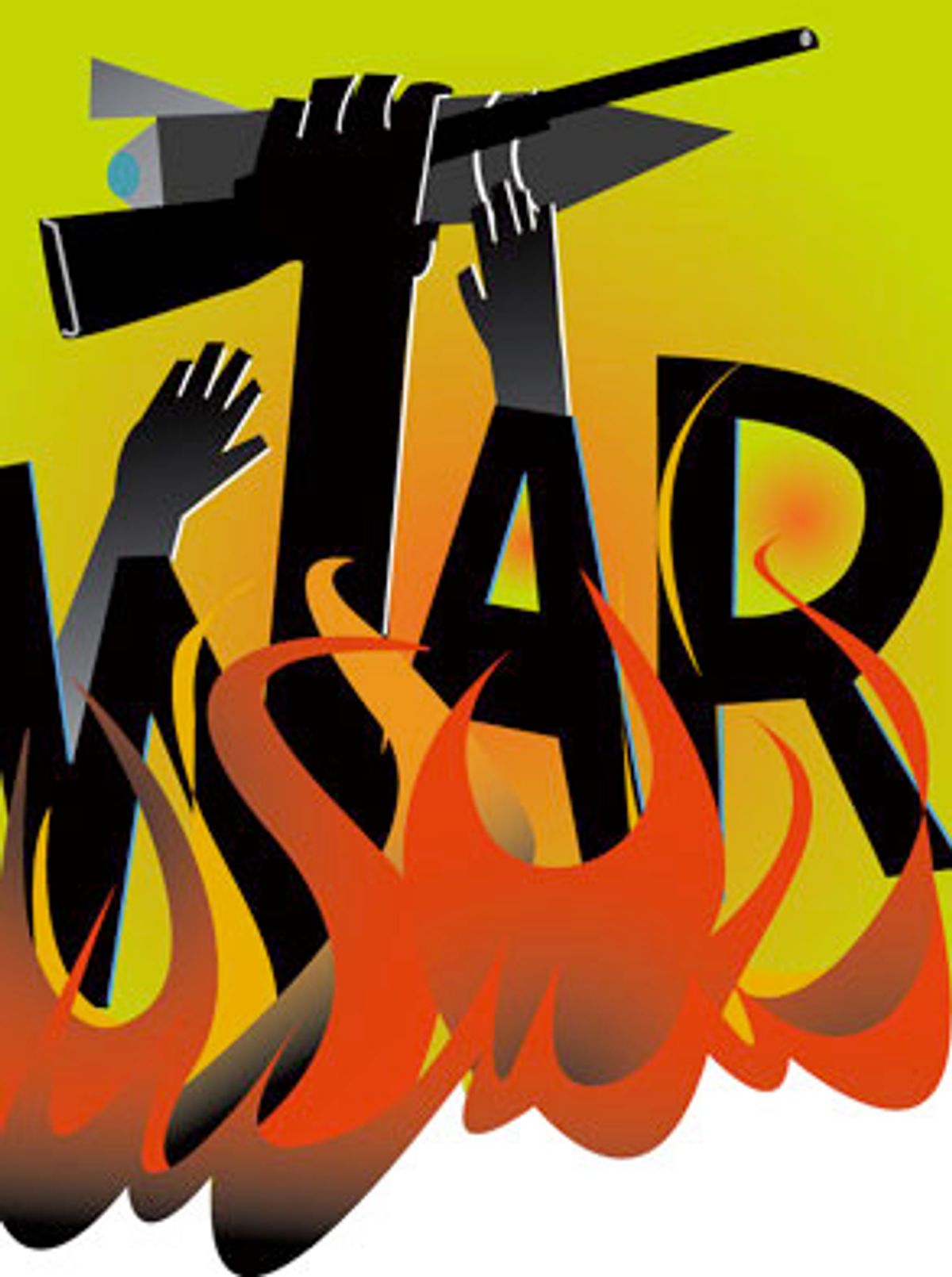
High on war

A foreign correspondent and eyewitness to horror argues that war and patriotism are lethal addictive drugs and America should go cold turkey.

There is no more implacable opponent of a drug than someone formerly addicted to it. For Chris Hedges, the drug was war. “War and conflict have marked most of my adult life,” he writes in “War Is a Force That Gives Us Meaning.” For 15 years, Hedges covered wars from El Salvador to the Sudan to Kosovo, mostly as a foreign correspondent for the New York Times. He saw men die yards away from him, witnessed the carnage left by death squads, observed the blood lust, the frenzy, the madness of war. And, he says, he fell in love with it. “I learned early on that war forms its own culture. The rush of battle is a potent and often lethal addiction, for war is a drug, one I ingested for many years.”

War is intoxicating, Hedges writes, because its extremity offers meaning, elevates life above the trivial. “Many of us, restless and unfulfilled, see no supreme worth in our lives. We want more out of life. And war, at least, gives a sense that we can rise above our smallness and divisiveness.” But the drug ends up destroying its users, Hedges writes — not just physically but psychologically and spiritually.

During his five-year stint in El Salvador, Hedges was evacuated three times because of tips that death squads planned to kill him. “By the end I had a nervous tic in my face,” he writes. “Yet each time I came back. I accepted with a grim fatalism that I would be killed in El Salvador. I could not articulate why I should accept my own destruction and cannot now. When I finally did leave, my last act was, in a frenzy of rage and anguish, to leap over the KLM counter in the airport in Costa Rica because of a perceived slight by a hapless airline clerk. I beat him to the floor as his bewildered colleagues locked themselves in the room behind the counter … I carry a scar on my face from where he thrust his pen into my cheek. War’s sickness had become mine.”

And that wasn’t the end: Hedges went on covering war for another 10 years.

“War Is a Force That Gives Us Meaning” is a peculiar book: At once scattershot and obsessively single-minded, it contains brilliant observations and crude generalizations, sometimes in the same paragraph. But if there is overstatement and some fuzzy thinking here, the book succeeds in its primary goal: It reminds us that war is dreadful beyond all imagining, and demolishes the myths we and our leaders embrace about war. Hedges speaks with authority about war’s visceral, sexually tinged appeal, the sucking void of its necrophiliac horror rush, the way it corrodes everything that humans take pride in. He sheds a merciless light on subjects we inevitably romanticize. Modern war, he reminds us, is industrial slaughter. As one of the few reporters who broke away from the official reporter pool and actually covered the Gulf War, he knows whereof he speaks.

Like Goya’s “Disasters of War,” a series of etchings that remains one of the most shocking depictions of the savagery of war, Hedges’ book aims to cut off all escape; it is unqualified. Goya’s etchings bear dreadful, simple titles like “This always happens” or “Nobody knows why”: In similar fashion, Hedges simply refuses to indulge in any discourse that normalizes the unspeakable.

Drawing on his own experiences on the front lines, on the home front and in the burned-out aftermath of war; on works of literature from Catullus and Shakespeare to Philip Larkin and Ivo Andric; and on writings on war by Primo Levi, Ernie Pyle, Ryszard Kapuscinski and many others, Hedges opens a withering line of fire on every single aspect of war and every belief that justifies it. Hedges stares down as if from some great height upon the human race’s millennia-old lust for organized killing; in a staccato tone in which anger, weariness and compassion seem compressed, he warns us not to open that door.

Hedge’s pronouncements are so sweeping, his condemnation so total, that distinctions, gradations, the whole spectrum of moral and ideological judgment, tend to vanish. Yet this weakness is also the book’s strength. The arguments in “War Is a Force” are not all convincing, but its passion, its sometimes stammering urgency, is. Nothing reveals the power of the sun more than the blind eyes of someone who has stared into it.

“One of the most difficult realizations of war is how deeply we betray ourselves, how far we are from the image of gallantry and courage we desire,” Hedges writes, describing the terror one feels under fire as “an elephantine fear that grabs us like a massive bouncer who comes up from behind.” He believes that Shakespeare’s Falstaff, who runs away from battle and scoffs at honor and glory as empty words, may be a more representative soldier than Henry V, he of the lofty “once more into the breach, dear friends” exhortations. He relates a story about a time when suspicious guards in the Sudan aimed their guns at him and another reporter. Without thinking, he quickly stepped behind his colleague. “Better to have any bullets pass through him first … To this day I have not had the heart to tell him.”

Hedges is equally corrosive on wartime “romance.” The notion that love has anything to do with wartime’s lurid, half-desperate, flesh-driven couplings is a myth: “With power reduced to such a raw level and the currency of life and death cheap, eroticism races through all relationships. There is in these encounters a frenetic lust that seeks, on some level, to replicate or augment the drug of war. It is certainly not about love, indeed love itself in wartime is hard to sustain or establish.” Hedges points out that the ancient Greeks knew that love and war were lasciviously linked. The war god Ares, who was “impetuous, quarrelsome and often drunk” and who delighted only in slaughter, was hated by the other gods but loved by Aphrodite, goddess of love, with whom he had an illicit affair.

Even more subversively, Hedges debunks the myth of combat friendship. He argues that war produces comradeship — a worthy and noble thing, but not as deep, difficult or complex as friendship. He quotes the philosopher and veteran J. Glenn Gray, who acutely noted that “the essential difference between comradeship and friendship consists, it seems to me, in a heightened awareness of the self in friendship and in the suppression of self-awareness in comradeship.”

If soldiers delude themselves, their cheerleaders back home suffer from bad faith on a cosmic scale. Hedges doesn’t just expose the unpleasant truth behind the claims made by wartime leaders that their cause is holy and just, and that their opponents are inhuman and evil: He denies that there often is any cause at all except the basest criminal greed. “The ethnic conflicts and insurgencies of our time, whether between Serbs and Muslims or Hutus and Tutsis, are not religious wars,” he writes. “They are not clashes between cultures or civilizations, nor are they the result of ancient ethnic hatreds. They are manufactured wars, born out of the collapse of civil societies, perpetuated by fear, greed and paranoia, and they are run by gangsters, who rise up from the bottom of their own societies and terrorize all, including those they purport to protect.” Because President Clinton accepted this “ancient hatreds” line — one popularized by Robert Kaplan in his book “Balkan Ghosts,” which is said to have had a profound influence on Clinton’s thinking — the U.S. failed to intervene until Slobodan Milosevic unleashed a whirlwind that claimed 250,000 lives and damaged millions more.

Not surprisingly, Hedges trains a particularly evil eye on patriotism. He recounts how the brutal and incompetent military junta in Argentina was on the verge of collapse, attacked by all sectors of society, before it invaded the Falkland Islands. The junta “instantly became the saviors of the country … Reality was replaced with a wild and self-serving fiction, a legitimization of the worst prejudices of the masses and paranoia of the outside world … Friends of mine, who a few days earlier had excoriated the dictatorship, now bragged about the prowess of Argentine commanders … Overweening pride and a sense of national solidarity swept through the city like an electric current. It was as if I had woken up, like one of Kafka’s characters, and found myself transformed into a huge bug. I would come to feel this way in every nation at war, including the United States after the attacks of Sept. 11.”

Hedges is not a pacifist: He accepts that war is sometimes necessary, “just as a person with cancer accepts chemotherapy to live.” He welcomed NATO’s intervention in Kosovo. But he is so aware of its horrors, so skeptical about its justifications and so appalled by its promoters, that he cannot bring himself to defend any given war — and certainly not the current “war on terrorism.”

Hedges does not make clear exactly what he believes the United States should do in the aftermath of the Sept. 11 terror attacks. But he is harshly critical both of America’s resurgent patriotism and the Bush administration’s “war on terror.” He regards both phenomena as dangerous because they are politically and morally myopic, and open the door to a retrograde, triumphalist view of war that he says Vietnam had temporarily purged from the American psyche.

Hedges argues that the American reaction to the terror attacks is dangerous because patriotic outrage, and the myth of American innocence that it rests on, prevents us from understanding the nature of the threat we face, the appropriate response and, in a deeper sense, our own responsibility. He dismisses the notion that America is innocent with a few terse sentences: “We often become as deaf and dumb as those we condemn. We too have our terrorists. The Contras in Nicaragua carried out, with funding from Washington, some of the most egregious human rights violations in Central America, yet were lauded as ‘freedom fighters.’ Jonas Savimbi, the rebel leader the United States backed in Angola’s civil war, murdered and tortured with a barbarity that far outstripped the Taliban. The rebellion Savimbi began in 1975 resulted in more than 500,000 dead. President Ronald Reagan called Savimbi the Abraham Lincoln of Angola.”

The list goes on: our own “genocidal campaign against Native Americans”; our support for Israel, ignoring the “profound injustice the creation of the state of Israel meant for Palestinians”; the oil-driven Gulf War; and Vietnam, where Robert McNamara “defined the bombing raids that would ultimately leave hundreds of thousands of civilians north of Saigon dead as a means of communication to the Communist regime in Hanoi.”

Hedges is not, of course, arguing that American complicity in the terrorizing of foreign nationals on a far greater scale than that visited on us, our longtime support for repressive regimes or our misguided imperialist or anti-Communist adventures means that we deserved to be attacked, or that we have no right to defend ourselves. Rather, he is arguing that the primitive, tribal response to the attacks is grossly inadequate and in fact dangerous, both to our nation’s security and to the minds and souls of Americans who abandon humility and critical thought to worship at the idol of the Good War and the Nation.

“As long as we think abstractly, as long as we find in the patriotism and the exuberance of war our fulfillment, we will never understand those who do battle against us, or how we are perceived by them, or finally those who do battle for us and how we should respond to it all. We will never discover who we are. We will fail to confront the capacity we all have for violence. And we will court our own extermination,” Hedges writes. “By accepting the facile clichi that the battle under way against terrorism is a battle against evil, by easily branding those who fight us as the barbarians, we, like them, refuse to acknowledge our own culpability. We ignore real injustices that have led many of those arrayed against us to their rage and despair.”

As previously noted, one of the flaws of “War Is a Force” is that Hedges, in his Cassandra-like haste to warn us, tends to level all distinctions — between wars, between the causes of wars, between types of patriotism. Like Shakespeare’s Thersites, the nihilistic Greek in “Troilus and Cressida” whom he quotes and who could stand as the spokesman for his book, Hedges is an absolutist; anything that praises war, points to war, invokes war, is tainted. His extreme assessment of the patriotic fervor that seized the United States after the Sept. 11 terror attacks is a case in point: Even those who agree that there were disturbing and excessive elements to it might not say that it made them feel like they had turned into Gregor Samsa. And, of course, Hedges’ comparison of America’s post-Sept. 11 reaction with Argentina’s after the junta invaded the Falklands ignores the fact that despite its historic sins, America, unlike Argentina, was the victim — not the aggressor.

For Hedges, however, even nations that find themselves victims must avoid draining the intoxicating cup of war. That does not mean never going to war: It means doing so with extreme misgivings, with humility, and, Hedges says, with “repentance.” It is telling that Hedges uses that word, with its Christian associations: In the spiritual climax of the book, Hedges celebrates love as the only force that can provide a meaning stronger than war. Hedges is no poet, but his aim is higher than the merely political. His bleak, faith-tinged affirmation of human solidarity even in the midst of hell recalls the work of the Polish poet Czeslaw Milosz.

At a personal level, Hedges’ call for humility in the face of those who would unleash the dogs of war is incontrovertible: It carries the haunted moral authority of someone who has seen too much and lived too long. But it is obviously more problematic when applied to national policy. What, specifically, does it mean to pursue a campaign against al-Qaida “with repentance”?

Hedges doesn’t say. But he seems to mean two things. First, an overly ambitious and open-ended response — a “war” on terror, as opposed to a battle or campaign — will create far more problems than it solves. Second, those who embrace war without understanding what it is risk losing their humanity. “I wrote this book not to dissuade us from war but to understand it,” Hedges writes. “It is especially important that we, who wield such massive force across the globe, see within ourselves the seeds of our own obliteration. We must guard against the myth of war and the drug of war that can, together, render us as blind and callous as some of those we battle.”

Translated into a policy prescription, what Hedges has in mind seems to be not quietism but a carefully calibrated response, perhaps along the lines of an international police action and/or selected U.S. military strikes, along with proactive steps to address underlying injustices that inspire Muslim terrorists and that we are party to, such as our blank-check support for Israel’s occupation of the West Bank and the Gaza Strip. As for America’s recently promoted public enemy No. 1, Iraq, Hedges says nothing about it, but it seems unlikely that he would sign off on the Bush administration’s war plans. The self-interested realpolitik motivations behind the Bush administration’s thirst for a war, and the probability that a war would hatch hundreds of new Osamas, would presumably outweigh the clear moral benefit of ridding the world of Saddam Hussein — especially since there is no compelling evidence that Saddam poses an immediate danger.

There is nothing particularly controversial about this position: It represents the view of many Americans across the political spectrum who want to track down and destroy al-Qaida, who hold no brief for bloody Saddam but have grave doubts about the wisdom of a unilateral, unprovoked American invasion of a sovereign state, particularly one in the heart of the Arab world. Hedges’ second, more personal point, however, is much trickier.

That Hedges would see war through the brutal lens of the particularly vicious conflicts he has covered — wars that give war a bad name — is not surprising. But perhaps as a result of his own experiences, Hedges seems not to have fully grasped the implications of our new age of what Michael Ignatieff calls “virtual war” — war that involves little or no risk, because one side enjoys total technological superiority. Such a war, as Ignatieff points out, becomes a spectacle, and one that does not even fully engage the passions of the citizens who are observing it. Kosovo was the paradigmatic example of a virtual war: NATO fought it not for national survival (only wars for survival, Ignatieff says, turn into “wars between peoples, with the mutual demonization which follows”) but for principle, and the allied side lost not a single combat casualty. Not surprisingly, it was barely perceived by the public as being a war at all.

So far the “war on terror,” whatever it is, bears much more resemblance to the virtual Kosovo war, the mostly virtual war in Afghanistan, or the semi-virtual Gulf War in which the U.S. took only a few dozen casualties while killing tens of thousands of Iraqis, than it does to real wars like Vietnam or World War II. Because America’s actual survival is not threatened, because the enemy we are fighting is invisible and stateless, because our armed forces are volunteers and because we are assured of victory in any orthodox military confrontation, the “war on terror” is not really a war at all. This has made it much easier to sell to the American people (although the Iraq war, if it comes, will be seen as being potentially an actual war and so may not be quite so easy to sell), but it also means that it is not something that we are deeply emotionally engaged with.

This throws something of a monkey wrench into at least part of Hedges’ thesis. There are two reasons that Hedges does not want us to embrace war too easily: because of what we will do to those we target, and because of what we will do to ourselves. The current situation bears out the first fear, but not the second — at least not in the way that Hedges thinks.

In “Virtual War,” Ignatieff raises the disturbing possibility that America’s absolute military superiority might lead us to an unrestrained use of force. “Fortunately — at least for those who advocate caution in the use of military force — modern democratic elites are increasingly reluctant to go to war,” he writes. “Precision violence is now at the disposal of a risk-averse culture, unconvinced by the language of military sacrifice, skeptical about the costs of foreign adventures and determined to keep out of harm’s way.” And this aversion to risk is coupled with a national policy that denies that we have the right to do what we want just because we can. Ignatieff notes that “we do [not] believe ourselves to be entitled to use military power to change a regime by force. So our tanks did not go to Baghdad and our forces did not enter Belgrade.”

“Virtual War” was written in 2000. What a difference two years and a terror attack make. Rumsfeld, Cheney and Wolfowitz are now in charge and 3,000 Americans lie dead. America’s leaders now do believe themselves to be entitled to change a regime by force, and they stand ready to do just that. And Congress — sort of — agrees with them.

The situation we now find ourselves in seems to be Hedges’ (and Ignatieff’s) worst nightmare: The nation is being herded docilely toward war. But where the situation differs from Hedges’ fears is that there is no drug. No one is high on the war on terror. There is some free-floating anxiety and anger — emotions exquisitely played upon by Bush and his team, who used them in combination with their brilliant Iraq gambit (all the benefits of war, none of the cost) to ensure they gained political control in the recent elections. But that’s about it. Despite the best efforts of patriotism-peddling Fox News, after the initial shock of the attack nickel bags of aggression, nationalism, purity, resentment and self-righteousness have not found that many buyers on the streets of America.

Hedges would surely welcome this development, if he thought it was true. Yet as Ignatieff warns us, in some ways, the public’s increasing distance from wars that are carried out in its name is a disturbing development. The bloodstained Serb militiaman performing ethnic cleansing, the Kosovo Liberation Army killer exacting his revenge, and the chanting tribes behind them, are not pretty to look at. But the American citizen watching half-interestedly from his couch as a high-tech pilot and three technicians pushing buttons on computers pulverize 1,000 invisible enemies may not be a giant leap up on the moral scale. The raw passions Hedges decries may be primal, they may tend toward fascism, but at least they bespeak a genuine awareness that war exists.

Hedges fears that the American people are more like the chanting tribal hordes and less like the virtual couch potato. It isn’t yet clear whether he’s right. The truth will not be known until the chips are down in Iraq, and if there is an invasion the American public may well prove to be some spectacularly banal combination of the two — a nation of half-awake fascists. But if in the end the American people maintain a relatively cool, detached temperament, and America’s leaders in the “war on terror” follow their example, one would have to agree with Hedges that that is a good thing. Outrage is an honorable and understandable emotion after one has been dealt a savage blow, but as every boxer knows, it takes a cool head to win. Storming angrily in throwing wild roundhouses is a good way to end up flat on your back and unconscious. The fact is, the war against terror is and should be a cold, not a hot, one.

Which is why it’s past time to stop beating the dead horse of those leftists — whose total number is probably in the thousands — who did not express sufficient outrage after the Sept. 11 attacks. Yes, the immediate leap to a coldblooded geopolitical analysis betrays a lack of compassion and human empathy for the victims, and a reflexive dogmatism. Hedges would have done better to have acknowledged this, and to have acknowledged that the outpouring of patriotism that followed Sept. 11 was both understandable and in large part a positive thing. But Hedges’ main point is incontrovertible. The state of reified and permanent outrage that conservative pundits define as the watermark of a “real American,” and that the Bush administration has whipped up for its various purposes, represents a far greater danger to the nation than the lack of fellow-feeling evinced by a handful of leftists (most of whom supported some self-defensive action by the U.S. in any case).

As Gen. Wesley Clark, the former Supreme Allied Commander in Europe — no poster child for the traitorous elites on the coasts — wrote in his blurb on the back of Hedges’ book, “Hedges provides a somber and timely warning to those — in any society — who would evoke the emotions of war for the pursuit of political gain.”

As the “war on terror” continues on its apparently endless and potentially catastrophic course, America would do well to heed Hedges’ and Clark’s warning.

Gary Kamiya is a Salon contributing writer.

Israel’s drone dominance

If you want to know how drones will change America, look to the Jewish State -- where they're already widespread

(Credit: Benjamin Wheelock)

Stark Aerospace of Mississippi is perhaps the only foreign-owned company with FAA permission to fly a drone in U.S. airspace. Based in the town of Columbus, not far from Mississippi State University, Stark is a subsidiary of the state-owned Israel Aerospace Industries — not that you could tell from looking at the company’s website, executive leadership or affiliations. You have to go to the Mississippi secretary of state website to learn that two of Stark’s three directors are Israelis.

So too with the America’s drone industry. The Israeli influence is not visible but it is real, documented and extremely relevant to the future of drones in America. If you want to know how drones may change American airspace in coming years, just look to Israel, where the unmanned aerial vehicle market is thriving and drones are considered a reliable instrument of “homeland security.”

“There are three explanations for Israel’s success in becoming a world leader in development and production of UAVs,” a top Israeli official explained to the Jerusalem Post last year. “We have unbelievable people and innovation, combat experience that helps us understand what we need and immediate operational use since we are always in a conflict which allows us to perfect our systems.”

Israel’s drone expertise goes back to at least 1970, according to the UAV page of the Israeli Air Force. Mark Daly, an expert on unmanned aircraft at Jane’s Defense in London, notes the Israelis were the first to make widespread use of drones in Israel’s 1982 invasion of Lebanon, when the aircraft were used to monitor troop movements.

Now, as the Arab media and Western reporters such as Scott Wilson of the Washington Post have reported, the Israeli Defense Force uses fleets of constantly hovering drones to intimidate and control the Arab population in the Gaza Strip.  (The residents call these drones “zenana,” which both sounds like the aircraft’s distinctive buzz and is Arabic slang for a nagging wife.) The IDF regularly uses drones for targeted assassinations of suspected militants, saying the drones enable them to use “precision strikes” to avoid hurting civilians. Yet as Human Rights Watch has documented, the drone strikes during the Gaza War killed scores of children who were nowhere near armed combatants.

Israel markets its expertise in defense to the rest of the world. Israeli academic Neve Gordon cites a glossy government brochure on drones titled “Israel Homeland Security: Opportunities for Industrial Cooperation,” which boasts, “no other advanced technology country has such a large proportion of citizens with real time experience in the army, security and police forces.” The chapter called “Learning from Israel’s Experience” notes that “many of these professionals continue to work as international consultants and experts after leaving the Israel Defense Forces, police or other defense and security organizations.”

The work has paid off when it comes to drones: The Jewish state is the single largest exporter of drones in the world, responsible for 41 percent of all UAVs exported between 2001 and 2011, according to a database compiled by the Stockholm International Peace Research Institute. Israeli companies export drone technology to at least 24 countries, including the United States.

In addition to exports, Israeli companies also create subsidiaries in consumer countries. “To increase sales outside Israel, Israel’s defense companies have to set up subsidiaries in target markets, rather than expand local manufacturing,” Haaretz reported  in 2009. The Israelis “set up Stark in 2006 to drum up business in America,” according to Haaretz, because the U.S. prefers “to buy armaments and other defense gear from local companies.” In 2007, Stark  “inaugurated its first production outfit, which makes Hunter unmanned vehicles that it sells through Northrop Grumman. In fact, the U.S. armed forces have been using [Israeli-made] Hunter drones since the early 1990s.”

As for domestic drone uses, the Israeli example is perhaps most instructive at the U.S. border. The 5 million Palestinian Arabs living in and around Israel, like the 11 undocumented resident aliens in the United States, are ineligible for citizenship in the land they call home. Both groups are subject to monitoring, barriers to entry and rapid expulsion. Not surprisingly one of the first uses of drones by the Department of Homeland Security was to monitor the U.S.-Mexico border, where it now flies Israeli-made Hermes 450 drones.

And the Israeli example is instructive not just at the border, but also south of it, where the Mexican government has allowed the U.S. to fly drone missions as part of the drug war. Mexico has, apparently, learned a thing or two from its northern neighbor about the best country for buying drones. In March, when it allegedly purchased two new drones of its own, it knew where to go: Israel.

Continue Reading Close
Jefferson Morley

Jefferson Morley is a staff writer for Salon in Washington and author of the forthcoming book, Snow-Storm in August: Washington City, Francis Scott Key, and the Forgotten Race Riot of 1835 (Nan Talese/Doubleday).

Can the NYPD (legally) spy on mosques?

A civil liberties expert explains how the city's Muslim surveillance program may have broken local and federal laws

NYPD Police Commissioner Ray Kelly (Credit: Reuters/Brendan McDermid)
This piece originally appeared on ProPublica.

Last August, the Associated Press launched a series detailing how the New York Police Department has extensively investigated Muslims in New York and other states, including preparing reports on mosques and Muslim-owned businesses, apparently without any suspicion of crimes being committed.

The propriety and legality of the NYPD’s activities is under dispute. Mayor Michael Bloomberg – who claimed last year that the NYPD does not focus on religion and only follows threats or leads – is now arguing that, as he said last week, “Everything the NYPD has done is legal, it is appropriate, it is constitutional.” Others disagree. In fact, Bloomberg himself signed a law in 2004 prohibiting profiling by law enforcement based on religion.

This week, Attorney General Eric Holder told a congressional committee the Justice Department is reviewing whether to investigate potential civil rights violations by the NYPD.

To get a better understanding of the rules governing the NYPD – and whether the department has followed them in its surveillance of Muslims – we spoke to Faiza Patel, co-director of the Liberty and National Security Program at the Brennan Center at NYU Law School.

The NYPD did not respond to our request for comment about allegations it has violated the law.

So Mayor Bloomberg and police commissioner Ray Kelly say everything that the NYPD did was legal and constitutional. Other people have disagreed – Newark Mayor Cory Booker, for example, said the wholesale surveillance of a community without suspicion of a crime “clearly crosses a line.” What restrictions is the NYPD operating under?

They are operating under at least three sets of rules. The first and most basic set of rules is the consent decree from the Handschu case – the so-called Handschu guidelines. This was a 1970s-era political surveillance case that was settled through a consent decree. The NYPD had been conducting surveillance of a number of political groups in the ’60s and ’70s. The initial consent decree regulated the NYPD’s collection of intelligence about political activity. It first said the NYPD can only collect intelligence about political activity if it follows certain rules. For example, the NYPD had to get clearance from something called the Handschu authority, which was a three-member board that consisted of two high-level police officials and one civilian appointed by the mayor.

Then, post-9/11 the NYPD went to court and asked a judge to review the consent decree because they wanted to have greater freedom in their counter-terrorism operations. What they wound up doing was adopting guidelines based on the FBI’s guidelines from 2003, issued by Attorney General John Ashcroft. These were different in several important ways. The first was that there was no pre-clearance, at all. There was no requirement that the NYPD get approval from the Handschu authority before they undertook any intel gathering about political activity. The second was that the guidelines explicitly say the NYPD can attend any public event or gathering on the same basis as another member of the public. So if I can go to a church, the NYPD can go to a church. But it goes on to say that the NYPD can’t retain the information it gathers from going to such public events unless it is connected to suspected criminal or terrorist activity.

So if you look at, say, the NYPD’s guide to Newark’s Muslim community obtained and published by the AP – which maps out mosques and Muslim-owned businesses without mentioning and suspicions of crimes – aren’t the police retaining exactly this kind of information?

There are a couple of documents that suggest they may have violated Handschu. For example, the [2006 NYPD report] on the Danish cartoon controversy, which is a collection of statements in mosques and other places that have been taken down by undercover officers or confidential informants.

What are the other rules the NYPD operates under?

The second set is that the NYPD has a profiling order in place, and New York City also has a racial profiling law. They are slightly different. The NYPD order [issued in 2002] does not include religion among the categories that they define as profiling. But the New York City law does. It prohibits police officers from relying on race, ethnicity, religion or national origin as a determinative factor in initiating law enforcement action. Normally you have quite a difficult time in racial profiling cases showing they’ve used one of these factors as the determinative factor. In this case, if you look at the documents, it seems quite clear that the NYPD had its eyes quite firmly on the Muslim community. So it’s possible it is also in violation of this law.

The third set of rules is, of course, the U.S. and the New York state constitutions. Within the Constitution you’re looking at least two broad categories of provisions – potential First Amendment claims for free speech, freedom of association and free exercise of religion. The other piece of it would be potential equal protection claims.

There was another AP story this week reporting that a bunch of federal grant money and equipment used as part of surveillance and investigation of the Muslim community. Does that muddy the legal questions about whether they were following federal rules as well?

The federal program that was giving them money is the HIDTA program – High Intensity Drug Trafficking Area. It’s geared toward providing funds to combat drug trafficking. HIDTA itself does allow for counter-terrorism spending to be an incidental purpose. It requires the HIDTA Executive Board to basically make sure that funds were being used for the purposes that they were supposed to be used for. So I think there’s a real issue about accountability and oversight of the use of HIDTA funds here.

So if the NYPD did potentially violate the Handschu guidelines and city law you mentioned, what are the penalties?

Well the Handschu lawyers already went to court last year and told the judge that the documents that had been released by the AP suggested that there had been violations of the Handschu decree. They asked for discovery so they could check the files of the NYPD to see whether they had violated the prohibition on keeping dossiers. I believe that that discovery will likely be starting soon. So there’s clearly a remedy through the Handschu mechanism. Because it’s a consent decree, it’s an ongoing thing. The judge has supervisory jurisdiction. There are also issues under the racial profiling law and under the First Amendment.

We’ve also turned to the question of oversight. The FBI, for all its faults, does have a fair amount of oversight – an inspector general internally and congressional oversight. We think a similar thing would be a great idea for the NYPD.

Continue Reading Close
Justin Elliott

Justin Elliott is a reporter for ProPublica. You can follow him on Twitter @ElliottJustin

The weakness of Obama’s strength

The president's image of national security success shows how little he has changed in U.S. foreign policy

President Obama and outgoing Chairman of the Joint Chiefs of Staff Admiral Mike Mullen in September 2011. (Credit: Kevin Lamarque / Reuters)

From Adlai Stevenson in 1952 to John Kerry in 2004, Democratic presidential candidates have usually been seen by voters as weak on the crucial issue of national security. Now, that seems to have changed, with defense becoming arguably President Barack Obama’s strongest asset in his 2012 reelection campaign. “Polls show voters believe Obama is handling the title ‘commander in chief’ better than other aspects of his job,” as USA Today bluntly put it last month.

Some Democratic pundits are giddy at their party’s turnaround on national security. “There’s no doubt Obama’s had a better first term in the White House on foreign policy than any Democrat going back to Truman, and frankly better than most Republicans’ first terms as well,” crowed Michael O’Hanlon of the Brookings Institution. Michael Tomasky has argued that Obama is on his way to being “not just a good but a great foreign-policy president.”  Michael Cohen made a good case in Foreign Policy for the Democrats being “the new national security party.” In other words, Obama has reversed decades of public perception about Democratic weakness, and it is time to uncork the champagne.

Not so fast. While it is welcome news to those of us who prefer the Democratic Party on domestic issues that it has finally neutralized Republicans on the crucial issue of national security, two problems persist. First, Obama’s popularity on foreign policy has come at great cost. Second, if the Dems exploit their national security advantage in the 2012 campaigns, they may be committing themselves to a permanent “Republican lite” agenda on the issue. American foreign policy still contains strong elements of militarism, interventionism and special-interest influence. Only if and when President Obama cures those underlying diseases can he be considered a great foreign-policy president.

Start with Obama’s national security track record. Obviously, it is far better than President George W. Bush’s, a low bar. Of all the post-Truman Democratic presidents, Obama’s tenure is equaled only perhaps by JFK’s. Successes have included the killing of Osama bin Laden, the downsizing of the American presence in Iraq, presiding over the relatively orderly exit of Hosni Mubarak in Egypt, and backing the removal of Gadhafi in Libya without sending U.S. troops. Obama and the Democrats deserve credit for laying the groundwork for a withdrawal from Afghanistan, and in showing the American people that diplomacy and multilateralism are not curse words but common sense. Most recently, the administration has begun paying more attention to Asia, where America’s attention should really be focused.

But these victories have been accompanied by significant failures. Obama’s escalation in Afghanistan was a predictable fiasco. His inability to turn the U.S. into an honest broker between Israel and the Palestinians is probably the proverbial final nail in the coffin of the so-called peace process. Obama never made clear how intervention in Libya was a vital strategic U.S. interest, and his engagement with Iran was halfhearted. Most disturbingly, from Guantanamo Bay to military commissions, the administration has continued many of the worst civil-liberties policies of its predecessor. And it is has even added some of its own in the form of stepped-up drone attacks, which not only kill scores of civilians but are vital in turning Pakistanis in crucial areas against the United States.

More broadly, Obama has been unable to fundamentally reorient U.S. foreign policy away from intervening in every region across the globe. The administration has not persuaded Americans that restraint would be both a wiser and more just approach to international affairs. It has not made the case that American exceptionalism is just a nationalist myth common to most nations. Instead, Obama has largely been successful in convincing the public that America can better dominate the world with something of a lighter touch.

If Obama and the Democrats rely on this approach in hopes of keeping the presidency and gaining seats in the House and Senate, they may only be extending America’s chronic foreign policy problems. If the administration does not even try, let alone succeed, in telling the American people that their defense budget is bloated, that the country must be much more selective in engagement across the world, and that civil liberties should be more than just an afterthought when conducting international affairs, all triumphs will be partial at best. Yes, Obama has proven terrific in regaining the national security edge the Democratic Party has relinquished for so long. And yes, that pays great dividends in both implementing the Democrats’ domestic policies and in turning Americans against the hyper-nationalist and -militaristic positions that defined the George W. Bush administration.

But we have seen the movie before. Lyndon Johnson’s administration was so obsessed with appearing soft on national security that this fear played no small part in embroiling the country in the disastrous war in Vietnam. More recently, many Democrats voted in support of the Iraq war for fear of seeming soft on the war on terrorism. Though Obama seems far too shrewd to engage in any quagmires of that scale, obsessing about electoral advantage has undeniable costs.

“Since at least the 1990s, the Democrats have embraced the premises of the GOP in national security,” says Julian Zelizer, author of “Arsenal of Democracy: The Politics of National Security — From World War II to the War on Terrorism.” “It’s about being tougher and more aggressive, not about international cooperation or dialogue with other countries.” Branding themselves as the “tough” party on national security is tempting, but if it prevents the Democrats from offering a genuine alternative to the current Republican Party, it may be too great a cost.

And therein lies the difficulty for Democrats, of course. Human nature presents challenges for any leader hoping to illustrate the counterintuitive reality that military power and obstinacy are actually only of limited use in the conduct of foreign policy. “When people are insecure, they’d rather have somebody who is strong and wrong than someone who’s weak and right,” President Clinton famously said after the 2002 midterm elections. Though cynical, Clinton was correct in his assessment. “It’s hard to tell people that you’re against being strong — the rhetoric sounds too good, even when the results aren’t,” says Zelizer, a professor at Princeton.

Obama has admirably succeeded in regaining the national security electoral edge from Republicans, who are still committed to pursuing hawkish policies even though they’ve been shown repeatedly to be wrongheaded. But success comes with its costs. When, and only when, the Democrats wean America off its addiction to global dominance can it truly claim to be a great party on national security.

Continue Reading Close

Jordan Michael Smith writes about U.S. foreign policy for Salon. He has written for the New York Times, Boston Globe and Washington Post.

The shadow of suspicion falls in the Mall of America

Visitors who have done nothing wrong are winding up identified in counterterrorism reports

On May 1, 2008, at 4:59 p.m., Brad Kleinerman entered the spooky world of homeland security.

As he shopped for a children’s watch inside the sprawling Mall of America, two security guards approached and began questioning him. Although he was not accused of wrongdoing, the guards filed a confidential report about Kleinerman that was forwarded to local police.

The reason: Guards thought he might pose a threat because he had been looking at them in a suspicious way.

Najam Qureshi, owner of a kiosk that sold items from his native Pakistan, also had his own experience with authorities after his father left a cellphone on a table in the food court.

The consequence: An FBI agent showed up at the family’s home, asking if they knew anyone who might want to hurt the United States.

Mall of America officials say their security unit stops and questions on average up to 1,200 people each year. With 4.2 million square feet under one roof, the two-decade-old mall is a monument to suburban shopping and entertainment. Nearly 100,000 people from around the world pass through on a given day.

The interviews at the mall are part of a counterterrorism initiative that acts as the private eyes and ears of law enforcement authorities but has often ensnared innocent people, according to an investigation by the Center for Investigative Reporting and NPR.

In many cases, the written reports were filed without the knowledge of those interviewed by security. Several people named in the reports learned from journalists that their birth dates, race, names of employers and other personal information were compiled along with surveillance images.

In some cases, the questioning appears to have the hallmarks of profiling — something that officials at the mall deny. In nearly two-thirds of the cases reviewed, subjects are described as African-American, people of Asian and Arabic descent, and other minorities, according to an analysis of the documents.

Mall spokesman Dan Jasper said the private security guards would not conduct interviews based on racial or ethnic characteristics because “we may miss someone who truly does have harmful intent.”

Much of the questioning at the mall has been done in public while shoppers mill around, records show. Two people, a shopper and a mall employee, also described being taken to a basement area for questioning. Officials at the mall would not address individual cases.

“The government is not going to protect us free of charge, so we have to do that ourselves,” said Maureen Bausch, executive vice president of business development at the mall. “We’re lucky enough to be in the city of Bloomington where they actually have a police substation here [in the mall] … They’re great. But we are responsible for this building.”

Reporters at the Center for Investigative Reporting and NPR obtained 125 suspicious activity reports totaling over 1,000 pages dating back to Christmas Eve, 2005. The documents, provided by law enforcement officials in Minnesota, give a glimpse inside the national campaign by authorities to collect and share intelligence about possible threats.

The initiative exemplifies one of the enduring legacies of the terrorist attacks 10 years ago: Organizations and individuals are now encouraged by U.S. leaders to watch one another and report any signs of threats to homeland security authorities.

There is no way for the public to know exactly how many suspicious activity reports from the Mall of America have ended up with local, state and federal authorities. CIR and NPR asked 29 law enforcement agencies under open government laws for reports on suspicious activities. Only the Bloomington Police Department and Minnesota’s state fusion center have turned over at least a portion of the paperwork.

In 2008, the mall’s security director, Douglas Reynolds, told Congress that the mall was the “number-one source of actionable intelligence” provided to the state’s fusion center, an intelligence hub created after 9/11 to pull together reports from an array of law enforcement sources.

Information from the suspicious activity reports generated at the mall has been shared with Bloomington police, the FBI and, in at least four cases, the federal Immigration and Customs Enforcement agency.

The push to encourage Americans to report suspicious activity began in the aftermath of Sept. 11, 2001, when government officials and citizens found out there had been hints about the attackers that intelligence analysts had missed.

In the decade since, the Justice Department and Department of Homeland Security have launched programs urging citizens to report suspicious activity. The private sector, including the utility industry and other businesses concerned with protecting “critical infrastructure,” have their own surveillance and reporting systems. Homeland Security Secretary Janet Napolitano has made such reporting a priority.

Last year the Department of Homeland Security launched a promotional campaign, “If you see something, say something,” encouraging Americans to report anything perceived as threatening.

Among those formally enlisted were parking attendants, Jewish groups, stadium operators, landlords, security guards, fans of professional golf and auto racing and retailers such as the Mall of America. Visitors “may be subject to a security interview,” the mall’s website says.

The suspicious activity reports from the mall are rich with detail. They contain personal information, sometimes including Social Security numbers and the names of family members and friends. Some of the reports include shoppers’ travel plans.

Commander Jim Ryan of the Bloomington Police Department said shoppers are not under arrest when stopped for questioning by private security. He said even he would walk away if the questioning seemed excessive.

“I don’t think that I would subject myself to that, personally,” he said. Ryan, however, defends security procedures at the mall.

Ryan said such reports are crucial to the nation’s safety in the post-9/11 era. He said the suspicious activity reports could be held by his agency for two decades or longer. He acknowledged that the mall’s methods, and reports the security guards file, may “infringe on some freedoms, unfortunately.”

“We’re charged with trying to keep people safe. We’re trying to do it the best way we can,” he said. “You may be questioned at the Mall of America about suspicious activity. It’s something that may happen. It’s part of today’s society.”

Some national security and constitutional law specialists question the propriety and effectiveness of such reports.

Dale Watson, a former top counterterrorism official with the FBI, said the mall’s reports suggest that anyone could be targeted for intrusive questioning and surveillance.

“If that had been one of my brothers that was stopped in a mall, I’d be furious about it — if I thought the police department had a file on him, an information file about his activities in the mall without any reasonable suspicion to investigate,” said Watson, who played key roles in the investigations of the 1995 Oklahoma City bombing and a 1998 attack on U.S. embassies in East Africa.

Shoppers, who for the most part had no idea that a visit to the mall led to their personal information being shared with law enforcement, reacted with anger and dismay when shown their reports.

“For all the 30 years that I have lived in the United States, I’ve never been a suspect,” said Emil Khalil. The California man was confronted at the mall in June 2009 for taking pictures, and he said an FBI agent later questioned him at the airport. “And I’ve never done anything wrong.”

Monica Lam, Center for Investigative Reporting

Brad Kleinerman, at home with his youngest son, was stopped after Mall of America security guards said he looked at them in a suspicious manner.

Mike Rozin, chief of a special security unit at the mall since 2005, acknowledged that the vast majority of people who come into contact with his unit “have done nothing wrong, have no malicious intent.”

“They just act in a suspicious manner that obligated me to investigate further,” Rozin said. “We talked to them for an average of five minutes, and they’re able to continue their shopping.”

Francis Van Asten’s experience with mall security lasted much longer.

On Nov. 9, 2008, the Bloomington resident videotaped a short road trip from his home to the Mall of America. Van Asten, now 66, planned to send it to his fiancée’s family in Vietnam so they could see life in the United States.

As he headed down an escalator, camera in hand, mall guards caught sight of him.

“Right away, I noticed he had a video camera and was recording the rotunda area,” a security guard wrote in a suspicious activity report.

Van Asten, a one-time missile system repairman for the Army, was questioned for approximately two hours, records show. He was asked about traveling to Vietnam and how he came to know people there. The FBI Joint Terrorism Task Force was alerted. He was given a pat-down search, and the FBI demanded that his memory card be confiscated “for further analysis.”

Authorities were concerned about his footage of an airplane landing at Minnesota’s nearby international airport. They also worried Van Asten was conducting surveillance of mall property.

Exhausted and rattled, Van Asten had trouble finding his car after the ordeal was over.

“I sat down in my car and I cried, and I was shaking like a leaf,” Van Asten said in an interview at his home. “That kind of sensation doesn’t leave you real quickly when you’ve had an experience like that.”

Bobbie Allen, a musician who lives in downtown Minneapolis, was stopped for writing in a notebook. As he waited for a lunch date on June 25, 2007, Allen jotted down some words, which caught the attention of security guard.

One guard wrote in Allen’s suspicious activity report: “Before the male would write in his notebook, it appeared as though he would look at his watch. Periodically, the male would briefly look up from his notebook, look around, and then continue writing.”

Guards asked for his name and for whom he was waiting. Allen, who is black, felt singled out for his race, according to the report. The guard responded that he was “randomly selected” for an interview.

The guards called Bloomington police, after deciding Allen was uncooperative and his note-taking “suspicious.” Allen was cleared, but a suspicious activity report was compiled, complete with surveillance photo, age, height, address and more. Much of that information ended up in a Bloomington police report.

Jeffrey Rosen, a law professor at George Washington University, said such actions trample on traditional civil liberties protections and shift unaccountable power into private hands.

Rosen said the risk of abuses is high, particularly if there turns out to be a lack of proven results. “If all they’re getting for amassing suspicious activity reports on innocent people in government databases is the arrest of a few low-level turnstile jumpers and shoplifters, that doesn’t seem very sensible,” Rosen said.

In Allen’s case, he responded in a way few others have: He complained to the Minnesota Department of Human Rights and filed a lawsuit. Department investigators concluded that there was probable cause to support Allen’s claim of racial discrimination.

Allen declined an interview, citing a settlement agreement reached with the mall.

Not everyone had a negative reaction to being written up. After a report naming him was forwarded to the FBI, Sameer Khalil of Orange County, Calif., said he believed that police and private security have an important job they must do.

“I think [the mall's program] makes America safer,” he said.

Businessman Najam Qureshi discovered how the suspicions at the mall can linger.

The FBI arrived on his doorstep shortly after a run-in with mall security. His family moved from Pakistan to the United States when Qureshi was 8. Police once pulled over their car for a minor traffic violation, and Qureshi remembers his father saying, “You don’t have to fear the police here. They are here to help.”

Qureshi opened a small kiosk at the mall so his aging father, a former aeronautical engineer named Saleem, could keep busy. One day in early 2007, Saleem Qureshi left his cellphone in a mall food court. When he returned for it, security personnel had established a “perimeter” around the phone, along with other unattended items nearby that did not belong to Saleem — a stroller and two coolers.

The “suspicious” objects eventually were cleared by security, documents show. But mall guards pursued Saleem Qureshi with questions.

“Qureshi moved around a lot when answering questions,” security guard Ashly Foster wrote in a report. “At one point, he moved to his kiosk and proceeded to take items off of two shelves just to switch them around. … He seemed to get agitated at points when I would ask more detailed questions.”

Four years after his father ended up in a suspicious activity report, his son was shown the report for the first time.

“Everybody that lives in this country,” said Najam Qureshi, “is a person of interest as far as these reports are concerned.”

– - – - – - – - – -

The Center for Investigative Reporting, the nation’s oldest independent, nonprofit investigative news center, reported this story along with National Public Radio. You can contact the reporters at gwschulz-at-cironline.org, zwerdling-at-npr.org and abecke-at-cironline.org.

Read the extended version on the Center for Investigative Reporting’s project site, americaswarwithin.org.

Margot Williams of NPR contributed to this report.

Continue Reading Close

Has our bloated security budget made us safer?

We've spent nearly $8 trillion on counterterrorism since 9/11. It's time to assess the results

The killing of Osama Bin Laden did not put cuts in national security spending on the table, but the debt-ceiling debate finally did. And mild as those projected cuts might have been, last week newly minted Secretary of Defense Leon Panetta was already digging in his heels and decrying the modest potential cost-cutting plans as a “doomsday mechanism” for the military. Pentagon allies on Capitol Hill were similarly raising the alarm as they moved forward with this year’s even larger military budget.

None of this should surprise you. As with all addictions, once you’re hooked on massive military spending, it’s hard to think realistically or ask the obvious questions. So, at a moment when discussion about cutting military spending is actually on the rise for the first time in years, let me offer some little known basics about the spending spree this country has been on since September 11, 2001, and raise just a few simple questions about what all that money has actually bought Americans.

Consider this my contribution to a future 12-step program for national security sobriety.

Let’s start with the three basic post-9/11 numbers that Washington’s addicts need to know:

1. $5.9 trillion: That’s the sum of taxpayer dollars that’s gone into the Pentagon’s annual “base budget,” from 2000 to today. Note that the base budget includes nuclear weapons activities, even though they are overseen by the Department of Energy, but — and this is crucial — not the cost of our wars in Iraq and Afghanistan. Nonetheless, even without those war costs, the Pentagon budget managed to grow from $302.9 billion in 2000, to $545.1 billion in 2011. That’s a dollar increase of $242.2 billion or an 80 percent jump ($163.6 billion and 44 percent if you adjust for inflation). It’s enough to make your head swim, and we’re barely started.

2. $1.36 trillion: That’s the total cost of the Iraq and Afghan wars by this September 30th, the end of the current fiscal year, including all moneys spent for those wars by the Pentagon, the State Department, the U.S. Agency for International Development, and other federal agencies. Of this, $869 billion will have been for Iraq, $487.6 billion for Afghanistan.

Add up our first two key national security spending numbers and you’re already at $7.2 trillion since the September 11th attacks. And even that staggering figure doesn’t catch the full extent of Washington spending in these years. So onward to our third number:

3. $636 billion: Most people usually ignore this part of the national security budget and we seldom see any figures for it, but it’s the amount, adjusted for inflation, that the U.S. government has spent so far on “homeland security.” This isn’t an easy figure to arrive at because homeland-security funding flows through literally dozens of federal agencies and not just the Department of Homeland Security (DHS). A mere $16 billion was requested for homeland security in 2001. For 2012, the figure is $71.6 billion, only $37 billion of which will go through DHS. A substantial part, $18.1 billion, will be funneled through — don’t be surprised — the Department of Defense, while other agencies like the Department of Health and Human Services ($4.6 billion) and the Department of Justice ($4.1 billion) pick up the slack.

Add those three figures together and you’re at the edge of $8 trillion in national security spending for the last decade-plus and perhaps wondering where the nearest group for compulsive-spending addiction meets.

Now, for a few of those questions I mentioned, just to bring reality further into focus:

How does that nearly $8 trillion compare with past spending?

In the decade before the 9/11 attacks, the Pentagon base budget added up to an impressive $4.2 trillion, only one-third less than for the past decade. But add in the cost of the Afghan and Iraq wars and total Pentagon spending post-9/11 is actually two-thirds greater than in the previous decade. That’s quite a jump. As for homeland-security funding, spending figures for the years prior to 2000 are hard to identify because the category didn’t exist (nor did anyone who mattered in Washington even think to use that word “homeland”). But there can be no question that whatever it was, it would pale next to present spending.

Is that nearly $8 trillion the real total for these years, or could it be even higher?

The war-cost calculations I’ve used above, which come from my own organization, the National Priorities Project, only take into account funds that have been requested by the President and appropriated by Congress. This, however, is just one way of considering the problem of war and national security spending. A recent study published by the Watson Institute of Brown University took a much broader approach. In the summary of their work, the Watson Institute analysts wrote, “There are at least three ways to think about the economic costs of these wars: what has been spent already, what could or must be spent in the future, and the comparative economic effects of spending money on war instead of something else.”

By including funding for such things as veterans benefits, future costs for treating the war-wounded, and interest payments on war-related borrowing, they came up with $3.2 trillion to $4 trillion in war costs, which would put those overall national security figures since 2001 at around $11 trillion.

I took a similar approach in an earlier TomDispatch piece in which I calculated the true costs of national security at $1.2 trillion annually.

All of this brings another simple, but seldom-asked question to mind:

Are we safer?

Regardless of what figures you choose to use, one thing is certain: we’re talking about trillions and trillions of dollars. And given the debate raging in Washington this summer about how to rein in trillion-dollar deficits and a spiraling debt, it’s surprising that no one thinks to ask just how much safety bang for its buck the U.S. is getting from those trillions.

Of course, it’s not an easy question to answer, but there are some troubling facts out there that should give one pause. Let’s start with government accounting, which, like military music, is something of an oxymoron. Despite decades of complaints from Capitol Hill and various congressional attempts to force changes via legislation, the Department of Defense still cannot pass an audit. Believe it or not, it never has.

Members of Congress have become so exasperated that several have tried (albeit unsuccessfully) to cap or cut military spending until the Pentagon is capable of passing an annual audit as required by the Chief Financial Officers Act of 1990. So even as they fight to preserve record levels of military spending, Pentagon officials really have no way of telling American taxpayers how their money is being spent, or what kind of security it actually buys.

And this particular disease seems to be catching. The Department of Homeland Security has been part of the “high risk” series of the Government Accountability Office (GAO) since 2003. In case being “high risk” in GAO terms isn’t part of your dinner-table chitchat, here’s the definition: “agencies and program areas that are high risk due to their vulnerabilities to fraud, waste, abuse, and mismanagement, or are most in need of broad reform.”

Put in layman’s terms: no organization crucial to national security spending really has much of an idea of how well or badly it is spending vast sums of taxpayer money — and worse yet, Congress knows even less.

Which leads us to a broader issue and another question:

Are we spending money on the right types of security?

This June, the Institute for Policy Studies released the latest version of what it calls “a Unified Security Budget for the United States” that could make the country safer for far less than the current military budget. Known more familiarly as the USB, it has been produced annually since 2004 by the website Foreign Policy in Focus and draws on a task force of experts.

As in previous years, the report found — again in layman’s terms — that the U.S. invests its security dollars mainly in making war, slighting both real homeland security and anything that might pass for preventive diplomacy. In the Obama administration’s proposed 2012 budget, for example, 85 percent of security spending goes to the military (and if you included the costs of the wars in Iraq and Afghanistan, that percentage would only rise); just 7 percent goes to real homeland security and a modest 8 percent to what might, even generously speaking, be termed non-military international engagement.

Significant parts of the foreign policy establishment have come to accept this critique — at least they sometimes sound like they do. As Robert Gates put the matter while still Secretary of Defense, “Funding for non-military foreign affairs programs… remains disproportionately small relative to what we spend on the military… [T]here is a need for a dramatic increase in spending on the civilian instruments of national security.” But if they talk the talk, when annual budgeting time comes around, few of them yet walk the walk.

So let’s ask another basic question:

Has your money, funneled into the vast and shadowy world of military and national security spending, made you safer?

Government officials and counterterrorism experts frequently claim that the public is unaware of their many “victories” in the “war on terror.” These, they insist, remain hidden for reasons that involve protecting intelligence sources and law enforcement techniques. They also maintain that the United States and its allies have disrupted any number of terror plots since 9/11 and that this justifies the present staggering levels of national security spending.

Undoubtedly examples of foiled terrorist acts, unpublicized for reasons of security, do exist (although the urge to boast shouldn’t be underestimated, as in the case of the covert operation to kill Osama bin Laden). Think of this as the “I could tell you, but then I’d have to kill you” approach to supposed national security successes. It’s regularly used to justify higher spending requests for homeland security. There are, however, two obvious and immediate problems with taking it seriously.

First, lacking any transparency, there’s next to no way to assess its merits. How serious were these threats? A hapless underwear bomber or a weapon of mass destruction that didn’t make it to an American city? Who knows? The only thing that’s clear is that this is a loophole through which you can drive your basic mine-resistant, ambush-protected armored vehicle.

Second, how exactly were these attempts foiled? Were they thwarted by programs funded as part of the $7.2 trillion in military spending, or even the $636 billion in homeland security spending?

An April 2010 Heritage Foundation report, “30 Terrorist Plots Foiled: How the System Worked,” looked at known incidents where terrorist attacks were actually thwarted and so provides some guidance. The Heritage experts wrote, “Since September 11, 2001, at least 30 planned terrorist attacks have been foiled, all but two of them prevented by law enforcement. The two notable exceptions are the passengers and flight attendants who subdued the ‘shoe bomber’ in 2001 and the ‘underwear bomber’ on Christmas Day in 2009.”

In other words, in the vast majority of cases, the plots we know about were broken up by “law enforcement” or civilians, in no way aided by the $7.2 trillion that was invested in the military — or in many cases even the $636 billion that went into homeland security. And while most of those cases involved federal authorities, at least three were stopped by local law enforcement action.

In truth, given the current lack of assessment tools, it’s virtually impossible for outsiders — and probably insiders as well — to evaluate the effectiveness of this country’s many security-related programs. And this stymies our ability to properly determine the allocation of federal resources on the basis of program efficiency and the relative levels of the threats addressed.

So here’s one final question that just about no one asks:

Could we be less safe?

It’s possible that all that funding, especially the moneys that have gone into our various wars and conflicts, our secret drone campaigns and “black sites,” our various forays into Pakistan, Libya, Yemen, Somalia, and other places may actually have made us less safe. Certainly, they have exacerbated existing tensions and created new ones, eroded our standing in some of the most volatile regions of the world, resulted in the deaths of hundreds of thousands and the misery of many more, and made Iraq and Afghanistan, among other places, potential recruiting and training grounds for future generations of insurgents and terrorists. Does anything remain of the international goodwill toward our country that was the one positive legacy of the infamous attacks of September 11, 2001? Unlikely.

Now, isn’t it time for those 12 steps?

Continue Reading Close

Chris Hellman is a Senior Research Analyst at the National Priorities Project (NPP).

Page 1 of 38 in National security

www.salon.com/topic/national_security/